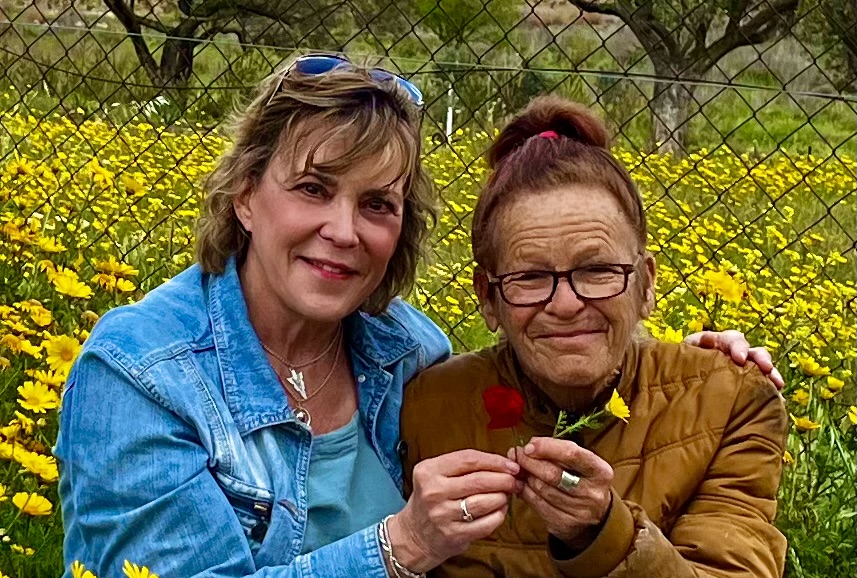
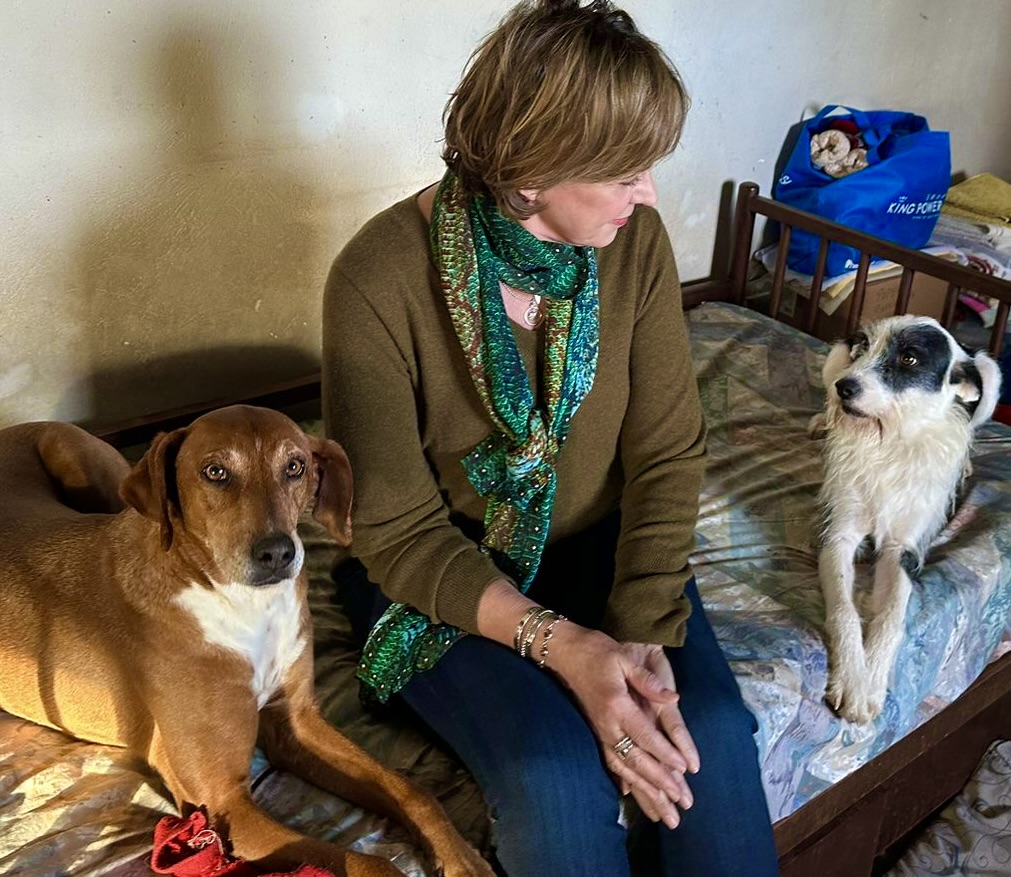
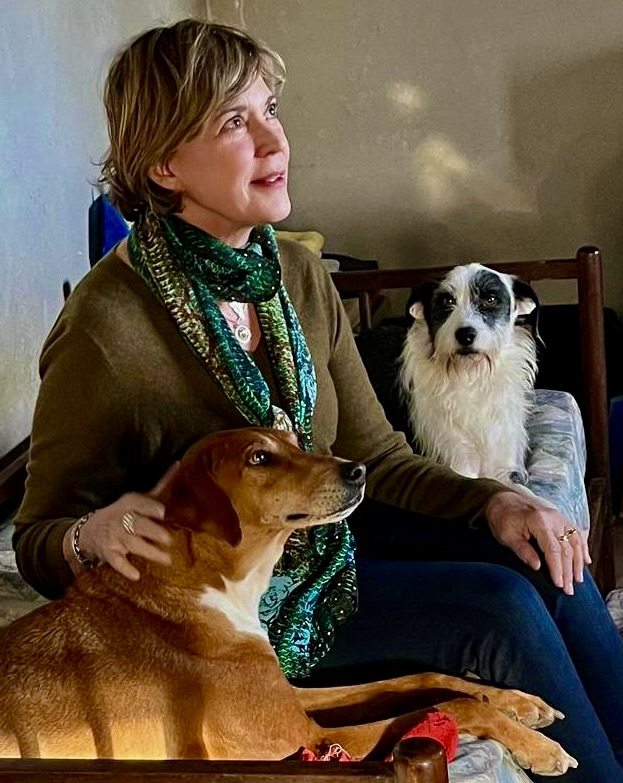
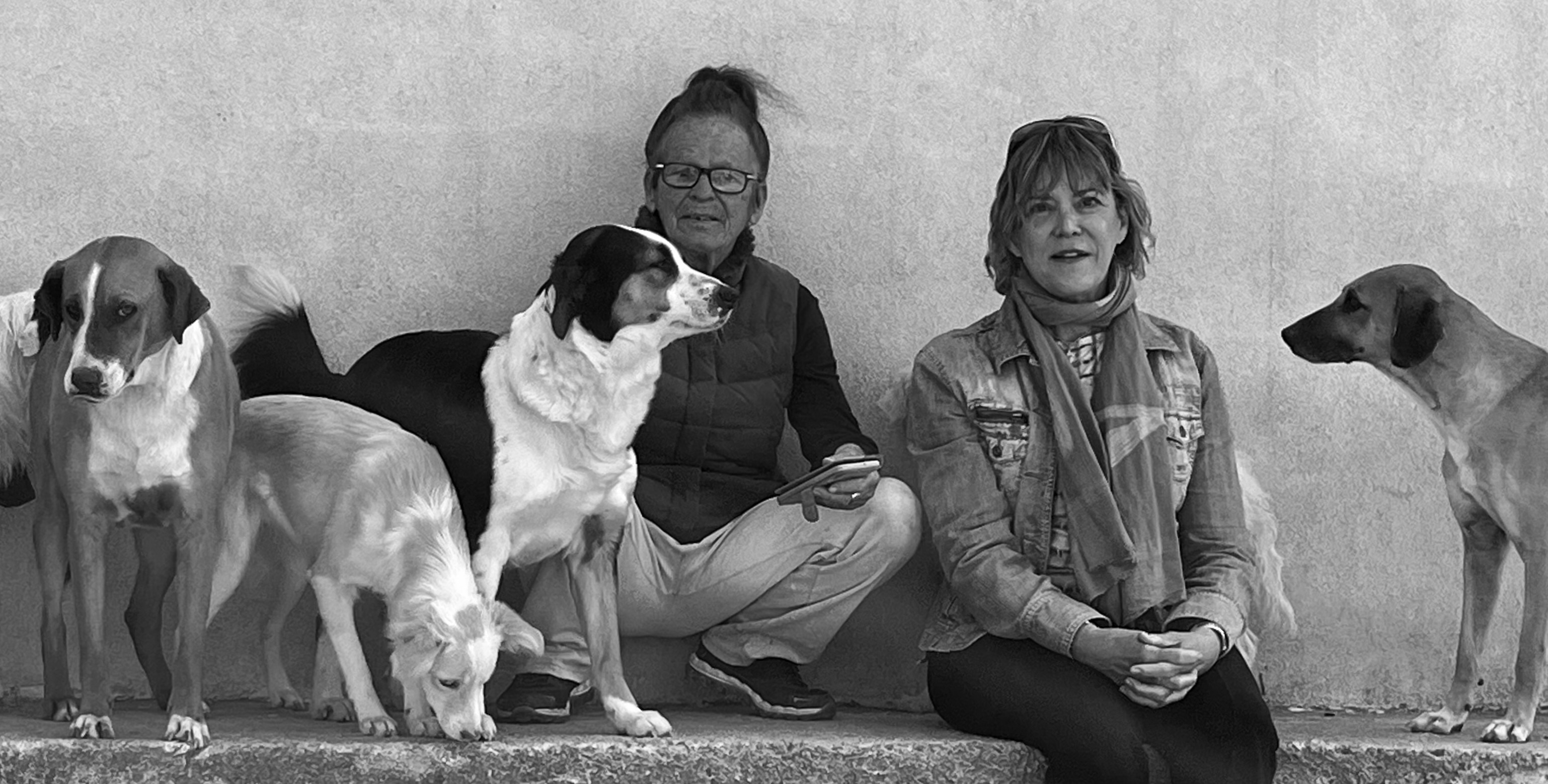
A year ago, I wrote a story about my friend Carla Walker in Athens, Greece. She is a dog lover since childhood, has a menagerie of her own strays (18), and for the past several decades has boarded dogs for owners who are traveling and need a home away from home for their pet. Since moving to a different rural location without any infrastructure five years ago, Carla has been seeking supportive ways to rebuild and resume her business while caretaking her own dogs. When I wrote her extraordinary life story, it offered the possibility of contributing to this mission. For the complete history and Carla’s connection with Cabby Tennis and Maddy Hewitt, read Carla’s Dogs.
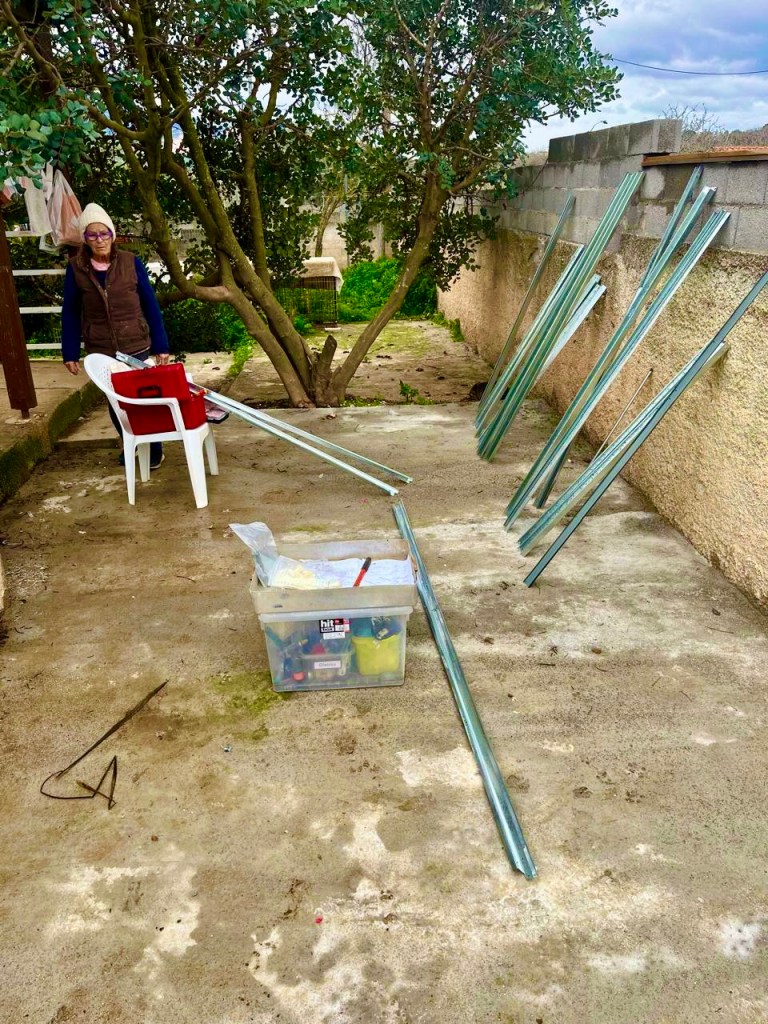
Here is what has transpired over the past year through voluntary crowd funding. Last September a large cement base was constructed behind the “View House” where it is backed by the stone wall of the property. This was to serve as the foundation for three large individual kennels which were purchased and shipped, unassembled, on pallets from northern Greece.
kennels arrive on pallets, cement slab foundation, quality control inspection
In February, Cabby Tennis spent days building three steel kennels consisting of many pieces, bolted them together and to the wall behind, with Carla assisting and supervising. The roof lines were angled and tiled to drain rainwater over the wall. Extra caulking was applied to the exterior and interior bases to also prevent water from running inside during heavy rains.
time lapse of one kennel construction with dogs running through it
first kennel assembled
3 kennels after assemblyroof tiling for drainage over wall
In April the kennels were carpeted with soft, green Astroturf for color and comfort. They are now ready to be outfitted with dog houses, and soon, animals for boarding.
carla with completed kennels, april 2025
Also, a computer was purchased so Carla now has the means to rebuild her website and advertise for short term dog boarding and the ability to Adopt-a-Pet virtually, which will contribute to consistent upkeep for food, vaccinations, medications, and vet care for the tribe.
For those who have donated to complete these projects over the past year, a heartfelt THANK YOU. There is still future work requiring financial support including exterior and interior painting, ceiling insulation and repair throughout the inside of the house to keep people and animals warm and dry in all seasons. There are ongoing monthly expenses for food, neutering and spaying, and vet care for the full-time resident dogs.
For anyone who loves dogs or a good dog story, there is a way to contribute or re-contribute to the future welfare and maintenance of Carla’s Magical Dog Kingdom.
You can donate to a VENMO account in the U.S. established for this purpose. If you already have an account, search the VENMO app for: Cabby Tennis @Dog-Kingdom. Be sure to include your name, mailing address, and email address on the form. For another way to contribute, contact Wendy at windowtoalifeoverseas@gmail.com
Carla is steadfast and unflinching in doing her part of good work in the world. She may have encountered more obstacles than many of us, but she is strongly committed to providing shelter and care for the four-legged creatures who live under her roof and run happily around the garden and olive orchard. Her unshakeable affirmation of purpose in providing animals with a good life is a reminder of how we can all make a difference, even with small acts of kindness.
…and my life is still, trying to get up that great big hill, of hope, for a destination. I realized quickly when I knew I should, that the world was made up of this brotherhood, of man…And so I wake in the morning and I step outside, and I take a deep breath and I get real high, and I scream at the top of my lungs, “What’s going on?” –Linda Perry, 4 Non Blondes, song “What’s Up?”, 1993
Recently, I made an overnight trip to Chapel Hill, North Carolina, to visit my “artist buddy” Jane Filer. Several years ago, I wrote a biographical story about her life and her paintings after we met in Santa Fe, New Mexico. Read: Being Jane Filer Two of her pieces are in our living room, “Eclipse” and “Elephant Journey”, both of them highlighted in the article.
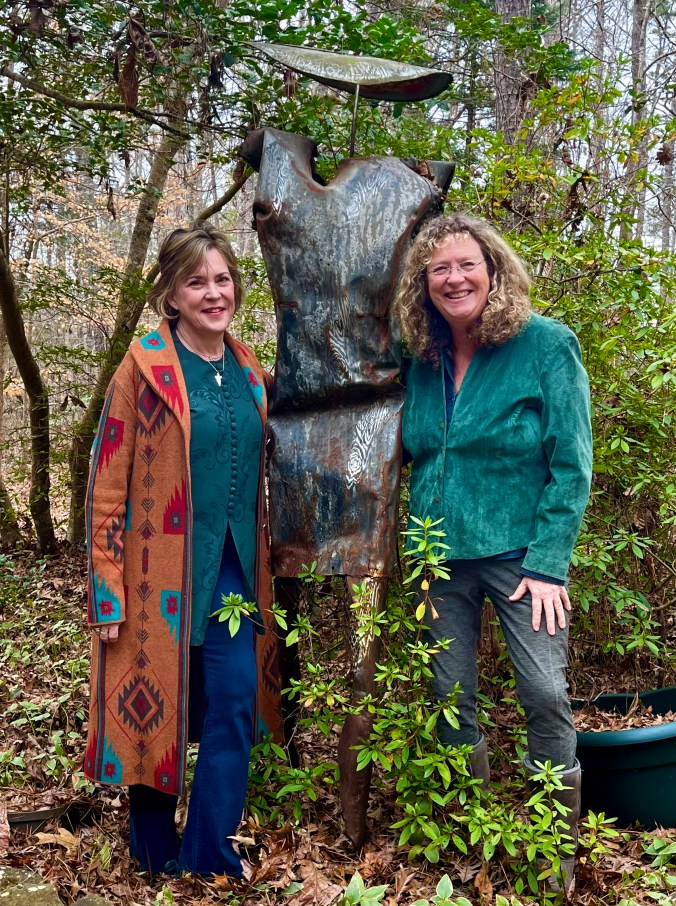
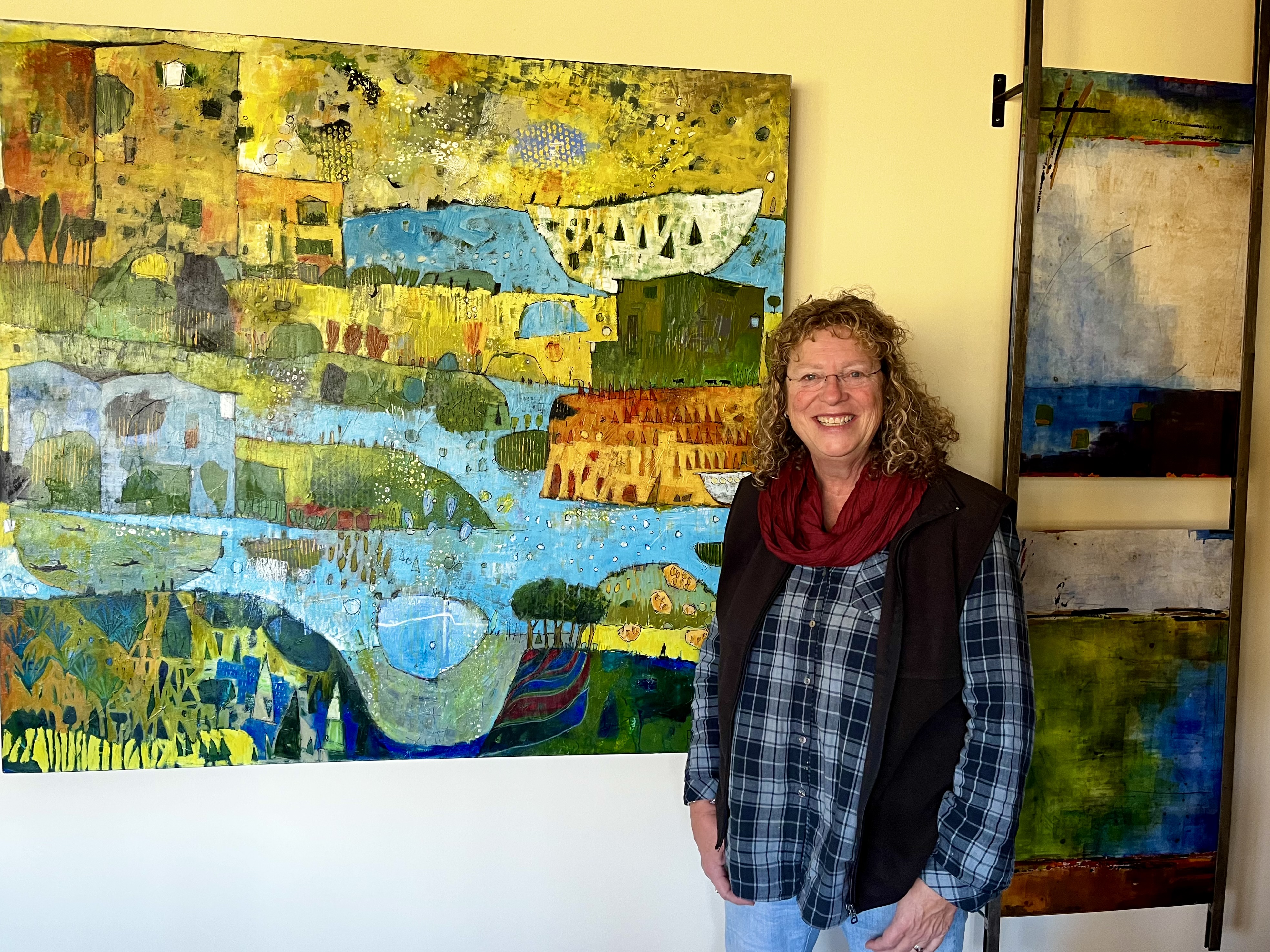
jane in the garden with headless hat woman
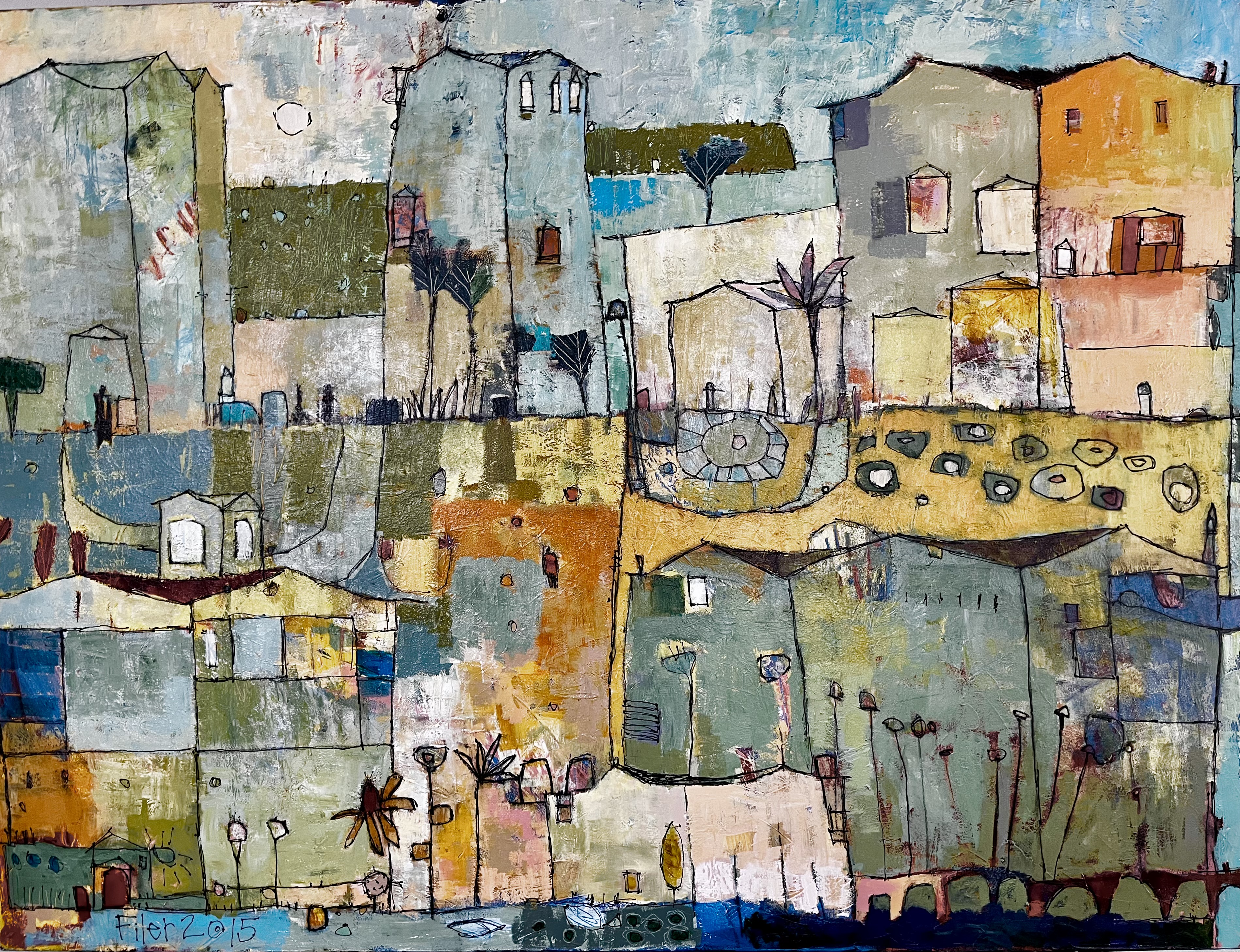
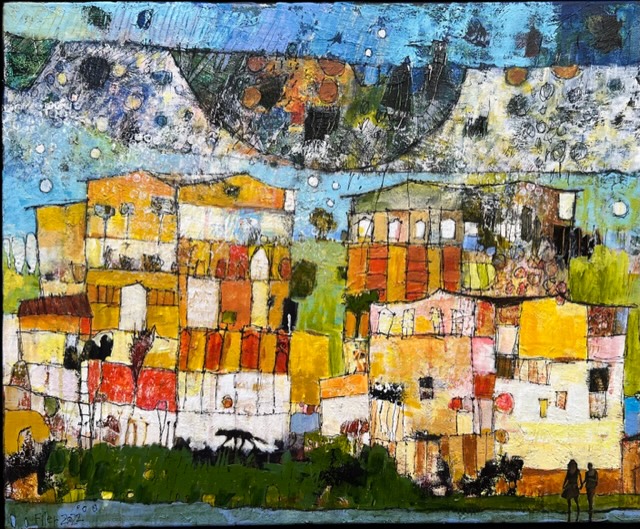
The premise of traveling to her home was a painting I noticed and kept returning to on her website janefiler.com under “Available Work”. It was entitled “Above the Bridge”. I finally called Jane and said I was really drawn to this one but needed to see the painting in person to know how it made me feel. She agreed, and we set a date.
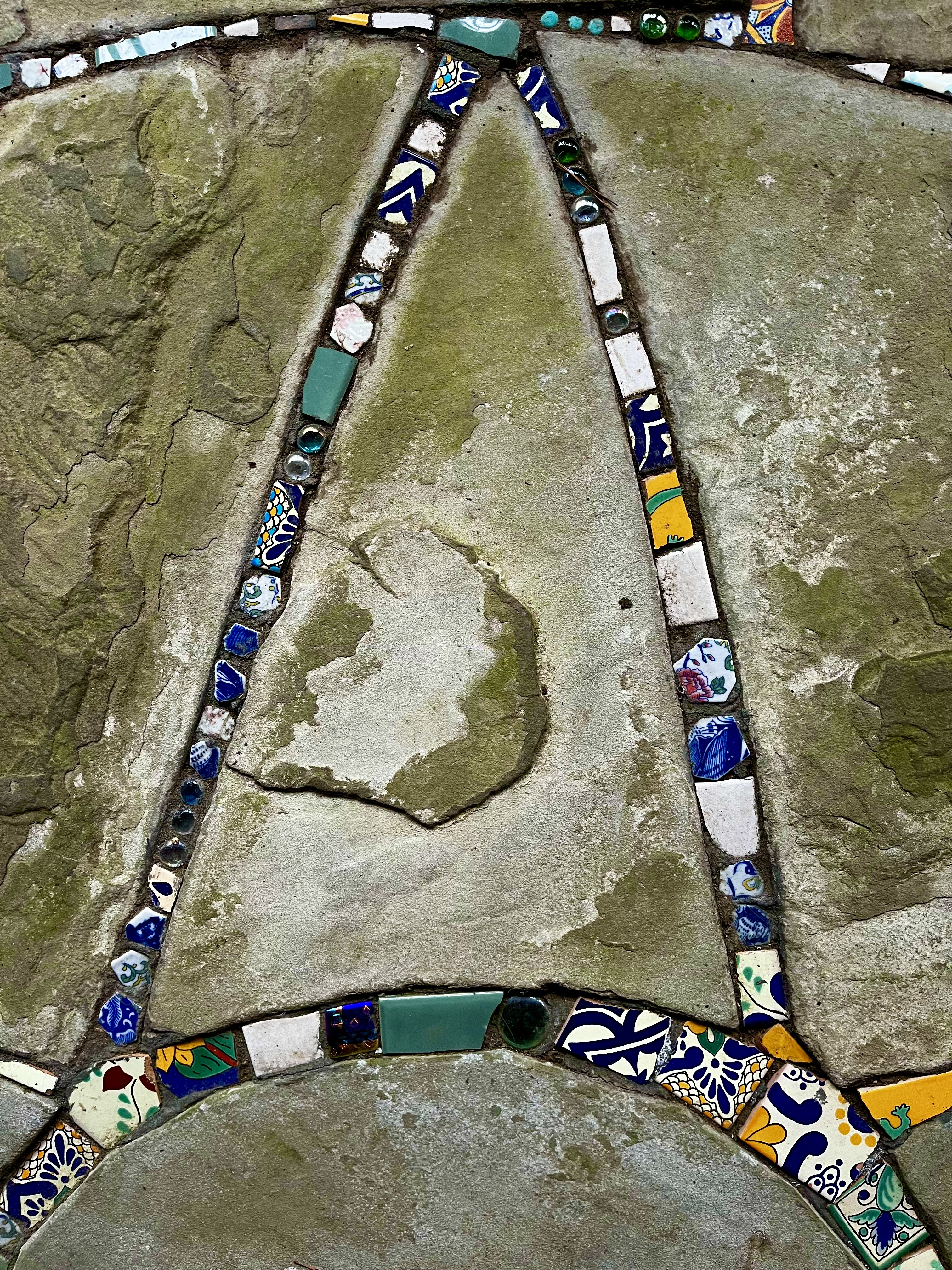
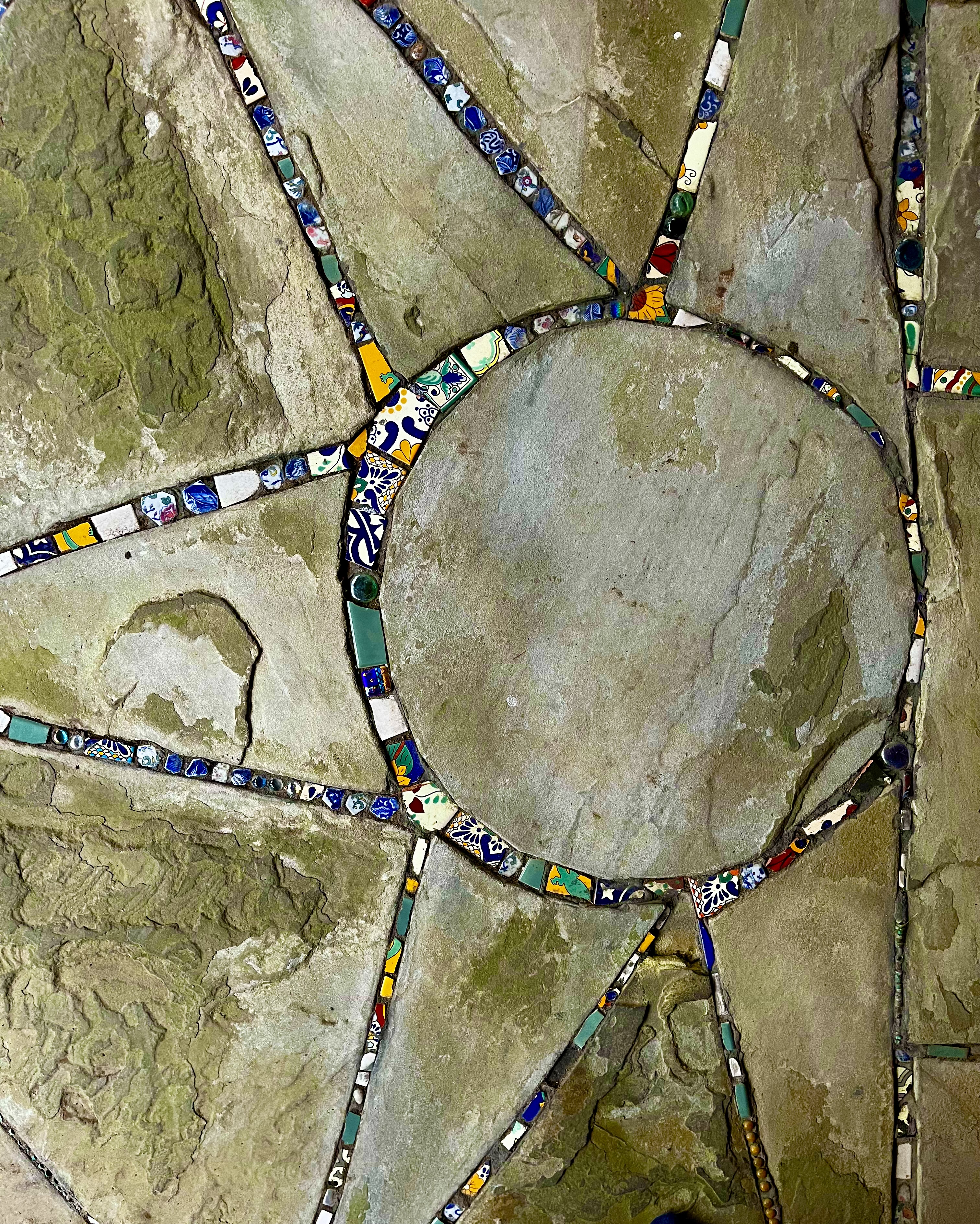
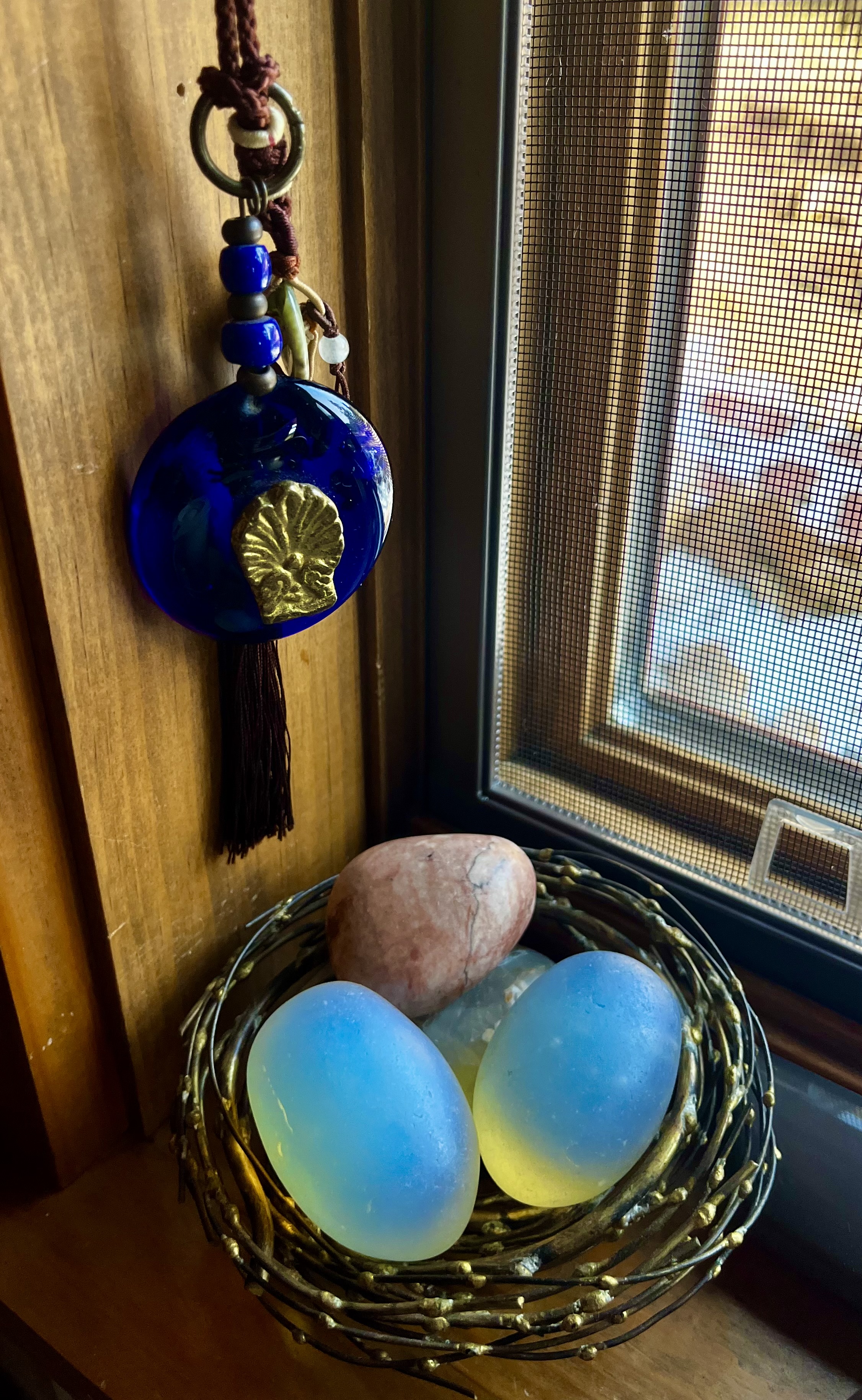
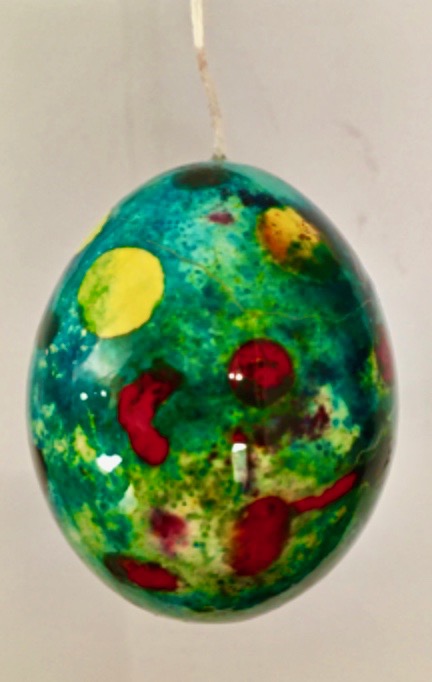
It was two years since we had last seen each other, but we fell into conversation easily, as friends generally do. I noticed the changes in her home and property since the last time I was there. A large shed had been renovated and turned into a gallery for on-site weekend art shows, there were now two cats in residence, and she started an outdoor project of reconfiguring stone pavers by outlining them with colorful pottery and pieces of glass. I picked up an alabaster egg on a windowsill to admire its smooth shape and beautiful translucency in my hand. She insisted that I take it home.
resting buddha in NC alabaster egg nest in CO
When we went into the studio to view the painting, Jane showed me a recently finished piece entitled “Congregation”. It was colorful and typical of her “primal modern” style which emanates from her dreaming-while-awake imagination. Then she moved “Above the Bridge” to the easel for my viewing. And I just knew. This was going to be my painting.
Above the Bridge by Jane Filer, 2024
The question is why? What resonated? Like so much of Jane’s art, there are layers upon layers to see and feel and think about. Then you bring your own meaning to it. The details I first noticed were two small black figures “under the bridge”. One is swimming strongly onward; the other is rising to the surface with one arm extended straight upward.
cropped image of under the bridge
swimmers enlarged
Musing about these small figures under the bridge with the larger world painted above the bridge struck me as symbolic and meaningful. Right now. These are actions to aim for; onward and upward. For anyone, for everyone.
the rest of the world above and below the bridge
In the current American climate, where everything is moving in the direction of political dismantling and destruction, many people want, and need, to find what can be done now, while also moving toward the future. Then I thought; these are the same movements–the actions we take in the present are what we will continue to do in the future.
Poets, artists, and writers are often sources of inspiration about what is needed in trying times. Art cuts deep to the marrow of reminding us how to refocus and get moving in stressful times, whether personal, cultural, political, or global.
Almost every generation of Americans for the past 250 years has encountered and eventually survived some kind of catastrophic period; revolution followed by war, destructive civil war, two world wars, years of severe economic depression, McCarthyism, a decade of political assassinations and riots, the unpopular 10-year Vietnamese war, murderous terrorist attacks, devastating viral pandemics. Just as it seems that so much changes within generations; history teaches that great things can, and do, persist after turmoil.
We all have a part in shifting the story. –Joy Harjo, 23rd U.S. Poet Laureate
Inside the head spinning turn of extreme change our democracy is currently undergoing, what part, as Harjo suggests, can we play in shifting the story?
It’s really the same part we play throughout life. First, we learn, we adapt, and we move forward with what we can control. Adaptive change often means taking on complex challenges that seem impossible in the beginning. Staying immobilized doesn’t help the situation. You have to try. Like the feeling a piece of art instills, we bring the meaning and sense to what can change and what we can change.
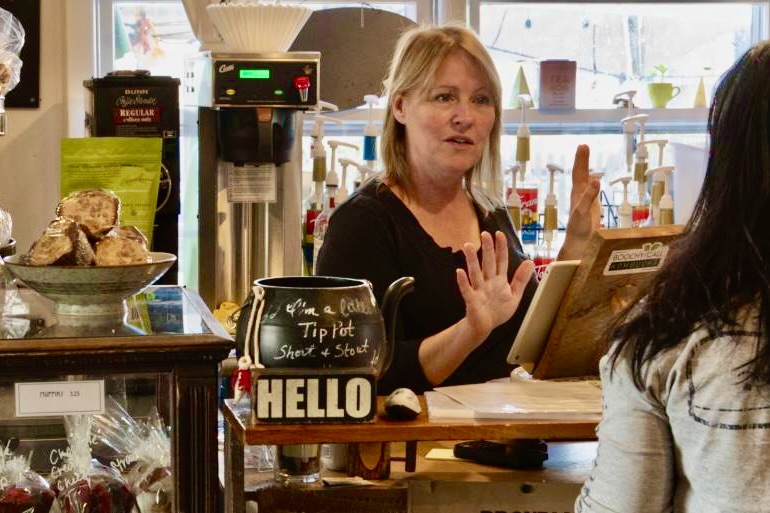
I read a story about a woman, Maureen Morris, who opened a coffee shop called Back Street Brews in a small, politically polarized Virginia town several years ago. During a time of stridently vocal opposing sides, she pushed the notion of a gentler America inside her café. Everyone was welcome to openly discuss their views, but there would be no attacking or judging. “If it comes up, as long as it’s respectful, you can talk about whatever your beliefs are…If you are a staunch this or staunch that, I always say, keep that out of here.”
Maureen Morrisback street brews, lovettsville, va
Customers began asking about each other’s family or simply shooting the breeze over coffee. Discussion groups of varying topics began showing up. Maureen’s café became known as a quiet force of civility while crossing the political divide inside a public space. Neighborly ways, respect, and social ties persist.
Ordinary people created a community where they listen and speak to each other without shouting. All due to one woman’s insistence that, amid the divisiveness of an era, she would lead from the strength of her beliefs. “It’s affecting people. Not me. Not in my bubble. We’re going to be fine, everyone! We’re going to land on our feet in my coffee bubble.”
This is how an individual shifts the story. By accomplishing small things that perhaps no one notices in the big picture but has real impact on people’s lives. Everyday lives. We nurture and nourish everyone in our circle of family, acquaintances, friends. We take care of ourselves. We stay true to our values.
Because there is a remnant of change that begins with one act of kindness, one spoken truth, one considerate conversation, one shared laugh, one poem, painting, or story. These are ways to move the narrative.
A brief scene in the old Hollywood movie, Casablanca, with Humphrey Bogart and Ingrid Bergman offers another example of one person’s action to restore balance.
During a busy evening in Rick’s American Café, a casino and piano bar in Casablanca, there is a scuffle when the thief Ugarte is discovered by authorities. After Rick refuses to hide him, Ugarte is hustled out in a loud commotion surrounded by police. The music stops and customers sit mutely, in stunned silence.
Afterward, Rick (Bogart) apologizes for the uproar, reassures everyone that the trouble is over, everything is all right, and they should continue having a good time. He speaks calmly to the crowd, tells Sam to resume playing, and without breaking stride re-rights an overturned wine glass on a table.
…the saloonkeeper’s cool response to Ugarte’s arrest and his instruction for the band to play on could suggest a certain indifference to the fates of men.But in setting upright that cocktail glass in the aftermath of the commotion, didn’t he also exhibit an essential faith thatby the smallest of one’s actions, one can restore some sense of order to the world? –Amor Towles, A Gentleman in Moscow
As we find our part in “restoring some sense of order”, we also climb “that great big hill of hope”. And make it a destination.
Poems and songs are written to get our minds thinking…in an unexpected way.
TROUGH
There is a trough in waves, a low spot where horizon disappears and only sky and water are our company.
And there we lose our way unless we rest, knowing the wave will bring us to its crest again.
There we may drown if we let fear hold us with in its grip and shake us side to side, and leave us flailing, torn, disoriented.
But if we rest there in the trough, in silence, being with the low part of the wave, keeping our energy and noticing the shape of things, the flow, then time alone will bring us to another place where we can see horizon, see the land again, regain our sense of where we are, and where we need to swim.
–Judy Brown
...Come dance with the west wind and touch on the mountaintops Sail o'er the canyons and up to the stars And reach for the heavens and hope for the future And all that we can beand not what we are...
We lived overseas for 31 years and became acquainted with a variety of characters who chose the same lifestyle we did. Many were our close friends. When those friends moved to different international schools in other countries, it was difficult to stay in touch with each other’s lives. Now, when I think back on all the places we lived; Singapore, Cyprus, Taiwan, Germany and France, some of those people we knew well are no longer together and some are gone.
Yet the memory of a specific moment of friendship and fun surfaces instantly with the mention of a familiar name from long ago. Even when that moment contains elements of being less than perfect. And especially if remembering it makes me laugh.
We arrived at Taipei American School in Taiwan one August with a group of educators who bonded quickly. Relationships developed easily over shared activities and interests. We were all living outside of our home cultures, and we all sought connections and enduring friendships. In addition to sharing holidays, vacations and travel, one of the best connecting places was around the dining room table.
Bob and Valerie were married to each other when we knew them in Taipei. Bob was more than a decade older than Valerie, with a background in private schools in the U.S. before embarking on an adventure in overseas education. His everyday on-the-job attire included a bowtie which he pulled off with dress-for-success propriety. He loved literature and could discuss books at length. He was perfectly matched to his job in Advancement and Fund Raising at the school. A charmer who could talk to anyone. And then get them to donate large sums of money. He was also an excellent cook and throwing a dinner party to perfection was his gift to friends.
Valerie and Bob in Taipei days
In the years we lived in Taipei, eating out culture was yin and yang. All forms of excellent Asian food were readily available in restaurants. But, in our Tien Mu neighborhood, food was typically served and eaten in mediocre surroundings. This meant fluorescent lighting, small plastic stools and tables crowded together, throw-away chopsticks, transparent pink paper napkins, and flimsy plastic beer cups that dented inward when picked up. Maybe things have changed…
We chose a different way to spend weekend evenings. So began the years of rotating dinner parties in each other’s homes where welcoming friends planned and prepared delicious cuisine, set the table with china plates, linen napkins, and stemmed glassware. Candlelight reigned. It was a cultural lifeline we anticipated, embraced, and shared gratefully.
Bob was a masterful chef and skilled host. He prepared all the food for his wedding to Valerie, and nothing was too finicky for him to try. It was often challenging for any of us to find western food ingredients in the tiny “Mom and Pop” grocery stores in our neighborhood, but Bob did. Dinner parties were events to anticipate and enjoy.
neighborhood grocery shopping
Alec and his wife, Charlene, are overseas friends we have stayed in contact with since the Taipei days. As are Maddy and Cabby. With Valerie and Bob, they rounded out some of our weekend dinner friends.
Charlene and AlecCabby and MaddyWendy, Maddy, Mark & Cabbyall of us in Mazama, WA, 2019
The six of us arrived one evening at Bob and Valerie’s apartment, with the usual gracious welcome and pouring of wine all around as a pre-dinner warm up. There was the quintessential appetizer that Bob almost always served, but no one everate. Small, dark-colored oysters from a tin, covered in a sheen of oil, with tiny crackers on the side. He was the only host who intuitively knew not to tantalize guests with a generous platter of hors d’oeuvres to fill up on before moving to the table.
tinned oysters as appetizer
We were ready to eat when it was time to gather table side.
Alec turns on his high energy self in public situations where he does everything faster than anyone else in the room: walking, eating, drinking, talking, and joking around. In the past, this created consequences like falling objects, breaking, spilling, and sometimes worse. We grew used to it and love him anyway. That night his quick reactions changed the course of the evening and saved the day.
One of the recipes Bob was known for was Pistachio Chicken Breasts with Herb-Garlic Cheese Filling. It came from The Frog Commissary Cookbook. This dish was a crowd pleaser but it required time consuming preparation. There were no bags of shelled pistachios in Taipei, so eight portions required a lot of hand shelling and chopping. It also involved thinly pounded chicken breasts, stuffed with a portion of herby cheese, coated in flour, egg, and rolled in pistachios. The final steps were to brown it on the stove and finish by baking in the oven. We had enjoyed it more than once in their home.
The main course was plated in the kitchen and served to each guest. Alec, whose metabolism and hunger were always on overdrive, dove right into his first bite while the rest of us were talking and sipping wine. In a split second, before anyone else touched a knife and fork, he leapt to his feet, picked up two plates, and ran to the kitchen. Without explanation, he cleared every plate from the table while we sat in confused wonderment.
Bob followed him. We waited for a verdict. The chicken was raw on the inside. It had been nicely browned, but that was all. We breathed a sigh of relief before laughter erupted all around. Our host apologized profusely. The blunder ran counter to his normally professional preparation which included a detailed explanation of the menu just before it was served. All of which led to unmerciful teasing about trying to poison unsuspecting guests with raw meat and making them wait so long for dinner that the oily oysters started looking edible.
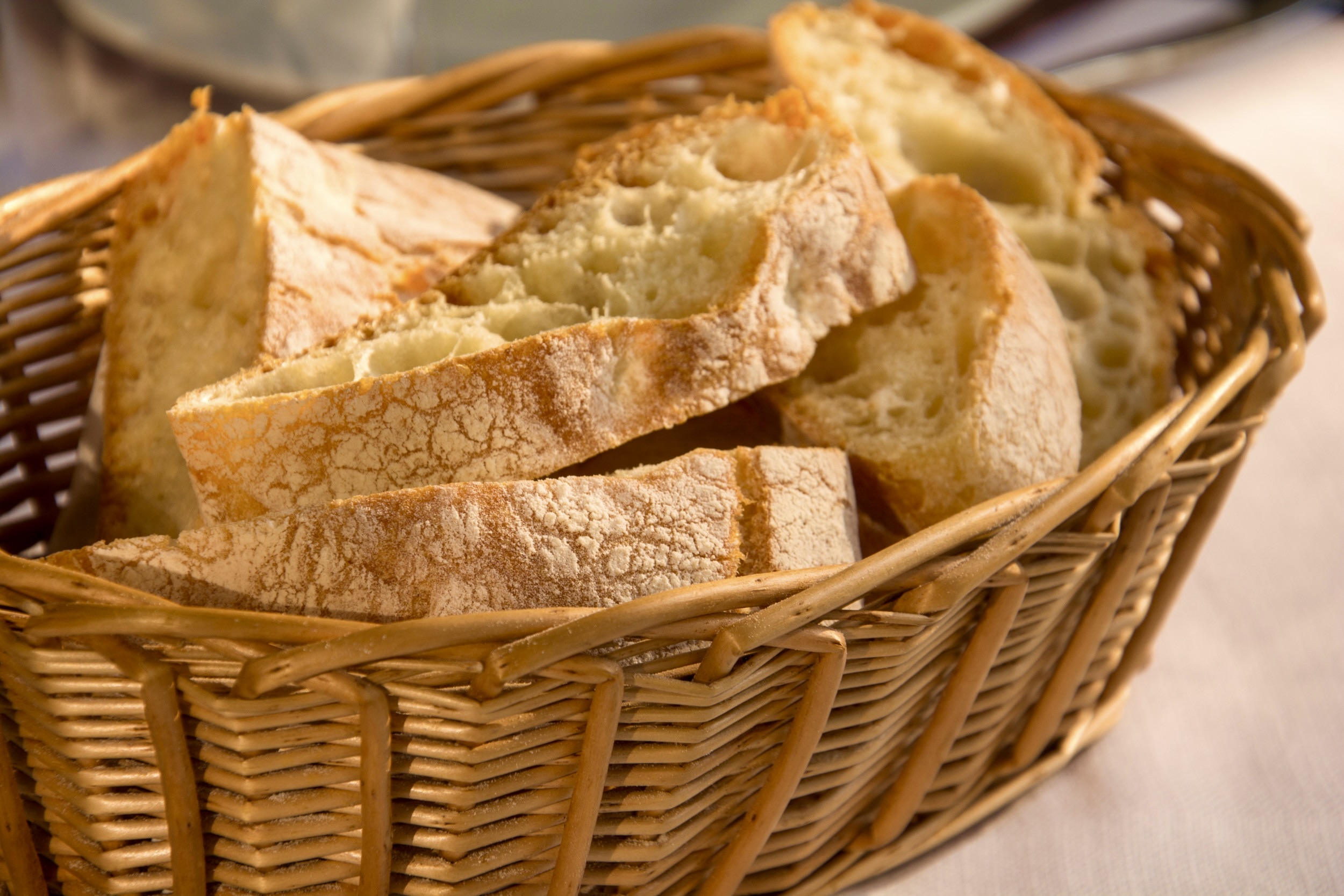
Back into the oven went the chicken. Alec, now well beyond his eating time, began devouring bread from a basket on the table. More wine was poured. Story telling began.
Valerie admitted [confessed] that she still slept with a piece of her baby blanket, now the size of a small, thin handkerchief. She kept it under her pillow where she rubbed it before falling asleep. Other revelations followed including stories of cultural faux pas while living away from home. The laughter was contagious.
There was additional joking and teasing while we waited. Alec finished the bread. Finally, the main course was served. Dessert followed.
In looking back, the highlight was not the mistake of undercooked food, but the laughter and humor that kept us entertained and engaged in story telling until an excellent meal was presented and shared.
Perhaps some of the best-remembered dinner parties are those with a mishap or gaff attached which lends to more vivid recall. But in that moment of camaraderie, and candlelight, and good company around a dining table, I knew that we were part of something special.
M.F.K. Fisher said it first. And best.
“There is a communion of more than our bodies when bread is broken and wine drunk.”
Some of life’s best moments of [im]perfection are simply like this. Friendship and food are never about one versus the other. Instead, in the right mix, the communing of friends and the blending of spirits around a dining table in Greece, or on a hillside picnic with roaming water buffalo in Yangmingshan, or around a campfire ring in the Rocky Mountains, or in the Mazama River valley are a perfect ending to any story.
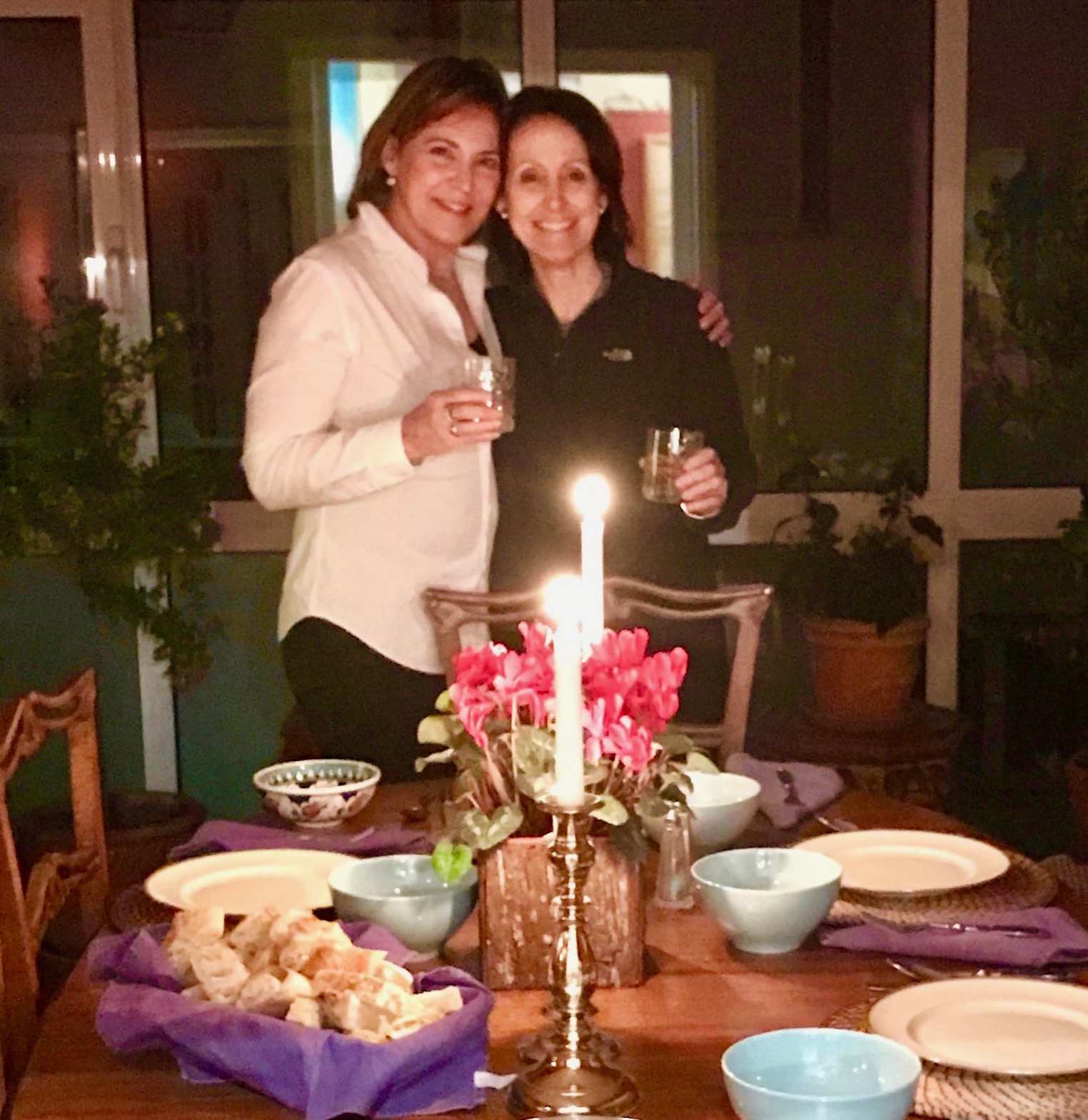
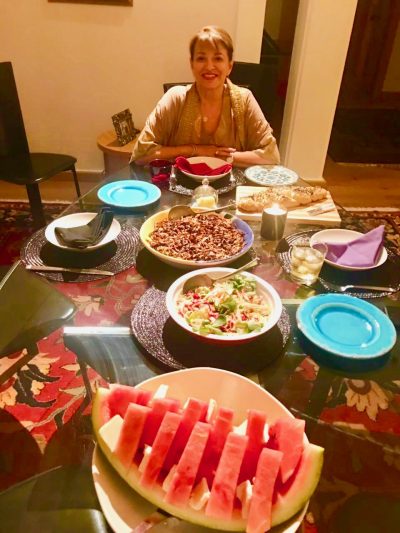
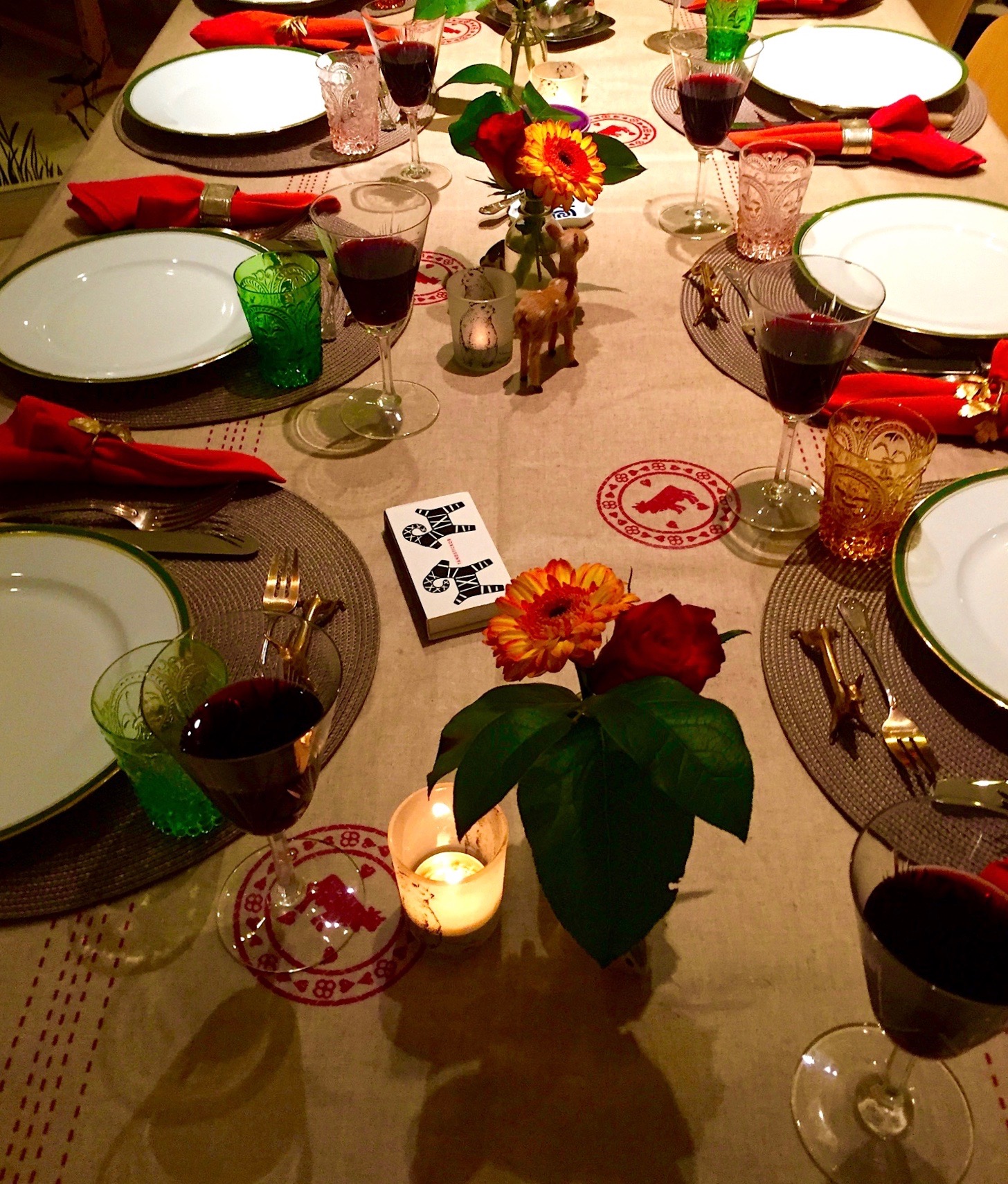
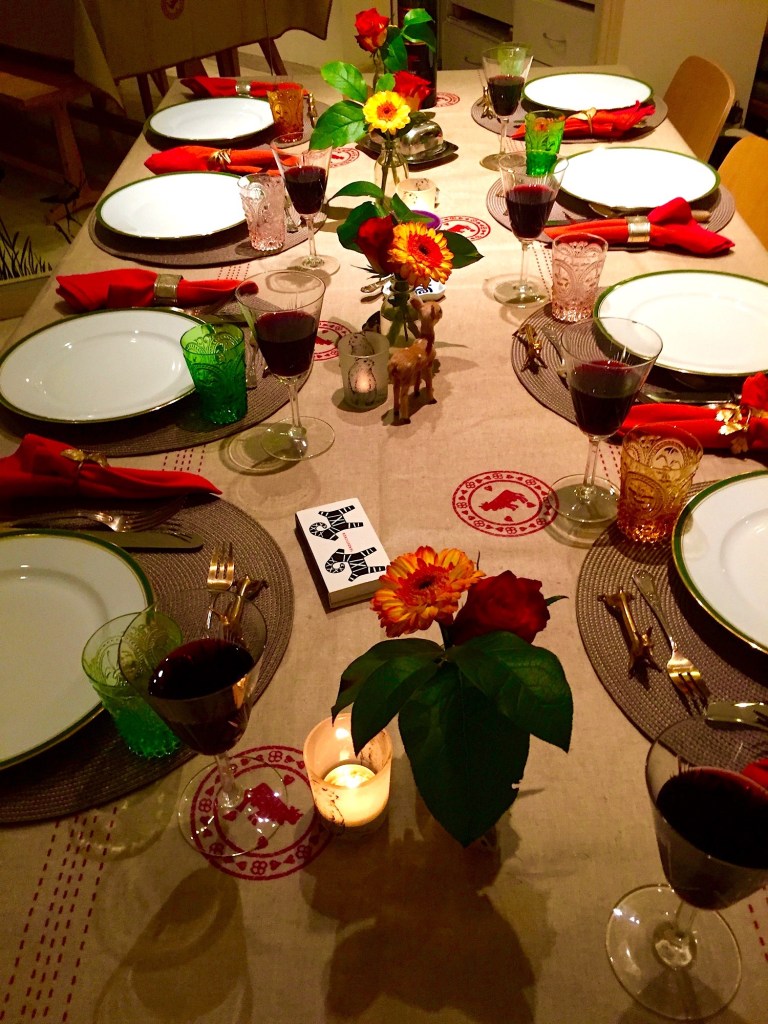
Tennis/Hewitt dining table, Athens, Greece
buffalo meadows, yangmingshan, taipei, taiwan
children and buffalo wandering in meadow before dinner
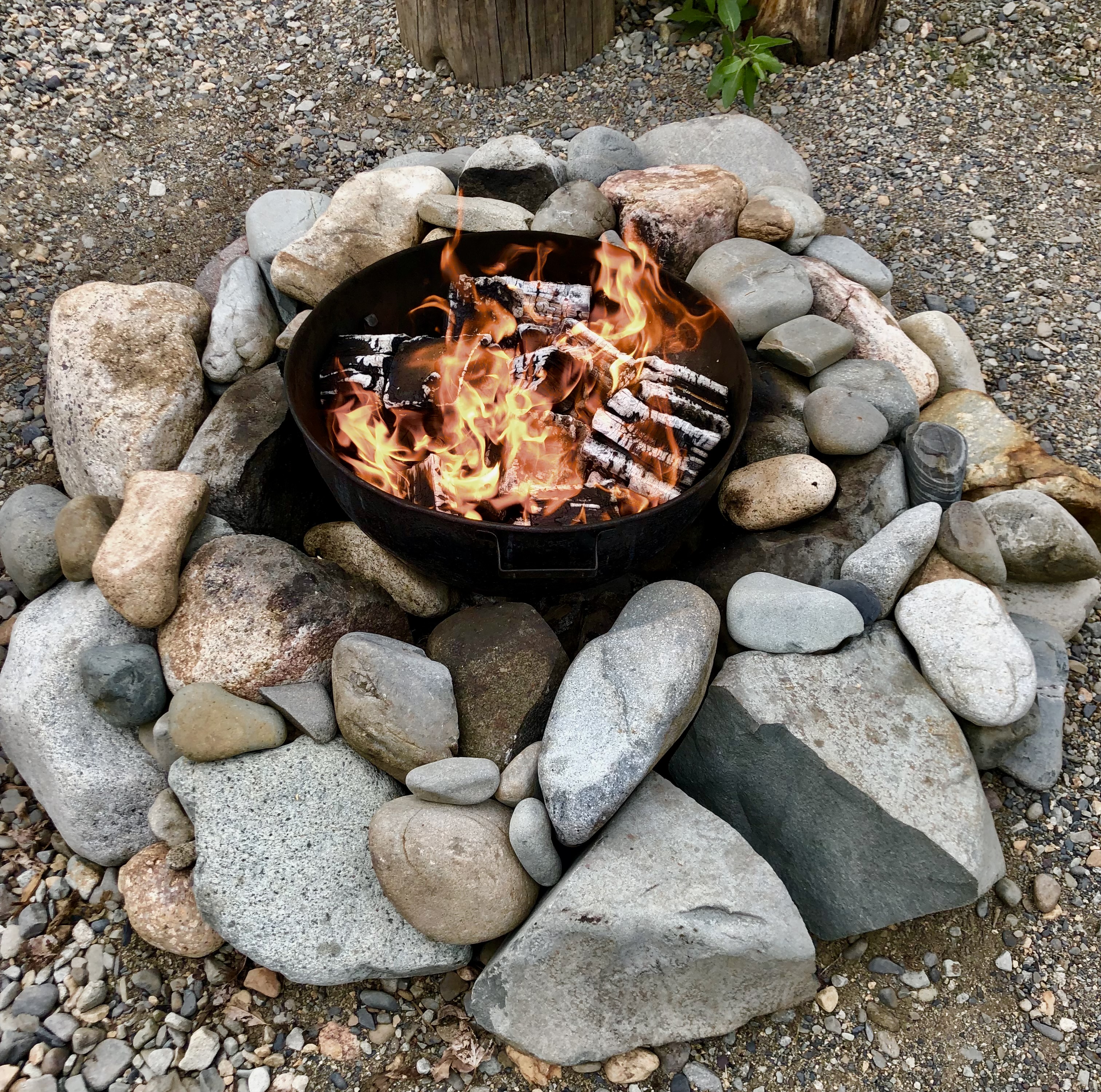
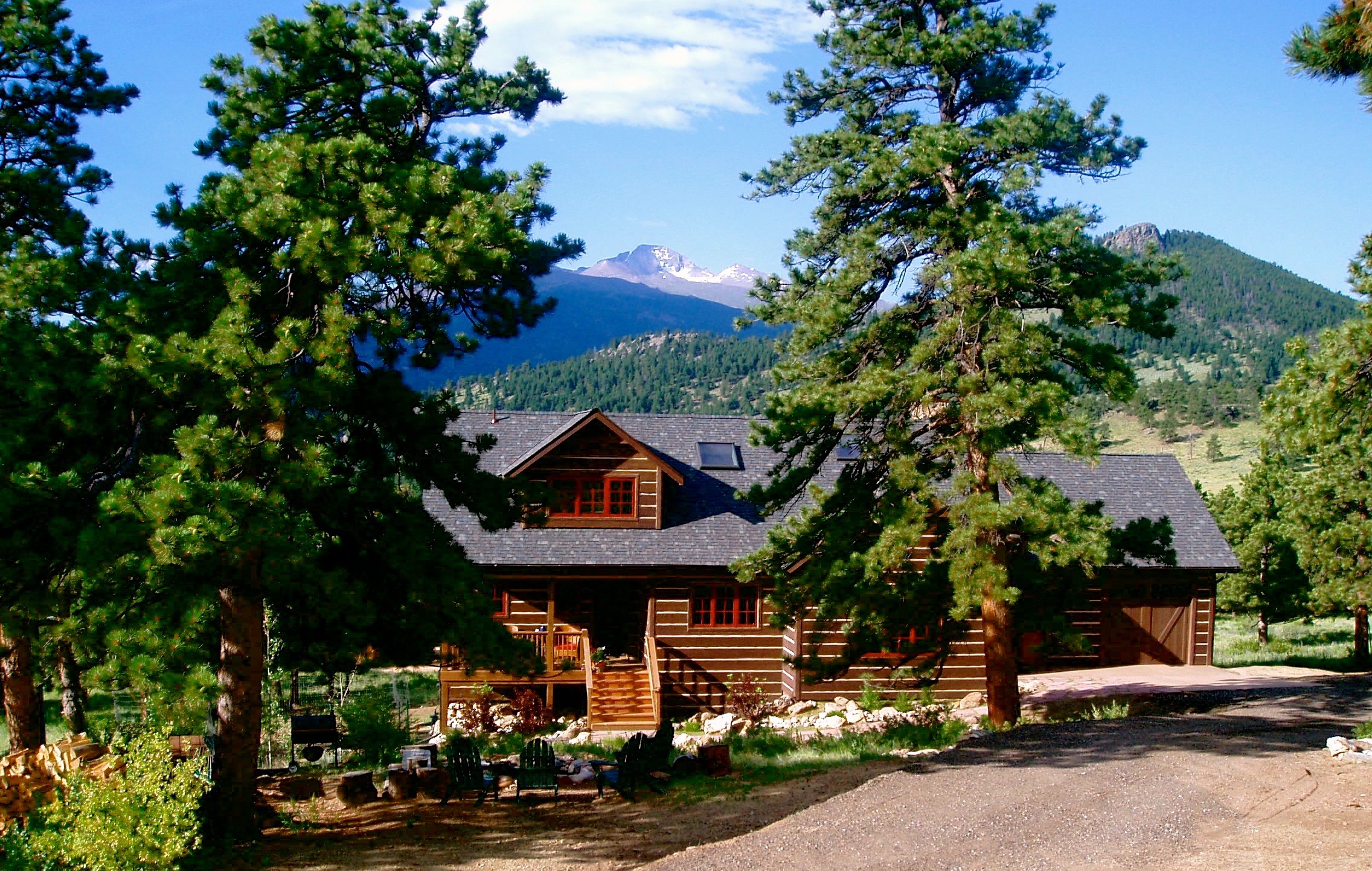
colorado rocky mountain campfiremazama washington methow river valley campfire
Pistachio Chicken Breasts with Herb-Garlic Cheese Filling
from The Frog Commissary Cookbook
Herb-Garlic Cheese Filling
8 oz cream cheese, softened
1 tsp minced garlic (or more!)
1 T. minced parsley
1/2 tsp pepper
1-2 T. minced fresh basil or 1/2 tsp dried
1/4 tsp salt
Chicken
8 boneless skinless chicken breast halves
1/2 C. flour combined with 1 tsp each salt & pepper
2 eggs, beaten
1 1/2 C. finely ground pistachio nuts [7 oz. shelled]
1/4 C. clarified butter [we used regular butter]
Filling
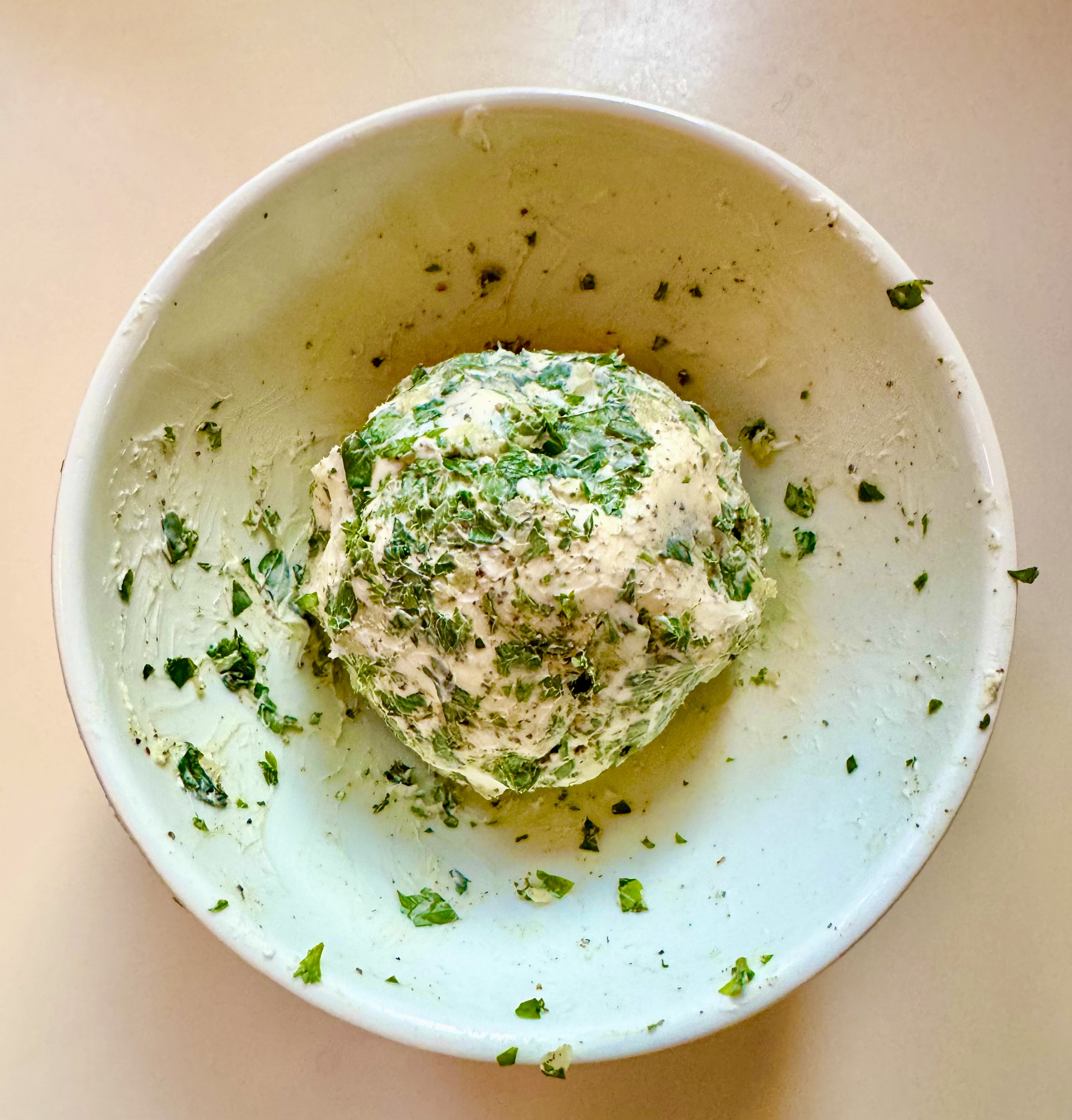
Combine the cream cheese with the garlic, herbs, and seasonings. Chill until firm and then form into 8 2″ long cylinders. Keep refrigerated until ready to use.
Chicken
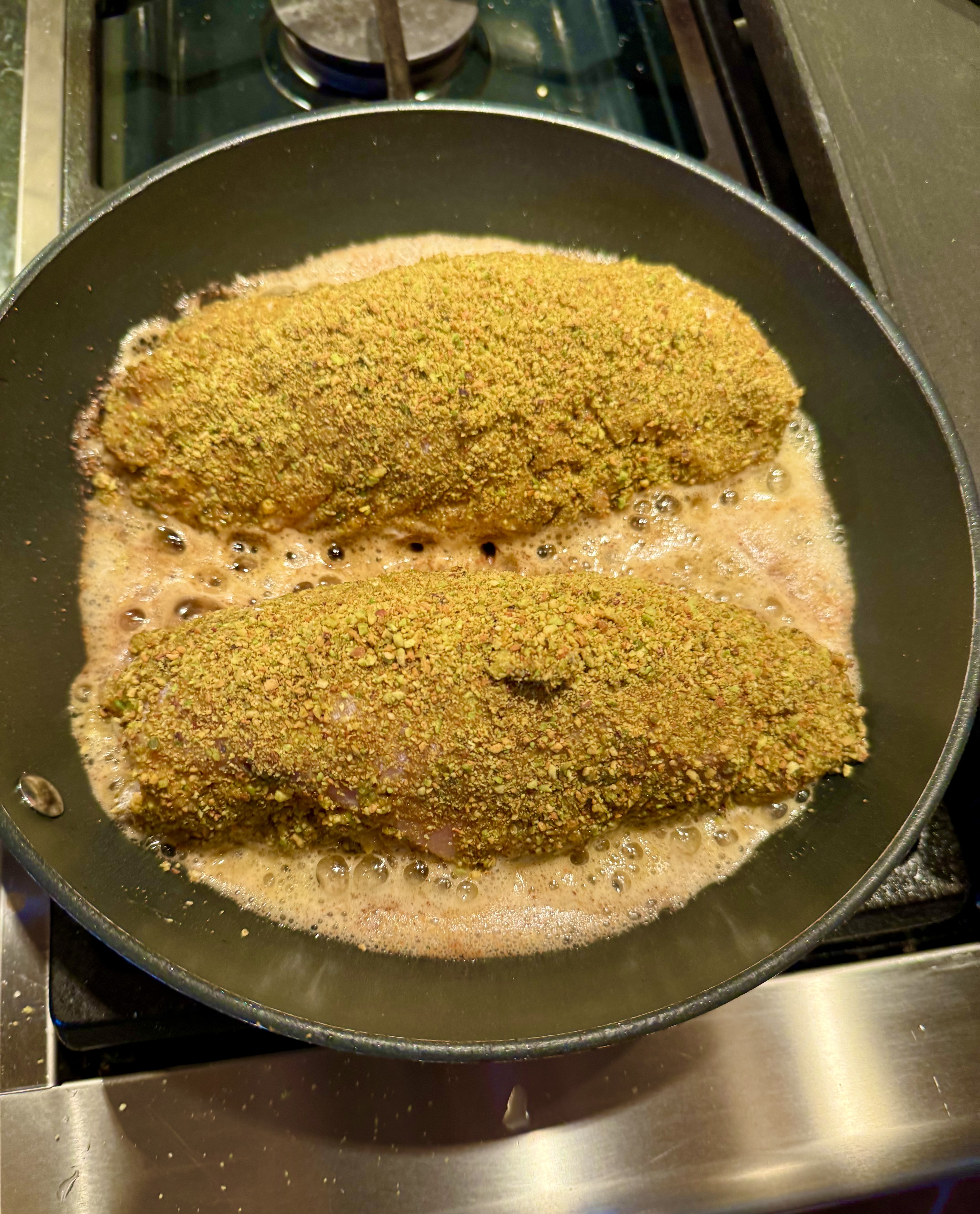
Preheat oven to 350 degrees F. Gently pound chicken breasts between wax paper until 1/4″ thick. For each portion, place 1 portion of the filling along 1 edge of a pounded chicken breast and fold and roll the chicken over the filling to completely and securely enclose it. Repeat with each piece of chicken. Roll each piece sequentially in the seasoned flour, the beaten eggs, and finally the ground pistachios. Sauté in butter over medium heat for 1-2 minutes on each side or until lightly browned. Transfer chicken to a baking pan and put in the oven for 15-20 minutes. Serve hot. Makes 8 portions.
pound to 1/4″ thicknessNinja blender ground pistachio nutssauté in butter to brownfinish in oven
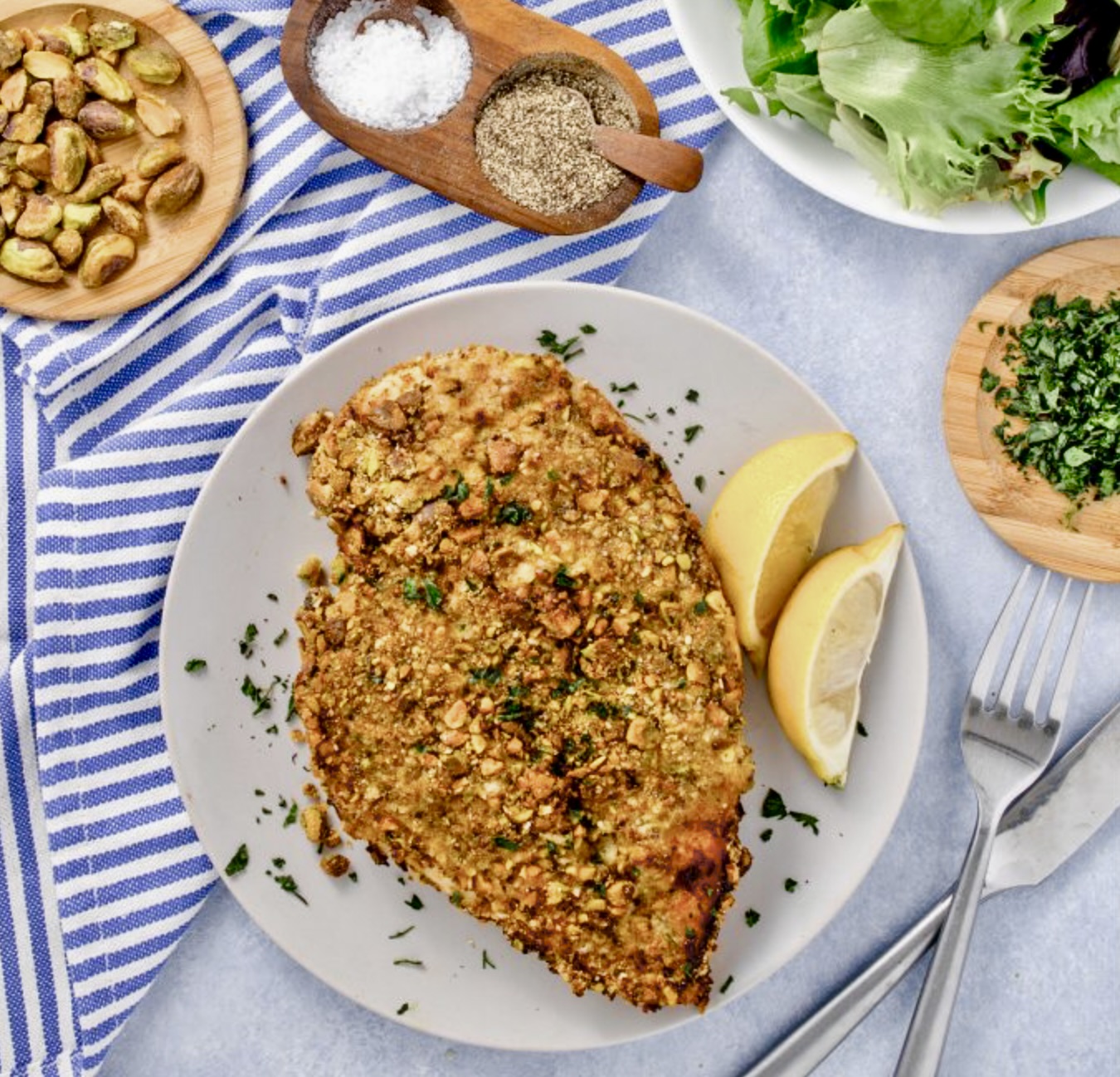
pistachio chicken breast, ideal version
Other overseas adventures with Alec and Charlene, Maddy and Cabby, found here :
Once, I was attacked by two pit bulls. The result was stitches and bruises. I’m not afraid of dogs. But I don’t love them unconditionally. And yet I know that dogs can be healers. Even abused and abandoned ones. My overseas friend, Carla Walker, proved this.
CARLA’S BEGINNINGS
Carla Gimbl was born in Germany, one year before the end of World War Two. She adored her Hungarian father who was seventeen years older than her German mother. Also in the home was an attentive but strong-willed grandmother who taught her the art and joy of cooking. Carla takes after her grandmother’s dominating spirit and cooking expertise.
Carla’s parentsand as a young girl
Until she was eight-years-old, Carla lived across the street from where the Nuremburg war trials were held. There were no other children nearby to play with. But, always, there were dogs—a beloved Airedale Terrier, or German Shepherds. They became her playmates and friends. She dreamed of owning a large property one day where she could live with dogs.
Tragedy struck on a foggy morning when her parents’ car collided head-on with a truck. Father was killed instantly and mother, although injured, survived. Carla wasn’t told of her father’s death until months later. It was her first experience with abandonment and loss.
Then her mother married a wealthy European businessman. While their life style improved, Carla’s stepfather was indifferent and abusive. At fourteen, she ran away from home and lived on the streets until authorities sent her to juvenile reform school for two years. When her parents were finally contacted to take her home, Carla’s mother arrived in a fur coat, fully embracing a life of luxury, looked at the girl and said, “That is not my daughter. I have no daughter.” More loss and abandonment. Carla never forgave her mother, and she never looked back. She was on her own.
In the early 1960s, still in Germany and working in a bar, Carla met 22-year-old Charles Walker, a U.S. Air Force policeman. She married him at nineteen. When they returned to the United States, the couple stayed with the extended Walker family in southern Georgia. Later, Carla lived in Las Vegas while Charles was stationed in Vietnam. Those were the wild partying years.
Then more tragedy.
Charles, a serial womanizer throughout the marriage, pushed Carla down a flight of stairs in her sixth month of pregnancy. She gave birth to a daughter, prematurely, who did not survive. This loss was a turning point for Carla. She was finished with people. She had experienced only disappointment and hurt from those closest to her.
By her own admission, Carla feels a strong bond with dogs, particularly stray dogs, as she sees the parallel between homeless animals and her own life. Living on the streets, abandoned, and surviving by resilience and grit. After her infant daughter died, she buckled down in fierce independence to live without asking for help or depending on anyone.
Carla filed for divorce after moving to Greece with Charles when he was stationed at the Air Force base in Athens. She left with only the clothes on her back, but supported herself with various jobs over the next decades. It wasn’t easy, but she worked as a bar maid paid on commission for drinks sold, cleaned houses for foreigners, babysat children. Her best paying job was with a large pharmaceutical company where she planned, shopped, cooked, and served food for all of their events and parties. The company eventually moved its base to Dubai. Carla was paid a large separation package, and then spent it all.
back in the daysa resilient young woman
When the American military base closed in Athens in 1988, the stray dog problem in Greece began. As families left the country, dogs were abandoned on the airport tarmac. Carla found them wandering around loose and starving. She started bringing them home. The first rescued dogs were adopted by families in Europe.
In the early 2000s, Carla began her business of boarding dogs. She moved to the rural outskirts of Athens where she rented a property with land and outbuildings. She had kennels built to her specifications in a former horse stable. She took in dogs while their owners travelled, and they went home happy. Her reputation spread. People brought her strays or dogs whose owners had died. She was alone, without people in her life, but happily living with her four-legged friends.
early advertisement for boarding with the dog lady
CARLA AND CABBY BEGINNINGS
I have known Cabby Tennis and his wife Maddy Hewitt for more than 30 years. We first became friends in Taipei, Taiwan with overseas school jobs and young families at Taipei American School. Cabby and Maddy are dog people. Now they live in Athens, Greece, travel often, but cannot always take their pet.
maddy and cabby
In 2019, after some unfortunate boarding experiences with their German short-haired pointer, Chop, a colleague of Maddy’s mentioned that a woman named Carla Walker operated a dog kennel outside the village of Markopoulo. Cabby took Chop out to the countryside to meet Carla. As they talked, Chop sat at Cabby’s feet in front of Carla. She stroked his ears. He closed his eyes and leaned into her. The connection was made. Chop’s first boarding at the dog kingdom equaled happy dog and happy owner.
Soon after, Carla told Cabby she had to close her business as the owner was selling the property with all the kennel infrastructure she had built into it. Luckily, she found an abandoned house for rent nearby. It had a large yard, wide-open views, and an orchard of olive trees. The grove was overgrown, the house vacant and stripped of everything by squatters and gypsies. It was literally four walls and a leaky roof.
Cabby, not about to walk away from the best boarding experience for Chop, insisted that together he and Carla could refurbish the house and property for her menagerie, which then numbered over twenty dogs. And so, a working partnership between two dog lovers began.
With Cabby’s intrepid can-do spirit, he and Carla [and Chop] worked for months installing plumbing, appliances and fixtures, doors, windows, and repairing the roof. They built fences and gates for the dog yard and orchard and established a garden area.
cabby, poppy, and romeo working inside the orchard
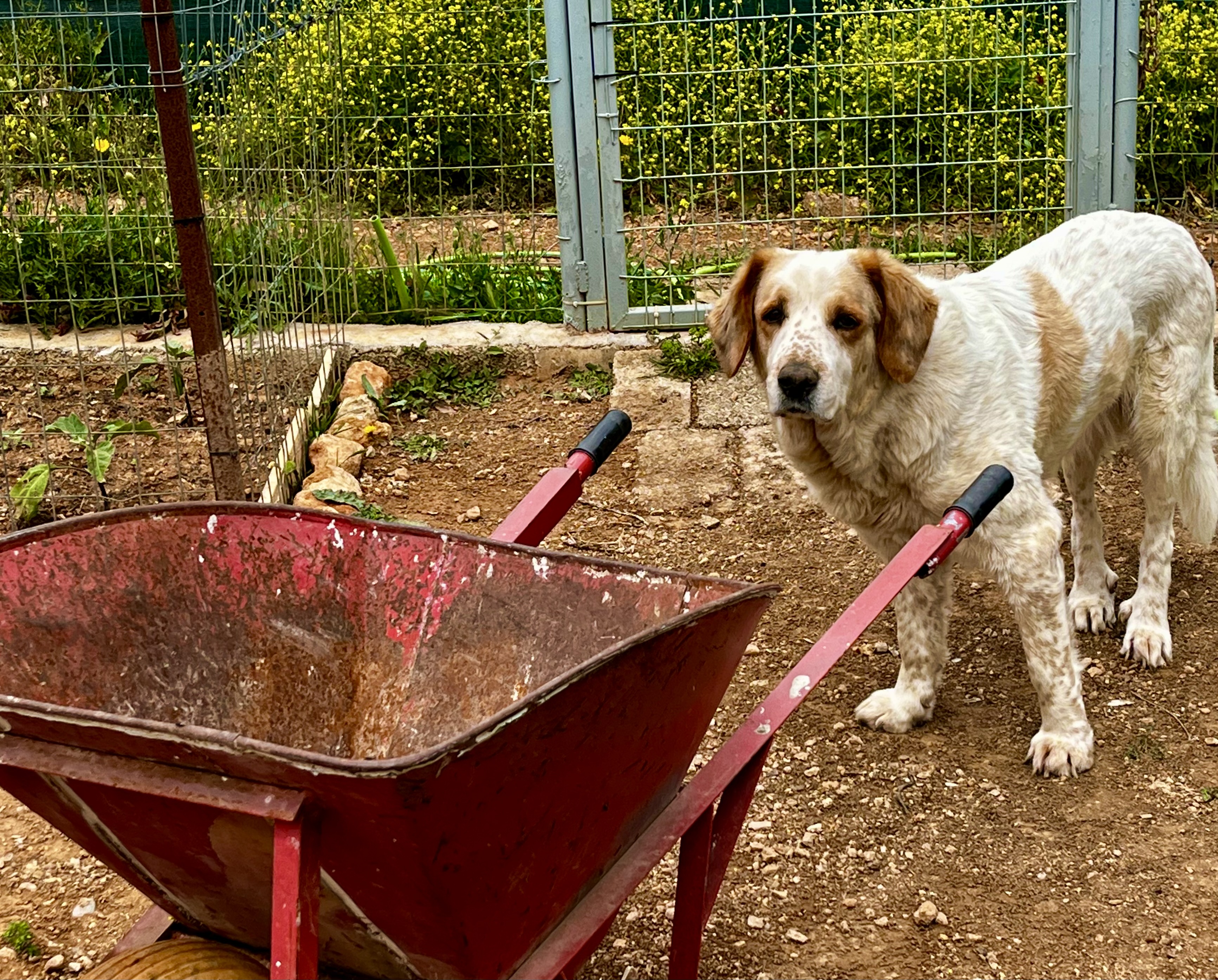
suzie and the wheelbarrow on the other side
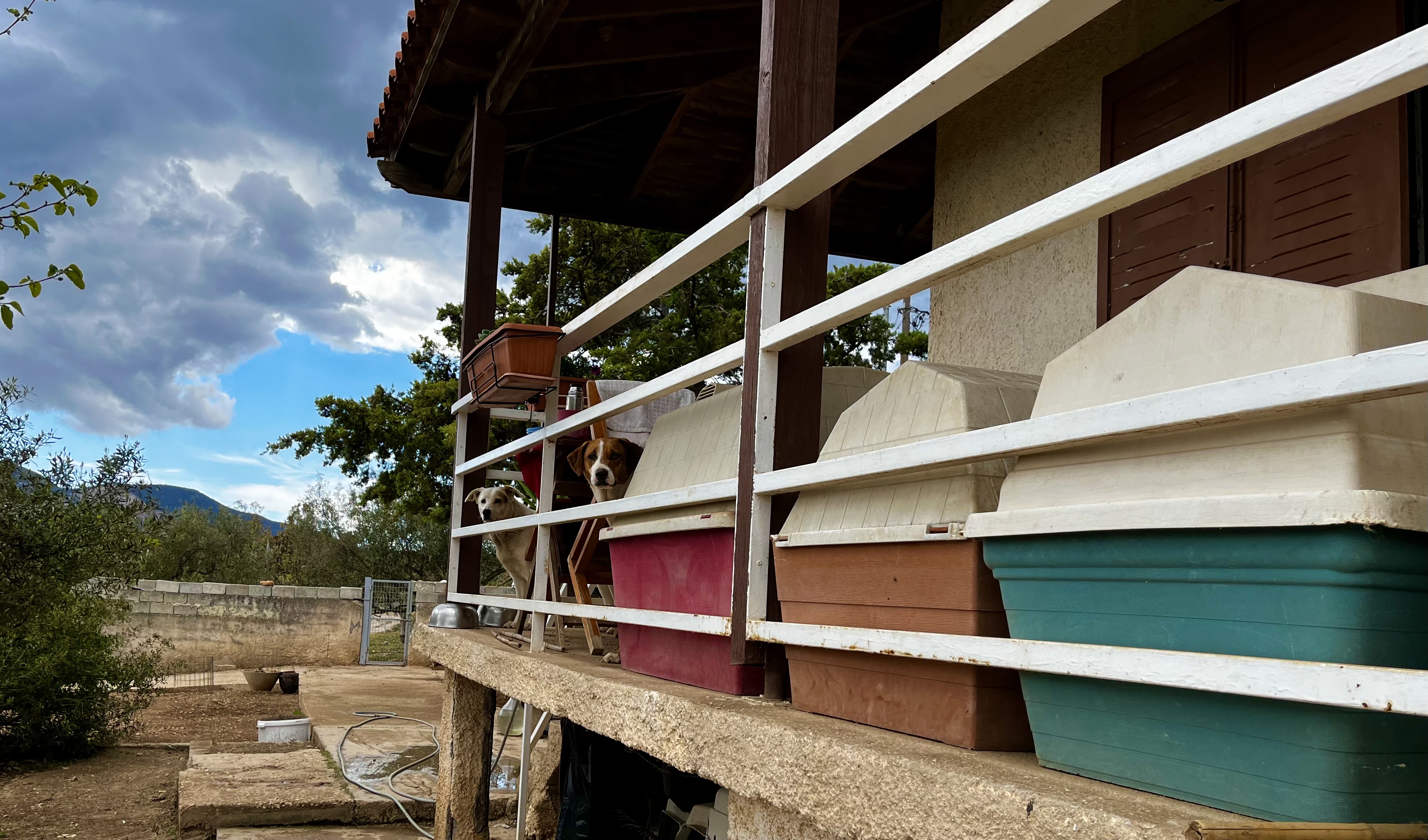
dogs and houses line the porch
regal rudisweet halvas
In 2020, Carla moved her furnishings and the dogs to “The View House” as she aptly named it. The collaboration between Cabby and Carla continued. They worked side by side with her tools [she taught him how to weld] and his heavy lifting to continue making improvements on the house and land. Of course, the work is ongoing and there is more to be done.*
the view house with [fence jumping] Rudi on his rounds
CARLA’S ABSOLUTES
Every animal whisperer is made of something the rest of us don’t really understand. Carla’s complete focus is on the dogs rather than herself. She is alert, attentive, and vigilant to their individual needs. The love between animal and human goes both ways.
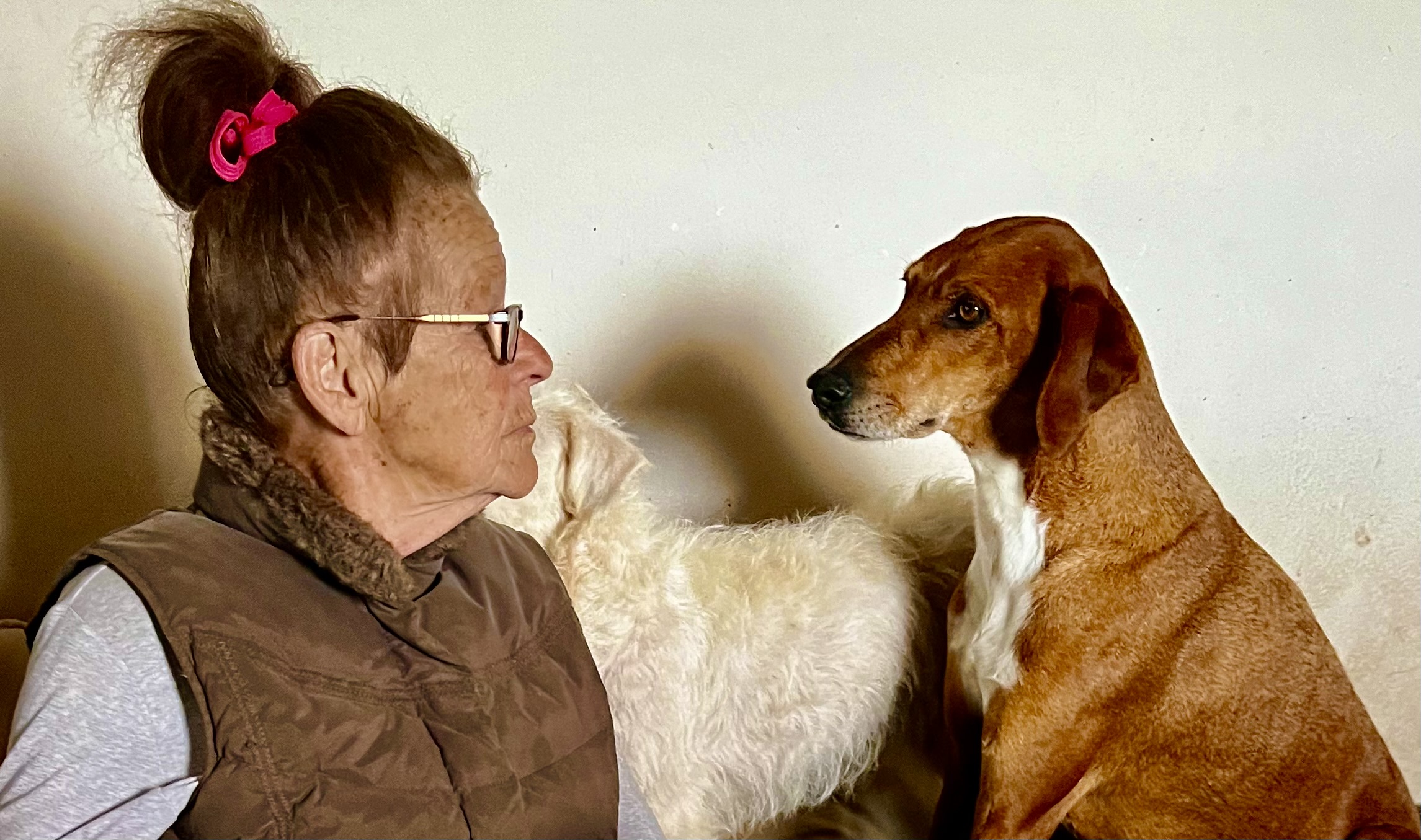
carla and bubusharing the love
There is knowledge behind her diligence and devotion. While living in the U.S., Carla studied Dog Psychology and Canine Nutrition for three years. Each animal receives one-on-one time. They seek her out for attention, taking turns, and reflecting adoration back on their caregiver.
with rudiwith kiki
All of this comes from a well-honed formula Carla calls her Absolutes with Dogs. They must unfold in a precise order: 1. Rules established. 2. Discipline. 3. Respect for her and each other. After this, love comes automatically.
CARLA AND CABBY COLLABORATION
These two remarkable people are as different as they are alike. Carla is tiny and petite. She is playful and feisty and readily shares strong opinions. Cabby is a very tall athletic-framed man with a calm, reassuring demeanor. Seeing them stand next to each other is a contrast of proportions.
Carla has smoked since childhood and has the husky voice of a long ingrained habit. Her laugh is deep, resonant, and engaging. Cabby has continued to work out and row competitively since his university crewing years. His wide smile surfaces easily, especially when telling a story, which he does often and well. The circumstances under which Carla and Cabby grew up could not be more different–an abandoned street urchin in Germany versus a loving two parent, four child household in America.
Their similarities are notable, too. Carla and Cabby each possess a steely strength of character and self-assurance that runs to their core. They share a strong work ethic that brings joy and a keen sense of accomplishment with every task undertaken. They are head-over-heels for anything “dog oriented”. When Chop died of old age, Cabby commissioned a commemorative headstone and installed it in the orchard among the olive trees and poppies.
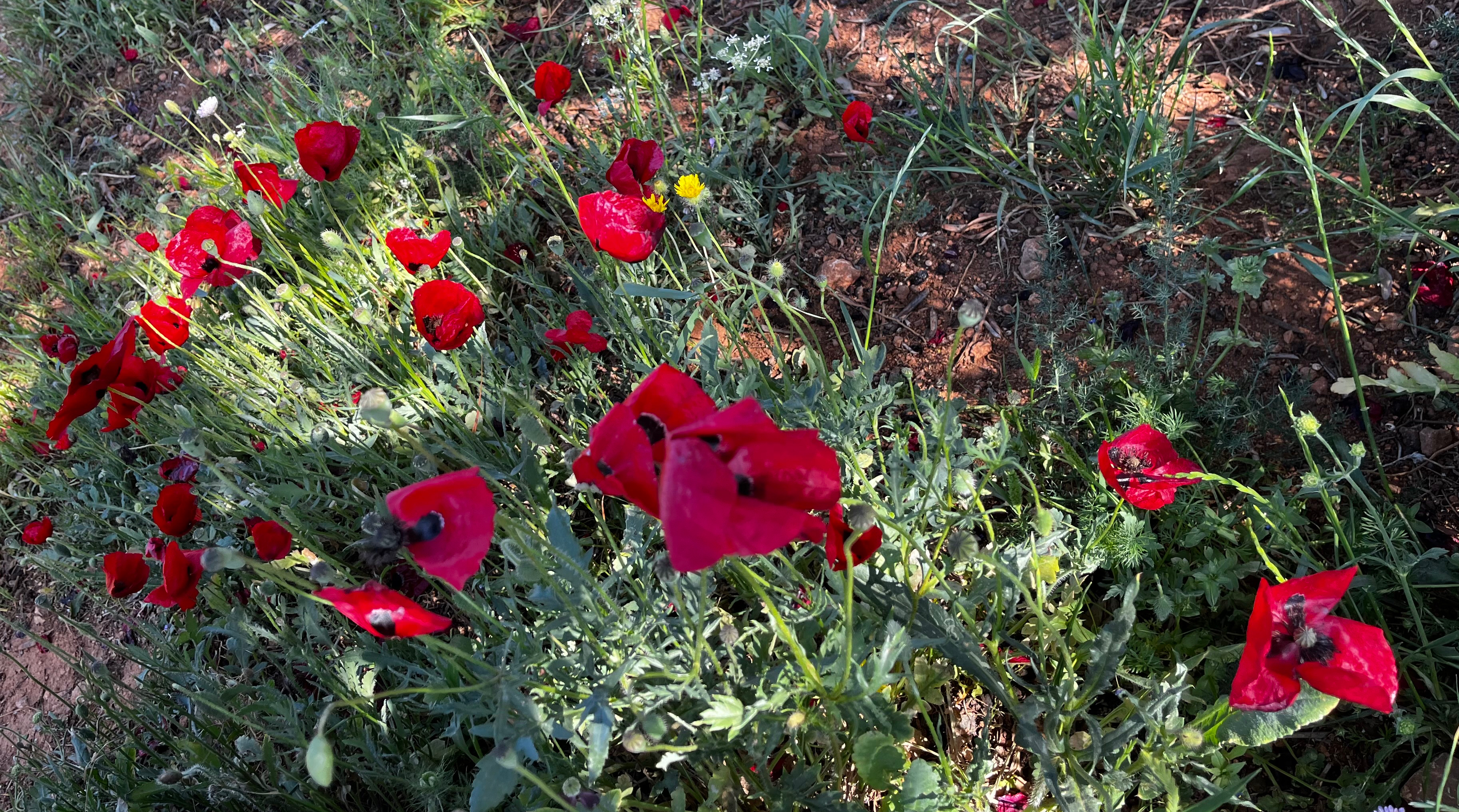
the orchard in poppy season
Relationships between people are not as easily defined as those between Carla and her dogs. By the time she turned 80 in February of this year, Carla lived many decades making independent decisions, getting things done on her own and in her own way without consulting anyone. Cabby, whom I have written about in other stories, is a Renaissance man with a multitude of gifts and talents. He can, and does, accomplish anything he undertakes as a project worth doing. He has a bottomless reservoir for giving time to others. People are drawn to his honest, ready assistance and hands-on approach.
Jumping in to help Carla set up and move into the View House is completely within Cabby’s character. But he was caught off guard by how this affected Carla’s independence and wariness in engaging with, or trusting, another person. He simply acts on what he thinks…let’s fix this. Then pitches right in.
Thankfully, for Carla, this was a karmic blessing of the right timing with the right person in the right place.
Four years later, Carla and Cabby continue to work toward the goal of creating the very best dog kingdom in Greece. They have overcome challenges and resolved friction about how to accomplish things. Two individuals with their own opinions have learned to listen with patience and compassion.
cabby and carla discuss future plans
I asked Carla and Cabby, separately, what has changed during their working friendship. Carla said that Cabby has become like a soul mate. He opened her to the realization that not all people with whom you grow close are going to hurt you or let you down. “Cabby has very good energy. He told me when he wakes up in the morning, he says to himself, ‘I’m going to be happy today.’” When he goes home at the end of a “Carla work day”, she often feels the positive energy leaving with him. She is not wired to wake up with optimism but she responds to it through Cabby.
Cabby, a man motivated by his “can-do” ethic, admits to developing humility from working with Carla. He takes time to listen and learn the back story behind Carla’s decisions. He respects her skill sets and holds back until there is agreement on what project to tackle next.
All of this has led to the best outcome for Carla and the dogs. She feels validated and loved in her relationship with both Cabby and Maddy. There is mutual respect. And there is true, deep, loving friendship. As Carla told me, “Cabby has made me softer. He was God’s gift when I was in a difficult situation.”
Dogs are Carla’s mission in life, her reason for being, and her touchstone to her own humanity. She has created a place of reciprocal need and love while living the life she envisioned as a child with a house and land for her animals.
From their first encounter, as Chop leaned into Carla’s soothing touch, it was clear to Cabby that this is a woman who lives life in joyful, meaningful work, founded on ability, confidence, and complete devotion to nurturing animals. Adding his labor and caretaking into the mix, Cabby mirrors back the importance, value, and beauty Carla brings, what they both bring…all for the love of dogs.
*ADDENDUM: Work Still To Be Accomplished
Carla is ready to take on next steps. She is not actively acquiring new strays or young dogs to raise, but currently has 19 animals depending on her care. She is eager to reopen another dog pension for financial reasons. The installation of sturdy, protected, outdoor kennels is a large project requiring funding for materials and labor.
If you love dogs, or other people who love dogs, or a good human interest story, there is a way to help with restarting Carla’s Happy Dog Pension. Consider the gift of a donation in the form of a one time sum or ongoing annual sponsorship for a few years. All funds are designated for kennel construction and maintenance, supporting dogs with food, flea/tick collars for the tribe, spaying, neutering, and other veterinary care health needs.
In the U.S., a Venmo account entitled Cabby Tennis @Dog-Kingdom has been set up for Carla and the dogs. If you contribute this way, please include your name and email address in the notes. Information will be kept confidential, but we would like to be able to thank you personally.
It is also possible to contribute directly to the Dog Kingdom bank account in Athens, Greece. For transfer information into the Euro account, contact Cabby cmdkwalker46@gmail.com or Wendy windowtoalifeoverseas@gmail.com.
If writing a check is your preferred method, contact Wendy and the Venmo deposit will be made for you.
No donation is too small. Any and all financial gifts will help Carla’s Dog Kingdom grow into the future…
FUN PHOTO GALLERY
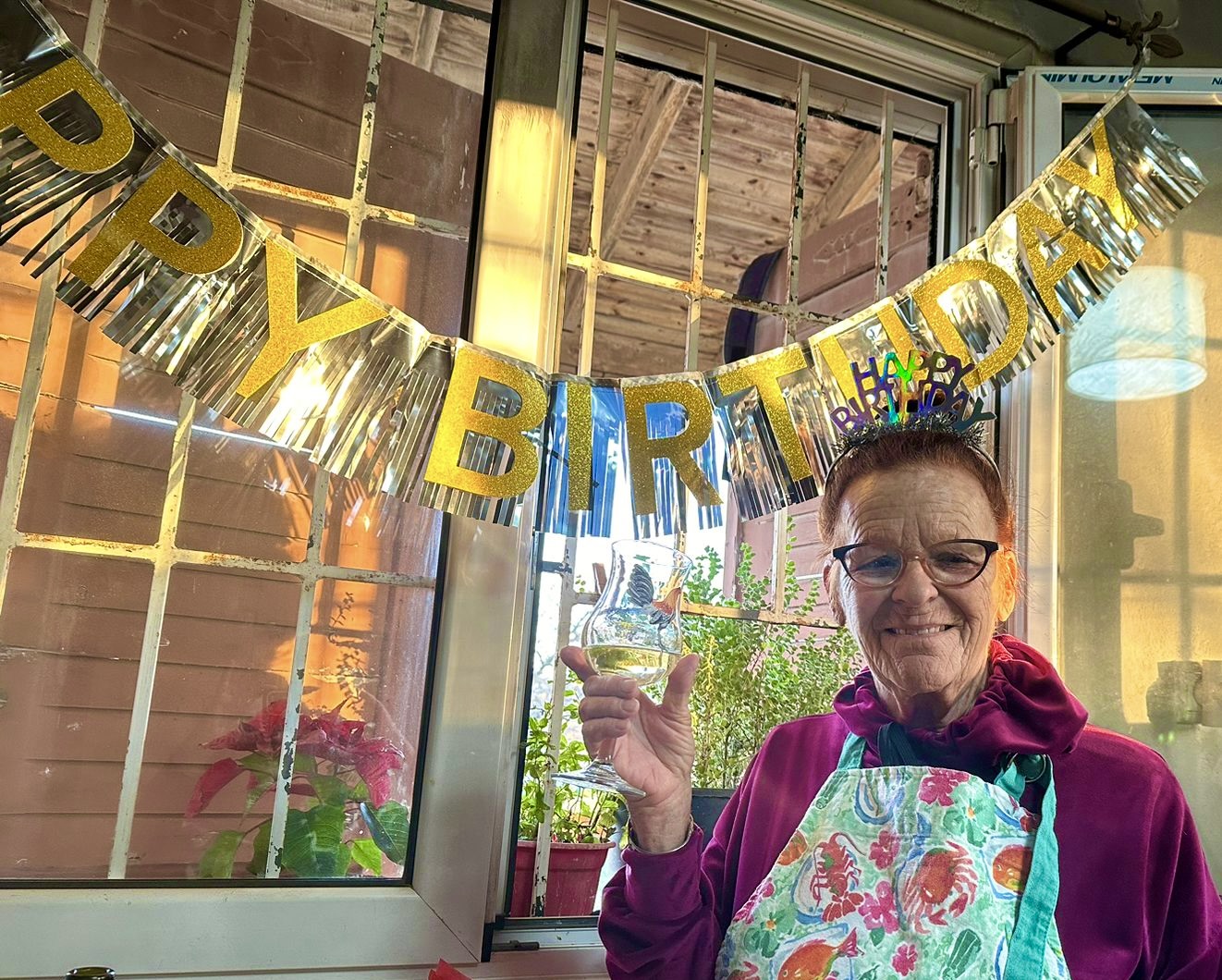
birthday party february 2024
maddy and carla sassy and classy birthday cardtoasting with pinK champagnemodeling birthday boots
trying to bond with the dogs
the best I can do
hanging out with the dogs
carla walker, dog lady extraordinaire
Click the link for the projects accomplished (with donations) in Carla’s Dog Kingdom over the past year.
Visiting an overseas friend who lives in Luxembourg, I found a book of poetry by Mary Oliver on a living room table. Awake early the first morning with jet lag, I settled into a comfy chair with a cup of coffee and thumbed through poems in the dim light. One entitled “Poppies” provided pause.
Oliver is known for connecting life lessons to her observations of love for the natural world. In “Poppies” her poetic sentiment contrasts the transient beauty of wild poppy fields with the inevitability of life and death.
“There isn’t a place in this world that doesn’t sooner or later drown in the indigos of darkness.”
To lighten the mood, she weaves in a moment of pure joy while visualizing poppies in the field.
“…But also I say this: that light is an invitation to happiness, and that happiness, when it’s done right, is a kind of holiness, palpable and redemptive. Inside the bright fields, touched by their rough and spongy gold, I am washed and washed in the river of earthy delight…”
While immersed in her river of delight, she circles back to darkness and loss, ending with a question.
“…and what are you going to do–what can you do about it–deep, blue night?”
Of course, there is nothing to do other than letting it go. Thus, exemplifying one of Buddha’s teachings that there is nothing anyone can successfully cling to in between the moment of conception and the moment of death.
Poppies became my favorite flower when we lived on the island of Cyprus for three years. Every spring, deep red fields of poppy flowers bloomed in profusion all over grassy orchards, fields, and pastures. Shaped like a fine teacup, the crepe-paper-thin petals flutter freely in the breeze. En masse on a roadside or in a field or even in a small clump, they are spectacular. But poppy season is brief. Flowers wilt, fade, and fall to the earth as graying-red dust in a short time. Breathtaking in the moment and then gone. Another year passes.
Our children were young in those years. On weekends we drove out of Nicosia searching for a carpet of red and green to spread out our blanket and picnic. Spending an afternoon in a wild field of flowers and tall grasses is still a magical memory. It was stunningly beautiful, a family outing in the season of rejuvenation, and it made me happy to be there with loved ones.
Cyprus poppy field, circa 1991
During World War 1, [1914-1918], most of the fighting in Europe took place in open fields where poppies proliferated despite the death and mayhem all around. In 1915, Lt. Colonel John McCrae wrote his famous, historic poem, “In Flanders Fields”* after witnessing the returning spring bloom across red battlefields.
*Full poem at the end of story.
Since then, poppies have been a symbol connecting the blood and sacrifice of soldiers with remembrance, hope, and peace. They are also associated with the Greek God Morpheus–the god of sleep and dreams. Morphine and opium narcotics are derived from poppies, hence the reference to death and sleep.
What draws me to experience a profusion of blooming poppy fields whenever possible? Because, like Mary Oliver, I connect them to a personal lesson. They remind me of the nature of our own family’s life cycle. Beauty in learning and growth, and the eventual letting go as necessitated by time. There was uncertainty and risk taken by our young family of four when we made a decision to live and work overseas in the late 1980s. In geographies and life styles, that were not a reflection of our home culture, we adapted and grew in individual ways. Incorporating the very best of each country’s experience added significantly to our lives.
Now we are all back living full time in America. Our children are young adults with children of their own. They each have a personal perspective about growing up in other countries for thirteen and sixteen of their formative years. My hope is that it enhanced and deepened their awareness as global citizens, as more thoughtful inhabitants to contributing to the health of the world and our planet for their own children’s future.
I think about these things along with the light and dark life cycle of the seasonal poppy. The lightness, the brightness, the earthly delight when seeing them massed in peak glory. The dark side of “here and now” beauty is knowing that it is fleeting. It will leave. Which must occur in order to be ready for the next opportunity to grow.
poppies fadeas beauty has its season
This past spring, the seasonal return of poppies in the wild offered an opportunity to re-experience an assault of red on the senses. We were in Greece in April. Poppy season was on, but had passed its peak in Athens. Then we traveled to the island of Hydra. Asking others to be on the lookout, someone said they saw “a whole field of poppies in bloom” on a hike.
It wasn’t exactly like that. What we found was a roadside of brilliant red flowers crowning a cliff high above the Mediterranean Sea, still lacy and vibrant and swaying in the breeze. It was a sought-after reminiscence, perfect for the moment, the contrasting beauty of vibrant red petals and deep blue sea.
…and it was enough, before moving on down the path.
We live in a world where people think happiness is a condition, but it’s not; it’s a sensation. It’s momentary.–Fran Lebowitz
This existence of ours is as transient as clouds. A lifetime is like a flash of lightning in the sky, rushing by, like a torrent down a steep mountain.–Buddha
You can’t say I’m not happy ‘cause happy’s not an action, you just feel that way. –Ambersunshower, from the song, ‘Walter T’, 1996 [Only available on YouTube.com]
POPPIESby Mary Oliver
The poppies send up their
orange flares; swaying
in the wind, their congregations
are a levitation
of bright dust, of thin
and lacy leaves.
There isn’t a place
In this world that doesn’t
Sooner or later drown
In the indigos of darkness,
but now, for a while,
the roughage
shines like a miracle
as it floats above everything
with its yellow hair.
Of course, nothing stops the cold
black, curved blade
from hooking forward–-
of course
loss is the great lesson.
But I also say this: that light
Is an invitation
to happiness,
and that happiness,
when it is done right,
is a kind of holiness,
palpable and redemptive.
Inside the bright fields,
touched by their rough and spongy gold,
I am washed and washed
In the river of delight––
and what are you going to do––
what can you do
about it––
deep, blue night?
IN FLANDERS FIELDSby John McCrae
In Flanders fields the poppies blow
Between the crosses, row on row,
That mark our place; and in the sky
The larks, still bravely singing, fly
Scarce heard amid the guns below.
We are the Dead. Short days ago
We lived, felt dawn, saw sunset glow,
Loved and were loved, and now we lie,
In Flanders fields.
Take up our quarrel with the foe:
To you from failing hands we throw
The torch; be yours to hold it high.
If ye break faith with us who die
We shall not sleep, though poppies grow
In Flanders fields.
poppies sown in Colorado fields, courtesy of Harrington’s ranch
The screen saver on my computer is a continually revolving door of the pictures in my digital photo library. Sometimes an image arises and pulls me into such strong “déjà vu” moment that I am carried back to that exact place and time. A photo from several years ago opened on the screen recently. I paused, after it flashed by, to reflect on the moment a very young child learned to adapt to uncertainty with resilience and her own brand of spunk.
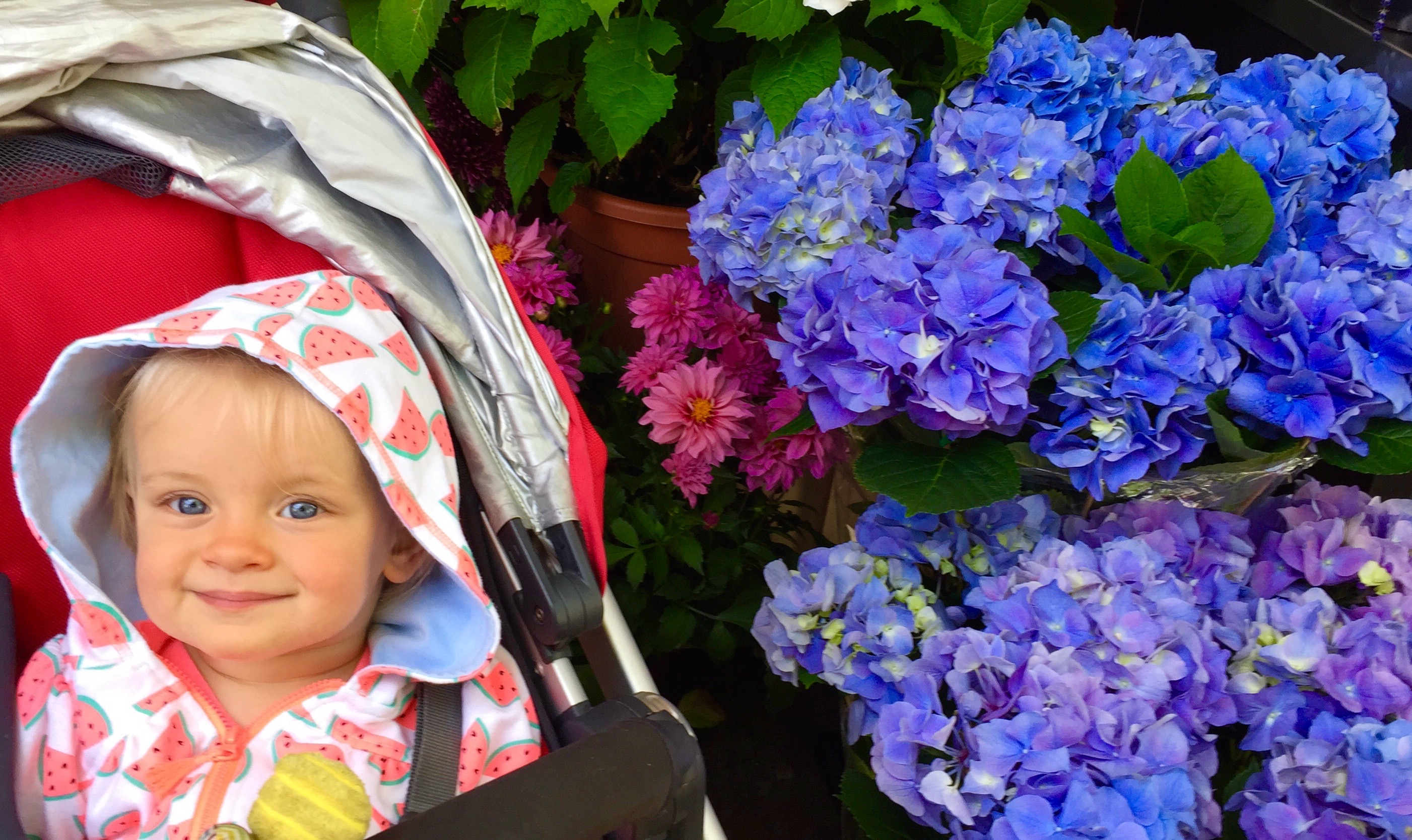
Leila before adaptation
We were living in Paris, France when our granddaughter, Leila, who had just turned one-year-old, was left in our care for a four-day weekend. Our son and daughter-in-law, who met and fell in love in London, were attending the wedding of close friends there.
Leila was an active, walking toddler with strong attachments to her parents, particularly her mother. She had never been in the care of a babysitter or day care since her birth in California in 2016. Although we were living overseas at the time she was born, we had been together many times in both the U.S. and France. But she was a baby. And we were not her parents.
Leila and Mommythe whole fam 2017
Anticipating separation anxiety even in the care of loving grandparents, I had suggested [several times] that the parents try some outside babysitting with other caregivers before leaving her with us in an unfamiliar environment in Paris. Well…
Our son flew directly to London on business before pleasure. Daughter-in-law and Leila flew to Paris first and were embraced by my husband and me in our Parisian apartment. Mother and daughter settled easily into the guest suite, and we spent a fine two days establishing routines and exploring the neighborhood. Then, early on the third morning, Mama left to catch a train to the UK. Seeing her mother descend on the elevator with a suitcase, life shifted dramatically in Leila’s experience.
all is well in the beginningof settling into Parisian life
This little girl cried herself into a state of exhaustion that resulted in an unusual morning nap. When she awoke, still inconsolable, it was time to mix things up. I called in reinforcements. My friend, Sally, came over. We went to a nearby park with a large sandpit playground. Sally and I watched Leila explore the play equipment, get dirty with digging toys, and sit with independently playing French children. Sad eyes throughout, but no tears. Home to lunch, an early bath, and second nap ending in the late afternoon.
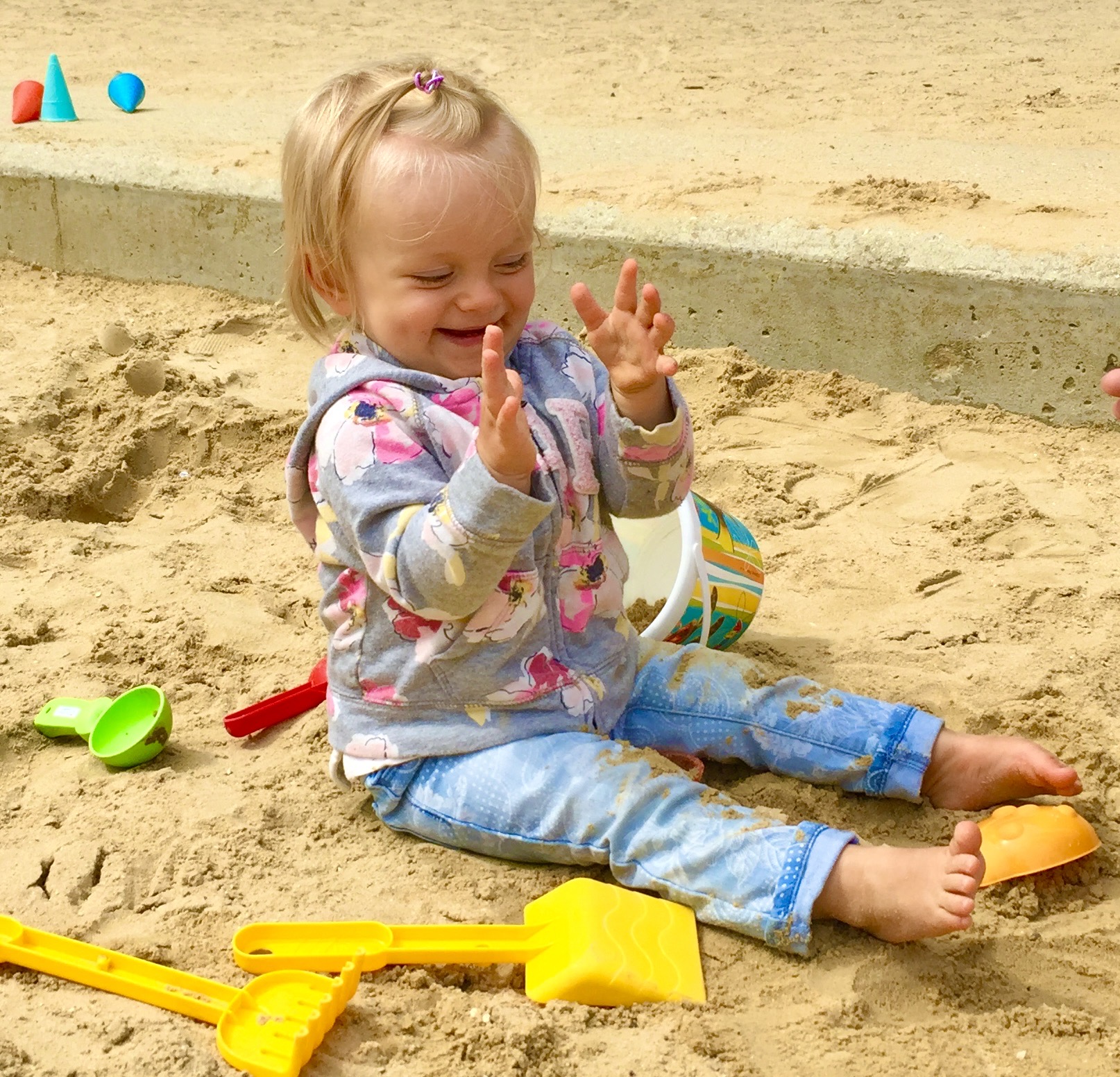
Sally to the rescue at the playground
the saddest eyes
Then an epiphany.
Hearing that she was awake, I went to the bedroom. Leila was sitting up, wearing an uncertain face, as she watched me open the door. It seemed another round of tears was about to begin.
And then something happened that I will never forget. While I spoke to her quietly, Leila looked at me, still in the doorway, closed her eyes and visibly shook herself. From head to toe. As if, by shaking, she was able to transport herself to a new place. As if, intuitively, saying, “I will shift gears. Right now.” In the eight hours since her mother left, an emotional switch turned. She emerged from complete misery to a different way of seeing things.
Leila reached out her arms to me. And I witnessed true grit in a little girl who visibly changed her perspective because she needed to, and then wanted to. Yes, adaptability is a trait in tiny people, too.
The next three days unfolded seamlessly. The daily park adventure was an anticipated and engaging outing. At home, we watched my revolving computer photos and talked about the people she recognized. Mommy and Daddy, Donk and DeeDee [Mark and me], herself as a younger baby. She imitated my yoga moves. We danced.
There were sweet moments of playtime in the bathtub, bedtime songs and stories, and hiding in the dining room curtains in a funny game of hide and seek with Leila certain that she was invisible. There were trips to the toy store and stops for coffee and snacks at our market street café. At a sidewalk table we watched the world go by and then explored the pedestrian street.
By the time Leila’s parents returned, a life lesson in trust and love and flexibility had been established. She was fine. We were fine. Back on the scene, witnessing their daughter’s smile and welcoming hugs, the parents were fine, too.
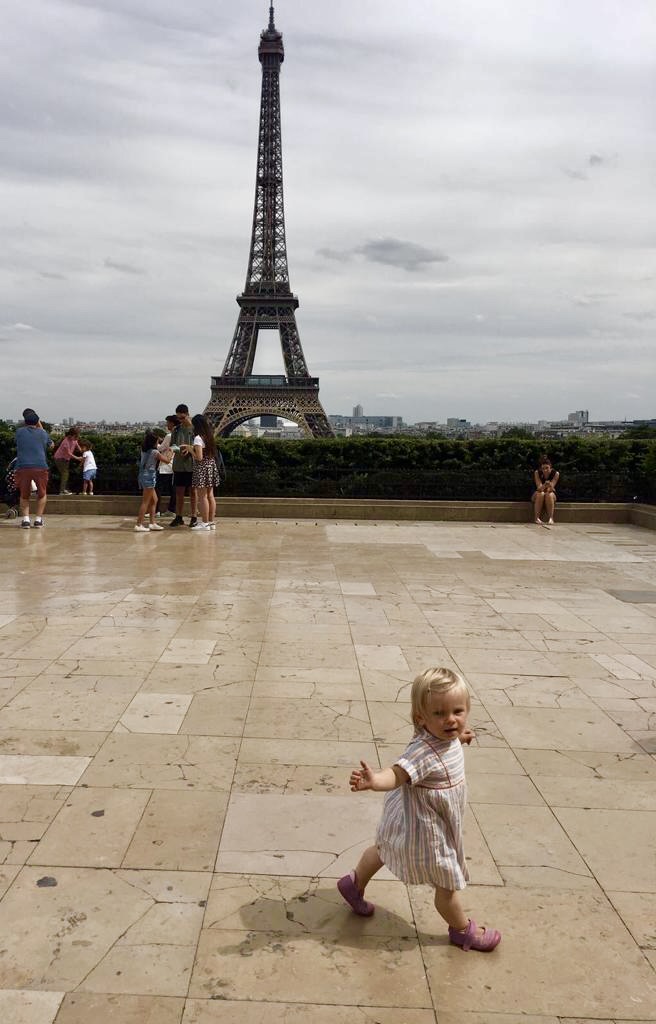
Trocadero playwith mommy back again
Adaptability is a step above resilience in human temperament. It takes behavioral and emotional coping skills to adjust to new circumstances. In the ever-changing situations of life, learning to adapt as quickly as possible, ideally with support from others, is vital developmental know-how. Leila hit the first mile marker.
As the saying goes, it takes a village to raise a child. Grandparents and grandchildren each need to find a way to create and live in their own special harmony. Young children can, and do, adapt when facing new or unfamiliar situations. But they need to figure things out in their own way and time. Successfully overcoming challenges, particularly at a young age, lays the groundwork for all that lies ahead in life.
When I see a photo of that memorable visit flash by on the computer screen, I relive the story of a beloved granddaughter who found the ability, within herself, to emotionally change at a tender age. In doing so, she grew. And thrived.
It happened right before my eyes. Simply unforgettable.
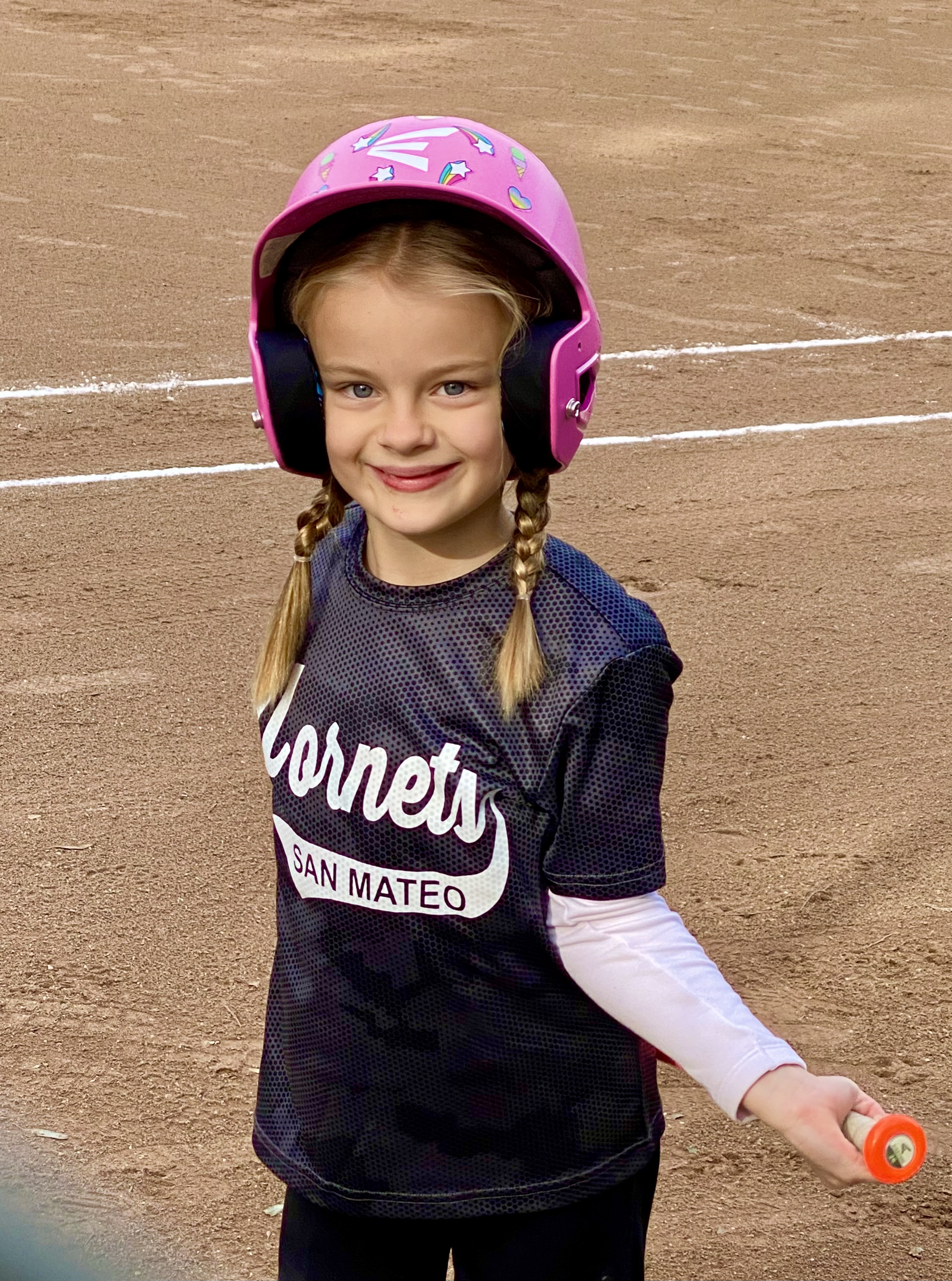
still friends at 18 months in Californiastill friends at 4 years in Colorado, 2020feeding the horses at 6 yearsballplayer at almost 7 years, 2023
The fact that I, myself, do not understand what my paintings mean while I am painting them does not imply that they are meaningless. –Salvador Dalí, Spanish surrealist artist
Years ago, a man named John Filer, found this quote by Dalí, and taped it to his wife’s easel because it reminded him of her work. His wife, Jane Filer, is an artist. She has been expressing herself through painting since she was a small child. In Kindergarten, Jane went to the standing easel during free time and painted a new picture every day the entire school year.
Today, Jane’s acrylic-on-canvas paintings carry the ethereal quality of an imaginative dream. Among overlaying colors, images materialize and hold one’s gaze. It’s impossible not to feel something and find meaning.
I wasn’t aware of Jane Filer or anything about her portfolio until I visited a friend in Boulder, Colorado more than a year ago. In her living room, there was a painting over the sofa that pulled me closer. It felt like looking into someone’s multi-layered dream. Even one of my own dreams. I wanted to know more. My friend, Cathy, told me it was painted by a woman named Jane Filer. She bought it from a gallery on Canyon Road in Santa Fe, New Mexico.
Cathy’s painting, High Tide, Full Moon by Jane Filer 2015
My husband and I were already planning a road trip to New Mexico the upcoming weekend. Good road trips offer new discoveries and lasting memories. What I didn’t expect as an outcome was friendship with an artist whose work I greatly admire.
Jane Filer was the middle child of four siblings–two older brothers, two younger sisters. Born on the coast of California, her accountant father moved the family to Australia for several years when she was 11. While living there, Jane gained appreciation for and inspiration from aboriginal art–particularly the strong colors and detailed, organic nature of the paintings.
As a child, Jane’s mother told her she had an “overactive imagination”. It was not meant as a compliment. Rather, Jane was endlessly criticized and berated as a “disappointment” for not being practical enough. She turned her creative energies and vivid imagination toward her younger sisters, making up stories and songs to entertain them. Eventually she was nurtured by a paternal aunt. Drawing came naturally before Jane entered school. And then she discovered the magic of a paint brush in her hand.
Before we drove to Santa Fe, I called Bill Hester, Jane’s art dealer at the time. We were coming to look at everything he had of her work. Bill spent a lot of time with us as we strolled the gallery, asking good questions, explaining Jane’s painting method along with his personal view on poetry, metaphor, and art.
My husband and I considered each painting individually and then circled back to speak together privately. One piece resonated with both of us. It was entitled Elephant’s Journey and reminded us of our years living overseas and the adventures we experienced as a family, in five countries for more than thirty years. Elephant’s Journey touched a mutual chord. The elephants are marching in line toward a cliff, but it is not catastrophic. We saw it as the poem for a risk we chose to live.
Elephant’s Journey, with closeup of elephants walking, Jane Filer, 2021
Jane’s family returned to the U.S. from Australia and settled in the Midwest. With encouragement from her mentoring aunt, she earned a Bachelor of Fine Arts from Southern Illinois University. After graduating, she met her husband, John Filer, who was five years older and worked in forestry. For many years, while John planted trees all over America, they travelled and lived simply in a camping trailer with national and state forests as their backyard.
At the University of North Carolina, Chapel Hill, Jane was offered a coveted spot in the art college, working toward her Master of Fine Arts. She began teaching painting and drawing for the next 21 years. In 1986, John and Jane bought 17 acres of woods and began to build their first real home. Much of the construction was accomplished by their own creative hands.
As she was about to turn 50, Jane left teaching, which she dearly loved, to devote herself full-time to painting. John, now retired from forestry, became her manager, counselor, and confidence builder. When Jane expressed self-doubt or struggled with difficult decisions, John would simply look at her and say, “Why are you asking me? You don’t need anyone’s advice. You’re Jane Filer!”
Ten years ago, Jane’s selling gallery expanded from Chapel Hill to Santa Fe, which is, the second largest art market in the world after New York City.
Six months after purchasing Elephant’s Journey, I returned to Santa Fe to view another Filer painting I had seen on the gallery’s website. But I was immediately distracted by a larger piece that had just arrived from Jane’s North Carolina studio the day before. Unwrapped, on the floor, it was leaning against the wall. I studied it silently and knew I could look at this painting every day for the rest of my life. It is called Eclipse.
Eclipse by Jane Filer, 2022
There are figures falling out of the sky, there are swimming figures, there is a grove of trees whose roots feed an underground river, with a tent and a lone camper above. There is water running through it and a full regatta of sailboats off on one side. The colors blend into a beautiful meditation even without the imagery. When I look at this painting, I continue to discover something new. It joined Elephant’s Journey in our living room.
closeup of sailing regatta, Eclipsecloseup of swimmers, Eclipsecloseup of texture using corrugated cardboardcloseup on tree grove, tent, and lone camper, Eclipse
Jane Filer is a happy-by-nature-extrovert with a warm, engaging smile, a tumble of spiraling blond curls, and twinkling blue eyes. I met her in person on my next visit to Santa Fe where she was painting for two weeks as “artist in residence” at the Hester gallery. Jane is an open communicator who simply loves people. Even people she meets for the first time.
Jane at home in Chapel Hill, NC
I am fascinated with life, light, love, and fear. –Jane Filer
We fell into conversation easily, starting with the psychology of being an artist. Jane told me that being off balance and a bit fearful is critical to her paintings. Dark and light, yin and yang are expressed in metaphoric imagery. She doesn’t explain what the imagery means. She doesn’t like repetition, but certain themes recur. Her connection with Nature in the form of animals, faces, figures, water, flowers, trees, are part of the story on canvas. There is often architecture, discernable buildings or shelters painted in, too. Because Jane considers art her therapy as well as a way of life, she is fearless about entering what she calls her dark side. She believes painting fills a need to dig deeply into life’s challenges and, by doing so, keeps her healthy.
After the Santa Fe meeting, we continued talking over the phone. Then Jane invited me to visit her studio/home in the woods of North Carolina. John Filer passed away prematurely several years ago. After he died, she hired the finishing work on the house to her specifications. I found everything about it to be an extension of her naturalness, her love of nature, and living close to the earth.
front doorcloseup on doorhand built in the Carolina woods
The first thing I noticed were collections everywhere. Rocks and geodes, jars and bottles, shells and bones, antique Indian artifacts–axe heads and arrowheads. There are faces that Jane has collected, sculpted, or painted. The furniture invites curling up to talk or muse on the green expanse of forest outside or to sit by the wood burning stove inside. The kitchen was one of my favorite indoor spaces. John built the wooden dish rack above an antique cast iron sink he found in the woods. It’s an efficient way to dry and store hand washed dishes. Jane designed the tile back drop over the stove and sink. The L-shaped counter invites sitting over morning coffee, talking to whoever is cooking, or sipping single malt whisky and more conversation in late afternoon. There are vignettes of photos, paintings, and artifacts tucked into wall niches or on windowsills.
hanging dish rack by John, inlaid tile work by Jane
faces everywhere
wall niche collectibles, John and Jane Filer photo by Lorri Zipperer
I can’t write songs and I can’t write stories, but I can paint. –Jane Filer
Observing an artist in their studio space is definitely zeroing in on their personal reality. Because Jane told me she dreams and/or has visions while she works, I assumed that, like writers, her working time is largely introspective, solitary, and quiet. In fact, life in the Filer studio can be just the opposite. There might be loud music and singing, phone calls and conversations. There is another artist, Michele Yellin, who paints with her, their easels set side by side. When I tried to retreat to my room to give her time to work, Jane invited me into the studio to talk while she painted. As I poked around looking at artifacts that caught my eye and asking questions, she transferred color, imagery, and texture to the canvas. Jane multi-tasks and dreams while awake.
Jane in the studio working on what will become Three Dogs, 2022
We dream all day long. –Jane Filer
To begin a new piece, Jane sits at her easel thinking quietly before reaching for paint and covering the canvas edge to edge in colors. She moves color around abstractly until layers and shapes suggest composition. It is free-falling. When patterns and colors start to feel exciting, she sketches over the abstract with fine charcoal lines. A language is developing, the beginning of a story emerges in her mind. She feels anticipation and energy about what comes next.
the abstract beginning, color everywhere
The next phase, moving from the abstract to the middle composition, is what Jane calls “The Hairy Middle”. It is the longest part of her painting method and often uncomfortable. Because in the “hairy part” she does a deep dive, directly facing what she likes and dislikes, and more importantly what she fears. There is collective unconscious to whatever bubbles up in this middle moment. The painting has become its own entity. Jane moves it further into existence by working through her emotions until she is on the other side. Her imagination stretches to completion, heads to an ending.
from the abstractinto the hairy middle
Jane can work on more than one painting at a time. She sets aside something that needs time to mature and starts a new canvas or goes back to an earlier one. She adds texture and shape with pieces of bubble wrap or corrugated cardboard, pressing them into paint and then onto the canvas. She might use a knife edge along with brush strokes to create depth. There are finely drawn outlines around imagery. The color palate is vibrant and rich. Yet the finished painting may have morphed numerous times from the original color scheme.
Lost Lobo by Jane Filer, 2022 from the abstract to the hairy middle [as seen above] to completion
For art to be complete, it must be let go–sent off into the world. –Jane Filer
Jane considers her paintings to be her offspring. They are born and nurtured on canvas. They are not meant to be literal, but rather offer an invitation to find personal meaning. Intuition tells her when each one is finished. Then she lets it go to stand on its own in the world.
I sent Jane a photo of her two paintings on our living room wall and invited her to come see them in person. Four months later, at the end of October, Jane and her friend, Michele Yellin, drove across the country and made Colorado their first stop.
It snowed all night after they arrived. We woke to a white wonderland in the morning. It didn’t stop us from driving into Rocky Mountain National Park and having lunch at the historic Stanley Hotel.
Jane, Wendy, Michele at Many Parks Curve overlook
Jane with EclipseEstes Park outings: RMNP, Stanley Hotel, home base
The best things in life cannot be told. –Heinrich Zimmer, German linguist and historian
That is to say, it is difficult to describe art that exists outside the reach of words. But this is the very essence of it, too. Art is created to inspire emotions and depth of feeling that are simply beyond description.
I think this is what it means to be in the presence of Filer art. What begins as a dream or vision in Jane’s metaphysical mind, gains momentum in color and imagery on canvas, and opens a poetic portal to both lose and find yourself at the same time.
I am inspired by this circle of connectedness–a painting in another’s living room, an art gallery in Santa Fe, two paintings in our home that enrich us every day, back and forth visits with an artist whose life began as a girl with an overactive imagination and is now my friend.
That’s being Jane Filer.
Hope as a Destination –be sure to read a new story about how a piece of Jane’s art, entitled “Above the Bridge”, inspires hope and encourages ways we can create impact in a tumultuous political climate.
Current information about Jane’s art, both painting and sculpture, can be found on her website janefiler.com
A guest is good or bad because of the host who makes being a guest an easy or a difficult task. –Eleanor Roosevelt
When I was a child, there was a book called Miss Jellytot’s Visit that formed my first impression of what it means to be both a host and a guest. Nine-year-old Katie O’Dea watched her mother host college friend, Irene, in the guest room of their home. The bed was made up with the best linens and quilts in the house. There were big, soft feathery pillows in pink pillowcases that you could sink back into, and a rose on the bedside table. The towels were fluffy and white in the spotless bathroom. Their guest was served breakfast in bed on a tray with another rose alongside. There was an assortment of magazines and books to peruse in lounging leisure.
Katie dreamed of being a guest in her own house, staying in that comfortable room with nothing to do but dress up in fancy clothing, wear French perfume, and be waited on like “Aunt Rene”. With her parents’ indulgence, she arrives as a “visitor” from out of town, calling herself Miss Jellytot because that was the name of her favorite cookies. Everyone stayed in their assigned roles. Katie was treated like an adult the entire visit.
Of course, there were problems with all of this. The first was that Aunt Rene stayed for two weeks and never lifted a finger as she had come “to rest and relax.” Mrs. O’Dea was not sorry to see her friend leave on the train. The second was that Katie learned being a grown-up meant missing pleasurable childhood activities like playing outside with friends, going to swim parties, or getting a new puppy. She couldn’t wait to end her “visit” after six days and be a kid again. Lessons: Don’t jump into adulthood when you haven’t finished the fun of being a child. And don’t overstay.
The story left me with “how-tos” carried into my own adult life. As a guest in someone else’s home, I stay no more than three days, with exceptions for family birthings or need-to-help home stays. I also like to set up a room for overnight guests in my home that is cozy and welcoming and well-outfitted. A room that I would enjoy spending time in, too.
In early December, a cousin’s memorial service created the need to travel to St. Louis while I was already out of town for another event. My niece, Rebecca, has a large home with a guest bedroom and bath separate from the family’s living space. It was mine for the weekend. I flew in from across the country on a blustery wet night, rented a car and drove to her house knowing that everyone was out for the evening.
It couldn’t have been a better welcoming. Shrugging off coat in the back door entry, I smelled something delicious. Christmas lights and decorations were twinkling in every room. There was soft music coming from a speaker in the kitchen. Simmering on the stove was a pot of homemade chicken soup. There was a place setting on the counter next to a fresh baguette, butter, and a note inviting me to help myself. I was warmed to my soul.
I sighed gratefully and headed for the bedroom. Lights were on, a little gift in a colorful bag was on the bedside table next to a carafe of water. White towels were folded on the chair by the window. The bed was layered with white quilts, comforters, and billowy pillows.
Back in the kitchen, I poured a glass of wine, served myself a bowl of soup with bread and butter on the side, and said aloud, “This woman gets it.”
Hosting overnight guests involves providing for them in surprising and generous ways, going out of your way to roll out the welcome mat, even if you aren’t there to open the door. My niece checked all those boxes.
Rebecca is an interior decorator and organizer extraordinaire in her home and for her clients.
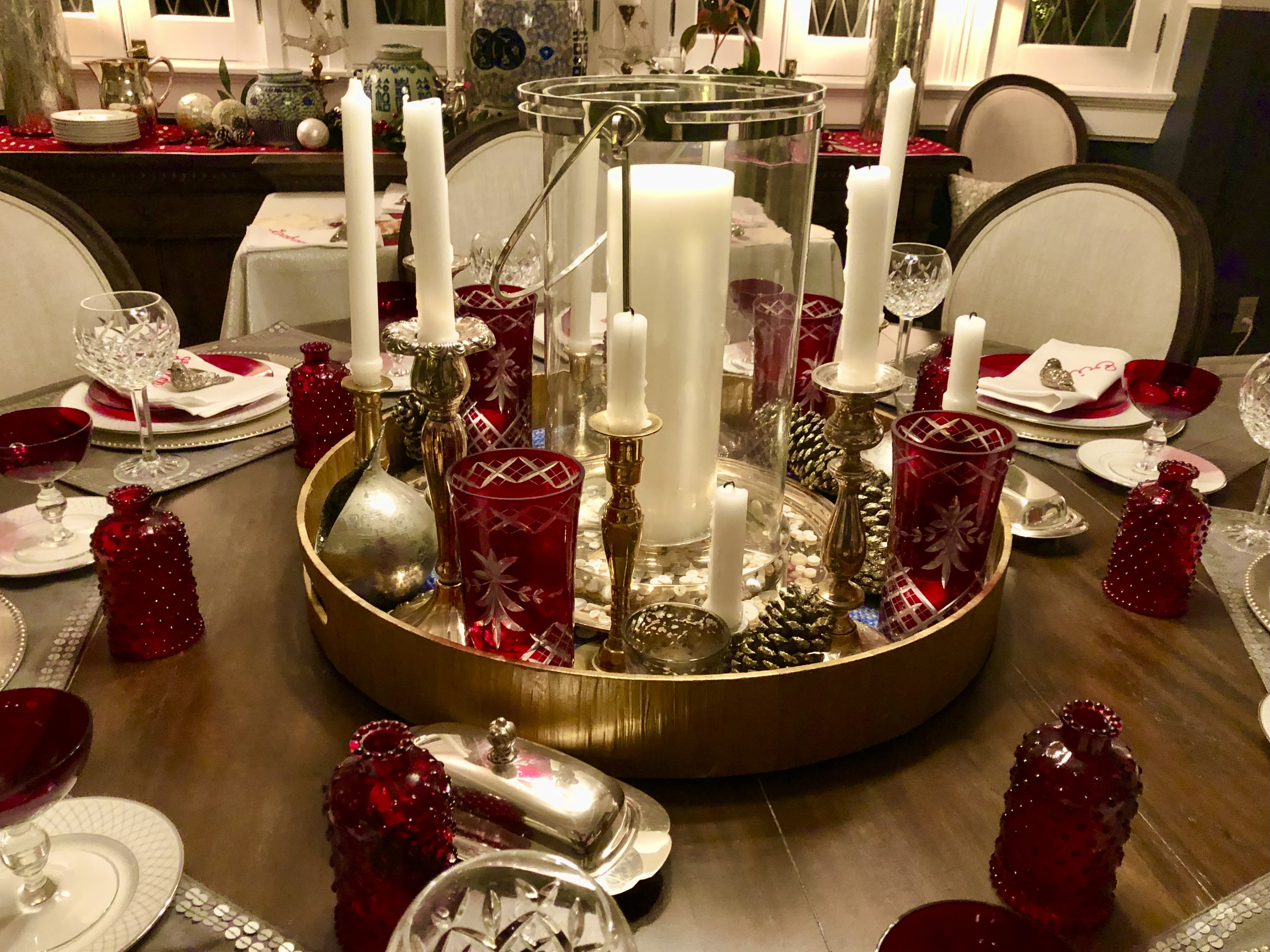
dining room decorated for holidays
Christmas table setting
the whole room
On a previous visit I noticed an opportunity where I could be of help. There is a small, temperature-controlled wine room in the basement. I had seen bottles of red and white and bubbly of differing vintages and values pushed randomly into wine slots. There were shelves a-jumble with gifted booze never opened and never intending to be drunk, gift bags strewn on the floor. If trying to find something special to serve and drink, well, there was no order.
My offer–to sit with her [and a charcuterie plate and two glasses of wine], pull everything off the shelves, put like vintages together, separate great bottles from the good and the cooking variety, use the label maker, toss out or give away questionable items like Ever Clear [!], horrible flavors of vodka, and other unidentifiable poisons. We set aside whisky that I might drink on another visit. She was thrilled. I was happy to spend time in a companionable activity in return for her hospitality. Win-win, like a thank you note in action.
Guest: Be genuine. Be remarkable. Be worth connecting with. –Seth Godin
Hosting at home can also be a celebratory party, a dinner, an outside barbecue. The host sets the stage while guests bring their exuberant mood, conversational banter, and best engaging self to round out the table. The most memorable get-togethers with family or friends have free-flowing discussions, storytelling, perhaps some soul searching, and laughter.
To me it has always been clear that a dinner party is about what is said, not what is eaten. There would always be wine and salad and bread and stew: chocolate and fruit and nuts and sparkling cold duck. But those were just the props — the conduits for funny and real and meaningful conversation; the set pieces of a lively, engaged, lingering old-school dinner party. The one that I have been chasing ever since…
–Gabrielle Hamilton,chef and author
at home in Paris with petit-déjeuner for guests, 2018
We have a friend who masterfully slips in what he calls “the provocation” during dinner parties and casual social gatherings. It’s not confrontational and participation is optional. It’s a conversational attention grabber along the lines of “Who was an important influence in your life?” or “What is something that changed the direction of your life?” or “Have you experienced anything scientifically unexplainable, something paranormal?” Everyone chimes in because it adds another dimension to what we know about people we care about, and isn’t that why we get together in the first place? Adding detail, bridging thoughts and ideas with content, creating connection.
One more thing about being a good host and an even better guest. After years of inviting people to our home in Colorado, and for many years overseas, I have learned to enjoy late hours clean-up after the candles are snuffed and guests have cheerily said, “Good Night”. I like putting the kitchen back in order by myself or with my husband and thinking about the best parts of the evening. Again, from Gabrielle Hamilton:
I’ve always been against the insistent, well-meaning cleanup brigade that convenes in the kitchen before anybody has even digested…When I invite you over, I mean it. I mean: Sit down. I will take care of you. I will buy the food and get the drinks and set the table and do the cooking, and I will clean up after. And when I come to your house, you will do the same. I will get to have the honor of being a guest. To perfectly show up, 10 minutes after the appointed time, with a bottle in hand for you, to bring my outgoing, conversational self, my good mood, my appetite, and to then enjoy all that is offered to me, and to then get my coat at the very end and leave without having lifted a finger. It is just the greatest thing of all time…
Yes, it is.
Rebecca in Paris, 2018
Notes:
Rebecca uses bamboo sheet sets from Cozy Earth. They live up to the advertising “sleeping on a cloud”. www.cozyearth.com
Gabrielle Hamilton wrote the memoir, Blood, Bones, and Butter. Her writing voice is very engaging. She also owned and cooked at Prune Restaurant in East Village, NYC until the first Covid shutdowns in 2020. She contributes occasional articles to the NY Times.
For additional stories, international anecdotes, and photos about hosts and guests there is this: The Grown-Up Table.
rebecca, daughter emily and aunt wendy in paris, march 2018
Sitting every night at the dining table with my wife, sharing our meal and a bottle of wine, discussing the events of the day…This daily ritual has been ingrained so profoundly within us that we could not live without it and that is how food memories are made. –Jacques Pepin
If you watch people eat, you can find out so much about them. Eating is learned behavior; one of the ways cultures define themselves is by teaching children what to eat…But as we get older, we begin to make our own food choices and they are equally telling. If I tell you I like very spicy food, I’m not just talking about food…I’m telling you I like adventure. –Ruth Reichl
Yesterday was the first rain/sleet/snowstorm in our part of the Colorado mountains. I spent the afternoon on the sofa with a fire blazing, a book in my lap, and candles on the coffee table as the light faded. The season for sitting outside with a cup of coffee, a glass of wine, or a meal is behind us now.
fireside afternoon, new snow on Long’s Peak
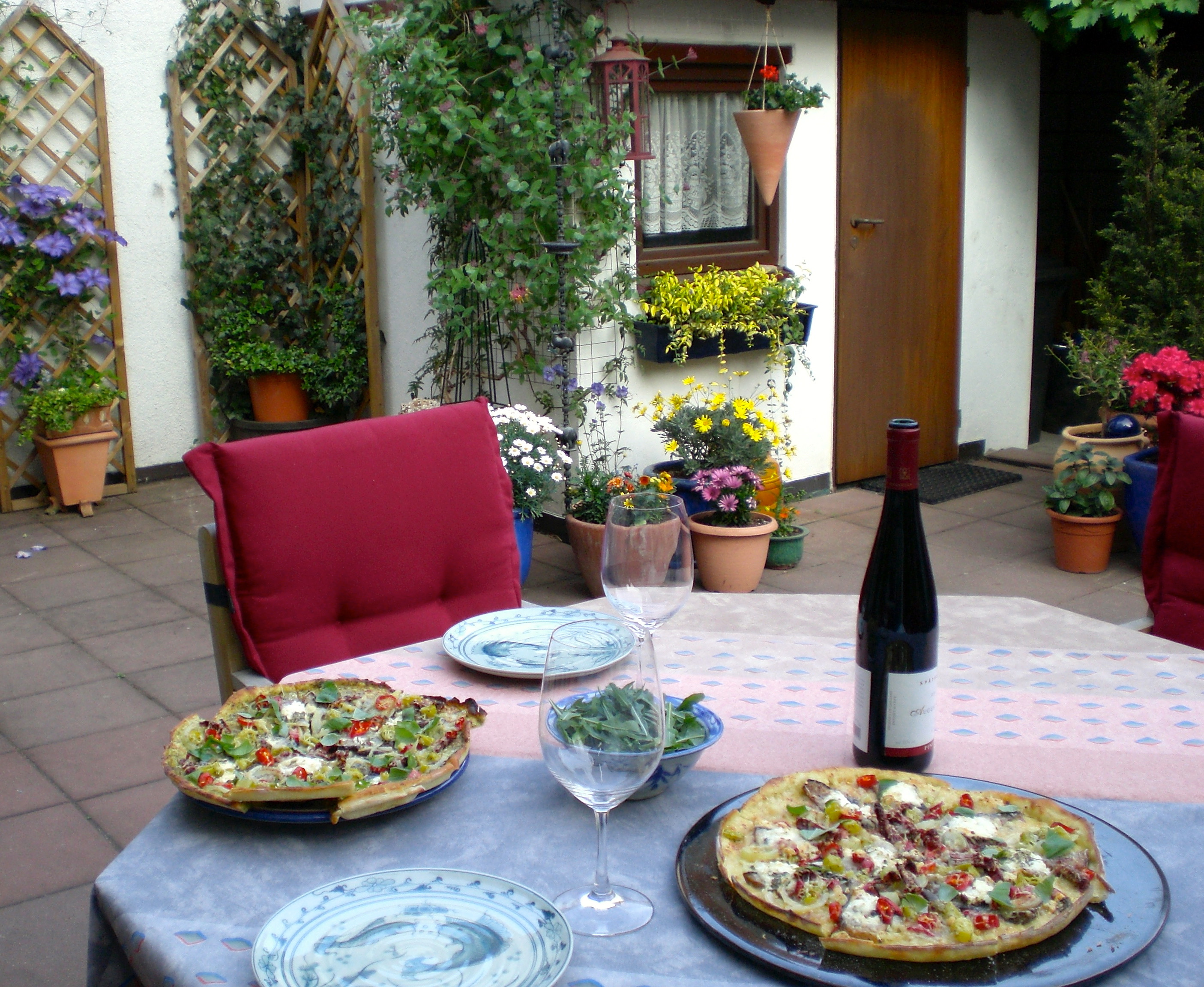
Europeans have well-established dining rituals built into their cultures for centuries. Having lived in Germany and France, memories filter in on this quiet day. When we lived in France dining outside, “al fresco”, occured throughout the year, weather permitting, whether sipping “un café” or “un verre de vin” or enjoying a meal. It is as acceptable to do this alone as it is with friends or family.
cappuccino and wine in Paris, pizza in the courtyard in Germany
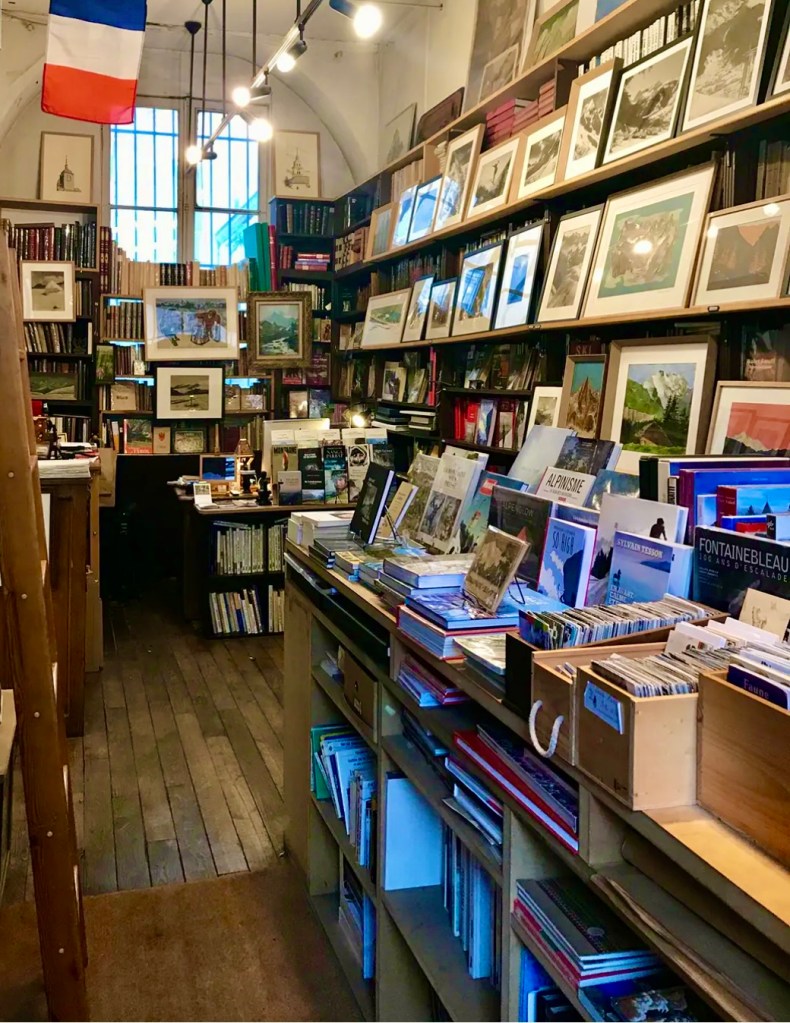
My friend, Michelle, is American/French, married to a Frenchman, Jean Louis. They both own their own businesses. Michelle and her partner are in relocation services with their company, A Good Start in France. Jean Louis took over his mother’s bookstore which started out specializing in rare books on mountain climbing in the 1930’s. Since then, Librairie des Alpes has expanded into books on mountain imagery, guidebooks, rare, vintage, and new books of photos, art, lithographs, and even postcards. It continues to reflect the spirit of the mountains on rue de Seine in Paris’ 6th Arrondissement.
outside and inside Librairie des Alpes
Michelle and Jean Louis live in a charming glass fronted two story house that looks like an atelier [artist’s studio] with so much natural light flooding in. It has a private courtyard outside the kitchen and living room.
welcome home
home courtyard lush with plants and art
Almost every Sunday morning Michelle and Jean Louis walk to the Porte de Vanves Flea Market which is in their neighborhood in the 14th Arrondissement.
flea market wares
After browsing and schmoozing with vendors they have long known, they head home stopping at a local market for lunch ingredients. Theirs is a mixed ethnic section of Paris which offers a rich variety of flavors in food choices in their market. Seasonal fruits and vegetables come straight from the farm, their favorite fish vendor is from Martinique and specializes in spicy, white fish dumplings called “acras de morue”, from the butcher they buy Lyon sausage, the boulanger provides fresh baguette and pastries.
What do I miss about living in Paris? It’s right here–in every local market in every neighborhood throughout the city. Choosing what to eat from the best and freshest ingredients all year long. I miss daily shopping on my market street.
fresh flowers & roasted chickensdessert!
Sometimes I ran into Michelle and Jean Louis on Flea Market weekends. One Sunday, shortly before we left France, I was invited to meet them at 10 AM for a walkabout/browse/pick up a trinket followed by lunch in their home courtyard. In the warm months, lunch takes on the informality of tapas, an assortment of small dishes. Always wine and a basket of sliced baguette.
The generosity of the French table is akin to honoring the spirit of the guests invited for a sit-down meal. Any meal, simple or formal, pays tribute equally to the guest and to the hosts who prepare it. It is a time to gather, enjoy good food, exchange information, share conversation (often politics), and memorable time with others. The art of the debate is encouraged and freely employed. No subject is off limits. This is a centuries-honored ritual of dining à la français.
For our lunch fare, the table was laid with spicy “acras” or codfish dumplings, slices of farm tomatoes with basil snipped from the courtyard garden, shrimp and avocado, cucumber salad with dill and a dash of piment d’espelette, a cheese assortment of buffalo mozzarella, goat, and camembert, smoked salmon, asparagus, roasted red peppers and tuna salad which Michelle spices with lots of chopped shallots and Dijon mustard. [She says French people think tuna salad is exotic because of its inherent American-ness]. A glass of wine, bien sûr.
Sunday tapas
What I remember is conversation that was lively and fluid, a Willy Ronin black and white photo [which I admired and was given as a gift], delicious food to dip bread into, and a host and hostess most charming. This “meal as a ritual of exchange and sharing”, in Michelle’s words, is a perfect reverie on a snowy indoor day. In France, every single sit-down meal is like this, whether sitting with one other person or a tableful of guests. Ah, France.
I believe we replicate this in America, perhaps not daily, but better on our national holidays of Thanksgiving, Christmas, and Easter where traditions and patterns around food are more universal in many families. Religious traditions also claim meal rituals and memories particularly around their holidays.
There are other stories of living in France, many written while we lived there. But today, this one of friends and food and time spent around a table in a cozy Parisian courtyard comes just at the right moment. It is vivid and warms me to the core while I gaze at blowing snow and autumn slides into winter.
Michelle and Jean Louis, chez eux
Michelle often makes a seasonal soup for Sunday lunch. Fresh spinach soup is one of her staples. Spinach is out of season here now, but this is her recipe in simple format to try on your own.
Michelle’s Homemade Spinach Soup
Thoroughly wash and stem 2 pounds of fresh spinach leaves.
Heat olive oil in a large stockpot, add lots of chopped shallots and sauté until wilted.
Peel and chop 1-2 large potatoes.
Add spinach, potatoes, and water or chicken or vegetable stock to the pot. [You can use a pressure cooker if you have one.]
Simmer until spinach cooks down and potatoes are soft.
Using an immersion blender, blend ingredients together in the pot.
Season to taste with salt and pepper and some piment d’espelette. [Espelette pepper]
Serve in a bowl with a little design made with cream or half and half on top.
There is something evanescent, temporary and fragile about food. You make it. It goes, and what remains are memories. But these memories of food are very powerful. –Jacques Pépin
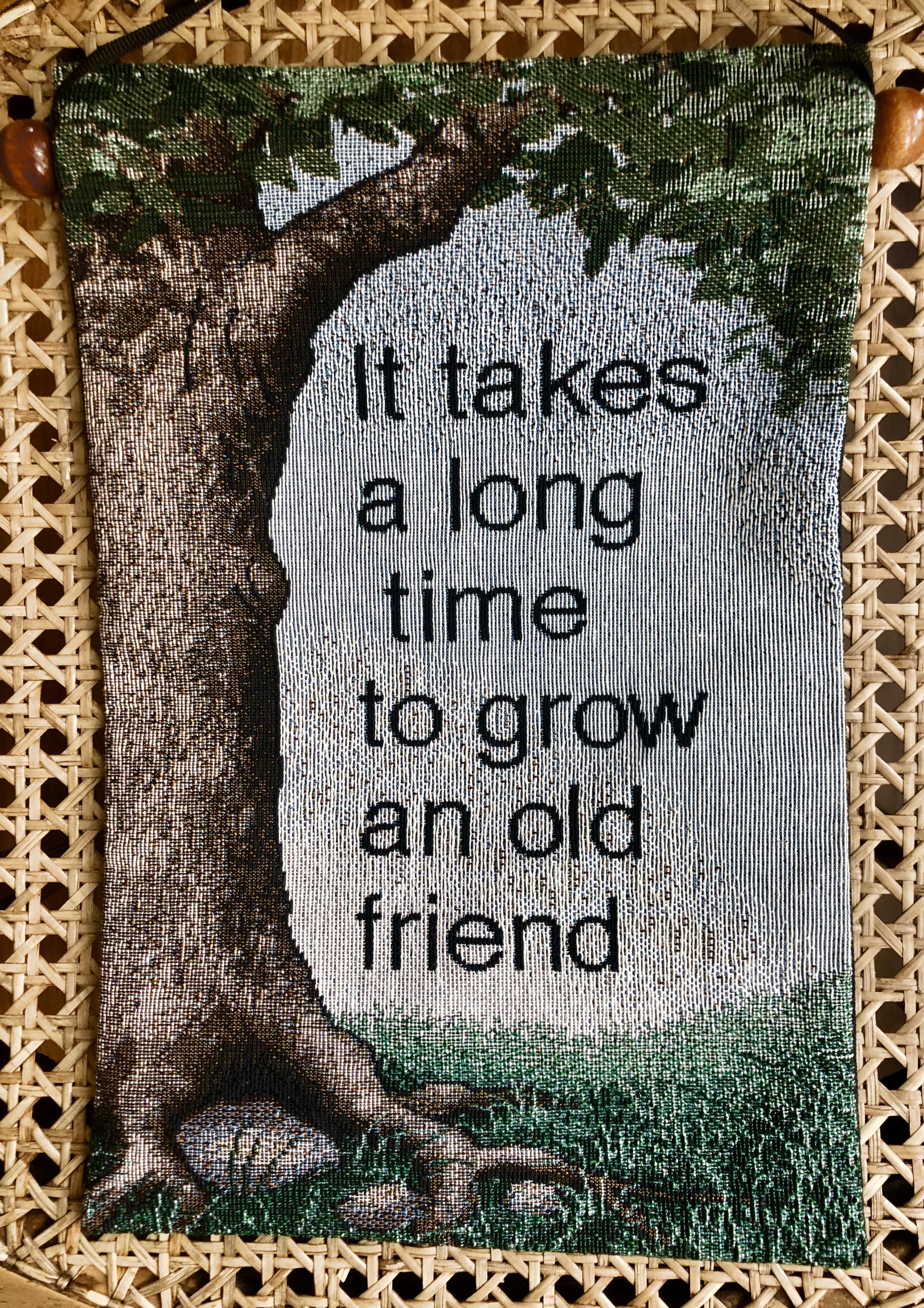
It takes a long time to grow an old friend. –John Leonard
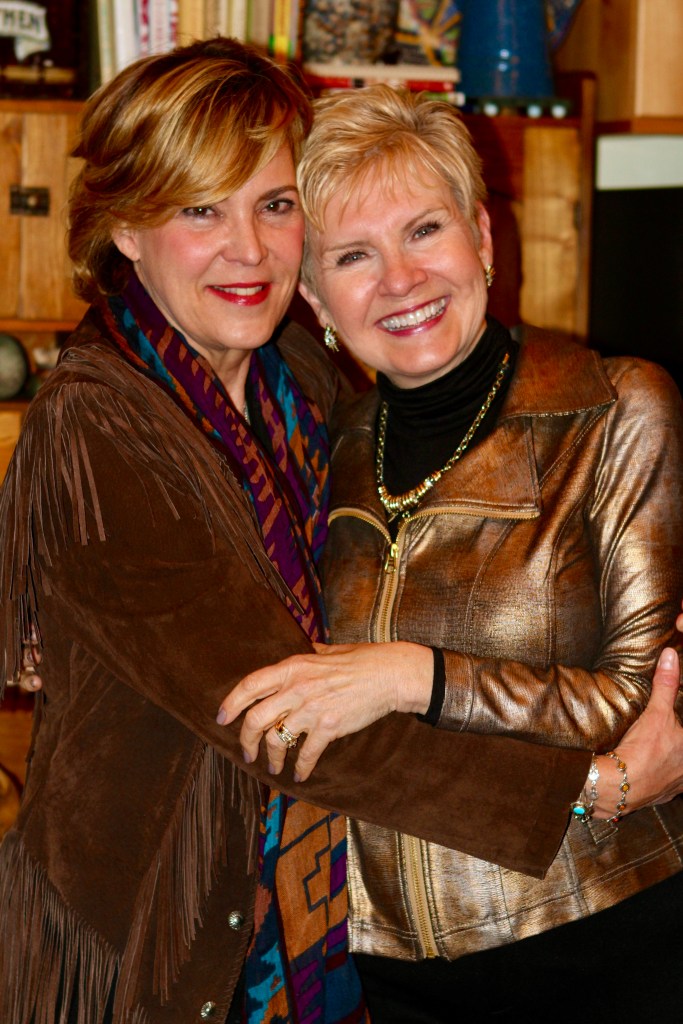
These quotes remind me of the last time I visited my friend Gail in the mountains of North Carolina. Gail is my longest “go to” friend. We met at age 16 when my family moved to a small town in Iowa along the Mississippi River. She balances my analytic nature with kindness and consideration toward everyone. She is intuitive and listens like a compassionate counselor. She knows my eccentricities and loves me anyway. When I was undergoing medical treatments and the rest of my family was overseas, she jumped in to help by coming to Colorado and being with me. We laugh easily and know each other’s stories. Even when too much time has passed, there is immediate ease when re-engaging in each other’s lives. Although we don’t share the same blood, she is my sister too.
sister girlfriends
We didn’t know it at the time we became friends as teenagers but that is when we began living the concept of “growing an old friend”. We were unwavering through the high school years, the university years, summer jobs in the Wisconsin north woods, a western road trip at 21, marriages one week apart, children, and now grandchildren. We haven’t lived near each other for a long time, but we talk on the phone or visit back and forth in our respective states of Colorado and North Carolina as often as we can.
When we were 20, Gail and I worked one summer at a camp for girls on a lake in northern Wisconsin. It was the same year that she introduced me to the man I would marry three years later. She loyally returned from her honeymoon to stand next to me in our wedding one week after I had been a bridesmaid in hers. With husbands, our friendship grew as couples.
The last time I was in North Carolina we spent the entire visit in the Blue Ridge Mountain community of Leatherwood rather than in the city. It was early August and humidly warm in the mountains. Low bluish clouds formed a canopy over and around the green mountains across the valley. It’s a mystical and captivating way to greet each morning. And such contrast to Colorado’s high rocky peaks, golden aspens, and dry mountain air.
blue ridge mountains vs rocky mountains
The food recollections from that visit are so clear. Gail made a pre-dinner apéro by muddling very ripe peaches in the bottom of a glass then poured Vino Verde [a light Portuguese sparkling white wine] over the top. Along with the wine were appetizers of pickled okra [very southern] and small slices of Manchego cheese. Manchego is a firm sheep’s milk cheese with buttery texture and mild taste. It was a perfect combination. The company, the light food, the ambience.
There was one quirky but memorable cocktail hour involving neighbors who invited us to their home. Burdette, a retired architect, 90 years-old, wanted to prepare his own version of “The World’s Best Martini”. Gail’s husband is a bourbon man and politely declined. But the three women–Gail, her sister, and I agreed to try. There was much ceremony involved in the preparation of glasses, the assembly of ingredients, the shaking of equal parts of vodka, gin, AND vermouth. Only one olive allowed per glass. We sipped. It was okay, but what I appreciated most was their living room Rumford fireplace–a tall, shallow, masonry fireplace of European design. They had added a swinging black pot apparatus to cook soup or stew over the open fire. It seemed romantically retro, but I could see myself sitting by a fire that way.
Rumford fireplacewith cooking pot
When in Carolina do as the locals do. Or drink as the locals drink. In many southern states, this means bourbon. Craig, Gail’s husband, is a quintessential bourbon guy. He has his own version of an Old Fashioned. The only time I drink bourbon whiskey is when he makes this for me. A slice of orange, some Bada Bing cherries, two shots of good bourbon, fill with club soda and ice. His daily bourbon is Maker’s Mark. For splurging, he reaches for Jefferson’s Ocean or Woodford’sReserve to sip over ice.
pickled okra, Gail’s glass of white, Craig’s bourbon old fashioned special
The best meal was something new to me. Shredded beef brisket with a smoky homemade sauce. Cooked long and slow in the oven and served as a main course with side dishes of cornbread, beans, and salad–the epitome of southern cuisine. Perfect for guests and great leftovers.
Each day was full–with morning walks before the heat rose to a crescendo, a side trip to Blowing Rock’s boutique shops, outdoor showers with wide-angle valley views, picnic lunch in a park, and noisy Jenga games ending with blocks crashing to the floor amid cries of “Oh no!” and laughter.
champagne picnic–Craig and Gail, Wendy & Tam
showering with that incredible view!
Craig’s handmade jenga set and studying the physics of play
The Carolina mountains have been on my mind recently for a particular reason. Several seasons have passed and now it feels like time to return. To a different climate and different scenery. To those lower, greener hills, and humid misty clouds. To friends who make a difference in my life when we are together and even when we are not.
Jacques Pepin is right about the fleeting nature of food. You make it. It goes. What remains, what is truly powerful, is when we nourish our lives with memories of food in a spectacular setting, in a meal around a table, and taking time to grow the very best of friends.
GAIL’S BEEF BRISKET
Brisket is a tough cut of beef that must be tenderized by long, slow cooking. I adjusted the recipe for high altitude as most food takes longer to cook at 8300 feet where we live. My edits are in parentheses. The secret to this recipe is the sauce. Shredding the cooked brisket rather than slicing it eliminates the fat layer, leaving only the lean.
INGREDIENTS:
5-6 lb brisket [I have used smaller]
Salt and Pepper
Liquid Smoke
Place brisket in baking dish with fat side up. Rub salt and pepper and liquid smoke onto both sides of meat. Cover with foil and seal edges of pan. Marinate 12 hours or overnight in the refrigerator.
pouring liquid smoke over and rubbing with salt & pepper
NEXT DAY:
Preheat oven to 275 degrees F.
Place sealed baking dish in oven for 5 hours.
[Better than timing is to test with a meat thermometer as it will take 2 or more hours longer at higher altitudes. Internal temperature should reach 200 degrees F.]
When meat is tender and done, take two forks and shred onto a serving platter.
Discard the fat layer.
Pour sauce over or serve in a pitcher, on the side.
Serve brisket on buns or as a main course with side dishes.
Leftovers are easily reheated and just as delish.
shred brisket with two forks, discard fat, serve with side dishes, pour sauce over the top or serve on the side
FOR THE SAUCE:
2 C. catsup
½ C. water
3 T. Liquid Smoke
4 T. Worcestershire sauce
8 T. butter
3 T. brown sugar
3 t. dry mustard
2 t. celery seed
¼ to ½ t. cayenne pepper
In a saucepan, slowly heat all ingredients together while stirring.
Your home has to be a refuge, the place you come back to after the world has done all the things it has done to you, where you can be truly yourself, power out, refuel. It should feel good every time you walk in the door. –Amanda Dameron
One year into the Covid-19 pandemic, where spending more time at home has been the norm, the importance of home space, how we create it, how we live in it, what it means, seems a timely topic.
Quarantine has redefined the rhythms of life at home. It has provided different ways to think about and use space. It’s not only about structure, but also light and air, comfort, privacy and intimacy in a place where we can safely talk, think, do, or just be.
colorado cabin, by elizabeth zareh, 2020
…as a child, I always wanted to be in other people’s houses. Now, though still fascinated by those other houses, I am only really comfortable and relaxed in my own. My house is like a garment, made to my exact measurements, draped around me in the way I like…–Margaret Forster
My interest in houses and interior spaces began in childhood. In a small town suburb of a mid-western city, my mother would pile my younger sister and me into the backseat of the station wagon whenever she visited a friend outside our neighborhood. I never refused to go. I knew we would drive past a certain house, on curvy Big Bend Road, where my imaginary friend Cindy lived. And every time we drove by, I said aloud, “Look, there’s Cindy’s house!”
Imaginary friends weren’t an option–they were essential. –Emory Ann, 23 Things Only Children Know to be True
I made up this friend, gave her a name, and pretended to call her on the phone from the car because there was something I loved about that particular house, shaded by tall trees on a curved lot. I wanted to run to the door and be invited to play with a friend who didn’t exist. In my eight-year-old mind, I even imagined living in this cottage-like home with people I didn’t know.
Like the body itself, a home is something both looked at and lived in.…it is an image, an idea, a goal; perhaps as it was for my mother…it has filtered down to me.–Rachel Cusk
It is common to find a family link in people who care about how they live, what their space looks like, how it feels to others. Often it begins in an environment during childhood, emulating a relative’s sense of design and comfort in the home. Sometimes it comes from other early life experiences.
I spoke with a sampling of family and friends about how their interest developed in creating a home that both nurtured them and resonated with others. I asked for a recollection or anecdote when they knew that space, of a certain style, just so, would be important for the rest of their lives.
Responses varied from a childhood obsession for re-arranging furniture in a tiny bedroom until it felt right, to sewing curtains, bedspreads and pillows to create a signature space. Others spoke of a fascination with miniature rooms in doll houses, or a teenage bedroom on the top floor of a Victorian house with a sink built into the closet, or annually setting up a primitive cabin in a summer boys’ camp.
My friend Marilyn Larson wrote a beautiful memory about playing with her younger sister on the family farm in southern Minnesota. In a small grove of trees, they carefully raked the ground and removed debris in preparation for setting up rooms for a home. Each room was given a name designated by purpose, furnished with orange crates, lumber, or broken implements scavenged outside the barn. Sometimes they played “restaurant” by setting up a counter on a long plank of wood dragged from the junk pile, accessorized with broken dishes. They served homemade “mud cakes” and tried to entice their brother to buy one.
My brother-in-law Erik, a professional designer, has two memorable stories. The first was when he carved the skyline of New York City into the pine headboard of the bed his father had just built. Only six-years-old, using pointy scissors and ballpoint pens as primitive tools, he was proud of the creation of what he thought New York might look like. His parents were not impressed. He also secreted clear plastic food containers from the kitchen to an empty neighborhood field where he spent hours constructing houses, buildings and towns in the open, weedy landscape. His mother had no appreciation for this either. But he was onto something that evolved into a life of designing and building sets and spaces for theater, television, and corporations.
Frank Lloyd Wright, whose work organically synced with nature, was influenced by space as a boy. His schoolteacher mother bought a set of educational blocks created by the German educator, Friedrich Froebel. These geometrically shaped blocks were designed to teach children about form and relationship to nature. Wright remembers being fascinated by them, assembling shapes and compositions for hours at a time. He credited them for kindling his creative mind toward architectural design.
…there is no true understanding of any art without some knowledge of its philosophy. Only then does its’ meaning come clear.–Frank Lloyd Wright
Considering houses as art forms, Wright suggests that to really understand them they should be viewed philosophically. But it was a book by Gaston Bachelard that first started me thinking about houses metaphorically.
Gaston Bachelard [1884-1962] was a French philosopher from the last century. His idea of the house as poetic space that holds memories and opens portals to dreams and imagination is timeless.
Bachelard uses the image of houses “as a tool for analysis of the human soul”. Simplified, the house is the container that shelters our body, which is the container for our inner life. To access inner life requires daydreaming. In order to daydream we need solitary time. With solitary time, we learn to love “the space inside us”, the creative dreaming place. Learning to happily “abide” within ourselves while in the shelter of the house is poetry, because the house is in us as much as we are in it.
What does this mean?
The house, a physical space, provides shelter for us to dream and make memories. These dreams and memories are held in our unconscious, a metaphysical place. Remembering dreams is easier with connection to an actual space. When the house offers places to curl up, in solitude, such as nooks and crannies, window seats, attics and garrets, one’s own bedroom, there are built-in places to think and dream and create. The circle of house around us housing the soul within us is poetry.
Bachelard says children must be allowed time to daydream. They need to learn to love being alone and, at times, even bored. Solitary time opens and invites new thinking in unexpected ways–just as poetry does. Time alone teaches children to live within themselves, too. Inside their daydreams is where they experience the immensity of imagining worlds within worlds.
The house protects the dreamer. The houses that are important to us are the ones that allow us to dream in peace. –Gaston Bachelard
The house you were “born in” is your first space of material warmth, protection and rest. It is imprinted in a place in the subconscious that you may or may not return to in dreams. If we dream about houses they are often not easily described by words. There’s where the poetry comes in.
In the house I was born into, my older sister had the best room. Her bedroom was underneath the roof. To the right, at the top of the stairs, was an aromatic cedar closet where seasonal clothes were stored. To the left, down a narrow hallway was the door to her room. The walls and ceiling were honey colored pine and the ceiling angled like a triangle from the peak. Low walls ran along both sides with cubbyhole doors that hid spaces further under the eaves. There was a tiny closet with low hanger bars and a narrow shelf for folded clothes. The only window opened to a flat roof over the front porch. It was forbidden to go out there because you might “fall through” the unsupported porch ceiling. But I learned that my sister crawled out the window to climb onto the higher roof and [secretly] smoke with her friends.
When she was away, I lay on her bed, stared into the peak, re-arranged the furniture in my head, and imagined how I would live if this were my space. Eventually I had a claim to the coveted room when it was time for her to go to university. But then my father took a job in a different state. And that perfect bedroom nest, which I never fully inhabited, still recurs in my nighttime dreams. [With the addition of a bathroom through the back wall of the closet invented by my subconscious.]
Our house is our corner of the world…it is our first universe. If looked at intimately–even the humblest dwelling is beautiful.–Gaston Bachelard
All inhabited space is essentially the notion of home. A house doesn’t necessarily have to be the shelter opening the doorway to creativity and dreaming. A hermit’s hut, a childhood bedroom, a tent in the woods, the car on a road trip, a favorite hike, a deep soaking bathtub, a tree next to a river–places where we can be alone are also conduits to accessing “inside” spaces where we think and dream and create. Even the humblest, most primitive space can be this place.
You have to filter out stale ideas that your mother gave you about how you should live, or what you should have in your space. Does it have to do with you, or not?–Interior designer, New York Times
My mother had a knack for making houses into homes. She intuitively knew how things should be arranged and was true to her own tastes for creating comfort in the places I grew up. She was on the sidelines with advice as I began experimenting with my own living spaces.
The time came when we both realized that choices going forward needed to be mine and not hers. One birthday she gave me a clear glass ginger jar lamp stuffed with white seashells. The shade had accordion pleats the color of beige sand. I didn’t say I hated it, but it had nothing to do with me. It was her idea of a cool accessory. So I diplomatically said I didn’t want a lamp as much as I wanted a professional bread knife with serrated edges. She kept the lamp. I got the knife. Future gifts were checks.
My first apartment living alone was in Madison, Wisconsin on the top floor of a house across the street from Lake Monona. It had a glassed-in porch that looked into trees on the lake shore. The bed was a saggy mattress on top of bouncy coil springs hauled down from the attic one floor above. I arranged green trees and plants for window treatments, hammered Indian cotton tapestries to the walls to hide plaster cracks, and covered splintery floors with funky patchwork rugs. There was no bedroom door so I tacked up a curtain of wooden beads that clinked and swayed in long strands. It was perfect.
Marriage followed with several changes in geography in the U.S. Eventually we made the decision to move overseas. Different stories accumulated while living in five countries over the next 30 years. Apartments or houses in Singapore, Cyprus, Taiwan, Germany and France were woven together by the layout of affordable space that fit our family and by treasures we collected from each place we lived. There were always challenges while adapting to a new job, unfamiliar languages and cultures. But whatever the outside world threw at us, when we crossed the threshold of each dwelling we breathed in familiar sights and scents. It was our space, our comfort, our sanctuary, our home.
courtyard and house in oberursel germany, paris apartment in 16th arrondissement
My artist friend, Catherine Ventura whom I met in Taiwan, said it best, “I make familiar spaces in unfamiliar places.” We all did.
The ideal of happiness has always taken material form in the house, whether cottage or castle. It stands for permanence and separation from the world.–Simone de Beauvoir
Frances Schultz recovered from a failed relationship and missteps in mid-life by buying and renovating a tiny dilapidated cottage with good bones. She wrote a therapeutic memoir, The Bee Cottage Story, about healing herself with the power and creativity of making a beautiful home.
There are no rules about how a house becomes a home. It requires thought, time and attention, and putting your stamp on it by living in the space. As far as decorating, Schultz advises intuition; “If it feels right, it probably is. If it doesn’t, it isn’t. Instincts are not wrong. Ignoring them is…when a space is right for you; there is an instinctive response to it–an intuitive sense of how you would live there, where your things would go, what you would keep, and what you would change. It’s a project, not a struggle.”
Ruth Bender, a long time friend, wrote these thoughts; “Making a home is a mentally engaging and creative gift to oneself. It is an expression of love to those we are lucky enough to actually be with and to those dear ones who are gone or far away.”
Houses that become homes are like a poem. They have structure that represents how we want to live in the world. They shelter our feelings for people and surroundings we love. And if the home is nourishing to the soul and allows expression of the “inner self”, then we are fortunate to have created our own poetry of space.
…believe that place is fate. Where you are is who you are. The further inside you the place moves, the more your identity is entwined with it. Never casual, the choice of place is the choice of something you crave. –Frances Mayes
smoky mountain views in RMNP [drone photo by Jeremiah Green]
To say it has been an atypical summer in the mountains is an understatement. Forest fires burning around us since July, ash and haze obscuring mountain outlines, no rain in three months, statewide fire ban, surging global pandemic, and a lack of visitors except for children and grandchildren.
playing with sticks around the unused fire ring, bro/sis time before bed
rocks and a river
I’m more than ready for next season’s return to normalcy if it works out that way. By ready, I mean that I have three exceptional recipes to satisfy the sweet tooth of any person or group that drops by, sits around a campfire, or stays overnight.
idle campfire ring [drone photo by Jeremiah Green]
Maddy’s Caramel Bars, Patricia’s Double Chocolate Brownies with Sea Salt, and Jean’s S’mores Bars are unbeatable for chewable bites of sweetness cut out of a 9×13 inch-baking pan.
As all great passed-on recipes should be, these come from stories about friends.
Last summer’s road trip in 2019 was to Maddy and Cabby’s cabin on the Methow River [A Guest Room Under the Porch] in eastern Washington State. Maddy is a great cook and hostess. Their log home, with overflow teepees and tents, is a revolving door of family and friends. She offered us her always-on-the-counter pan of caramel bars and said, “Try these. People love them! They are my go-to for company all summer long.” We sampled and agreed. Caramel bars with chocolate chips and pecans were prepared over and over for our own guests, with rave reviews.
cool completely before cutting
Patricia, whom I have written about in several adventures, Cocoa Cake With My Curry, Please, Sunshine on the Back of Your Knees] vacationed in Colorado in August. She rented a cabin bordering on the National Park just down the road from us. The double chocolate brownies she brought to our front porch originated from a friend in Wisconsin. Richly chewy, with texture from chocolate chips inside, these brownies are for every chocoholic. I switched out the garnish of powdered sugar for flaky sea salt sprinkled over the top. Et maintenant ç’est plus délicieux. Chocolate and salt can’t be beat. Except by caramel and salt. Or almost anything with salt.
double chocolate brownies with sea salt
The last recipe came onto the scene this summer because of the harsh no burn season. We invited neighbors for a socially-distanced outdoor cookout around the fire ring. S’mores were requested for dessert. Except a campfire couldn’t be lit. Our friend, Jean, came bearing S’mores Bars baked in the oven and cut into bite-sized squares. These are even better than real s’mores, which often feature charred marshmallows blackened over red-hot coals.
With baked s’mores you can revisit the original in one chewy, not overly sweet, bite of marshmallow and chocolate chip cookie dough over a graham cracker crust. There is melted chocolate on top so licking fingers is required. I substituted dark chocolate for traditional milk chocolate. [S’more better.]
baked s’mores
I’m anticipating the return of a next summer’s season of sequential guests. This winter while I drink coffee next to the picture window with the wide angle view of Long’s Peak, I will muse about the return of daily summer afternoon rainstorms followed by rainbows, campfires by sunrise, sunset, or moonrise, and baking pans full of dessert bars to sweeten everything that happens in between.
CARAMEL BARS [Maddy Hewitt]
First Layer:
1 C melted butter
1 C flour
1 C oats
1 C brown sugar
1 ¼ tsp baking soda
Combine dry ingredients in a bowl. Pour melted butter over and mix in. Reserve ¼ of the mixture for topping. Pat the rest into bottom of a 9 x 13 inch baking pan. Bake 15 min. at 350 F. Cool 5-10 min.
line up of ingredients, first layer pressed into bottom of pan
Second Layer:
1 bag Kraft Caramels, wrappers removed
3 ½ Tbs butter
3 Tbs cream [or Half & Half]
Melt all together, SLOWLY, in cast iron skillet over low heat. Stir constantly. When melted, pour over cooled crust.
Third Layer:
1 C semi sweet chocolate chips [or dark chocolate chips]
¼ to ½ C pecan pieces
Mix together and sprinkle over caramel layer
reserved crust mixture for 4th layer is sprinkled over top of chips and pecan layer
Fourth Layer:
Using reserved crust mixture, sprinkle over the top of chips and pecans
Bake 10 min. more at 350 F. Allow to cool completely before cutting. Store in tins. Freezes well.
caramel bars
DOUBLE CHOCOLATE BROWNIES WITH SEA SALT FLAKES [Patricia Green-Sotos]
4 oz. unsweetened chocolate
1 C butter
2 C granulated sugar
4 eggs
2 tsp vanilla extract
1 C flour
12 oz semi-sweet chocolate chips
1 ½ C miniature marshmallows
Flaky sea salt crystals
ingredients for brownies with sea salt
Melt chocolate and butter slowly in a saucepan over low heat. When melted, add sugar and set aside to cool slightly. Beat in eggs, one at a time. Stir in vanilla and flour. Mix well. Fold in chips and marshmallows.
melting chocolate and butter over low heatbeat in eggs, add chips and marshmallowsspread into parchment paper lined pan, sprinkle with sea salt after baking
Bake in a parchment paper lined 9 x 13 baking pan [or grease the pan] for 30-35 minutes at 350 F. Top may be bubbly. Don’t overcook. Sprinkle with sea salt flakes and cool completely before cutting. Store in tins or plastic ware. Freezes great.
S’MORES BARS [Jean Adam]
Crust:
1 ½ sleeves graham crackers, crushed with rolling pin in zip-loc bag
2/3 C melted butter
1/3 C granulated sugar
Mix together and press into bottom of 9×13” pan lined with parchment paper. Bake 7 min at 350 F. Cool slightly.
crushed graham cracker bottom layer
Cookie Top:
1 C butter softened to room temperature
¾ C brown sugar
¾ C white sugar
1 tsp vanilla
Cream together. Add:
2 eggs
Stir in:
2 ¼ C flour
1 tsp salt
1 tsp baking soda
Mix in:
1 C semi-sweet or dark chocolate chips
2 ½ C mini marshmallows
drop clumps of cookie dough layer over crust, then gently press to sides of pan
Drop by large spoonfuls of dough carefully over crust and press into graham crackers without disturbing the layer underneath. Bake 15 min at 350 F or until golden brown on top. Quickly remove from oven and cover the top with broken pieces of Hershey’s dark chocolate bars. [2 large ones or 3 small]
Return to oven until chocolate melts ~ 3-5 min. Don’t overcook or let the top get too brown.
place broken chocolate bars over baked cookie dough layerheat in oven just until melted
Cool completely before lifting parchment out of pan and cutting into small squares.
Refrigerate to slightly harden. Freezes well.
Summer’s End…
“It was now one of those moments when nothing remains but an opening in the sky and a story–and maybe something of a poem.” –Norman Maclean, “USFS 1919-The Ranger, the Cook, and a Hole in the Sky” from A River Runs Through It
Many of the most rewarding relationships in my life are friendships formed when we lived in Asia, the Mediterranean, and Europe. Our family friendship with the people in this story, Nancy, Maddy, and Cabby, began in Taiwan in the 1990s. We forged relationships in the midst of howling typhoons and bed-shaking earthquakes, during Thanksgiving pig roasts, in delivery rooms birthing babies, on hillside picnics with roaming water buffalo [transcendent-picnics], at uncountable dinner parties in each other’s homes, and on apartment rooftops.
In 2018, we decided to have a reunion in Greece. Shortly before Easter, Nancy flew from New York to Paris where I was living. Together we traveled to Athens where Maddy and Cabby are now living.
In Greece, we shed our Asian history and jumped right into a mix of antiquity and contemporary adventures. As we climbed to the rooftop of their home, the Acropolis and Parthenon appeared stage center before our eyes. Hellooooooo Athina.
Acropolis and Parthenon, Athens 2018
Mornings began with breakfast carried to the roof–an image imprinted forever in my mind. Strong French-pressed coffee, a bowl of Greek yogurt with sour cherries spooned on top, a basket of buttered toast, hardboiled eggs. And that view…
chop checks out petit dejbrekkie with a view
streetscape on the plaka, athens
top of the acropolis, wendy, nancy, maddy
seaside, temple of Poseidon, nancy, wendy, maddy
Family and holiday traditions are often a shared experience with friends overseas. During the Taiwan years, when our children were young, Maddy and Cabby hosted an annual family-centered party at Easter time. Eggs, dyed and decorated, were hung from dried branches standing upright in a tall vase to form a colorful egg tree. Multiple families were invited. There was food and a ceremony involving candles and a song. Then the eggs were selected from the tree, one to each person, and taken home in carefully packed containers.
Twenty-five years later, Cabby was in the final phase of decorating 60 eggs hanging over the second floor balcony. I don’t mean simple-dipped-in-one-pastel-color-dyed eggs. I mean Eggs As Art.
sample of the 2018 egg line up
last step–lacquering
In the 1990s, decorating small bare tree branches as “Easter Egg Trees” became popular in the United States. In the Tennis/Hewitt family, the first egg tree was produced in Cambridge, Massachusetts when their first-born, Liza, was a toddler. It consisted of a single branch decorated with a few colored eggs taken to a party of graduate school friends.
Following graduate degrees and the birth of a second child, Maddy and Cabby moved to Taiwan. In succeeding years, their egg tree tradition was shared with international school families from Taipei, to Cairo, to Johannesburg, to Saudi Arabia.
Watching the tradition unfold in Athens, I realized that an important annual event, merged with artistry, had created outreach and a ripple effect in international relationships. Families from different countries and cultures invited to the Egg Tree celebration often carried it forward. They began new traditions that passed on beyond the Tennis/Hewitt family.
Maddy inspires action. Cabby implements details. It’s one of the ways they complement each other. Together they prioritize the importance of nurturing the family they created with lasting traditions.
maddy inspires
cabby implements
Cab also has a knack for research and prototyping. Since crafting the first egg tree, he experimented and fine-tuned the “how to” process of taking a raw white egg and turning it into something spectacular. The steps from A to Z are not for the impatient or the faint of heart. But, the results are dazzling.
In the beginning, there was trial and error. He blew out the egg interiors as a first step only to realize that empty eggs don’t sink in bowls of dye. There was year-by-year evolution, advancing the dyeing/waxing techniques used today. For example, randomly splattered candle wax creates only one type of pattern underneath–spots. So Cabby made small tools from toothpicks and wooden skewers that allow painting stripes, swirls, and even plaid patterns onto the shell with hot melted wax. Complexity and depth magically emerge after rounds of dyeing/waxing/dyeing/waxing on a single egg. Each egg reveals a surprise ending.
The bleaching process arose from a mistake of leaving an egg too long in one dye. Because it turned an ugly dark color, he wondered why not lighten it with bleach. A new step was added when he discovered bleaching enhanced the depth and range of dye colors.
Growing up overseas, the three Tennis children spent time around the table with their parents learning the egg dyeing craft. One Christmas, when they were older, each of them received a complete supply kit with containers, dye packets and tools to build their own egg tree and carry on the tradition after leaving home.
Oldest son, Whiting, took on the challenge first as a university student. Now married and teaching in an international school overseas, he produces spectacularly decorated eggs and invites faculty families to participate in the Egg Tree Party.
2020 egg tree
After leaving Athens, I thought about the generosity of sharing this family-centered tradition all over the world and how comfortably it links people together in international communities. Cabby and Maddy exemplify a natural ability to build and create inclusiveness in every one of their relationships.
The Tennis Family Egg Tree Tradition is one way their family has fostered love and respect in their global and personal family and friends network. It begins at home with a circle of people gathered around a bare branched tree covered with kaleidoscope colored eggs.
I’m reminded of the ending to the movie Annie Hall. The main character muses about the nuances of relationships, suggesting they are sometimes irrational, usually complex, and often absurd. He tries to sum up his feelings with a joke:
…A guy walks into a psychiatrist’s office and says, hey doc, my brother’s crazy! He thinks he’s a chicken. The doc says why don’t you turn him in? The guy says, I would but I need the eggs.
And, he’s right. We strive to hold onto each other in love, support and caring, because, actually, all of us…need the eggs.
This is the definitive “How-To” for dyeing and decorating eggs in the Tennis/Hewitt tradition. Instructions are by Cabby Tennis. There is minor editing on my part for clarity.
THE TENNIS FAMILY EGG TREE
WHY GO TO ALL THIS TROUBLE FOR A FEW COLORED EGGS?
It brings family and friends around the table working creatively together.
There is hands-on learning––coordination, art, safety, chemistry, physics, perseverance, patience and the final “wow” factor with each finished egg.
There is grace and humility in overcoming a “Humpty Dumpty” moment of loss on the kitchen floor.
Cover surface of worktable with taped together garbage bags, a vinyl tablecloth, or shower curtain liner. Layer of newspaper on top absorbs spills. Do not work over carpeting! Outside picnic table is ideal.
Set up table with plastic gloves, liquid dye containers, plastic spoons, eggs, paper towels [pre-torn into a stack of single sheets], empty egg cartons, waxing tools [explained below], 3 bowls for bleach and rinse water, candles for waxing, small saucepan for hot melted wax, scissors, pen, scotch tape.
the set up
EGGS – Unstamped white eggs are best. Large [not XL] range free eggs tend to have stronger shells. Rinse under water–no soap. Eggs are dyed raw because they are heavier and will sink. Blowing them out comes later.
CONTAINERS FOR LIQUID DYES – Any glass jar [preferably with lid] such as jam jars, canning jars, etc. One plastic spoon per jar to prevent color mixing as eggs move between dyes. Leftover dye can be kept year to year, so save the jar tops. If not enough jars, use water glasses.
one spoon per jar, labelwith dye color, keep the lids
DYE MIXING – 1 packet powdered dye diluted with ¾-1 cup boiling water. Add 1 T. white vinegar. Apple or grape vinegar is ok. (Exception: No vinegar for orange dyes because they will curdle.] Follow package directions for diluting liquid concentrate dyes. Cut off color name from dye packet and tape on jar for reference.
WAXING METHODS
Partially used taper candles set into aluminum tea candle base for dripping or sprinkling wax over eggs.
A small saucepan with hot melted wax to use with tools [see below] or for complete immersion of egg into wax. Leftover candle remnants can be melted over low heat in saucepan on stovetop, camp stove, or hotplate. If no candles at home, purchase 2-3 thrift store pillar candles [any color] as melting base.
old candles to melt down, saucepan with solidified wax ready to heat
WAYS OF APPLYING WAX – Time to get creative. Holding a lit candle above egg, drip or shake/splatter wax onto shell. You can also use tools made from several toothpicks or split bamboo skewers bound with rubber bands to paint on wax. Repeatedly dip wooden tool into melted wax in saucepan, then touch or tap the egg with the tool. Egg color underneath the wax will be preserved and not take on next dye color. This is how you create different color patterns by waxing stripes, dots, or splatters on the dry egg. The number of colors on the egg depends how many times it goes through the cycle of 1. Wax 2. Dye 3. Dry.
candle set up for waxing, wooden tools made from toothpicks and skewersresults of using waxing tools
DUNK DYEING – Place waxed egg into any dye jar, then remove and gently dry with paper towel before waxing on a new layer of stripes or splatters. Repeat sequence as many times as you wish. Each wax application retains the color underneath it. Dyeing sequence is from light colors to dark. Begin with yellow [or any light color] moving toward darker colors each time you 1. Wax 2. Dye 3. Dry. Creativity and patience are keys to this technique.
BLEACHINGas part of the dunk dyeing process – An optionalbut effective way to reverse the usual light to dark dyeing sequence. Bleach lets you cut through any final dye color [even black] that is un-waxed on the egg. Once the dark color is bleached, a lighter color can be dyed over it. This takes deft handling. Three bowls recommended. One with 1 part bleach to 2 parts water, and two [or 3] rinsing bowls with plain water. Dip the egg into bleach solution. Then move it through the rinse cycles, swirling thoroughly through each bowl. Egg continues to bleach with each step. Dry with paper towel. Note: The bleach will creep under some of the wax edges so be quick with the steps. You can do several rounds of 1. Bleach 2. Rinse 3. Dye 4. Wax 5. Dye and then repeat.
POWDER DYEING – This is a simple and efficient one step method to achieve beautiful eggs with the look of Monet water lilies or a ‘60s tie-dye experience. Eggs must be moist after soaking in plain water or liquid dye. Use leftover powder remnants [from envelopes used to make liquid dye] or open new ones specifically for this technique. With previously opened packets, write the color name on the outside to identify the powder inside.
METHOD FOR POWDER DYEING – Wearing clean, dry gloves lift a wet egg from bowl and hold each end between thumb and fingers. Tap the powder dye envelope against the egg to sprinkle grains onto the moist surface. Upon contact they will explode into fireworks shapes. Turn the egg and keep applying powder until it has the look you want. Use different colors, but be careful of combinations. Red, green and blue used together will turn brown. When desired color is achieved, quickly pat dry and immerse in saucepan of hot melted wax to seal. Or splatter with candle wax.
results of powder dyeing
DE-WAXING EGGS – Wear gloves. Place used candle stubs or pillar candles into small saucepan over low to medium-low heat on stovetop. You need enough wax to completely immerse an egg. Have a stack of prepared paper towels nearby. With a slotted spoon, lower egg into the pan and stir gently, watching for wax coating to loosen and shed. [Stirring speeds up wax removal.] When the coating is clearly melted, add a second egg to the pan and lift first egg out. Rub loosened wax off first egg with paper towel. It should feel smooth with no rough spots and have a shiny patina. When wax in the pan starts to film over, time to re-heat on low temperature.
Safety note: Heat wax only until it liquefies. If it starts to smoke, it’s too hot and should be removed from heat.
Economy note: Place the saucepan of wax in the refrigerator overnight. The solidified wax will pop out the next morning. Store for re-use the next year.
BLOWING OUT THE EGGS – Use a bellows type egg blower. Good source: BestPysanky Egg Blower. With the awl that comes in the kit, make a hole in the exact bottom of egg the size of a wooden kitchen matchstick. The bellows pumps air in and forces white and yolk out the bottom hole. Be gentle. Take your time. Too much pressure and egg can explode. Use a paper clip or thin wire to break yolk or un-jam clogs as needed. Do this in rounds, about 10 eggs in a round, letting each egg sit upright between rounds so gravity can help the insides move to the bottom. Next, do a “gravity shake”. Holding egg upright in fingers, firmly and repeatedly whack your wrist against the tabletop onto a paper towel. When drips emerge from bottom of egg, blow it out again. Repeat until nothing comes out of egg and it feels light and empty. Finally, carefully use the awl to make a hole the size of a thick paperclip in the top center of egg. This is where knotted string will be attached later.
sample of egg blowing apparatusbellows extraction of egg interiorgravity shake to aid final removal of yolkBest Pysanky egg blower, extracting yolky interior, gravity shake to move the last bits down
BAKING THE HOLLOW EGGS – This removes the final film of wax and bakes inside of eggs to prevent spoiling. In a preheated metal pan, place 6 eggs at a time on their sides. Make sure both ends of egg are open and unplugged or egg can explode in the oven. Bake at 350 F for 4 minutes. Watch carefully so they don’t burn. Remove from oven and cover pan with foil or kitchen towel to retain heat. Place next pan of eggs in to bake. Quickly rub each baked egg with paper towel to remove any wax residue before it cools.
the ever-ready stack of paper towels, a baking disaster
STRINGING THE EGGS – Use thin string such as dental floss or embroidery thread. Tie a knot and create a loop where the size of the knot barely fits inside top hole of egg. Hold the knot against the hole, and gently push it inside the egg with a paper clip. Expand hole with the awl if necessary. Line up strung eggs for gluing. One by one squirt a tiny dab of super glue into the hole. This affixes knot inside the egg. Let eggs rest on their sides [string parallel to table top] while glue dries. Avoid getting too much glue on the string above the egg as it will dry stiffly and can snap like a twig over time.
loop, knot, squirt of glue, dry in side lying pose
HANGING AND FINAL CLEANING OF EGGS – String a rope where eggs can be suspended at least 6 inches apart. Use large paper clips or loops of wire to attach eggs to rope. If inside the house, place drop cloths below to catch drips. Wear gloves and use a soft cloth to gently wipe each egg all over with paint thinner [white spirits in Europe]. Dry with another soft cloth to remove any residual wax. Let stand for 30 minutes. This step speeds up drying time of the lacquer.
LACQUERING THE EGGS – Use clear polyurethane [Varathane] or Spar Varnish to seal eggs and enhance colors with a durable finish coat. Varnish can be satin or gloss finish. [Cabby prefers gloss.] Dip fingers into the urethane and rub each egg, coating from top to bottom. Dab off accumulated drips with paper towel. Lacquer can take 1-3 days to dry. Eggs kept year to year can be re-lacquered annually. The Tennis family has one egg, “Jungle Book”, with over 15 coats and a deep hard shine.
NAMING [Optional, but great fun] – Give each egg a creative name–something it reminds you of. Examples from the 2020 collection: The Duke of Earl, Violet Sultana, Jigsaw Cyan, Fly Like an Eagle, Calypso, Sgt. Pepper, Tetherball, Clouds of Mercury, Purple Reign, Gilly Spring
kaleidoscope eggs
BEST EGG TREES – Made with dry sticks or branches with many limbs. Bougainvillea branches are excellent. Bind branches with string or zip ties and place in a large vase or container, preferably metal. Fill with rocks/pebbles to keep branches secured and centered. Hang eggs in a pleasing arrangement.
THE EGG GIFTING TRADITION – Invite families with young children to your home. Have an Easter reading about the historic symbolism of eggs, the season of spring and renewal, or related meaningful traditions. Light hand held candles one by one around the circle, and sing, “This Little Light of Mine”. Pass a bowl of folded bits of paper with numbers on them. Eggs are chosen from the tree in numerical order. [Parents sometimes trade numbers so children can pick earlier.] Number 1 leaves the room after pre-selecting an egg in their mind. The group tries to guess which egg will be chosen. #1 returns, removes their egg and the sequence continues. The key is to keep the pace going without dampening the enthusiasm of conjecture.
Egg cartons are filled with selected eggs for each family to take home.
A new egg tree tradition begins.
Cabby has additional details such as video clips of different stages of the process and a movie of the complete 2020 egg line up with names included. For more information, contact: windowtoalifeoverseas@gmail.com
A Hollywood movie was released in 1998 called Sliding Doors. It’s a romantic comedy in which the plot alternates between story lines depending on whether the female character jumps through a closing subway door and catches the train or misses it entirely.
The concept of “sliding doors” is life’s trajectory. Even mundane moments of decision-making can alter future outcomes. We all think about what might have been if we had chosen differently in our lives.
I wonder if we sometimes pass through sliding doors completely unaware. When what we are doing is different than what we think it is. When someone else chooses for us.
It helps to have an active imagination.
For example, I could have been recruited as a CIA operative earlier in life, making a conscious choice to jump through that door. But it didn’t happen that way. Instead, the CIA found me.
In the early 1990’s, I was married and raising two young children with a husband working in Nicosia, Cyprus. We had a friend I will call “John”. His job was with the “State Department” in the U.S. Embassy. We assumed he was part of the CIA desk because he made extensive trips throughout the Middle East, Europe and North Africa. Also, he never talked about his work.
John was a foodie before the term was common in popular culture. He relished good food and wine, and was knowledgeable about both. When he wasn’t out of town gathering information and following leads, he enjoyed long lunches at his favorite Italian restaurant, La Romantica. The owners knew him well. They were cued to his wine preferences and shared what was fresh on the menu. He always reserved the same corner table.
As John often entertained visitors, he began inviting me to join his lunch gatherings. I had no idea who any of the guests were, met them only once, never saw them again. It was always new people from different countries and cultures. At first, I thought I was rounding out the table for some good food and conversation with a friend and his clients.
I can talk to just about anyone in a social setting, even people I don’t know, by asking a question that leads to a further question. “Tell me about…” followed up with “And what about…?” A slight nod and unwavering eye contact helps people go on and on with their stories.
As a conversational skill, the focus is on the talker. Begin with one searching question, followed by the next, and then another. Sometimes people share more than intended. Perhaps John knew I naturally asked a lot of questions. What I noticed about him was that he hardly said anything at all. He just listened.
Oh, he ordered bottles of wine for the table, joked with the chef and his wife and made recommendations about food. Otherwise, he quietly took in what people were saying, what they were telling me.
After several lunches, I began to wonder if I was gathering info for his professional files instead of being a good guest chatting up sophisticated visitors. The thought escalated after my husband asked, “Do you ever wonder why John invites you to lunch with people you don’t know?”
Eventually the lunch crowd thinned and the restaurant emptied, but our table remained intact. There was no mention of needing to vacate the space. This should have been my cue to excuse myself so John and his guests could get down to “real business.” If non-verbal cues were signaled, I missed them.
Instead, I busied myself a different way. Over the course of four, and sometimes five-hour lunches, I became familiar with Romantica’s owners who invited me into the kitchen for a mini-cooking lesson. With hindsight, Signor and Signora “Romantica” were probably in on the gig, too. Allowing John some professional space in the front of the house while they tried to beef up my cooking skills in the back of the house.
I have often said that I am not a natural born cook. Eating well is important, but I love when someone else is in charge of the preparation of a good meal. Still, I learned two memorable recipes from my post-lunch lessons.
The first was how to make a fresh tomato sauce from the beautiful, deep red, Cypriot tomatoes. It begins with removing the skins by dropping them into boiling water. After de-skinning, it is basically a stir-fry for about 20 minutes with olive oil, garlic, salt and pepper, fresh basil leaves added at the end. The eye-closing-wonderful-taste of this simple sauce, with any pasta, has everything to do with tomatoes grown in ancient soil, ripened in blazing hot Mediterranean sun. I found it difficult to replicate elsewhere.
The second thing I learned was how to prepare my favorite order at Romantica; spaghetti aglio, olio e peperoncino. This became one of my comfort foods–spaghetti with garlic, oil, and red pepper flakes. It’s a fast prep made as easily for dining solo as for a crowd.
If the afternoon wore on toward 4:00 or 5:00PM, my husband and John’s wife would show up, their working day ended. They wondered why lunch had stretched into the apéro hour, but sat down as John ordered a final round of wine before we all headed home.
What they didn’t realize was that I had completed another assignment of covert information gathering as a CIA volunteer.
Well, anyway, all imagining aside, what those lunches provided was a set of skills that served me for the rest of our years overseas. With insightful questions, I learned to navigate, and [mostly] enjoy, large social gatherings where I didn’t know anyone.
I’m not wild about stand-up cocktail parties, shoulder-to-shoulder receptions, huge galas, or fancy dancing balls. But we participated in all of these during 31 years overseas. Many times. Gearing up for such events was less formidable when I realized I didn’t have to talk to every person or “work the whole room” as my husband did naturally and very well.
My tactic was to zero in on one or two people for meaningful conversation. Time flew by in a satisfying way and felt better spent without idle mingling and wishing to kick off high-heeled shoes. Thus, my brief interrogation stint with the CIA had a positive afterlife.
Life’s opportunities come and go. Whether we decide to enter a door as it opens, or miss it and choose the next–there is always an experience or an unexpected something that follows.
Overseas living was a sliding door of opportunity for us. The courage to jump [blindly] was necessary only once. With the next international job and the next, we understood that our family unit would remain tight and our collection of memorable stories would continue to grow.
However, I still wonder about one sliding door, many years ago, which briefly opened for me personally. Riding horses in my 20’s, and newly married, I was offered a job as an exercise rider for thoroughbreds. It required travel and hinted of excitement, risk, adventure.
Now there’s another story ending to imagine…
SPAGHETTI AGLIO, OLIO E PEPERONCINO
Ingredients:
1 lb. spaghetti
1/3 C. good olive oil
8 garlic cloves, minced
½-1 tsp. red pepper flakes
½-1 C. flat-leaf parsley or baby spinach, coarsely chopped
1 C. freshly grated Parmesan cheese
only 6 ingredients: red pepper, olive oil, parsley, garlic, parmesan and spaghetti
parsley ready to cut in tall glass with scissorsparsley coarsely chopped and ready
Preparation:
Cook spaghetti in boiling salted water until al dente. Reserve ½ C. pasta water.
Heat olive oil in large saucepan.
Sauté red pepper flakes with garlic until garlic just begins to brown.
Stir in the reserved pasta water.
Add the cooked spaghetti and heat through, mixing all together.
Sprinkle with parsley and Parmesan.
Serve immediately.
Use additional parsley and Parmesan as garnish.
If you don’t like spice, leave out the pepper flakes and you have spaghetti aglio e olio.
sauté garlic & red pepper in olive oiladd cooked spaghettitoss in parmesan and parsleystir together and heat through
comfort food garnished with extra cheese and parsley
or a whole meal with spinach salad, wine, and candles
Addendum:
Some Italian lineages say never use Parmesan on any pasta dish with an oil base. Parmesan is for tomato sauces. Signora Romantica was of that tradition. But we love Parmesan and made it our own addition.
Other stories of friends and adventures in Cyprus [with recipes, too]:
Summer in the Colorado Rocky Mountains began in June this year.
A guest I wasn’t expecting had already arrived. Stepping onto the covered front porch, a young deer with budding antlers leapt out from underneath my feet. He had moved in below the decking, among rocks laid down years ago.
The buck didn’t venture far, sticking close to nearby pine trees, pretending to graze and glance silently at me. Over the course of days, I became familiar with his routine and he with mine.
Buddy as a youngster
I began calling softly, “Hey Buddy, it’s just me”, when he startled awake with my footsteps above him. If it was late afternoon, nocturnal foraging began and he wandered away.
My husband arrived one week later. We have our morning coffee here, on the porch that faces north, with a view of craggy rock knobs and old Ponderosas. Rays of rising sunlight are welcome when the air is cool.
We began to see Buddy meandering “home”, well after sunrise, having pulled the typical all-nighter for a mule deer. Sometimes there were two younger bucks with him. When he angled down the hill toward his sleeping space the others strolled on down the road.
Because we were often sitting on top of his semi-concealed den, he began lying down in the grass area off the porch, awake and relaxed. He saw us. We saw him. He heard our voices as we talked. An unusual compatibility formed. When we left our chairs he would ease back into his rocky enclosure and bed down. One day led to the next…
Mule deer are indigenous to Colorado and Rocky Mountain National Park. They differ from their whitetail cousins with a larger body build, oversized ears, a black tipped white tail, and white patch on the rump. Males prefer sleeping among rocky ridges while females like bedding down in meadows protected by trees and shrubbery. Life span can approach ten years, but only if they avoid mountain lions, bobcats, and packs of coyotes.
the corner guest room
Antlers are shed and re-grown every year. In the beginning, they are covered in hairy skin called velvet. Velvet supplies blood to protect and nourish them while they are still soft and fragile. As they grow, [as much as half an inch a day] a deer’s antlers branch forward and “fork”, then fork again. When full size is reached, the velvet dies off and bucks remove it by rubbing on trees and bushes. This also strengthens their neck for sparring with other males in the fall rut.
Days turned into weeks as we watched Buddy’s frame fill out. His antlers seemed to grow visibly overnight, forking once, then twice into an impressive display. He was going to be a player in this season’s rut.
antler growth one half inch per day
In late July, we left Estes Park heading northwest on a road trip to visit two families of overseas friends. In contrast to dry, grassy, wildflower meadows and granite-rock mountains, our friends summer near water–a large lake in the Idaho panhandle, and the Methow River valley in northern Washington State.
finally left home alone
Sometimes we wondered about our under-the-porch guest back in Colorado. Husband surreptitiously placed a web cam to observe activity while we were away. Feedback went to his phone, but only for a short time. Within days, Buddy stuck his face into the camera lens and apparently kicked the whole thing over. We could only guess whether he abandoned the den…or simply triumphed over unwanted technology.
dozing
and spotting the web cam
Spending time with friendships that began in Taiwan in the 1990s was the highlight of our days on the road. In northern Idaho, on our friends’ boat, we enjoyed a scenic tour of Lake Pend Oreille followed by a sunset dinner al fresco. The next day, in a two-car caravan, we drove to Mazama, Washington where the Methow River runs through the property of our friends.
Lake Pend Oreille, Idaho
Methow River valley, Mazama, Washington
Important activities take place along this strip of rocky, sandy riverbed as the Methow flows by. Cooking over fire in a circular rock surround, lumberjacking dead trees for winter firewood, sleeping in teepee or tent, sharing meals, talking and story telling, watching clouds, the sunrise or the sunset, reading with the soothing background noise of water sounds. Rhythms of a summer lived outside play daily here. It is the spiritual landscape of our friends. While sharing their space we moved within its cadence and felt it, too.
symbolic exchange of antique tins with back and forth visits
A circuitous route took us back to Colorado after saying good-bye in Mazama. When we pulled off the dirt road onto the cabin driveway, it was still light enough to note the sleeping den was empty. The web cam was upside down near rocks about fifteen feet from the porch steps. Buddy returned the next morning, noting our presence by plopping down and waiting for us to finish breakfast and move off the porch.
Our cabin was built to house a crowd. Family and friends pile upstairs and bunk in rooms with multiple beds. Less than a week after we returned home there were rounds of guests–more footsteps, new smells, even a baby’s babbling voice. Buddy moved out.
It’s been several weeks now since he left. A woman mentioned that her husband saw a deer sleeping in an unused barn on the property they are renting. It is just below us. Visiting sister-in-law saw a buck with good-sized antlers walking with a doe early one morning. We ran into Buddy, grazing one evening, as we walked home from a neighbor’s cabin. He started to walk toward us, then turned and kept his distance. There is a return to natural order on the hillside.
These days the morning air smells of approaching autumn. The temperature at sunrise can be nippy in that put-on-your-sweatshirt-to-sit-outside kind of way. Sunlight has shifted its arc. The bugling chorus of bull elk, signaling the start of the rut, is only days away. Change of season in the mountains propels the notion of moving on.
Yet, for a short while this summer we shared an uncommon acquaintance with a young deer as he grew into strength and maturity. We liked his quiet presence. He tolerated ours. We didn’t invite him, so I guess he chose us…because he found a guest room that suited him under the porch.
Long’s Peak sunrise
and sunset
buddy keeping watch by the fire ring
CLICK HERE to view a short video of Buddy coming home
Naples, Italy is the birthplace of pizza. When tomato was added to flat bread in the late 18th century, pizza, as we know it today, was born. If you go to Naples, you will certainly enjoy eating pizza on a cobblestoned street after touring the Amalfi coast and the dusty excavations in Pompeii. Then fly out the next day. Naples is not an easy city.
Neapolitan pizza
Pizza ranks high as a favorite food all over the world. You can order in, carry out, or enjoy at your neighborhood spot. However, I don’t eat restaurant pizza anymore, except in Italy, because my husband learned to make perfect pizza dough at home. His finesse began with a friendship of mine.
My husband enjoys creative time in the kitchen. Not everyday. But when people come to our home he will go to finicky recipe extremes. I call it performance cooking. Guests love it. Each course is beautifully plated and presented with a detailed description of what goes into whatever is being served.
His foray into kitchen time began when we lived in Taiwan. Home dinner parties were an almost every weekend event. This, in contrast to meeting up with friends in fluorescent lit, Formica tabled, disposable chopstick, plastic plate restaurants circa 1990s.
We did that often, as well, because the food in Taiwan is fresh and delicious. However, it wasn’t a place for long, conversation filled evenings with good wine and food, heavy china, linen napkins, and candles flickering down the middle of the table.
One of our family rituals while the children were growing up was to have a formal Sunday night dinner. Husband was in charge of menu planning, shopping and meal prep. I laid the table with the “fancier” china and flatware. Son and daughter were on cleanup and some form of “presentation” as entertainment. Those responsibilities worked some of the time.
My friend, Linda, is a Midwestern ex-pat who moved to Taipei with her family several years after our arrival. We became fast friends with husbands and children joining in. Linda’s Sunday night family ritual was making homemade pizza. Her youngest daughter liked to participate by carefully rolling out the dough, just so. Her two teenagers showed up for the eating part.
When she made pizza for guests, I discovered my favorite Linda-topping-recipe. It was always this: the thinnest crust, basil pesto sauce, toasted pine nuts, sliced garlic and fresh chili peppers with grated Parmesan cheese over the top.
Along the way, a quirky tweak was added to her recipe because of an Italian chef named Max, who found himself temporarily employed in a Taipei restaurant. He left Barbados for one year while the hotel where he worked was being renovated. What he loved about the Caribbean was the warm, turquoise colored water and beautiful beaches. Max found Taiwan on a map and saw it was an island, too. He thought he could happily cook and still be near sand and water. That didn’t exactly work out. Not much white sand and blue water in Taipei.
Max enjoyed chatting up lingering late night restaurant customers after the kitchen closed. When Linda mentioned she often made pizza from scratch at home, he told her the secret for the “best pizza dough”. It was a tip from his Italian mama.
Don’t add salt right away. Wait at least 20 minutes to let the yeast, sugar and warm water begin their bubbly reaction. Yeast reacts better without salt added until later. It creates more pliable and elastic dough. From a mother in an Italian village, to a beach loving chef in Taiwan, to an American home cook, here was insider pizza chemistry.
Before Linda left Taiwan, I wrote down her dough recipe with Max’s tweak. I’m the basic kind of cook rather than the finicky kind, so it was filed away and several years went by. Children left home. A new job with new geography moved us out of Asia.
With only two at the table, formal Sunday dinners faded away. We ate out more often because it was Europe! Germany! Restaurant atmosphere was charming. And the food didn’t disappoint.
Sundays in Germany are quiet. Everything closes from Saturday afternoon until Monday morning. Pulling out Linda’s recipe, I waved it in front of my husband and suggested, “We need a new Sunday eating ritual. I love Linda’s pizza. Why don’t you learn to make it?”
And so, my man began kneading and punching and creating homemade dough with puffs of flour in the air and a rolling pin in hand. Sunday night became Pizza Night. It worked when there was just the two of us. It worked as a night for entertaining guests. It worked as a Christmas Eve meal for a crowd.
pizza patio in oberursel germany
From rustic Naples centuries ago, to an ex-pat friendship in Taiwan, to a displaced Italian chef and his mother, to a man who found contentment in mixing flour, water, yeast and salt into elastic dough, a new family tradition was formed. Linda’s pizza became ours.
We have made it for family, and for people from cultures around the world. In whatever geography we find ourselves, and in the midst of complexity and the rush of life, we always wait twenty minutes. And then add salt.
MARK’S PIZZA CRUST
Yield: 4, 15-inch or 6, 12-inch pizzas
the basics–flour, water, yeast, sugar [not pictured], and salt
Ingredients:
2 packages active dry yeast
1 t. sugar
2 C. semolina flour–mix in first [optional, but a good Italian touch]
3 C. all purpose flour, plus more for kneading
2 t. salt
Olive oil for coating bowl as dough rises and for pizza pans
Preparation:
Place 2 C. warm water [110-115 degrees F.] in small mixing bowl.
Stir in 1 t. sugar. Then sprinkle in yeast. Stir to combine.
Set aside for at least 20 minutes, letting it expand and bubble.
After 20 minutes, combine flours, salt and yeast mixture in a large bowl. If using semolina flour, stir in first, then add the rest.
When dough becomes difficult to stir with a wooden spoon, turn out of bowl onto a lightly floured smooth surface.
Begin kneading by hand. Add small amounts of flour, as needed, so dough is not sticking to hands and surface.
Knead at least 10 minutes, squeezing and folding dough over on itself, pushing with heels of both hands. I like to pick the dough up and throw it down hard onto kneading surface several times. Husband likes punching it.
When dough becomes smooth and elastic, form into a ball.
Lightly wipe a large bowl with olive oil. Place dough in bowl. Turn once to coat both sides in oil. Cover with a clean kitchen towel.
Set aside to rise 45 min. to an hour or until doubled in bulk.
Punch down, reshape dough, and cover. Let it rise once or twice more as you wish. It’s not necessary to do multiple risings, but time gives more structure and flavor to the dough.
Preheat oven to 465 degrees F.
Wipe or spray pizza pans lightly with olive oil. Optional to sprinkle pans with semolina flour.
Roll out sections of dough as thinly as possible to fit prepared pans.
Arrange toppings on dough. Less is more with homemade pizza. This keeps crust from becoming soggy and heavy.
Bake in preheated oven to desired doneness. Start checking at 10-12 min. Watch the edges so they don’t get too brown.
Remove from pans and cut into slices. Kitchen scissors work great.
Toppings:
Unlimited variety
Individual preferences rule
Allow guests to create their own pizza topping combination
Toppings and Sauce suggestions: light brushing of red pesto, basil pesto, tomato sauce or olive oil over unbaked dough
Thinly sliced [or diced] garlic cloves–always
Red pepper flakes or sliced fresh chili peppers–optional
Meat–chicken, prosciutto, pepperoni, sausage
Or no meat
Roasted vegetables such as eggplant, broccoli or cauliflower
Raw veggies like sweet peppers, mushrooms, black olives, onions or shallots
I like freshly grated Parmesan, only, over top of ingredients.
Husband mixes a little fresh buffalo mozzarella, or goat cheese, or mixed grated cheeses with a topping of Parmesan.
Final Flourish:
Fresh arugula or baby spinach strewn over cooked pizza adds a bite of salad and green. Add before serving or let people help themselves table side.
Champagne is our pizza beverage of choice. There is some kind of chemistry going on there too. In your home, family choice rules.
Santé, cheers, za nas [За нас]
champagne sipping for assembling and eating
Final Note:
Practice makes perfect. Play with proportions until you are comfortable with the sequence of steps. You won’t need a recipe if you make it regularly.
This makes a LOT of dough, which is efficient for later use.
It freezes well in zip lock bags and thaws easily. Place in refrigerator overnight or on the countertop until soft.
Roll out on lightly floured surface and proceed with toppings.
Make friends and family happy! Pizza night!
yeast bubbles begin
stir to mix flour, salt and yeast mixture turn lump of dough out onto floured surfacebegin kneading by handpushing, pulling, flatteningand punching doughafter 10 or more minutes of kneading, form into ballplace dough in lightly oiled bowl, turn once to coat top and bottomlet rise and double in bulkpunch dough down and reform into balllet rise againtake sections of dough and begin to roll into a circleflat and thinkitchen scissors for cutting slicesdinner for guests
I knew when I met you an adventure was going to happen. –Winnie-the-Pooh
The important relationships in my life are best explained by this phrase: Stick with people who pull the magic out of you and not the madness. These are the people who fill my gaps with their strengths. They have characteristics I love and want to absorb when we are together. They are the ones with whom I am always comfortable.
I have written about my overseas friend, Janmarie in an earlier story, Hellenic Halloumi. We saw each other almost every day for the three years we overlapped while living in Nicosia, Cyprus. She came to my kitchen table five mornings a week for coffee and conversation, after dropping off her children at the International School.
In 1993, our family moved from Cyprus to Taiwan and the daily connection was left behind. It was long before emails or international phone calls were common so we lost touch with the changes in each other’s lives. In 2018, during our last year of being overseas, Janmarie was living in Beirut, Lebanon while I was in Paris. She urged me to visit her before leaving Europe. I didn’t hesitate to say, “Yes”.
Friends are the family you choose. –Jess C. Scott
In an overseas lifestyle, friendships tend to be intense and become surrogate family on holidays, vacations, and for celebrations.
My mother visited us the first Christmas we lived in Taiwan. We had just arrived a few months earlier. She was surprised by the closeness and quality of friendships we had already established. She said that we were at a depth of relationship and caring about people we had known for only months that could take years to develop at home.
Having lived in Singapore and Cyprus before, we knew that filling in the details of our home away from home started with the people who came into our lives by chance…and shared geography.
Janmarie met me at the airport in Beirut. We slipped into easy conversation on the way to her apartment as if it had been 25 minutes instead of 25 years. She told me how important it was to her that I made the effort to come to her home, how much it honored her, and our friendship.
A true friend is one you can go extended periods without seeing or talking to, yet the moment you are back in touch it’s like no time has passed at all.–Ellie Wade
Janmarie’s plan was to immerse me in the beauty and culture of Lebanon. Generosity and freshly prepared food are hallmarks of Lebanese hospitality. After we arrived at her apartment, the dining room table was laid with an array of home-prepared food made for my visit.
Because I had watched Janmarie feed her family in Cyprus, I knew the importance and love that goes into making nourishing and delicious meals followed by sitting ” à la table en famille” in Lebanese/American households. An abundantly laid table with my friend’s vivacious spirit was the perfect beginning.
the welcoming table
Janmarie introduced me to Marti, an American of Lebanese heritage who grew up in Kansas and now lives in an apartment in the same building. She is a scholar and an intellectual, studying the Quran with a private teacher, working her way through reading and reciting all of the holy prayers in Arabic. Marti became a new friend because of an old friend. We connected right away.
The three of us took a day trip outside Beirut to the beautiful Shouf Mountains and the picturesque village of Deir el-Qamar [Monastery of the Moon], which is a UNESCO World Heritage site. Along the way we stopped for coffee and a typical pastry snack, ka’ak [Arabic for cake]. It was savory rather than sweet–a ring shaped bread “purse” filled with cheese and covered in sesame seeds. At lunchtime we dined al fresco, under trees overhanging a restaurant patio, with freshly prepared traditional dishes that we shared.
the weekend house in deir el-qamaris stunning
My favorite cultural experience was the “Hubbly Bubbly” ritual. This is a tall water pipe that sits on the floor and is used for vaporizing flavored tobacco. It is available in every bar, restaurant or café. Janmarie chose a mint/lemon flavor for me. Not a smoker by habit, but there was enjoyment in relaxing with friends and making big puffs of smoke from an aromatic hookah in the midst of others doing the same. When in Lebanon, do as…
hubbly bubbly time
boutique optionstea with shopping
We spoke about the Cyprus years when our children were young and life had a different framework. But we shifted seamlessly to exchanging stories of experiences, perspectives and beliefs that define who we are today. It’s an important quality for ongoing friendships–each person capable of keeping the relationship moving forward while savoring shared times from the past.
The day before I left, I asked Janmarie to cook one of my favorite Lebanese dishes, Mujadarah. She taught me to make it years ago when my cooking specialized in one-dish meals for the family. Mujadarah is a lentil/rice casserole smothered in fried onions. I probably served it alone because it is flavorful and filling. The version she made for me was finished with a lemon-y dressed cabbage salad over the top. I finally learned to make a complete one dish meal, salad included!
pounding garlic for salad dressing
There are reasons, perhaps subconscious, as to why we want to return to certain friendships. And why others remain at a distance. There are people in our lives where any amount of time spent with them is just right, and exactly what we need. We swoop into their orbit because they pull out our better selves, even our best selves. And when a friend knows the joy in your company that you feel in theirs…then the magic is complete.
…And let there be no purpose in friendship save the deepening of the spirit. –Kahlil Gibran, “On Friendship”
raw ingredients for mujadarah
ingredients for cabbage salad
MUJADARAH WITH CABBAGE SALAD-Serves 4
1 C. dry lentils
¾ C. dry rice
Cook the lentils and rice separately. [Leftover rice works great.] Mix cooked ingredients together in a decorative bowl. Season to taste with salt and olive oil.
Cut two onions into thin slices. Deep fry onions in oil until crispy and brown. [I like to use less oil and sauté onions very slowly until caramelized, but you have to be patient, watch and stir them so they don’t burn.]
Smother the top of the lentil/rice combo with cooked onions.
cooked lentils, rice, fried onionsmix in decorative bowl
cabbage salad
Cabbage salad:
2 C. finely sliced cabbage
2 cloves garlic, minced [or probably more]
¼ C. olive oil
¼ C. freshly squeezed lemon juice [or more]. Can use vinegar, but lemon is so right for this!
½ t. salt
Pomegranate seeds [not optional as they add color and zing.]
Optional: 2 T fresh or 1 T. dried mint, also green onions
lunch in beirut
The Dressing:
Pound garlic and salt in mortar and pestle.
Add lemon juice [or vinegar] and olive oil.
Whisk together and pour over cabbage.
Toss. Refrigerate 1 hour or so to blend flavors.
Adjust seasonings.
To Serve:
Place Mujadarah on a plate. Top with cabbage salad. Salad must be crunchy because the cabbage rules!–Janmarie
A new experience can be extremely pleasurable, or extremely irritating, or somewhere in between, and you never know until you try it out. ―Lemony Snicket, The Blank Book
artist rendition of singapore, 1980s
There are myriad ways to experiment with life. Moving away from the known or familiar is one way to keep things interesting. Finding enriching friendships is another.
In the late 1980’s, a new job opportunity nudged our family geographically away from the comfort zone in middle America. Our two children were young and adaptable. As the decision-making adults we took a chance–letting go of two jobs, two cars, a house in the ‘burbs of Denver, Colorado. Just for a couple of years. We moved to Southeast Asia.
From the beginning, everything we saw, smelled, ate, drank, or experienced in those first years in Singapore laid the foundation for what followed over the next three decades. We moved to four other countries. Singapore was the catalyst to keep the experiment going.
Singapore when we moved there, 1987shopping, late 1980s
My husband remembers pacing the aisles of the airplane as we flew there for the first time, children sleeping peacefully, worrying about what he had wrought on our family. How would we adapt a very American lifestyle to this small, tropical, island-state with three predominant cultures–Chinese, Malaysian, and Indian?
Actually, it was easier than we imagined. Because of the people we met, the friends we made–living a little off balance, in the unknown, became our new norm. The first important overseas experience happened when I met my friend, Jan.
Jan was an operating room nurse–we had that in common–who left her job to follow a husband who worked in Germany and then Singapore. We both missed the camaraderie of our co-workers and the hospital environment. Here we were, in a foreign country, unable to work professionally. It was time to find something else to do.
still a lot of bicycles in 1987, singapore
There was a refugee camp located in a former British barracks on Hawkins Road in the Sembawang area of Singapore. It was established after the fall of Saigon in 1975 for Vietnamese “Boat People”. Because Singapore did not accept refugees, this camp was a transit stop before deportation to countries accepting them. Volunteer nurses were needed. Jan signed us up.
We took long bus rides to the north of the island to work in the clinic. Giving immunizations, tending injuries, dressing wounds, treating minor illnesses in men, women and children who usually spoke no English, but knew how to smile in gratitude. A steady influx of refugees created long lines of those needing help. I jumped feet first into learning the risks that other people take, too.
risking all for a new life
singapore refugee camp, 1975-1996
Another friendship, with Sandy, provided something different. She was also an American nurse who moved to Singapore with a husband and three children several years before we did. It didn’t take long for her to start a business by filling suitcases with wholesale women’s clothing made in Hong Kong and selling them out of her home. Clothing in Singapore in the ‘80s was available only in small Asian sizes and styles. Non-Asian women were an eager and ready market for her niche.
updated façades, little india, 2017
singapore little india shops, 2017
merlion park and a modern city backdrop, 2017
Sandy’s home was a cozy, eclectic mix of styles and textures that I loved. When I asked where she found certain pieces of furniture or funky artifacts, she said, “We should go Kampong shopping.”
The word “Kampong” is from the Malay language, meaning village. Throughout Singapore’s early history, and well into the 20thcentury, kampongs were settlements of houses and small shops where the indigenous population lived. Initially, huts were built with palm-thatched roofs designed to let the air pass through and temper the heat of tropical sun. Later, wood and zinc replaced thatch because it leaked like a sieve in monsoon rains and housed centipedes and other creepy crawlies that dropped down from overhead.
The kampong communities were close-knit, doors left open, children of Chinese, Malay, Indian, and Eurasian culture played together seamlessly. Rainwater was collected. Cats, dogs and chickens roamed in co-existence. Later, generators that sometimes worked brought electricity.
map of known singapore kampong locations
Colonial British government began addressing overcrowding and poor hygienic conditions within the kampongs in the early 1900s. Public housing began in earnest after WWII as the Singaporean population rapidly increased.
In 1960, (prior to independence in 1965) the Housing Development Board [HDB] was established to further urban renewal. Mass demolition of shop houses and kampongs began to build affordable, low cost, high-rise, housing estates for all Singaporeans. HDB flats led to the creation of “new towns” throughout the island.
Transition from kampong living to government sanctioned housing flats allowed people to easily enjoy clean water, electricity and gas. However, life changed dramatically in the sense of decreased community spirit, less neighbor interaction, and a population of children who grew up playing on concrete, not in nature.
By the time we moved to Singapore many kampongs had been partially bulldozed or completely razed as residents moved on to modern living. Tropical heat, humidity, and prolific vegetation growth from daily rains rapidly invaded and took over abandoned sites.
remains of kampong house
steps leading to nowhere
the jungle takes over in time
Sandy knew locations of deserted kampongs where, if you dared to venture into the overgrowth of tenacious weeds and jungle vines, dodge snakes and crawling things, repel dengue-fever-bearing mosquitoes, you could unearth left behind possessions with potential for renewal and use.
abandoned ruins in the jungle
jungle jars
food and oil storage pots, 1988-’89
It was the Singapore equivalent of an archeological dig, with a recycling component. Here we witnessed the life of a community after the community had moved on.
Kampong shopping was always a dirty, sweaty proposition of hunting, excavation and fun. Rewards were in the discovery. We found crocks used for storing water, oil or food, incense burners, altar tables, tea pots, baskets, dragon pots, glass jars, marble lamp bases, teak tables, a wooden kitchen cabinet with rusted screens. We hauled our “treasures” home and spent hours cleaning or refinishing them. They functioned as decorative or usable artifacts, with a back-story.
kampong teapot
dragon pot
unearthed jar
altar table, refinished
ceramic pots for storing water or food
baskets refurbished
Initiation into the exciting world of Singaporean cuisine came from my friend, Mary, who was Singaporean Chinese, married to a German man. She was a tiny woman who loved food–as culturally important to her as her matrilineal family hierarchy. Mary would call me on the phone and say, “I’m picking you up to go eat. Right now!” The food in Singapore was, and is, phenomenal. This is the country where my taste buds learned to crave spices, with Mary as my guide.
We ventured to her favorite “Hawker Centres”–informal, open-air food stalls specializing in Chinese, Malaysian, Indonesian, or Indian food. Cooked to order on site, eaten with chopsticks while sitting on plastic stools at plastic tables on the sidewalk.
I tasted Nonya Laksa [Laksa Lemak] for the first time at Peranakan Place on Orchard Road–a spicy hot noodle soup in curried coconut broth with prawns and a quail egg. Carrot cake [Chai tow kway] is not cake and not carrots, but a favorite hawker dish of mine. Steamed white radish and rice flour cut into cubes and fried with garlic, eggs, preserved radish and other spices. Whatever Mary ordered I ate, sweated through, and loved.
nonya laksa
fried carrot cake
Peranakan Place pre-urban renewal, 1979
one rendition after renovation
current look in june 2017
Singapore was the beginning of making friends who lived as we did, away from the usual, outside the familiar. People who said “yes” to living outside of the box.
I thrived in our international moves because of every friend I made. Sometimes it was hard to leave one place to rebuild relationships in the next. And sometimes friendships were lost with the geographical changes. But shared experiences with every friend remain in my most important memories.
Creating relationships and life lessons is really what overseas living is about. In such a nomadic lifestyle, the key is making a home where you embrace friends as family.
Anywhere in the world.
A REASON, A SEASON, OR A LIFETIME
When someone is in your life for a REASON, it is usually to meet a need you have expressed. They have come to assist you through a difficulty, to provide you with guidance and support, to aid you physically, emotionally, or spiritually. They are there for the reason you need them to be.
Then, without any wrongdoing on your part, this person will say or do something to bring the relationship to an end. Sometimes, they die. Sometimes, they walk away. What we must realize is that our need has been met, our desire fulfilled; their work is done. The prayer you sent has been answered. Now it is time to move on.
Then people come into your life for a SEASON, because it is your turn to share, grow, or learn. These people bring you peace or make you laugh. They may teach you something you have never done. They give you an unbelievable amount of joy. It is real, but only for a passing season.
LIFETIME relationships teach lifetime lessons, things you must build upon in order to have a solid emotional foundation. Your job is to accept the lesson, love the person, and put what you have learned to use in all other relationships and areas of your life.
It has been several months between writing stories while we packed up our life after 31 years overseas and repatriated home. Now there are new jobs to learn and new geographies to explore on the east coast of the U.S. And while there are other overseas adventures to share, this is my farewell to eight years in Paris.
boxes exit out the window
empty living room
window view
If ever a city were designed to distract us from our troubles, it would be Paris.–Thomas Jefferson
If you are lucky enough to have lived in Paris…then wherever you go for the rest of your life, it stays with you, for Paris is a moveable feast. –Ernest Hemingway
When I read Hemingway’s The Old Man and the Sea as a student, I found it dry as dust. Decades later, after devouring A Moveable Feast, his memoir to first wife Hadley set in 1920s Paris, our lives intersected more personally. Because I was living there.
My “earnest” infatuation with all things Hemingway began in 2010. It was more than literary interest. I walked up and down streets of the 5thand 6thArrondissements (neighborhoods) seeking addresses transcribed into my pocket-sized black moleskin notebook. I found the location of every apartment, restaurant, bar, and café where Hemingway was known to have lived, eaten, slept, talked, consumed alcohol, or written. More than 90 years later, in cafés where he nursed a single café crème for hours to keep his table and construct that “one perfect sentence”, I sat and read his books.
The first apartment where he and Hadley lived until the birth of their son, Jack, is marked with a plaque outside the entry door on rue du Cardinal Lemoine. The studio apartment he used for writing was around the corner from Place de la Contrascarpe on rue Descartes. He carried bundles of sticks up six flights of stairs to burn in the fireplace for winter heat.
plaque identifying 74 rue de cardinal lemoine
entry to apartment
rue descartes studio entry
top floor studio was where he wrote
Hemingway crossed through the Luxembourg Gardens, often passing by La Fontaine de Médicis, on his way to meet Gertrude Stein at her apartment on rue de Fleurus for conversation and counsel before the unfortunate rupture of their friendship.
la fontaine de médicis, jardin du luxembourg, paris
He borrowed books and talked with other struggling writers at the Shakespeare and Company bookstore owned by Sylvia Beach on 12, rue de l’Odeon. Sylvia lent him money when he was hungry, along with the books. Today, the original Shakespeare is a clothing boutique.
After WWII, Shakespeare and Co. re-opened across the river from Notre Dame. The owner, George Whitman, eventually passed it on to his daughter, Sylvia, named after Sylvia Beach. Under Sylvia Whitman, Shakespeare now encompasses two storefronts plus a café.
notre dame paris
shakespeare and company, 37 rue de la bûcherie, 75005 paris
george whitman passed the torch to daughter sylvia in 2004
When Hemingway began an affair with Hadley’s girlfriend, Pauline Pfeiffer, the marriage ended on a sad note. After marrying Pauline, they lived on rue Férou near Saint Sulpice church. In this apartment he wrote A Farewell to Arms.
I read stories of the bar at the Ritz Hotel where Hemingway, F. Scott Fitzgerald and others convened for hours on end. Since Hemingway was a regular there for 30 years, and the bar was eventually named after him, it was on my list to know first hand.
bar hemingway ritz paris
Actual discovery did not begin until our last year in Paris due to an extensive four-year renovation of the entire Ritz infrastructure. Toward the end, a roof fire created even more delays before the reopening.
Bar Hemingway, a very small space in the Ritz footprint, has it’s own unique history. In the early 1920s, it began as a ladies bar or “steam room”, followed by a poets’ bar, and then a writers’ bar called Bertin’s. Bertin was a friend of Hemingway’s who gave him gambling tips. And more than a few free drinks. Ernest was a man who often counted on the generosity of others.
In 1979, Mohamed Al-Fayed (owner of Harrods, London) bought the Paris Ritz. That same year, Hemingway’s family officially named the “Hemingway Bar”. Three years later it closed for the next twelve years, 1982-1994. Two years after reopening, in 1996, the name was copyrighted as “Bar Hemingway Ritz Paris.”
the first menu of the newly reopened bar in 2016
Located on the backside of the hotel, it is most easily accessed from a small side street. But I like to enter via Place Vendôme, through the front door of the Ritz, where there are uniformed doormen. Walking down expansive high ceilinged hallways past splendidly decorated rooms where tea or drinks or food is served, I peek into display windows of the high-end shopping gallery. Turn another two corners, go down several steps and walk in the door of a cozy, wood-paneled room.
two small rooms
and a bar
Minimal changes were made here during the renovation. Woodwork was stripped and refinished and new lamps were added over the bar. The Hemingway paraphernalia is all there–books, magazine portraits, photographs with wives, friends, and dead animals, a black Corona typewriter like the one he used, a long barreled hunting rifle behind the copper bar, fishing rods, a boat propeller, and a bronze bust of his head.
Sometimes I would go with a girlfriend or two when it opened at 6 PM, other times with my husband on a weekend. But if I wanted to ask questions and learn more, I went by myself to claim an empty barstool and talk with head barman, Colin Field.
colin behind the bar
white bordeaux and a seat at the bar
What is it that draws crowds of people every day to this little piece of real estate tucked into the backend of a high-class hotel? Is it romanticized lore of Hemingway’s life in Paris–from marriages to Hadley and Pauline in the 1920s, to working as a WWII correspondent in the ‘40s, a short-lived third marriage, spiced with competitive friendships and raucous fights with other painters and writers of the time? Or is it because of the drinks, many of which are original and creative but, at the same time, over-the-top expensive?
the signature martini
served with a frozen olive ice cube
and salty snacks
I believe Bar Hemingway’s current popularity continues to be about ambience and lore and cocktails, with the added garnish of Colin Field’s 24 year history there. His amiable personality, professional bartending and management skills, and vast anecdotal knowledge of famous past patrons have kept it high on the list of iconic places to visit.
In 1994, Colin was hired to reopen the Hemingway Bar [before the name change and after the twelve-year closure]. In the beginning, as the sole employee, he did everything single-handedly. But, he added a twist–keeping the bar open until 4:00AM when all others in Paris closed at 2:00AM. During times when it was too busy to manage alone, he recruited regulars to help–answering the phone, greeting and seating customers, taking orders. In exchange, their drinks were free.
Opening night, August 25, 1994, happened to be the 50thAnniversary of the liberation of Paris in WWII. Jack Hemingway [son by Hadley, father of Margaux and Mariel] was invited and came for the party. It turned into a bash. People dressed in GI and MP costumes. A full line-up of army Jeeps was staged along the street outside. Chaos reigned inside. Hemingway would have loved it.
These days, there are five or six employees who serve a regular flow of clientele seven days a week from 6:00PM until 2:00AM. Colin continues to hold court behind the bar, chatting up customers and blending new drinks.
Shortly before our departure from Paris, I met friends at Bar Hemingway on a clear summer evening. They invited me for a final good-bye drink.
kandice and sally
“new age caipirinha”, a lime smoothie plus
Conversation flowed as we reminisced about shared experiences and future plans. We mused about hiking together in Portugal and Spain on the Santiago de Compostela trail a couple years before. And then, it was time to part ways. Walking back through the corridors of the Ritz, we stopped outside to say good-bye on Place Vendôme.
napoleon atop column vendôme, paris
There is never any ending to Paris and the memory of each person differs from that of any other. We always returned to it no matter who we were or how it was changed or with what difficulties or what ease could be reached. It was always worth it and we received a return for whatever we brought to it. –E. Hemingway
Like Hemingway, Paris doesn’t end for me because I no longer live there. When I return, it will be with the happiness of years of wide-eyed discoveries, friendships for life, and the realization that…I will always be coming home.
Long ago, M.F.K. Fisher [1908-1992] wrote about the art of good eating in one of these combinations: “one person dining alone, usually upon a couch or a hillside; two people…dining in a good restaurant; six people…dining in a good home.”
Fisher suggests that six people, together in a private dining room, form the ideal dinner party combination. The reason is simple–it engenders the best conversational exchange with everyone’s participation.
The six should be capable of decent social behaviour: that is, no two of them should be so much in love as to bore the others, nor at the opposite extreme should they be carrying on any sexual or professional feud which could put poison on the plates all must eat from. –mfk fisher
dinner for six
Her other requisite for a memorable party is to make the usual unusual, the ordinary extraordinary. In other words, when inviting people to your home, be playful and sometimes mix up expected rituals or habits.
I still believe…that hidebound habits should occasionally be attacked, not to the point of flight or fright, but enough. –mfk fisher
During our years of living overseas, we have been both frequent dinner party guests and hosts in various countries and cultures. Our own rituals evolved from naive beginnings. But we improved with creativity and practice.
sunday pizza night–courtyard oberursel, germany
When we first began inviting guests to dinner, I needed guidance to learn one decent party dish to cook. [Two Non Cooks Saved by the Brazilians] After that I shifted into doing-everything-mode; the guest list, menu planning, shopping, prepping, cooking, creating the ambience, serving and finally…retreating into a Zen moment of clean up.
Gradually, and gratefully, the entertaining routine evolved into a shared partnership. My husband began cooking for dinner parties. He planned menus, shopped for ingredients, selected the wine, did most of the cooking and serving.
Left to my preferred activities, I carefully prepared the table. Sometimes layering antique linens that belonged to my mother and grandmother. Filling tiny vases with small flowers or vines, alternating them with candles down the middle of the table. Scattering glass beads to reflect the candlelight.
After echoes of departing guests drifted away, I stayed up late to put the kitchen in order listening to favorite tunes on high volume. Then, lights off, I sipped a last bit of wine in fading candlelight and remembered the best parts of the evening.
My current mentor of all things culinary is Gabrielle Hamilton, owner and chef of Prune Restaurant in the East Village, New York City. Her memoir, Blood, Bones, and Butter, was a gift to me several years ago by my daughter. Since then, I have gone to Prune every time we find ourselves in NYC. Twice, late at night, I have seen Gabrielle climb the stairs from the basement kitchen and hurry out the door as diners lingered over conversation and dessert. Once, she stopped to briefly say hello and signed a copy of her book.
Prune Restaurant, East Village, NYC
I have read Hamilton’s description about the art of a grown-up dinner party. Her words depict not only a vision of a perfect dinner but also some advice for the perfect guest.
Gabrielle’s words from a New York Times series of articles published October 2017 are in bold italics preceded by her initials, GH. They are followed by my own thoughts and experiences.
GH: To me it has always been clear that a dinner party is about what is said, not what is eaten. There would always be wine and salad and bread and stew: chocolate and fruit and nuts and sparkling cold duck. But those were just the props — the conduits for funny and real and meaningful conversation; the set pieces of a lively, engaged, lingering old-school dinner party. The one that I have been chasing ever since…
The art of good conversation and story telling is central to a successful party of any kind. I also believe the best dinner parties are the ones you think about afterward. When guests have departed, before candles are snuffed for the night and you head to bed, there are a few moments spent remembering everything from mishaps [such as our friend Alec’s kitchen clumsiness Taiwan Green-Marble Pesto] or ideas exchanged during a group study of Joseph Campbell’s Power of Myth interviews. Optimally, thisis the way a good party night should end–in a quiet, candle lit room reflecting on the spirit of friends present around the table hours earlier.
For guests, “debriefing” is the perfect transition while returning home. Once, my husband and I laughed out loud during a taxi ride in Paris about the enforced departure from our host’s home. We were offered orange juice on a silver tray followed immediately by our coats. Buh-bye now.
GH: …But there were always, also, a couple of guests who knew exactly what to do. Who never arrived too early but allowed you a 10-minute breather just past the hour they were expected. Who never just plopped their paper cone of bodega flowers on the kitchen prep table in the middle of your work but instinctively scanned the cabinets for a vase and arranged the gerbera daisies then and there. They found the trash and put the wrapping in it, leaving your counters clean and your nascent friendship secured for eternity. When less-experienced guests arrived, those perfect friends guided them quickly to the bedroom to stash their coats and bags so they wouldn’t sling them willy-nilly over the backs of the chairs at the dinner table I had spent a week setting.
There is cultural variety in correct “arrival times” to dinner parties. Americans are almost always on time, unless they follow Hamilton’s ten-minute rule. Europeans generally adhere to a 20-30 minute-late ritual. They also thoughtfully send flowers in advance so there isn’t the scurry to trim stems, arrange, and find a vase while other dinner prep is going on. I love this idea. But if you haven’t pre-planned, then be the guest who knows how to put flowers in a container without leaving a mess.
GH:I’ve always been against the insistent, well-meaning cleanup brigade that convenes in the kitchen before anybody has even digested. Those people who are pushing back their chairs and clearing the dessert plates from the table just as you are squeezing the oily tangerine peels into the flames to watch the blue shower of sparks, who are emptying all the ashtrays just as you are dipping your finger in the wine and then running it around the rim of your wineglasses to make tones like those from a monastery in Tibet. When I invite you over, I mean it. I mean: Sit down. I will take care of you. I will buy the food and get the drinks and set the table and do the cooking, and I will clean up after. And when I come to your house, you will do the same. I will get to have the honor of being a guest. To perfectly show up, 10 minutes after the appointed time, with a bottle in hand for you, to bring my outgoing, conversational self, my good mood, my appetite, and to then enjoy all that is offered to me, and to then get my coat at the very end and leave without having lifted a finger. It is just the greatest thing of all time…
This is my pièce de résistance, the centerpiece of all parties. Invited guests should be the King and Queen of Everything. They should not clear plates or stack dishes or put away leftover food or wipe down kitchen counters. They have been invited to be taken care of, to feel special. A guest need only bring an appetite, a good sense of humor, and their best “conversational self”.
informal dinner for 4
thanksgiving table, chez bentley
GH: …The dinner party now depends more than ever on having one frequently, offhandedly, with abandon. If there are only eight seats and you know a few are going to end up with someone who’s got his head down to check his phone every 20 minutes, or who will be drunk on red wine by the salad course, just think of next month. To know that there will always be, for you, month after month, year after year, decade after decade, a well-set table and a roast and a salad and still,always, the wine, is to know that you are always going to find along the way another perfect friend, and then yet another.
About the wine…When living in Taipei, Taiwan we had an experience of marked East/West differences around wine and a meal. Seated in the dining room of our Chinese host’s home, the first bottle of red wine was a 1953 Château Lafite Rothschild which had been “breathing” on a side table before gently poured into each glass. A brief toast, then the tasting which was velvety, delicate and delicious. There was a pasta course generously garnished with white truffles imported from Italy. He proposed another toast. This time he held his wine glass with both hands and looked directly at my husband, who followed his example but held his glass slightly lower to show respect. Then they executed a perfect “ganbei”, the traditional Chinese toast of draining glasses until empty. It was a time-and-place cultural experience, but tragic, too. This vintage Bordeaux wine, which we were privileged to drink once in our lives, was downed like a beer on a hot day.
A dinner party doesn’t require formality. As Hamilton says, throw them often, even with reckless abandon. It’s about getting people together. We love hosting an informal dinner of homemade pizza topped with arugula and served with champagne for Sunday night supper. There could be placemats instead of tablecloths or bare wood with a colorful tapestry down the middle of the table. Candles always. [Kindle Some Candlelight]
family style, at the cabin, estes park
GH: …Set the table. Arrange the chairs. Even if you can now afford real flowers, trudge across a field for a morning anyway collecting attractive branches and grasses to arrange down the center of the table — it will put you right. Roast the rabbits and braise the lentils, and clean the leeks and light all the candles. Even now, someone may get a little lit on the red wine and want to do a shot. But that may be just what your dinner party needs…When your kids come downstairs to say good night, give them a glimpse of something unforgettable.
Our children are adults now and the best ones to say what they remember about growing up overseas. I believe they might recall coming home, from their own night out, to a dining room full of adults known to them, backlit with candles, open bottles of wine, empty dessert plates and drained coffee cups and, always, the lingering aura of good friendship around a table.
I can’t say whether this memory is unforgettable to them. But it is indelible in my mind as the communion of wonderful people around a grown-up table.
How can I cook dinner tonight–we’re out of garlic!–Aunt Josephine, from the Gilroy Garlic Cookbook
It’s not an exaggeration to say that an absence of garlic in the house could be, as far as dinner goes, a showstopper. Garlic simply makes things taste better. As Aunt Josephine makes the case, without it why bother?
creative advertising, estes park market
There is more lore about garlic than any other food. As one of the oldest cultivated plants, it was thought to be a cure-all, to have mystical powers, and even to protect from evil spirits. It was used in Egyptian burials and placed on windowsills when babies were born.
Garlic is a member of the lily order of plants and the onion family that includes chives, shallots, scallions and leeks. But the most important thing about garlic is the magic it performs when blended into other foods, creating delicious, taste-enhancing flavors.
I love garlic like I love my friends. Friends, carefully cultivated with time and circumstance, blended into my life, simply enhance everything. Friends going back to childhood at home in the U.S. and friends made while living all over the world.
Our early years in Taiwan, in the 1990s, were the beginning of a ritual of rotating Friday afternoons among a group of women I grew to know and love. We took turns gathering in each other’s living rooms. Through the revolving door of overseas life, those Friday afternoons of “wine and unwinding” were highly anticipated.
sampling of TGIF friends, Taiwan, late 1990s
Food served invariably included a healthy dose of garlic. In certain seasons in Taiwan you could find big heads of garlic that were perfect for roasting whole. We squeezed warm, nutty, oil-soaked roasted cloves onto fresh bread or directly into our mouths. Open bottles of wine stood at attention, ready to replenish glasses.
We let our hair down and put our feet up. The formula within the formula was that all ideas, problems, or dreams were fair topics. Laughter kept everything in check. We appreciated each other’s insights, intelligence and strengths. We learned to love the idiosyncrasies. And couldn’t wait to return to garlic and friendship a week later.
What garlic is to food, insanity is to art. –Augustus St. Gaudens
10,000 years ago garlic was first discovered. It has evolved since then, having survived winters in the caves of our ancestors. Garlic is a natural antibiotic, fights bacteria and viruses, thins the blood, detoxifies the liver, decreases inflammation and lowers bad cholesterol. It is also low in calories–one or two per clove.
There are five elements: earth, air, water, fire and garlic…without garlic I simply would not care to live. –Louis Diat
my garlic tin
filled with rose garlic
Store garlic in a cool, dry place with ventilation. Not above or next to the stove, sink, or in a window with sun exposure. Never in the refrigerator! Strands of garlic can be braided attractively into plaits, ready to pull off a head as needed.
braided garlic lasts a long time
and looks beautiful too
There is no such thing as a little garlic. –Arthur Baer
To eliminate garlic on the breath: chew fresh parsley or, my favorite, allow a piece of good, dark chocolate to melt slowly on your tongue and slide down your throat.
The best way to rid garlic odor on the hands is to wash with soap and water then rub fingers and hands back and forth on the chrome of the kitchen faucet. This works!
Avoid at all costs that vile spew you see rotting in oil in screw top jars. Too lazy to peel fresh? You don’t deserve to eat garlic! –Anthony Bourdain
For easy peeling of cloves, separate them from the head. Smash each individually with the broad blade of a chef’s knife. Slip skin off. Or, from Dietitian Daughter, place cloves in a plastic container with lid and shake like crazy. The skin will loosen and separate, ready to be easily peeled away. For either method it helps to first cut off the stem ends.
One little known use for garlic was as glue in the middle ages. It was used to affix gold and silver leaf to furniture, mend glass and porcelain. This seems like a natural idea when literally everything sticks to garlicky fingers after peeling and chopping.
Tomatoes and oregano make it Italian; wine and tarragon make it French. Sour cream makes it Russian; lemon and cinnamon make it Greek. Soy sauce makes it Chinese.Garlic makes it good. –Alice May Brock
As good as the garlic was in Taiwan, it is even better in France. I’m partial to the big bulbs of rose garlic on my market street. [My Market Street] It has a pink purplish tinge to the skin unlike white garlic. Once peeled, all cloves look the same. Rose garlic cloves are uniform in size and have a less pungent smell and taste.
Remove garlic root or not?
I remove it unless garlic is very young
We went to a party in Paris one Christmas season. The dining table was laden with an impressive array of food, but I made a beeline toward a casserole of hot artichoke dip. It was perfuming the room with a warm, garlicky aroma that I could not resist. After the first taste, I spooned it directly into my mouth foregoing bread or crackers. I learned that a lot of garlic was the secret.
That recipe for garlic artichoke dip played center stage at the French version of “wine and unwind”, chez moi in Paris. Not all of the women knew each other well, but conversation and laughter flowed as effortlessly as it does among long time friends. Garlic seemed to be the tie that binds. And, well…a few bottles of memorable white and red Bordeaux [Les Hauts de Smith Blanc et Rouge] from my husband’s wine closet worked a bit of magic, too.
It is not really an exaggeration to say that peace and happiness begin, geographically, where garlic is used in cooking. –Marcel Boulestin
I don’t cook everyday now, but I always have a bulb or two of garlic in the kitchen. I’m afraid of being caught in a pinch, like Aunt Josephine, unable to put a meal together because the garlic tin is empty. And, if some girlfriends are getting together, I’m ready with my go-to ingredient to enliven the party…and create a memory of food and friendship.
ROASTED HEADS OF GARLIC
Cut ¼ to ½ inch off the top of head of garlic.
Cut off just enough so all clove ends are exposed.
Drizzle with olive oil. Salt and pepper as desired.
Rub oil in with finger or use a brush to evenly coat.
If roasting 1 or 2 heads, wrap each in foil and seal.
If roasting many heads, place them in baking pan with cut sides up. Cover the whole pan with foil.
Roast 45 minutes at 400 F. [205 C.]
Cool a bit.
Squeeze roasted cloves out of skins onto fresh bread, crackers or mix into potatoes or any pasta dish. Or place in oil and refrigerate to use later.
GARLIC ARTICHOKE DIP
2-15 oz. [400gm] cans artichoke hearts in water. Drain water.
1 whole fresh jalapeno pepper
3 large or 6 small green onions
6 large cloves garlic, chopped, then smashed in mortar and pestle
1 C. [250gm] grated mozzarella cheese
½ to ¾ C. freshly grated Parmesan cheese
2-3 drops Tabasco, Siracha or chili sauce
Salt and pepper
½ C. [or less] good quality mayonnaise. Not Hellman’s. [just enough to bind ingredients]
Sprinkle of cayenne over top
Bake 350 F. [175 C.] for 30-40 minutes until bubbly and brown. Serve with bread, crackers, or vegetable crudités.
ingredients for garlic artichoke dip
dip ready to bake
ready to serve
serve with a side of friendship
SPAGHETTI JOSEPHINE from Gilroy Garlic Cookbook
This dish was prepared regularly for the family when we lived in Taiwan. You can add in other ingredients as desired. But I like it best Josephine’s way. Serve with a big salad.
1 medium head cauliflower, separated into tiny flowerets.
1 lb. [500 gm] spaghetti
6 cloves garlic, minced
2 T. olive oil
¼ C. minced parsley [cut with scissors in tall glass]
½ C. butter
½ C. or more freshly grated Parmesan
Freshly ground pepper
Cook cauliflower in boiling salted water until almost tender [~5 min.]
Cook spaghetti al dente.
Sauté garlic in olive oil ~1 min, then add butter and parsley.
Cook on very low heat until hot and bubbly.
Add garlic butter to spaghetti and cauliflower.
Toss together. Add Parmesan and toss again.
Serve immediately with additional grated cheese and the pepper grinder.
Janmarie with mortar & pestle & garlic, Cyprus circa 1992
There are two kinds of people who make messes in the kitchen–those who cook and those who prepare meals because they have to eat.
Anna, our Latvian/Russian daughter-in-law, is one who cooks. All the women in her family chop, stir, taste, and serve wholesome food. From a young age she learned from her grandmother and mother before beginning to experiment on her own.
The cooking gene skipped around in our family. My grandmother cooked. My daughter cooks. My mother prepared food that fed us. Joy of cooking doesn’t fill me either.
For most of my life, I never made lasagne. To me, béchamel sauce is like wallpaper paste. Bolognese is so heavy with meat and thick with canned tomatoes. Then, all those layers of rubbery pasta–simply too much of everything.
One year, for Christmas Eve dinner, Anna made what she called Latvian Lasagne. It was a recipe she invented. The origins began while she was a student in university in England. It evolved as her life changed and each improvement in the recipe was sparked by an episode of love.
The Beginning:
In 2007 Anna left Riga, Latvia to attend Bournemouth University in the United Kingdom. She bought a used book called Simple Pasta for one pound Sterling. It featured a Bolognese recipe, full of vegetables, which she cooked for herself and friends in their shared living quarters. They poured it as a sauce over pasta or ate as a hearty stand-alone main course. It was nourishing and inexpensive on a budget.
Anna in the UK
The Next Episode:
For a time, there was a German boyfriend. His mother was a wonderful cook who took pride in her meals. However, once while Anna was visiting, lasagne was served and it was a disaster. The green-colored pasta was undercooked and crunchy, the sauce, dry and tasteless. Three sons complained loudly over the meal. There was drama. German mother, humiliated by criticism, slammed her hand down on the table, picked up a full bottle of wine, and left the room.
Anna thought the recipe could be improved. She began by using her already delicious sauce, layered it with thin, flat sheets of pasta and baked it in the oven.
The Final Episode:
A new relationship bloomed between Anna and our son, Adam. He told her his mother said he should eat something green everyday. So they began adding fresh spinach and basil leaves into the lasagne layers. He suggested that a bit more cheese might enhance it. This became his part of the assembly. Together, they improved the recipe to its final evolution and, soon after, began a new life together. Letting Go In Latvia
It was during that Christmas Eve dinner when Adam and Anna were dating that my taste buds took serious notice. This was lasagne I wanted to eat again. It wasn’t ponderously heavy. It was slightly sweetened with the addition of bacon, lots of vegetables, liquefied and mellowed with milk and red wine reductions. The ingredients blended smoothly and distinctively. Everything worked in this dish. Now I wanted to know how to cook it.
November 2015, in the first days after the terrorist shootings in Paris, cooking this recipe offered me respite from the shock of a devastating event. Planned violence at several popular cafés and the Bataclan concert theatre occurred on a Friday night. Everyone in Paris was tender and raw. Friends from the United States were arriving on vacation. We had planned to take them out for dinner in our neighborhood.
one of the restaurants where shootings occurred, as a memorial site
Eating out was the last thing anyone felt like doing. Instead, I shopped in the morning on my eerily quiet and deserted market street. Then spent the afternoon meditatively chopping, sautéing, and stirring a bubbling pot of sauce. I set a formal table, assembled, and baked Anna’s lasagne for our guests. It was focused and calming, cooking food for friends we hadn’t seen for many years.
That evening, six of us sat around the table, warmed by candles, nourishing food, friendship, and conversation. It was the right blend of the right ingredients and the right recipe. I remember everything, even now, entwined as it was in those circumstances of the time.
With our dual-culture family in Paris with us this Christmas, we will chop, stir, and assemble layers of Latvian Lasagne on Christmas Eve. It’s a new family holiday tradition.
Even if you have your own traditional holiday meals, this lasagne recipe is one of the very bestcold weather comfort foods for family or guests.
Everything about the result is worth the mess it creates the kitchen.
LATVIAN LASAGNE
flat sheets of pasta, spices, canned tomatoes in juice, white and red sauces, red wine, milk
Ingredients for Bolognese:
2 large carrots, diced
1 large onion, diced
4 large stalks celery, diced
6 large mushrooms, chopped in half, then sliced
6 cloves garlic, chopped
1/2 lb. thin slices of bacon, chopped [I use center cut bacon]
1 lb. lean ground beef [5 -10% fat]
1 large can or 2 regular size cans diced tomatoes in juice
Red sauce of choice, ~2 C. This is approximate, but use an amount that when mixed with the white sauce covers the casserole to the edges.
White Alfredo or lasagne sauce of choice, ~1 C.
8 oz. Italian blend cheese, grated
8 oz. mozzarella cheese, grated
Baby spinach or torn up leaves of regular spinach
Fresh or dried lasagne noodles, enough for 3 layers in casserole dish Use thin, flat sheets of pasta, rather than the wavy variety.
Making the Bolognese:
Heat 2 T. olive oil in large saucepan over medium heat.
Sauté onion until translucent.
Add carrots and celery. Cook until softened.
Add chopped bacon and cook until it turns pink.
Add ground beef. Cook and stir until it turns brown.
Add red wine, reduce heat and simmer until ½ has evaporated.
Add milk and do the same thing.
Stir in canned tomatoes with juice, marinara sauce, chopped garlic, sliced mushrooms, dried spices and fresh ground pepper.
Keep stirring and mix everything together well.
Turn heat to low for 45 minutes to 1 hour until mixture is very thick.
Take off heat and set aside.
This sauce can be used with any type of pasta.
sauté first ingredients
adding mushrooms and spices later
Assembling the Layers:
Wipe bottom and sides of a deep-sided casserole dish lightly with olive oil.
Place a layer of noodles on the bottom. Break dry noodles to fit evenly in pan.
Spread one layer of sauce over noodles.
Sprinkle a sparse layer of grated cheeses over sauce.
Add a layer of fresh spinach, as much as you wish, and a few mushroom slices if you kept any aside.
Cover with another layer of noodles.
Repeat layers one more time.
Cover all with noodle sheets.
Mix red and white sauces over top and spread to edges of pan.
Cover with remaining cheese, as generously as you desire.
Bake 350 F. for convection oven [385 F. for gas oven] for 60 minutes. If pasta sheets are fresh, 30 minutes cooking time. Keep an eye on it. When top is browning and bubbly, check that noodles are cooked all the way through. Cover top lightly with foil if cheese is too brown before noodles are tender. Remove from oven and let sit 5-10 minutes before cutting into squares and serving.
first layer of noodles, sauce, light cheese, spinach
mushrooms sprinkled in
red and white sauces over top layer and spread to edges
fine tuning the cheese on top
out of the oven and to the table
Serve with salad and fresh baguette. Decant a red wine from Burgundy or pour a Chablis if you prefer white. Light candles. Sit around the table for a long, relaxing evening.
dining room chez nous, Paris
Final notes:
Purists will note this is not Italian style lasagne. Anna describes it more as a “pasta cake”. She believes cheese is what makes the whole thing delicious. Adam still does the cheesing at home. She usually thinks he overdoes it, but then says it turns out great.
You can make it non-dairy by eliminating milk, white sauce and cheeses. It then becomes a tasty red-only-pasta-cake.
You could make it vegetarian by eliminating bacon and beef. However, bacon adds something sublime to the sauce.
No added salt. Bacon and cheese are enough.
There is flexibility in personal touches. I usually put red pepper flakes on the table because I never know other’s preference for spiciness. Sometimes I sprinkle them inside the layers.
Before I was reading news digitally, I cut out an article by a humor columnist from a prominent international newspaper. The subject was why Americans eat turkey for Thanksgiving.
roast turkey or la dinde rôtie
In 1952, an earlier version of this article was published under the title “Explaining Thanksgiving to the French”. The back-story, which prompted the reprint I read, was that a woman in Maryland bought an old, yellowed newspaper clipping at a garage sale. She paid $10 for it. Someone-in-the-know, at the Library of Congress, told her it was worth $80,000 as a collector’s item. She framed it as art on the wall of her home.
We were living in Germany when I read the printed article. I didn’t speak French then, but found the story quirky enough to save. I understand French better now, so the literal translation reads even sillier.
For history buffs wishing to be enlightened without forking over $80,000, here is one version of why Americans eat turkey on Thanksgiving:
One of our most important holidays is Thanksgiving Day, known in France as le Jour de Merci Donnant.
Le Jour de Merci Donnant was first started by a group of Pilgrims [Pèlerins] who fled from l’Angleterre to found a colony in the New World [le Nouveau Monde] where they could shoot Indians [les Peaux-Rouges] and eat turkey [dinde] to their heart’s content.
They landed at a place called Plymouth [a famous voiture Américaine] in a wooden sailing ship called the Mayflower [or Fleur de Mai] in 1620. But while the Pèlerins were killing the dindes, the Peaux-Rouges were killing the Pélerins and there were several hard winters ahead for both of them. The only way the Peaux-Rouges helped the Pèlerins was when they taught them to grow corn [maïs]. The reason they did this was because they liked corn with their Pèlerins.
In 1623, after another harsh year, the Pèlerins’ crops were so good that they decided to have a celebration and give thanks because more maïs was raised by the Pèlerins than Pèlerins were killed by Peaux-Rouges…
…And so, on the fourth Thursday in November, American families sit down at a large table brimming with tasty dishes, and for the only time during the year eat better than the French do…1
Living overseas for 30 years, without extended family around, our Thanksgiving holidays have been celebrated sometimes untraditionally. During Taiwan years, there was an annual pig roast in Maddy and Cabby’s backyard, linen covered tables lit in candlelight, adults drinking wine and trading stories while children ran rampant until late at night.
Another year, we shared Thanksgiving with Chinese friends who delighted in the array of traditional-American-food-in-excess more than we did.
The year we became empty nesters, I said to my husband, “No more beige, brown and white food for Thanksgiving. Let’s check into a hotel and eat what we want.” So we did. Spicy Thai is what I remember because we still lived in Asia.
After moving to Europe, with both children permanently in the U.S., we continued to lay low during this holiday-that-was-never-a-holiday in the country where we were living.
A couple of Novembers ago, we were invited to our friends’ Sally and John’s Paris apartment for Thanksgiving. It was an intimate group of eight, but international with one Spanish husband and one Italian boyfriend mixed among the Americans. We brought champagne, red wine, and something green to offset the neutrals of what would undoubtedly be served. Thanksgiving food, in brown and white, is traditional.
twice baked potatoes
pumpkin and fruit pie
something green [and red] to offset neutrals
But then–I was completely turned upside down by the holiday dinner we had been avoiding for years. At John and Sally’s table there was color, there was taste, there was texture, andthere was deliciousness in the one dish I detest the most–dressing.
Everyone in this family is creative. They are artists, film producers, film animators, screenwriters, painters, musicians, and, as it turns out, they are kitchen creative, too.
The dish I now call “John’s Original Holiday Dressing” is superior to the sage-y, soggy, overly bread-y brown mess I have skipped since childhood.
John’s dressing, rich with veggies, full of crunch, a hint of sweetness and tang, was the centerpiece to a remarkable meal in my favorite city [Paris] where Thanksgiving is not celebrated.
Last year, when we were invited again, I asked to learn the secret to the best dressing ever invented to be eaten with roast turkey on Thanksgiving. Like most naturally creative cooks, John uses no recipe. It varies from year to year, ingredients added or subtracted.
For the Benson/Bentley family legacy, as well as our own holiday celebrations, here, thankfully presented, is the most delicious stuffing/dressing recipe you will ever enjoy eating. Second and third helpings-yes! Next day leftovers if there happen to be any-yes!
There is room for your own creativity too. Play with the spice amounts and optional ingredients.
À chacun son goût. To each his own taste. The essence of French-splanation.
1. Story excerpt from International Herald Tribune, November 5, 2005
JOHN’S ORIGINAL HOLIDAY DRESSING [serves 12]
Ingredients:
1 head celery, chopped
4 onions, chopped
6 large cloves garlic [or more], chopped
2 red bell peppers, chopped
2 yellow bell peppers, chopped
2 green bell peppers, chopped
Button mushrooms, sliced
Fresh bread croutons–explained below
2 apples, chopped
Greek Kalamata or Moroccan olives, pitted and chopped-optional
Tomato confit [or sun dried tomatoes, softened with just enough hot water], chopped–optional
1/2 to 1 lb. good butter, melted–as much as you want
1 bay leaf
2 tsp. thyme
4 tsp. sage, rosemary, oregano and tarragon [approximate]
Turkey, chicken or vegetable broth, 2/3-1 Cup*
Olive oil
Several Tbs to 1/4 cup Maple syrup**
*For turkey broth: boil/simmer neck and chopped gizzard in 2-3 cups water, lightly covered, for an hour. You want 2/3 to 1 cup of liquid to add per casserole dish. Okay to use chicken [or veggie broth] as substitute.
**John’s turkey preparation involves brining it beforehand. He likes using the salty drippings and basting liquid to add to the dressing. He uses maple syrup during basting to caramelize the skin and add sweetness. If you don’t use the drippings with syrup in them, then add syrup, as directed, at the end of preparation.
Preparation:
1. In a large pan, sauté red, yellow and green peppers in olive oil on medium to high heat, until they are slightly browned and softened. Add in onions and finally garlic. Add spices–2 tsp. thyme, 4 tsp. each sage, rosemary and oregano during sauté. [Quantities are suggestions because he doesn’t precisely measure.]
“It needs to smell herby-and good-as it is cooking!”–JohnBenson
2. In another pan [flat-bottomed] melt a couple tablespoons of butter. Place sliced mushrooms flat in pan without overlapping. Sprinkle tarragon over it all for a light coating. Brown both sides on medium to high heat. Keep adding butter to the pan as mushrooms soak it up. Don’t skimp on butter. Mushrooms should still be firm on the inside.
3. Make croutons by cutting day old baguette into cubes. Sprinkle olive oil and rosemary over them and toss together. Place in oven on low temperature until browned or crispy.
“They should get oiled all around a bit, not soggy of course. Rosemary should be a light sprinkle.”–JohnBenson
cubed bread before oil/rosemary toss and crisping
4. Mix together all sautéed ingredients in a large bowl while still warm. Add prepared croutons.
5. Add remaining melted butter, at least 1/4 cup or 250 ml [melt more if you need it!]. Divide amounts evenly per casserole dish. Just pour it over and mix in. Use 1/2 bay leaf for each casserole.
6. Stir in broth, a little at a time until everything is mushy and moist, but not soggy.
“Croutons should not crumble into crumbs if smashed. You will probably use 1-2 C. of broth, based on crouton softness.“–John Benson
7. Now add chopped celery, apple, seeded olives, and sundried tomatoes [or tomato confit]. These will add crunch, flavor, and a bit of tang.
8. Smell and taste. Perhaps add more butter or broth and drippings. Can also add sprig of fresh thyme or extra sage.
9. Stir in some maple syrup, a few tablespoons up to 1/4 cup per casserole.
10. Spread all ingredients into ovenproof dishes. Can place some inside turkey as stuffing. Grind black pepper over the top, if you think about it.
11. Bake uncovered 180 C. [350 F.] for about 1 hour. Halfway through, give it a stir to check for softness. If it’s too wet, stir again in 15 minutes to help with evaporation of broth. If still too moist after an hour, turn on broiler for a couple of minutes to brown and crisp the top. Watch carefully so it doesn’t burn!
“Ingredients are already cooked so baking is to evaporate the broth and crisp everything. A good dried out, browned, crispy top is unbeatable. I think it’s the butter.”–John Benson
maybe the secret is in the butter, but it’s really much more than that…
2014 paris thanksgiving table2016 paris thanksgiving table
Set a festive holiday dinner table. When seated among family and friends give thanks to everyone and everything for which you are grateful.
Remember to raise a glass to those Peaux-Rouges and Pèlerins who started it all…
Joyeux Jour de Merci Donnant!
Happy Thanksgiving!
john bensonsally bentley and john bensonquinn bensonsneaks some dressing before dinner
Every part of the Earth is sacred to my people. Every shining pine needle, every sandy shore, every mist in the dark woods, every humming insect is holy in the memory and experience of my people. The perfumed flowers are our sisters; the deer, the horse, and the great eagle; these are our brothers. We are part of the Earth and it is part of us.–Chief Seattle, native American
It’s autumn now in northern Europe where I returned a week ago. The courtyard Virginia creeper vine is reddening more each day. Heavier bed linens are in place so the window can remain open for good sleeping. Scarves donned for outdoor wear. And rain.
autumn in paris
Still, for the moment, I’m thinking about a longer than normal summer season in Colorado. Three months at “Camp Estes”–our hillside home with Front Range views and walk-in access to Rocky Mountain National Park.
camp estes’ long’s peak view
What made it particularly special were the visitors, different from other summers. A toddler grand-daughter’s first time to roam rocky, hilly landscapes, a reunion of women from my high school graduating class, visual apparitions of campfire spirits after two years of “no-burn” ban, s’mores with dark European chocolate, and a herd of rutting elk who wandered in–and stayed.
These events merged with other things I love; wildflowers in profusion, mountain sunrise and sunsets, thunderstorms and rainbows, low hanging clouds clearing to snow on the high peaks, elk bugling in the change of season.
Returning to the mountains is particularly meaningful to me because of our overseas lifestyle. For twelve summers, during the years we lived in Taipei, Taiwan, I needed to come home and recalibrate. Living and breathing for a few months at a higher altitude under clear blue skies was very different from a big Asian city of concrete, tile, and smoggy air.
The mountains give us our “spiritual geography”, a term coined by Kathleen Norris in her book Dakota: ASpiritual Journey. It is the place we inhabit to find our best selves.
Mythologist Joseph Campbell wrote of the importance of finding individual “sacred space”.
A sacred space is any space that is set apart from the usual context of life. It has no function in the way of earning a living or a reputation…In your sacred space, things are working in terms of your dynamic–and not somebody else’s…You don’t really have a sacred space until you find somewhere to be…where joy comes from inside, not something external that puts joy into you, a place that lets you experience your own will and your own intention and your own wish…
Your sacred space is where you find yourself again and again.–J.Campbell
My sacred spaces begin in physical forms–a cabin in Colorado mountains, a carefully constructed stone campfire ring, and a secretive destination called “Rock on the River” where I hike alone to heal or think.
There is a chameleon-like aspect to living an overseas lifestyle, between home in the U.S. and home elsewhere in the world. In the mountains I live in jeans and soft shirts, moccasins or cowgirl boots. I drink coffee on the front porch in sunshine or on a deck overlooking Long’s Peak and Rocky Mountain National Park. I go to bed after sitting around a campfire and awaken to the smell of smoke on my pillow.
Returning home to Paris, there is a seamless slide into the city version of myself. I adapt to the rhythms around me as I sit in cafés watching people instead of coyotes, hawks, deer and elk.
Returning to the mountains is what makes this work. Feeling small and insignificant amid the backdrop of a huge landscape clears my mind. I love the smell of rapidly changing weather, poking campfires with a stick, and wild animals that roam without fences. I think about the good fortune that lies ahead–sharing this with a generation of grandchildren.
Another way to tell the story is with pictures. To those who dropped in, or to those who stayed awhile, and to those who will return–a look back at the best of this season’s memories…
“mexican hat” flowers germinated from seeds sown over many years without luck. in 2005, a new cabin was built and they popped out of dormancy
leila 15 months, discovers and wobbles on uneven terrain
jet lag means 5:30AM sunrise with coffee on the deck
horse rides at the shaka shaka [Russian for playground]
chalk art in perfect squat formation.
early morning reading with auntie “yaya”
thunderstorm in sunshine

followed by perfect rainbows
sunset champagne
fire ring supper with leila, deedee and yaya
high school girlfriends reunite in estes park, photo by betty cleffman hager
marking time with an “old time” photo
september light, RMNP, photo by debbie windus
“shining pine needles”, photo by mary beckey kelly
blooming russian sage, photo by debbie windus
fire ring built in 1991 is mostly in the same configuration. when a landscaper called it a “spiritual circle”, I quit messing with it.
s’more ingredients: grahams, marshmellows, European chocolate choices–plain, sea salt or caramel and sea salt. whisky and wine, optional
smush together, enjoy with adult beverage of choice
fall begins the elk rut. 6:30 AM bugling wake ups outside bedroom window
CLICK HERE for 30 second video taken from front porch of Mr. Big re-claiming the harem after three younger males tried a take-over coup
herding on south side of camp estes
baby elk cuteness
leila cuteness
natural symmetry
low clouds, aspen turning in distance
next day, new high country snow
spirit of the flames turns into double horse head
And finally, to our darling grand-daughter Leila; I hope the wide and wild natural world will always be part of your adventure, that you will be nurtured by its rhythms and beauty, and know that nature exists to support all of her creatures. You are now part of the earth and it is part of you.
Climb the mountains and get their good tidings. Nature’s peace will flow into you as sunshine flows into trees. The wind will blow freshness into you, and cares will drop away like leaves of Autumn.
Our friend, Max, has spent a lot of time with his hands in the dirt. That is, when he wasn’t a student athlete, coach, husband, father, and Athletic Director for two universities in the mid-western United States. Since retiring [as AD] from Kansas State University, Max keeps an active hand as consultant and mentor to athletes, coaches and other athletic directors around the country. He is a man who is wired to pay it forward by giving back to his profession as well as devoting boundless time and energy to his family and friend relationships.
Max also likes to get his hands a little dirty–by tending the soil.
hands of max
He grew up in Troy, Ohio in a family of three boys. Every spring his parents planted a large “truck garden” outside of town. A truck garden is larger than a backyard or “kitchen” garden. A pick-up truck is often used to haul things back and forth to the plotted site. His parents worked the fertile Ohio soil without motorized equipment, using only hand tools. Each summer they grew the fruit and vegetables their growing family would eat for a year.
From an early age, Max played alongside the garden patch as his parents worked. He learned the rituals of tilling, planting, weeding and harvesting. It became natural–this annual cycle of producing fresh food with your own hands. And feeding people you love from the harvest.
He carried the tradition into adulthood while raising a family and growing his career. Certain veggies are a mainstay. He always plants asparagus, beets, cucumber, green beans, leaf lettuce, onions, potatoes, spinach, tomatoes, and zucchini squash. He sometimes plants bell peppers, hot peppers, garlic, peas, or yellow squash.
We are among the fortunate beneficiaries of the abundance that grows from Max’s hands and heart, in the friendship he shares with us. Visiting his home in Kansas or when he and his wife drive to our cabin in Colorado there is always a gift…fresh and delicious from the garden.
Two summers ago, Max brought something different. Green beans in a jar, packed in seasoned brine. It was a new thing–pickling the extra beans from a bountiful harvest.
Admittedly, at first glance, these beans deserved some skepticism–pale and limp in liquid–I wasn’t sure whether I could even try them. That’s because I grew up in a household that served beans only from cans. At the family dinner table, my learned behavior was to move them as quickly as possible from mouth to paper napkin to garbage can.
Max’s proffered jars were placed in the cupboard and overlooked until later in the summer. I finally took one as a dinner hostess gift to a neighbor on our mountain hillside. She called me a few days later and raved about the pickled beans. She said they were better than any otherkind of pickle, especially for hamburgers. Did I have more jars to share?
Our daughter came to visit. She likes almost everything and is creative about ways to present food. I cracked open a jar of pickled beans and added them to a tray of small bites to serve with drinks before dinner. At her suggestion, we placed them in icy martinis to sip on the shaded front porch.
I tried my own hand at pickling beans purchased from the local farmer’s market. It was a little trickier at the higher altitude of the Colorado Rockies, [see notes for high altitude processing at end] but they turned out fine. Now I’m hooked.
This summer I drove back for a lesson from the source–Max’s plot of land in the Manhattan, Kansas Community Garden. We awakened early–Max, Lynn and I, to pick beans before heat, humidity, and biting insects overtook us.
Max and his beanstalks
some of the morning produce
In the afternoon, we pickled our harvest from start to finish, ending the day with wine and unwind time–featuring, you guessed it, pickled beans.
wine and unwind time starring beans, etc.
Our Latvian daughter-in-law comes from Russian heritage that pickles any and all kinds of vegetables. Current nutritional trends suggest that fermented or pickled food should be included daily in healthy diets. Preserving food this way is an easy activity to do at home. Everyone reaps the benefits.
Pickled beans can be eaten as a low calorie snack or as a garnish to any food where pickles are used [as in neighbor Barbara’s hamburgers!]. They can be added to drinks such as Bloody Marys or martinis in lieu of olives. Let the beans stand as green centerpiece to a tray of rainbow colored hors d’oeuvres. They make a unique and perfect homemade gift to a friend, tied with a ribbon and a sprig of herbs.
Max–here’s to you. Keep your hands in good soil and your beans in brine.
2 pounds green beans–washed, trimmed and sorted by size
½-1 tsp cayenne pepper [optional, if you like a bit of spice]
4 heads fresh dill weed or 4 tsp dill seed
4 cloves garlic, peeled
2 ½ C. water
2 ½ C. 5% white vinegar
¼ C. pickling salt
4 tsp pickling spices
METHOD:
Sterilize pint sized canning jars and lids by boiling for a short time in a water bath. Place lids first in bottom of pot to keep jars off the bottom.
Tightly pack same-sized beans, lengthwise, into sterilized jars, leaving ½ inch of headspace. [Stem end goes on top [Max style], unless you trim both ends of beans, which I like to do.]
sorting
packing, stem end up
Make pickling solution by combining the vinegar, water, salt and pickling spices. Bring to a boil.
Pour hot liquid over beans, leaving ½ inch headspace.
Place one clove garlic, fresh dill weed or dill seed on top of beans before sealing lids. [Can also garnish with a strip of red bell pepper or red onion.]
add garlic and fresh dill
or dried spices
Remove air bubbles. Wipe jar rims. Adjust lids securely but not overly tight.
Process in boiling water bath for 5 minutes. Water should cover jars by 1-2 inches.
water bath boil, cover jars by 1-2 inches
Remove from water and set upright on countertop.
canning tongs to remove from preserving bath
Each jar will have a small rounded dome in the center of the lid. After 15 minutes of cooling time, there is an audible “Ping” sound as the dome depresses and the jar becomes sealed.
domed jar in front before “ping”, sealed jar behind–post-ping
Let beans stand at room temperature for at least two weeks to allow flavors to develop. Refrigerate after opening.
VARIATIONS FOR HIGH ALTITUDE WATER BATH PROCESSING
If you are preserving at an altitude higher than 1000 feet above sea level, you need to adjust processing time as indicated in the chart below.
Altitude in Feet Processing Time [Increased by Minutes]
1001-3000 +5 minutes
3001-6000 +10 minutes
6001-8000 +15 minutes
8001-10,000 +20 minutes
After removing from water bath, leave undisturbed on countertop for 12-24 hours. Then check jar lids for sealing. They should not flex up and down when the center is pressed. If the lid does not seal in 24 hours, product can be immediately reprocessed or refrigerated.
For some, this might involve a long trip across many time zones. Perhaps even to geography halfway around the world.
Yellow Flower Cafe at sunset, Ubud, Bali, Indonesia
Because of our overseas lifestyle, I have been flying internationally at least twice a year for the past 30 years. In the beginning, I ignored the concept of jet lag and simply acclimated with a lot of sleeping. It is easy for me to fall asleep on planes. When the engines rev up and white noise begins, I close the window shade and REM sleep takes over. After reaching destination, I sleep some more. Eventually, day and night realign.
ganesh in bali
buddha’s feet in bali
ubud, bali
Numerous tips have been written about preventing or overcoming jet lag. Some are helpful.
Suggestions such as a good night’s sleep before a long flight, over-hydrating by consuming more water than you want, and refraining from too much alcohol or caffeine. Other tips include not flying with a hangover [major hydration no-no] and immediately adopting the day/night schedule of your destination geography.
These days jet engines don’t automatically make me pass out, so I think about waking/sleeping hours on a plane differently. I diligently perform ankle circles and spinal twists in my seat. I get up to walk or stand. I drink many glasses of water. I take brief naps rather than sleep for hours at a time. All are decent behaviors for trying to align my body clock. But they never accomplish the whole thing.
Recently, I made a long flight from Paris to Singapore and Bali and back to Europe two weeks later. Sixteen hours of flight time each way with six hours of time difference.
My friend, Patricia, who travelled with me to a yoga retreat in Bali had two jet lag ideas that were completely new. The first came from a limited study done in 1998. It was quirky enough I wanted to believe its conclusion–exposing the back of your knees to light, particularly sunlight, in the first days after travel, alleviates jet lag.
An instant antidote! And perfectly timed as we had two recovery days in a hotel in Denpasar before the retreat began. Our base of operation was established immediately after breakfast in poolside lounge chairs. When knees overheated [front or back], we obligingly cooled them by sliding into the water. If boredom or cloud cover made it silly to continue this “therapy”, we went exploring.
retreat location, ubud, bali, by patricia green-sotos
our room in Ubud
our porch view
The other jet lag treatment she knew of was more medically aligned with the body’s circadian rhythms. It was the result of a hormone study by her physician brother on human cortisol fluctuation.
I emailed him after the trip to ask more about it. Dr. John replied, “Jet lag is hormone dislocation.” Translation: The body’s normal clock gets out of whack when you pass through multiple time zones.
“Your cortisol level surges each day at awakening. It is set to your biological clock and changes only reluctantly–about one hour per day per time zone. Hence the lag.”
At the opposite end of the day, when it’s time to go to bed, the brain produces melatonin and off to sleep we go. Cortisol levels rise again with the sun. The cycle continues.
Big time zone changes mixed with fluctuating biorhythms can play out dramatically in young children. Our son was six-years-old the first time we flew home to the U.S. after moving to Singapore. During an early dinner, we watched his head suddenly sag forward and plop down in the center of his plate. Sound asleep in mashed potatoes.
Dr. John suggests: “The fix [to jet lag] is in replacing the hormone [cortisol] at the right time of day. Hydrocortisone is safe and effective when you take it at 7:00AM local time for just three days. You can’t do it everyday, only with international travel. Combine that with melatonin [3-10mg] to help get you to sleep and you get the benefit both ways. Works like a charm.”
Take 20mg Hydrocortisone for three days only, at 7 AM local time, for international travel.
You need a medical prescription for oral cortisone and it may be challenging to find a physician willing to write one for jet lag, even in such a limited dose. You could try encouraging your physician with what Dr. John says: “Simple replacement dose is not the same as a treatment dose of prednisone which overpowers your own cortisol. It’s safe and effective.”
I have yet to use cortisone therapy for jet lag. Instead, I researched that back-of-the-knees-light-study from the ‘90s. It was debunked, not long afterward, as nonsense. I tried it anyway.
After returning to Paris from Bali, I took 45 minutes each afternoon for a week to lie on the floor inside my dining room window and expose the back of my knees to sunlight. Instead of a jet lag daytime nap, I found that sunny-knee-time seemed to warm up my brain and nourish it, too. I was more alert, avoided the nap, and slept through the night.
Fact or fiction, back-of-the-knee sun exposure worked for me.
Regardless of suggestions for recalibrating your body clock, you can just live out jet lag and do nothing. Eventually, day and night cycles return to “normal” wherever you are.
Based on our son’s experience, it’s best to avoid falling asleep at the dinner table after traveling across oceans. Or, at least try to finish your meal so as not to drown in a pool of gravy.
There is a story behind the phrase “13–a baker’s dozen”. In the days when bread was sold by weight, bakers regularly gave customers an extra +1, or 13 items, on every dozen sold. There were strict penalties if found guilty of shorting the customer. Since loaves easily varied in size and weight, they made a practice of “giving more”. Today, generous bakeries might offer a “freebie” as a courtesy for buying a dozen.
laurel in the treize kitchen
Laurel Sanderson was a baker long before she decided to open a restaurant in the back of a Paris courtyard. She comes from a line of southern home cooks and bakers going back to her mother and grandmother in upper Charleston, South Carolina, USA.
At twenty years old, Laurel took off to learn French–in France. She immediately found other English-speaking friends doing the same thing. The combined excitement of new friendships and travel initially slowed the process of acquiring a second language.
After four years of polishing her French and having fun, she moved to Paris and began working in a bar off rue Mouffetard in the Latin Quarter. There, a group of same-age ex-pats from all over the world bonded in friendship. Most of them stayed on. They gravitated from those beginning days of tending bar to the grown up world of food and beverage distribution, management, organizational planning, and in Laurel’s case–a bakery.
Fast-forward another fifteen years–after starting a family and ending her bakery business partnership, Laurel discovered a former auto garage, at the far end of a centuries old cobblestoned courtyard, in the middle of Paris. She envisioned a new enterprise, all her own, and named it Treize…a baker’s dozen.
For the first two years, after opening in January 2014, Laurel managed with irregular part time help that came and went. Finally, in February 2016, she asked a friend from those early bartending days to join her full time.
Kaysa von Sydow is Swedish. For many years, she owned a special events business with food and beverages. Now she runs the front-of-the-house at Treize, which highlights her engaging people skills along with creative coffee, tea, juices, and drinks. She brings the best of Swedish café culture [Fika]–savouring the moment, slowing down, making time every day for a break with coffee, tea, a baked good and [perhaps] some friendly gossip. She also sources the best products for variety and bio-freshness.
kaysa and laurel, chez treize
Laurel now focuses on lighting up the kitchen space, as well as the whole restaurant, with whatever she is doing: cooking, baking or treating customers as life-long friends.
dans la cuisine à treize
kaysa’s detox special
Why did a southern girl from South Carolina open a miniscule resto in a space that evolved from a storage workshop for antiques, to a jeweler’s workshop, to a hair salon, to a mechanic’s garage? When asked how she made the switch from full time baking to chef she replies, “It was actually pretty easy. People want pastry, but people need food.”
carrot cake in process
always biscuits all the time
There’s more to it than that, of course. She missed the tastes and recipes from her southern American roots. She wasn’t planning to return to Charleston because “home” was now Paris, with a husband and children. So she created her own style of southern comfort cooking and opened it to the public.
When you push open the many-paned glass door at Treize, it’s like walking into a favorite friend’s quirky kitchen and dining room combined. It’s highly organized with floor to ceiling storage, but overflowing with jars and baskets and tins and spices, hanging cast iron and copper pots, piles of fruits, vegetables and herbs. Even the windowpane grills hold ripening avocadoes. There are flea market finds decorating out-of-reach shelves; vintage muffin tins, dough cutters, cake pans, antique copper or enamel cafetières. There is a gargoyle. And cookbooks tucked in everywhere.
a place for everything and everything in some place
carrot cake under glass, a basket of biscuits, ginger root, & a gargoyle!
On the largest wooden table, there is a seasonal flower arrangement next to a stacked pile of “Garden and Gun” magazines. [Laurel’s favorite periodical, from Charleston, y’all.] In the corner by the door, birch tree trunks support curling dried vines that snake upward toward the skylight. Vines decorated seasonally, of course. An antique glass chandelier hangs from the pressed tin ceiling. On one wall is a black and white mural of a little girl swinging meditatively into the air. Opposite, a chalkboard sign reads “In Buttermilk Biscuits We Trust” along with the recipe for this daily served bread.
winter vines in twinkly lights, snowflakes, & pages from a french novel
springtime in greenery and birdhouses
southern biscuits, y’all
It’s an eclectic use of very small space. Vintage, antique-y, industrial-ish, chic/messy/favorite auntie décor are all terms that describe Treize. Your senses respond instinctively to the all-embracing ambience. Capturing any empty stool or chair, you melt into the friendliness AND the delicious food smells. It is the sanctuary you were dreaming to find–an escape in an accelerated world.
telephone in the bathroom
to check in with your imaginary friend
The kitchen is an incredibly small working space, but open to everything. As soon as anyone enters, Laurel and/or Kaysa look up with huge smiles and say, “Heeeeyyyyy, how are you? Come on in!” If they know your name, you are greeted with bisous [xx] too. By now, they know practically everyone who walks in, from around the globe.
The recipes change by the day and the season. Menus are based on traditional family recipes that Laurel grew up eating. Some are inspired from The Southern Cookbook. All have been updated and improved with Laurel’s creativity and by sourcing 100% bio ingredients. Top-notch staples of butter, flour, cream, sugar, seasonal fruits and veggies are easily found in Paris. They make everything taste better.
Everyday, Laurel bakes light-as-a-feather, melt-in-your-mouth buttermilk biscuits. [More than 40,000 since Treize opened!] Everyday, there is a three-tiered butter-cream-frosted carrot cake under glass. Laurel’s carrot cake is inspired. It is her own particular version. People come in just because they have heard about it. They return because they are hooked by everything else about Treize, too.
carrot cake extraordinaire
Laurel generally arrives first, very early in the morning. This is her quiet time to bake–biscuits, cakes [one or two in addition to carrot cake], and small pastries for savory tarts. Kaysa arrives next, soon followed by the current prep-cooks, Sam and Anne. Alam arrives last, but stays well past closing to finish cleaning and setting up for the next day. He moves quietly and knowingly in the back of the kitchen. By late afternoon, he nudges Laurel out to sit down for a moment.
After hours of multi-tasking: chatting up customers, overseeing and doing preps, sorting out Kaysa’s orders over the din of customers, unceasing chopping, cooking, baking– finally, it’s late afternoon and a special time to be at Treize. A bottle of wine is often opened and glasses poured. There may be time for more in-depth conversation while sitting on high stools around a tall table peeling oranges and lemons for the next day’s juices. It’s my favorite time to be there. I join in and the prep work goes faster.
I’ve spent many hours at Treize since stumbling into this hidden gem of a courtyard three years ago. I have taken friends or out-of-town guests or my family. I especially love going alone. In this coziest of environments, I find my better self.
There are stories about other people who find Treize, too. A family of five from Luxembourg was visiting Paris. They were looking for food after normal restaurant hours on a frigid wintery day. No place would serve them. They staggered into Treize–cold, tired and famished. Arms readily opened to hold the baby while mom ate her meal. The other children were nourished. Everyone was nurtured. They return every year.
tea blends
tout fait à la maison
A honeymooning couple scanned a fashion blogger’s website where Treize was mentioned and happily lingered over lunch and several rounds of beverages. A weekly table of mothers and babies has been coming in since before the babies were born. “Paris by Mouth” [restaurant review website] rents the large table several times a week to end their tourist walking tours with wine and cheese. A stream of regulars working in the area, bring in their own plates or coffee cups to be filled and taken back to work. A professional chess player, who summers every year in Paris, eats there weekly, if not more. A newcomer, curious about what he saw at the end of an ambient courtyard, walks in and claims his new favourite place in Paris. People find Treize. And they return.
il y a d’or a la fin de la cour
The success of Treize is not hard to understand. But there are subtle, even humble, layers mixed into the daily joy of achievement. For Laurel, Treize is not about her or what she has built. It is about the connectedness created with everyone who walks in the door. It’s a throw back to an environment beautifully crafted twenty years ago in a bar off rue Mouffetard, where customers became friends. Sharing back-stories and experiences, staying in touch with each other’s lives, supporting one another through thick and thin. Both Laurel and Kaysa are masters of weaving friendship into work they love.
The essence of Treize, the thing that lingers, is this–no matter the time of day or the moment in the week or whatever else is going on in the world, when you push open the door, you always feel glad to be exactly there. It’s about broad smiles and sparkling eyes. It’s about lighthearted banter between co-workers doing what they love to do. It’s about warm greetings to everyone, every single time. It’s the kind of place where you want to know their names and their stories. And they want to know yours, too.
There is a feeling of receiving something “more” each time you go. And that’s because the heart of Treize is not simply a baker’s dozen, it’s a baker’s soul…
the smile that lights up a kitchen and a restaurant
Addendum July 2018:
Treize has a re-opened in a new and larger location across from Jardin du Luxembourg. Check their website for menu offerings and hours. No reservations. 5, rue de Médicis, Paris, 75006
It is almost impossible for the average person to prepare authentic Indian curry. With its’ countless spices and detailed combination of ingredients, you need to be born into the culture. Or, you can absorb the know-how as my friend Patricia did, by growing up in India.
Friendships and food, often in exotic locations, are part of the story that has richly colored, and flavored, our life overseas. “Curry Love” began in our family when we moved to Singapore with two young children in 1987. It is also where Patricia and I became friends.
Patricia was born in a colonial bedroom in the remote village of Tilda, in the state of Chattisghar, central India. Two generations before, her grandfather built the hospital there. Infrastructure was limited because it was a tribal area, but the local people had medical care. One generation later, her father returned to India as a Village Extension Worker with a specialty in agriculture. His job was to bring clean water, air, and other forms of conservation [soil, sewage] to rural India. He moved the family to a different village, Bisrampur, with a local population of 500, when Patricia was very young.
From the age of five, the four children in the Whitcomb family were sent to Woodstock, a Christian boarding school in Mussoorie, Uttarakhand, India. Mussoorie-Landour was a former British hill station in the foothills of the Himalayas. Hill stations, during the British Raj, were high altitude towns used for vacations to escape summer’s blistering heat and dust in the plains.
It took three days and three nights on a third class train to reach Mussoorie. One carriage held all the students rounded up in various villages. There were many stops, re-hooking to different trains, and finally taxis up to Woodstock. The school is spread over a steep hillside, 7000 feet in altitude. Students scamper up and down trails from campus into town like mountain goats. The beauty is stunning.
Woodstock School, Mussoorie Landour, established 1854sunrise over the snowy himalayaswinter line sunset over mussoorie
At eighteen, Patricia moved to the United States. She attended the University of Iowa with a double major in East Asian Languages and Literature [Japanese] and Anthropology/Archeology. Four years later, she earned a bachelor’s degree in Nursing [BSN]. She received an ESL degree [English as a Second Language] in Singapore after moving there with her teaching husband and young family in the mid-1980s. When they returned to the U.S., she worked as a neonatal ICU nurse in Madison, Wisconsin for more than 25 years. In retirement, she teaches and leads retreats in Alignment Yoga with 500-hour teacher’s certification. Oh, and by the way, Patricia speaks fluent Hindi, too.
During school holidays, back in the village, Patricia and her local friends entertained themselves creatively. Collecting dried dung patties for fuel, they cooked rice and curry in primitive outdoor picnics. Later, in university years, her older sister, Cate, began the tradition of family curry night.
Curry-themed parties in Singapore, hosted by Patricia and Bart, brought together a large group of friends. Sometimes we dressed in traditional garb from “Little India”. We also went there to eat curry with our hands, served on fresh, green banana leaves. The pungent aroma of open barrels of fresh spices intermingled with the heady sweet smell of jasmine flowers woven into necklaces is my takeaway memory of Little India.
Patricia, Bart, and friends, curry night, 1988-89
our try at Indian style, 1988-89
In May 2015, Patricia came to visit me in Paris. She proposed one full day to teach me to cook a curry meal. This was worked in between sight seeing, yoga-posing photo ops, and eating delicious French things.
place des vosges, paris
triangle pose, trocadéro, paris
double tree pose, jardins du palais royal, paris
We purchased fresh produce and spices at the Indian grocery store in the 10th Arrondissement. Green beans, tomatoes, eggplant, green chili, garlic, ginger root, potatoes, onions, spinach, and okra. This is also the neighborhood with the best Indian restaurants in Paris.
It takes many spices to cook proper curry. We accumulated black mustard seeds, yellow mustard seeds, sambar powder, garam masala, turmeric, coriander and cumin seeds, desiccated coconut, dried curry leaves, cumin powder, fenegreek, red pepper flakes, sea salt and black pepper.
sooooo many spices
The menu was all vegetable curries, as those are our favorites, with fried pokora, an Indian fritter made with graham flour and veggies and coriander chutney on the side.
I busied myself taking photos of the beautiful array of ingredients and spices in between some chopping prep work. When it was time to begin cooking, Patricia talked me through each step–one by one.
Suddenly overwhelmed, I drifted to the other side of the kitchen with a strong urge to re-arrange the spice cabinet. Admittedly, I abandoned the micro steps of curry prep almost from the beginning. I lost my way with the endless ingredients and order of spices from start to finish. Notes I wrote were a jumble of words without amounts or explanation. I cannot replicate a single dish she prepared.
The truth is, you have to feel it with curry.
curry feast, except pokora which was consumed before reaching the table
At the opposite end of the food spectrum, dessert, I learned a Patricia recipe I have used many times. In the Green family’s Singaporean kitchen there were two things you could count on. One was about food. The other was about tropical living.
On the kitchen countertop there was always a dark cocoa chocolate sheet cake with thick gooey frosting. Everyone was welcome to dig in, anytime. The tropical living side involved a gecko that resided under the refrigerator. He scurried out to eat mosquitoes, ants, and food crumbs, usually under cover of darkness. In the beginning he was tiny, two or three inches in length. Over the years he grew substantially longer–and wider.
One day, Patricia came home and found the chocolate cake tin uncovered. Not a good idea in that climate. On closer inspection, she saw the gecko, now a robust eight-inches, floundering on his back in the frosting. Alive and wiggling wildly, unable to re-right himself, he was going nowhere.
She picked up the cake pan and ran outside. With a spatula, she flipped the gecko onto the grass. Fearing fire ants would attack his sugary skin, she doused him with pitchers of water to rinse away some of the chocolate-y coating. Eventually, he was left to his fate.
Back in the kitchen, she scraped off a bit of frosting, re-smoothed the surface and covered the pan. That evening, her husband asked, “What happened to the cake? The icing is so thin.”
In the end, she had to tell him because, after all, the gecko was part of the family. Somehow that chocoholic lizard found his way back to the five-star-refrigerator-hotel and remained part of the household until they moved.
Of the many things I have learned from Patricia throughout our friendship, I believe this to be the most important. Her upbringing as a third culture kid in India paved the way to a life lesson she exemplifies so well in adulthood. Honed in primitive villages in the dry plains, to boarding school from a tender age amid lush Himalayan hills, to the mid-western United States, to Singapore, and back to the U.S., Patricia learned to lean into life’s changes and persevere through its’ challenges.
She didn’t teach me how to cook curry, but she teaches everyone by example. With compassion, intelligent curiosity, a completely positive outlook, flexibility, and laughter, Patricia leads in the direction of how far we can grow.
friends anywhere in the world, paris, may 2015
COCOA CHOCOLATE CAKE [credit to Cate Whitcomb and P. Green-Sotos]
Butter and flour a 9×13 or 9×9 inch cake pan. Preheat oven to 350 degrees F.
Ingredients and Preparation:
1 ¾ C. flour
2 C. sugar
¾ C. cocoa [best quality cocoa recommended]
1 ½ t. baking soda
1 ½ t. baking powder
1 t. salt
Combine all dry ingredients in a large bowl.
2 eggs
1 C. milk
½ C. vegetable oil
2 t. vanilla extract
Mix the wet ingredients into dry. Beat at medium speed for 2 minutes.
1 C. boiling water
Add this last, stirring just until combined. Do not over-mix.
Bake 30- 35 minutes or until a toothpick inserted in center of cake comes out clean.
Icing:
½ C. softened butter
2 C. powdered sugar
4 T. cocoa
3-4 T. milk [or enough to moisten icing so it spreads easily]
Beat with mixer until light and fluffy. Spread over cooled cake.
We lived in Asia for a total of fifteen years in two separate cycles. First in Singapore for three years, followed by an interim three years in the Mediterranean, followed by twelve years in Taiwan. Throughout Asia the daily carbohydrate staple is obviously rice.
As a child who grew up in the American Midwest our daily carbohydrate was the potato. When my mother tried to spiff up meals by serving rice, we shunned the bland pile of grain. She resorted to sprinkling sugar over it, which made things worse.
Fast forward to life in Singapore where rice and noodles became a regular part of the family diet. It was presented in many delicious ways as a base to vegetables or meat. Our son and daughter learned the dexterity of handling chopsticks at tender ages.
For me, making rice was always a guessing game–ratios of water to rice, cooking time, lid or no lid, rice cooker or no rice cooker. Finally, it was our Taiwanese helper, Alon, who showed me that preparing perfect rice requires only one thing–an index finger.
The index finger method works for any kind of rice–white, brown, red, black or multi-grain. It works in any size pot. It works over gas, electricity or induction heat. It is the best way to prepare fluffy, un-sticky rice.
PERFECT RICE HACK
Ingredients:
1 cooking pot and lid, any size
rice of choice, optional to rinse first
water
brown or basmati
Preparation:
Place any amount of rice into cooking pot.
Add water to cover and stir gently until floating rice grains settle on bottom.
Gently touch the tip of your index finger on the top layer of rice.
Continue adding water until water level reaches the line of the first joint.
place rice in pan
place tip of index finger on top of rice
add enough water until it reaches the line of the first joint
Cooking:
Place uncovered pot over high heat. [Sometimes I add a drizzle of olive oil or vegetable bouillon cube for flavor.]
When water begins to boil, adjust heat to continue boiling gently at lower setting.
When there is no water visible and the surface of the rice shows craters, immediately turn heat to lowest setting and cover with a lid.
Set timer for exactly 5 minutes.
Turn off heat when timer buzzes.
olive oil and veggie cube added to rice and water
beginning rapid boil
at full boil, reduce heat to medium
surface forming craters or sink holes
when no boiling water visible, cover with lid, turn heat to lowest setting
time exactly 5 minutes, then turn off heat
No fussy measurements. Just a finger joint level of cooking water. And a timer. Rice is ready immediately or will stay warm under cover until ready to serve.
use fork to fluff up rice in pan
ready to garnish
For small amounts of rice, the cooking is very fast, only a few minutes. For larger amounts with more water to boil away, keep an eye on it until it’s time for the final five minutes.
For heavier rice grains like black, red or multigrain, I measure water to just above the line of my index joint. Somehow it always seems to work.
Because I don’t measure the amount of rice there is always more for another meal. I found a new recipe for leftover rice called Torta di Riso. Cut into squares, it’s a terrific snack, picnic food, or meal on the go. Credit to Sasha Martin from her memoir Life from Scratch.
TORTA DI RISO
6 slices bacon, chopped [can be omitted for vegetarian]
1 T. olive oil, plus more for baking dish
1 chopped onion
3 C. leftover cooked rice, any kind
6 eggs, lightly beaten
½ C. grated parmesan cheese, or more
¼ C. chopped parsley, or more
salt & pepper
Red pepper flakes, optional
Sauté bacon in olive oil until fat begins to render. Add onion. Sauté until it turns light brown. Set aside.
In large bowl, place rice, cheese, eggs, parsley, salt and pepper. Can add chopped up raw spinach for more green.
Stir in slightly cooled onion mixture.
Pour into lightly oiled 8×8 inch casserole.
Bake 400 F. [or 205 C.] for 35 minutes or until golden brown on top.
Cool 15 minutes.
Cut into squares or diamonds.
Serve room temperature or cold.
mixing ingredients
ready to bake
crunchy on top and with red pepper flakes throughout [optional]
painting by gustave moreau, french symbolist, 1826-1898
Some “firsts” you remember and others you don’t. I can’t remember my first Sex in a Pan.
Many years ago, I was told Sex in a Pan was for women only. Men don’t like it. It is something you never do alone, always with others, preferably in the afternoon.
Hemingway once said, “Never go on trips with anyone you do not love.” I say, never have Sex in a Pan with anyone you don’t like–at least a little bit. Otherwise, why go to all the trouble?
What’s special about Sex in a Pan? It’s not the equipment, which is ordinary. It’s not the getting ready, which is straightforward. It’s not the result, which is pleasurable. It is when everything comes together.
I remember one Sex in a Pan party around my friend Linda’s table when we lived in Taiwan. The other guests were Asian women who had no idea what to expect. But, as with our American Thanksgiving dinners, they wanted to learn and share new customs. So they joined in…and loved it.
Sex in a Pan is like secretly swiping your finger across a thickly frosted cake. It’s what lingers in the memory after taste melts away. But Sex in a Pan is not cake. It is a decadent dessert of many layers–for sharing.
The recipe I have carried around the world is in someone else’s handwriting. That well-worn piece of paper is the key to unlocking where I was and who I was with my first time. It’s lost to memory now.
author unknown
So, by default, Sex in a Pan is mine to offer anyone who loves smooth and creamy with some crunchy, slightly sour with some salty, chocolate-y, close your eyes, eat-with-a-spoon-kind-of-fun.
At the Taiwan party, inhibitions were safely shed around the table as we talked of taste and texture and guiltless self-indulgence while eating something fun. There was laughter and letting go among friends. And that, in its nutty crust, is what Sex in a Pan is about.
Since we live in France, the ingredient choices are different. Butter from Normandy embedded with crystals of sea salt, Chantilly whipped crème instead of Cool Whip, dark chocolate, shaved into curls, instead of milk chocolate.
We were four women around the table–two Americans, one French and one German. The other three had no forewarning except I needed help to write this story.
It doesn’t really matter who or how many you gather for Sex in a Pan. Once you invite people in, they are mostly curious, ready to dabble in the unconventionally offbeat, perhaps with a touch of “double sens”, [“double entendre”, which is strangely not the expression in France]. The truth about Sex in a Pan is that what’s in the pan is simply a channel for what happens around it.
sex in a pan parisian party, champagne of course
In double-sens-speak, I learned that “sensuously seductive” is said to be “croustillante” in French or “eine heisse Affäre” in German. We romanticized taste by describing the salty [yes to French butter!] and crunchy [those pecans]. Layers of chocolate, sweetened cheese, and fluffy crème mingled. Tiny pellets of chocolate atop hid unexpected softness below. Voilà! Quelle langue!
We sipped Champagne and dipped into the communal dish. Late afternoon gave way to evening where everyone had different liaisons waiting…
Sally digs in
When you host a Sex in a Pan party, try to keep the memory alive by having it again…and, then again.
SEX IN A PAN
Ingredients:
1 C. flour
½ C. butter–best quality salted butter you can find
¾ C. chopped pecans
8 oz. cream cheese at room temperature
1 C. icing sugar
1 large pkg. instant chocolate pudding [6 ½ C. size]
1 large pkg. instant vanilla pudding [6 ½ C. size]
3 C. cold milk
1 large container Cool Whip or any good whipped cream
1 large dark chocolate bar
Preparation:
Mix flour, butter and pecans and press into bottom of 8 1/2 x 11 inch [22 x 28 cm] pan. Bake for 20 minutes, 350 degrees F. [180 C.].
Mix cream cheese and powdered sugar and spread on top of cooled crust.
Spread ½ of Cool Whip or whipped cream over cream cheese layer.
Mix together instant chocolate and vanilla pudding with COLD milk and beat by hand with a whisk until it starts to thicken.
Spread over top of whipped cream.
Spread remaining Cool Whip or whipped cream over pudding.
Shave, grate and chop the chocolate bar. Sprinkle all over the top.
Refrigerate until ready to serve.
Serves 12-15 from one pan, depending on appetites.
Serving:
Pass out spoons, one to a person. Place Sex in a Pan in the middle of the table. In the spirit of communal adventure everyone dips in and eats spoonful by spoonful from the pan. Scoop all the way to the bottom with each bite.
So far, I’ve only known one man who said he enjoyed Sex ina Pan. He was able to rise above the gooey communal aspects others have no taste for. However, let it be known that my brother-in-law, Frank, is very partial to anything chocolate.
We might live in less divisive times if world leaders learned a few lessons from multi-cultural families.
The intersection of New Year’s weekend in Latvia with the Russian side of our family [by marriage] with news of cyber-hacking by Russia’s government in the U.S. presidential election is one example. Cultural and political tensions between nations have always been complicated to resolve. In contrast, relationships in our dual culture family grow stronger with shared experiences, cooperation, and acceptance. People behave better than governments.
The holiday time in Riga made me think about new ways to initiate diplomacy between Russia and the United States. It might begin with, well…making Russian dumplings.
I have been to Latvia twice before with our daughter-in-law’s family. [Shrooming in Latvia, Letting Go In Latvia] What I know about Russian generosity, from the first time and thereafter, is that it begins at the table and flows outward from the heart.
New Year’s Eve, December 31, 2016
holiday lights in Riga
This was the evening for a small family gathering. After gifts were exchanged, we sat down at Aunt Olga and Uncle Ivar’s large dining table.
olga and ivar
site of the feast
sergei and tania
There was food covering the entire surface. We generously helped ourselves to dishes of caviar or smoked fish and quail eggs on bread. There was a huge platter of olives, pickled tomatoes, stuffed peppers, salted cucumbers, garlic and mushrooms. There was perch salad, stuffed calamari, meat salad, and layered shrimp salad. There was sturgeon in fish jelly, herring-in-a-coat, and lamprey–a bottom feeding fish that I diplomatically declined.
aubergine salad, crudités, caviar, quail eggs on smoked fish, meat salad, marinated mushrooms [from the forest]
That was the beginning. Later, a second round of eating featured mutton, potatoes, and more of the first courses. The finale was cousin Polina’s homemade cheesecake.
We toasted throughout the meal, which meant raising a shot glass of icy Beluga Vodka and downing it whenever someone spoke. After the first two toasts, I strategically sipped my drink. The other women refrained from vodka and drank juice or wine. I stayed with the cold Beluga, finding it perfect with the food.
At 11:00 PM, when it was midnight in Moscow, we toasted Russian New Year. One hour later we toasted the arrival of 2017 in Latvia. Fireworks lit up the sky. Seven-month-old granddaughter was carried to an upstairs window to see the colorful light show.
anna, leila, babushka [vera]
wendy, adam, leila
New Year’s Day, January 1, 2017
The day for partying with family and friends! Guests and more guests arrived throughout the afternoon. It was an open house that overflowed with adults and children of all ages. There were platters and casseroles of food, shots of vodka [yes, indeed], glasses of cognac [with tonic and lemon], prosecco, champagne, beer and wine.
Russian music concerts played nonstop on the television. Women gossiped around the table or in the living room. Men stood at the kitchen island for manly talk and vodka. I learned that if Beluga is not available, Grey Goose or Finlandia are good choices for icy shots.
manly toasting with vodka on new year’s day
Yuri Gorbacev is the maternal grandfather of Anna, our daughter-in-law. Every year, on January first, he makes fresh dumplings from a family recipe that originated in the Ural Mountains.
Meat stuffing had been prepared the day before. It was a mixture of ground beef and pork, eggs, salt and pepper, onions and cabbage. When it was time to make the dough, two young girls joined Yuri. A new generation was eager to learn, as there is no written recipe.
Basic Dumpling Dough [by observation]:
Start with a glass bowl with water in it. Break three eggs into the water. Stir yolks with a fork until broken. Throw in two unmeasured amounts of salt [like mini handfuls]. Add more water. Pour in flour straight from the bag in several batches. Keep stirring with the same fork, even when dough gets thick and sticky and hard to turn. Arm muscles helpful.
yuri gorbacev
photo by kristians lipse
muscles for stirring dough
photo by kristians lipse
Eventually, dump the lump of dough onto floured counter. Begin kneading.
yuri’s hands, photo courtesy of kristians lipse
The girls were fully engaged under Yuri’s guidance. The rest of us watched. Our hands-on help time was approaching. Kneading completed, the dough was rolled out flat and thin, then cut into small rounds with the open end of a glass. Each round had to be packed full of the meat mixture, pinched tightly closed, bent into a circle and laid on a floured tray.
the art of cutting circles, photo courtesy of kristians lipse
stuff, pinch and…
…turn into dumpling circles
Readied dumplings were placed in boiling water. In a few minutes, they were pulled from the pot and immediately served. Latvian sour cream with or without black pepper was the dipping sauce. Vodka shot optional.
serve hot with sour cream
and vodka! photo by kristians lipse
My son, Adam, and I stood next to each other as part of the dumpling-filling team. Others continued to roll dough, cut circles, fill or boil dumplings. Volunteers rotated by choosing a part to play: production, cleanup, serving, eating, or simply enjoying the party.
photo by kristians lipse
leila lends her helping hand
Suddenly, the volume of voices grew very loud. Russian–spoken, shouted and sung overwhelmed the room. The cacophony turned into background “white noise” for Adam and me. We spoke of feeling “invisible” in the middle of a hubbub we couldn’t understand. It was surprisingly peaceful, even meditative. We murmured in our own language, rhythmically filling, pinching, and turning out dumplings.
Adam said it is like this every year. The dumpling ritual gives him a purpose. Then, when he can no longer discriminate words through the tangle of sounds, he slips into his own thoughts. It’s a little quieter there, yet he remains physically present amid the chaos. He can be happy in both places at the same time.
I had my own thoughts, too. Here I was, on New Year’s Day, in a houseful of partying Russians and Latvians who embraced me with ease. No tension. No discord. An international marriage, a dual culture grandchild and, of course, Yuri’s dumplings bound us all together in friendship, joy, and love.
In April 2016, my husband and I headed to Provence for an early spring weekend getaway. We wanted to explore Avignon, the former Papal capital during the Middle Ages. The direct TGV train from Paris’ Gare de Lyon took us there in a little over three hours.
staircase up to le train bleu
We arrived at the station two hours before departure time and ascended the wide curving staircase to the historic restaurant on the second floor, Le Train Bleu. It overlooks the tracks of incoming and outgoing trains, on one side, and the city of Paris, on the other.
track side view, judith clancy drawing, 1979
street side view, judith clancy drawing, 1979
The first order of business was to relax in comfortable ambience before the train departed. The second was to order petit déjeuner à la M.F.K. Fisher who wrote stories about this restaurant from the 1930s-1960s. I wanted to replicate her experience 50+ years later.
Le Train Bleu is always grand, but mostly empty in the early mornings. A few scattered travelers may show up to drink coffee or tea, but the white tablecloth tables and red leather banquettes are unavailable until lunch. We were seated at an unadorned table near the trackside windows.
the revolving door into another century
We invited friends, Sally and John, to join us even though they were not travelling. They were first timers to Le Train Bleu, and we knew they would enjoy the historical elegance with a light breakfast, too.
Fisher’s typical order was thin slices of Italian Parma ham, good bread and butter and a half bottle of brut Champagne. Parma ham is no longer a choice, but whole grain brown baguettes with butter and jam are still traditional. Cappuccino or café noir was our beverage of choice.
petit dej at gare de lyon
We breakfasted leisurely, ordering a second round of coffees. As our friends left to return to their apartment in Montmartre, we boarded the train going south.
Exiting the station, the train picked up speed passing sooty graffiti-walled cityscape. Then came the banlieue [suburbs] with blocky cement apartment buildings and finally pastoral countryside dotted with farms and grazing animals.
Avignon sits on the banks of the Rhône River in Provence, north of the coastal city of Marseille. When the Catholic Church moved the papacy from Rome to Avignon in the 14th century, it became the center of Christianity. The Palais de Papes [Popes’ Palace] was occupied for the next seven decades by a succession of seven popes.
UNESCO world heritage sites: bridge of avignon and pope’s palace
Avignon was still under papal control until the time of the French revolution in 1789. Afterward, it was used as a barracks and then as a prison for many years. Today it is a UNESCO World Heritage site with a must-see museum–the Palace itself.
The Palais de Papes is the largest Gothic palace ever built. Its’ walls are an impenetrable 17-18 feet thick. Immense proportions are filled with cavernous halls, chapels and chambers.
top of the pope’s palace tower
palace walls 17-18 ft. thick
The “Treasure Room” was where all the gold, silver and jewels owned by the Church were kept. Back then it was off limits to everyone except the Pope. Today the room has a glass floor where you can see massive rectangular stones, propped up, under which the treasures were hidden, back in the day. It is impossible to imagine the wealth once secreted under these stones.
papal tower thru a rampart
three gargoyles
We stayed at La Mirande, an historic hotel in the shadow of the Palace museum. Originally it was a Cardinal’s palace, resurrected into a period hotel centuries later. Our room had a small, walkout walled terrace overlooking rooftops and a church steeple.
closeup on the steeple view
rooftop mosaic from terrace
As often the case when traveling, one of the best experiences we had was stumbling upon an unknown restaurant when we were rain-soggy, tired, and very hungry.
We were lucky to slip into the last table for two in a tiny, terra cotta tile-floored café called Chez Lulu. On a piece of black slate, we were served a small round of Camembert cheese baked in its’ thin wooden container. Around the cheese box there were rolled up slices of prosciutto, tiny roasted potatoes, small green cornichons, and a lightly dressed mixed salad.
That molten cheese into which we dipped bread, potatoes, prosciutto and pickles is as memorable now as it was at first bite. The cold dampness of all-day showers disappeared. Dim interior lighting radiated warm ambience. Provençal wine complimented the peasant-like simplicity of the meal. We ordered a second glass.
There is subtle enjoyment in the harmony of opposites. Early morning spring sunshine in Paris–chilly, all-afternoon rain in Avignon. Beginning the day under the splendor of Belle Époque frescoes in Le Train Bleu and ending it in an unpretentious brick walled café with fogged over windows dripping rain.
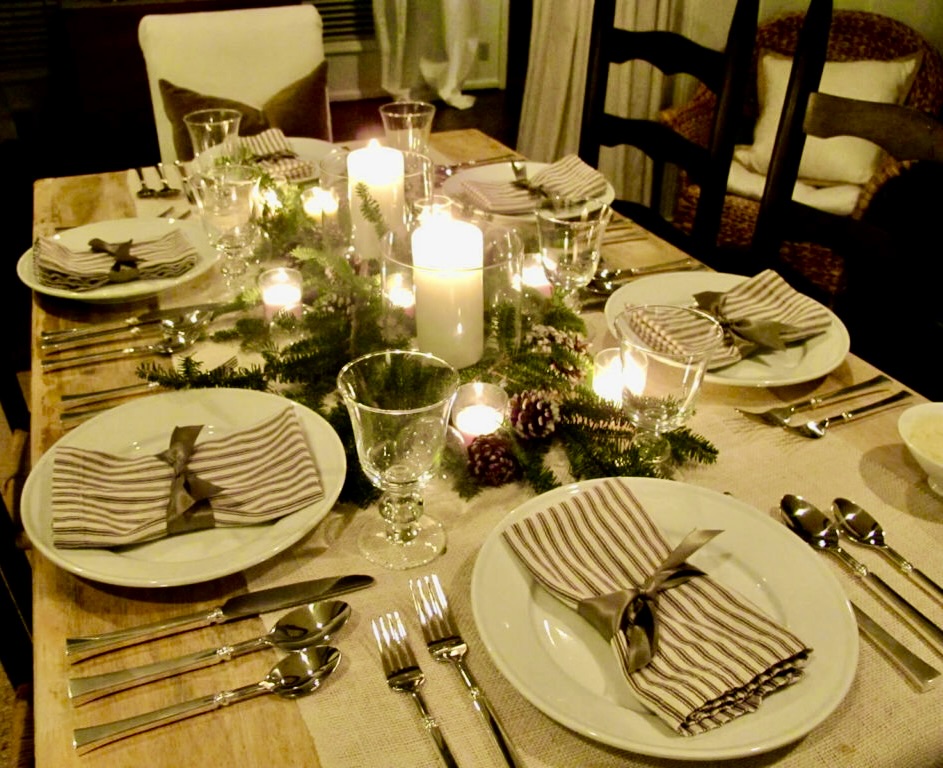
Si vous êtes chanceux, alors ça va parfois dans la vie…
remove some rind, insert garlic slices, drizzle with olive oil
sprinkle with rosemary and/or chili peppers, place in an oven proof dish
Preparation:
Remove the paper covering over cheese. Line the inside of the wooden box with aluminum foil to keep cheese from leaking out of box. Place cheese back in box. [Box should be held together with staples, not glue.]
Cut a thin layer off the top rind to expose interior. Insert several slices of fresh garlic, place a few fresh rosemary leaves on top, a sprinkle of sea salt or chili peppers, as desired.
Drizzle a tiny amount of olive oil over. Place on baking sheet or in cast iron skillet then into preheated oven set at 180C or 350F.
Bake no more than 10-15 minutes, until cheese is “melt-y”.
Place box of oozing Camembert on serving plate arranged with prepared potatoes, crudités, pickles, meat, and salad.
In June 2015, our son Adam married his bride, Anna Jerovejeva, next to a lake in the Latvian countryside. The partying went on for two days and was told in a previous story, Letting Go In Latvia.
the wedding site, june 12, 2015
The women in our daughter-in-law’s Russian family–mother, aunt, grandmother–invited me to return to Riga, Latvia for mushroom hunting season in September. Foraging the forest for edible fungi is an anticipated annual event.
The lack of language on both sides [no Russian-me; basically no English-them] was slightly daunting. Then I realized it would be crazy to pass up an adventure like this. Think of the advantages. 1. I would forge a new Russian/American alliance. 2. I would participate in an ancient survival skill involving tools and hunting. And 3. I would learn to avoid poisonous fungi that could upset international family relations.
the historic part of riga
Arriving in Riga, I was hosted to a private tour of the old city and its history. My guide, a young Latvian woman, spoke fluent English. Anna’s mother, Tania, who speaks a little English but not confidently, acted as my personal photographer.
ceiling in the orthodox church
tania and wendy and a monument
touring riga
Like many Eastern European countries, Latvia has a complicated history. In the beginning it was purely Pagan. Then Germanic people arrived bringing Christianity to the old world mix. They set up shops and churches and a new form of civilization. There were influxes of settlements of Poles, Finns, and Russians.
on the city tour with tania
After WWI, from 1918-1940, Latvia had a brief twenty-two year period of complete independence. The Russians returned in 1940. Then the Germans replaced the Russians until WWII ended. In 1945, the Russians ran the Germans out for the last time. The Soviet Period lasted until 1991. Finally, Latvia underwent its second independence with the breakup of the USSR. The post-Soviet years began.
In 1991, a new law stated that in order for citizens of Russian heritage to receive Latvian passports they must learn both the language and history of the country. Many chose not to as they were past school age, raising families or trying to get by working their everyday jobs. Anna’s maternal grandmother, Vera Gorbacova, is one example. She was born on the eastern edge of Latvia near the current border with Russia. She raised two daughters, Tania and Olga, and worked in a factory as an engineer. She never learned to speak Latvian. The family mother tongue is purely Russian.
vera aka “babushka”
Mushroom hunters in Latvia are a devoted cult. The day of the hunt has its own rituals. As foragers, the women have favorite forest areas where they return many times each season. Mushrooms are best harvested in cool, rainy weather where fungi grow plentifully in mossy groundcover under trees, rocks, and leaves.
Early fall of 2015 was unseasonably warm and sunny . I didn’t need to dress traditionally in rubber boots or even wear a coat. We left Riga mid-morning and drove 45 minutes outside the city to the secret woods. My guides were Tania, her sister Olga, and their friend Edita, who acted as my translator. That day they needed to do some serious sleuthing to find the coveted treasure.
I was given my own set of tools–a basket holding a knife for harvesting and a purple plum for energy. I was shown how to cut mushrooms close to the ground with the special blade. Off we went, fanning out to cover maximum territory.
The woods were not particularly dense, but if I wandered out of visual range I would hear a plaintive “Wennndeeeeey, where are you?” These women were not about to lose their American relative in the Latvian forest. I tried to stay within their range of comfort.
serene beauty in a secret forest
Olga is particularly gifted in guiding the hunt. She would search an area alone and then call me over to do the actual picking. Or cutting. But I really liked finding some little nest of mushrooms on my own. However, when I showed them off proudly, Olga threw most of them back on the ground because they were too small. Or they were, well…poisonous.
olga scouting for me
the highly coveted cepe mushroom
a little mushroom family
beauty=danger=POISON!
a prize cepe mushroom
my morning crop
baskets set aside for lunch
One of the great parts of the day was when we returned to the car for lunch. A tailgating party! From the open trunk came a delicious little feast you could hold in one hand. No plates or napkins necessary. Silvery smoked fish covered small squares of sliced black bread. There was a whole hardboiled egg, and a big wedge of red tomato. Lunch looked like a beautiful still life painting–in my hand.
an edible still life-in hand
olga and edita my translator
Two more hours of hunting before returning to the city, changing clothes, and meeting at Tania’s to cook dinner. My translator from that point on was the vivacious Julia, married to the very patient Juris who would not take a drink of alcohol during our time together because he was responsible for safely chauffeuring “precious cargo”–Julia and me. You have to love a man like that!
cleaning ‘shrooms with julia
the harvest pre-cleaning
Tania was cleaning mushrooms when we arrived. Her technique was meticulous. They must be completely peeled–head to stem. [Thus, bigger means less work for the end result.] If the inside of the stem was not perfectly white, when looking at it from the bottom, it meant worms had invaded. These were immediately discarded as unacceptable. After peeling, mushrooms were rinsed and drained in a colander.
tedious peeling
perfectly cleaned, ready to cook
While the cleaning is tedious, the cooking is easy. Slice and chop stems and heads into random sized pieces. Sauté diced onion in olive oil. Add mushrooms and cook on medium-high heat. Keep the water that is released and stir it around to steam them.
Then, drain the water. Add some butter. Add two big spoonfuls of solid cream [like crème fraîche]. Add salt. Serve immediately. I would add a generous grind of fresh pepper or even some red pepper flakes. But this is not the Russian way.
While Tania was preparing our meal of roast duck, fried potatoes, sautéed mushrooms, and sliced tomatoes, Julia was introducing me to the finer points of drinking vodka Russian style. It should be consumed in shots with traditional food pairings.
fish, onion, tomato on black bread, icy cold shot vodka
First the vodka is frozen. Pour into a shot glass. Drink the shot. Immediately eat a tiny piece of black bread covered by oily fish, onion, and tomato. Or, down a shot followed by a pinch of warm fried potatoes and some pickled cabbage. Either way–deliciously satisfying. No side effects.
vodka with bread and fish or
with a pinch of cabbage
A cultural turning point occurred at evening’s end. For dessert we had eaten sweet watermelon chunks with our fingers. This reminded me of a story daughter-in-law Anna had told me from her childhood. So I shared it with the others.
When her parents, Tania and Sergei, would go out on summer evenings leaving her at home, Anna would slip out of the apartment and go to the market with saved coins. She would pick out a big ripe watermelon and lug it home. Managing to cut it in two pieces, she ate one whole half by herself with a spoon down to the white rind. Seeds and all!
As I finished telling the story, everyone glanced down at the dessert plates. On every plate there were two or three watermelon seeds idly dropped. But on my plate there was a mountain of black and white seeds because I had carefully picked them out before eating the sweet fruit. Every single seed.
I quietly covered my plate with a napkin. But it was too late. The women watched and erupted into uproarious, mirthful laughter. So did I.
As it turned out, Glasnost prevails. Around this cross cultural table of Anglo/Russian women we laughed long and hard. And saw each other clearly.
A perfect summer day is when the sun is shining, the breeze is blowing, the birds are singing and the lawn mower is broken. –James Dents
Hey! It’s summer! Be free and happy and danceful and uninhibited and now-y! –Terri Guillemets
Summer afternoon–summer afternoon; to me those have always been the two most beautiful words in the English language. –Henry James
My husband refers to me as a “late adopter”. This has been true regarding certain forms of technology. I’m not the first to run with the latest innovation when it enters popular culture. But when I do jump in, it’s all the way. Then, I can’t remember life as it was before.
This summer I was surprised with a different type of “late adaptation”. It happened to be with a beverage I had never tried, even once.
On the July 4th American Independence Day holiday weekend I was with Dietician Daughter, her husband, and his Kansas family. She served me a berry and fresh fruit topped drink in a tall glass with a straw. It was deep burgundy in color. The icy glass, sweating beads of condensation, was garnished with succulent fruit. It was her version of Sangria.
On a sultry summer afternoon, around a backyard table with good people, this drink captured my attention. There was thirst-quenching coolness. There was the lushness of summer berries in red wine. I drank a second glass.
Sangria has been around for 2000+ years. When the Roman Empire reached the Iberian Peninsula of Spain and Portugal and began mixing wine into the water to sanitize it, the beginnings of Sangria were born. Long a common, informal drink on the European continent, Sangria was not widely consumed in the U.S. until it was introduced at the New York World’s Fair in 1964.
Twice I have been to the Iberian Peninsula in western Spain hiking the Camino de Santiago de Compostela, but I was not offered Sangria there. We drank wonderful Galician wines every evening as an accompaniment to the regional food. It was poured straight from the bottle and never mixed with anything.
trail marker camino de santiago
Sangria comes from the Spanish and Portuguese word “sangre” meaning blood because of its’ dark red color. It is traditionally made with Spanish red wine, fruit, brandy, some kind of sweetener and ice. Carbonated water may or may not be added for fizz.
That’s all there is to it. This is also where Sangria becomes much more interesting. With a rudimentary knowledge of ingredients, the end result is in the hands of the maker. Dietician Daughter was imaginative in her “berry” form of creativity. Now I can’t drink it any other way.
For the rest of the summer, I began ordering Sangria in restaurants. Some were made with white wine, some with red. At the very most they might have one or two pieces of shredded, mangy looking citrus fruit in the bottom of the glass. Pizzazz and eye candy beauty were nonexistent. Not one was memorable. Not one reminded me of friends and family sharing stories and playing games on a summer afternoon. Not one begged to be repeated.
My short scientific study convinced me that the only Sangria worth the calories is the one you make yourself. With ingredients you choose. The wine must be of a quality that you would drink on its own. The fruit must be plentiful. And FRESH.
sangria ingredients: summer fruit, wine, brandy, and a jar
Here is the very best summer SANGRIA you will ever make. Or drink. It’s simple, it’s fruity, slightly dry and slightly sweet, a bit boozy, and refreshing like a lazy summer day. Pass the pitcher around a table in the mountains, by the sea, on the terrace, or in the backyard. Say, “yes” to a berry summer sangria. Then go lie in a hammock under the trees and muse.
sangria in the mountains
sangria on the côte d’azur, france
sangria on a terrace in germany
in full summer bloom
LARA’S BERRY BEST SUMMER SANGRIA
fresh whole berries [or pieces of fruit] for garnish
ice to chill
750 ml bottle of Spanish Red wine, chilled [I used Ribiera de Duero. Or Rioja.]
½ C. brandy
¾ C. orange juice
3-4 T. brown sugar
any seasonal combination of blueberries, raspberries, blackberries, strawberries. [Or use peaches and mangoes]
½ orange, rind on, sliced thinly
½ apple, skin on, chopped
In a large glass jar or pitcher, place fruit and sugar and muddle with a wooden spoon or muddler.
Add OJ and brandy and muddle again. Add red wine and stir.
Taste and adjust flavors to your liking. [More brandy or OJ or sugar as you wish.] Stir again. Add ice to chill and serve as is in clear glasses.
Get the fruit on. Garnish with lots of fresh berries or fruit of choice. Serve with a spoon for scooping winey fruit into your mouth between sips.
May be stored, covered, in refrigerator to steep and chill several hours, but then don’t add ice until serving.
The Road has no beginning, and the Road has no end. The towns they run together and they run apart again. Right now is the only moment, and Time is the time to go and make yourself a pilgrim on the Road to Santiago. ¡Buen Camiño! –David M. Gitlitz & Linda Kay Davidson, The Pilgrimage Road to Santiago
starburst scallop shell marks “the way”
For more than 1000 years, the Camino de Santiago [the Way of St. James] has been a pilgrimage route from the foothills of the Pyrennes, in southwestern France and northwestern Spain, to the cathedral of Santiago de Compostela on the Iberian Peninsula. In ancient times it was undertaken for spiritual cleansing or “losing time in Hell”.
Why is this pilgrimage so historically significant? Here’s the story.
James was a fisherman on the Sea of Galilee and the 4th disciple recruited by Jesus. He was assigned to the Iberian Peninsula to spread “the word of God”. He made it as far as Galicia in northwestern Spain. Upon returning to the Holy Land he was tortured. Adding insult to injury, he was beheaded. Became a martyr. His body was secreted out of Jerusalem on a boat. Across the Mediterranean Sea, through the Straits of Gibraltar, along the Iberian coast, back to the shores of Galicia. His tomb became enshrined in the Cathedral of Santiago de Compostela.
santiago de compostela
So began the third most important Christian pilgrimage in the Middle Ages, after Rome and Jerusalem. During the Renaissance and years of religious reformation [16th century] the Camino’s importance waned. It fell even more out of favor during the Age of Enlightenment [18th century]. Yet pilgrimages to Santiago de Compostela never stopped completely. Nowadays the Camino is rocking in popularity. 262,459 certificates, or Compostelas, were awarded in 2015. Pilgrims traveled by foot, bicycle, or horseback. Some in wheelchairs.
In ancient times as well as today, travelers often carry their provisions in a backpack, camp out, or sleep in hostels, retreating from normal life for days, weeks, or months. Usually their journey ends at the cathedral in Santiago.
There is also another “way” to experience the Camino, which is what I did.
In May 2014, I was with a group of women who started the journey where most people end–in the courtyard of the cathedral. We walked from there to the actual “ends of the earth” [Finisterre] on the Atlantic Ocean. We carried only a daypack with water and rain gear. Our worldly goods were transported to the next charming “casa rurales” [bed and breakfast] along the route. After hiking all day we enjoyed a hot bath or shower, delicious Galician cuisine and wine, followed by restful sleep–in a bed.
The Camiño de Fisterra-Muxía is the road less travelled these days, particularly in the off-season. On the fourth day we arrived at the lighthouse on Cape Finisterre overlooking the ocean. On the fifth day we walked up the coastline to Muxía where we received the Compostellana [Certificate of Accomplishment]. You must walk at least 100 km to receive the certificate. We walked 117.
route from santiago to muxía
compostela record
stamps acquired along the way
lighthouse at the cape
Our group came together through the joint venture of two American women, Sally and Sienna, who met in Spain while Sally was producing a documentary entitled, “Walking the Camino: Six Ways to Santiago”. In 2013 they began organizing small group trips for people to experience the Camino as a one week venture.
sally on the trail
The topography of Galicia is extremely hilly. It is also very rainy which keeps the landscape lush and green. And, in May, there were fields upon fields of pink foxglove. Future heart medication [digitalis] growing wild.
Digitalis purpurea, common foxglove
“Oreos” were spoken of frequently. In Spain they are tiny barns of granite or shale stone built on mushroom-like pedestals. Functioning as storage granaries in rural areas, they are mounted off the ground to deter rodents. Later, when I learned the Galician word was actually “hórreos”, I understood what they had in common with the name of a cookie. Absolutely nothing. But “oreos” is what I remember.
Forewarned about the hilly terrain, I brought hiking sticks, which gave me a long rhythmic stride. So I was often by myself, up ahead, looking for trail markers [the yellow scallop shell or the painted yellow line] and discovering new terrain. After the first day, I realized that hiking alone was going to be my experience on the Camino.
yellow marks the way across water too
romanesque bridge and aqueduct
Everyone goes on a journey for some reason. It’s often initiated during a moment of transition, a need to “walk through” personal issues, let go of the old, let in the new, or to simply break up routines. It might bubble up as a search for healing or forgiveness or a time to give thanks or to mark a special occasion. Perhaps the motivation is to meet new people, hear their stories, see new places, rediscover something forgotten or discover something new. Journeys can be the catalyst for creative inspiration, finding harmony in nature, exercise, penance, meditation, or delving into the spiritual.
My own journeys are usually discovery seeking ones. They widen my perspective, feed curiosity, and replenish me with the adventure. Those quiet hours in the hills, forests, villages, foxglove fields and countryside of Galicia brought real contentment. I was part of the changes in weather–the pouring rain, looming storm clouds and intermittent sun. I was one with the topography–the out of breath up-hills, the knee jarring down-hills and the blessed stretches of flat terrain in between. Often I was lost in thought about the history and natural beauty of this part of the world. It is impossible not to feel connected to others who walked the same trail over past millenniums.
Day 3, last 5k of steep downhill, long negotiation of massive boulders ahead
Evening meals were social bonding time. We were treated to delicious regional cuisine including famous Galician wines. Arroz con calamares [rice with squid], zamburiñas [scallops in shells], and a giant fried prehistoric style fish that looked ominous but melted in the mouth.
dining ambience
happy pilgrims
scallops on the half shell
tender prehistoric fish
A uniquely Galician tradition, the queimada ceremony, was performed for our group. Queimada is made from a special Spanish liqueur distilled from grapes, flavored with spices, herbs, sugar, lemon peel and coffee beans. The ingredients are put together into a clay pot, set on fire and allowed to burn slowly. The concoction is stirred frequently by lifting a ladle of flaming liquid and pouring it back into the pot. When the flame burns blue, it is ready to serve in ceramic cups.
our queimada master
blue flame means ready to drink
There is a recitation chanted as the queimada burns–to purify the drink and to share it with the souls of family and friends not present to enjoy it. Special powers are conferred on the queimada and to those drinking it. We didn’t experience anything supernatural, but there was a lot of infectious laughter and animated conversation after a long hiking day. Sound sleep followed.
Upon reaching the cliff at the end of the world on Cape Finisterre, we saw blackened remains of burned clothes and shoes on the rocks. It’s a tradition for those who venture all the way to give up their worldly goods. None of us were moved to burn anything. Instead we picked up a stone to throw into the sea, giving it the name of something to let go of.
the end of the road, 0 km
Cape Finisterre
wendy and sally at the end of the earth
I couldn’t bring myself to throw my stone away. I kept touching it in my pocket and wondering about the hesitation. My friend Margaret suggested that I wasn’t ready to let go. There was something I needed to do with that energy. She was right. Three weeks later, in June 2014, I published my first story on this website. Later, I noticed white markings on the stone that reminded me of a face. I keep it on the bedside table for good luck.
everybody needs a rock
All pilgrimages have a fixed end point. But they begin wherever you start walking.
“The going is more memorable than the getting there.”
When you are ready, just put on your boots, and go…
galician coastline, iberian peninsula, spain
margaret, laurel, nina, sally, carole
nina, sally, carole, wendy, teresa, laurel
Some of the photos in this story are courtesy of Nina Cooper or Teresa Goodwin.
When laughter helps without doing harm, when laughter lightens, realigns, reorders, reasserts power and strength, this is laughter that causes health. When laughter makes people glad they are alive, happy to be here, more conscious of love…lifts sadness and severs anger…when they are made bigger, made better, more generous, more sensitive, that is sacred [laughter]. –Clarissa Pinkola Estés
Sometimes I laugh so hard the tears run down my legs. –Unknown author
It is bad to suppress laughter. It goes back down to your hips. –Unknown author
Laughter is part of the universal human language. Everyone speaks laughter. Laughter exercises the diaphragm, the abdominal, respiratory, facial, leg and back muscles. It’s a workout!
Laughter is yogic. Nothing works faster to bring the body and mind back in balance than a good laugh.
Laughter is cathartic. When the good feeling from a big laugh remains, it lifts your mood for hours.
Recently, some tear inducing out loud laughter took over my day. Bursts of laughter broke free for hours. It made me feel great.
The source was a story written by Alec, a friend with a gift for spinning a comedic phrase. This time it was personal to my experience of having lived in Germany and then making a specific request to my friend.
Alec knows there are things I miss from Germany, so he always offers to bring “a list” when he and his wife drive to Paris to visit. This time I tacked on “one more thing” to the list, but felt it needed more description:
…Oh, there is one more thing you could bring. It’s very lightweight and packable, but you have to go to the Oberursel Altstadt to find it. On the main street is the One Euro Store. Not everything there is one euro, but it’s a cheap junk store you should know about anyway.
Inside, they have these little cloth shopping bags that come wrapped in a cloth carrying case. The name “Reisenthel” is on the side label. They cost more than one euro, about 4.95 each. They are brilliant. I use them daily or give them away to family and friends, doing my “green best”.
I only like solid benign colors. Black, blue, green, brown. No patterns or foofy florals. 6-10 bags if you find them…
I received the following email from him the day before their arrival. It was titled:
On A Mission for Wendy
I loitered outside the dollar store in the winter cold, waiting until the store emptied before I approached the owner.
Uncertain of his level of English, I said with some hesitation, “Guten Tag. I am shopping for a woman-friend who lived here six years ago. She asked me to pick up some packable lightweight shopping bags she used to buy in your store.”
He remained silent so I continued, “They’re made by Reisenthel. She gives them away to be environmentally friendly. Do you still carry them?”
He stared at me and I wasn’t sure if he was mentally translating what I said from English to German or was wondering if I was crazy enough to think a dollar store carried the same merchandise over such a long period of time.
He gestured to a box that had packable shopping bags in a floral pattern. Apologetically I said, “Um, she doesn’t really want a floral pattern.”
Again, the stare as he said, “She wants to be environmentally friendly but doesn’t like flowers?”
He had a point, but I stood my ground. “I think she wants to be fashionably friendly to the environment.”
This time his stare lasted even longer. He scratched his head. I couldn’t tell if he was thinking about whether he had other bags in the store or if he was beginning to understand why a person like Donald Trump could be elected if Americans were all like me.
He opened a cabinet and handed me a slightly larger shopping bag-inside-a-bag, this time in basic black. The tag indicated it was manufactured by “Schneider”.
Now it was my turn to hesitate. Finally I got up the nerve to say, “Um, this is a Schneider bag, but my friend really wants a Reisenthel bag.”
I felt completely stupid. I said “Reisenthel” like it was some kind of designer brand from Bloomingdales or Saks, but the shelves lined with cheap bric-a-brac reminded me I was far from Fifth Avenue.
By the look on his face, I feared he was going to hit me with one of the dozens of snow globes within easy reach. Instead he just blinked. It was one of those blinks where the eyelids remain closed long enough that I could have slipped out of the store. Maybe he was offering me an out, but I stayed. I was on a mission for Wendy.
Finally, he opened his eyes and said, in an accent heavier with each exchange, “And what, may I ask, is so special about a Reisenthel bag?”
Luckily for me I came prepared with an email from my friend. I pulled it out of my pocket and quickly read aloud what she wrote. “Um, well, she says here that, ‘They are brilliant.’”
He squinted at me, considering my words. Then he repeated very slowly, as if offering me a chance to take one of the small green pills prescribed by my psychiatrist, “These bags. They are brilliant?”
Rather than hold his stare, I looked back at my friend’s email and blurted out the first words that caught my eyes. “She says here they should be benign”. Then, realizing how incredibly stupid that sounded, I tried to make a joke with a forced chuckle, “But I assume all of your bags are benign, right?”
For the first time he looked at me with something other than pity or spite and said with clear relief, “So you want nine bags?”
I looked down at my shoes. It took only a moment to realize my joke had been misunderstood. I looked up and then again at my friend’s email with the very explicit directions of what she wanted.
Drawing upon an inner strength, built from more than 20 years of living overseas, battle-tested by language and cultural barriers from Asia to Europe. I looked him straight in the eye, and said…
“No. I’ll take ten…Danke.”
It doesn’t happen nearly often enough–this kind of mirthful laughter that tickles to my core and ripples throughout the day. I laughed until I cried. Then I laughed all over again–thanks to my friend.
A year ago I wrote a story about my favourite Colorado hometown cafe. It was titled A Mountain Gem for 70 Years.The owner, Rocky St. John, passed away right before Christmas. In tribute to her, I have revised my words and added additional photos. Her sons Ben and Joe, along with their father, are keeping the cafe open in her memory. She trained them well.
Allenspark, Colorado lies in a curvy bend off Highway 7, between Estes Park and the valley below. As you drive past the majestic scenery of Wild Basin and the backside of Long’s Peak, it’s easy to simply bypass this tiny town. But if you turn right onto the business spur, it’s probably because you know about Rocky’s Meadow Mountain Cafe.
On a hillside halfway through town is a small green building with purple trim. Colorful buttons are mixed into the cement between slate stone steps climbing to the front porch. The main room has knotty pine walls and an antique potbelly stove, radiating warmth. Shelves are lined with an eccentric collection of salt-and-pepper shakers. Local artwork is for sale on the wall. Behind this quaint façade is a long history of food, friendly service, and loyal customer relationships.
It began in 1946 with a local character named Lil Lavicka. Known as the “Pie Lady”, Lil was famous for her homemade baked goods. As part of a divorce settlement, her husband hastily built a two-room cafe across from her tiny home. Lil’s Pie House flourished for twenty summer seasons.
Then, after several changes of ownership, Meadow Mountain Cafe was born. Breakfast and lunch became the daily fare. Food was fresh and home-cooked to order. Coffee was hot–with a touch of cinnamon. Consistently good food, friendly service, and reasonable pricing enhanced its’ reputation beyond the boundaries of the small community. Locals and tourists line up for a table inside or on the covered porch, complete with hummingbirds, flowers and an overhanging pine tree. Lil Lavicka’s seasonal pie house evolved into a legendary year-round cafe with returning customers who became friends.
Roxanne [Rocky] St. John began waiting tables at Meadow Mountain more than 30 years ago. It wasn’t long before her cooking finesse and creativity nudged her into the kitchen full time. Rocky worked the grill for several female owners until finally, in 2007, she took over solo ownership. Already an established part of the ongoing success of Meadow Mountain, it was time to put her personal stamp on the place.
Rocky introduced two new house specialties–the veggie burger and the green chili sauce for huevos rancheros. Cinnamon spiked coffee is still standard, of course. She chose the outside paint colors and easy-on-the-eye peach walls for the kitchen. The button-inlaid steps were designed and built for safer access in all weather conditions. An herb garden was planted out in back. Inside, the eclectic collection of coffee mugs and salt-and-pepper shakers [always part of her style] continued to grow. The kitchen blasting music-of-choice ran along the lines of Bob Dylan and Johnny Cash.
We have been driving from our cabin in Estes Park to Meadow Mountain Cafe for more than 15 years. It never disappoints. It’s not meant to be fast food. You wait patiently and sip good coffee, talk leisurely. Perhaps you warm your back near the antique stove, muse over the salt-and-pepper collection, read a book or eavesdrop quietly on another conversation. You watch regulars walk into the kitchen to say hello. At a corner table, friends sit and play cards after their meal. A man at the counter leans his chin into one hand and dozes, holding a coffee cup with the other.
Orders parade out of the kitchen. Coffee mugs are refilled. Homemade brown bread, thickly sliced for toast or sandwiches, is baked twice daily in summer to keep up with demand. The scene is homey and multi-dimensional–from the diversity of customers stepping through the door to the din of country or rock-n-roll music pouring out of the kitchen. Conversation and laughter is spiced with the clatter of plates and silverware as tables empty and fill.
beaded tapestry made by a friend of Rocky’s
What sustains this kind of success in a town of just over 500 people? Rocky, along with the women before her, crafted a timeless formula. It begins with an old-fashioned hard work ethic. It’s maintained by keeping quality high, service friendly, and community relationships strong. Rocky was passionate about what she did and consistently did it very well. And then, just maybe, that hint of cinnamon in the coffee didn’t hurt either.
Rocky St. John, 1960-2015
new step up to the cafe
Rocky was a well-known and well-loved figure in the Estes Valley community. Meadow Mountain will continue to flourish in her memory. After a 70-year legacy of female owners [since 1946], the cafe will now operate under the expertise of Dan, Ben, and Joe St. John. In Ben’s words, “We have been well-trained.” Indeed.
And the rest of us will continue to be there to support them.
I have a problem trying to figure out whatto cook for dinner. It’s silly because if you hand me a restaurant menu I know right away what will feed my hunger. My husband always asks what I am ordering before he makes up his own mind. He knows he will want it too. Especially after he orders something else and then sees the better choice in front of me.
Cooking at home is a repetitive daily hang-up. Over the years I have relied on friends whose culinary skills seem effortless, nurturing, even joyful. This kind of decision-making must be inborn. It bypassed my genetic makeup. Despite 39 years of marriage and two children, daily cooking is my predicament.
During our years overseas, friends taught me to prepare simple, delicious one-dish meals to nourish a growing, hungry family. Some of those meals became staples that over time no longer required following a recipe. Mujuddarah, People Who Pull the Magic Out of You Rancher’s Pasta, Lebanese egg-potato salad, veggie fried rice, Spaghetti Josephine Garlic and Girlfriends to name a few.
By the time we moved to France, children had grown and there were only two of us. It was also when I met my friend Sally.
Sally is an artist and teacher who moved to Bolivia for two years in the late 1980s. She became involved in running a house to support children living on the streets. A young boy in the program captured her heart and she adopted him. In 1990, they returned to the U.S. where she resumed her teaching job in the Arizona public schools.
Sally is a born nurturer who also happens to love cooking. Every day. She always has a plan.
Her picnics, in our Parisian neighborhood park, were memorable. Over colorful Bolivian blankets spread on lush grass, she arranged platters of sliced poached chicken, fragrant with spices, raisins, and sautéed onions, thyme and rosemary roasted potatoes, Mediterranean quinoa salad, cheeses and fruits, and chocolaty brownies. Flutes of champagne or a glass of wine served as accompaniment. Flowers stood in a vase. Sally made it look effortless. On many summer evenings, she and her husband charmed a revolving door of houseguests over the two years they lived here.
our park for picnics in paris 75016
One day, undecided about a cooking idea, I asked Sally what she was making for dinner. She said, “Galette.” What? I knew galette in the form of a cake [Galette de Roi] served in the early days of the New Year in France. It has a plastic toy king baked inside that is a good luck charm for the finder.
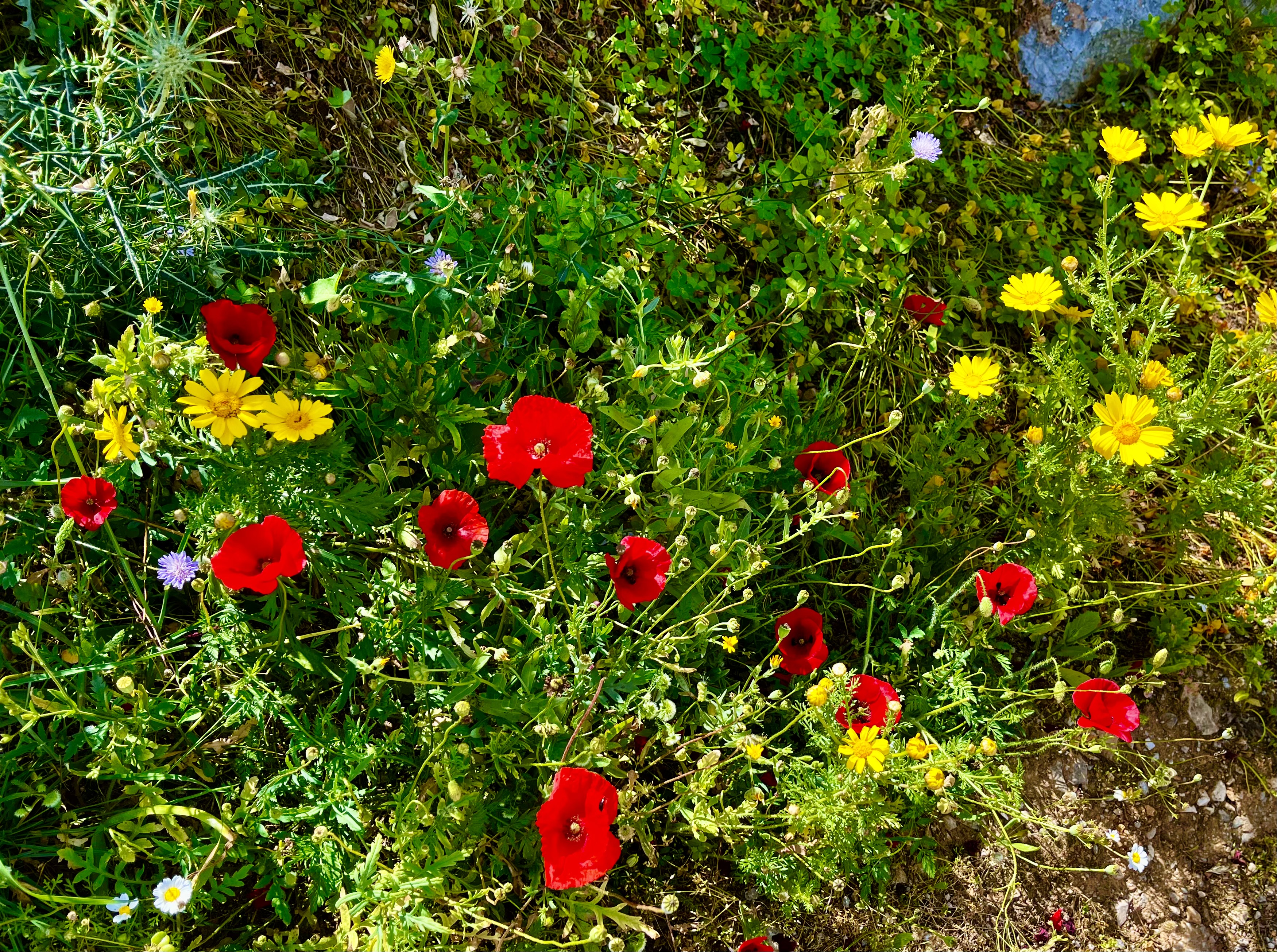
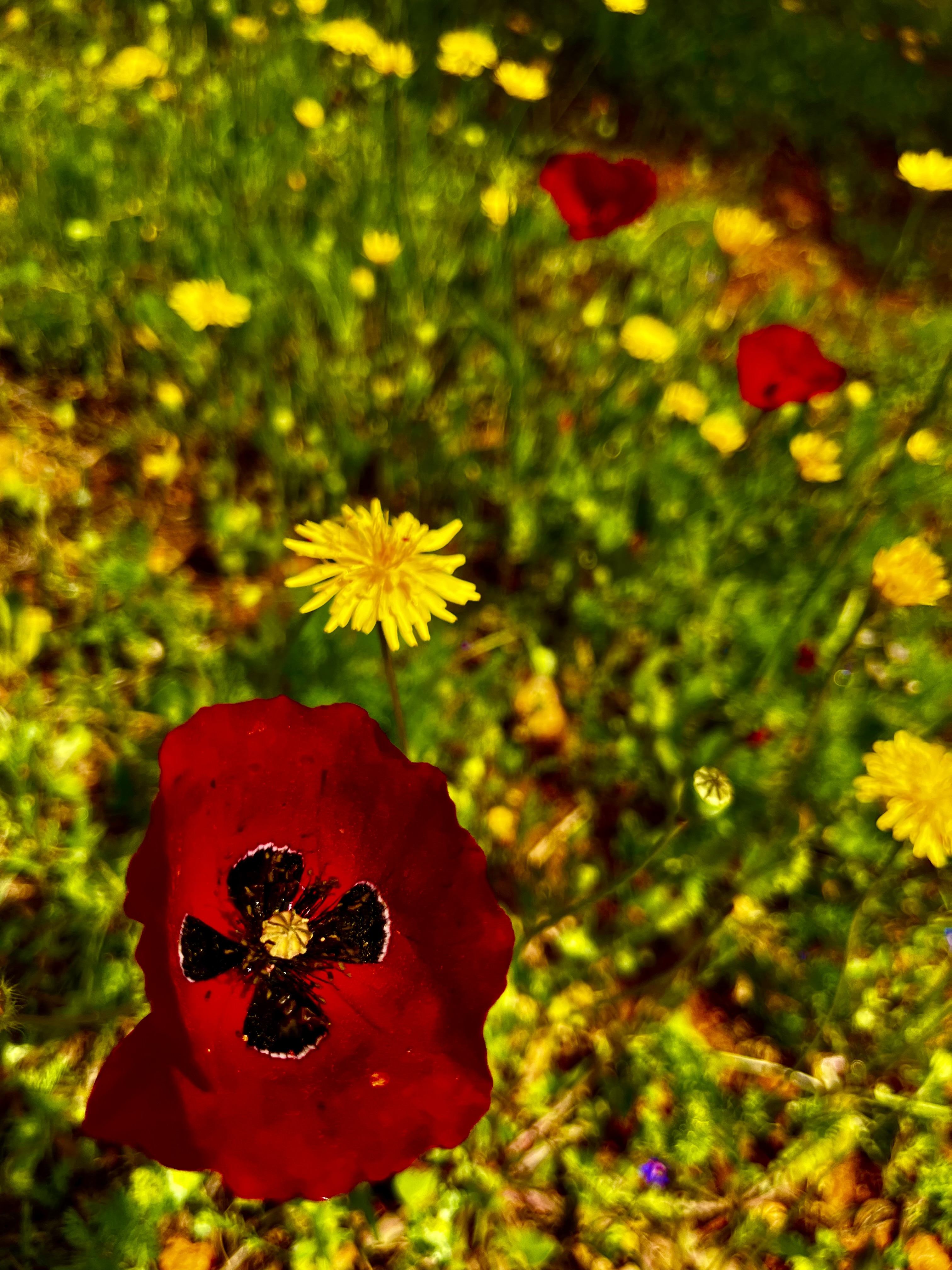
“No, no, no”, Sally said, “This is different. Galette can be savory as well.”
Traditionally, galette is a covered crust over cooked ingredients–savory [meat or veggies] or sweet [fruit]. She began to describe the process but I cut her off. “I’ll never remember, just show me.” We agreed to meet the following week in my kitchen-with-a-view for an afternoon of cooking.
best kitchen view
That evening, on the day we met, I was to attend a potluck dinner party in the courtyard of our apartment building. All the other residents are French. At the time I didn’t know them well and felt intimidated by what to bring.
Back in the kitchen, there was a bottle of Burgundy in the counter wine rack. We opened it and got busy. From start to finish, preparing a galette couldn’t have been easier. A little glass of wine is a great buffer. –Sally Boyle
Sally brought cooked chicken breasts and potatoes, roasted red peppers, spinach, zucchini, olives, onion, and soft goat cheese. While I shredded the chicken, she sautéed chopped onion and sliced zucchini rounds in a pan with olive oil until tender. Frozen pastry circles thawed quickly at room temperature on a baking sheet.
It was simple assembly after that–one meat galette and the other, vegetarian.
fold crust over for half-moon galette
For the meaty one, we layered chicken, potatoes, and vegetables [zucchini, onion, red pepper and olives] over the pastry, seasoning well with salt and pepper. [Add red pepper flakes if you like more heat. Yes I do!] For vegetarian, we used a combination of cooked spinach, goat cheese, zucchini, red peppers, olives and onions.
ready to bake
the lovely result
Cover with the top pastry or fold over in half and seal the edges. [I have also made a one-crust version, which is even lighter.] Make holes in crust to let out steam. Bake 20 minutes at 210 Centigrade or 400 Fahrenheit. Voila–an instant main course worthy of a king, Serve warm or cooled to room temperature. Add green salad and glass of wine, as desired.
one crust, open faced
one-dish meal with salad and wine
Later that evening at the party, I discreetly placed my contribution on the table with other food offerings. Then moved away to meet and greet neighbors. As people began to eat, I overheard several women murmuring about something delicious on their plates. It was the galette! They wanted to know how to make it and what was inside.
my dinner party galette
Surprised to receive notice in a foodie crowd, I said, “Oh, it was very simple…”
There is more than the communion of bodies when bread is broken and wine drunk. –m.f.k. fisher
M.F.K. Fisher [1908-1992] wrote that the best outdoor eating is on the side of a hill in the early evening. Her story of an unforgettable picnic took place in Switzerland in the 1930s. Sixty years later, in the 1990s, on a grassy meadow in Taiwan, we had a similar family experience. Continents and decades apart, the stories are interwoven because both Fisher’s memory and mine are reflections about more than the menu.
Fisher’s story went like this. She and her husband were building a small house above Lake Geneva, Switzerland, on a steep hillside surrounded by vineyards. Her parents came from California to visit. Late afternoon sun in June promised just enough warmth for an outside meal. The four of them carried baskets to the construction site, after workers had left for the day.
A table under the apple tree was covered with a checkered cloth and set with silver, ceramic plates and cloth napkins. Bottles of wine were placed in an ancient spring-fed fountain to chill. A fire was built, ringed with stones and roofing tiles, fueled with wood shavings.
The first spring peas were ready to harvest. As the men picked from the terraced garden uphill, Mary Frances ran baskets downhill to her mother who quickly shelled them into a pot. An iron casserole was set over the open fire where the peas “cooked for perhaps four or five minutes, swirling them in butter and their own steam”. Salt and pepper at the end, then table side.
On each plate lay a small roasted pullet. There was salad of delicate mountain lettuces, a basket of good bread, and fountain-chilled white wine generously poured. And those tender young peas–freshly steamed and seasoned! They shared the harvested feast and each other’s company as the surrounding hills turned rosy and the sun began to sink. Suddenly, in a neighboring field, “…a cow moved her head among the meadow flowers and shook her bell in a slow, melodious rhythm, a kind of hymn.” Fisher never forgot it.
In the spring of our first year in Taiwan, we went on a picnic where the alignment of people, place, and food replicated Fisher’s kind of perfection. More importantly, our young daughter began to understand the communal spirit created when food is shared in good company.
Yangmingshan is the national park north of Taipei. It was typically crowded on weekends with cooped up city people seeking fresh air, hiking trails, flowers and greenery. Friends Maddy and Cabby knew of an area in the park where water buffalo grazed freely and people were few. They organized a picnic in Buffalo Meadows on a late afternoon. We were four adults and three young children.
From the parking area we hiked uphill in a cloud so dense it moistened our hair and skin with droplets of water. At the top of the trail the landscape turned sunny and green with views all around. The soft grass was picnic perfect. Out of a backpack came a Frisbee and the men organized play on the hillside. Lara and Liza tired of running after a frisbee they couldn’t catch. They tried to follow a slow moving water buffalo. He wandered on.
lara, liza and water buffalo
girls thinking about things
Our nine-year-old daughter came over and sat down to watch the food preparation. There was a small camp stove along with a battered and blackened Japanese wok in which to put together the meal. Ingredients had been sliced, steamed, grated and pre-cooked at home. Once the stove was leveled, primed, and producing enough heat, assembly began.
Olive oil was generously poured into the wok and heated. Thinly sliced cloves of fresh garlic were added to the hot oil. Shaking the pan continuously, the slices began to brown around the edges. Bite sized broccoli flowerets were stirred in with freshly ground pepper. Pre-cooked penne pasta was added along with butter. Everything was tumbled together with a large wooden spoon until thoroughly heated. Finally, freshly grated Parmesan cheese was layered on top and melted into everything. Lightly browned garlic slices gave toasted sweetness to the broccoli and pasta. A one-dish meal. Perfect.
Plates were passed. We sat side by side on blankets eating, laughing and talking. As the sun lowered over the far hills, the temperature cooled and we reached for jackets. Thimble sized portions of single malt whisky were passed among the adults. A breeze stirred and we leaned in closer, wrapping arms around children. Four-year-old Liza was zipped into the front of her father’s grey sweatshirt where she fell asleep curled into his chest, only the top of her blonde head showing. We talked quietly as darkness descended. The mist returned. It was time to go home.
Days later, our daughter asked if I could make that broccoli pasta. She had a faraway look in her eyes while she spoke of the picnic in Buffalo Meadows and how wonderful it had been. Looking at her face and listening to her speak I knew she had made a connection about more than the food. She was asking to go back to a feeling created on a tranquil hillside with close-knit family and friends. I never forgot her request. She had connected the dots that Fisher writes about so well–the communion of spirits when food and love are shared, around a table or on a hillside, with people who are important to us.
Perhaps this explains why a picnic, so many years ago, is vivid in my memory. Although I love reflecting on Fisher’s story of peas, a Swiss hillside, and a cowbell, my own recollection is this–a beat-up Japanese wok filled with steaming broccoli pasta, a grassy meadow, adults and children with arms around one another, and a water buffalo.
Simmer broccoli in boiling water 1-2 minutes, drain, rinse in cold water.
Heat oil ~ 1 min. Add garlic slices and cook, shaking pan until it begins to brown ~1 min.
Add broccoli, stir, grind pepper on top.
Add butter and penne, stirring continuously until well mixed and heated through.
Sprinkle with freshly grated Parmesan cheese.
Serve immediately.
Pass the pepper mill.
Add garnish and extra Parmesan.
For variety, add shredded or cubed cooked chicken, sliced black olives, or leftover veggies. Red or yellow bell peppers make a colorful addition. [Steam or stir fry before adding.] Red pepper flakes for added spice. Cherry tomatoes, cut in half, as garnish before serving.
Hotel de Ville on the Grand Place, Brussels, Belgium
Brussels is an important city for several reasons. Politically, it is the capital of Belgium and the European Union. Historically, it’s importance as a fortress town began in the 10th century. Architecturally, the Grand Place central square is designated a World Heritage Site of striking 17th century design and construction.
For me, the importance of Brussels is tied to memories of food I ate there while visiting a friend years ago. Now that we lived next door to Belgium, in France, it was time to revisit. We took a road trip from Paris.
In 2002, when I was living in Taiwan, my friend Nancy invited me to Brussels. She had moved there from Taipei several years before. The guest room was on the top floor of their multi-level row house. The ceiling angled sharply from the peaked roof. An over-sized skylight opened to fresh air and rooftop views. Wooden floorboards were painted white. On the bed was a puffy duvet of green and white gingham. The adjoining bathroom housed a big, white bathtub and thick towels warmed on a radiator.
I called it the Heidi-hayloft-room because it reminded me of the children’s book about the little Swiss girl who slept in a hayloft. I had flown from Asia into a fairytale.
A four-year-old boy who believed he was Batman lived in the household. It was impossible to separate costume and character from the child. So his parents lived with a masked, black-caped superhero. At pre-school, Brady acquired a perfect French accent. And, like everyone else in Brussels, he loved pommes frites.
Frites are a national snack food in Belgium. Locals and tourists eat them like popcorn at the movies. Storefronts sell paper cones filled with them. A range of sauces is offered to go on top. Each order is freshly made and just right–crispy on the outside, feathery on the inside. I believe Belgians perfected frites because they know that eating them outside on a freezing day warms you on the inside. We shared a cornet on bitingly cold February days. And stayed warm to our bones.
side by side friteries
sauce choices
cornet with a dollop of spicy samourai sauce
While Nancy and I walked around the Grand Place during my visit, she said, “You must eat this. Right now.” I was handed a waffle wrapped in crisp paper from a street vendor’s cart. On the outside it looked like any waffle, except it was thicker through the middle and more irregular around the edge.
Then I bit into a surprise. Partially melted, caramelized sugar crystals crunched and then dissolved into syrup. My mouth filled with warm sweetness. Time, place, and taste blended into one moment. A winter morning on a cobblestoned square with gothic spires and a hot waffle. I never forgot it.
My food-writing mentor, M.F.K. Fisher, had a similar experience. As a young woman living in France, in the 1920s, she hiked with an Alpine club. Most of the members were much older. She was the only foreigner. On a very cold day, while catching her breath at the top of a steep hill, an old general said, “Here! Try some of this young lady!” He gave her a pale brown piece of chocolate.
“In my mouth the chocolate broke at first like gravel into many separate, disagreeable bits. I began to wonder if I could swallow them. Then they grew soft and melted voluptuously into a warm stream down my throat.”–m.f.k. fisher
Another hiker said, “Wait, wait! Never eat chocolate without bread, young lady!”
“And in two minutes my mouth was full of fresh bread and melting chocolate, and as we sat gingerly, the three of us, on the frozen hill, looking down into the valley…we peered shyly and silently at each other and smiled and chewed at one of the most satisfying things I have ever eaten…” –m.f.k. fisher
MFK’s hillside bread and chocolate. My perfect waffle. Fisher calls them “peaks of gastronomic emotion”. Still, moments like these are personal and hard to describe.
In 2015, waffle vendors were no longer allowed in the Grand Place. Off the square, many shops sold waffles loaded with extras. It wasn’t what I wanted.
waffles plus
waffles loaded
On a side street, I spotted a parked truck painted with “Gaufres Chaudes”. A man was making waffles in his van. What he handed me was smaller and not as dense as I remembered. On the inside there was a thin layer of molten sweetness but no crunch of sugar crystals turning into syrup. The taste was fine. I was hungry. It was cold. But it wasn’t the same.
food truck waffles
The best food revisit turned out to be mussels. “Moules-frites” because they always come with fries. Nancy had introduced me to Aux Armes de Bruxelles. My husband and I found the restaurant and ate there three times over three days. There was no reason to go elsewhere. It’s that special. Belgians get their mussel fix there too.
best moules-frites in brussels
September to April is the season for jumbo mussels from Zeeland, a southwestern province in the Netherlands. It is the only region from where to obtain this particular type of mussel. So our server said. Other mussels, and those eaten throughout the year, are not the same. Smaller. Different. Not as tasty.
They were served in a big bowl, frites on the side, and always bread to sop up the sauce and veggies at the bottom. It was trial and error to choose a favorite sauce. My husband found his on the first try–white wine and cream sauce [au vin blanc et crème]. I asked for a made-up combination that became my favorite–white wine, lots of garlic and red pepper [au vin blanc, beaucoup d’ail, et piment]. It’s not on the menu but the kitchen obliged.
The broth is full of chopped onion, celery, fresh parsley, and once, tiny asparagus tips. It is an intoxicating combination–a bowl of jumbo Zeeland mussels, steamed heat and aroma from the sauce wafting up, crisp fries on the side. We smiled and sipped wine between morsels of mussel and bites of frites.
two ways to eat: using shell as utensil
or fork
The best accompanying beverage required more trial and error. Belgian beer was good for the beer drinker. A glass of Bordeaux was good for the red wine lover. But the unanimous favorite was sharing a bottle of Chablis from Burgundy. Begin sipping while you wait for the moules-frites to arrive.
Mussel memory in Brussels will always be one of my food highlights. Sharing the adventure with a loved one means we both understand what a “Fisher moment” of gastronomic perfection smells, tastes, and feels like.
“...Everything is right. Nothing jars. There is a kind of harmony, with every sensation and emotion melted into one chord of well-being.” –mfk fisher
Fisher describes it better than anyone. Mussels in Brussels. C’est tellement très bon.
Allenspark, Colorado lies in a curvy bend off Highway 7, between Estes Park and the valley below. It is situated within the Roosevelt National Forest and surrounded by mountains of the Front Range Colorado Rockies. As you drive past the majestic scenery of Wild Basin and the backside of Long’s Peak, it would be easy to bypass the business spur and keep descending the mountain.
Long’s Peak from CO Hwy 7
But if you do make the right hand turn into Allenspark, it’s probably because you know about an historic hillside landmark halfway through town–Meadow Mountain Cafe.
On the outside, it is painted green with purple trim. There is always a line up of cars parked below. An assortment of buttons are mixed into the cement and stone steps that you climb to the front porch.
Inside, the main room has original knotty pine walls and a working potbelly stove for heat. Hand colored photographs by a local artist are displayed for sale.
An eccentric collection of salt-and-pepper shakers line the walls.
Behind this quirky façade, there is a long history of food and relationships that began in 1946, with a local character named Lil Lavicka.
Lil was known as the “pie lady”. As part of a divorce settlement her husband hastily built a small two-room cafe where she could sell her baked goods. On this hilly spot, in tiny Allenspark, her pie house flourished for twenty summer seasons. It was just a stone’s throw across the street from a small house where she lived into her 90’s.
Several changes of ownership and some 30 years later, Lil’s place was renamed Meadow Mountain Cafe. The menu became daily breakfast and lunch fare. Food was fresh and home-cooked to order, the coffee was hot and had a hint of cinnamon. Consistently delicious food, friendly servers and reasonable pricing enhanced its reputation within the small community and radiated beyond. Locals and tourists began lining up for a table inside, or on the covered porch with hummingbird feeders, flowers and an overhanging pine tree. Lil’s seasonal pie house evolved into an Allenspark landmark with regularly returning customers, who eventually became friends.
Roxanne [Rocky] St. John began waiting tables at Meadow Mountain in the late 1970s. Almost right away she was moved into the kitchen and continued to work the grill after two other women purchased it in the 1980s. Rocky finally took over solo ownership in 2007. It was time to put her personal stamp on the place.
Rocky is responsible for introducing the veggie burger and the incredible green chili sauce for huevos rancheros. Both became specialties of the house. Cinnamon spiked coffee remains standard, of course.
veggie burger and sweet potato fries
huevos rancheros with green chili sauce
She chose the current paint colors, including easy-on-the-eye peach walls in the kitchen and built the button inlaid steps for safer access in all weather conditions. The funky array of coffee mugs and salt-and-pepper shakers were always part of her style. The music that blasts from the kitchen is pure country western or rock-n-roll oldies. Son Joe mans the grill, daughter Alicia works the front, and husband, Dan, does whatever needs doing. It’s a full family operation, year round, with added help in summer. On Tuesdays, they take one day of rest.
We have been driving from our cabin in Estes Park to Meadow Mountain Cafe for more than 15 years. I go by myself, with family, or with friends, usually for breakfast, sometimes lunch. It never disappoints. It’s not meant to be fast food.
You wait patiently and sip good coffee, talk leisurely. Perhaps you warm your back sitting at the counter by the antique stove, muse over the salt-and-pepper collection, read a book, or eavesdrop quietly on another conversation. You watch regulars walk into the kitchen looking for Rocky and to say hello. A table of friends play cards in the corner after their meal. At the other counter, a man leans his chin into one hand, and dozes, holding his coffee cup with the other.
Orders parade out of the kitchen. Coffee mugs are refilled. Homemade brown bread is sliced thickly for toast or sandwiches. Summer requires twice-a-day baking to keep up with demand. The scene is homey and multi-dimensional–from the diversity of people stepping through the front door to the din of kitchen music, mingled conversations and laughter, and the clatter of clearing plates as another table empties and fills. It always feels just right. You are glad to be hungry and in Allenspark.
What sustains 70 years of successful continuity in a community of just over 500 people? Rocky, and the female owners before her, perfected a simple yet timeless formula. Starting with an old-fashioned hard work ethic, they stay passionate about what they do and consistently do it very well. Quality is always high, service friendly, and customer relationships strong. And then, just maybe, a little hint of cinnamon in the coffee doesn’t hurt either.
I hope you have your own gem of a hometown cafe–a place with honest food, ambience, and feeling of community–where you go to be nurtured over and over again.
St. Catherine of Siena Chapel [Chapel on the Rock], St. Malo Conference Center along Hwy 7, Allenspark, CO
Growing up in a family with regular fire-making rituals, I inherited an obsession with flames. When the outside temperature dropped, it was time to place newspaper, kindling, and wood in the fireplace and watch it burn. Now I live in an historic Parisian apartment with seven stone and marble fireplaces. All of them sealed shut. In the dark winter months there is only one thing to do. Between four and five in the afternoon, as the sun is setting, I begin lighting candles.
Recently, I became aware this is not a tradition others follow as consistently as I do. On a dark December afternoon, my friend Lesli invited a group of women to her apartment in Paris for “wine and unwind” time. This is a time of bringing friends into your home, opening a bottle of something, and letting conversation flow.
Lesli’s apartment is furnished with a spectacular crystal chandelier from another century. While admiringly it, I noticed it was outfitted with candles! They had never been lit since Lesli moved in three years before. She needed little encouragement from me. I climbed on a chair, broke off the old wicks and re-lit them. In full glow, this antique beauty became a Versailles-worthy show stopper.
candlelight transformation
Her apartment also had six or eight candles in heavy glass jars from the oldest candle making store in Paris. Cire Trudon is the most prestigious French wax manufacturer in existence since 1643. The wicks were deeply buried in hardened wax. It took some digging and trimming, but those, too, were put into burning use. Soon the living room was alight with candle glow, “coupes de champagne” in everyone’s hand, and easy banter among friends.
trimmed and untrimmed wick lengths
Candlelight warms up any room and the atmosphere immediately turns festive and ambient. Some people believe candles are messy and never use them except on special occasions. As requested by a few friends in France, here is basic candle etiquette to keep your home aglow anytime.
Always trim the wick before relighting a candle. It will break off in your fingers at the perfect starting point. Otherwise, smoke from a too-long wick blackens walls, ceilings and pollutes the room.
Prevent excessive dripping messes by keeping lit candles out of drafts. This seems obvious. Also for safety reasons.
If you light a lot of candles, it’s good to use a candlesnuffer for extinguishing rather than blowing them out. This reduces smoke pollution and prevents spraying wax on walls and surfaces.
candlesnuffer
held over wick 5-10 seconds
voilà! no smoking candle or sprayed wax
When engaging in regular candle usage, there are other interesting tips to know.
Never display new taper or column candles in your home with white, unburnt wicks. If you leave wicks un-blackened they look like the store display, not something your actually use for home ambience and decoration. White wicks can be lit briefly and extinguished, unless using the candle right away. Votive candles are an exception. Light them when ready to use.
votive monks
Don’t burn candles during daylight. Candles are for darkness only, morning or evening. Breakfast or coffee before sun-up with candlelight is a mellow way to start the day. Evening is natural timing. A candle-lit bath is self-care luxury. The long days of summer are for being outside so save candle rituals for the hibernating months.
breakfast candles with match holder
When a drippy mess occurs, as it will, consider it part of the experience. A plastic spatula gently scrapes wax from hard surfaces. Hot water on a washrag does the rest, melting it away.
One way to prolong the life of column candles is to gently press around the outside rim as it is burning, folding the soft wax in toward the wick. This will help the rim melt into the wax pool and keep it level. If the wax pool becomes too deep, pour the liquid out right after extinguishing. Occasionally trim the hollowed out part of the candle to make it flush with the wick using a cutting board and a large knife. The candle is shorter, but it will burn better.
wrought iron candelabra, paris
best of electricity and candlepower, colorado
I can’t explain how fire and candle lore became second nature to me. But I do know our “indoor lives” are enhanced by strategic candlelight. It’s a personal, creative choice for the selection of candle holders, shapes, and colors. Almost any non-flammable container will hold some type of candle. Oil lamp candlelight is a no fuss no muss option, except for needing to occasionally replenish the oil. The rule of thumb is buy good candles, not the least expensive ones. You get better candle power return with the investment.
mix regular and oil burning candlelight
coffee table candles
shadow play
So on these dark days and long nights of winter, kindle a candle, or two, or three at home on a regular basis. Enjoy some flickering flames with family or friends. After all, ‘tis the season.
Our family lived in Taipei, Taiwan for twelve years, from 1993-2005. If you look for symbolism in numbers like I do, it was a complete 12-year cycle of the Chinese Zodiac calendar. Twelve Chinese New Years celebrated traditionally with red envelopes and NT [New Taiwan] dollars, deafening strings of firecrackers, and an annual assortment of snacks from the market on Dihua Jie.
lara and friends, dihua jie, early 2000s
dihua jie market, every chinese new year
In our Tien Mu neighborhood, we ate in local restaurants that served delicious and always freshly made Chinese food. You signed off on ambience while dining out for taste. Formica tables, plastic stools, plates and bowls, disposable chopsticks with splintery ends, napkins like toilet paper, and strong fluorescent lighting–all standard dining décor. It was a good way to get the eating chore done, which we did often in favorite haunts. It was the opposite of cozy.
Desire bred creativity so we found another way of eating with excellent menus in ambient surroundings. Familiar friends around a candlelit table set with china or pottery plates, gleaming silverware and tall stemmed wine glasses became an almost-every-weekend event. It was regular “dining-out” that happened to be in each other’s homes.
Sourcing ingredients was an adventure in foraging. There was one grocery store with more than two aisles, which we fondly referred to as “Two L Wellcome”, as that was the spelling. Otherwise, there were tiny mom-and-pop shops where the nuances of supply, demand, and restocking necessitated flexible planning.
tien mu grocer, of the mom and pop variety
There were several men among our group of friends who enjoyed preparing party meals. One of them was Alec. He inspired my husband to start cooking. Our own dinner parties became more elaborate over the years. Fortunately, Mark adopted Alec’s kitchen-to-table results rather than his in-kitchen “bull in a china shop” methodology.
It’s a fact that Alec operates on a high metabolism. He prowls the kitchen after midnight to down a bowl [or two] of cereal for hunger and insomnia in the wee hours. He bikes up mountains and through forests, he jogs, he talks quickly, and moves fast always. He makes us laugh when he pours coffee into his shirt pocket instead of his mouth or re-arranges pictures by knocking them off the wall. Luckily for his wife, he is the designated chef for their family by mutual choice. He nurtures both family and friends with home-cooked recipes.
Alec not only cooks and bakes, but makes jams and condiments, too. For several years, he brewed fruity varieties of brandied liqueur and tried to persuade us to love them. There were annual gifts of syrupy sweet alcohol and floating fruit. Our appreciation never ripened. We finally had to tell him we didn’t know what to do with the growing collection of unopened bottles.
Sometimes Alec and Mark teamed up for a special celebratory dinner in our home. We had a good-sized kitchen, but I learned to stay out of it during prep time. Unpleasant noises mixed with exclamations of “Oh no!” were normal. Things shattered on the floor and crunched underfoot when Alec was present. Our kitchen table accumulated a series of distressing gouges and missing wedges of wood. By the time we left Taiwan, it was designated firewood. Guests were blissfully unaware of what went on behind the scenes and completely charmed by the three-course meal.
alec and mark prepping dinner, late 1990s
When Alec is wrestling with ingredients in any kitchen, mishaps happen. The first dinner party in their Taipei apartment foreshadowed the future doom of our table. We just didn’t know it at the time.
Six or eight of us were chatting amiably around the dining table while Alec’s final preparations were underway behind the swinging kitchen door. A loud metallic crash was followed by a muffled wail. Conversation stopped. We peeked into the kitchen. Splayed like a fan on the green marble floor was an enormous spilled kettle of spaghetti and basil pesto. It was a vivid image of green and white on green and white, with a touch of barely suppressed laughter. Using the well-known 10-second rule, there was hurried scooping, wiping and reheating. Flustered nervous systems settled. Tableside, we murmured gratefully over the best pesto pasta that ever shined a Taiwanese Hualien-marble floor.
Hualien marble floor, made in Taiwan
My favorite recipe of Alec’s, and the most memorable, is this homemade pesto. Served immediately over hot pasta, it is a garlicky, basil-y, olive oil-y sensation. Each time we were invited to dinner I secretly hoped it was on the menu.
There are several advantages to making your own pesto. It’s easy and versatile and can be frozen if made in big batches. Aside from pasta, it can be stuffed into chicken breasts, spread on sandwiches, used as a dip, or an alternative base sauce for homemade pizza.
It’s up to the cook whether to use it to polish the kitchen floor.
ALEC’S GREEN-MARBLE PESTO
basil pesto ingredients
2 C. tightly packed fresh basil leaves
6 large cloves garlic
¾ C. extra virgin olive oil
1 C. freshly grated parmesan cheese
½ C. pine nuts or walnuts [or both]
¼ to ½ tsp. salt and pepper [start light and adjust upward]
red pepper flakes [optional] for those who need some heat
toast pine nuts in un-oiled pan
Blend ingredients in food processor until smooth. Taste and adjust S&P. Dilute with a bit of hot water to mix easily with prepared pasta. Delicious on it’s own or add cooked chicken, sun dried tomatoes, artichoke hearts, black olives, or cherry tomatoes.
Recipe is sufficient for up to two pounds [1000 gm] of pasta. Adjust pesto amount to your taste. I tend to go on the lighter side when adding other ingredients. Store any extra in airtight container under a thin film of oil.
I have also made pesto à la Alice Waters [Chez Panisse] using only a mortar and pestle. This is a labor of love, and meditation, with a uniquely wonderful result. For pesto purists. Or those without food processors.
the usual raw ingredients
prepared for food processor or mortar and pestle: oil, garlic, pine nuts, basil, parmesan
For three years, in the early 1990s, we lived on the island of Cyprus in the eastern Mediterranean Sea. The capital, Nicosia, was divided in half by the Turkish invasion of 1974. After the conflict, U.N. troops kept peace along a border called The Green Line. This line divided the entire island between the Turkish occupied northern section and the Greek populated land to the south. We lived on the Greek Cypriot side of Nicosia. Although you could still see bullet holes in certain places, the old part of the city was very charming—vine covered walls, stone terraced tavernas, shops of pottery, pewter, and hand made lace, narrow cobbled lanes with flowers spilling out of pots.
nicosia old town
We lived on the ground floor of a small apartment building adjacent to the International School of Cyprus [ISC], as it was called in those years. The kitchen and living room had glass doors that opened onto a large terrazzo-tiled terrace bordered by a white iron railing. It was overhung with willow branches from an enormous tree growing out of the garden of the Greek restaurant on the hillside just below.
In warm weather, sounds of clinking glassware and cutlery drifted upward as tables were set for dinner on the patio. We befriended the owner and sometimes he beckoned us to join him for a late night glass of wine. When the last diners departed, we tiptoed down the stone stairs between our terrace and his restaurant to have a drink and conversation under candle lanterns in the willow tree.
I met Janmarie during our first year in Cyprus. Her four children attended ISC. After dropping them off in the morning, she was at my kitchen table for coffee by 8:30AM. Every day. We became good friends over those visits, talking easily about many things.
Sometimes morning coffee conversations merged into lunchtime hunger. When this happened, particularly in the wintertime, Janmarie would say, “Let’s go for some Halloumi.” We headed downtown to the old part of the city.
Halloumi is a cheese that originated in Cyprus centuries ago. Traditionally it came from sheep’s milk, is pure white, shaped in semi-solid blocks and packed in salty brine. Once relieved of it’s packaging and drained, it looks anemic and unappetizing. The subtlety of this cheese is that it transforms into something special by grilling it to a golden color.
sealed in brine
before transformation
On the streets of old-town Nicosia, hot off the grill, layered on Panini bread with tomato and cucumber slices, then grilled again in a sandwich press, halloumi was more than a hand held snack. It was the taste of salt from the sea mixed with creamy chewiness and warmth, in sharp contrast to the cold air in which we sat.
On a wintery day in a Cypriot taverna, that sandwich reminded me of ancient history beneath the cobblestones–9000 years of island invasions and conquerors, Greek mythology, Roman ruins, and archeological digs. In our own time, it was a reminder of spring picnics in fields of red poppies, smooth-stoned beaches, and tile-roofed houses of old stone overlooking the sea. All told, grilled halloumi is the remembrance of a specific time and place, nourishing food, and my friend.
Kourion Roman Amphitheater used for ISC graduation
stones on Pissouri beach
When we lived in Cyprus, halloumi was a local product only, made and consumed on the island. Later, we lived in Taiwan, Germany and France and halloumi was forgotten.
Then one day, in a Greek delicatessen on our Parisian market street, I spied bricks of that briny cheese. The global market had caught up. Taste and memory were about to be rekindled.
There are different ways to prepare and enjoy halloumi. The easiest way is to slice it ¼ inch thick and fry in a little bit of good olive oil. When nicely browned on both sides, it is the start of a great sandwich using pita bread or a tortilla wrap. Layer in tomatoes, cucumbers, red onions, spinach or leafy lettuce.
brown over medium heat
add spinach, tomatoes, cucumbers, red onion
As a snack or hors d’oeuvre, halloumi can be prepared a little differently. Cut into cubes and brown on all sides in a small amount of olive oil. When golden, place in a bowl, drizzle with a bit more oil and sprinkle with red pepper flakes. Pass out the toothpicks and eat it right away. You can make tapas with olives and fresh crudités, or enjoy the salty creaminess on its own.
cube
fry in olive oil
add red pepper flakes and serve
Although I can eat halloumi cheese anywhere in the world these days, I cherish most these three things–a Mediterranean island steeped in ancient history, the camaraderie of a great friend, and a hot-off-the-grill halloumi sandwich on a cold winter day.
“There is more than the communion of bodies when bread is broken and wine drunk.” These words, written long ago by M.F.K. Fisher [1908-1992], speak of the chemistry that occurs with the right combination of people, place and food–a communal spirit shared around the table with family or friends. Bread and wine are not the only catalysts. It can happen around a pot of egg coffee, too.
Three weeks ago we reconnected with a group of people we have known for many years but not seen in a long time. It was one of those bittersweet reunions–gathering to celebrate the life of a friend who passed away. And, at the same time, seeing others with whom we had shared great moments in the past. The weekend was one of those memory jolts when you re-encounter special friendships after losing touch with them. It’s easy to catch up because what you loved about them before is still there.
the stone farmhouse, courtesy of marilyn larson
For several years in early marriage, we made repeated visits to a stone farmhouse in Ann Arbor, Michigan. It was the family home of Dale and Marilyn Larson. The house was thick walled with deep windowsills constructed from native fieldstone. Of all the warm memories of time spent on that beautiful farm, the clearest one is standing in the kitchen around an enamel coffeepot with a broken egg inside.
flea market enamelware, paris
Legend has it that the recipe for egg coffee was carried on a boat from Sweden to the New World sometime during the 1800s. In Larson family lore, the story goes like this.
A young Swedish girl, named Edla, moved to southern Minnesota in the late 1880s. She was terribly homesick, often going into the fields late at night to have a little cry. Then, Karl Larson proposed marriage and a new life began on his farm. It was 1890. There was no more homesickness. And there was always a pot of egg coffee on the stove.
Two generations later, Edla’s grandson, five-year-old Dale Larson, walked across two farm fields to visit his grandparent’s home. To gain his mother’s permission for the trek, he had to hold the hand of his older sister. She was six-and-a-half. Upon entering the kitchen, Edla would say to them, “Milk is bad for you. Coffee is good. Drink this.” So he did. For the next 80 years.
Every time we visited the Michigan stone farmhouse we drank it, too. It was a morning ritual perfected over generations and fascinating to watch. Making egg coffee became the symbol for something else–time spent with people we admired and loved. And who loved us back. Important life lessons were absorbed over cups of egg coffee in those years.
During the memorial weekend for our mutual friend, an important message from the Larson kitchen returned. It’s this–spend time with people who bring out the best parts of you, the best version of you. Then remember to go back and get refreshed.
I tried making egg coffee each time we returned from those Ann Arbor visits. But it was never quite right. I was probably too impatient or easily lured by push button coffee making. Eventually the attempts stopped and the enamel pot became merely decorative.
These days I’m more patient about the sweet spot of perfecting a ritual. With an enamel coffee pot from the flea market and step-by-step practice, I can make a good cup of egg coffee now. And always within this ritual, I’m reminded of friendship and lessons learned first in a kitchen, in a field stone farmhouse, with a broken egg at the bottom of the coffeepot.
…And in the sweetness of friendship let there be laughter, and sharing of pleasures. For in the dew of little things, the heart finds it morning and is refreshed.”–Kahlil Gibran, “On Friendship”
LARSON FAMILY EGG COFFEE
one egg, one coffeepot, coarse ground coffee, boiling water, and a chopstick
Determine how many cups [8oz] of coffee your pot makes. Break one egg into bottom of pot, with or without the shell.
Measure in coarse ground coffee–one heaping scoop for each cup plus one for the pot.
3. Stir mixture with chopstick to combine egg and coffee grounds. Pour boiling water over egg/coffee mix. Stir together with chopstick.
4. Place enamel pot over heat. When it starts to foam up and boil, turn off heat immediately. Watch closely so it doesn’t boil over.
5. Cover and let steep for 5 minutes. Then pour and enjoy. You can use a sieve to strain, but if you pour slowly it is not necessary.
Egg coffee is as good as it gets for those who love a strong, smooth, mellow brew. What happens is this: The egg congeals coarse coffee grounds into a clump and neutralizes acidity that makes coffee taste bitter. It also acts as a filter, because essential oils from the beans are in the finished beverage, rather than on a paper filter. More oils make better tasting coffee. If you throw the whole egg with shell in the pot, you probably get some added calcium benefits, too.
Edla Larson kept adding water to the same pot all day long. She was probably frugal with both eggs and coffee. I have used a second round of boiling water, but don’t go beyond that. Just start over.
What to put on toast in the morning was not something I thought much about for most of my life. That is, until four years ago, when we moved to France. It is interesting how a nondescript food item can suddenly become an art form when you step outside your normal way of experiencing it.
Most jams and jellies in North America are found in the supermarket aisle alongside peanut butter or honey. They can be chosen by color, flavor or, in my case, if there was red fruit and seeds in it. One jar usually sat forgotten in the door of the refrigerator unless I remembered to pull it out. It had the status of something easily ignored and possibly moldy.
Within the first year after our move to Paris, I experienced a “jam epiphany”. Students in French language courses learn “la confiture” is something to spread on the breakfast baguette or to stir into plain yogurt for dessert. Outside of class the learning curve rises steeply when you discover that confiture in no way resembles Welch’s-fructose-sugar-product in a jar. Yes, it is packaged in jars, but there are shelves upon shelves dedicated to the myriad brands and flavors in every market or shop. Another difference is that you want to savor, remember, and talk about what the flavors taste like.
considering the options: la chambre aux confitures
While wandering about Paris, I discovered a small shop completely dedicated to “Les Confitures”. This specialty store, stocked floor to ceiling with out-of-this-world-jams, was not in my normal shopping district. Now I plan excursions across town to pick up a jar, or two, or three. I send visitors there to buy gifts to take home.
What is it about jam in France that turned my head around? For one thing, each jar tastes exactly like its name–-to the ingredient. You can close your eyes and identify the fruit from which it is made without looking at the label. The sweetness is not cloying and sugary, but subtle. The taste is pure, sweet, fragrant fruit in spreadable form.
breakfast buffet arrangement
Sometimes confiture tastes like flowers. At a breakfast buffet in a château hotel in Normandy, I zeroed in on an arrangement of seven jars in a perfect circle of color, each with it’s own long handled spoon. They had names like Violettes de Provence, Cerise Grillotes, Oranges Améres, Lait Confiture, and Roses Confit.
I tried four of them on the fresh bread being served. They were all exceptional. Those named after flowers tasted as you might imagine a violet or rose would taste. They had what looked like pieces of flower petals mixed into the jellied matter.
Lait Confiture is light caramel in color and taste. It is notable for a creamy texture that makes you want to close your eyes and hum. When my nephew visited us in Paris from the United States, I watched him quietly stir a spoonful of Beurre Lait Confiture into his coffee each morning.
I have written before of my love for Normandy French butter imbedded with crystals of sea salt; how I spread it daily over toasted pieces of grainy baguette. On the weekends, breakfast has a different routine. My husband and I share a leisurely petit déjeuner in the small eating area overlooking the vine-covered courtyard of our apartment building.
He starts the coffee and begins making a plate of toasted pieces of baguette. Sometimes we have the crusty round bread from Poilâne bakery. On the round marble-topped table goes a clean cloth. From the refrigerator comes a special pottery container filled with confiture transferred from its original jar to this one. The flavor is whatever is on hand: mango, fig, strawberry/rhubarb, wild blueberry, pear, or simply “fruits rouges”, red fruits. Weekend breakfasts are when we indulge pleasurably—when there is time to sit and read, or converse quietly, without rushing out the door. It’s a sweet formula we have come to love.
petit dej on the weekend
I learned something new about enjoying fine confiture from a young French boy. Nico, ten-years-old, lives in Strasbourg, and stayed overnight with us one weekend.
His mother and I were chatting when he arrived at the table to have breakfast. I served him a small wedge of Spanish omelet and two pieces of baguette toast. While our conversation continued, I was distracted by Nico’s approach to his food.
He looked into each of the two open jars of confiture and smiled to himself. Next, he scooped a generous amount of strawberry/rhubarb jam onto a piece of toast. With patience and precision he pressed the fruit of the confiture into the larger holes of the baguette, using the back of a spoon. Then he smoothed the entire surface, back and forth, back and forth, for about three minutes until it was evenly and completely covered out to the edges. Not one millimeter of bread showed through the jam. It looked beautiful. Like a rosy still life painting. Once satisfied, he began to eat. For Nico, nothing was more important than preparing his toast and confiture, just so.
It reminded me of a story M.F.K. Fisher [1908-1992] wrote about Lucullus, a gourmand from ancient Roman times. He had a reputation for hosting lavish, elaborate banquets. But a solo dining experience was just as important to him.
Once, when served a meal where “he was conscious of a certain slackness” in the food, he became annoyed. When the summoned chef protested, “We thought there was no need to prepare a fine banquet for my lord alone…”, Lucullus responded icily, “It is precisely when I am alone that you pay special attention. At such times, you must remember, Lucullus dines with Lucullus.”
At my kitchen table, Nico was dining with Nico. With full attention and pleasure.
We stopped talking and watched as the second piece of toast was readied. With no less concentration, each meticulous step was repeated–smilingly scooping out jam, pressing it in, painting long strokes from edge to edge. His mother asked him what he was enjoying more, his toast or his confiture.
There was no need to answer. Nico’s contentment was visible from his smile down to the bottom of his little boy soul.
World Cup 2014: Germany 7, Brazil 1 [soccer-blogger.com]
There has been plenty of press about Brazil lately. Their national depression over losses in the recent World Cup barely registered with me. Reported problems readying venues for the 2016 Olympics in Rio de Janeiro seem a minor glitch. These things usually work themselves out. Even if, at the deadline, there is little hot water in the hotels, as Sochi 2014. The Games must go on!
My interest in Brazil comes not from sports. It begins with a recipe that solved my first-dinner-party-dilemma when we lived in Singapore. An overseas friend recently reminded me of this. She was there, and it saved her too.
Mary was present in my life in the first three of our five international settings. We met in Singapore as part of a group of friends and families who celebrated Thanksgiving and went on beach holidays together. Then, in Cyprus in the early 1990s we became better friends. She lived in the apartment above us and was our son’s third grade teacher.
When Mary wanted to make a plan with me, an empty coffee can was lowered from her balcony, above our terrace, on a piece of string. When I saw a tin can swaying in the breeze, I knew there would be a folded piece of paper inside with a note: “Meet after school for a brisk walk” or “Come up for a wee dram of scotch”. Often it was both. Later, in Taiwan, we were part of a group of women who bonded in weekly TGIF afternoons in each other’s homes. Our “Wine and Unwind” parties solved most of the world’s problems during those years.
adam and mary, International School Cyprus, 1991
During our first year in Singapore we accepted many invitations to dinners, parties, and holiday events. By the second year, we were past due in repaying friends for their kindness. At the time, I barely cooked and had nothing dinner party worthy in my repertoire. I consulted cookbooks and fretted about what to make.
For the family I stuck to one-dish meals, everything mixed together without the fuss of separate courses. In planning a party, I took M.F.K. Fisher’s advice to heart. She said an in-home dinner party is best when served to no more than six invited guests. Since that required several weekend party paybacks, I needed a menu that was repeatable, too.
Singapore is awash in fresh seafood and world-class cuisine. The spicy mix of Chinese, Indian and Malaysian food cultures always made eating out an adventure. In the late 1980s, we frequently dined at a seaside restaurant on Punggol Point. The specialty was chili crab that made our lips and faces sting. It was served with thick white bread to mop up the sauce. No one stopped eating until the table was a littered mess of shells, claws and sauce. We ate with our hands, wearing a paper bib. When finished, chili sauce covered both hands, went up the arms, and was smeared across cheeks and chin. Hoses were conveniently available.
singaporean chili crab, courtesy of serena foxon
peranakan place, earlier days
peranakan place, now
The other Singaporean dish I fell for was Nonya Laksa. This is from the Peranakan culture, a combination of Chinese and Malaysian cuisine. It’s a coconut curry-based soup with noodles, vegetables, prawns, and hardboiled quail’s eggs. I lost my taste buds to the heat of spices in this soup and never looked back. A walk from our apartment down Emerald Hill Road to the restaurant at Peranakan Place on Orchard Road is where I learned to eat this national treasure. It’s a double whammy to sweat from the heat and humidity of tropical temperatures while sweating from spicy food in an un-air-conditioned cafe. We adapted. And loved it all.
nyonya laksa, courtesy of fiona foxon
It was a different friend who solved the dinner party menu dilemma. Knowing that I needed simple and foolproof, she suggested Brazilian Shrimp Stew–a one-dish wonder. Finding fresh shrimp and produce was easy. Cooking everything all together in a large pan, even easier. A portion of rice for any size appetite with shrimp stew swimming over the top seemed like a hostess’ dream. Easy preparation, plenty of time for socializing with guests and a repeatable result, I couldn’t ask for more.
Mary and her husband were invited to one of the dinners. Like me, she was [and is] uninspired by daily cooking. This easy-to-make stew not only caught her attention with its’ spicy coconut shrimp tastiness, she carried it forward to her own in-house entertaining. Mary reminded me of eating shrimp stew first under our roof, then making it her own success story.
We both thank the Brazilians for saving two non-cooks from dinner party angst many years ago.
Preparing and enjoying Shrimp Stew is for everyone who loves Brazil, her fanatic football fans, and the simplicity of a guest-worthy one-dish meal. Just add dessert.
Bon appétit.
BRAZILIAN SHRIMP STEW
1 kg [2.2 lbs] peeled shrimp
1/4 C. olive oil
1/4 C. chili oil
4-5 large fresh tomatoes, diced, or 1 large can diced tomatoes [do not drain or seed tomatoes]
1 large onion, chopped [or a combination of red and white onion]
1 large green, yellow or orange bell pepper, chopped [or all three]
3 T. parsley [fresh is best, cut with scissors]
6-7 crushed garlic cloves [or more]
fresh red or green hot peppers, chopped and seeded [optional, or to taste]
1 t. salt
¼ t. pepper
½ can unsweetened coconut milk [or the whole can because what else will you do with the rest?]
Heat oils. Add all ingredients except coconut milk. Cook 10-15 minutes. Remove from heat. Add coconut milk. Serve over rice.
Use chopped green onions and fresh lime wedges as garnish. Squeeze fresh lime juice over the stew, table side. Serve with good bread to soak up the sauce.
raw ingredients
ready to cook
cooks in only 15 minutes
dinner party worthy shrimp stew
In Mary’s words: “I have made this recipe many times. Since you don’t specify how many it feeds, I just add more of everything if it doesn’t look like enough.” Spoken like a true non-cook who adapts.
I made this recipe amount recently and it easily serves six people.
Baking is a handy skill. There are good reasons to spend time this way. One reason is mental because you need to measure and time things accurately. Another is physical because there is beating, stirring, or folding ingredients. It is also meditative because while things are in the oven you can muse about important matters as you clean up the mess. There are sensory and emotional elements too. Whatever is in the oven smells great, creates memories, and tastes better than anything from the store.
My reasons for enjoying baking evolved over time. In the beginning, it satisfied an insatiable teen-aged sweet tooth. I convinced myself that large batches of homemade cookies were “healthier” than Coca Cola and candy bars. Later, it was an expression of love for a growing family.
There were no appetizing sweets when we lived in Cyprus and Asia in the 1990s. Imported Oreos or Chips Ahoy were available only in the form of stale crumbs. Fig Newtons were occasionally purchased, but only after squeezing the package for freshness. I kept the family in cookies, muffins, and coffee cakes for years. Baking was also useful for saying thank you to friends for a kindness or favor.
Allison & Busby Publisher, 1986
When our children were very small, there was a storybook called Five Minutes’ Peaceby Jill Murphy. I’m not sure they remember it. It was really for mothers, which is why I remember it. An elephant named Mrs. Large tries to claim five minutes of peace from her three rambunctious offspring. Of course she never does. They always want to see what she is doing. They follow her into the bathroom while she is bathing, into the kitchen while she tries to read the newspaper or drink a cup of tea. She never claims a full five minutes by herself because they want her undivided attention. At one time or another most mothers of young children fantasize about a bit of quiet solitude away from family routines.
Once, an artist friend in Cyprus gave me such a gift. We lived in Nicosia for three years in the early 1990s. Most of that time, an Italian friend, Fabio, painted landscapes while living in an ancient stone house in a small Greek village. His art was inspired by Cypriot village life, the countryside, or the sea. He also loved to cook and talk about food. But he did not bake. He kept himself trim with rules about portions, particularly sweets. He always took “a bite” of something sweet while drinking his strong Italian coffee. One bite. Never more.
I enjoyed strong coffee, with or without a bite of something on the side, so we got along fine. He knew I had a young family with the usual busy demands. He also understood I enjoyed being on my own. One time, when he planned to be in Nicosia for the week, he asked if I would like to stay by myself in his village home for a couple of days. I jumped on the opportunity for an overnight getaway.
The house was built in old-Cypriot style. A high stonewall with a wooden door opened onto a cobblestoned open-air courtyard. Each of rooms of the house faced directly onto the courtyard. On one side was the kitchen and living room. On the other side was the bathroom and two bedrooms, one atop the other. An open stone staircase led to the upper bedroom. Olive trees, cactus, succulents, herbs and flowers were in clay pots or scattered about in earthy plots of garden.
the entrance
the courtyard
The house walls were at least two feet thick. A sunny windowsill over a stone kitchen sink held ripening tomatoes, drying herbs and smooth rocks that looked like translucent eggs. There were many decorative blue glass “eye” amulets scattered around to ward off bad spirits. I settled in and went exploring.
The house nearby begged for archeological excavating. It had crumbled into abandoned ruins long before.
Minor foraging produced two mud-encrusted baskets and some tiny tea glasses. They cleaned up nicely. I fixed a simple meal in the primitive kitchen: eggs with fresh tomatoes and herbs, village bread and wine. From the open window above my bed, I stared at the stars and breathed in cool night air before falling asleep.
scavenged baskets as decorations
Driving back to Nicosia the next day, I considered the gift of restorative time Fabio had bestowed. In an old fashioned house in a dusty village, I had a rejuvenating adventure with myself.
A thank-you was in order. I decided to bake something to challenge Fabio’s portion control principles. There are brownie recipes and then there are brownie recipes. Brownies Cocaine can sideswipe almost anyone with its dark chocolate-y decadence.
A day or so later, I brewed some strong coffee and placed six squares of Brownies Cocaine on a plate. Fabio was invited over. While I recounted spending time grooming the courtyard garden, re-arranging windowsills, scavenging rubble in the abandoned house next door, and a blissful night of sleep, he silently ate brownies. Until the plate was empty. That day our coffee klatch was a rule breaker.
Fabio returned to the ancient stone village with extra brownies. And I returned to family life with memories of a quaint dusty courtyard and house that offered me more than five blessed minutes of peace.
BROWNIES COCAINE
baking ingredients in France, except vanilla extract from USA
3/4 C. butter
1 1/8 C. unsweetened cocoa [a good European brand, if possible]
2 T. oil
Melt these ingredients together slowly, over low heat, stirring continuously. Set aside to cool.
6 eggs, at room temperature
1/4 t. salt
3 C. sugar
1 1/2 t. real vanilla extract
Beat the eggs, salt, sugar and vanilla together.
1 1/2 C. flour
Add flour by half cupfuls, folding each one in.
Stir in cooled chocolate mixture quickly using only a few strokes.
Bake 350F. [180C.] 25 minutes in greased 9×13 pan. Cool before cutting.
Libby is my renaissance friend. She lives in a small medieval village on top of a hill in the French countryside. Founded in the 12th century, Lauzerte was designated as one of 100 “Most Beautiful Villages in France” in 1990.
central square, Lauzerte
opening onto town square
Although Libby is talented in painting, writing, decorating, and starting successful businesses, she inspires me most with what comes out of her kitchen. I learn something memorable about food every time I see her. She and her husband left the hectic world of U.S. finance to retire early and bought a farm in rural France.
Libby paints sheep
Before long, they opened a “Luxury Boot Camp” called Camp Biche in a ten-bedroom stone mansion, half a block from the central square in Lauzerte. It’s a place where you go to exercise [a lot], receive daily massages and eat three well-proportioned meals a day, including dessert and wine. The result is to lose weight and inches and discover hidden muscles. “Camp” is the kind of place to jump-start the way to a fitter, leaner, healthier you. But it’s not for the faint of heart.
Around Easter in April 2009, I went to see what boot camp and luxury had in common. Advertising had put them on the map, but I was the solo guest for two weeks. At 6:30AM the day began with a glass of hot lemon water and 30 minutes of abdominal exercises followed by an hour of yoga. Then came breakfast, which was always a bowl of Libby’s homemade granola with sheep’s yogurt and freshly cut up fruit, coffee or tea. After eating, it was out the door to hike the rocky, hilly, pilgrimage trails of southern France for the next three to four hours. Lunch was served at 1:00PM, in three courses, with a brief rest afterwards. Back to the exercise room at 3:00PM for one hour of weight training and aerobics followed by an hour of Pilates mat work.
countryside around Lauzerte
At 5:00 PM came the blessed massage and a post-exercise swoon. A soaking bath with aromatic soaps and oils, a shower, and dressing for dinner almost completed the day. The first week, I made my way downstairs to the dining room holding onto both the wall and the ancient wooden banister, negotiating one step at a time. Pausing halfway down to admire candles on the landing gave ache-y muscles a tiny rest.
Dinner was always a fine reward. The table was set with antique linens and good china. A candlelit chandelier and wood burning fire created warmth and ambience. Locally produced wine accompanied the three-course dinner. No bread was ever served. Each meal was based on nourishing food in reasonable portions without the contents of a basket of bread to nosh on between courses. Instead, “carbs” were consumed in small glasses of wine, which was fine by me.
Somehow, I kept my part of the conversation going until I could excuse myself and navigate up the stairs for the night. Over the course of fourteen lunches and dinners the three of us covered a lot of conversational territory. Libby and I became friends.
After I was a guest, Libby read The China Study by Campbell & Campbell. The menus changed overnight as she embraced all vegan cuisine. She took charge of the kitchen, planning and preparing all meals. The food was still amazing and few guests complained. Online reviews raved about the meals and the hard-earned body changes typical after a weeklong stay.
In early March of this year, I took the train from Paris to help Libby with a big spring cleaning before the guest season began. Eating was informal and mostly unscheduled. We prepared a couple of delicious veggie soups, but a food epiphany was born in the middle of a sandwich. The bread spread Libby called “Cashew Ricotta” was anything but a nutty cheese. Vegan it is and ricotta only in name. It’s inherent creaminess and spread-ability came from very soft tofu blended with raw cashews, fresh lemon juice, olive oil, garlic, salt, and basil.
The first taste was transformative. Giving up sea-salted butter on my toast for the week? Not a problem. Liberally spread, Cashew Ricotta on the morning baguette fueled energy for vacuuming cobwebs, dead bugs, and dust bunnies, wiping out cupboards and shelves, hauling firewood, and carting many wheelbarrow loads to the garbage and recycling bins. I sneaked restorative breaks by dipping into the container of “sandwich spread” with carrots, cucumbers, bread and occasionally a finger when nothing else was available. An obsession was born.
cashew ricotta and sandwich ingredients
With a few ingredients and a food processor, Cashew Ricotta can be made in a flash. It’s a wonderful alternative to hummus since it is also vegetable protein. As well as on sandwiches and toast, it can be used as a dip for crudités, breadsticks, crackers, a topping on baked or boiled potatoes, even hardboiled eggs. It’s probably pretty incredible with French fries but I haven’t tried that, yet. Good-bye forever store-bought mayo! This spread could easily be mass marketed, but the best way to enjoy it is to make your own, à la Libby.
1 lb. very soft tofu, drained [the softest and creamiest you can find]
1 ½ t. dried basil [can use fresh basil in larger amount]
1 ½ t. salt
In food processor blend cashews, basil, lemon juice, garlic. Then add tofu, oil and salt. If using fresh basil, cut into smaller pieces with scissors and add with the second batch of ingredients. Use as much as you want until you like the color.
processing
served with crudités
After twelve successful years of operation, Camp Biche was put on the real estate market in 2019. All of us who went there once, or multiple times, will remember our “luxury boot camp” experiencewith fondness.Good luck Libby and Craig on next ventures!