Warm wishes to All:
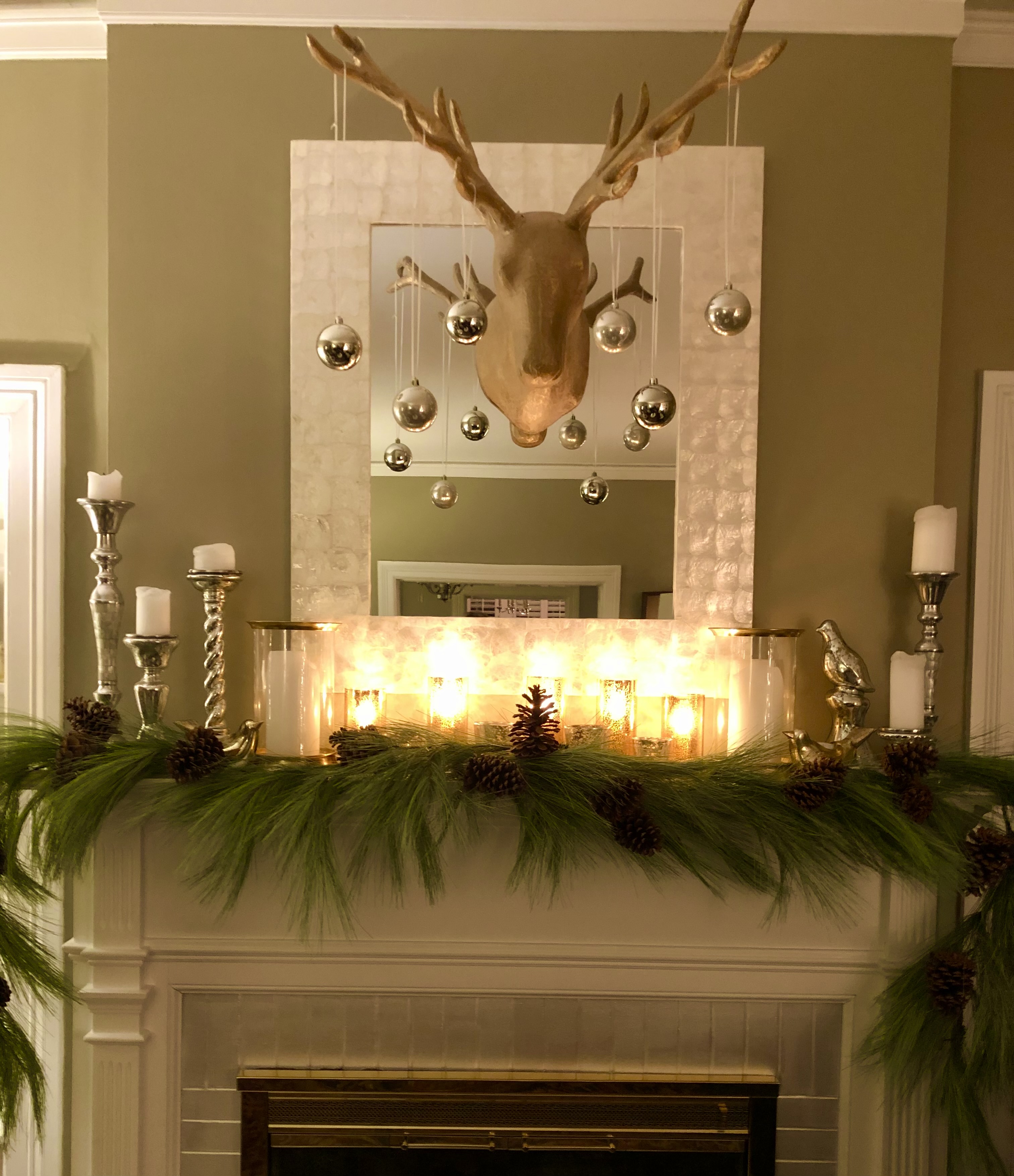
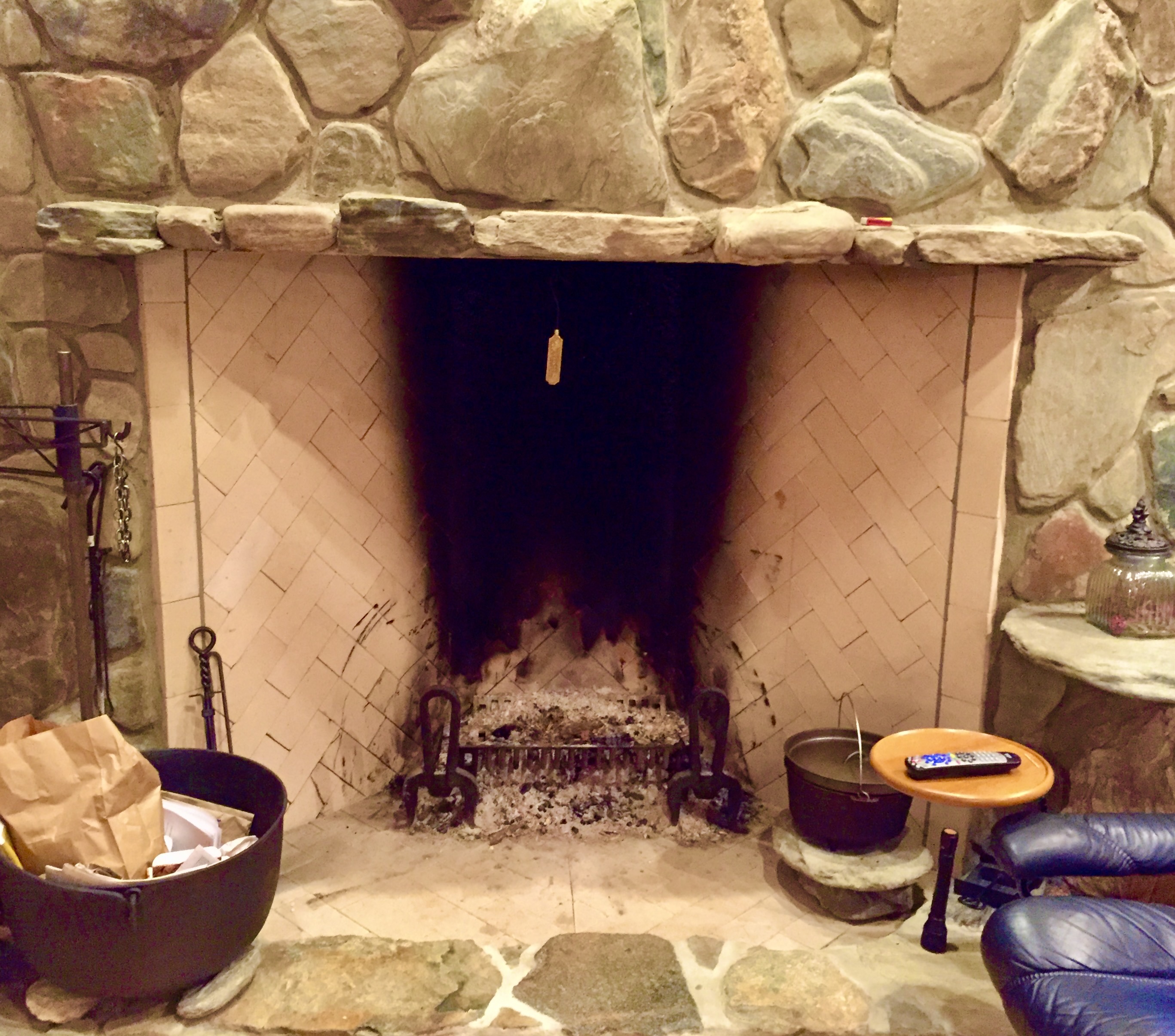
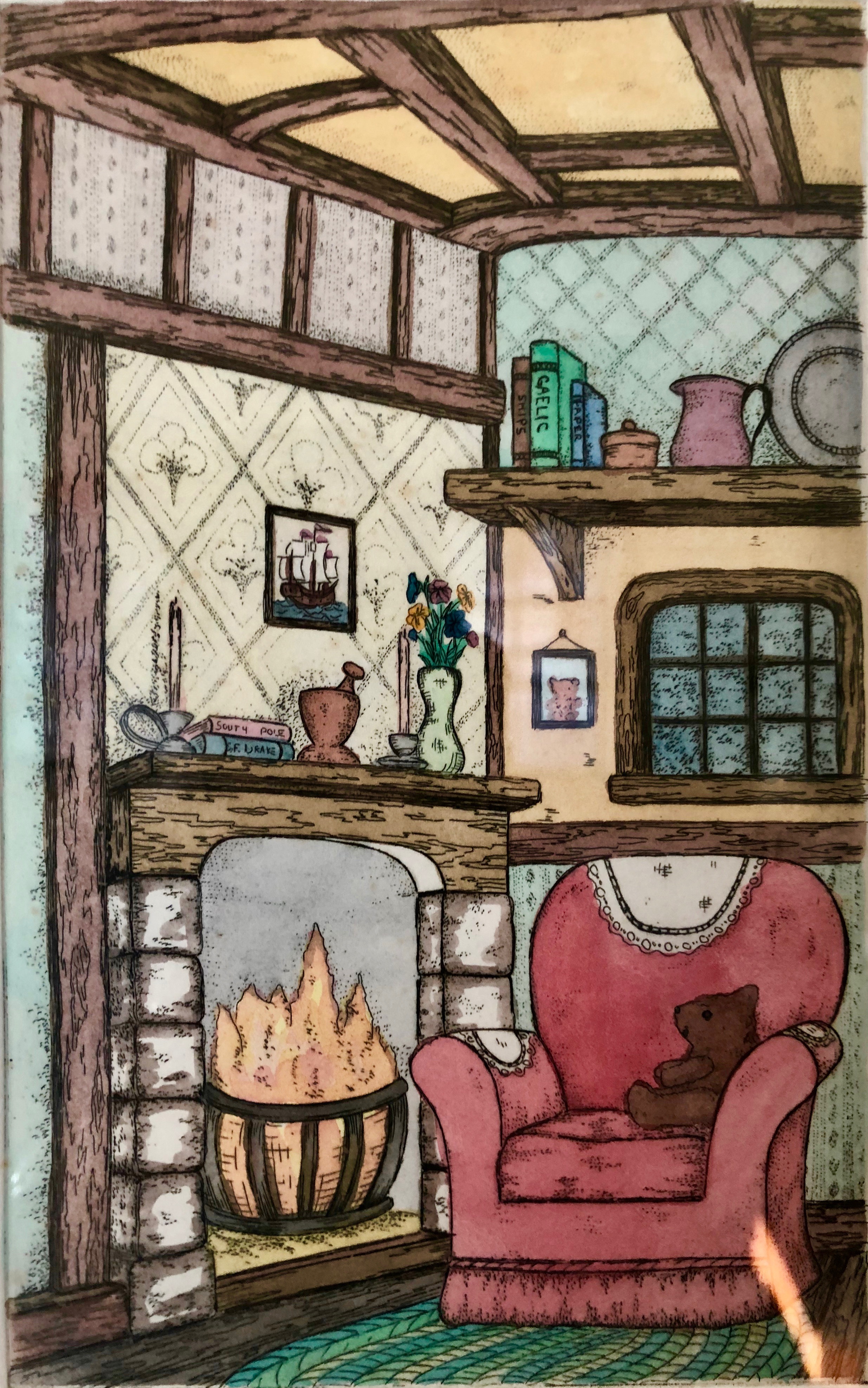
In the hope that you are able to spend this holiday season near a toasty fireplace, with good will in your heart, in the surround of family and friends into the coming New Year.


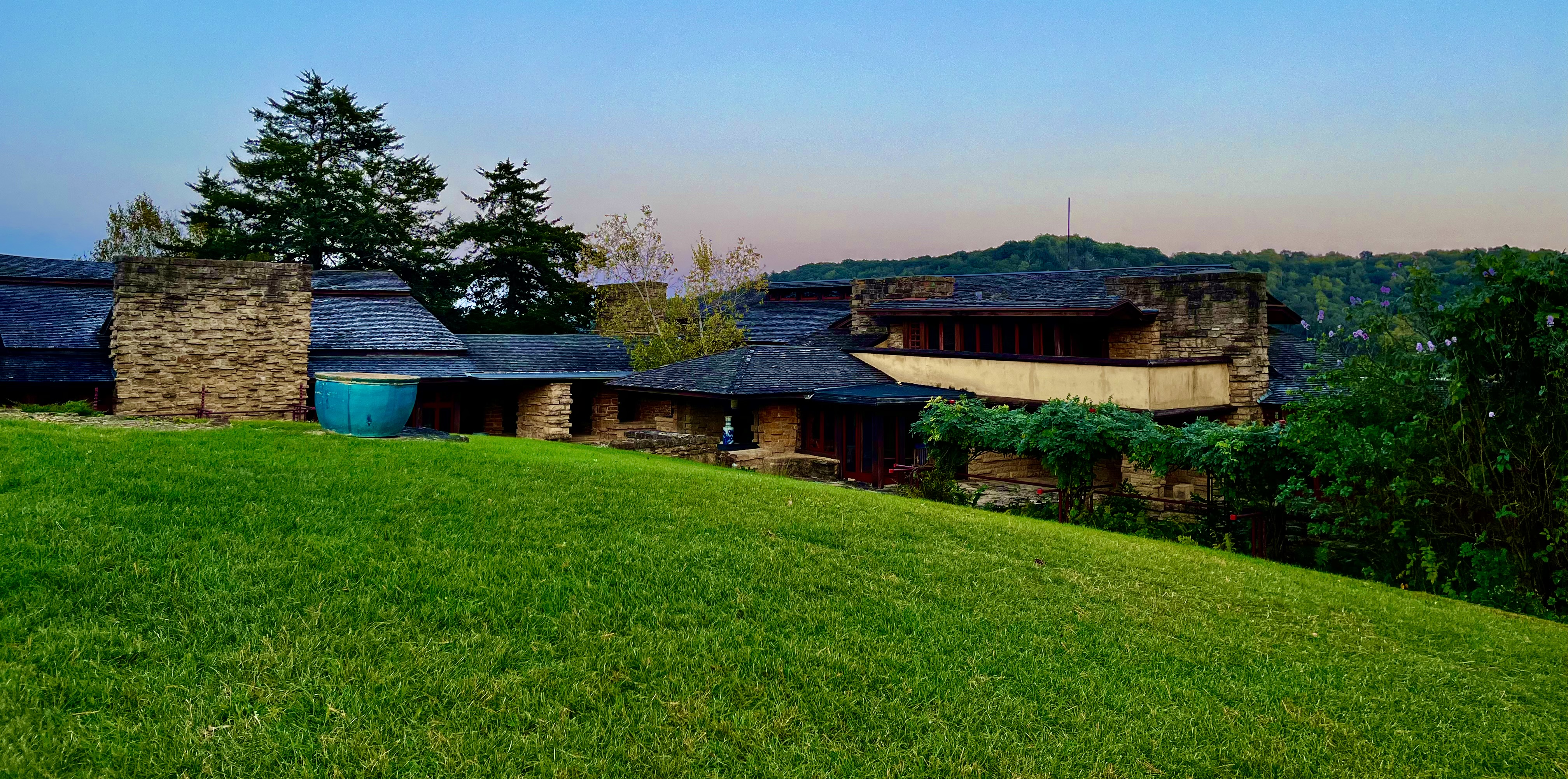
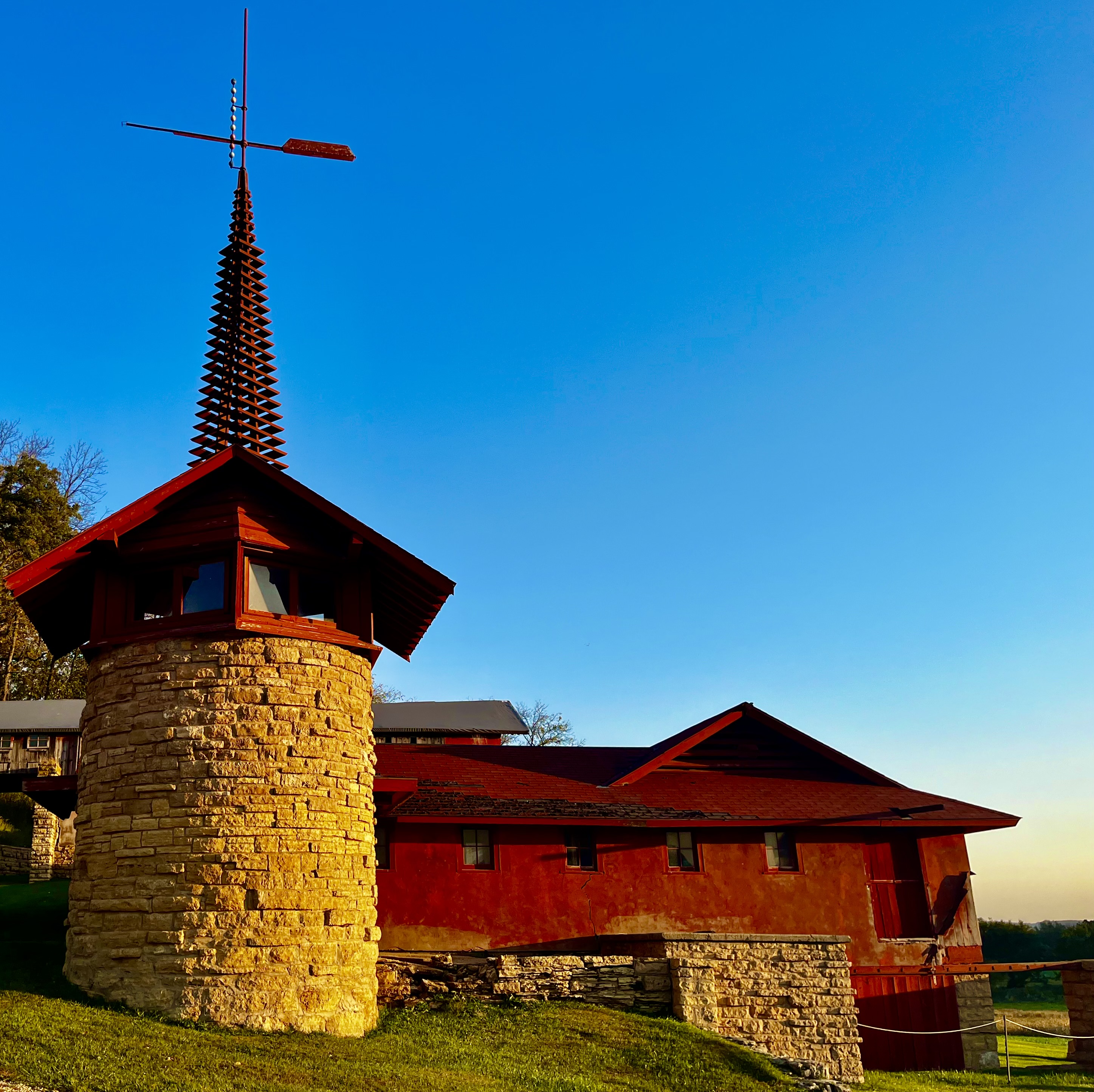
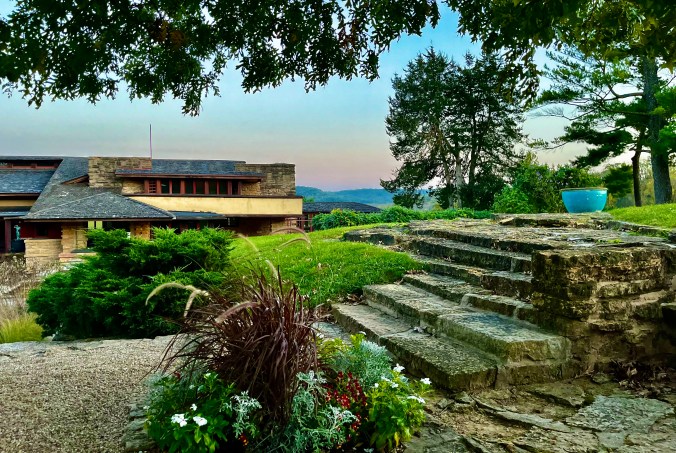
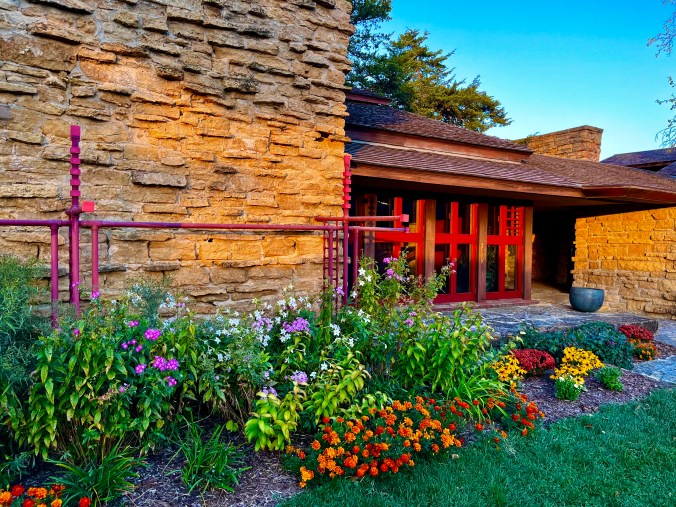
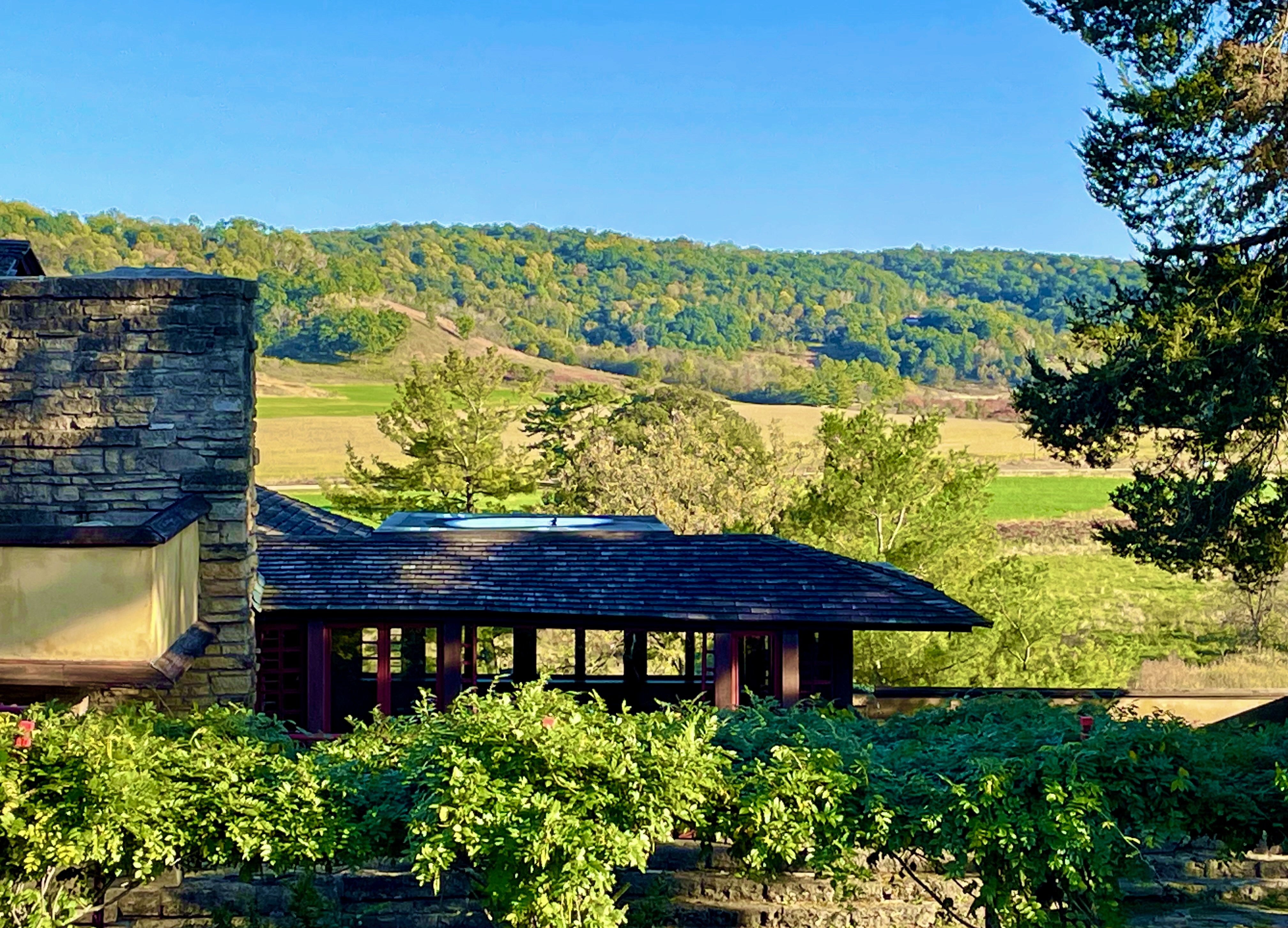
On a warm October weekend in 2024, I lived in a bedroom on the lower level of Frank Lloyd Wright’s “Shining Brow” home outside the town of Spring Green, Wisconsin. He designed and built it more than 100 years ago in the rolling farm and woodlands where his Welsh ancestors had settled as farmers in the 1840’s. Taliesin, which means Shining Brow, is the Welsh word by which the 800-acre estate is known because it sits on top of the hill and blends seamlessly into the landscape around it. I wanted to experience Wright’s unique design philosophy by spending time in this geography.
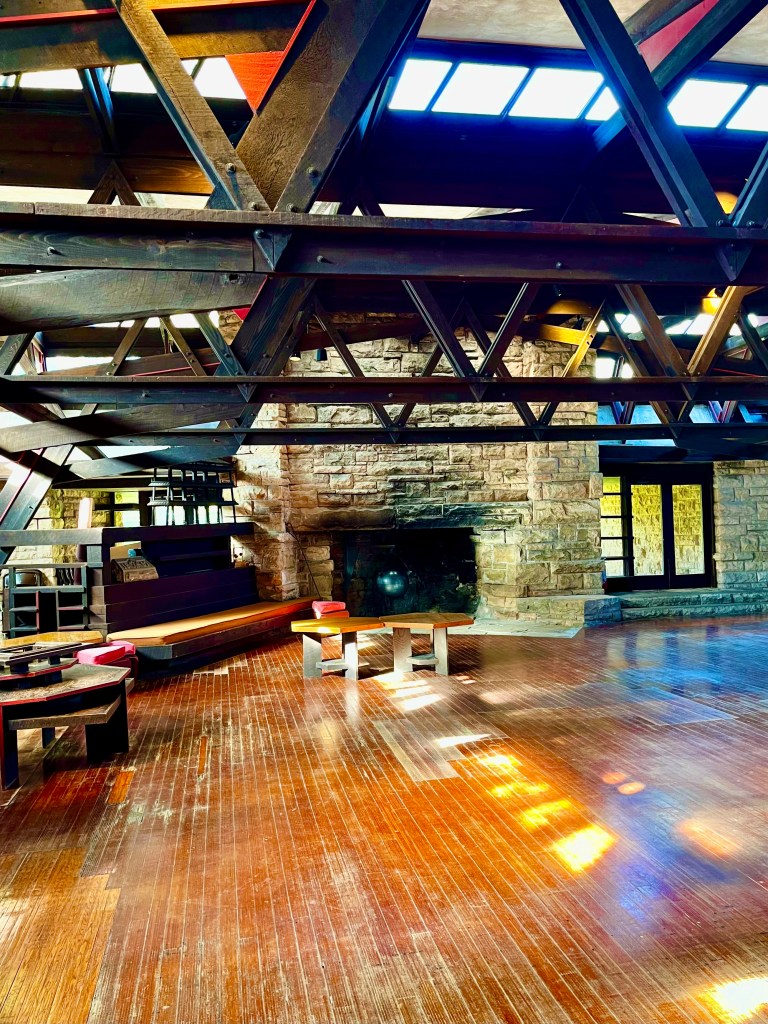
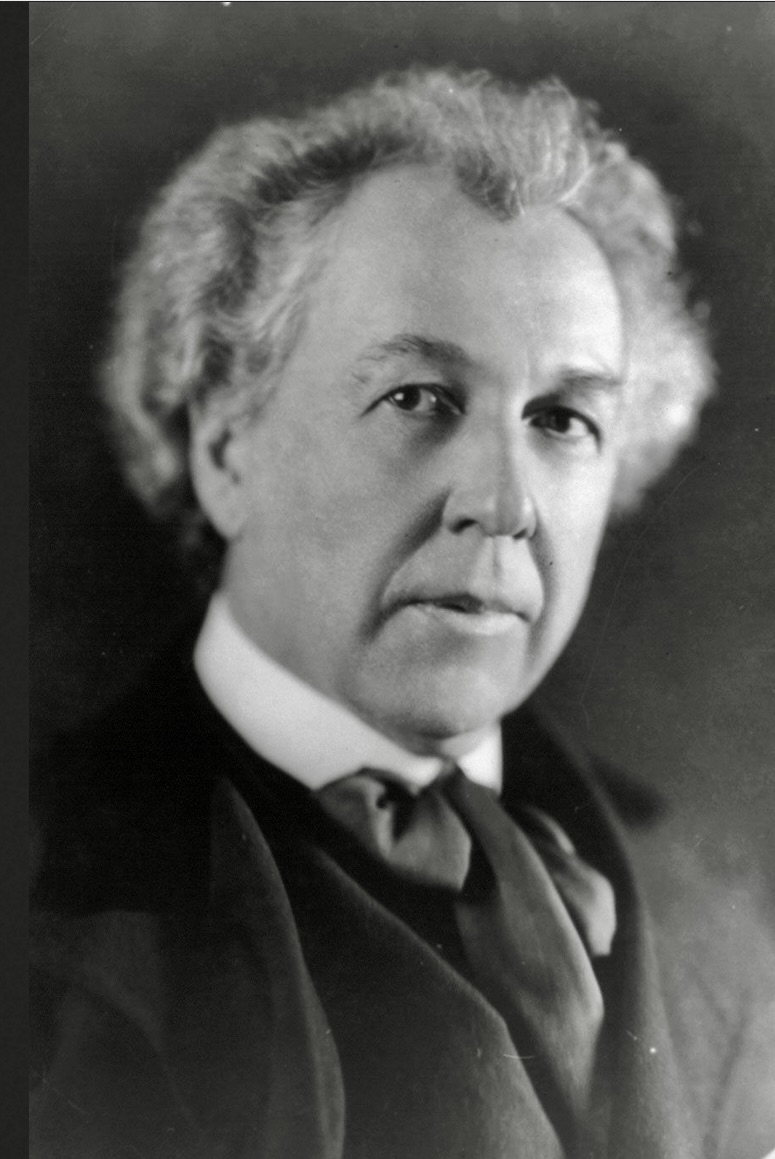
Frank Lloyd Wright [1867-1959] was an American architect of renown in the last century. He designed houses and buildings in careful harmony with the natural environment, using the landscape’s resources, materials, and topography as guidelines. In his houses everything complements nature; low slung, wide, cantilevered eaves and flat rooflines, walls of windows framed in wood, and always a large, centrally located open fireplace. He designed the lighting and the furniture too, believing that spaces [both practical and aesthetic) should serve how people move and feel within them.


Since I was a young child, I have been intrigued by houses, how we create spaces in them that resonate with our spirit. I remember when I fell in fascination with Frank Lloyd Wright as a creator of special “places”. In my first job as a Pediatric nurse in Madison, Wisconsin, one of my colleagues lived with her boyfriend and several other people in a house they were renting. When I walked in, I felt something visceral; this was a place and a space that made me feel like I wanted to wake up there every day. A huge open fireplace in a large living room, red polished floors, floor to ceiling walls of windows bringing light and outside greenery in. I asked my friend if another bedroom was available to rent. I would have moved in that day.
Frank Lloyd Wright was a complicated genius, as many artists are apt to be. As the only son in an extremely dysfunctional marriage between a preacher and a teacher, his mother put all her efforts toward the goal that Frank would be an architect. He played for hours as a young boy building complex designs with geometric shaped blocks, called Froebel’s Gifts and Occupations, which she ordered from Germany. The “Gifts”, used educationally in advanced German kindergartens, consisted of different sized blocks, pegs, pieces of colorful paper or yarn. They were instrumental in fueling his imagination for crystalline and geometric design shapes.
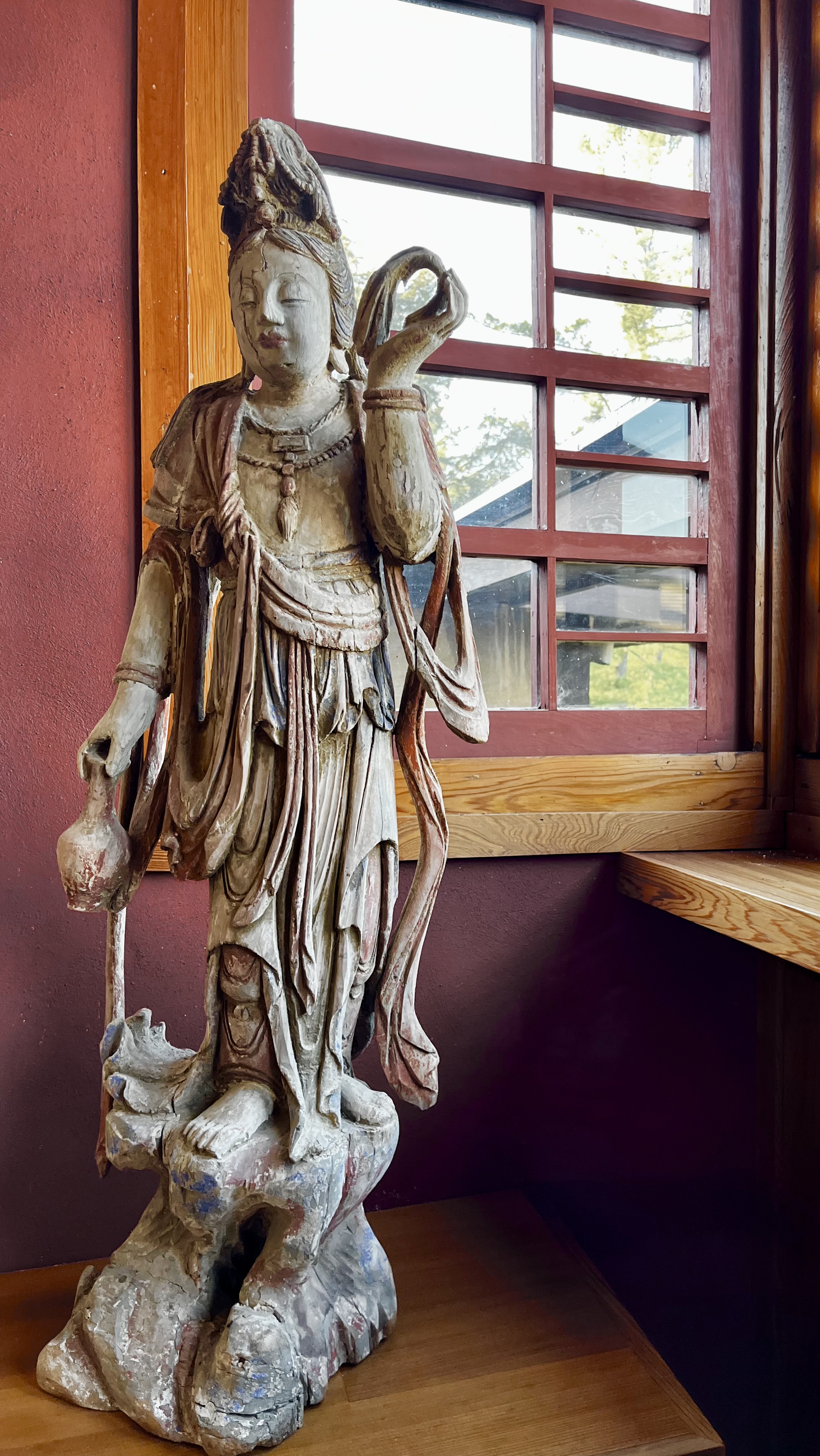
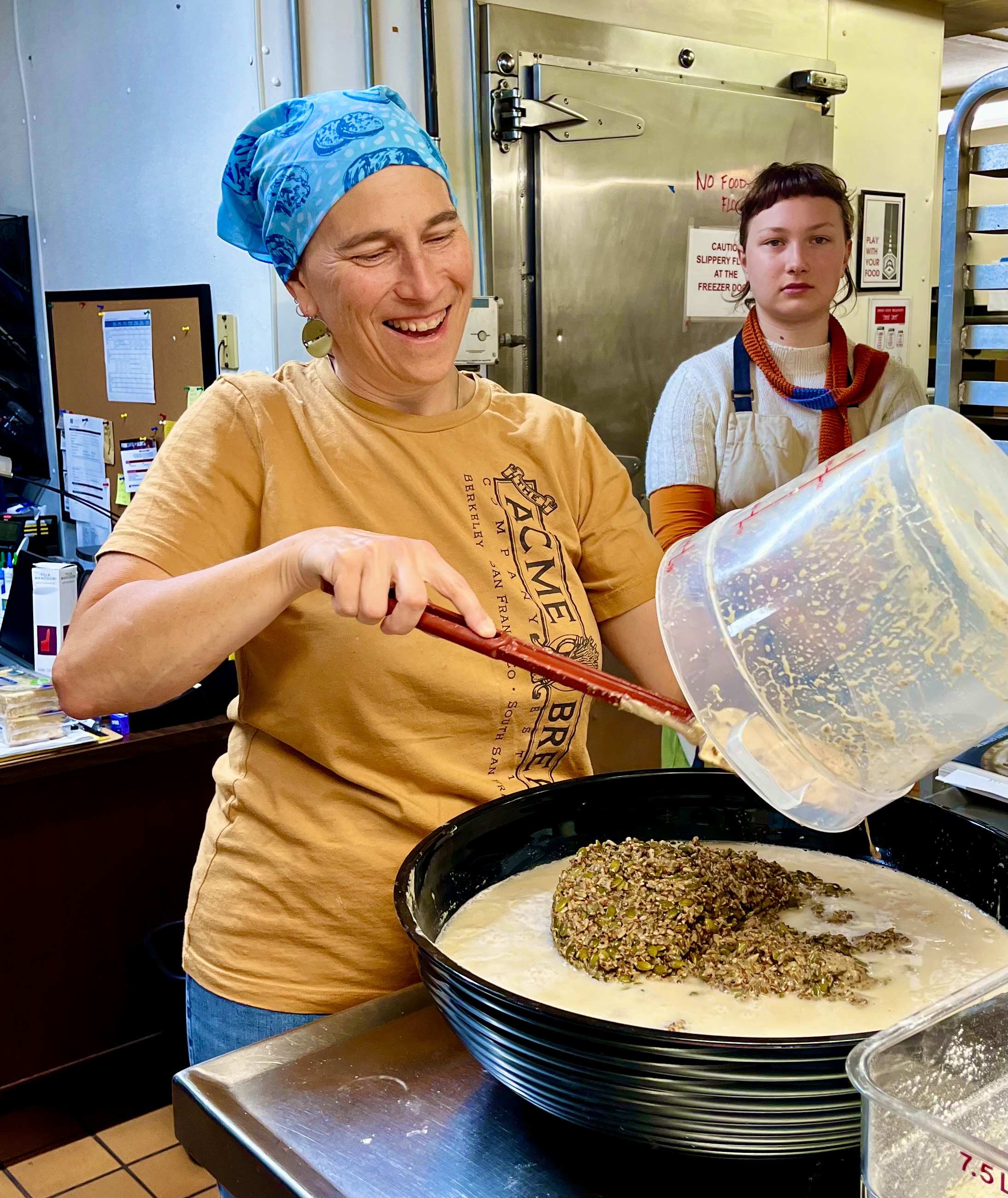
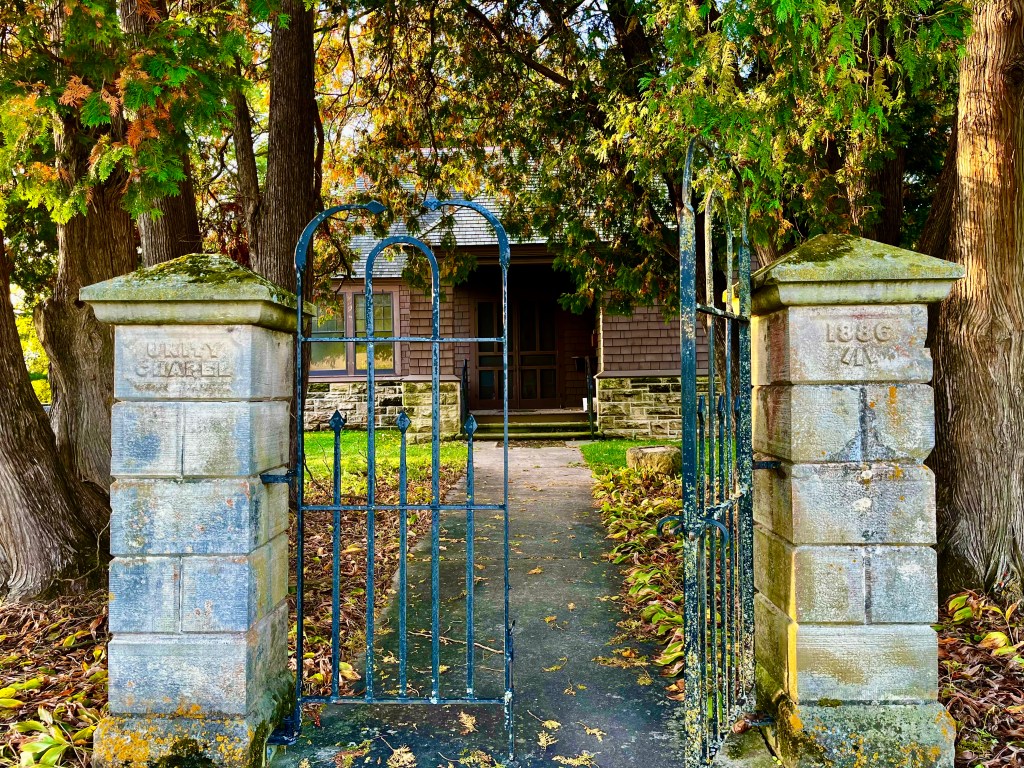
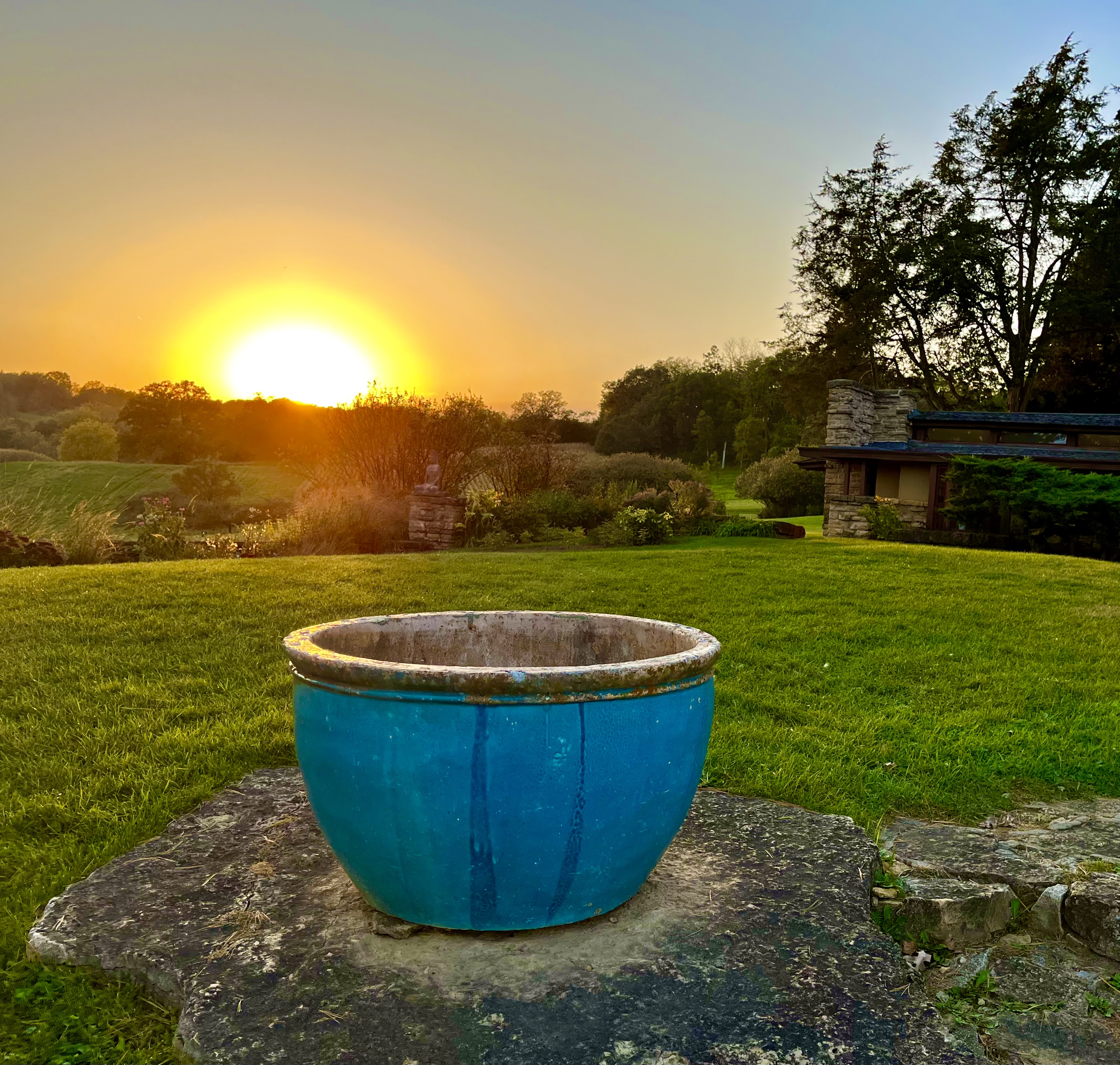
The premise of living at Taliesin for a weekend was a workshop on bread baking taught by Bazile (Elizabeth) Booth, a Spring Green baker. It was offered to a small group. Only ten people. Because we were paying guests and living on the grounds, we had the privilege of a private tour of the house and the Hillside School. The school, designed by Wright, was his first professional project in 1886. It was built for his aunts who taught a progressive day school curriculum. A later wing was added as an architectural drafting studio for interns, fellows and apprentices who lived and worked on site. We had freedom to wander the estate during the weekend, so I took advantage of photographing everything Wright designed–the school and apprentice studio, the big red barn, the Romeo and Juliet windmill, the family Unity Chapel, as well as the house and grounds.


Frank inherited his father’s short stature and good looks, his charismatic charm and engaging ability to tell a story, his lifelong talent and love for music. Wright was a poor student and never obtained a degree in his chosen field. He had a terrible reputation with finances, cost overruns, and not meeting timelines. He presented himself with panache and flair in both speech and attire. Capes, canes, and porkpie hats were his later signature dressing style. He held lofty opinions of himself and his creative gifts and proclaimed them often, and publicly. He was conservative and religious by upbringing, but his actions were ingrained by the family motto “Truth against the World”. He used this to justify his nonconforming professional and life choices.


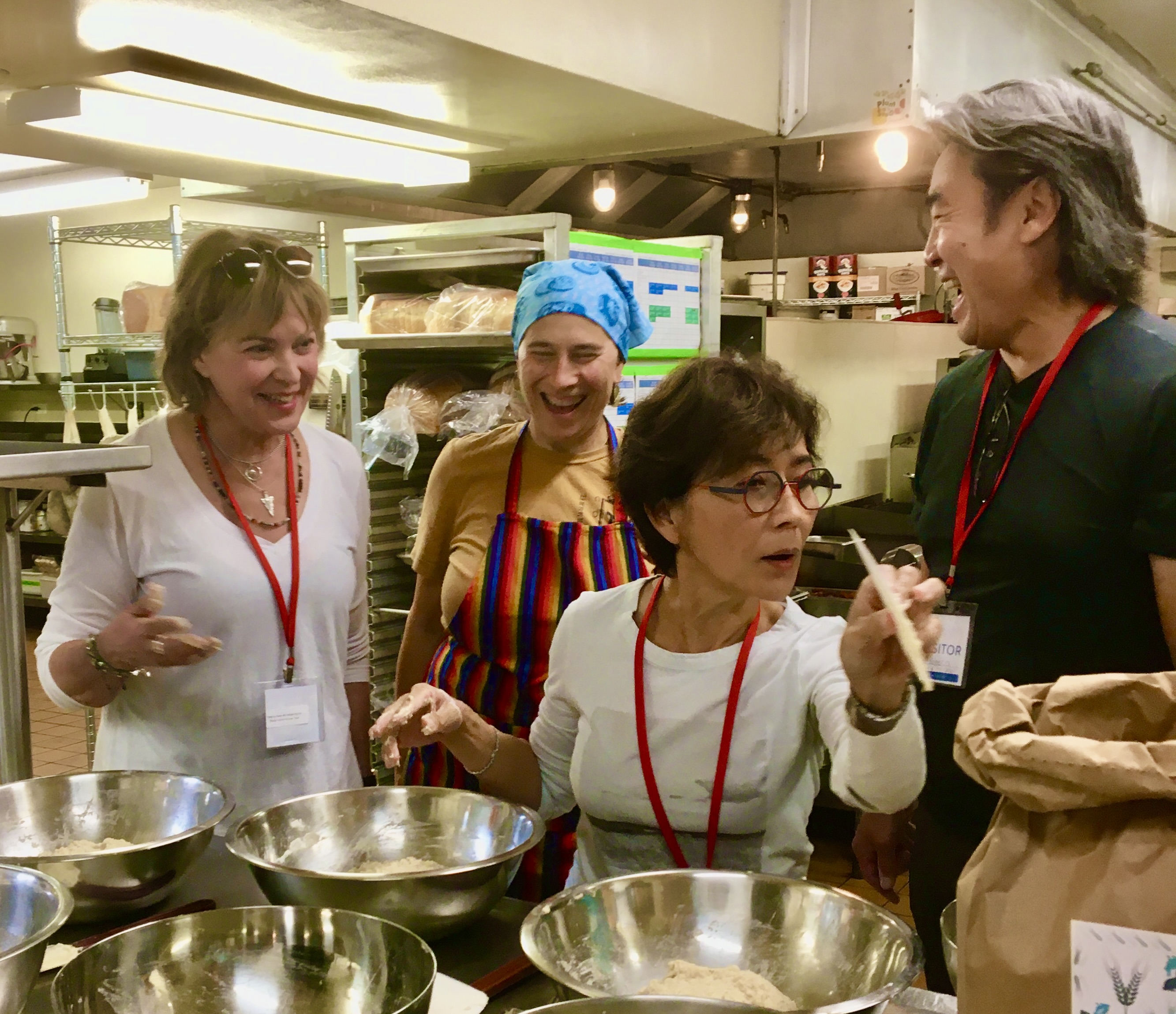
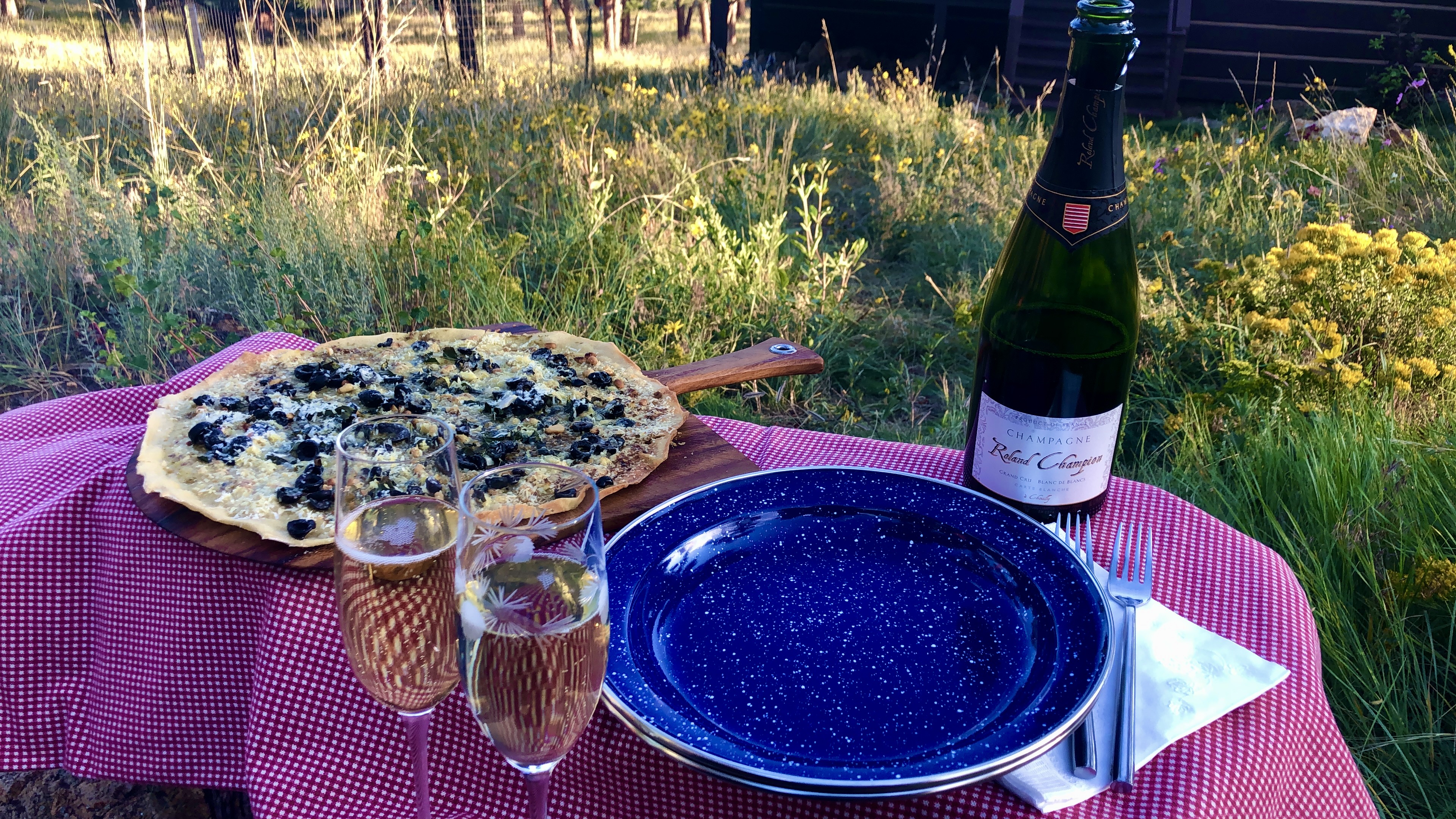
Our baking workshop group was geographically represented from the east coast to the west, the south, and the mountains of Colorado. There was a mother/daughter duo, a married couple, and the rest of us came as single bakers–four men and six women. Several people were already experienced bread bakers. After the welcoming introductory afternoon including a champagne reception in Taliesin’s main living room, touring the house’s inner sanctums, and dinner in town, we were bonded as a group.
I was probably the least interested in taking sourdough bread making into my own kitchen, challenged by an altitude of 8300 feet. I might have been the most versed in Frank Lloyd Wright history, trivia, and lore. To each their own interests. But baking my own “boule” of country loaf was what got me there and set the daily schedule of morning and afternoon. We started right after breakfast on Day 2.
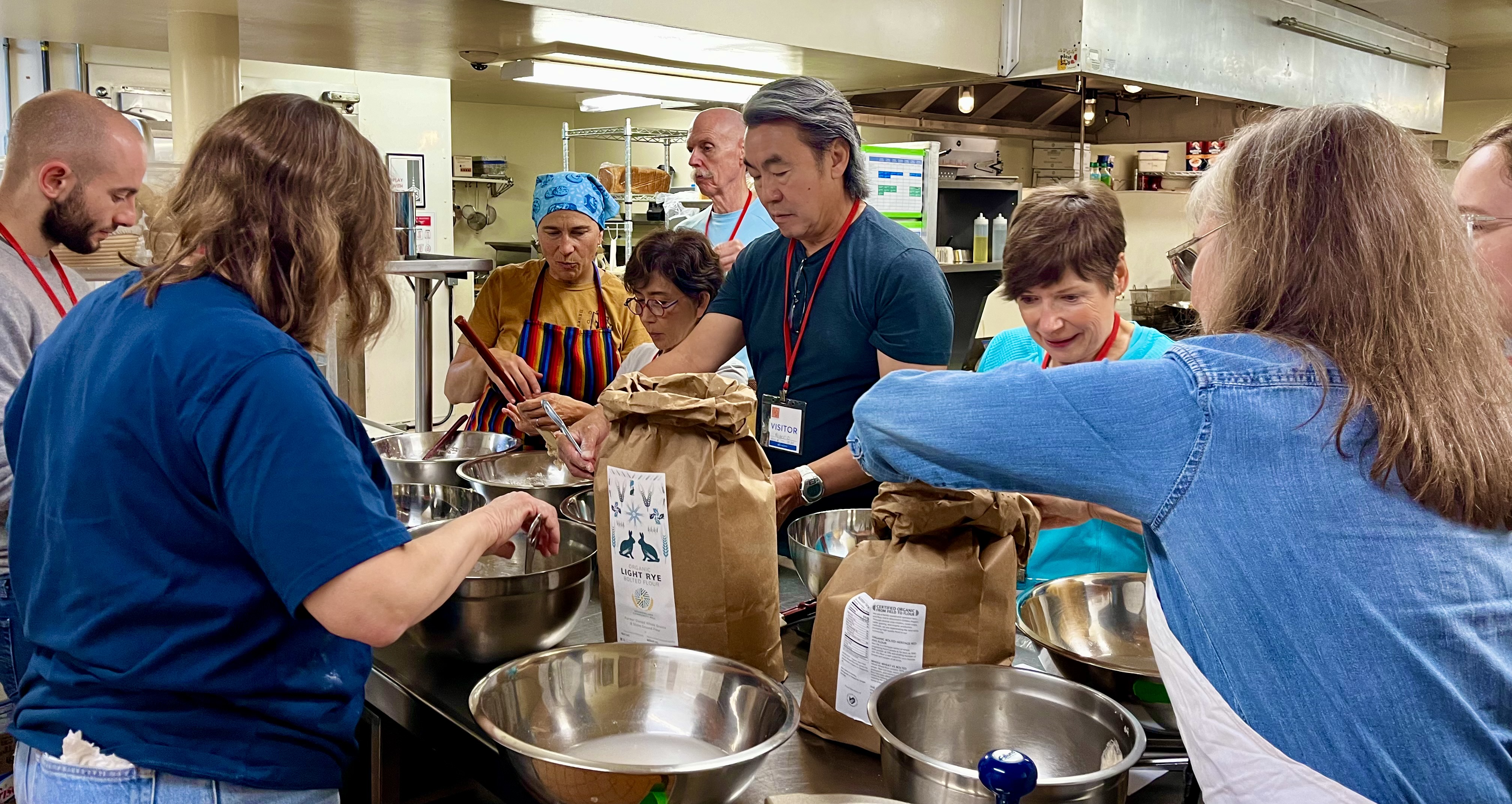
Bazile Booth is a professional baker with a successful storefront and business in downtown Spring Green. She is also a great teacher with a laid-back approach toward getting 10 pairs of hands to wind up with a successful loaf of bread. We measured and weighed ingredients, then waited to let the natural fermentation process of water and flour and sourdough starter begin their magic.


We hovered over our bowls, cheered each other’s success while bubbles formed as the yeast grew active. We stretched and turned the dough to aerate it. It took all day.
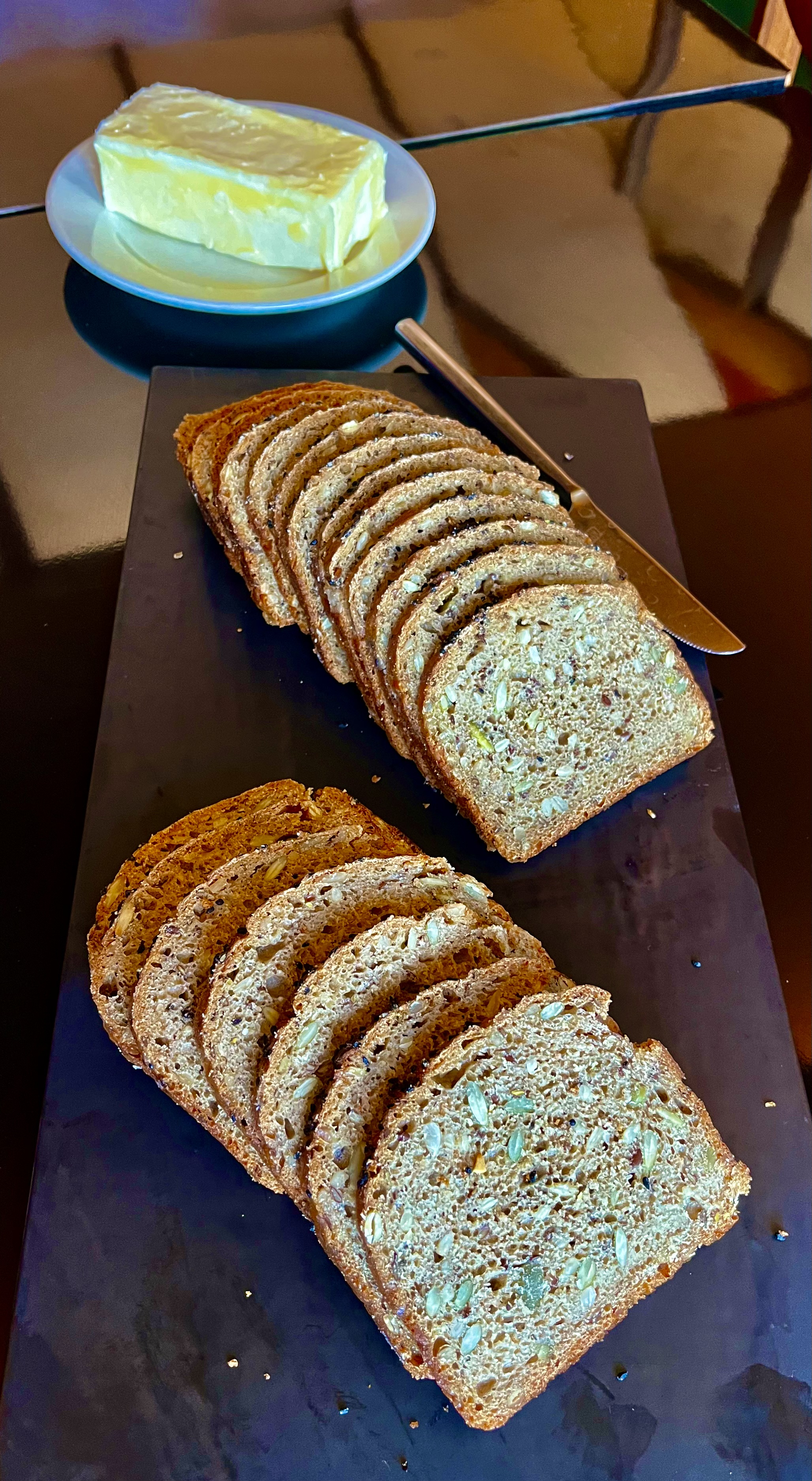
We didn’t bake the bread until Day 3. Instead, the dough “rested” in cloth lined baskets in the refrigerator until it was successfully turned into a beautiful brown loaf the next morning. After the final lunch we claimed our loaves to take home as if they were newborn babies.


Frank Lloyd Wright evolved into a successful and sought after architectural designer who was artistically ahead of his time. Then, he fell deeply in love with the wife of a neighbor and client in Oak Park, Illinois at a time when marriages were not easily dissolved. When they could no longer deny their attraction and desire to be together, Frank and Mamah (pronounced May-ma) sat together with their spouses, Catherine Wright and Edwin Cheney, to explain the situation. Frank’s Victorian-era wife flatly refused to divorce him so Frank and Mamah left the country for a year, in 1909, where they both worked in Europe.


Mamah was intelligent, highly educated, lovely, and an early feminist before that was a trend. Fluent in several languages, she taught school while in Germany. Then she was hired to translate the writings of a Swedish feminist, Evelyn Keys, whose work she and Frank admired and followed. Some of it formed the basis of what they believed about living together in love, even without a legal contract. Frank was busy working on a portfolio book of his work for publication in Berlin. They were often apart, but it was a break from the excruciating gossip back home. Upon returning in 1910, Edwin Cheney divorced Mamah, but Catherine Wright steadfastly refused to sign papers. Instead, she encouraged media attention to humiliate and denigrate her husband who broke convention and remained in his relationship with Mamah.
In 1911, to escape relentless criticism fueled by the newspapers, Wright designed and built Taliesin in the ancestral countryside west of Madison on land his mother purchased.
Three years later, in August 1914, Lloyd Wright suffered a devastating loss of love and property when a mentally deranged employee killed seven people on the estate while Frank and one of his sons were working on an uncompleted project (Midway Gardens) in Chicago. It was more gruesome than anyone could imagine, especially for Wright when returning to the aftermath.
Julian Carlton, houseman at the time, served the lunch soup on a hot summer day to Mamah and her two children, seated on a screened-in porch. Then he broke her skull with a “shingling hatchet” before turning the weapon on young John and Martha. Workers, gardeners, and apprentices were dining in another area of the house. Julian again served the soup, bolted the door shut, spread gasoline outside the room until it ran underneath the door, then ignited it. Men who tried to escape were attacked with the hatchet. By the end of that horrific day, seven people were murdered by axing and/or burning to death. Two-thirds of Taliesin was in smoldering ashes.
Frank’s son, John Lloyd Wright, made this observation about his father. “Something in him died with her, a something lovable and gentle that I knew and loved…As I reflect now, I am convinced that the love that united them was deep, sincere and holy in spite of its illegality–I am convinced that the woman for whom he left home was of noble character.”
Wright, numbed by emotional and physical pain, his body broken out in boils, eventually realized that faith and hope were now lost to him. “Something strange had happened to me. Instead of feeling that she, whose life had joined mine there at Taliesin, was a spirit near, she was utterly gone. After the first anguish of loss, a kind of black despair seemed to paralyze my imagination in her direction and numbed my sensibilities. The blow was too severe.” As a form of consolation, he felt that only by immersing in the work of rebuilding Taliesin could he get relief. “In action, there is release from anguish of mind.”


Taliesin II rose from the ashes in a completely new rendition. And then again, in 1925, when faulty wiring caused another fire, Wright rebuilt it for the third time into the current version.
One hundred years after the second redesign and rebuilding of Taliesin I walked around the estate grounds as the light changed from late afternoon to dusk. I wanted to feel what Frank and Mamah lived together in this rich green farmland with the hills and a river running through it. I wondered why Wright was compelled to rebuild after not one, but two devastating fires. What was it about this rural setting on a verdant hillside with expansive views overlooking the Wisconsin River that inspired him to continue life there after immeasurable tragedy?
I worked my way around the landscape, sitting in various spots to photograph scenery and imagining the bevy of apprentice architects who laboriously built the stone walls, walkways, and gardens a long time ago. I thought about how and why it framed Frank and Mamah’s short life together there over three years. The reasons began in his childhood.


Frank’s love and loyalty to the land began as a boy when he labored on Uncle James Lloyd-Jones’ farm summer after summer. It was a grueling learning curve to a stronger body and a fierce work ethic. He termed the phrase, “tired on tired” to describe the relentless fatigue and suffering endured from being wakened at 4:00 AM until falling into bed at night. But that steady seasonal diet of hard physical farm work set a high standard for the rest of his working life, seven decades, until his death at 92.
Wisconsin farmland, orchards, green wooded hills, a flowing river and nature were Wright’s roots. He built and rebuilt Taliesin here, pushing through times of great loss and suffering through the work. He returned when he needed to go home and restore his spirit. The landscape and the memories were the foundation of his physical, mental, emotional and spiritual health.
I first encountered the term “spiritual geography” in a book by Kathleen Nolan called Dakota: A Spiritual Geography. It’s the story of how she returned to the territory of her upbringing in South Dakota when her grandparents died. She and her husband traveled from New York City to settle the estate and ended up staying there for 25 years. The premise is that where you are from forms a part of your spiritual expression and never leaves you. Spiritual geography is the beginning of how we see and inhabit the world and how it inhabits us. It is where and how we learn the lessons to slow down, savor peace, solitude, and open spaces (where they are available). We take the lessons from our earliest remembered spiritual geographies and live the concept wherever we go.
I understand it two ways. My early childhood years were spent in a small suburb of St. Louis, Missouri with regular visits to the farm where my grandmother lived 30 miles away. It gave me comforts, freedoms and connection to both city and country living. Later, moving to Colorado in married life, a small town in the mountains bordering a national park became my grown-up spiritual geography. As we navigated life with two children in five countries around the world, always creating a home wherever we lived, I knew where the permanent “home” was waiting. It was where we refreshed our spirits every summer during the overseas years–in a mountainous landscape larger than we were that diminished the small details of life.

Frank Lloyd Wright’s return to the rural hills of his youth regenerated and nurtured his soul over a lifetime. Later, after his marriage to Olgivanna, he created a second spiritual geography near Scottsdale, Arizona. The desert environment and beauty of the southwest resonated with them both. Taliesin West was built, using the landscape as a guide, for their winter home. Wisconsin and Arizona remained an important summer/winter hiatus for the rest of their lives. They found spiritual renewal in both places.
The weekend at Taliesin reinforced my belief that how we create and inhabit our homes and personal spaces is another form of spiritual geography. Not landscape based, but living based. If we are fortunate, we can have both. Our home spaces (and how we live in them) provide emotional nurturing, too. Developing “inside geography” takes thought and effort. It requires letting go of anyone and everyone else’s notions of what is nourishing and meaningful in your life. It requires spending real time thinking, imagining, and playing with both practical and aesthetic beauty. Then, as Frank Lloyd Wright, you go about the work. You take up the action by collecting, arranging and rearranging. It’s a continual process. It can evolve over years. But, in time, you wake up every day in your version of spiritual geography.
WHY I LOVE WISCONSIN
By Frank Lloyd Wright
(Excerpts from an essay posted inside the Taliesin house)
I love Wisconsin because my staunch old Welsh grandfather with my gentle grandmother and their 10 children settled here nearby. I see the site of their homestead and those of their offspring as I write. Offspring myself, my home and workshop are planted on the ground grandfather and sons broke before the Indians had entirely gone away.
This Wisconsin valley with the spring-water stream winding down as its center line has been looked forward to or back upon by me and mine from all over the world, as home.
And I come back from the distant, strange, and beautiful places that I used to read about when I was a boy and wonder about; yes, every time I come back here it is with the feeling there is nothing anywhere better than this is.
More dramatic elsewhere, perhaps more strange, more thrilling, more grand, too, but nothing that picks you up in its arms and so gently, almost lovingly, cradles you as do these southwestern Wisconsin hills…
…Wisconsin soil has put sap into my veins. Why, I should love her as I loved my mother, my old grandmother, and as I love my work.

Resources (and quotes) used in this story are from:
Frank Lloyd Wright, A Life by Ada Louise Huxtable, 2004, Penguin Books (a short and very readable biography of the man, accounting for both flaws and genius)
Death in a Prairie House by William Drennan, 2007, University of Wisconsin Press (a detailed background, history, and accounting of the murders at Taliesin in 1914)
Dakota: A Spiritual Geography by Kathleen Norris, 1993, Houghton Mifflin Co. (coming home to find yourself)
A Brave and Lovely Woman, Mamah Borthwick and Frank Lloyd Wright by Mark Borthwick, 2023, University of Wisconsin Press (distant relative of Mamah Borthwick writes a detailed portrait of her life, before and with FLW)
More about creating spiritual geography at home: The Poetry of Space
Childhood spiritual geography in rural Missouri: The Coleman House, Villa Ridge, Missouri
Adult spiritual geography in the Colorado mountains: Bugling Elk and Sacred Spaces
End Note:
Over the past year the true bread bakers in our Taliesin workshop have shared multiple emails with suggestions, successes and failures, tidbits learned in their home kitchens, encouragements, book recommendations and photos. It remains a group where the journey continues in practice and spirit. I came to Taliesin because of an artisanal bread workshop and to gather information to write a story. I dedicate this to all the bakers from that weekend, and to Elizabeth (Bazile) Booth, teacher extraordinaire, owner of Sky Blue Pink Bakery in Spring Green, and Caroline Hamblen, our guide and Director of Programs at Taliesin Preservation.
This is a factual but personal story about my daughter & son-in-law’s entrepreneurial, creative, community and philanthropic spirit in the business they created together. These two inspire me.
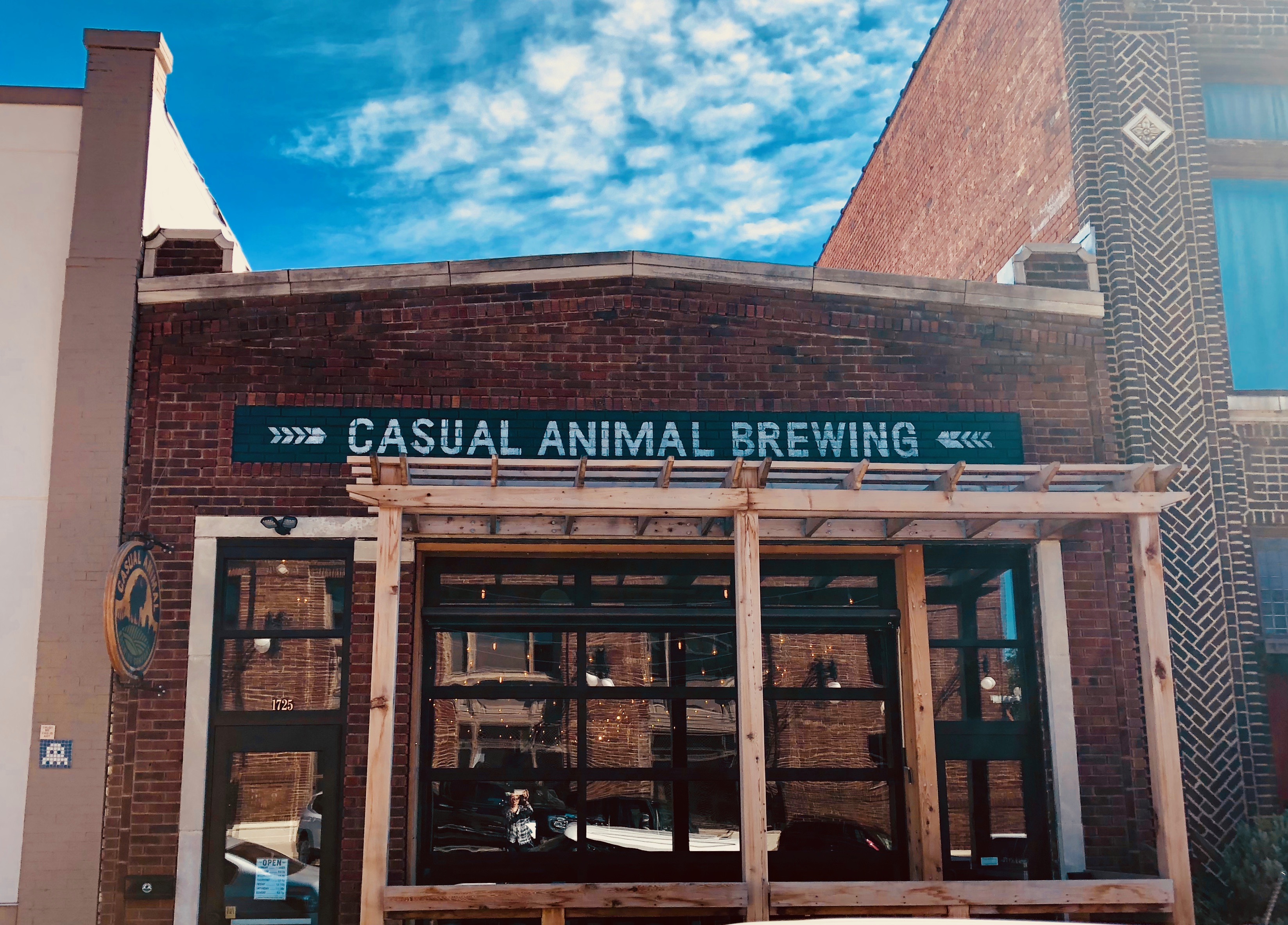
In the Crossroads area of downtown Kansas City, Missouri, directly across the street from the attractive brick façade of the former Kansas City Star Newspaper, resides Casual Animal Brewing Company.
On the outside, a colorful mural is painted above a window that opens like a garage door when the weather favors outdoor seating. The bar stools, where customers sit and sip cold craft beer, overlook the sidewalk as pedestrians pass by.
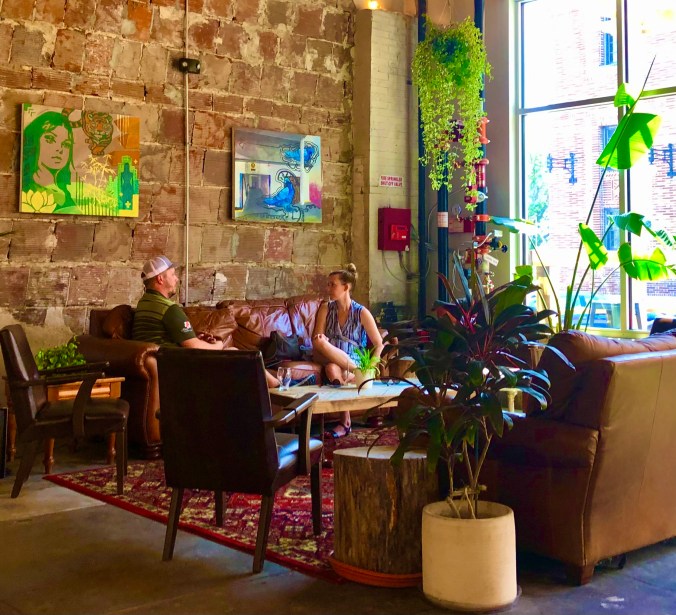
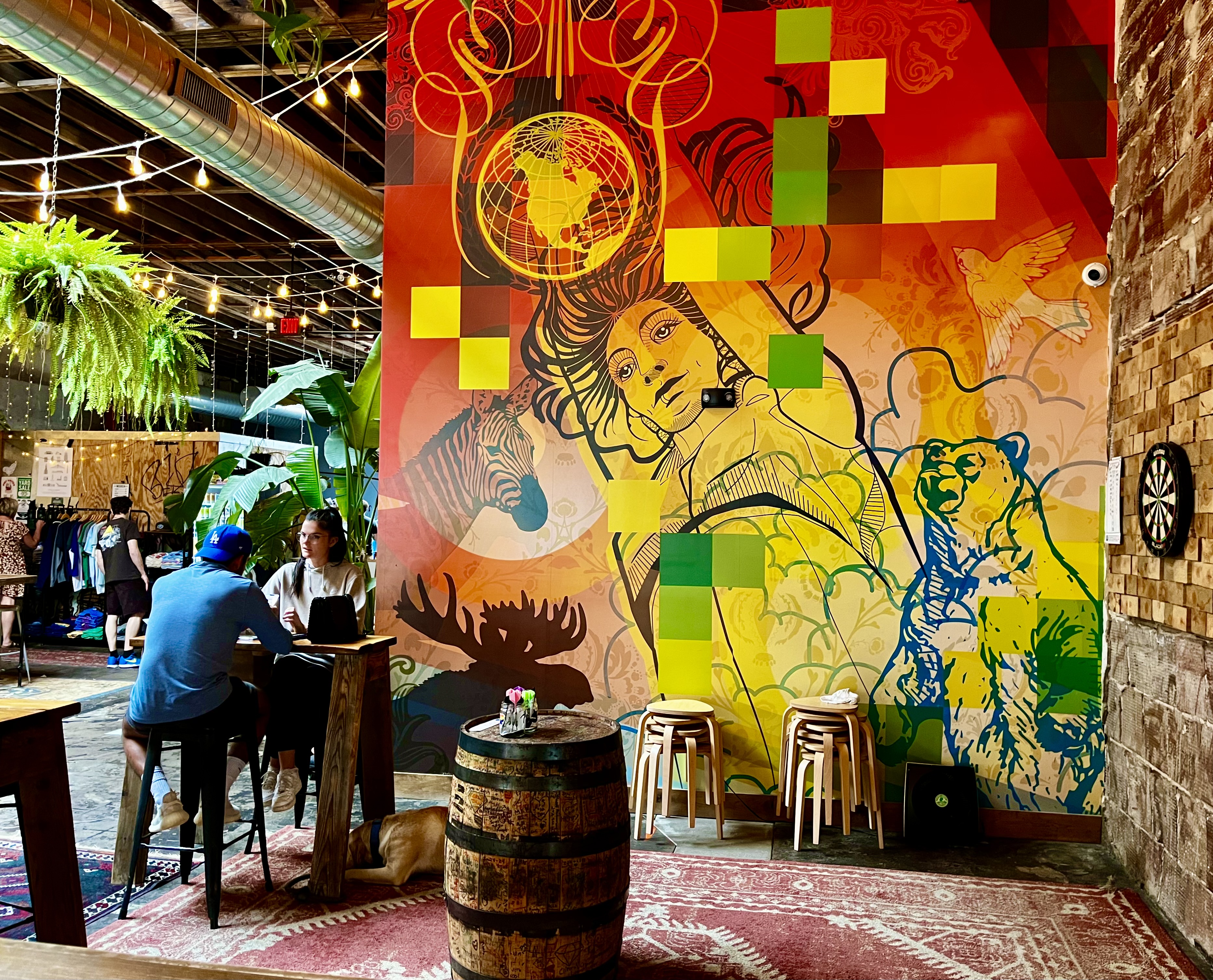
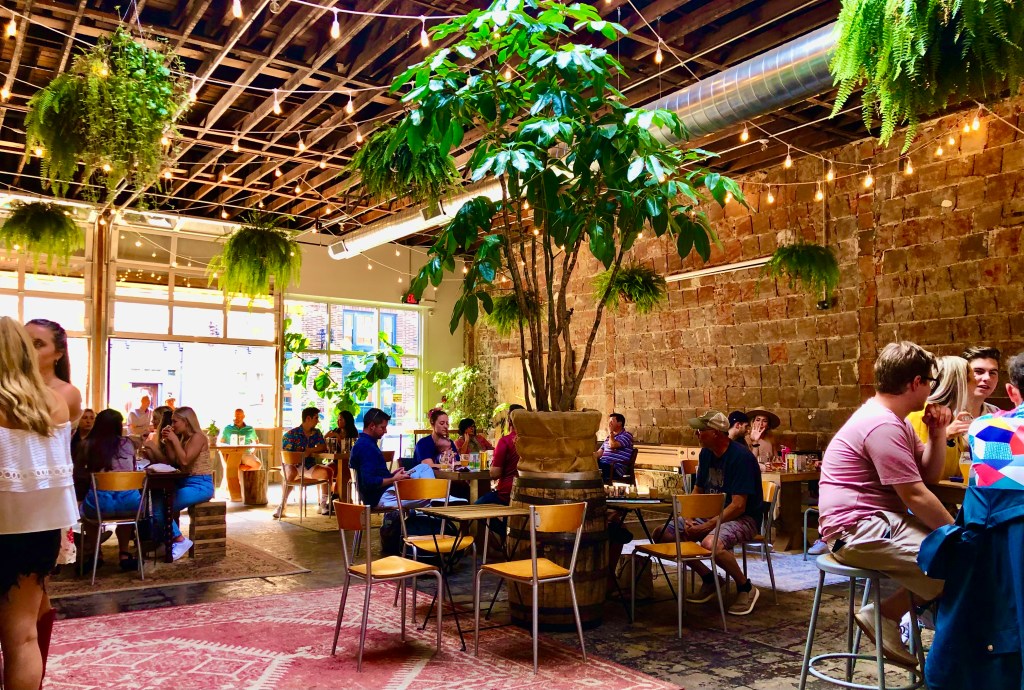
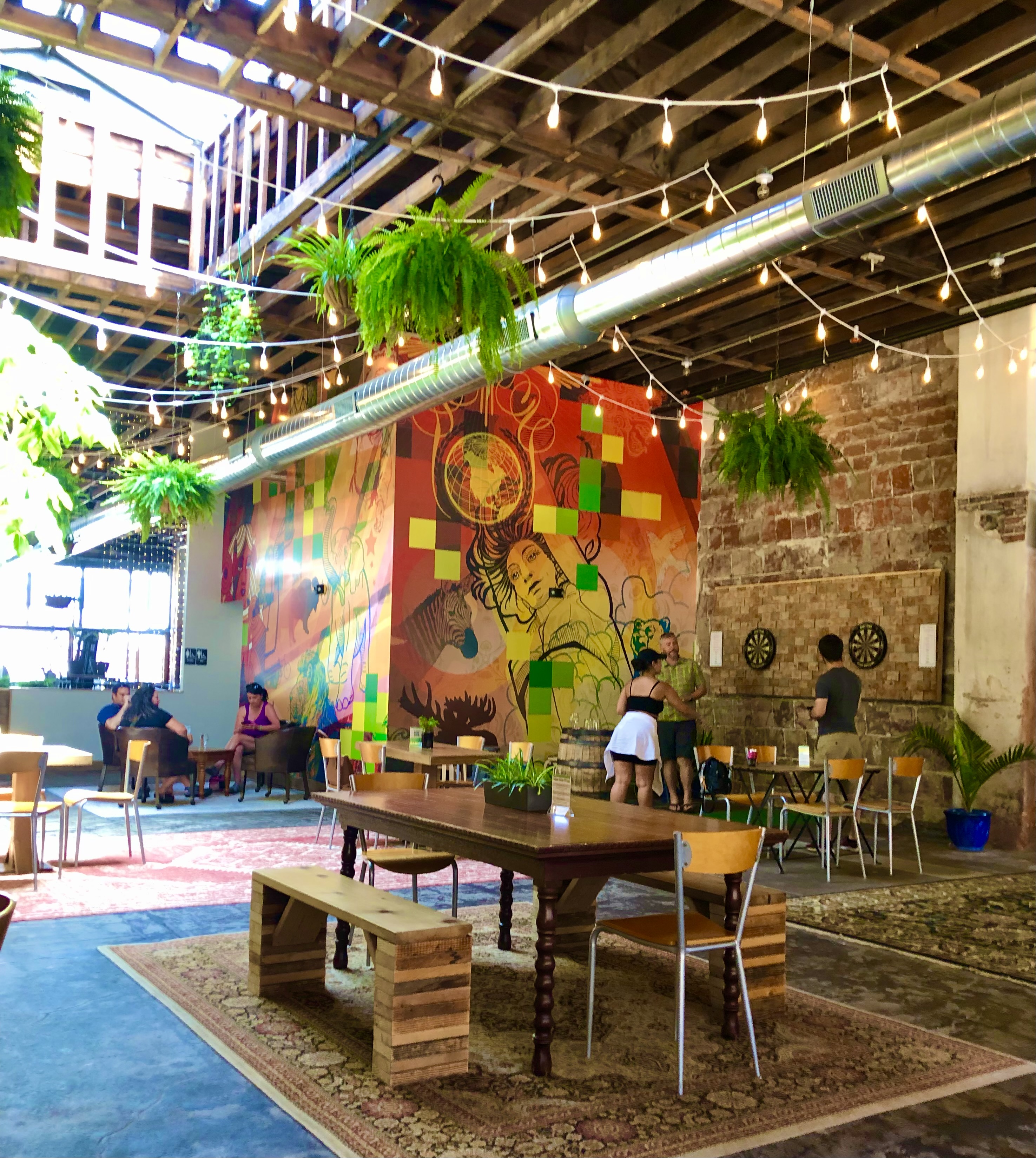
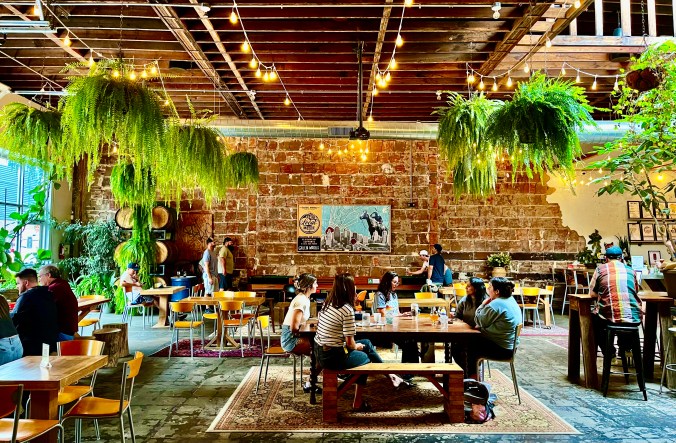
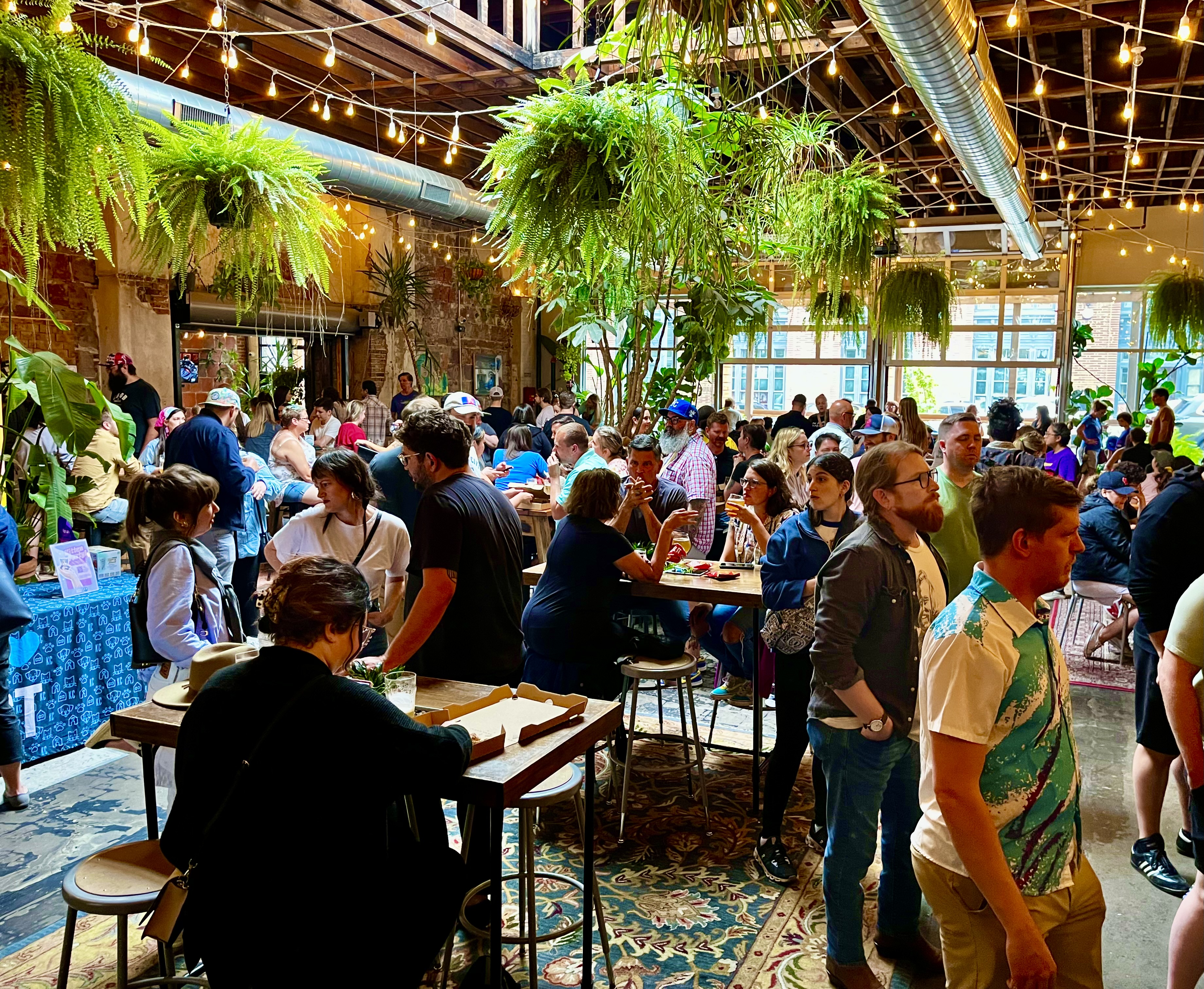
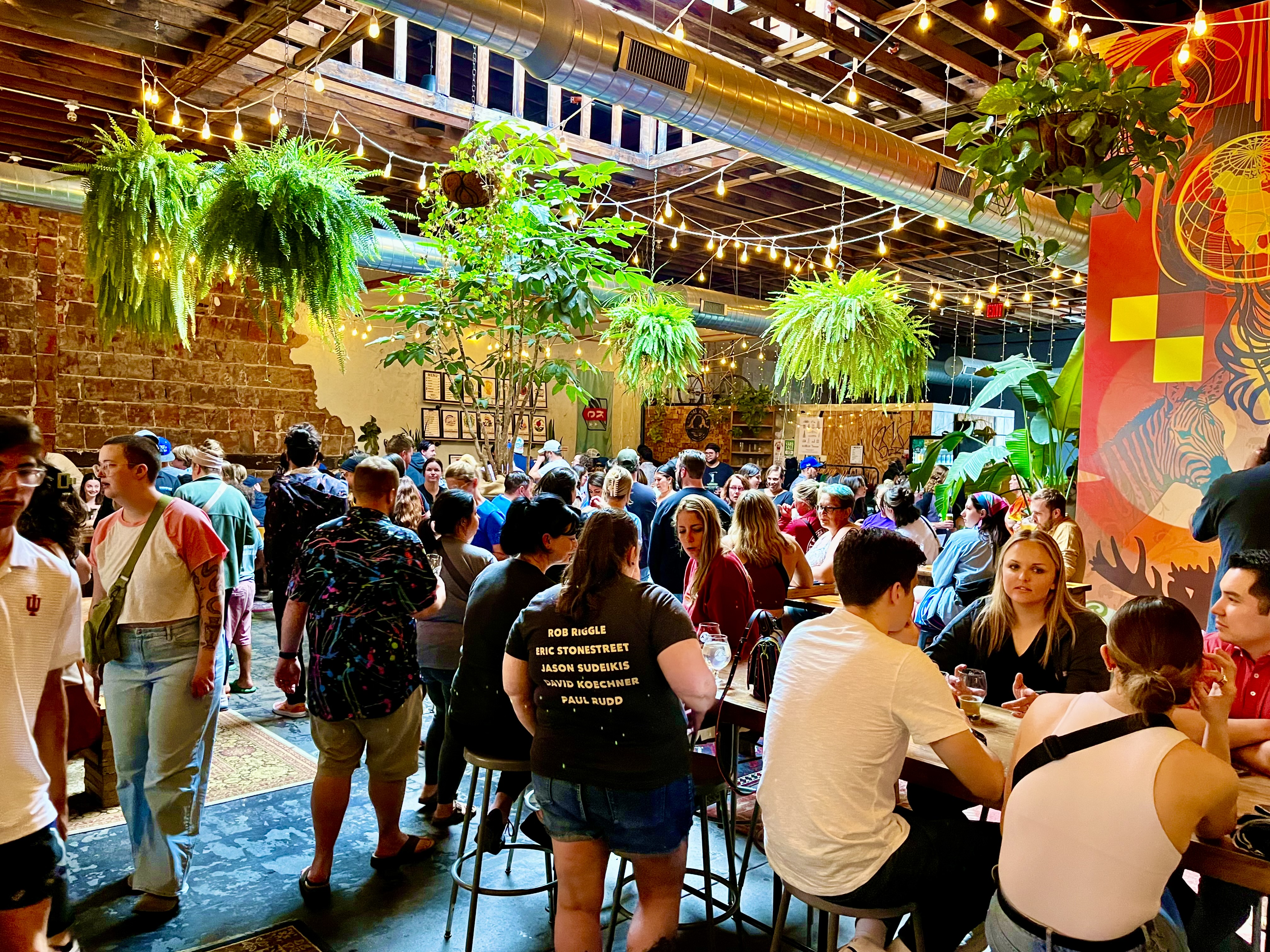
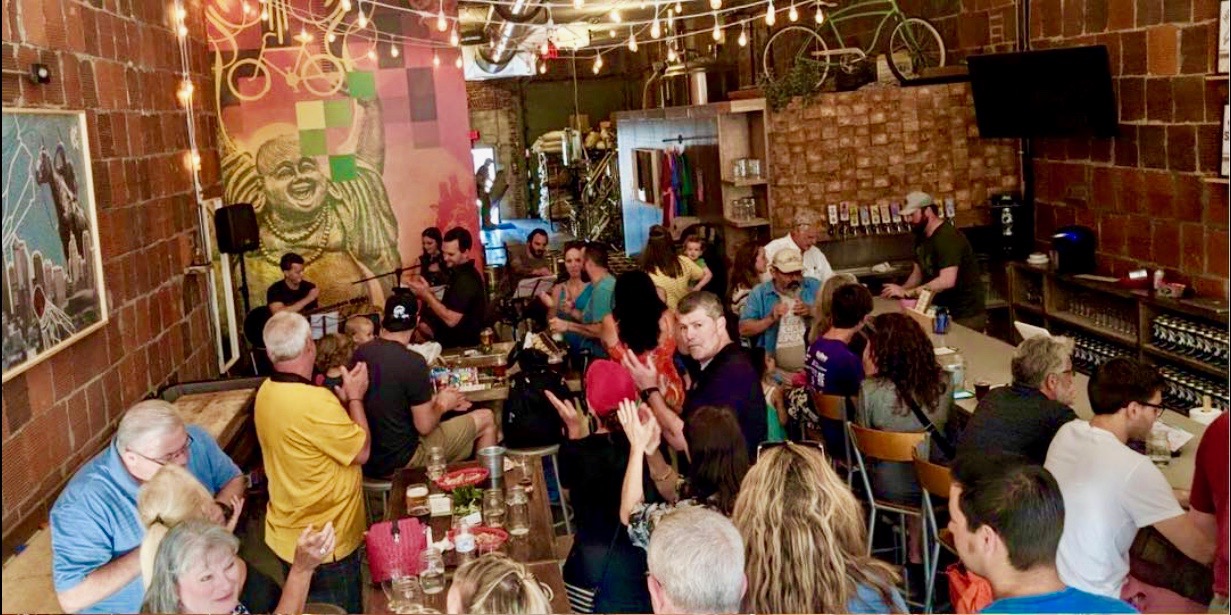
Inside, industrial steel cylinders are tucked under open ceiling beams and skylights. Hanging Boston ferns trail down from above and a tall Umbrella tree reaches upward to the central skylight. The seating is mostly handmade wooden tables. Refinished log stools line the sides of one long table. Leather sofas and cushioned chairs are placed in cozy conversation corners surrounded by potted green plants.


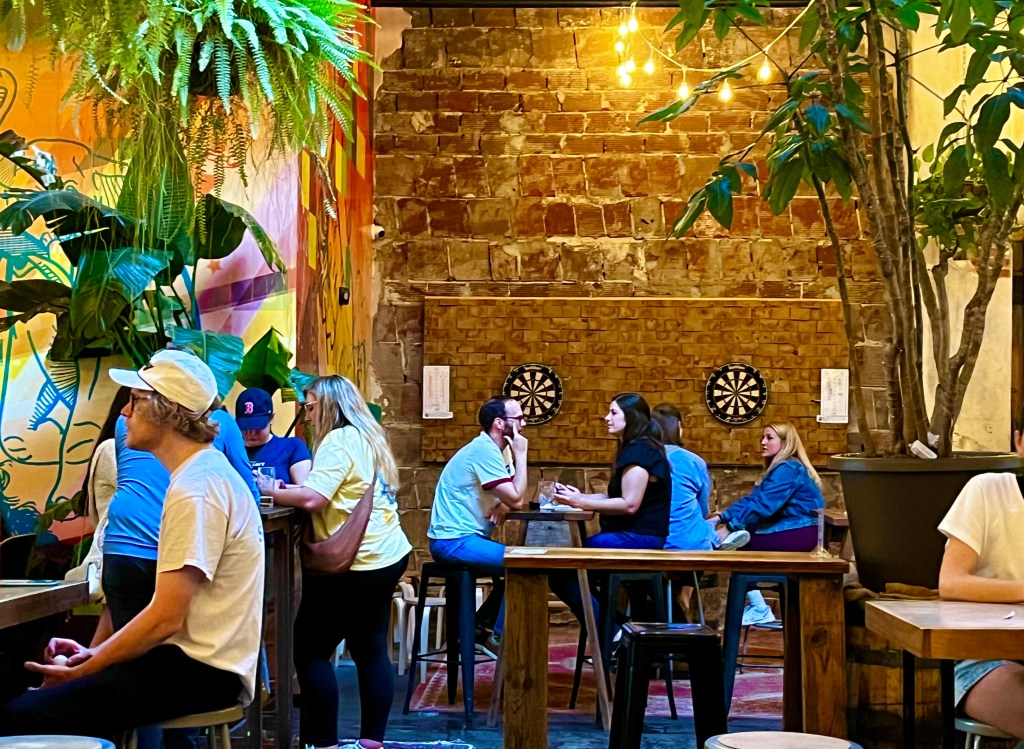
Colorful oriental carpets lay on the cement floor in a patchwork fashion. Shuffleboard, darts, and boxes of board games are ready to play with family or friends. Strings of lights are draped throughout, exposed brick walls create texture, along with original art wallpaper and paintings designed by head brewer, Kyle Gray. He also happens to co-own Casual Animal with his wife, Lara. The overall atmosphere of this craft brewery exudes laid-back ease with an infusion of warm ambience. You want to sit down, order a beer from one of eleven full taps, and just hang out for a while.


Kyle runs the “back of the house”; creating beer recipes, brewing twice a week in a 7- barrel system, canning, designing logos for labels or merchandise sold online and directly from the brewery. Lara takes charge of the “front of the house”, staffing and training, social media and marketing, taproom events, distribution and delivery in local restaurants, liquor stores and bars.
Lara is also the current President of the East Crossroads. This is their neighborhood organization whose goal is to unify all area businesses as a destination entertainment district for locals, conferences, business travelers, and vacationers. One important aspect is to increase traffic and retail business for the diversity of restaurants, small shops, craft breweries, and cocktail bars in Crossroads. Recently she has helped the neighborhood receive $35,000 in grant monies from the city of Kansas City. This will be used for commercial branding, highlighting the district with streetlight pole banners, directional signage, and other resources.


The Beginnings Through a Pandemic to Today
The background of how Casual Animal Brewery was first dreamed and conceived by Kyle and Lara in 2017-18 is a compelling story of its own, and told here: Becoming a Casual Animal
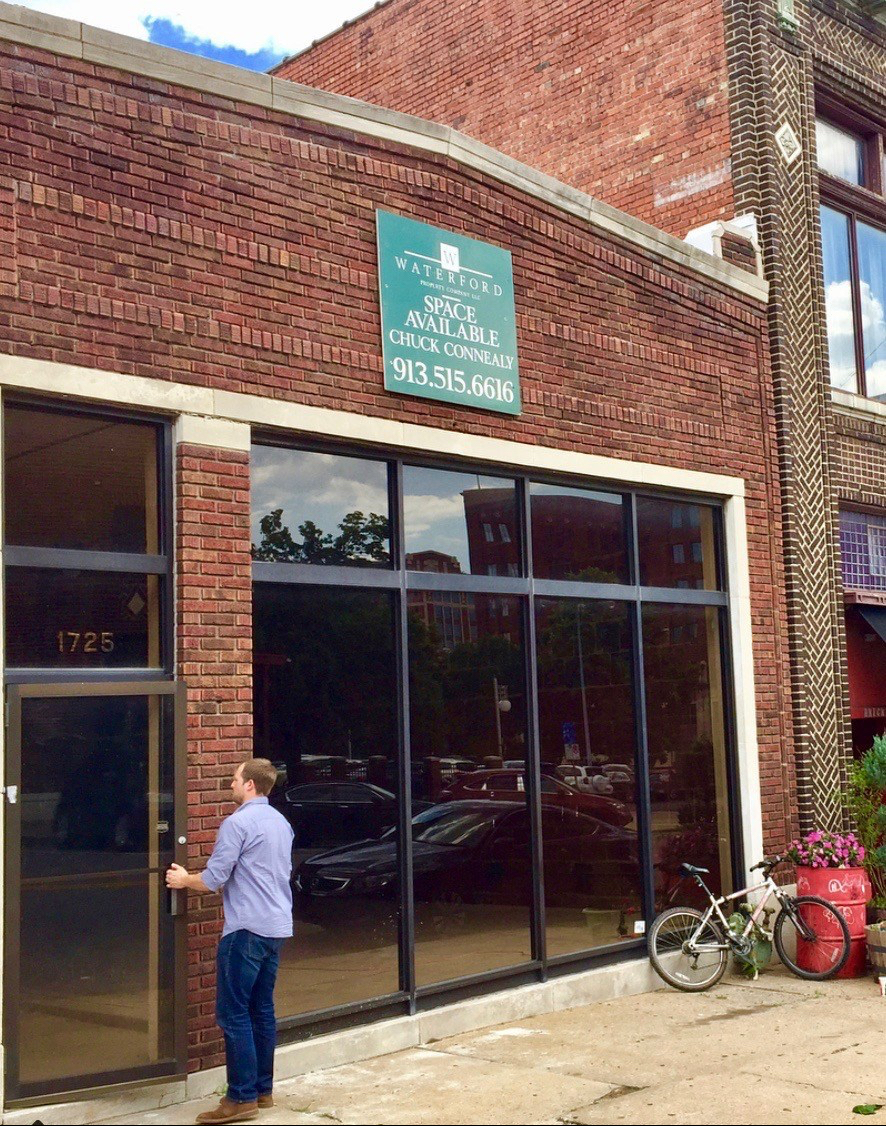
The story of the opening of the larger, plant-draped conservatory side of the brewery began just before the shutdown of the Coronavirus pandemic. In November 2019, Kyle was taking trash out to a dumpster in the back alley. A secretary from a neighboring business was standing outside on a break. She asked Kyle if he knew the building next door to the brewery was for sale. At the time, it was a truck storage warehouse with zero infrastructure. But it was big and shared a common wall.
Kyle called the owner, toured the space and applied for a loan in February of 2020. They closed on the property in May of that year when the whole country was hibernating at home amid the uncertainties of Coronavirus. Kyle’s brother, Alex, was hired as General Contractor and moved into their house for the next nine months.
The risk of taking on a new, larger loan and beginning a complete renovation to expand Casual Animal (by more than doubling its size) started in earnest while a global pandemic was raging. Kyle had serious doubts and anxieties about moving forward, but ultimately decided there was no better time to expand the brewery than with this serendipitous opportunity.
Crafting a New Craft Brewery
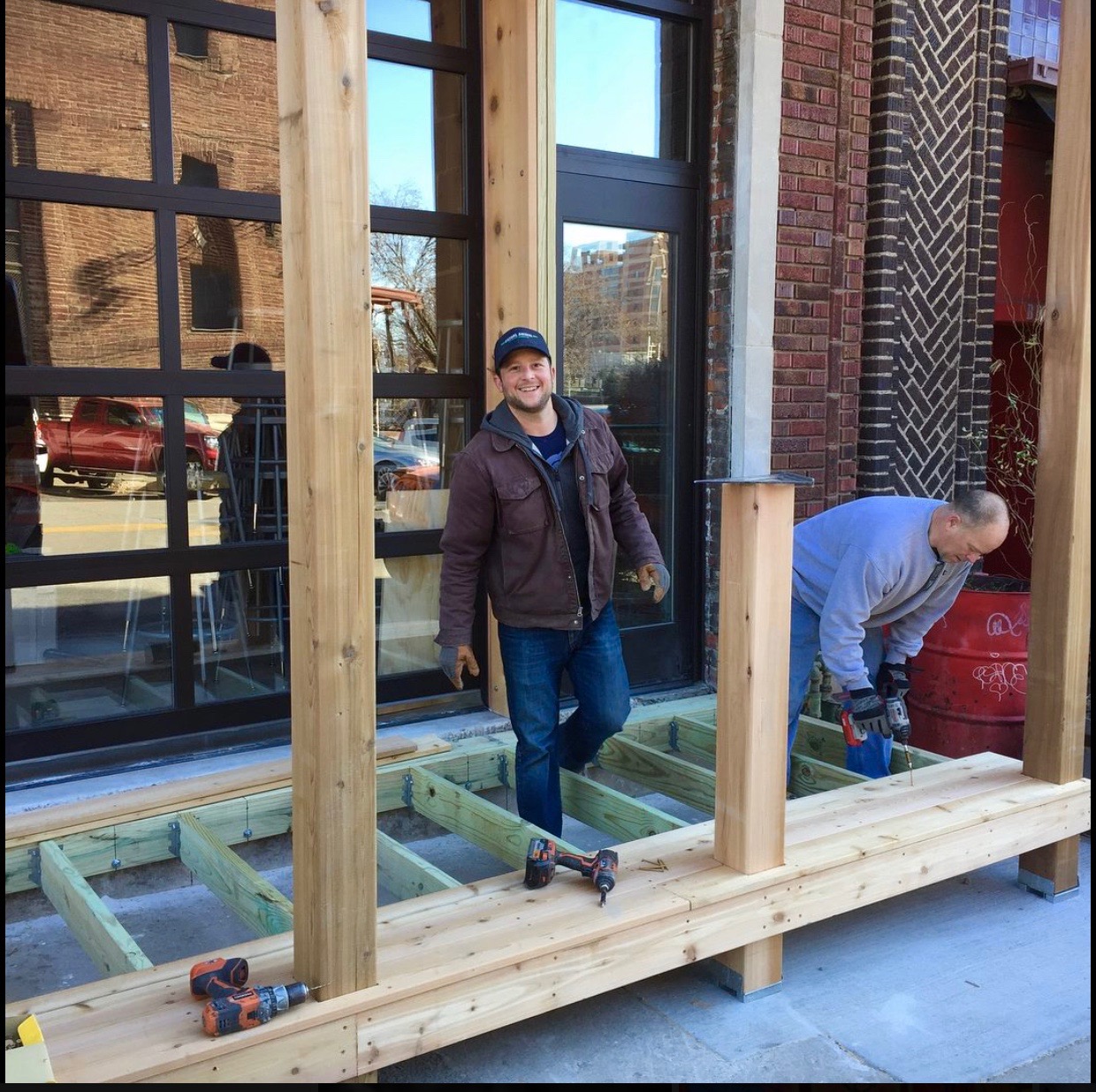
Deconstruction before construction. Kyle, with Alex and their father, Kass, jump started the demolition. There was junk removal of heavy lath, bundles of old wire, and equipment. The linoleum floor tiles were scraped clean to the concrete underlayment. In the rear space that now houses four 15-barrel fermenters, an old ceiling of tin, wire, and plaster was painstakingly cut out, dropped, and hauled away.
Plaster walls were blasted with a jack hammer to reveal the brick underneath. It was hard, excruciating and dirty work. Finally, Alex said, “Stop. Leave some of the wall plaster and call it done.” It is an attractive stopping point. Alex then got busy and built bathrooms, the new, larger bar area, and engaged in even dirtier work by climbing high into the ceiling rafters to painstakingly clean away 100 years of industrial dust and grime!


Subcontractors installed electricity, HVAC, plumbing, and the front garage door window to match the original side of Casual Animal. Creating openings into the common walls required considerable consultation with structural engineers because both buildings are more than a century old. In the end, doorway-sized holes were sawed through two walls (one for each building) and reinforced with steel beams. And just like that–the taprooms and brewing areas were connected.
Debut Side 2
In January 2021, nine months after taking possession, with the mask mandate and six feet of separation still in full effect, Casual Animal, side two, opened to the public.
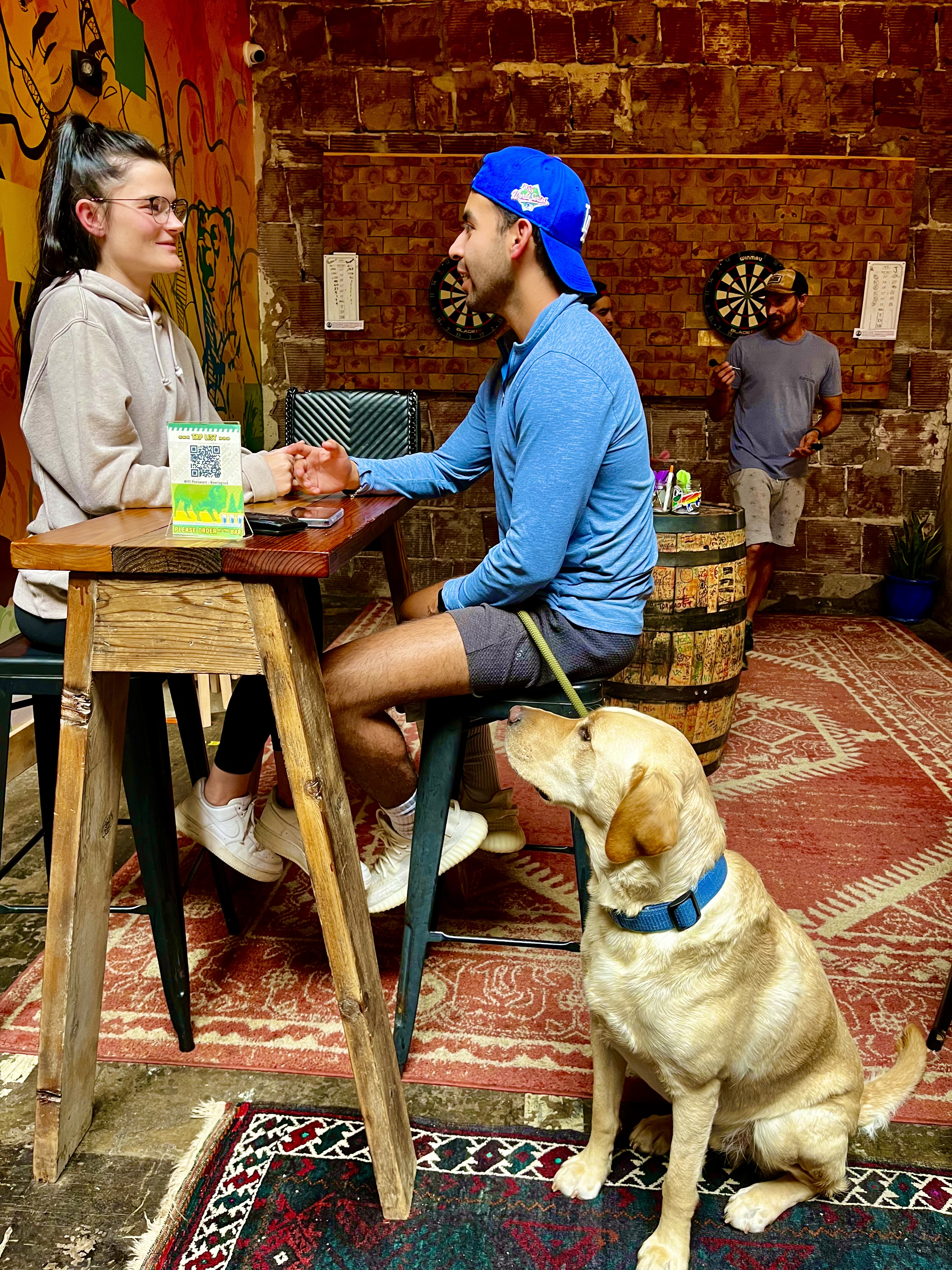
From the beginning, the word got out, and the people flocked in. The high ceilings, the big windows and skylights, the greenery and wide spacing between tables and “living room” conversation corners were a welcome reason for being with friends in public again. There was a feeling of being safe in your own “pod”. Families, and dogs, welcome. Everyone loves the casual-animal-dogs-are-welcome theme.


The Current Vibe
Last fall, with the garage door opened wide on a perfect autumn day, I sat in my favorite spot next to the wall at one end of the bar–the best vantage point to soak in the early afternoon atmosphere. Sunlight was streaming in from the central skylight, customers were working on computers or talking in quiet conversation around the room. Mellow music provided soft background sound. The back brewing area behind the big tap room was clean and quiet. Tables were laid around the tall central Schefflera tree in a spoke-like pattern over the oriental carpets. Kyle-designed merchandise was hung on hangers, or neatly stacked on shelves––t-shirts, hoodies, baseball hats, water bottles. Next to the merchandise, a glass front refrigerator displayed the current variety of canned six-packs for take away. Customers regularly strolled to the bar to place an order.


Seven women entered as a group. None of them drank beer. They ordered red sangria (locally made and canned, but not in-house), rosé wine, and vodka spritzes (a house-made cocktail on draft). The friends sat down to play Kansas City Trivia in a lively fashion.
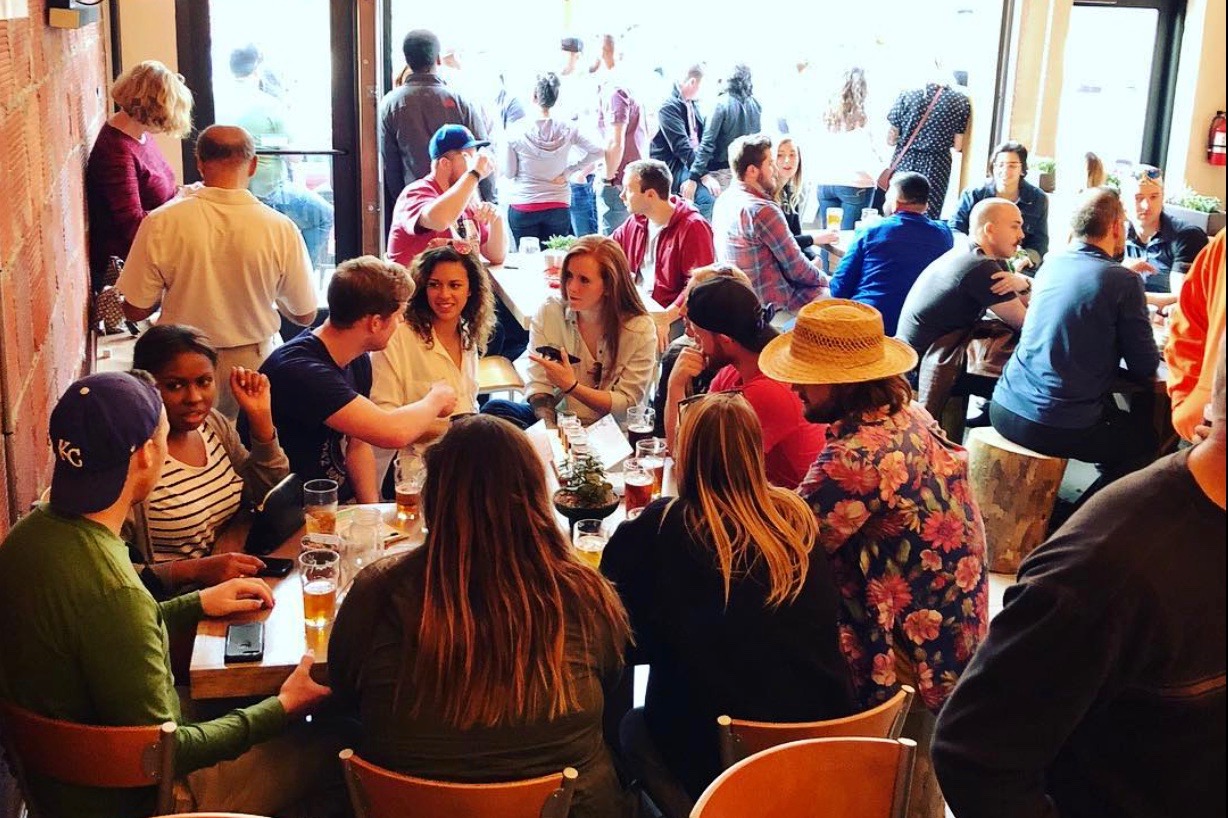
It’s now late Friday afternoon. The scene is growing steadily livelier as more people arrive, order a beer, and mingle with friends. Darts and shuffleboard are active. A group of twelve takes up the center court tables under the skylight and tree. They are standing, sitting, talking, laughing, taking pictures and enjoying themselves.

Kirstie, with 4+ years on staff, works the tap room, knows and can talk in detail about every style of beer. She offers a taste to customers who are particular or unsure. Erika has also worked at the brewery for four years. She spent 2 ½ years brewing with Kyle. Now she works in the front of the house, serving and chatting up customers. Ethan started at Casual Animal in 2018 when the first side opened. He left two years later, then returned in 2024 to become the assistant brewer with Kyle. These three, along with the rest of the employees, embody the small business model of a loyal Casual Animal family. They know their regular customers and suggest who I might approach with a few questions.
I sat down with a couple who told me they live within walking distance and often come after work or on a day off. What they love; always a likeable beer flavor in rotating fashion, the ambience of hanging lights, skylights, garage-door-open windows, the mash-up of decorating textures, the food pop-ups. As to the beer, he likes all Lagers, she is more experimental and willing to try different styles.
Another couple has a newborn. They have been coming to Casual Animal since the time of Covid when their first baby arrived. After getting vaccinated they brought the infant with them to get out of the house into a cool environment to sit and talk and sip beer. Now they are repeating the cycle three years later with baby number two. They love the plants, the trees, the natural lighting, the soft seating. They wish food was served regularly but enjoy the pop-up vendors that rotate through on a regular basis.
Madi has been a regular casual animal for 3-4 years. She comes in the early afternoons during the week, when it is mellow and quieter, to work on her computer. She always sits at the bar, knows and likes the staff, and chats with them while working.
Commitment to Community
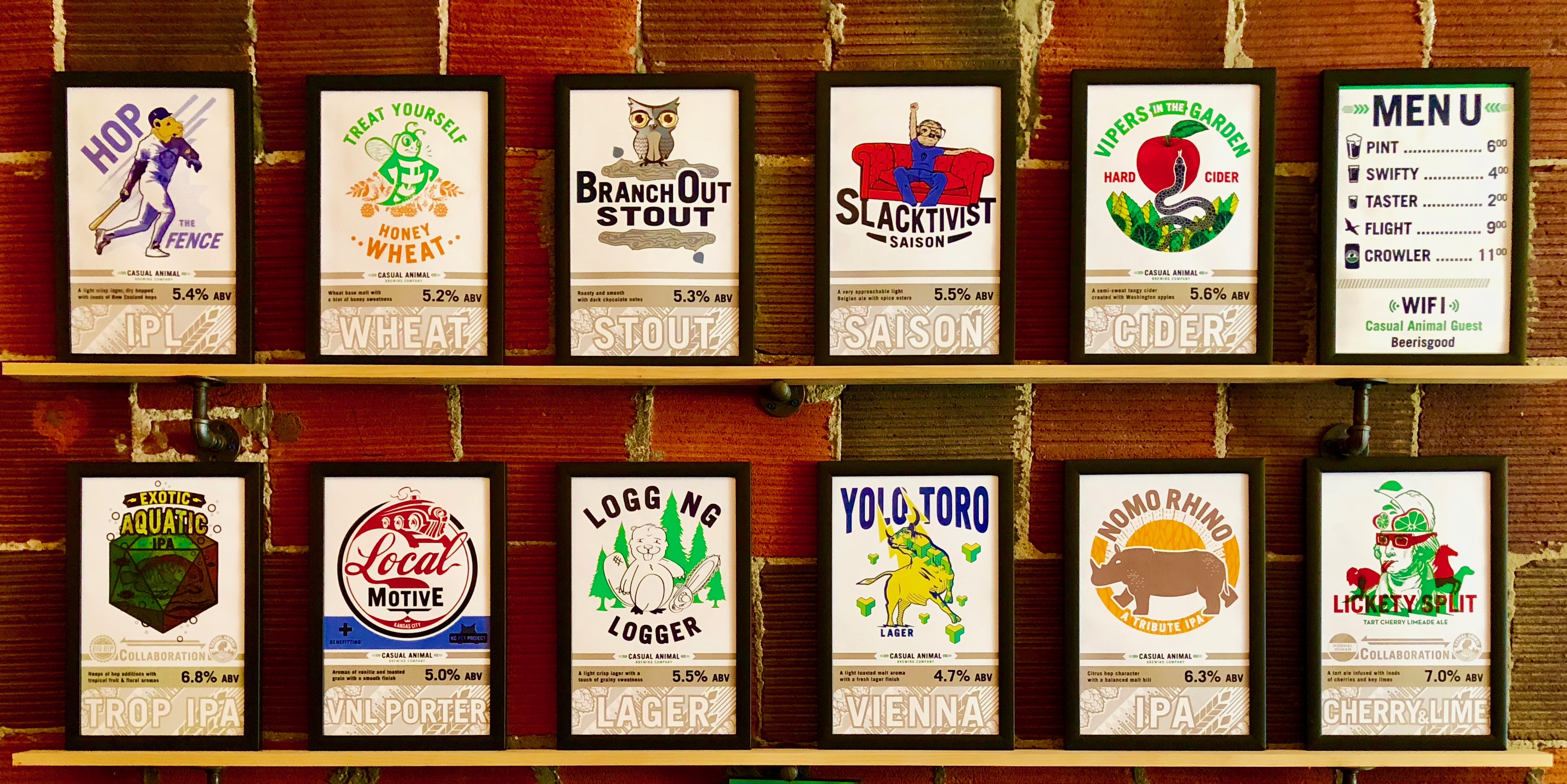
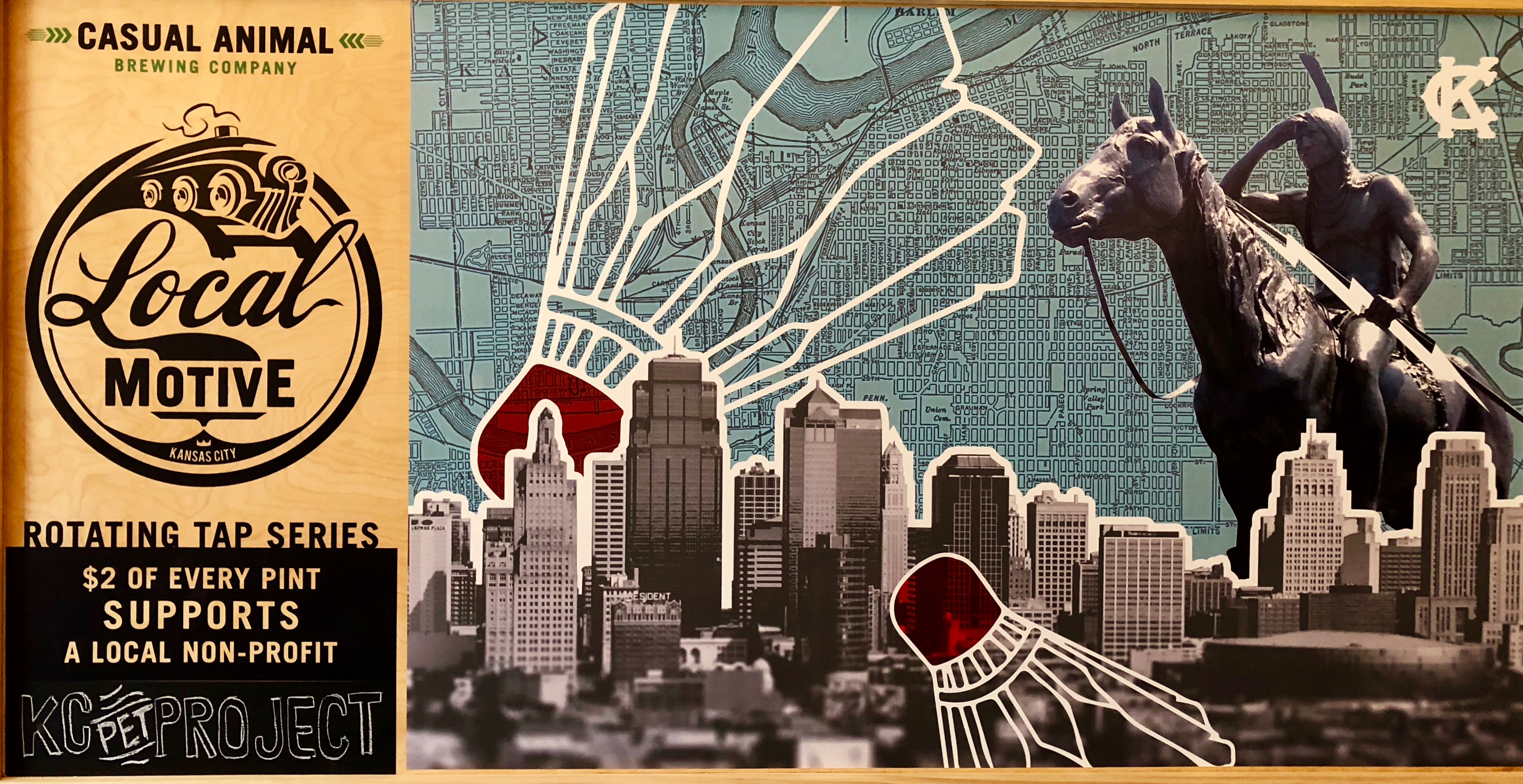
Local Motive is the name of Casual Animal’s fund-raising beer selection, sold to support Kansas City non-profit organizations. It was written into their business plan from the start, as a way of giving back to the local community. It began as a quarterly offering for the first two years. However, for half of 2020 and all of 2021, during Covid, it was placed on hold.
Now Local Motive rotates to a new charitable cause every two months. Two dollars from the sale of every pint of one specially selected “Local Motive” beer is donated to the non-profit’s cause at the end of a rotation period. Each non-profit can organize events at the brewery to educate the public and optimize giving during their cycle. Some of these have involved trivia nights, live music, or bringing in rescued kittens and puppies for adoption.
Lara and Kyle annually select from a wide variety of Local Motive applications submitted on their website, choose about 15 that meet the criteria they have set, and present them to the staff. The staff votes for six non-profits as local motive recipients for the upcoming year. By the end of 2025, over the past 8 years, Casual Animal will have hit a new marker for giving back–more than $100,000 flowing into the Kansas City community and helping 30+ organizations.
Better Together
There is a collaborative relationship between Casual Animal, other breweries, and even farmers. Kyle has generated several co-branding ventures to promote a new beer, such as with Odell Brewing in Ft. Collins, Colorado, Cinder Block, Double Shift, Big Rip and others in the Kansas City area. This is usually a one-of-a-kind endeavor to co-produce something different and even experimental in the craft beer industry.
Then there are the livestock farmers. Kyle has always donated his spent grains, barley, oats, wheat and rye, to farmers as feed for pigs, chickens, cows. In the past several years a joint relationship was formed with KC Cattle Company. Head rancher Marc Wermersen has loved cows since childhood. He is in charge of hand raising and feeding 275 head of selective Wagyu beef cattle.
Wagyu is the American version of the highly marbled, tender, Kobe beef from Japan. For these cows, fed largely on pasture grass, the small grains extracted from Kyle’s tanks (mixed with corn) are a high energy supplemental food. As Marc says, “Good feed equals good beef equals good taste.” The relationship is reciprocal. The brewery receives Wagyu summer sausage and shaved peppered beef to serve as charcuterie meats in the taproom. Marc often gifts the brew team with steaks, ground meat, and award-winning beef hotdogs.
Special Events
Planning and organizing events is one aspect of Lara’s on-site job description. Currently, Casual Animal offers special taproom evenings such as Wednesday Art Night, where coloring and painting supplies are available to dabble in, or pop-up food vendors serving inside or from trucks on the street. There is an annual Earth Day celebration on April 22.


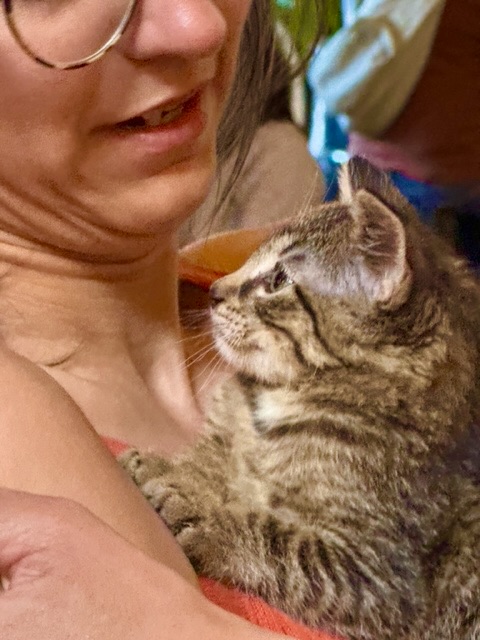
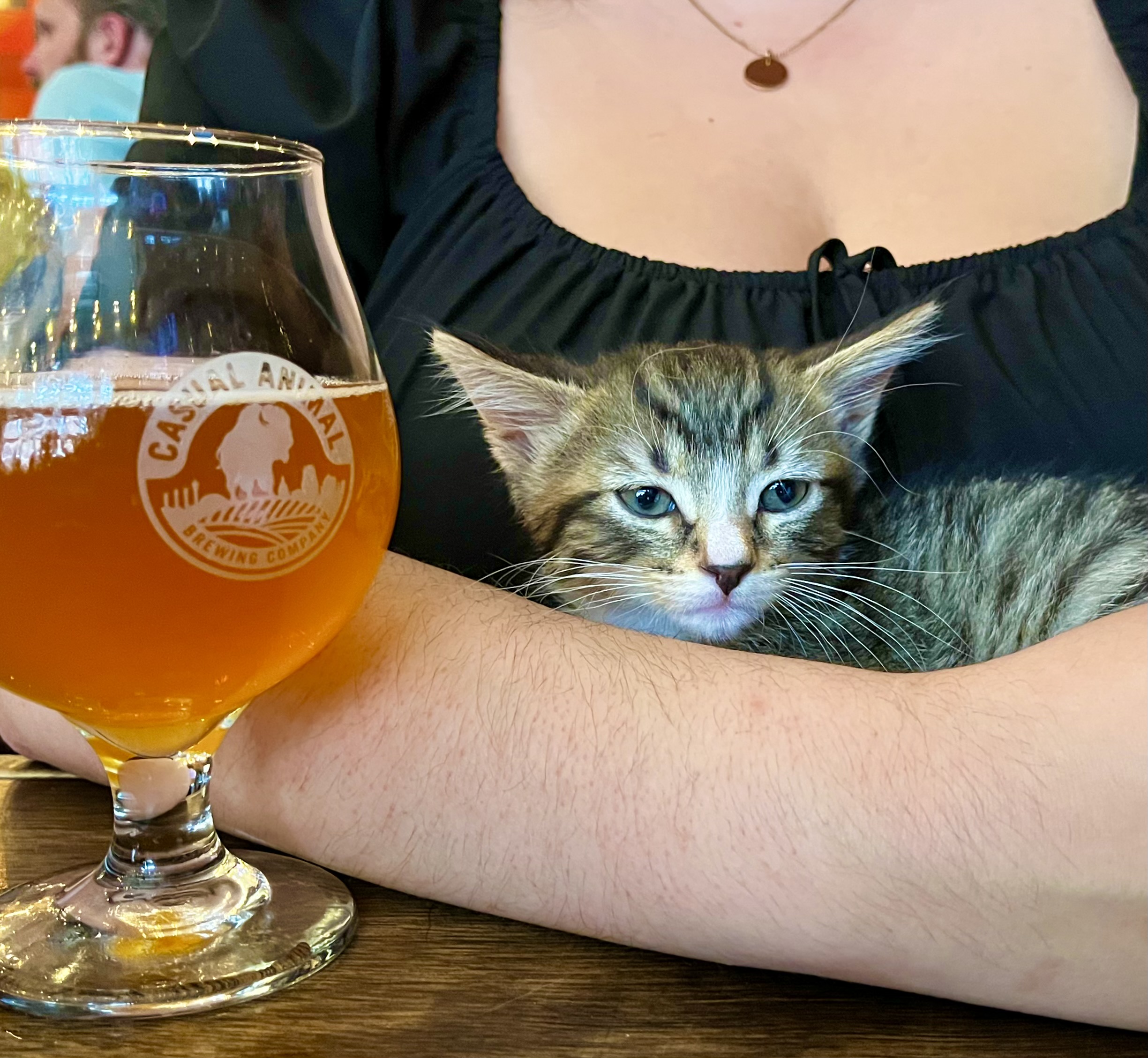
Perhaps the most popular and very highly attended event is the Kitten Pop-Up Party. KC Pet Project, a no-kill pet shelter as well as a former Local Motive recipient, currently sponsors a bi-annual Kitten Party offering rescued babies for adoption. Foster parents bring their kitten charges in baby buggies or pet carriers and customers are allowed to cuddle, play with, and love up the kitties while foster moms and dads supervise. Singles, couples, families, and kids all participate in a standing room crowd.


Being Beer Specific
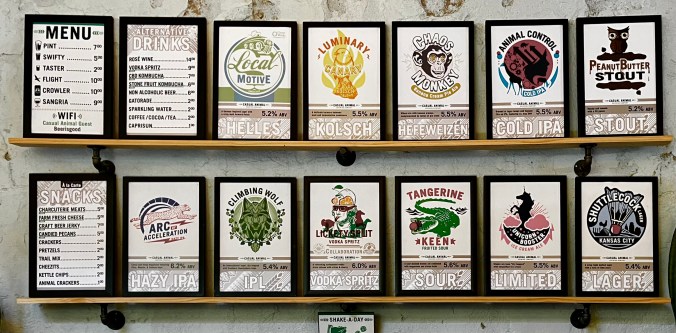
And what about those beer flavors served up from Kyle’s creative, revolving list of recipes? There is a favorite taste for every palate–hazy IPAs, sours, dark stouts, lagers, Kolsch, cold IPAs, West Coast IPAs, wheat beer, nitro offerings, including some atypical choices such as an Ice Cream ale.
When I asked Kyle and Lara to name Casual Animal’s most requested and top selling beverage choices, they said (although it varies somewhat), #1 is the Hazy IPA, #2 is a Lager, #3 a Wheat or Sour choice, #4 and #5 rotate between another kind of IPA or the Local Motive choice. Moving up in line of popularity is the Vodka Spritz draft cocktail made on site and sold on draft as a gluten free option. There is always a hard cider on tap for non-beer palates as well.
Styles of beer have creative names that are usually animal-related to the brewery theme. Animal Control Cold IPA, Bear Hug Brown, Climbing Wolf Hopped Lager, Hyper Lynx French Pilsner, Vipers in the Garden Hard Cider, Blue Flamingo Fruited Sour, Luminary Canary Kolsch, and my personal name favorite–Chaos Monkey Hefeweizen.
This is Your Third Place
So, what’s left to tell? Perhaps it’s time to stroll into Casual Animal when you find yourself in Kansas City or peruse their creative website for merchandise if you’re not. Go with friends, with family, or by yourself to work on a quiet afternoon in a beautiful environment, to attend an evening event, to plan a gathering, to sit and drink good craft beer, to listen to background music or watch a special sports event like the Super Bowl with a crowd.
Casual Animal is the classic drop-in, home-away-from-home, relaxed and easygoing brewery you have been searching for. Meet friends and stake out your favorite seats in the house.
From its origins, Casual Animal was conceived of and built to represent the “Third Place”. That other place you seek after home and after work. It’s the place you go to relax and let go, to find joy and camaraderie, to feel safe, and to have fun. It’s not just about the beer or the greenery or the skylights. What it is…no actually, what it’s about, is being somewhere else, spending good time with people in warm and welcoming community surroundings.
Isn’t that something we all need?
CASUAL ANIMAL BREWING COMPANY
1725 McGee St, Kansas City, MO 64108, USA
Telephone: +1(816) 648-0184
Hours: Monday-Thursday, 12-9PM, Friday & Saturday, 12-10PM, Sunday, 12-7PM
www.casualanimalbrewing.com
Facebook: Casual Animal Brewing Co.
Instagram: casualanimalbrewing
When the first side of Casual Animal opened in early February 2018, the Gray family was brewing their first baby, and daughter Sloan was born in October 2018. When they closed on the building for the second side, in May of 2020, son Isaac had just entered the world on May 13. The Grays today are a beautiful family of four.


…and my life is still, trying to get up that great big hill, of hope, for a destination. I realized quickly when I knew I should, that the world was made up of this brotherhood, of man…And so I wake in the morning and I step outside, and I take a deep breath and I get real high, and I scream at the top of my lungs, “What’s going on?” –Linda Perry, 4 Non Blondes, song “What’s Up?”, 1993
Recently, I made an overnight trip to Chapel Hill, North Carolina, to visit my “artist buddy” Jane Filer. Several years ago, I wrote a biographical story about her life and her paintings after we met in Santa Fe, New Mexico. Read: Being Jane Filer Two of her pieces are in our living room, “Eclipse” and “Elephant Journey”, both of them highlighted in the article.
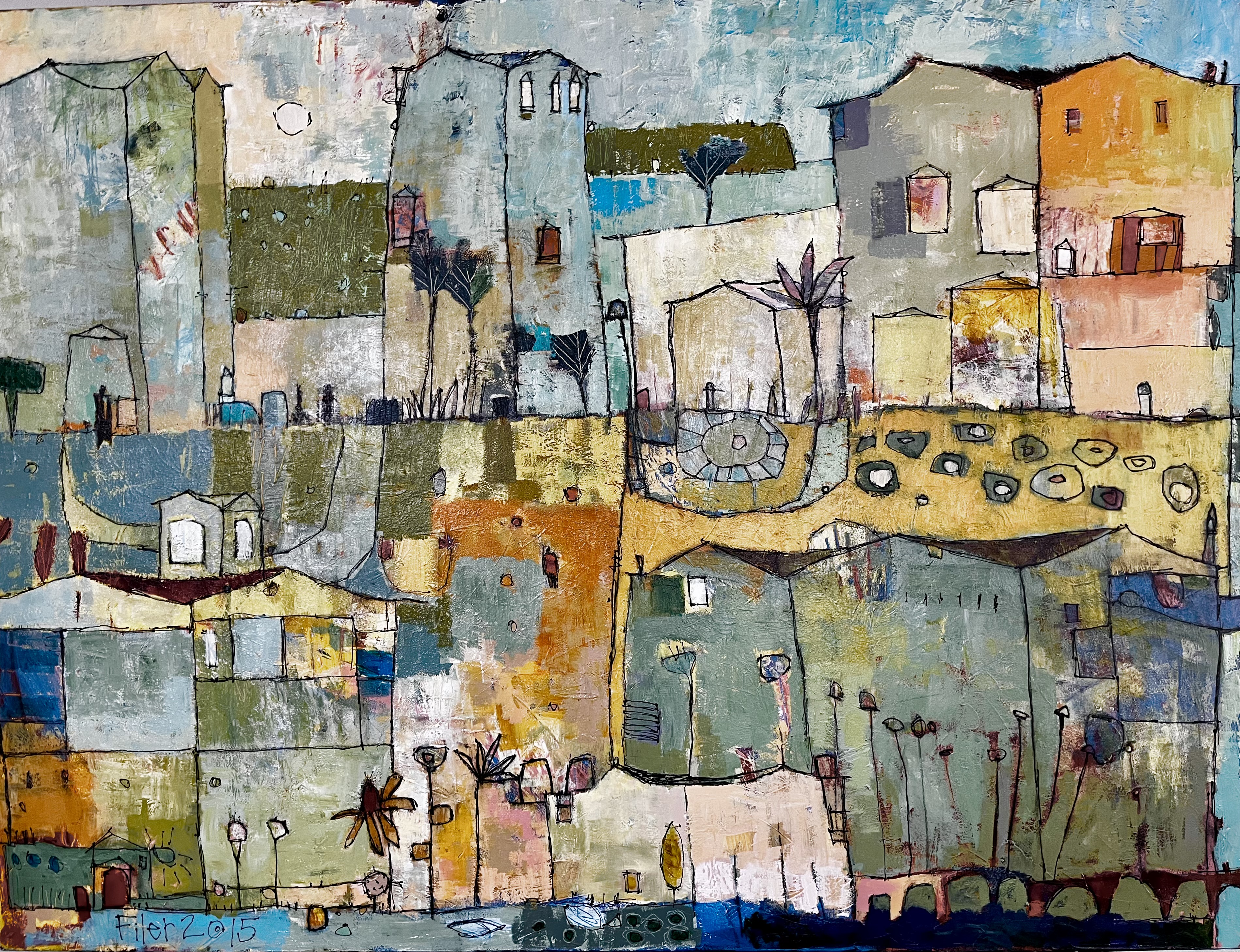
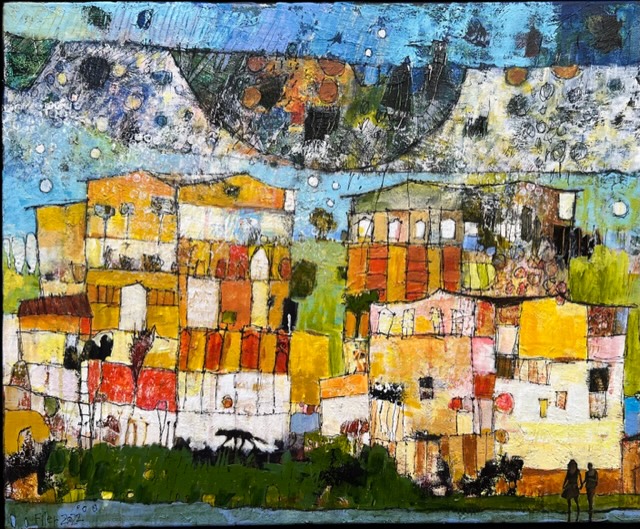
The premise of traveling to her home was a painting I noticed and kept returning to on her website janefiler.com under “Available Work”. It was entitled “Above the Bridge”. I finally called Jane and said I was really drawn to this one but needed to see the painting in person to know how it made me feel. She agreed, and we set a date.
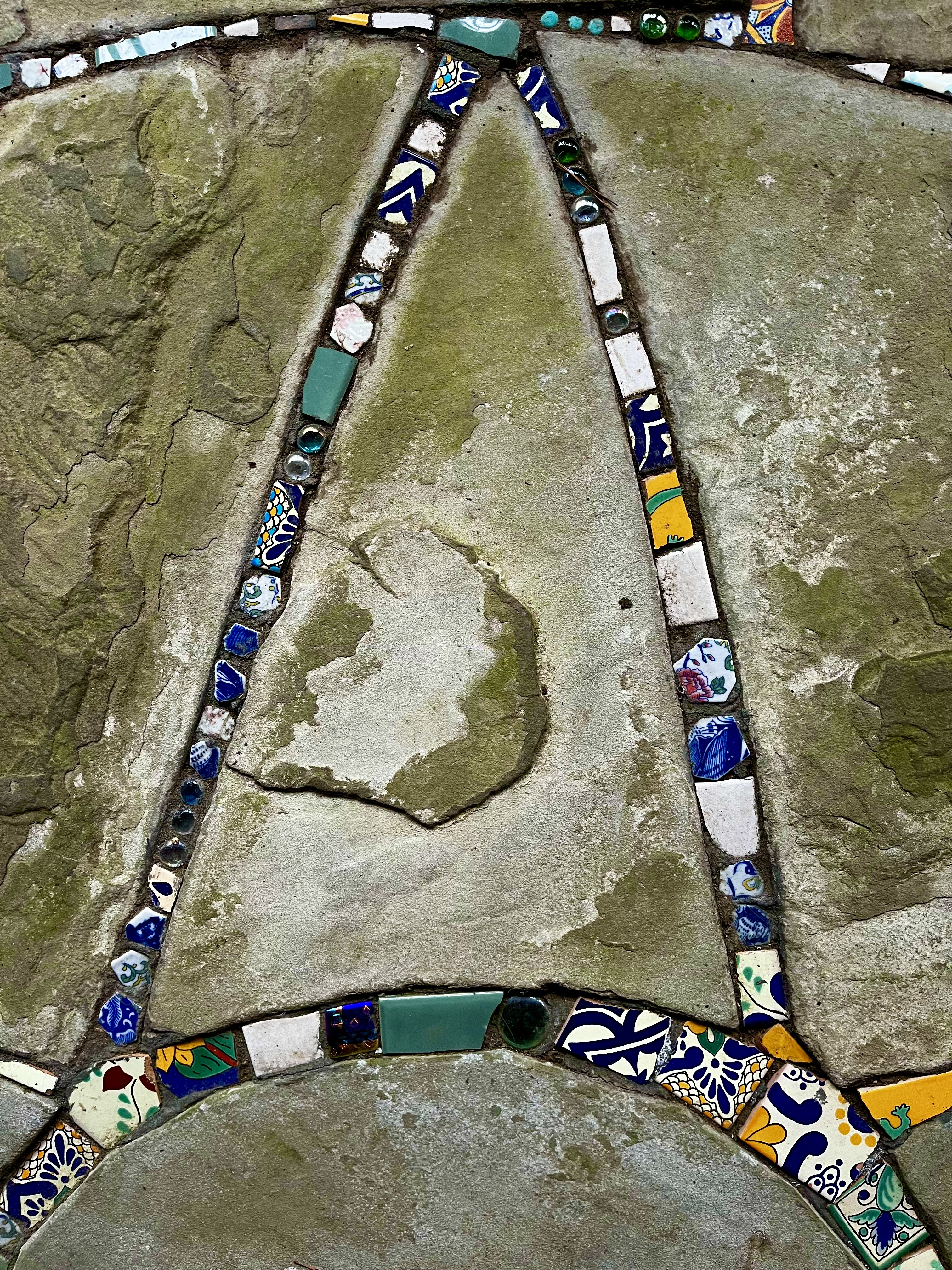
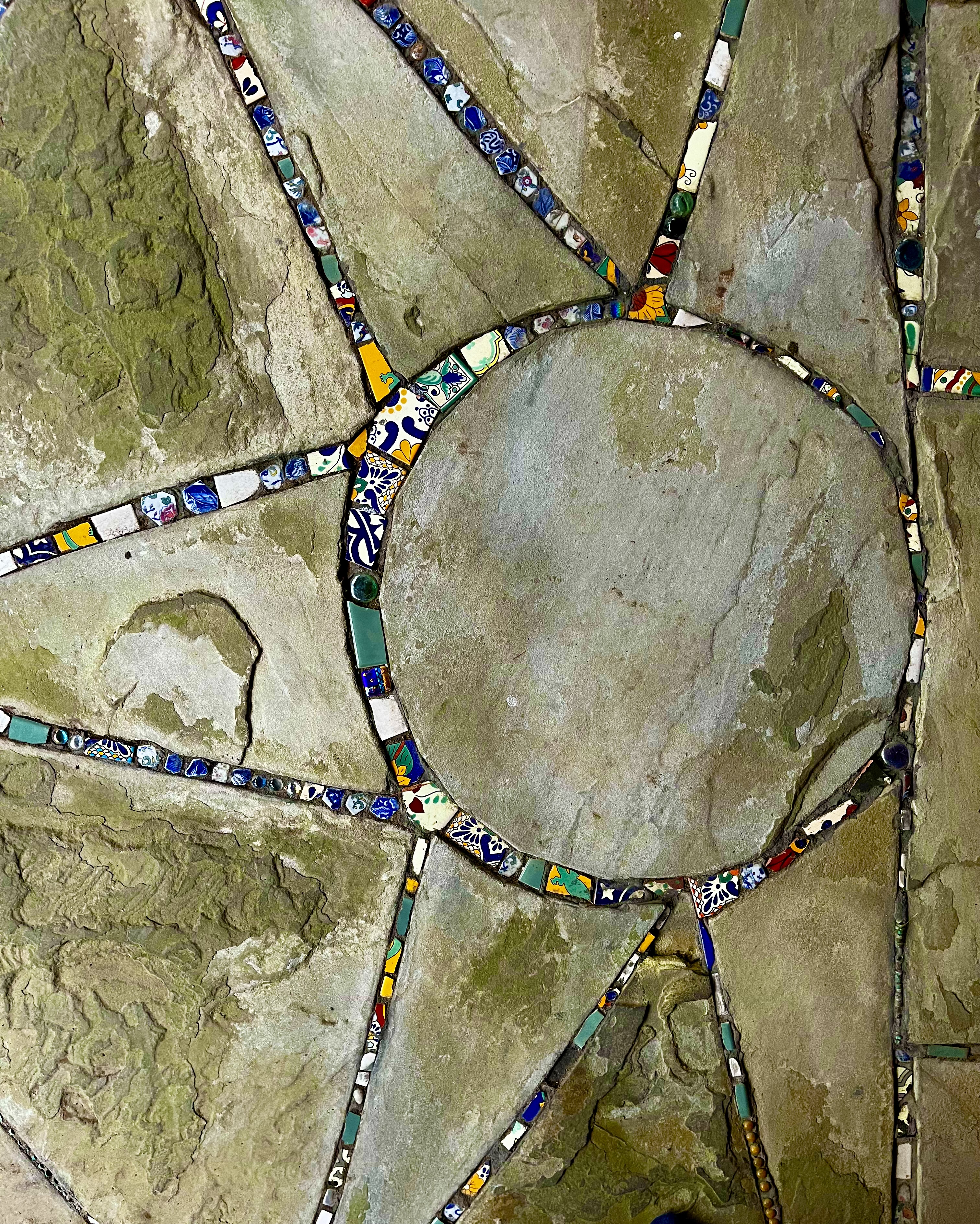
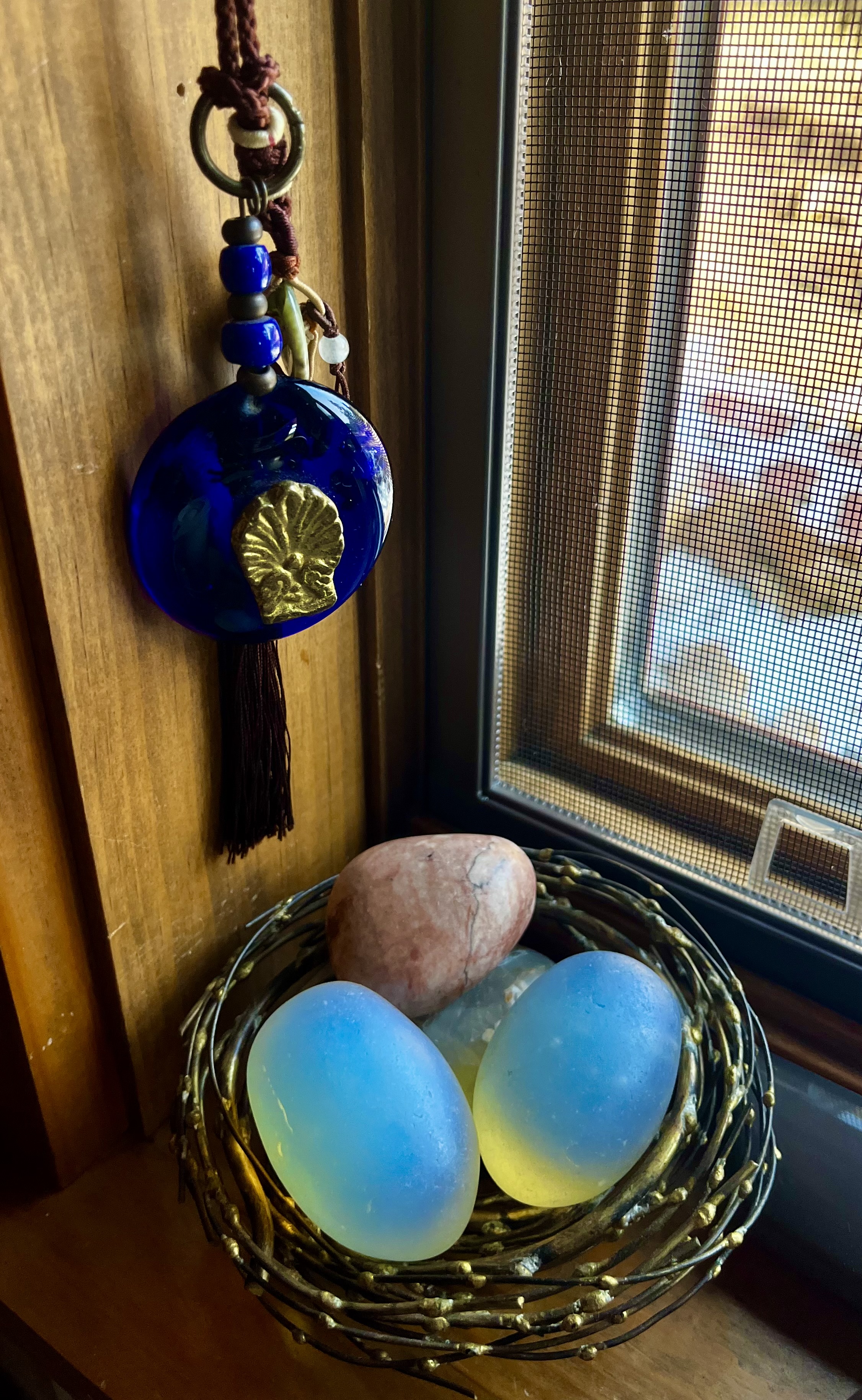
It was two years since we had last seen each other, but we fell into conversation easily, as friends generally do. I noticed the changes in her home and property since the last time I was there. A large shed had been renovated and turned into a gallery for on-site weekend art shows, there were now two cats in residence, and she started an outdoor project of reconfiguring stone pavers by outlining them with colorful pottery and pieces of glass. I picked up an alabaster egg on a windowsill to admire its smooth shape and beautiful translucency in my hand. She insisted that I take it home.


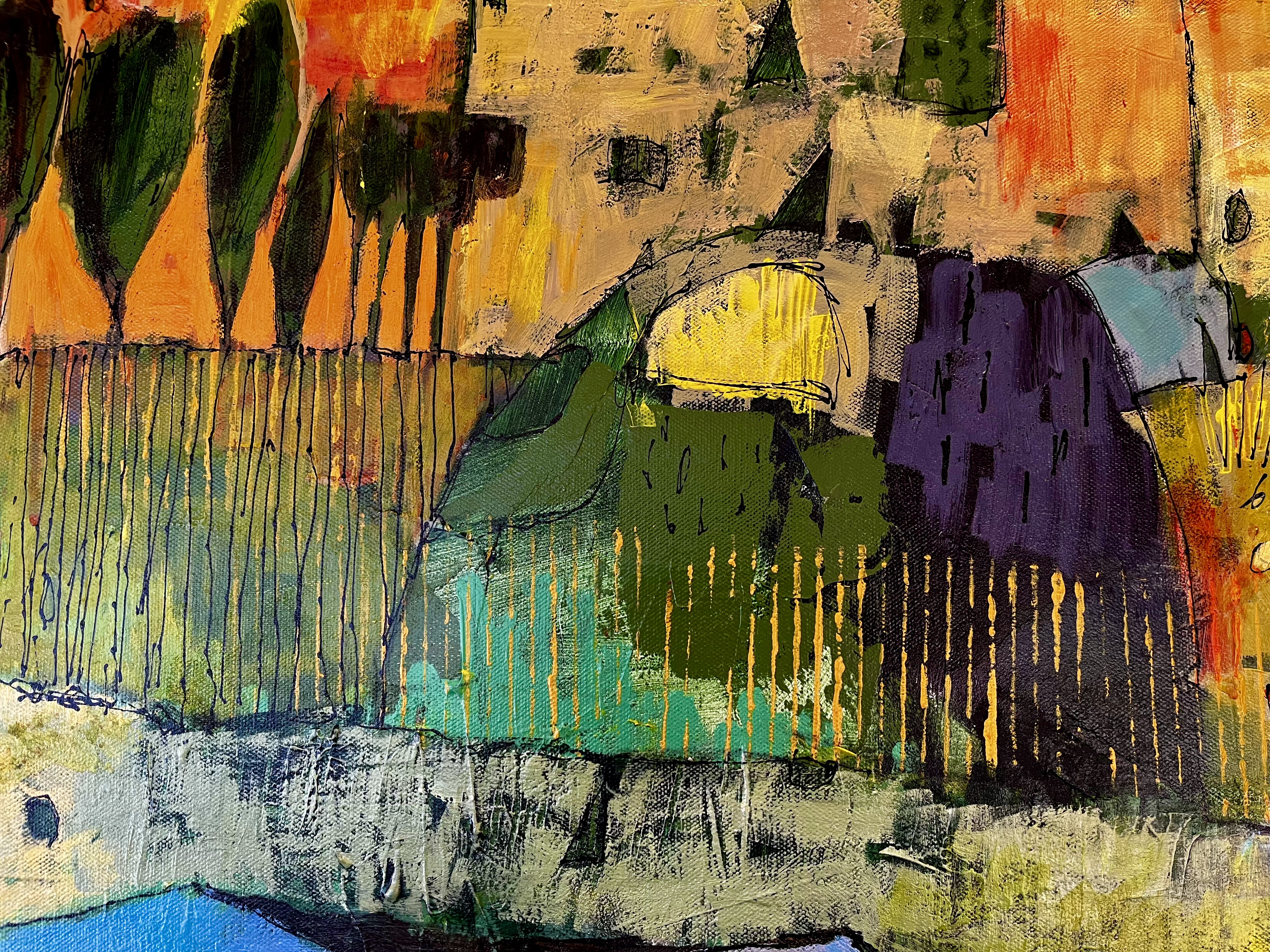
When we went into the studio to view the painting, Jane showed me a recently finished piece entitled “Congregation”. It was colorful and typical of her “primal modern” style which emanates from her dreaming-while-awake imagination. Then she moved “Above the Bridge” to the easel for my viewing. And I just knew. This was going to be my painting.
The question is why? What resonated? Like so much of Jane’s art, there are layers upon layers to see and feel and think about. Then you bring your own meaning to it. The details I first noticed were two small black figures “under the bridge”. One is swimming strongly onward; the other is rising to the surface with one arm extended straight upward.

Musing about these small figures under the bridge with the larger world painted above the bridge struck me as symbolic and meaningful. Right now. These are actions to aim for; onward and upward. For anyone, for everyone.
In the current American climate, where everything is moving in the direction of political dismantling and destruction, many people want, and need, to find what can be done now, while also moving toward the future. Then I thought; these are the same movements–the actions we take in the present are what we will continue to do in the future.
Poets, artists, and writers are often sources of inspiration about what is needed in trying times. Art cuts deep to the marrow of reminding us how to refocus and get moving in stressful times, whether personal, cultural, political, or global.
Almost every generation of Americans for the past 250 years has encountered and eventually survived some kind of catastrophic period; revolution followed by war, destructive civil war, two world wars, years of severe economic depression, McCarthyism, a decade of political assassinations and riots, the unpopular 10-year Vietnamese war, murderous terrorist attacks, devastating viral pandemics. Just as it seems that so much changes within generations; history teaches that great things can, and do, persist after turmoil.
We all have a part in shifting the story. –Joy Harjo, 23rd U.S. Poet Laureate
Inside the head spinning turn of extreme change our democracy is currently undergoing, what part, as Harjo suggests, can we play in shifting the story?
It’s really the same part we play throughout life. First, we learn, we adapt, and we move forward with what we can control. Adaptive change often means taking on complex challenges that seem impossible in the beginning. Staying immobilized doesn’t help the situation. You have to try. Like the feeling a piece of art instills, we bring the meaning and sense to what can change and what we can change.
I read a story about a woman, Maureen Morris, who opened a coffee shop called Back Street Brews in a small, politically polarized Virginia town several years ago. During a time of stridently vocal opposing sides, she pushed the notion of a gentler America inside her café. Everyone was welcome to openly discuss their views, but there would be no attacking or judging. “If it comes up, as long as it’s respectful, you can talk about whatever your beliefs are…If you are a staunch this or staunch that, I always say, keep that out of here.”


Customers began asking about each other’s family or simply shooting the breeze over coffee. Discussion groups of varying topics began showing up. Maureen’s café became known as a quiet force of civility while crossing the political divide inside a public space. Neighborly ways, respect, and social ties persist.
Ordinary people created a community where they listen and speak to each other without shouting. All due to one woman’s insistence that, amid the divisiveness of an era, she would lead from the strength of her beliefs. “It’s affecting people. Not me. Not in my bubble. We’re going to be fine, everyone! We’re going to land on our feet in my coffee bubble.”
This is how an individual shifts the story. By accomplishing small things that perhaps no one notices in the big picture but has real impact on people’s lives. Everyday lives. We nurture and nourish everyone in our circle of family, acquaintances, friends. We take care of ourselves. We stay true to our values.
Because there is a remnant of change that begins with one act of kindness, one spoken truth, one considerate conversation, one shared laugh, one poem, painting, or story. These are ways to move the narrative.
A brief scene in the old Hollywood movie, Casablanca, with Humphrey Bogart and Ingrid Bergman offers another example of one person’s action to restore balance.
During a busy evening in Rick’s American Café, a casino and piano bar in Casablanca, there is a scuffle when the thief Ugarte is discovered by authorities. After Rick refuses to hide him, Ugarte is hustled out in a loud commotion surrounded by police. The music stops and customers sit mutely, in stunned silence.
Afterward, Rick (Bogart) apologizes for the uproar, reassures everyone that the trouble is over, everything is all right, and they should continue having a good time. He speaks calmly to the crowd, tells Sam to resume playing, and without breaking stride re-rights an overturned wine glass on a table.
…the saloonkeeper’s cool response to Ugarte’s arrest and his instruction for the band to play on could suggest a certain indifference to the fates of men. But in setting upright that cocktail glass in the aftermath of the commotion, didn’t he also exhibit an essential faith that by the smallest of one’s actions, one can restore some sense of order to the world? –Amor Towles, A Gentleman in Moscow
As we find our part in “restoring some sense of order”, we also climb “that great big hill of hope”. And make it a destination.
Poems and songs are written to get our minds thinking…in an unexpected way.
TROUGH
There is a trough in waves,
a low spot
where horizon disappears
and only sky
and water are our company.
And there we lose our way
unless
we rest, knowing the wave will bring us
to its crest again.
There we may drown
if we let fear
hold us with in its grip and shake us
side to side,
and leave us flailing, torn, disoriented.
But if we rest there
in the trough,
in silence,
being with
the low part of the wave,
keeping our energy and
noticing the shape of things,
the flow,
then time alone
will bring us to another
place
where we can see
horizon, see the land again,
regain our sense
of where
we are,
and where we need to swim.
–Judy Brown
...Come dance with the west wind and touch on the mountaintops
Sail o'er the canyons and up to the stars
And reach for the heavens and hope for the future
And all that we can be and not what we are...
–John Denver, song The Eagle and the Hawk, 1971
Fun Final Photo Shoot:


We lived overseas for 31 years and became acquainted with a variety of characters who chose the same lifestyle we did. Many were our close friends. When those friends moved to different international schools in other countries, it was difficult to stay in touch with each other’s lives. Now, when I think back on all the places we lived; Singapore, Cyprus, Taiwan, Germany and France, some of those people we knew well are no longer together and some are gone.
Yet the memory of a specific moment of friendship and fun surfaces instantly with the mention of a familiar name from long ago. Even when that moment contains elements of being less than perfect. And especially if remembering it makes me laugh.
We arrived at Taipei American School in Taiwan one August with a group of educators who bonded quickly. Relationships developed easily over shared activities and interests. We were all living outside of our home cultures, and we all sought connections and enduring friendships. In addition to sharing holidays, vacations and travel, one of the best connecting places was around the dining room table.
Bob and Valerie were married to each other when we knew them in Taipei. Bob was more than a decade older than Valerie, with a background in private schools in the U.S. before embarking on an adventure in overseas education. His everyday on-the-job attire included a bowtie which he pulled off with dress-for-success propriety. He loved literature and could discuss books at length. He was perfectly matched to his job in Advancement and Fund Raising at the school. A charmer who could talk to anyone. And then get them to donate large sums of money. He was also an excellent cook and throwing a dinner party to perfection was his gift to friends.
In the years we lived in Taipei, eating out culture was yin and yang. All forms of excellent Asian food were readily available in restaurants. But, in our Tien Mu neighborhood, food was typically served and eaten in mediocre surroundings. This meant fluorescent lighting, small plastic stools and tables crowded together, throw-away chopsticks, transparent pink paper napkins, and flimsy plastic beer cups that dented inward when picked up. Maybe things have changed…
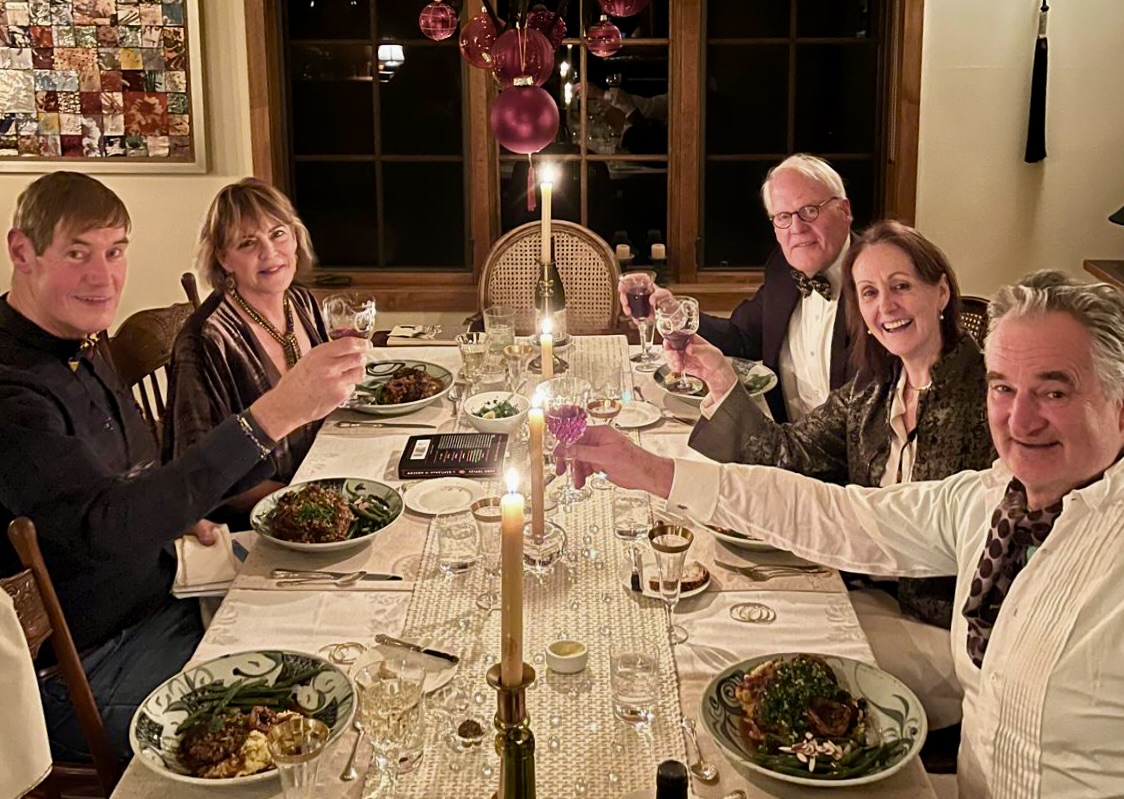
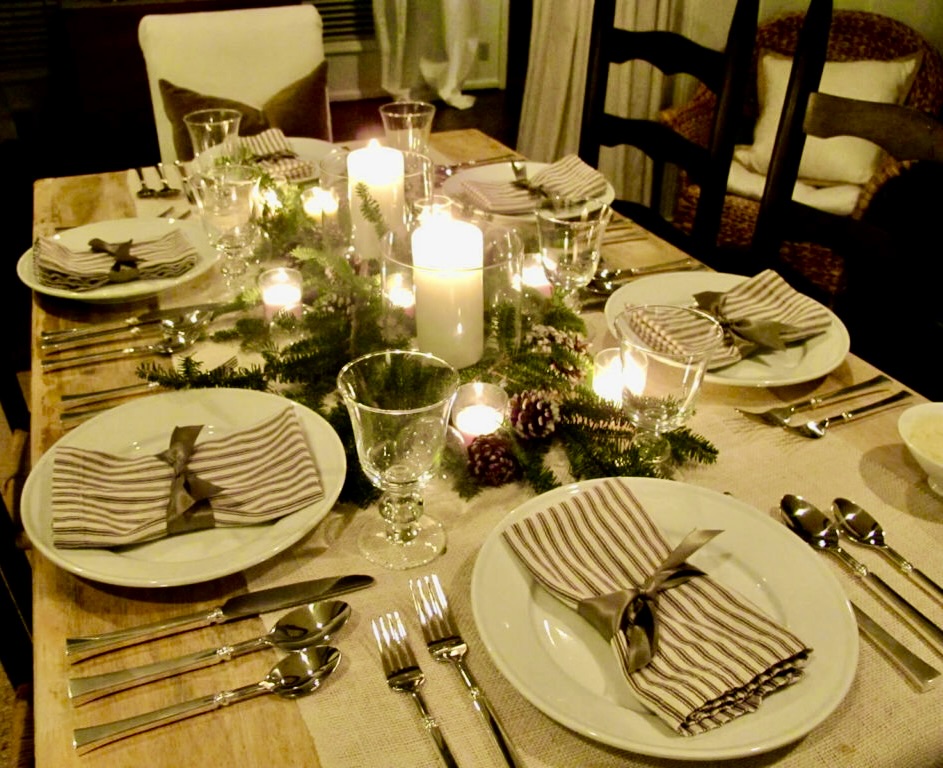
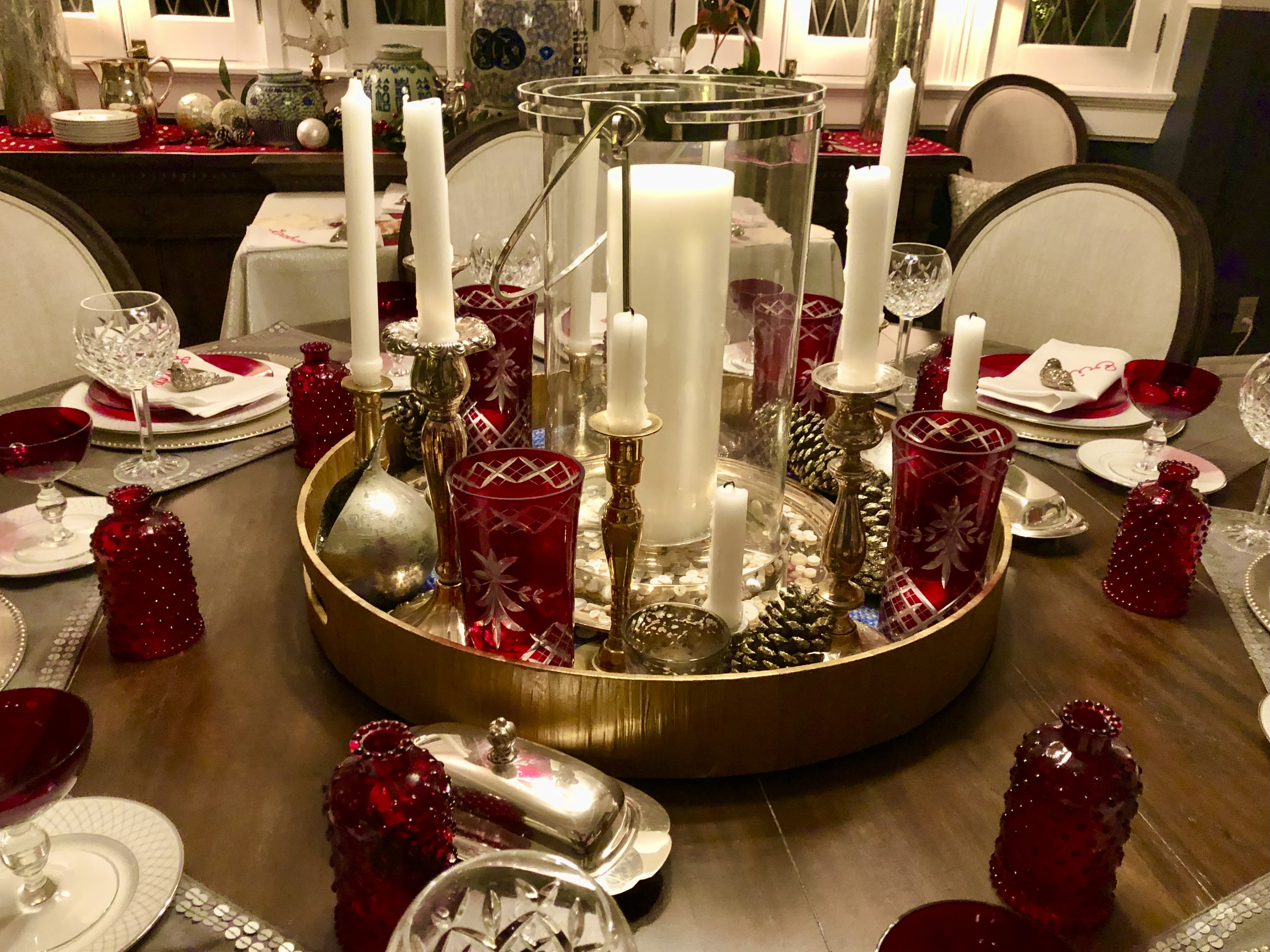
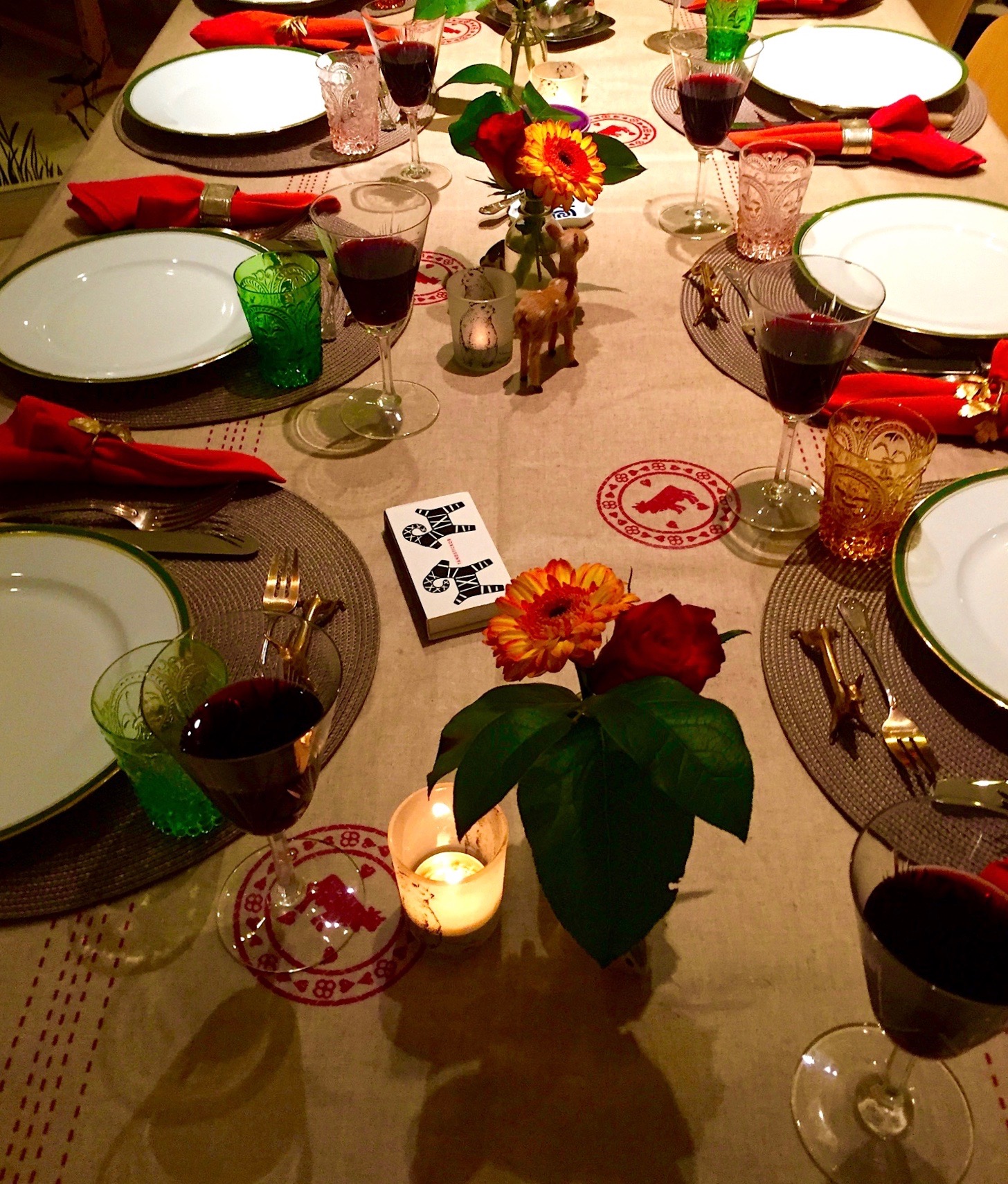
We chose a different way to spend weekend evenings. So began the years of rotating dinner parties in each other’s homes where welcoming friends planned and prepared delicious cuisine, set the table with china plates, linen napkins, and stemmed glassware. Candlelight reigned. It was a cultural lifeline we anticipated, embraced, and shared gratefully.


Bob was a masterful chef and skilled host. He prepared all the food for his wedding to Valerie, and nothing was too finicky for him to try. It was often challenging for any of us to find western food ingredients in the tiny “Mom and Pop” grocery stores in our neighborhood, but Bob did. Dinner parties were events to anticipate and enjoy.
Alec and his wife, Charlene, are overseas friends we have stayed in contact with since the Taipei days. As are Maddy and Cabby. With Valerie and Bob, they rounded out some of our weekend dinner friends.


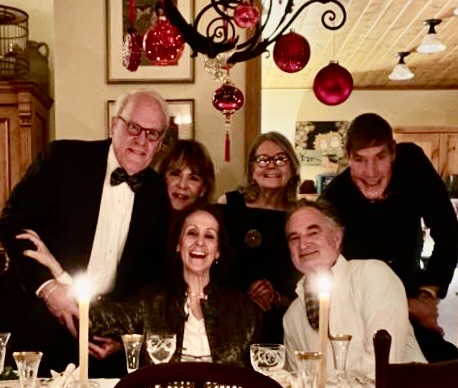
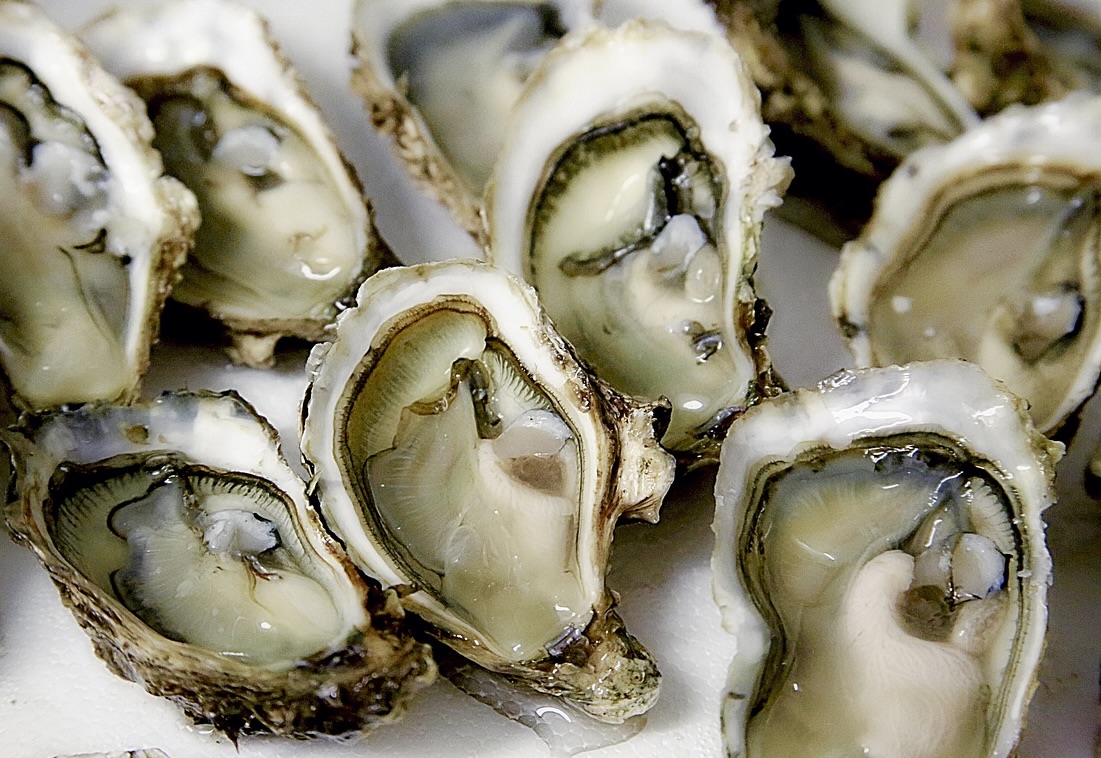
The six of us arrived one evening at Bob and Valerie’s apartment, with the usual gracious welcome and pouring of wine all around as a pre-dinner warm up. There was the quintessential appetizer that Bob almost always served, but no one ever ate. Small, dark-colored oysters from a tin, covered in a sheen of oil, with tiny crackers on the side. He was the only host who intuitively knew not to tantalize guests with a generous platter of hors d’oeuvres to fill up on before moving to the table.
We were ready to eat when it was time to gather table side.
Alec turns on his high energy self in public situations where he does everything faster than anyone else in the room: walking, eating, drinking, talking, and joking around. In the past, this created consequences like falling objects, breaking, spilling, and sometimes worse. We grew used to it and love him anyway. That night his quick reactions changed the course of the evening and saved the day.
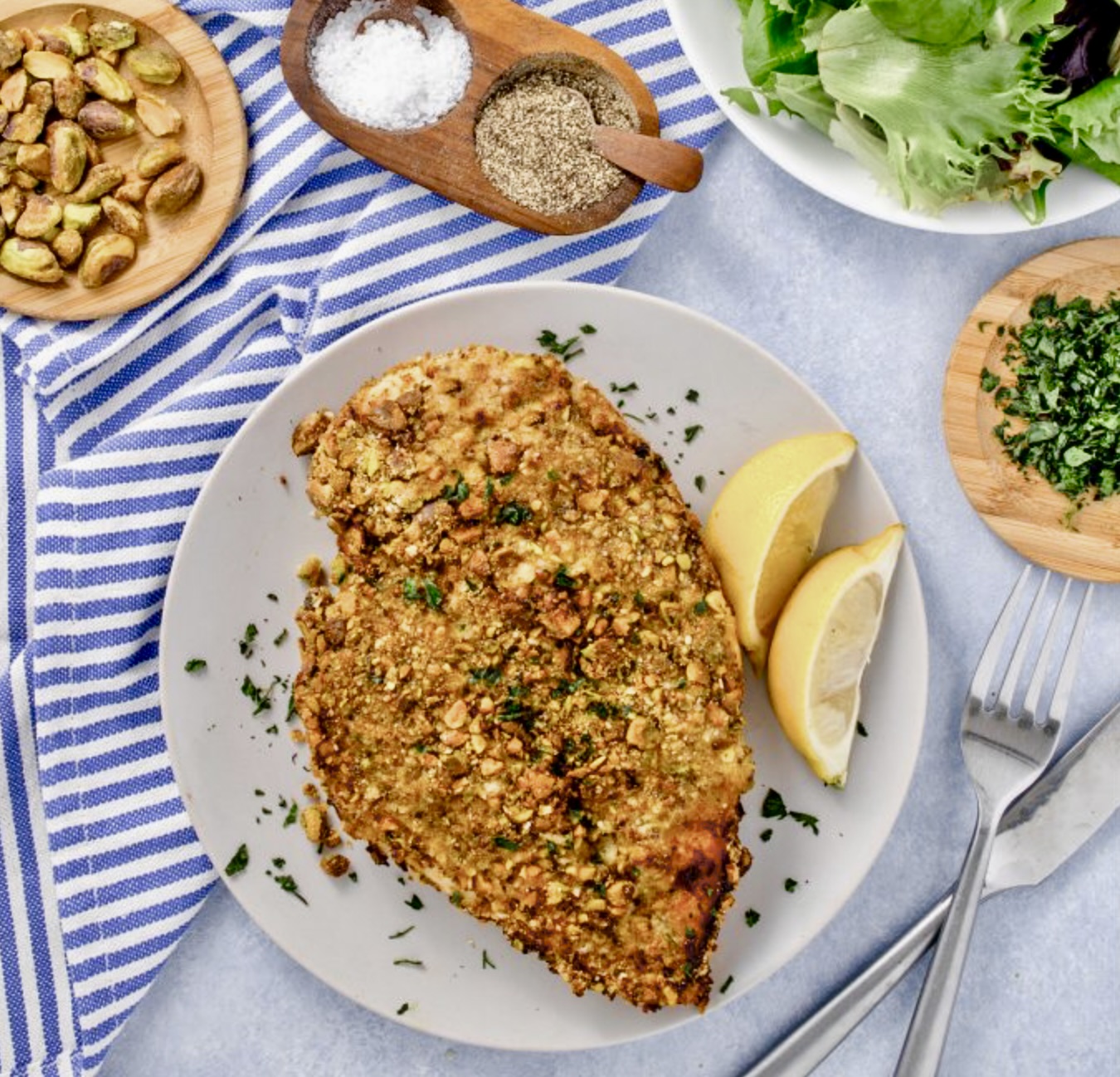
One of the recipes Bob was known for was Pistachio Chicken Breasts with Herb-Garlic Cheese Filling. It came from The Frog Commissary Cookbook. This dish was a crowd pleaser but it required time consuming preparation. There were no bags of shelled pistachios in Taipei, so eight portions required a lot of hand shelling and chopping. It also involved thinly pounded chicken breasts, stuffed with a portion of herby cheese, coated in flour, egg, and rolled in pistachios. The final steps were to brown it on the stove and finish by baking in the oven. We had enjoyed it more than once in their home.
The main course was plated in the kitchen and served to each guest. Alec, whose metabolism and hunger were always on overdrive, dove right into his first bite while the rest of us were talking and sipping wine. In a split second, before anyone else touched a knife and fork, he leapt to his feet, picked up two plates, and ran to the kitchen. Without explanation, he cleared every plate from the table while we sat in confused wonderment.
Bob followed him. We waited for a verdict. The chicken was raw on the inside. It had been nicely browned, but that was all. We breathed a sigh of relief before laughter erupted all around. Our host apologized profusely. The blunder ran counter to his normally professional preparation which included a detailed explanation of the menu just before it was served. All of which led to unmerciful teasing about trying to poison unsuspecting guests with raw meat and making them wait so long for dinner that the oily oysters started looking edible.
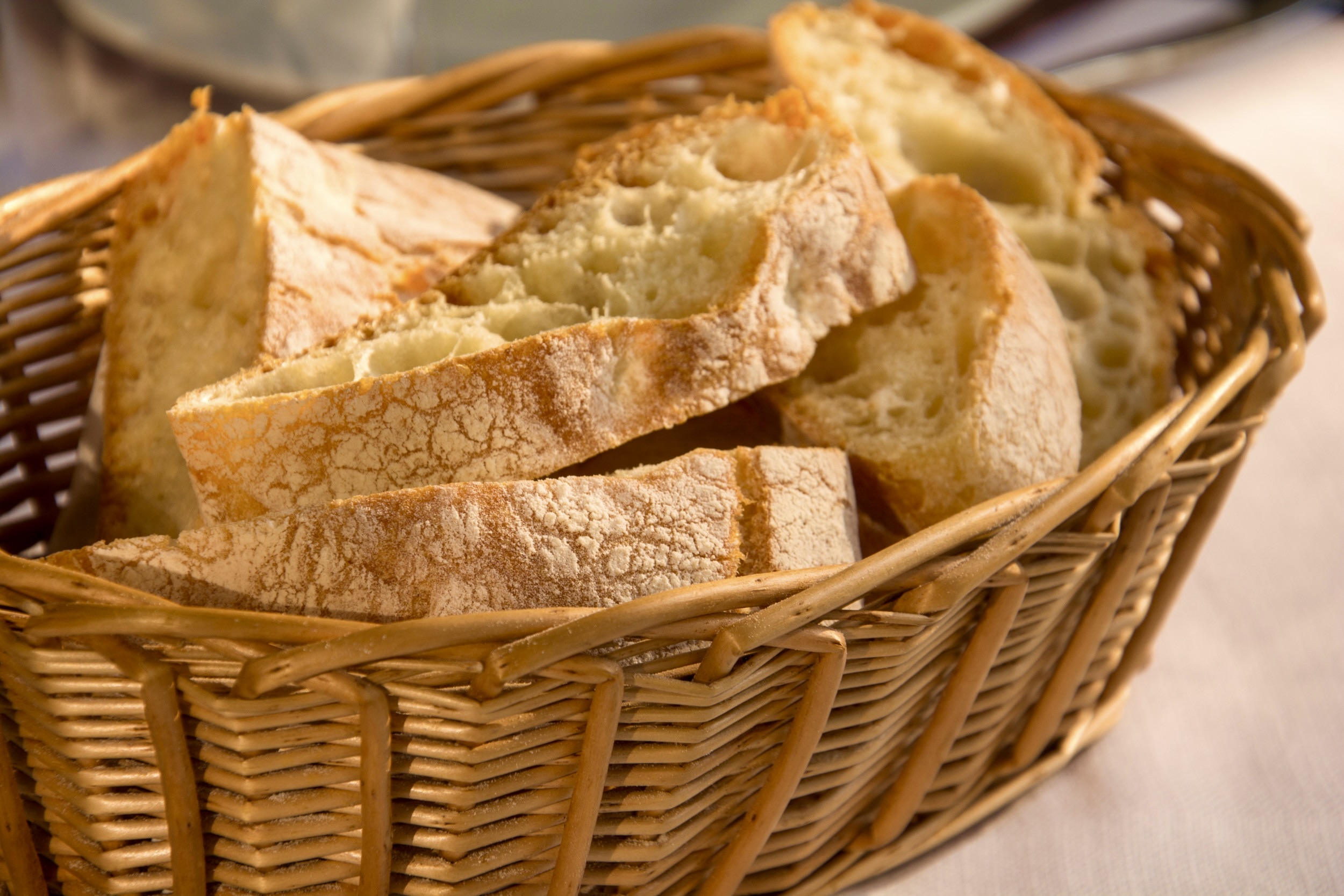
Back into the oven went the chicken. Alec, now well beyond his eating time, began devouring bread from a basket on the table. More wine was poured. Story telling began.
Valerie admitted [confessed] that she still slept with a piece of her baby blanket, now the size of a small, thin handkerchief. She kept it under her pillow where she rubbed it before falling asleep. Other revelations followed including stories of cultural faux pas while living away from home. The laughter was contagious.
There was additional joking and teasing while we waited. Alec finished the bread. Finally, the main course was served. Dessert followed.
In looking back, the highlight was not the mistake of undercooked food, but the laughter and humor that kept us entertained and engaged in story telling until an excellent meal was presented and shared.
Perhaps some of the best-remembered dinner parties are those with a mishap or gaff attached which lends to more vivid recall. But in that moment of camaraderie, and candlelight, and good company around a dining table, I knew that we were part of something special.
M.F.K. Fisher said it first. And best.
“There is a communion of more than our bodies when bread is broken and wine drunk.”
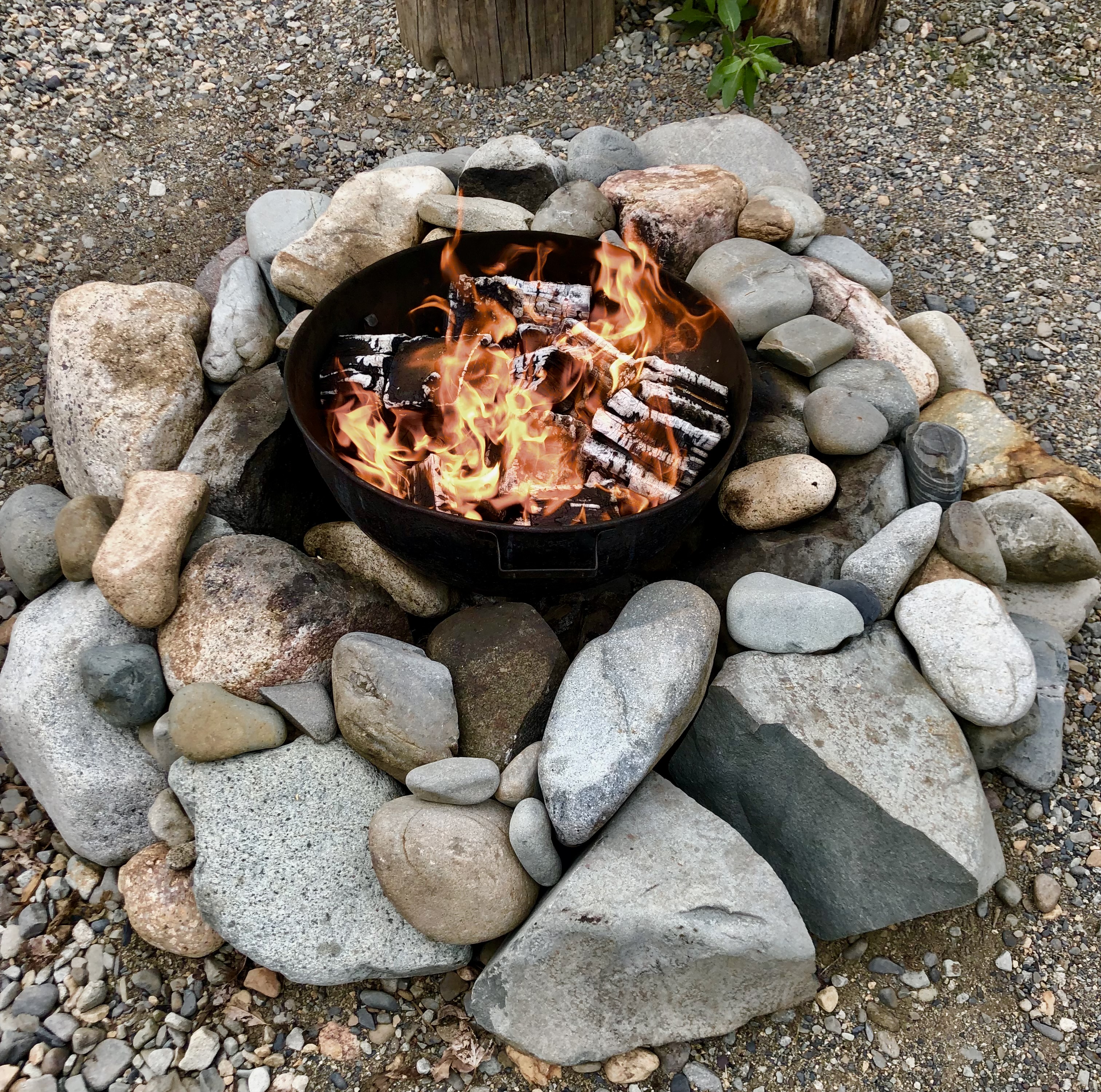
Some of life’s best moments of [im]perfection are simply like this. Friendship and food are never about one versus the other. Instead, in the right mix, the communing of friends and the blending of spirits around a dining table in Greece, or on a hillside picnic with roaming water buffalo in Yangmingshan, or around a campfire ring in the Rocky Mountains, or in the Mazama River valley are a perfect ending to any story.


Pistachio Chicken Breasts with Herb-Garlic Cheese Filling
from The Frog Commissary Cookbook
Herb-Garlic Cheese Filling
Chicken
Filling
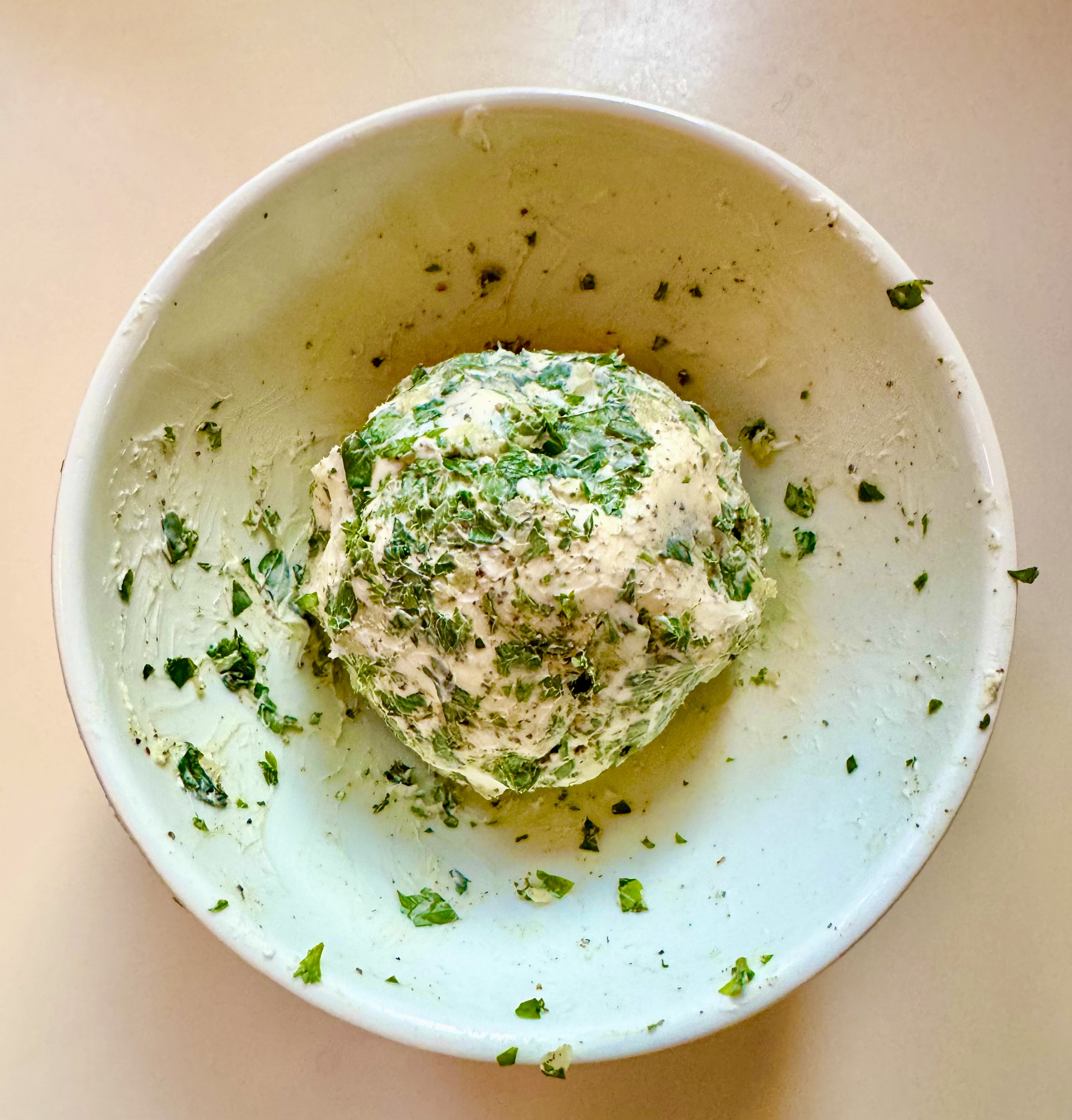
Combine the cream cheese with the garlic, herbs, and seasonings. Chill until firm and then form into 8 2″ long cylinders. Keep refrigerated until ready to use.
Chicken
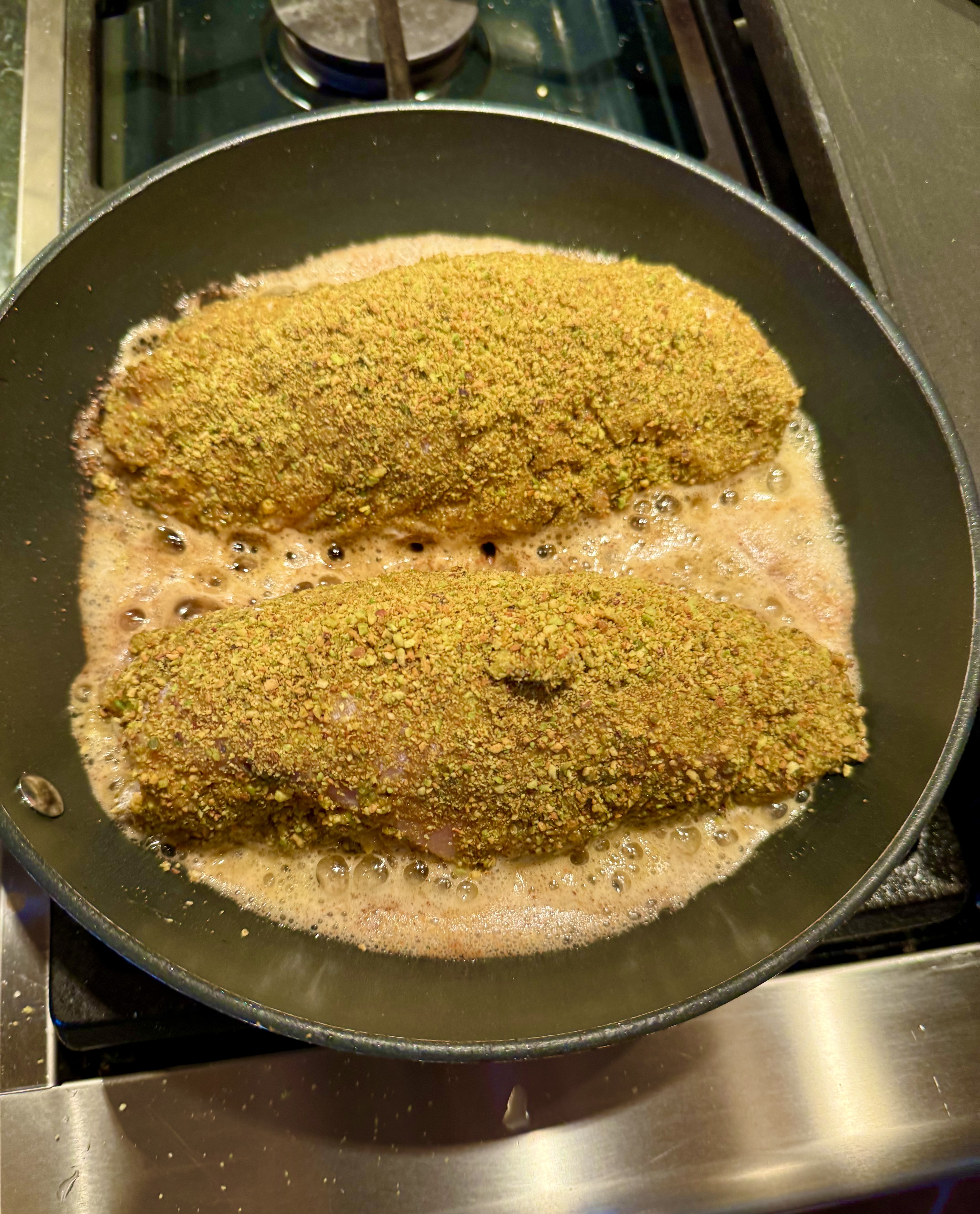
Preheat oven to 350 degrees F. Gently pound chicken breasts between wax paper until 1/4″ thick. For each portion, place 1 portion of the filling along 1 edge of a pounded chicken breast and fold and roll the chicken over the filling to completely and securely enclose it. Repeat with each piece of chicken. Roll each piece sequentially in the seasoned flour, the beaten eggs, and finally the ground pistachios. Sauté in butter over medium heat for 1-2 minutes on each side or until lightly browned. Transfer chicken to a baking pan and put in the oven for 15-20 minutes. Serve hot. Makes 8 portions.


Other overseas adventures with Alec and Charlene, Maddy and Cabby, found here :
I spent the 248th anniversary of our country’s declaration of independence in 1776 in Washington, DC. Because we were married in the bicentennial year of 1976, I add 200 years to our anniversary as a reminder of the creation of democracy in the United States. In the scope of time and human existence, our form of government is very young.
We were invited to watch the July 4th fireworks from an 11th floor rooftop on Pennsylvania Avenue. Heavy rains in the afternoon and evening ended before dark. The nighttime air was warm and humid as we climbed the stairs and took our viewing positions.
Rapid bursts of cascading fireworks left thick clouds of lingering smoke which partially obscured our view, but overall it was a fine holiday display. Being in Washington, DC in July makes me feel patriotic and thoughtful about our democratic history.


American liberties were hard fought and hard won more than 200 years ago. Our Federalist form of government was founded on commonly held ideas; the rule of law, separation of powers, checks and balances, respect for human rights, free and fair elections, and peaceful transitions of power. These principles are unique to our democracy. They are meant to hold us together as a nation.
Democratic values are born and reborn in stormy arguments and turbulent debate. They are fragile to sustain. Every day we see and read about conflict and political discord fueled by a continuous barrage of media that is difficult to tune out. Facts are often shrouded in misinformation.
Democracy works but it is “We, the People” who work it. In return for living in freedom we give back our thoughtful intelligence, critical thinking, and vital participation in the form of voting.
The flash, noise, and smoke on Independence Day were a visual reminder that we are living in a period of political heat and turmoil. There is daily drama amid verbal fireworks. Clouds of doubt form when truth is disregarded or cast aside. In a few months, after a presidential election, it will be seen whether smoke obscures our democracy or begins to dissipate.
Right now, it feels like being in the midst of dark skies and cascading fire power which briefly lit the Washington Memorial and the National Mall with explosive booms, riotous colors, and lingering smoke on July 4, 2024.
The essential moral skill is being considerate to others in the complexity of everyday life. Morality is about how we interact with each other minute by minute. The wise person’s essential gift is tender receptivity. –Iris Murdoch, British writer and philosopher
Is there no virtue among us? If there be not, we are in a wretched situation. –James Madison, American stateman, Founding Father, fourth President of the United States
In the current state of incivility between nations, religions, politics, and sometimes within family lines, when the argument of “us vs. them” feels overwhelming, I think about Count Alexander Rostov, the protagonist in Amor Towles’ best-selling novel, A Gentleman in Moscow. The story begins during the years after the first Russian Revolution, the assassination of the last Czar and his family, and World War 1. The Bolsheviks are firmly in power.
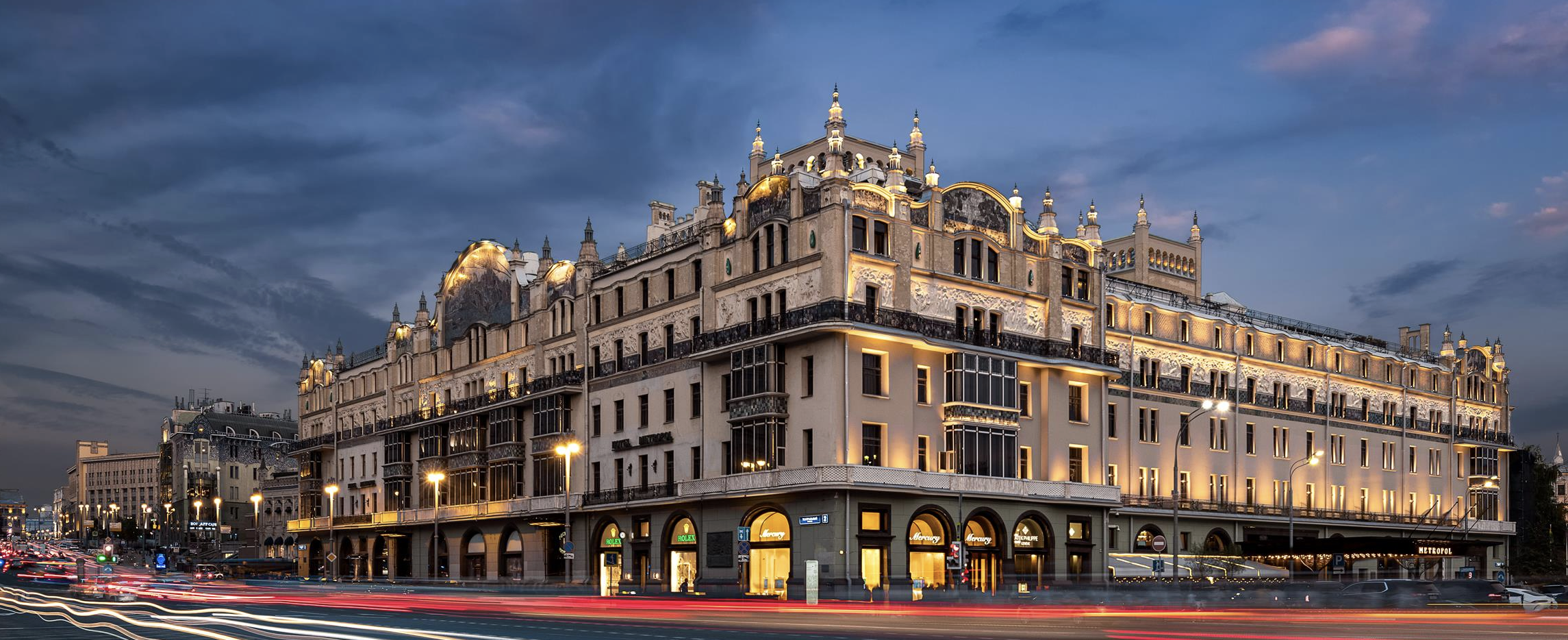
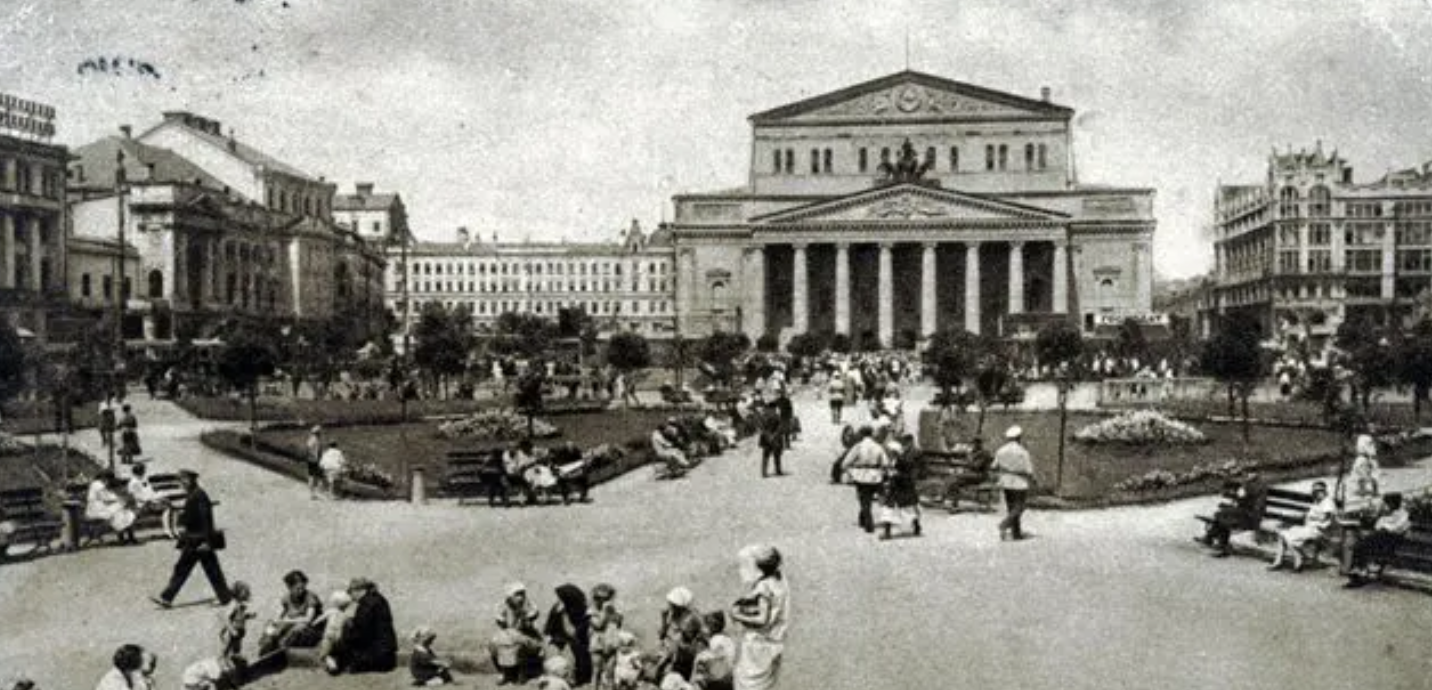
Count Rostov, born an aristocrat, was tried in a Bolshevik tribunal court in 1922 when he was 32-years-old. He was found guilty of being a gentleman of leisure and privilege and of allegedly writing a poem nine years earlier now deemed anti-revolutionary. He was sentenced to turn over his wealth, his personal property, and the luxurious suite where he resided in the Metropol Hotel, near the Kremlin, in Moscow’s Theater Square. Forcibly relocated to one tiny room, a former servant’s quarters in the hotel attic, the final provision was that he would be shot on site if caught outside the hotel premises. House arrest for life.

Rostov settled into meager quarters with few of his inherited possessions. He found the space depressingly confining, hitting his head on the sloping eaves, squeezing his tall body between his father’s large Louis XVI desk and the bed on creaking springs. To ease the cramped conditions, he secretly knocked out the back wall of the built-in wardrobe which connected to another tiny room. He made this into a study, furnished with a bookcase, lamp, two chairs, and his grandmother’s coffee table retrieved from storage, thus doubling his livable space. He remained there for the next 32 years.

Early adjustments were difficult. Rostov’s daily routines were confined to the hotel lobby, barber shop, tailor shop, two restaurants–the formal Boyarsky on the second floor and the less formal Piazza on the ground floor, a bar, and his own 6th floor digs. In the fourth year of confinement, he contemplated suicide by climbing to the hotel roof at midnight one night in order to throw himself off, but was stopped by an unexpected conversation with a hotel caretaker he had previously befriended.
Everything can be taken from a man but one thing: the last of the human freedoms—to choose one’s attitude in any given set of circumstances, to choose one’s own way. –Viktor Frankl, Auschwitz survivor
But freedom of will has been a well-established tenet of moral philosophy since the time of the Greeks. –Amor Towles, A Gentleman in Moscow
Rostov made a decisive shift in order to survive the next three decades of house exile. Instead of succumbing to bitterness with the loss of money, social position and possessions, he chose free will, his own intelligence, and the resilience of the human spirit to move forward, and live.
He took a job as the head waiter in the formal Boyarsky restaurant because, as a gentleman, he knew good food and wine and how to serve both properly. He forged deep, sustainable relationships with the hotel staff–first as a live-in guest, then as a colleague, confidante, and finally as a friend. He conversed at length with international guests, had a longterm romantic relationship with a Russian actress in frequent residence, befriended a child who lived in the Metropol and showed him hidden spaces with her master key. Later, she returned as a young woman and abandoned her five-year-old daughter, Sophia, to Rostov’s care. He shared his limited space, raised the girl to young adulthood, and learned paternal love. He tutored a Party Member, formerly an officer of the Red Army, who was partially responsible for his fate. For many years they met monthly for dinner and conversation about being a gentleman, learning to speak French and English, understanding the ways of western culture by watching American movies.
Rostov accomplished all of this by treating everyone with equal parts civility, respect, and kindness. He observed human nature by foregoing judgement. Interacting with individuals from every station and age in life with the same courteous manner, the Count matured in self-awareness, humility, and understanding.
Alexander Rostov’s story, before and after exile, is rich in complexity and detail during a turbulent political time in Russian history. A well-crafted, but nail-biting escape awaits in the end. Yet the heart of Rostov’s life under house arrest is that civility, or courtesy, has nothing to do with one’s social class, clothing, or bank balance. Rather, civility is a moral choice, and along with graciousness is the kind of practice that never goes out of style. Count Rostov is one of the most endearing literary examples.
The Count took pride in wearing a well-tailored jacket, but he took greater pride in knowing that a gentleman’s presence was best announced by his bearing, his remarks and his manner. Not by the cut of his coat. –Amor Towles, A Gentleman in Moscow
Rostov’s gentlemanly qualities, the humanity, love, and respect he gained in return, illustrates that there are high rewards when civility prevails. As individuals, we can’t fix the world’s overwhelming problems of wars between nations, historic hatred between factions, partisan divides. Still, bridging the gap from Rostov’s choices to the philosophy of Joseph Campbell which says there is something we can control.
When we talk about settling the world’s problems, we’re barking up the wrong tree. The world is perfect. It’s a mess. It has always been a mess. We are not going to change it. Our job is to straighten out our own lives. –Joseph Campbell, mythologist, writer, lecturer [1904-1987]
In 1595, French Jesuits composed 110 Rules of Civility. George Washington is known to have copied them into his school notebook by the time he was 16 years old, more than two centuries later. He titled them, “The Young George Washington’s Rules of Civility and Decent Behavior in Company and Conversation”, and they were formative in the development of his character. A system of courtesy and respectful behavior appropriate in the company of individuals was later expanded to a nation when he became President. A man of that time wrote this about Washington, “…no wonder every body honored him who honored everybody.”
The first and last of 110 Rules of Civility:
110. Labor to keep alive in your breast that little spark of celestial fire called conscience.
One final story. When our son, Adam, was four-years-old, we were at Lake of the Ozarks in Missouri with 16 extended family members together in a big house for a reunion weekend. Two of his cousins, brothers, then four and six years old, were rolling around on the floor aggressively punching, kicking, and yelling as young boys or puppy dogs are apt to do. Adam, after watching the ruckus on the sidelines, finally approached, and standing directly over them asked, “Can’t we all try to get along now?”
To put the world in order, we must first put the nation in order. To put the nation in order, we must first put the family in order. To put the family in order, we must cultivate our personal life; and to cultivate our personal life, we must first set our hearts right.
–Confucius [551-479 BC]
Paul to the Corinthians:
For our boast is this; the testimony of our conscience, that we have behaved in the world to be decent.
Books by Amor Towles:


The fact that I, myself, do not understand what my paintings mean while I am painting them does not imply that they are meaningless. –Salvador Dalí, Spanish surrealist artist
Years ago, a man named John Filer, found this quote by Dalí, and taped it to his wife’s easel because it reminded him of her work. His wife, Jane Filer, is an artist. She has been expressing herself through painting since she was a small child. In Kindergarten, Jane went to the standing easel during free time and painted a new picture every day the entire school year.
Today, Jane’s acrylic-on-canvas paintings carry the ethereal quality of an imaginative dream. Among overlaying colors, images materialize and hold one’s gaze. It’s impossible not to feel something and find meaning.
I wasn’t aware of Jane Filer or anything about her portfolio until I visited a friend in Boulder, Colorado more than a year ago. In her living room, there was a painting over the sofa that pulled me closer. It felt like looking into someone’s multi-layered dream. Even one of my own dreams. I wanted to know more. My friend, Cathy, told me it was painted by a woman named Jane Filer. She bought it from a gallery on Canyon Road in Santa Fe, New Mexico.

My husband and I were already planning a road trip to New Mexico the upcoming weekend. Good road trips offer new discoveries and lasting memories. What I didn’t expect as an outcome was friendship with an artist whose work I greatly admire.
Jane Filer was the middle child of four siblings–two older brothers, two younger sisters. Born on the coast of California, her accountant father moved the family to Australia for several years when she was 11. While living there, Jane gained appreciation for and inspiration from aboriginal art–particularly the strong colors and detailed, organic nature of the paintings.
As a child, Jane’s mother told her she had an “overactive imagination”. It was not meant as a compliment. Rather, Jane was endlessly criticized and berated as a “disappointment” for not being practical enough. She turned her creative energies and vivid imagination toward her younger sisters, making up stories and songs to entertain them. Eventually she was nurtured by a paternal aunt. Drawing came naturally before Jane entered school. And then she discovered the magic of a paint brush in her hand.
Before we drove to Santa Fe, I called Bill Hester, Jane’s art dealer at the time. We were coming to look at everything he had of her work. Bill spent a lot of time with us as we strolled the gallery, asking good questions, explaining Jane’s painting method along with his personal view on poetry, metaphor, and art.
My husband and I considered each painting individually and then circled back to speak together privately. One piece resonated with both of us. It was entitled Elephant’s Journey and reminded us of our years living overseas and the adventures we experienced as a family, in five countries for more than thirty years. Elephant’s Journey touched a mutual chord. The elephants are marching in line toward a cliff, but it is not catastrophic. We saw it as the poem for a risk we chose to live.


Jane’s family returned to the U.S. from Australia and settled in the Midwest. With encouragement from her mentoring aunt, she earned a Bachelor of Fine Arts from Southern Illinois University. After graduating, she met her husband, John Filer, who was five years older and worked in forestry. For many years, while John planted trees all over America, they travelled and lived simply in a camping trailer with national and state forests as their backyard.
At the University of North Carolina, Chapel Hill, Jane was offered a coveted spot in the art college, working toward her Master of Fine Arts. She began teaching painting and drawing for the next 21 years. In 1986, John and Jane bought 17 acres of woods and began to build their first real home. Much of the construction was accomplished by their own creative hands.
As she was about to turn 50, Jane left teaching, which she dearly loved, to devote herself full-time to painting. John, now retired from forestry, became her manager, counselor, and confidence builder. When Jane expressed self-doubt or struggled with difficult decisions, John would simply look at her and say, “Why are you asking me? You don’t need anyone’s advice. You’re Jane Filer!”
Ten years ago, Jane’s selling gallery expanded from Chapel Hill to Santa Fe, which is, the second largest art market in the world after New York City.
Six months after purchasing Elephant’s Journey, I returned to Santa Fe to view another Filer painting I had seen on the gallery’s website. But I was immediately distracted by a larger piece that had just arrived from Jane’s North Carolina studio the day before. Unwrapped, on the floor, it was leaning against the wall. I studied it silently and knew I could look at this painting every day for the rest of my life. It is called Eclipse.
There are figures falling out of the sky, there are swimming figures, there is a grove of trees whose roots feed an underground river, with a tent and a lone camper above. There is water running through it and a full regatta of sailboats off on one side. The colors blend into a beautiful meditation even without the imagery. When I look at this painting, I continue to discover something new. It joined Elephant’s Journey in our living room.


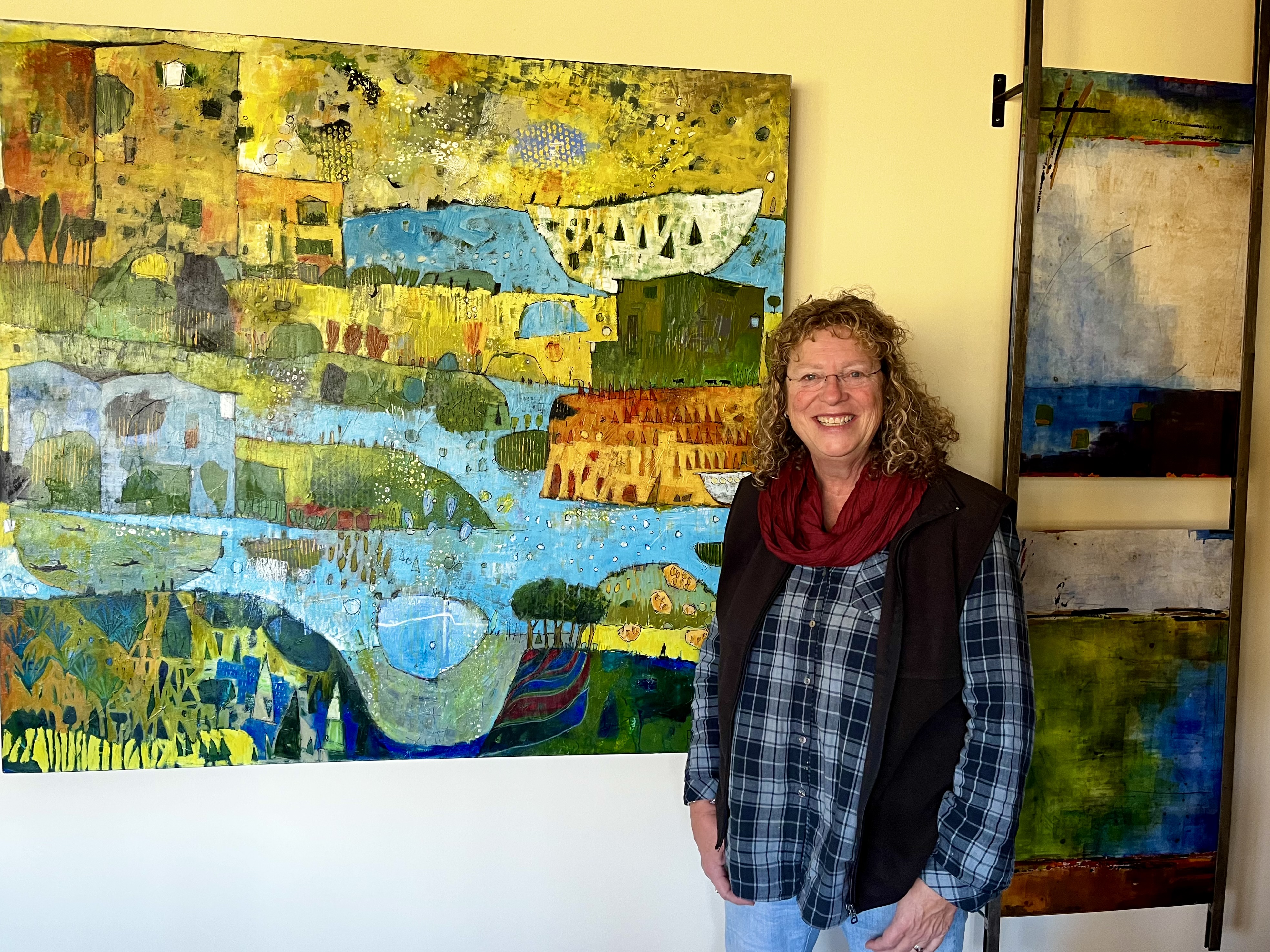
Jane Filer is a happy-by-nature-extrovert with a warm, engaging smile, a tumble of spiraling blond curls, and twinkling blue eyes. I met her in person on my next visit to Santa Fe where she was painting for two weeks as “artist in residence” at the Hester gallery. Jane is an open communicator who simply loves people. Even people she meets for the first time.

I am fascinated with life, light, love, and fear. –Jane Filer
We fell into conversation easily, starting with the psychology of being an artist. Jane told me that being off balance and a bit fearful is critical to her paintings. Dark and light, yin and yang are expressed in metaphoric imagery. She doesn’t explain what the imagery means. She doesn’t like repetition, but certain themes recur. Her connection with Nature in the form of animals, faces, figures, water, flowers, trees, are part of the story on canvas. There is often architecture, discernable buildings or shelters painted in, too. Because Jane considers art her therapy as well as a way of life, she is fearless about entering what she calls her dark side. She believes painting fills a need to dig deeply into life’s challenges and, by doing so, keeps her healthy.
After the Santa Fe meeting, we continued talking over the phone. Then Jane invited me to visit her studio/home in the woods of North Carolina. John Filer passed away prematurely several years ago. After he died, she hired the finishing work on the house to her specifications. I found everything about it to be an extension of her naturalness, her love of nature, and living close to the earth.


The first thing I noticed were collections everywhere. Rocks and geodes, jars and bottles, shells and bones, antique Indian artifacts–axe heads and arrowheads. There are faces that Jane has collected, sculpted, or painted. The furniture invites curling up to talk or muse on the green expanse of forest outside or to sit by the wood burning stove inside. The kitchen was one of my favorite indoor spaces. John built the wooden dish rack above an antique cast iron sink he found in the woods. It’s an efficient way to dry and store hand washed dishes. Jane designed the tile back drop over the stove and sink. The L-shaped counter invites sitting over morning coffee, talking to whoever is cooking, or sipping single malt whisky and more conversation in late afternoon. There are vignettes of photos, paintings, and artifacts tucked into wall niches or on windowsills.


I can’t write songs and I can’t write stories, but I can paint. –Jane Filer
Observing an artist in their studio space is definitely zeroing in on their personal reality. Because Jane told me she dreams and/or has visions while she works, I assumed that, like writers, her working time is largely introspective, solitary, and quiet. In fact, life in the Filer studio can be just the opposite. There might be loud music and singing, phone calls and conversations. There is another artist, Michele Yellin, who paints with her, their easels set side by side. When I tried to retreat to my room to give her time to work, Jane invited me into the studio to talk while she painted. As I poked around looking at artifacts that caught my eye and asking questions, she transferred color, imagery, and texture to the canvas. Jane multi-tasks and dreams while awake.


We dream all day long. –Jane Filer
To begin a new piece, Jane sits at her easel thinking quietly before reaching for paint and covering the canvas edge to edge in colors. She moves color around abstractly until layers and shapes suggest composition. It is free-falling. When patterns and colors start to feel exciting, she sketches over the abstract with fine charcoal lines. A language is developing, the beginning of a story emerges in her mind. She feels anticipation and energy about what comes next.
The next phase, moving from the abstract to the middle composition, is what Jane calls “The Hairy Middle”. It is the longest part of her painting method and often uncomfortable. Because in the “hairy part” she does a deep dive, directly facing what she likes and dislikes, and more importantly what she fears. There is collective unconscious to whatever bubbles up in this middle moment. The painting has become its own entity. Jane moves it further into existence by working through her emotions until she is on the other side. Her imagination stretches to completion, heads to an ending.


Jane can work on more than one painting at a time. She sets aside something that needs time to mature and starts a new canvas or goes back to an earlier one. She adds texture and shape with pieces of bubble wrap or corrugated cardboard, pressing them into paint and then onto the canvas. She might use a knife edge along with brush strokes to create depth. There are finely drawn outlines around imagery. The color palate is vibrant and rich. Yet the finished painting may have morphed numerous times from the original color scheme.
For art to be complete, it must be let go–sent off into the world. –Jane Filer
Jane considers her paintings to be her offspring. They are born and nurtured on canvas. They are not meant to be literal, but rather offer an invitation to find personal meaning. Intuition tells her when each one is finished. Then she lets it go to stand on its own in the world.
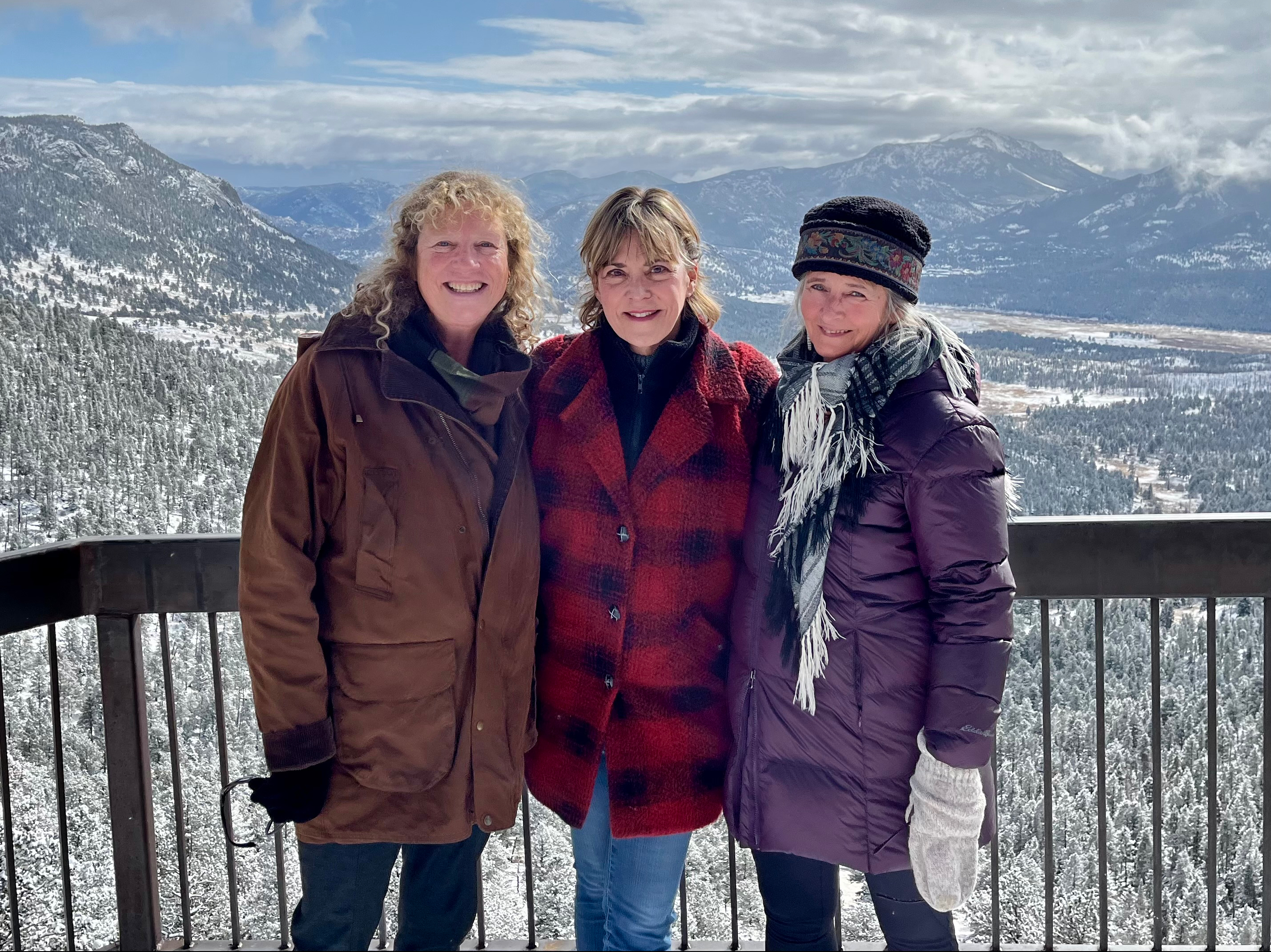
I sent Jane a photo of her two paintings on our living room wall and invited her to come see them in person. Four months later, at the end of October, Jane and her friend, Michele Yellin, drove across the country and made Colorado their first stop.
It snowed all night after they arrived. We woke to a white wonderland in the morning. It didn’t stop us from driving into Rocky Mountain National Park and having lunch at the historic Stanley Hotel.


The best things in life cannot be told. –Heinrich Zimmer, German linguist and historian
That is to say, it is difficult to describe art that exists outside the reach of words. But this is the very essence of it, too. Art is created to inspire emotions and depth of feeling that are simply beyond description.
I think this is what it means to be in the presence of Filer art. What begins as a dream or vision in Jane’s metaphysical mind, gains momentum in color and imagery on canvas, and opens a poetic portal to both lose and find yourself at the same time.
I am inspired by this circle of connectedness–a painting in another’s living room, an art gallery in Santa Fe, two paintings in our home that enrich us every day, back and forth visits with an artist whose life began as a girl with an overactive imagination and is now my friend.
That’s being Jane Filer.
Hope as a Destination –be sure to read a new story about how a piece of Jane’s art, entitled “Above the Bridge”, inspires hope and encourages ways we can create impact in a tumultuous political climate.
Current information about Jane’s art, both painting and sculpture, can be found on her website janefiler.com
Subcultures are made up of people who share a passion about a specific interest that is often stereotyped. Hippies, bikers, skate boarders, NASCAR racers, bird watchers, body builders, punk rockers, break dancers, to name a few. Recently, I learned about an American subculture that has been around since 1992 but escaped my attention for a couple of reasons–geography and interest.
We were living in Cyprus and Taiwan in the 1990s, and I was involved in learning quirky details about other cultures rather than paying attention to what was going on in my home country. Also, the subculture I recently witnessed in California was about 180 degrees outside of my normal interests. Possibly because it involves five and six-ton vehicles doing impossible tricks–jumping in the air, spinning donuts, flipping over, standing on two wheels, and racing in circles. It is a competitive spectator sport of huge trucks with notorious names and drivers. This is Monster Jam.


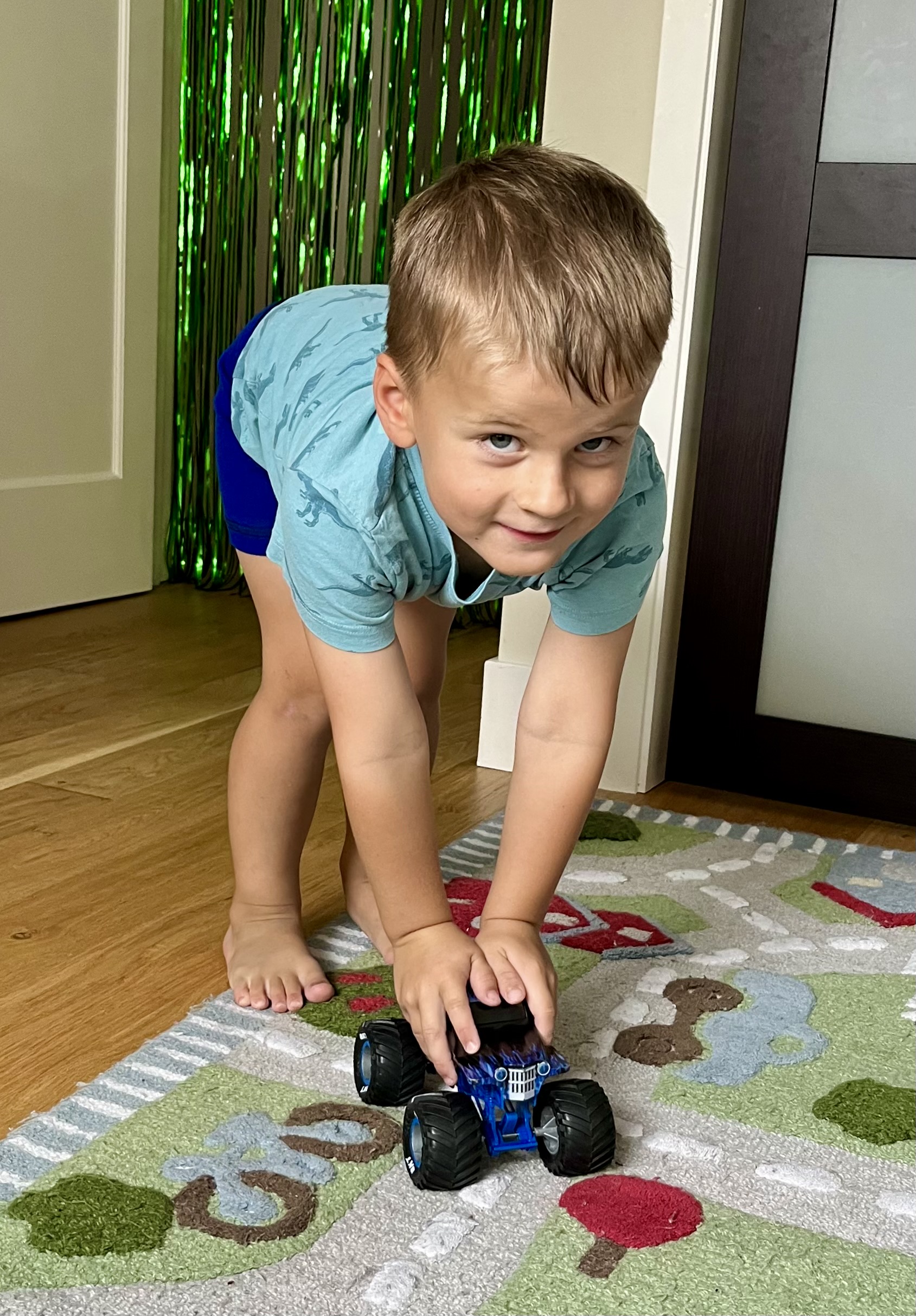
While visiting a four-year-old grandson who is obsessed with cars, trucks, and trains–basically anything with rotating wheels, I was notified by his father that we would be attending a Monster Jam rally with the entire family on Sunday afternoon. I watched a YouTube video that told me, “If you don’t know what Monster Jam is, you are a certified city slicker.”


Monster Jam is a live motorsport event under the auspices of U.S. Hot Rod Association, based primarily in North America. The Monster Truck series is the longest running and most successful competition of big trucks in the last 30 years.
Monster Trucks are special off-road vehicles with heavy duty suspension, 4-wheel steering, and oversized tires. The tires are a monstrous 66 inches tall and 43 inches across. Each truck is built like “an engineered fighter jet airplane” but only used for competitive entertainment. They cost $250,000.


The drivers work on teams, performing in seasonal rallies that tour the U.S. with famously known and named vehicles–Grave Digger, Son-uva Digger, Zombie, Whiplash, El Toro Loco, Megalodon, or Jurassic Attack. Currently, there are 14 female Monster Truck drivers in a predominantly male circuit. All driving teams are salaried and receive no prize money.
Monster Jam is one of the safer driving sports. Drivers are protected from head to toe in custom-made fire-resistant suits, helmets, and gloves. They are completely strapped in with head, neck, and body support. When a truck flips upside down or catches fire, most drivers walk away unscathed.
It’s very LOUD when turbo-charged engines rev up and grind away in competitive stunts for several hours. Six-year-old Leila and four-year-old Archie wore protective headsets with flashing lights over their ears. We stuffed orange and white foam plugs tightly into each ear canal. The arena was packed with fans of all shapes and sizes, ages, and genders, defying stereotypes. Families, couples, and singles gathered for the same purpose, waiting for their favorite Monster truck to take center stage and perform.


And so, the show began.
Exactly on starting time, overhead lights dimmed. Multiple Monster trucks vroomed into the stadium flashing headlights, painted in bold designs. The first competition was racing around in a circle. Followed by the Two-Wheel event where each truck has two attempts to show their strongest skills on two wheels, either front or back. Drivers could choose to spin in a whirlwind of donut dust as an alternative in this category. The final competition was Freestyle, where trucks showcase any, or all, of their abilities in timed competition from ramp jumps and diving, flips, or wheelies.


Like any subculture, Monster Jam has its own vocabulary. Cyclones are high speed donuts. Doing an endo is not cool. This is where the truck does a front-end rollover and crashes. Pagos are good and applauded loudly. It means doing a wheelie and bouncing forward on the rear tires. In contrast, riding the wave is bouncing up and down while standing precariously on the front tires. The hot shoe is the top driver who scores the most points overall. Grave Digger driver, of course.


During our show, the lone female driver attempted a flip…but failed. The indoor venue was a bit small for this maneuver, but she was the only one who tried. Then had to be rescued from sitting on her head by a massive crane that re-righted her machine. She emerged smiling and waving to the cheering crowd. And won the Freestyle event.
It’s a formula that works and has gained popularity over the decades. For adult spectators, large-can beer drinking is involved. For children, sticky blue and pink cotton candy from a bag is preferred. For any age, heavily breaded chicken nuggets and french fries smothered in ketchup. American dining not at its finest. But this is Monster Jam!


We said “yes” to it all and were caught in the uplifting atmosphere of a new experience. It was about participating in the enjoyment of a boy who knows the names of all the big trucks and has a fine collection of them at home. He owns this subculture, for now.
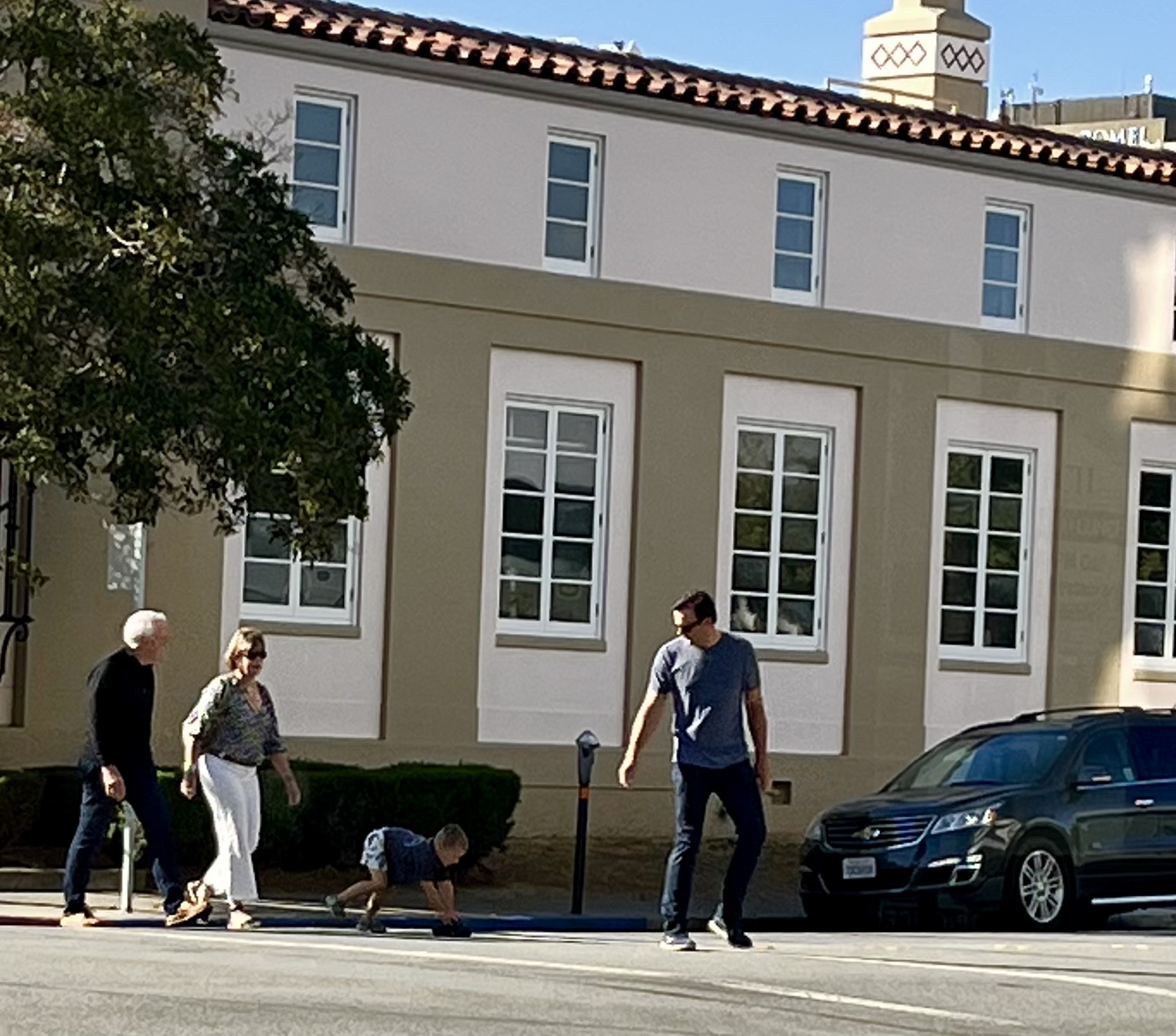
Here’s to boys and girls everywhere who love to push, [even across the street on the way to breakfast] or drive, big wheels that go around and around and sometimes even upside down.


Monster Jam. Know what it is. Don’t be a city slicker.


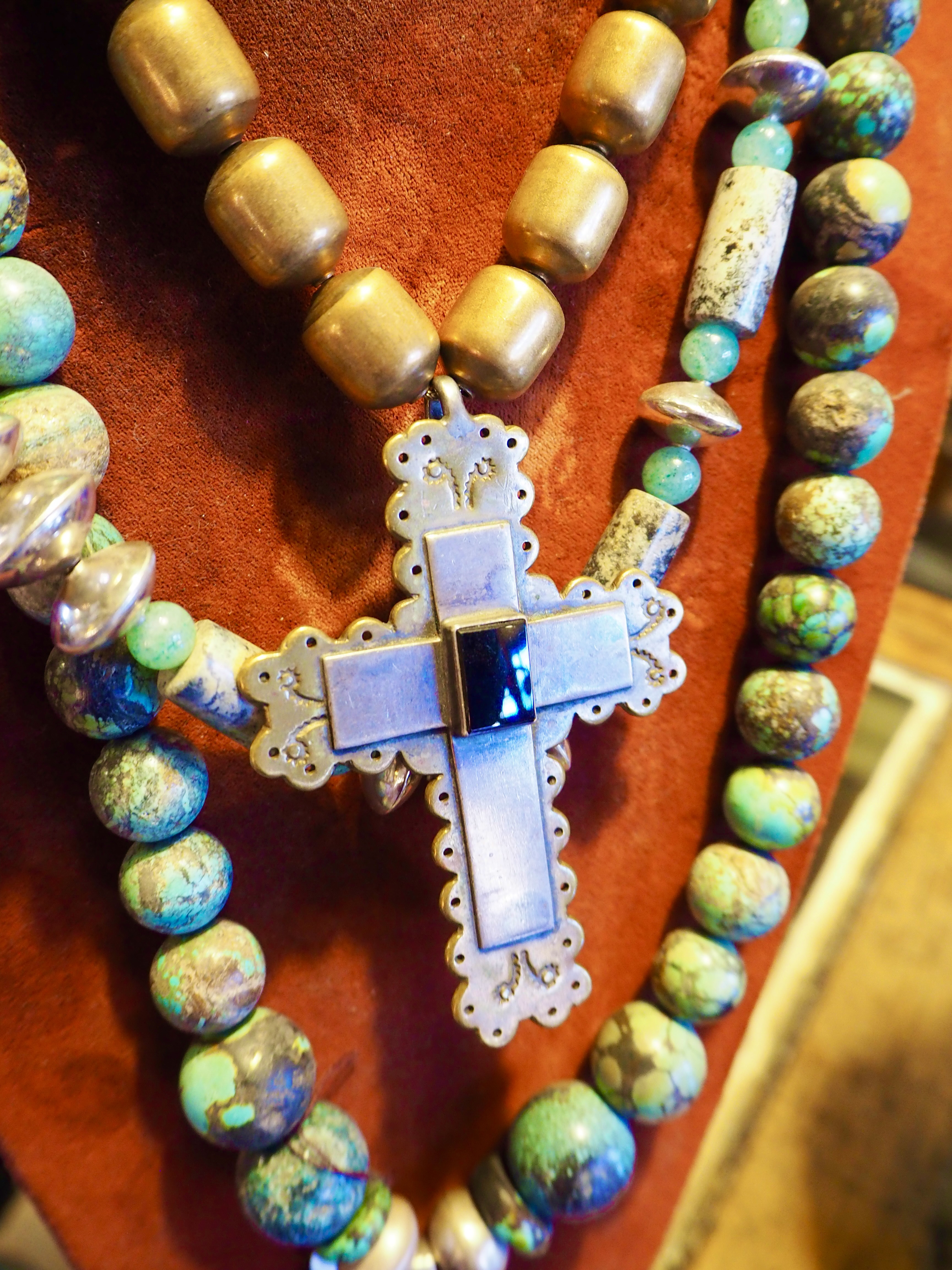
Walking down a street off the square in Taos, New Mexico, I noticed an adobe building with a colorful door set back off the sidewalk. The name, El Rincón, caught my eye because a friend in Colorado had mentioned buying interesting turquoise jewelry there. Opening the bright blue painted door, I didn’t immediately realize I was entering the domain of a family saga that began more than 100 years ago. But I would soon learn that the maverick who started it all was named Ralph Waldo Emerson Meyers.
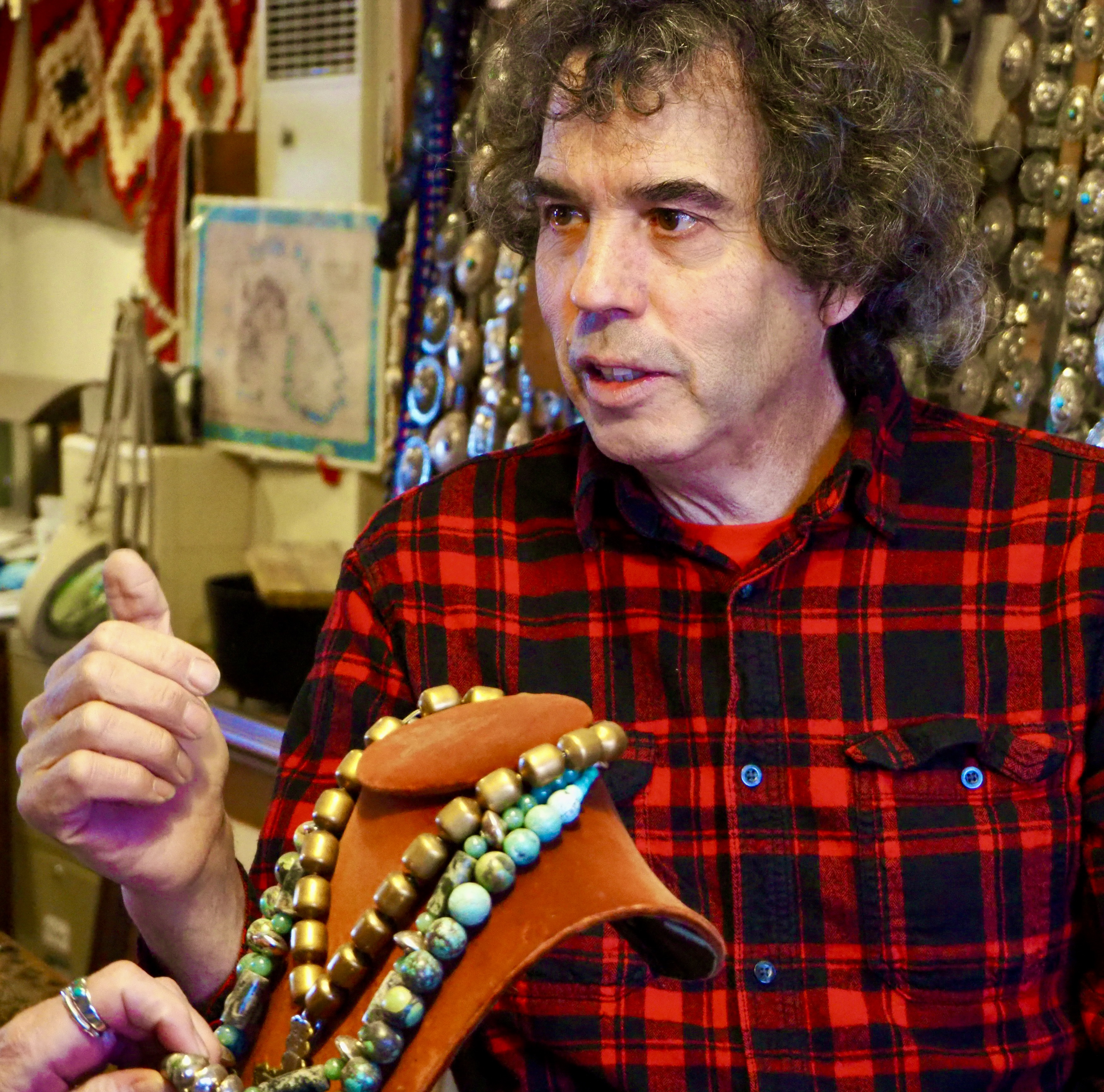
On that afternoon, Estevan Castillo, grandson of Ralph Meyers, greeted me from behind an antique display cabinet. Estevan has dark, curly, gray-flecked-hair and a gentle, soft spoken demeanor. He is a musician, a talented silversmith jeweler, and the owner of El Rincón, known as the oldest trading post in Taos. More importantly, he is “Contador de historias”, the teller and keeper of family stories.


Old wooden display cases with deeply scratched glass countertops drew me in right away. Some were filled with vintage “pawn” turquoise and silver. My appreciation for one-of-a-kind jewelry art has roots in a small cottage business I started when we lived overseas. For several years, I designed and sold ethnic necklaces and earrings made from beads, stones, and silver collected around the world.


Questions I asked Estevan were answered with stories. About bead strands collected and worn by his grandmother Rowena Meyers, artifacts made by Indians in his grandfather’s time, a photo of Estevan in the shop as a boy cutting holes in silver beads, one of his grandmother’s buckskin dresses hanging on the wall. I wanted to know more.


El Rincón first opened as the Mission Shop, an Indian curio store started by Ralph Meyers in the early part of the last century. Now it spans three generations. The evolution and survival of Taos’ oldest trading post is as remarkable as the museum quality Native American art and artifacts Meyers traded and sold. Some of his collections are now in the Smithsonian and Guggenheim Museums.


The history begins with a young man’s all-consuming passion to live his life in the “old west” of more than 100 years ago. And his desire to paint pictures of Indians. The history is best divided in two parts–during and after the life of Ralph Meyers.
PART ONE–The Ralph Meyers Years
Born in 1885, Ralph Waldo Emerson Meyers grew up in Denver, Colorado. He was a disinterested student and dropped out of school after third grade. But he was an avid learner with keen listening skills. He hung onto stories told by “old timers” of his era. Stories of Indians and rugged geographic beauty and remote life in the west. Even without formal art training, he wanted to make paintings of Indians in their environment. He talked easily to everyone which made him adept at turning relationships into friendships. And so, with a head full of stories, good communication skills, and an innate ability to teach himself anything, Meyers took off for rural New Mexico.
He worked as a fire guard for one year with the U.S. Forestry Service, stationed near Blue Lake, north of Taos. Blue Lake is sacred ceremonial ground for the Taos Pueblo Indians, worshiped as the source of life for the irrigation of their land. [See *End Notes]
Meyers lived a hermit’s life that year, but he connected personally with the Pueblo people and began trading with them. After several years of collecting Indian artifacts throughout the west and southwest he settled permanently in Taos, and the Mission Shop trading post opened for business.
Ralph Meyers was an outlier. He was the first white man to make social and professional relationships with the secluded Pueblo-dwelling Indians around Taos. Initially, the trading post highlighted Native American pottery, rugs, jewelry, baskets, buckskin, moccasins, and ceremonial beadwork. Then, as a self-taught oil painter, Meyers began displaying his own work. He was part of the emerging artist colony of Taos in the 1920s and ‘30s. Other creative people arrived–painters, photographers, and writers. Many were captivated by the beauty of the landscape, the simple unhurried pace of life, and they stayed.


He was drawn into the close circle of friends that wealthy New York art patron Mabel Dodge Luhan brought to the area–painter Georgia O’Keefe, writer D.H. Lawrence, photographer Ansel Adams, heiress and jewelry designer Millicent Rogers, Russian emigré and portrait painter Nicolai Fechin. Hollywood actors, musicians, and other artists cycled through Taos. Ralph Meyers knew them all. His ability to sustain trusted friendships across Indian and Spanish-American cultures, socio-economic status, gender, and notoriety contributed to his stature as a leading citizen.


Ralph Meyers was a mountain guide, business entrepreneur, and a Renaissance man of his generation. By observing other artists, he taught himself to oil paint. He learned to be a skilled silversmith, made his own tools, and created beautiful jewelry. He took up furniture making and wood carving in the Spanish colonial style. He taught himself leather working and beading. He learned to spin, dye, and weave wool blankets in the traditional ways. He trained and hired Indians to make jewelry, hand-bead moccasins, buckskin garments, and ceremonial ornaments in his shop. They were paid fair market prices which further engendered loyalty.


Then came family life. Rowena Matteson, born in Pennsylvania in 1909, moved to the Taos area as a child. She was engaged to an employee in The Mission Shop while she was a teenager. That relationship faded and another bloomed. Rowena married Ralph Meyers in 1933. He was 48. She was 24. Two children were born. Daughter Nina and son Ouray became artist/painters.


A rattlesnake bite through his thumbnail was the beginning of Meyers’ demise. He saw what he thought was a dead snake hanging in a tree and began swinging it around to entertain friends. It doubled back and bit him. There was no anti-venom treatment. After a debilitating infection and illness he died in 1948 at the age of 63.
For more than 36 years Ralph Meyers was a trusted icon in Taos and Pueblo communities. He was introspective with an extrovert’s personality. He had demons too. Mainly alcohol, which fueled angry and sometimes destructive behavior. One night, under the influence of whiskey, he took 30 of his paintings and set them on fire.
He loved his children but was self-absorbed by an extreme need to create or build or paint something every day. He was not remembered as a nurturing father. Rowena filled the gap.
Ralph Waldo Emerson Meyers was an unconventional man who loved Native American culture as an outsider but found his way inside the New Mexican Pueblo community. An original western icon who listened, learned, and bridged cultures with a legacy lasting long after a snake bite.
PART TWO–The Mission Shop becomes El Rincón
After Meyers’ death, Rowena closed the trading post, moved away, and leased the space to The Taos Bookshop for the next twenty years.
She returned in 1970, in a second marriage with another son, and moved into a house behind The Taos Bookshop. There she opened El Rincón [“the hidden corner”, in Spanish] to showcase jewelry, costumes, and artifacts acquired from continued trading. When the bookstore owners vacated the trading post building, Rowena moved back into the larger space and added a museum. The name El Rincón remained.
Eventually Rowena’s home became La Doña Luz Inn, a bed and breakfast started with daughter Nina in 1985. The building has been extensively renovated with new additions designed and built by Paco Castillo, Nina’s middle son. When Nina died in 2007, La Doña Luz was Paco’s inheritance. Nina’s vivid paintings can be seen throughout the inn in the form of colorful folk art kitchen cabinets, bathroom murals, and kiva fireplace surrounds. It’s a lovely historic building, rich in family art and creativity.


Oldest son of Nina, Miguel Castillo, owns the part of Ralph and Rowena’s homestead that was attached to the trading post. The front rooms were once a restaurant, also called La Doña Luz. With Ralph serving as chef, their dinner parties with other artists and guests were legendary and raucous, lasting long into the night. Now renovated, these rooms and former living quarters house boutique shops.
When I first walked into El Rincón, it felt like living history in every direction. There were relics and heirlooms and stories everywhere, hanging from the ceiling, tacked to the walls, or loaded into display cases. Shelves with dusty pottery and baskets. Concho belts, bolo ties, strings of beads, necklaces, bracelets, earrings, and rings, vintage and new silver and turquoise. A back room piled with artifacts, too many to absorb.


Over my several visits to Taos, Estevan has been a generous “Contador” of his family’s stories. Often, we talked in his workshop where strong natural light pours in the big windows with a view toward his brother’s Inn. Jewelry making tools, silver, stones, and unfinished projects cover the workbench. There are cans and containers of beads and silver lining a high shelf along one wall.


Estevan Castillo is a nostalgic man. He remembers Rowena sitting on her chair in the late afternoon talking to Indian traders and customers while sipping a beer. He knew that his mother Nina was driven by a consuming need to paint every day. Just like her father. He is proud of the history and contributions of the ancestors who preceded him. He understands artistry, creation, and relationships founded on trust. Estevan knows devastation from tragic accidental deaths of his uncle and cousins. He has lived the bittersweet blessings of caretaking his grandmother and mother as they faded and died.
Today, Estevan preserves the legacy that began in the Mission Shop and continues in El Rincón. His stories are vivid. And like the grandfather he never knew, he can talk to anyone. In the worn adobe walls, darkly stained wooden beams, and eclectic collection of artifacts there are layers upon layers of stories. Ask a question or wonder about Taos history and the oldest trading post from 100+ years ago, then be ready for where Estevan’s stories take you.
*END NOTES:
Facts About the Taos Pueblo


A guest is good or bad because of the host who makes being a guest an easy or a difficult task. –Eleanor Roosevelt
When I was a child, there was a book called Miss Jellytot’s Visit that formed my first impression of what it means to be both a host and a guest. Nine-year-old Katie O’Dea watched her mother host college friend, Irene, in the guest room of their home. The bed was made up with the best linens and quilts in the house. There were big, soft feathery pillows in pink pillowcases that you could sink back into, and a rose on the bedside table. The towels were fluffy and white in the spotless bathroom. Their guest was served breakfast in bed on a tray with another rose alongside. There was an assortment of magazines and books to peruse in lounging leisure.
Katie dreamed of being a guest in her own house, staying in that comfortable room with nothing to do but dress up in fancy clothing, wear French perfume, and be waited on like “Aunt Rene”. With her parents’ indulgence, she arrives as a “visitor” from out of town, calling herself Miss Jellytot because that was the name of her favorite cookies. Everyone stayed in their assigned roles. Katie was treated like an adult the entire visit.
Of course, there were problems with all of this. The first was that Aunt Rene stayed for two weeks and never lifted a finger as she had come “to rest and relax.” Mrs. O’Dea was not sorry to see her friend leave on the train. The second was that Katie learned being a grown-up meant missing pleasurable childhood activities like playing outside with friends, going to swim parties, or getting a new puppy. She couldn’t wait to end her “visit” after six days and be a kid again. Lessons: Don’t jump into adulthood when you haven’t finished the fun of being a child. And don’t overstay.
The story left me with “how-tos” carried into my own adult life. As a guest in someone else’s home, I stay no more than three days, with exceptions for family birthings or need-to-help home stays. I also like to set up a room for overnight guests in my home that is cozy and welcoming and well-outfitted. A room that I would enjoy spending time in, too.
In early December, a cousin’s memorial service created the need to travel to St. Louis while I was already out of town for another event. My niece, Rebecca, has a large home with a guest bedroom and bath separate from the family’s living space. It was mine for the weekend. I flew in from across the country on a blustery wet night, rented a car and drove to her house knowing that everyone was out for the evening.
It couldn’t have been a better welcoming. Shrugging off coat in the back door entry, I smelled something delicious. Christmas lights and decorations were twinkling in every room. There was soft music coming from a speaker in the kitchen. Simmering on the stove was a pot of homemade chicken soup. There was a place setting on the counter next to a fresh baguette, butter, and a note inviting me to help myself. I was warmed to my soul.


I sighed gratefully and headed for the bedroom. Lights were on, a little gift in a colorful bag was on the bedside table next to a carafe of water. White towels were folded on the chair by the window. The bed was layered with white quilts, comforters, and billowy pillows.


Back in the kitchen, I poured a glass of wine, served myself a bowl of soup with bread and butter on the side, and said aloud, “This woman gets it.”
Hosting overnight guests involves providing for them in surprising and generous ways, going out of your way to roll out the welcome mat, even if you aren’t there to open the door. My niece checked all those boxes.
Rebecca is an interior decorator and organizer extraordinaire in her home and for her clients.
On a previous visit I noticed an opportunity where I could be of help. There is a small, temperature-controlled wine room in the basement. I had seen bottles of red and white and bubbly of differing vintages and values pushed randomly into wine slots. There were shelves a-jumble with gifted booze never opened and never intending to be drunk, gift bags strewn on the floor. If trying to find something special to serve and drink, well, there was no order.
My offer–to sit with her [and a charcuterie plate and two glasses of wine], pull everything off the shelves, put like vintages together, separate great bottles from the good and the cooking variety, use the label maker, toss out or give away questionable items like Ever Clear [!], horrible flavors of vodka, and other unidentifiable poisons. We set aside whisky that I might drink on another visit. She was thrilled. I was happy to spend time in a companionable activity in return for her hospitality. Win-win, like a thank you note in action.
Guest: Be genuine. Be remarkable. Be worth connecting with. –Seth Godin
Hosting at home can also be a celebratory party, a dinner, an outside barbecue. The host sets the stage while guests bring their exuberant mood, conversational banter, and best engaging self to round out the table. The most memorable get-togethers with family or friends have free-flowing discussions, storytelling, perhaps some soul searching, and laughter.
To me it has always been clear that a dinner party is about what is said, not what is eaten. There would always be wine and salad and bread and stew: chocolate and fruit and nuts and sparkling cold duck. But those were just the props — the conduits for funny and real and meaningful conversation; the set pieces of a lively, engaged, lingering old-school dinner party. The one that I have been chasing ever since…
–Gabrielle Hamilton, chef and author
We have a friend who masterfully slips in what he calls “the provocation” during dinner parties and casual social gatherings. It’s not confrontational and participation is optional. It’s a conversational attention grabber along the lines of “Who was an important influence in your life?” or “What is something that changed the direction of your life?” or “Have you experienced anything scientifically unexplainable, something paranormal?” Everyone chimes in because it adds another dimension to what we know about people we care about, and isn’t that why we get together in the first place? Adding detail, bridging thoughts and ideas with content, creating connection.
One more thing about being a good host and an even better guest. After years of inviting people to our home in Colorado, and for many years overseas, I have learned to enjoy late hours clean-up after the candles are snuffed and guests have cheerily said, “Good Night”. I like putting the kitchen back in order by myself or with my husband and thinking about the best parts of the evening. Again, from Gabrielle Hamilton:
I’ve always been against the insistent, well-meaning cleanup brigade that convenes in the kitchen before anybody has even digested…When I invite you over, I mean it. I mean: Sit down. I will take care of you. I will buy the food and get the drinks and set the table and do the cooking, and I will clean up after. And when I come to your house, you will do the same. I will get to have the honor of being a guest. To perfectly show up, 10 minutes after the appointed time, with a bottle in hand for you, to bring my outgoing, conversational self, my good mood, my appetite, and to then enjoy all that is offered to me, and to then get my coat at the very end and leave without having lifted a finger. It is just the greatest thing of all time…
Yes, it is.

Notes:
Thanksgiving Day 2021 is the 400th anniversary of the first harvest feast when the English Pilgrims of Plymouth Rock, Massachusetts celebrated survival after a harsh introductory year in the New World. It wasn’t until 1863 that President Abraham Lincoln decreed an annual Thanksgiving holiday on the fourth Thursday of November.


Is what we know about Thanksgiving a day of celebration based on actual history or popular mythology? It depends where you get the story–from the perspective of the victors or the vanquished. In actual history, the Wampanoag Indians, who indeed helped the Pilgrims survive, were not officially invited to the celebratory harvest dinner. But they showed up anyway. And stayed for three days.
In land covering present day southeastern Massachusetts and part of Rhode Island, the Wampanoag Nation once numbered 30,000-100,000 strong. Their lineage can be traced back more than 10,000 years. They lived on the coastline in summer and moved inland during winter. Their geography provided herring and trout from the water, deer, elk, and bear from the forest, and crops planted and harvested on cleared land.


For the previous 100 years, the Wampanoag and other tribes had been trading and fighting with European explorers who passed through the area. Shortly before the Pilgrims came to settle at Plymouth Rock in 1620, the Wampanoag population had been decimated by a three-year pandemic of smallpox and yellow fever which they called “The Great Dying”. They lost approximately two thirds of their people.
Seeing women and children disembark from the Mayflower, the Wampanoag chief decided these people had not come to fight, but to stay. That winter, the Indians watched as half of the English died of cold, starvation, and disease.
Because of their own reduced numbers after the pandemic, the chief wanted to make allies, not war, with the new settlers. He had another ulterior motive–to get better weapons [guns] to use against their own neighboring tribal enemies. So, the Wampanoag people approached the starving settlers in the spring of 1621 and showed them the best way to plant, fertilize with fish entrails, and harvest crops that would survive–corn, beans and squash.
That fall, after a successful first harvest and the know-how to see them through succeeding winters, the Pilgrims decided to celebrate with a feast of thanks. The Wampanoags were not invited but showed up after hearing gunfire which they presumed to be the start of a war. They were dressed to fight but ended up joining the Pilgrim party as guests. Indian hunters brought in five deer to share. The feasting and revelry went on for three days and nights.
Was it a mistake for the Indians to befriend the Pilgrims? No one can answer for the actions of their ancestors, but today’s surviving members of the Wampanoag nation believe the wrong decision was made. After that first feast of celebration for a plentiful harvest and survival, colonization began in earnest. It was followed by the slow genocide of native people. More waves of Europeans landing on the shores led to more disease and more death of the indigenous cultures. The Wampanoag lands were stripped away, and their traditions shunned with enforced Christianity and boarding school attendance for children.
In 1970, a Wampanoag activist designated a “National Day of Mourning” to counter the national celebration of Thanksgiving Day.
Today, immersion schools have begun for Wampanoag children to learn subjects in their [almost lost] native language. For adults there are language classes. A museum near Plymouth is dedicated to the Wampanoag Indians and their contributions. There is an emphasis on the education and explanation of culture, traditions, and history, including the original Thanksgiving story.
From the conquerors’ gain, there is always loss and disarray left behind. On Thanksgiving Day, as in other years, the Wampanoag gather for a meal and give thanks, not for the Pilgrims arrival in the New World, but to their ancestors and for their survival as a tribe.
For the past 158 years, since Thanksgiving became a holiday, we pause on this day to say “Thank You” for blessings great and small among family and friends. As we gather to share with others in celebration and gratitude, let’s also remember the diverse contributions on both sides of the table, beginning more than 400 years ago.

______________________________________________________________________________
The inspiration for this Thanksgiving story came from an article in the Washington Post by Dana Hedgpeth, “This Tribe helped the Pilgrims survive their first Thanksgiving. They still regret it 400 years later.”
For a different view of Thanksgivings spent in countries overseas where it is not a holiday and the Best Dressing Recipe in the World, see the story French-splaining American Thanksgiving
Thanksgiving Blessing
Today we give thanks:
For food in a world where many walk in hunger,
For friends in a world where many walk alone,
For faith and hope in a world where many walk in fear or sorrow.
Let us give thanks for this food, this home, and all things good,
For the wind and sun above
And most of all for those we love–
Family and friends here and around the world.
–Author unknown
Gratitude
I offer my gratitude for the safety and well-being I have been given.
I offer my gratitude for the blessings of this earth I have been given.
I offer my gratitude for the measure of health I have been given.
I offer my gratitude for the family and friends I have been given.
I offer my gratitude for the community I have been given.
I offer my gratitude for the teachings and lessons I have been given.
I offer my gratitude for all this, including the life I have been given.
–Jack Kornfield


Sitting every night at the dining table with my wife, sharing our meal and a bottle of wine, discussing the events of the day…This daily ritual has been ingrained so profoundly within us that we could not live without it and that is how food memories are made. –Jacques Pepin
If you watch people eat, you can find out so much about them. Eating is learned behavior; one of the ways cultures define themselves is by teaching children what to eat…But as we get older, we begin to make our own food choices and they are equally telling. If I tell you I like very spicy food, I’m not just talking about food…I’m telling you I like adventure. –Ruth Reichl
Yesterday was the first rain/sleet/snowstorm in our part of the Colorado mountains. I spent the afternoon on the sofa with a fire blazing, a book in my lap, and candles on the coffee table as the light faded. The season for sitting outside with a cup of coffee, a glass of wine, or a meal is behind us now.


Europeans have well-established dining rituals built into their cultures for centuries. Having lived in Germany and France, memories filter in on this quiet day. When we lived in France dining outside, “al fresco”, occured throughout the year, weather permitting, whether sipping “un café” or “un verre de vin” or enjoying a meal. It is as acceptable to do this alone as it is with friends or family.


My friend, Michelle, is American/French, married to a Frenchman, Jean Louis. They both own their own businesses. Michelle and her partner are in relocation services with their company, A Good Start in France. Jean Louis took over his mother’s bookstore which started out specializing in rare books on mountain climbing in the 1930’s. Since then, Librairie des Alpes has expanded into books on mountain imagery, guidebooks, rare, vintage, and new books of photos, art, lithographs, and even postcards. It continues to reflect the spirit of the mountains on rue de Seine in Paris’ 6th Arrondissement.


Michelle and Jean Louis live in a charming glass fronted two story house that looks like an atelier [artist’s studio] with so much natural light flooding in. It has a private courtyard outside the kitchen and living room.
After browsing and schmoozing with vendors they have long known, they head home stopping at a local market for lunch ingredients. Theirs is a mixed ethnic section of Paris which offers a rich variety of flavors in food choices in their market. Seasonal fruits and vegetables come straight from the farm, their favorite fish vendor is from Martinique and specializes in spicy, white fish dumplings called “acras de morue”, from the butcher they buy Lyon sausage, the boulanger provides fresh baguette and pastries.
What do I miss about living in Paris? It’s right here–in every local market in every neighborhood throughout the city. Choosing what to eat from the best and freshest ingredients all year long. I miss daily shopping on my market street.


Sometimes I ran into Michelle and Jean Louis on Flea Market weekends. One Sunday, shortly before we left France, I was invited to meet them at 10 AM for a walkabout/browse/pick up a trinket followed by lunch in their home courtyard. In the warm months, lunch takes on the informality of tapas, an assortment of small dishes. Always wine and a basket of sliced baguette.
The generosity of the French table is akin to honoring the spirit of the guests invited for a sit-down meal. Any meal, simple or formal, pays tribute equally to the guest and to the hosts who prepare it. It is a time to gather, enjoy good food, exchange information, share conversation (often politics), and memorable time with others. The art of the debate is encouraged and freely employed. No subject is off limits. This is a centuries-honored ritual of dining à la français.
For our lunch fare, the table was laid with spicy “acras” or codfish dumplings, slices of farm tomatoes with basil snipped from the courtyard garden, shrimp and avocado, cucumber salad with dill and a dash of piment d’espelette, a cheese assortment of buffalo mozzarella, goat, and camembert, smoked salmon, asparagus, roasted red peppers and tuna salad which Michelle spices with lots of chopped shallots and Dijon mustard. [She says French people think tuna salad is exotic because of its inherent American-ness]. A glass of wine, bien sûr.

What I remember is conversation that was lively and fluid, a Willy Ronin black and white photo [which I admired and was given as a gift], delicious food to dip bread into, and a host and hostess most charming. This “meal as a ritual of exchange and sharing”, in Michelle’s words, is a perfect reverie on a snowy indoor day. In France, every single sit-down meal is like this, whether sitting with one other person or a tableful of guests. Ah, France.
I believe we replicate this in America, perhaps not daily, but better on our national holidays of Thanksgiving, Christmas, and Easter where traditions and patterns around food are more universal in many families. Religious traditions also claim meal rituals and memories particularly around their holidays.
There are other stories of living in France, many written while we lived there. But today, this one of friends and food and time spent around a table in a cozy Parisian courtyard comes just at the right moment. It is vivid and warms me to the core while I gaze at blowing snow and autumn slides into winter.
Michelle often makes a seasonal soup for Sunday lunch. Fresh spinach soup is one of her staples. Spinach is out of season here now, but this is her recipe in simple format to try on your own.
Michelle’s Homemade Spinach Soup

There is something evanescent, temporary and fragile about food. You make it. It goes, and what remains are memories. But these memories of food are very powerful. –Jacques Pépin
It takes a long time to grow an old friend. –John Leonard
These quotes remind me of the last time I visited my friend Gail in the mountains of North Carolina. Gail is my longest “go to” friend. We met at age 16 when my family moved to a small town in Iowa along the Mississippi River. She balances my analytic nature with kindness and consideration toward everyone. She is intuitive and listens like a compassionate counselor. She knows my eccentricities and loves me anyway. When I was undergoing medical treatments and the rest of my family was overseas, she jumped in to help by coming to Colorado and being with me. We laugh easily and know each other’s stories. Even when too much time has passed, there is immediate ease when re-engaging in each other’s lives. Although we don’t share the same blood, she is my sister too.

We didn’t know it at the time we became friends as teenagers but that is when we began living the concept of “growing an old friend”. We were unwavering through the high school years, the university years, summer jobs in the Wisconsin north woods, a western road trip at 21, marriages one week apart, children, and now grandchildren. We haven’t lived near each other for a long time, but we talk on the phone or visit back and forth in our respective states of Colorado and North Carolina as often as we can.
When we were 20, Gail and I worked one summer at a camp for girls on a lake in northern Wisconsin. It was the same year that she introduced me to the man I would marry three years later. She loyally returned from her honeymoon to stand next to me in our wedding one week after I had been a bridesmaid in hers. With husbands, our friendship grew as couples.
The last time I was in North Carolina we spent the entire visit in the Blue Ridge Mountain community of Leatherwood rather than in the city. It was early August and humidly warm in the mountains. Low bluish clouds formed a canopy over and around the green mountains across the valley. It’s a mystical and captivating way to greet each morning. And such contrast to Colorado’s high rocky peaks, golden aspens, and dry mountain air.


The food recollections from that visit are so clear. Gail made a pre-dinner apéro by muddling very ripe peaches in the bottom of a glass then poured Vino Verde [a light Portuguese sparkling white wine] over the top. Along with the wine were appetizers of pickled okra [very southern] and small slices of Manchego cheese. Manchego is a firm sheep’s milk cheese with buttery texture and mild taste. It was a perfect combination. The company, the light food, the ambience.
There was one quirky but memorable cocktail hour involving neighbors who invited us to their home. Burdette, a retired architect, 90 years-old, wanted to prepare his own version of “The World’s Best Martini”. Gail’s husband is a bourbon man and politely declined. But the three women–Gail, her sister, and I agreed to try. There was much ceremony involved in the preparation of glasses, the assembly of ingredients, the shaking of equal parts of vodka, gin, AND vermouth. Only one olive allowed per glass. We sipped. It was okay, but what I appreciated most was their living room Rumford fireplace–a tall, shallow, masonry fireplace of European design. They had added a swinging black pot apparatus to cook soup or stew over the open fire. It seemed romantically retro, but I could see myself sitting by a fire that way.


When in Carolina do as the locals do. Or drink as the locals drink. In many southern states, this means bourbon. Craig, Gail’s husband, is a quintessential bourbon guy. He has his own version of an Old Fashioned. The only time I drink bourbon whiskey is when he makes this for me. A slice of orange, some Bada Bing cherries, two shots of good bourbon, fill with club soda and ice. His daily bourbon is Maker’s Mark. For splurging, he reaches for Jefferson’s Ocean or Woodford’s Reserve to sip over ice.

The best meal was something new to me. Shredded beef brisket with a smoky homemade sauce. Cooked long and slow in the oven and served as a main course with side dishes of cornbread, beans, and salad–the epitome of southern cuisine. Perfect for guests and great leftovers.
Each day was full–with morning walks before the heat rose to a crescendo, a side trip to Blowing Rock’s boutique shops, outdoor showers with wide-angle valley views, picnic lunch in a park, and noisy Jenga games ending with blocks crashing to the floor amid cries of “Oh no!” and laughter.


The Carolina mountains have been on my mind recently for a particular reason. Several seasons have passed and now it feels like time to return. To a different climate and different scenery. To those lower, greener hills, and humid misty clouds. To friends who make a difference in my life when we are together and even when we are not.
Jacques Pepin is right about the fleeting nature of food. You make it. It goes. What remains, what is truly powerful, is when we nourish our lives with memories of food in a spectacular setting, in a meal around a table, and taking time to grow the very best of friends.


GAIL’S BEEF BRISKET
Brisket is a tough cut of beef that must be tenderized by long, slow cooking. I adjusted the recipe for high altitude as most food takes longer to cook at 8300 feet where we live. My edits are in parentheses. The secret to this recipe is the sauce. Shredding the cooked brisket rather than slicing it eliminates the fat layer, leaving only the lean.
INGREDIENTS:
Place brisket in baking dish with fat side up. Rub salt and pepper and liquid smoke onto both sides of meat. Cover with foil and seal edges of pan. Marinate 12 hours or overnight in the refrigerator.


NEXT DAY:


FOR THE SAUCE:
In a saucepan, slowly heat all ingredients together while stirring.


One of my favorite M.F.K. Fisher quotes is: Wine and cheese are ageless companions, like aspirin and aches, or June and moon, or good people and noble ventures. To this I would add another companion comparison from my own recent experience: children and ice cream.
In 1686, the first café in Paris, Le Procope, opened in Saint-Germain-des-Prés with a Sicilian chef at the helm. His recipe of milk, cream, butter and eggs, an early Italian gelato, made ice cream available to the general public for the first time. For centuries it had only been enjoyed by the aristocracy. Over in America, it wasn’t until 1790 that an ice cream parlor opened in New York. George Washington, Thomas Jefferson and Abraham Lincoln were known to have an affinity for this creamy icy treat. Ice cream’s reign as an indelible taste of summer is in the hearts of people around the world. Perhaps children most of all.
When I was growing up, the seasonal ice cream truck rang its bell through the streets of our neighborhood in St. Louis once or twice a week every June, July, and August. Parents doled out pocket change. We shouted and ran to the ice cream man who opened his portable freezer filled with drumstick cones or chocolate coated vanilla ice cream on a stick or ice cream sandwiches. It was a race to eat as fast as possible in the heat and humidity while trying not to lose precious drips on the way home. There was usually some kind of messy “plop” on the sidewalk which was left for the ants.
There are, of course, other foods typically consumed in the summer besides ice cream. Fresh corn-on-the-cob or s’mores made around a campfire are two of them. Food happiness, measured individually by expression, is certain to occur when delicious things are eaten by young children for the first time.


In April, we drove across two states to care for a two-and-a-half-year old grand-daughter and her eleven-month-old brother while their tired parents flew somewhere else for adult R & R. We brushed off muscle memory around the heavy lifting required with infants and toddlers. By the third day, it was time for a change of scenery away from the house, backyard, and front porch. Some kind of field trip.
Because of the previous fifteen months of shutdown life during Covid, I thought an outing for ice cream might be just the thing for young and unsuspecting palates. Also, it could be accomplished outdoors on a warmish spring day.
With the 2-year-old, things began with the anticipation of a drive somewhere new. There was curiosity to stand at a window, place an order, and be held up to see what was going on inside. There was eagerness when a cup of vanilla ice cream smothered in rainbow sprinkles was handed through the window. There was barely contained excitement while carrying it to a red iron bench and sitting down with a spoon and her own multi-colored delight.


While husband fed tiny tastes of ice cream to infant brother, the independent “I-dood-it-myself” girl spooned one transformative bite into her mouth. After one or two more she discovered a faster method.


It was the hand-to-mouth-vacuum-cleaner-technique. Her eyes narrowed momentarily as the heady sensation of cold and sweet sank in. Both hands tipped the cup to vertical maximum.


There was a moment of selfish possessiveness as she huffily pulled away from brother’s outreaching hand. Letting the remainder of the icy creamy semi-liquid slide into her mouth, she paused to consider what had just happened. Then, with a smug and satisfied grin, what was left was an empty container and face, hands, and clothes covered in sticky.


The success of the outing was summed up in one final moment. It was the kind of moment that captures the best part of kids and ice cream. With a timely click of the camera, a small girl was framed in a spontaneous second of joy…and ice cream euphoria.
Happy Summer.

Joseph Campbell said that sacred places are where you go to wake up something important about yourself. Specifically, “A place where you can simply experience and bring forth what you are or what you might be.”
…go where your body and soul want to go. When you have that feeling, then stay with it and don’t let anyone throw you off. –J. Campbell
When I wrote about how creating and inhabiting personal space nourishes us from the inside out The Poetry of Space, I remembered a place rooted in my childhood. It was an 1840’s, pre-Civil War, stately brick home fronting more than 600 acres of Missouri woods and farmland.
Why did a 100+ year-old house in Villa Ridge, Missouri, deeded to my grandmother on the sudden death of her second husband, John Coleman, take me metaphorically “where body and soul wanted to go”? I stayed with the feeling, as Campbell suggested, dug into archival history, then realized it was a story of its own.
This place, in rural Missouri, is why houses and spaces resonate with me. Time spent here, in a house with more than a century of history, was where I learned that certain spaces are more than a container with walls and floors.
I don’t remember John Coleman, who wed my grandmother late in life, but I do remember the house that his grandfather, Spencer J. Coleman, bought exactly one hundred years before John, his last living heir and my step-grandfather, dropped dead outside the home where he was born.
That unexpected death occurred two years into the second marriage of John Coleman and my paternal grandmother, Effie (“Fifi”) Harbour Coulter. They wed in 1954. John died two years later at age 77. Fifi, widowed for the second time at age 68, was deeded the house and 665 acres of prime Missouri farmland.
The Coleman House, as it is called today, became the place for our extended family to spend time together. Thirty miles from St. Louis off old Highway 100, Fifi’s six children and many grandchildren annually spent Memorial Day, July 4th and Labor Day holidays at the farm. Potluck picnics were set up on tables in the side yard. The adult crowd socialized on lawn chairs set out under towering trees while grandchildren from toddlers to teens were largely left to their own devices.
In my age group, cousins ran freely around the house and outbuildings or across the road to the school playground. We banged out every duet version of “Chopsticks” on the old upright piano. We walked the grassy road to the first big gate. If the black bull with a reputation for charging wasn’t in sight, we went on through and down the hill to the pond. Or we walked farther into the woods looking for the headstones of a family cemetery.
It was a jubilant time with a different brand of freedom; protected independence, discovery and exploration, wide-open country spaces, and the backdrop of a slightly downtrodden, but still imposing house, with tall-ceilinged rooms so different from the way we lived in town.
The condition and decor of the house might be described as mid-20th century shabby. There had been multiple renovations since its pre-Civil War prime. At this time, it featured large-patterned wallpaper, beige carpeting over wood floors, rickety enclosed porches with creaky, tilting floorboards, and fireplaces sealed or completely walled off. The eat-in kitchen had no built-in counter space. The plumbing upstairs and down was cast iron bathtubs, no showers.
What it looked like didn’t matter. What I remember is feeling happiness and liberating independence when I was there. Coleman House was where I “woke up” to making a decision about the future. I would only live in places and spaces that offered a brand of comfort and being at home in myself.
The summer I turned 11, we moved to a different state. Two years later we returned to visit the St. Louis family. At that time, an aunt and uncle and two of my closest cousins were living with Fifi to help manage the big house, the livestock, and the fields.
When it was time to drive back to Texas, I begged to be left for a longer stay. The rest of that summer is etched in long-term memory. Finally I was living in a place I loved, where learning and experiencing and confidence building occurred by waking up in rural country spaces every day.
My cousin Karen taught me to drive a stick shift VW Beetle on farm roads. I gathered eggs, hung wet laundry to dry outside, picked garden strawberries, rode tractors, hand milked the cow, and stuck my finger into the thick layer of cream at the top of the milk canister. In the pick up truck, we checked on the cows down in the fields, sometimes with hay or a block of salt. I hiked to where the tiny Coleman cemetery was hidden in the woods.


My cousin Judy and I had a job selling July Fourth fireworks at a temporary stand on the highway. We sweated through our clothes, walked home covered in dust, and with a little money in our pockets. Before falling asleep, I climbed onto Judy’s bed under the window hoping to catch a whiff of breeze. Every night, with hands propped under her chin, she rattled off the make, model, and year of each passing car as it rounded the curve in the highway. Squinting at red taillights from a second floor window and listening to her monologue was completely sleep inducing.
In the old house, Judy felt the presence of “others.” No one believed her. According to her daughter Elise’s retelling, radio and television dials were in the habit of flipping on and off. Once, to make it stop, Judy unplugged the big radio in the kitchen, but the music continued. Sometimes the vacuum cleaner mysteriously went into action with no human nearby. On her only visit to the house, Elise herself experienced an eerie vision of “a coffin with a body” right where she was standing. She ran out of the house to escape the image. In an earlier century, the room she was in would have been used as the viewing parlor when family members died. Current owners of Coleman House mention “a light” or “a shadow” going up the staircase from time to time.
When Fifi died, her estate was sold in its entirety, house and acreage, to a real estate firm in St. Louis and later to Ralston Purina Company. Purina owned much of the surrounding land since the 1920s and still operates a research farm in the area.
I knew the Coleman House before I understood Joseph Campbell’s sentiment about “sacred places and spaces”. It awakened something inside me at a tender age for two reasons. It was a unique and memorable place. And I was with people who granted me the freedom to experiment and experience during formative years.
Everything that happened at Coleman house helped nurture my better self then. And everything that happened brought forth the person I became.
ADDENDUM 1
A Consolidated History of the Coleman Family and Coleman House
In 1837, Spencer Joseph Coleman [1816-1888] moved west, with his father and brothers, from the depleted soils of Virginia to land south of the Missouri River near St. Louis. They planned to start a new family plantation. By 1841, Spencer married Elizabeth Ann Wright and decided he liked the land further west, near Gray Summit, in Franklin County. So he split off from the family and began buying up different sized parcels over many years. Eventually he acquired 665 acres of rolling hills and fertile fields for growing tobacco and hemp.
Along the way he saw an elegant red brick mansion built by James Ming in the 1840’s. He offered to buy it with an attached 200 acres. Ming was a skilled craftsman and had built the home for himself using walnut, white pine, and oak cut from the land. He oversaw the making of each brick–cut from clay soil, shaped, molded and fired on site. But he sold the house and land to Spencer for $6000.00 in 1856.
It was initially called Bellaire, a solidly built mansion of masonry walls two bricks thick with a foundation of limestone blocks. The front porch entry was relatively small, but featured hand carved decorations and four columns on the front and two on either side of the door. There was leaded glass above and around the door.

Inside were two large rooms flanking a central walnut staircase. The back entrance opened to a double open porch gallery of two stories with its own smaller stairway. Beams used to support the upper gallery were hand hewn from trees cut on property and cemented with wooden pins. The kitchen was also in the back with an attached summer kitchen for hot weather cooking. Upstairs were three bedrooms, two large ones at the front of the house and a smaller nursery behind. There were six fireplaces for heating, three on each floor.
Spencer Coleman, with wife Elizabeth Ann [1823-1867] and four children, moved into Ming’s mansion in 1856. For the next 100 years it was passed down through succeeding Coleman generations. Eldest son William Joseph Coleman [1848-1925] was the first to inherit the house and farm when Spencer died in 1888.
William Coleman married 15-year-old Emma Lou Sullivan [1860-1883] in 1875. She bore three children before dying tragically when her skirts caught on fire while burning trash and leaves in the orchard. She was only 23. William was left with two young living children–Emma Josephine [1876-1952] and my grandfather by marriage, John Marshall Coleman [1879-1956]. William asked his unmarried sister, Elmira, to move in and help care for the family. He never married again.
That generation of Colemans, Emma and John, children of William and Emma Lou, and grandchildren of Spencer and Elizabeth Ann, produced no heirs.
John Coleman’s first wife died in 1925. He waited 29 years to remarry. The second time was to my paternal grandmother Effie Lavina Harbour Coulter (Fifi). He was 75. She was 66. Fifi had raised five daughters and one son, my father Joseph Clayton. My grandfather, Andrew Joseph Coulter, left her widowed in 1946.

Effie and John had already known each other for many years. John was a lawyer by degree but worked as the bookkeeper for my grandfather’s “Coulter Hay Feed and Grain” store in downtown Kirkwood, Missouri. It is rumored that he was sweet on Fifi for a long time before asking her to marry. She moved into Coleman House in May 1954.
Two years later, John was in the yard talking to a neighbor about building another pond in the fields when he keeled over from a heart thrombosis and died instantly. My cousin, Linda, remembers it vividly because she was spending the night at the farm as she often did with Fifi.
From the purchase of the property by Spencer in 1856 to John’s death in 1956, one hundred years of Coleman legacy ended that summer evening. My grandmother inherited the estate. For the next seventeen years Coleman House and farm was part of our extended family.
In 1973 Fifi died and everything was eventually purchased by Ralston Purina Company. It added a large parcel to their adjacent land. Transient workers, who were researching animals or Purina product development, moved in and out. Soon everything–the house, grounds, and outbuildings fell into crumbling disrepair.
Finally, in 1985, Purina sold the house “as is” with a few acres of land to a couple working for the company. That’s when transformation began. I didn’t meet these owners, but I learned that their labor-of-love restorations saved the historic property from complete ruin. Over many years, with a contractor’s help, the house was gutted and literally rebuilt from the inside out.
Because it was solid brick construction, they began pulling down interior plaster walls to build new walls with studs, insulation, and dry wall. All six fireplaces were opened and restored to the top of the chimneys. In the kitchen, one fireplace was hidden behind a wall. It turned into a beautiful and usable part of the room.


White pine floors were uncovered and refinished. The walnut staircase was refurbished. The attic was insulated. Original single pane windows were replaced by custom built ones. Two rickety enclosed porches on the back were torn off and rebuilt to their original open architecture.


The smallest of the upstairs bedrooms was opened and incorporated into the master bathroom with a fireplace and sitting area, which is now used as a sewing room. The summer kitchen was torn off and rebuilt brick by brick to become the back entrance. The old wooden front porch must have been unsalvageable because it was replaced with bricks spanning the front of the house and a second floor balcony was added. Shutters were hung on the outside windows.


After years of living in a construction zone, a job change occurred, and the property sold in 2003 to the couple who now live there. They have added their own touches–an attached garage and an outbuilding for storing antiques for their business. The summer kitchen entry was raised by one story to house an office upstairs and an improved bathroom/laundry area below. The cedar shake roof was replaced with metal after severe hail damage several years ago. They built a patio and walkway around the house with 10,000 cobblestones and added to the landscaping by replacing dead trees, planting many shrubs, and adding a large flower/vegetable garden.


The current owners graciously allowed me to visit Coleman House in early spring this year. I went with my cousin, Karen, who had lived there with her mother, father, sister, and our grandmother.
It was wonderful to see the changes from “then to now”. Coleman House was truly saved after 1985. It was revitalized to modern living standards and new generations continue adding to its legacy. Restorations that took decades of vision and a tremendous outlay of work enhance the original beauty of James Ming’s craftsmanship from almost two centuries ago.


ADDENDUM 2
Added Coulter Lore with Pics


*Final musings about my grandmother.
When I began this research, I wasn’t thinking about the work-a-day life for women in my grandmother’s era. But it was overwhelming by anyone’s standards. Over the span of 17 years, Effie bore 5 girls and 1 boy at home in a bedroom and raised them almost singlehandedly. Her husband, a middle-aged man who provided for the family, was uninvolved in household life. Grampa Joe was known to sit in his chair reading the newspaper with a spittoon at his feet, seemingly oblivious to the chaos of six children running circles around him. Added to that workload was the daily care and feeding of a mother-in-law who couldn’t, or wouldn’t, get out of bed for the last 20 years of her life. And then, after early marriages, several daughters lived at home with their husbands until finding other living arrangements.
The overall picture of Fifi’s life looked like this: The full management of a large household with six children underfoot, a disconnected, but working, husband, a mother-in-law who decided to stay in bed for 20 years, taking in boarders for extra money, and adult daughters moving in and out with spouses.
Perhaps John Coleman saved Fifi by wooing her out to the farm where she only had one man to worry about.
Your home has to be a refuge, the place you come back to after the world has done all the things it has done to you, where you can be truly yourself, power out, refuel. It should feel good every time you walk in the door. –Amanda Dameron


One year into the Covid-19 pandemic, where spending more time at home has been the norm, the importance of home space, how we create it, how we live in it, what it means, seems a timely topic.
Quarantine has redefined the rhythms of life at home. It has provided different ways to think about and use space. It’s not only about structure, but also light and air, comfort, privacy and intimacy in a place where we can safely talk, think, do, or just be.
…as a child, I always wanted to be in other people’s houses. Now, though still fascinated by those other houses, I am only really comfortable and relaxed in my own. My house is like a garment, made to my exact measurements, draped around me in the way I like… –Margaret Forster
My interest in houses and interior spaces began in childhood. In a small town suburb of a mid-western city, my mother would pile my younger sister and me into the backseat of the station wagon whenever she visited a friend outside our neighborhood. I never refused to go. I knew we would drive past a certain house, on curvy Big Bend Road, where my imaginary friend Cindy lived. And every time we drove by, I said aloud, “Look, there’s Cindy’s house!”
Imaginary friends weren’t an option–they were essential. –Emory Ann, 23 Things Only Children Know to be True
I made up this friend, gave her a name, and pretended to call her on the phone from the car because there was something I loved about that particular house, shaded by tall trees on a curved lot. I wanted to run to the door and be invited to play with a friend who didn’t exist. In my eight-year-old mind, I even imagined living in this cottage-like home with people I didn’t know.
Like the body itself, a home is something both looked at and lived in.…it is an image, an idea, a goal; perhaps as it was for my mother…it has filtered down to me. –Rachel Cusk
It is common to find a family link in people who care about how they live, what their space looks like, how it feels to others. Often it begins in an environment during childhood, emulating a relative’s sense of design and comfort in the home. Sometimes it comes from other early life experiences.
I spoke with a sampling of family and friends about how their interest developed in creating a home that both nurtured them and resonated with others. I asked for a recollection or anecdote when they knew that space, of a certain style, just so, would be important for the rest of their lives.
Responses varied from a childhood obsession for re-arranging furniture in a tiny bedroom until it felt right, to sewing curtains, bedspreads and pillows to create a signature space. Others spoke of a fascination with miniature rooms in doll houses, or a teenage bedroom on the top floor of a Victorian house with a sink built into the closet, or annually setting up a primitive cabin in a summer boys’ camp.
My friend Marilyn Larson wrote a beautiful memory about playing with her younger sister on the family farm in southern Minnesota. In a small grove of trees, they carefully raked the ground and removed debris in preparation for setting up rooms for a home. Each room was given a name designated by purpose, furnished with orange crates, lumber, or broken implements scavenged outside the barn. Sometimes they played “restaurant” by setting up a counter on a long plank of wood dragged from the junk pile, accessorized with broken dishes. They served homemade “mud cakes” and tried to entice their brother to buy one.

My brother-in-law Erik, a professional designer, has two memorable stories. The first was when he carved the skyline of New York City into the pine headboard of the bed his father had just built. Only six-years-old, using pointy scissors and ballpoint pens as primitive tools, he was proud of the creation of what he thought New York might look like. His parents were not impressed. He also secreted clear plastic food containers from the kitchen to an empty neighborhood field where he spent hours constructing houses, buildings and towns in the open, weedy landscape. His mother had no appreciation for this either. But he was onto something that evolved into a life of designing and building sets and spaces for theater, television, and corporations.
Frank Lloyd Wright, whose work organically synced with nature, was influenced by space as a boy. His schoolteacher mother bought a set of educational blocks created by the German educator, Friedrich Froebel. These geometrically shaped blocks were designed to teach children about form and relationship to nature. Wright remembers being fascinated by them, assembling shapes and compositions for hours at a time. He credited them for kindling his creative mind toward architectural design.


…there is no true understanding of any art without some knowledge of its philosophy. Only then does its’ meaning come clear. –Frank Lloyd Wright
Considering houses as art forms, Wright suggests that to really understand them they should be viewed philosophically. But it was a book by Gaston Bachelard that first started me thinking about houses metaphorically.
Gaston Bachelard [1884-1962] was a French philosopher from the last century. His idea of the house as poetic space that holds memories and opens portals to dreams and imagination is timeless.
Bachelard uses the image of houses “as a tool for analysis of the human soul”. Simplified, the house is the container that shelters our body, which is the container for our inner life. To access inner life requires daydreaming. In order to daydream we need solitary time. With solitary time, we learn to love “the space inside us”, the creative dreaming place. Learning to happily “abide” within ourselves while in the shelter of the house is poetry, because the house is in us as much as we are in it.
What does this mean?
The house, a physical space, provides shelter for us to dream and make memories. These dreams and memories are held in our unconscious, a metaphysical place. Remembering dreams is easier with connection to an actual space. When the house offers places to curl up, in solitude, such as nooks and crannies, window seats, attics and garrets, one’s own bedroom, there are built-in places to think and dream and create. The circle of house around us housing the soul within us is poetry.


Bachelard says children must be allowed time to daydream. They need to learn to love being alone and, at times, even bored. Solitary time opens and invites new thinking in unexpected ways–just as poetry does. Time alone teaches children to live within themselves, too. Inside their daydreams is where they experience the immensity of imagining worlds within worlds.
The house protects the dreamer. The houses that are important to us are the ones that allow us to dream in peace. –Gaston Bachelard
The house you were “born in” is your first space of material warmth, protection and rest. It is imprinted in a place in the subconscious that you may or may not return to in dreams. If we dream about houses they are often not easily described by words. There’s where the poetry comes in.
In the house I was born into, my older sister had the best room. Her bedroom was underneath the roof. To the right, at the top of the stairs, was an aromatic cedar closet where seasonal clothes were stored. To the left, down a narrow hallway was the door to her room. The walls and ceiling were honey colored pine and the ceiling angled like a triangle from the peak. Low walls ran along both sides with cubbyhole doors that hid spaces further under the eaves. There was a tiny closet with low hanger bars and a narrow shelf for folded clothes. The only window opened to a flat roof over the front porch. It was forbidden to go out there because you might “fall through” the unsupported porch ceiling. But I learned that my sister crawled out the window to climb onto the higher roof and [secretly] smoke with her friends.


When she was away, I lay on her bed, stared into the peak, re-arranged the furniture in my head, and imagined how I would live if this were my space. Eventually I had a claim to the coveted room when it was time for her to go to university. But then my father took a job in a different state. And that perfect bedroom nest, which I never fully inhabited, still recurs in my nighttime dreams. [With the addition of a bathroom through the back wall of the closet invented by my subconscious.]
Our house is our corner of the world…it is our first universe. If looked at intimately–even the humblest dwelling is beautiful. –Gaston Bachelard
All inhabited space is essentially the notion of home. A house doesn’t necessarily have to be the shelter opening the doorway to creativity and dreaming. A hermit’s hut, a childhood bedroom, a tent in the woods, the car on a road trip, a favorite hike, a deep soaking bathtub, a tree next to a river–places where we can be alone are also conduits to accessing “inside” spaces where we think and dream and create. Even the humblest, most primitive space can be this place.
You have to filter out stale ideas that your mother gave you about how you should live, or what you should have in your space. Does it have to do with you, or not? –Interior designer, New York Times
My mother had a knack for making houses into homes. She intuitively knew how things should be arranged and was true to her own tastes for creating comfort in the places I grew up. She was on the sidelines with advice as I began experimenting with my own living spaces.
The time came when we both realized that choices going forward needed to be mine and not hers. One birthday she gave me a clear glass ginger jar lamp stuffed with white seashells. The shade had accordion pleats the color of beige sand. I didn’t say I hated it, but it had nothing to do with me. It was her idea of a cool accessory. So I diplomatically said I didn’t want a lamp as much as I wanted a professional bread knife with serrated edges. She kept the lamp. I got the knife. Future gifts were checks.
My first apartment living alone was in Madison, Wisconsin on the top floor of a house across the street from Lake Monona. It had a glassed-in porch that looked into trees on the lake shore. The bed was a saggy mattress on top of bouncy coil springs hauled down from the attic one floor above. I arranged green trees and plants for window treatments, hammered Indian cotton tapestries to the walls to hide plaster cracks, and covered splintery floors with funky patchwork rugs. There was no bedroom door so I tacked up a curtain of wooden beads that clinked and swayed in long strands. It was perfect.


Marriage followed with several changes in geography in the U.S. Eventually we made the decision to move overseas. Different stories accumulated while living in five countries over the next 30 years. Apartments or houses in Singapore, Cyprus, Taiwan, Germany and France were woven together by the layout of affordable space that fit our family and by treasures we collected from each place we lived. There were always challenges while adapting to a new job, unfamiliar languages and cultures. But whatever the outside world threw at us, when we crossed the threshold of each dwelling we breathed in familiar sights and scents. It was our space, our comfort, our sanctuary, our home.


My artist friend, Catherine Ventura whom I met in Taiwan, said it best, “I make familiar spaces in unfamiliar places.” We all did.
The ideal of happiness has always taken material form in the house, whether cottage or castle. It stands for permanence and separation from the world. –Simone de Beauvoir
Frances Schultz recovered from a failed relationship and missteps in mid-life by buying and renovating a tiny dilapidated cottage with good bones. She wrote a therapeutic memoir, The Bee Cottage Story, about healing herself with the power and creativity of making a beautiful home.
There are no rules about how a house becomes a home. It requires thought, time and attention, and putting your stamp on it by living in the space. As far as decorating, Schultz advises intuition; “If it feels right, it probably is. If it doesn’t, it isn’t. Instincts are not wrong. Ignoring them is…when a space is right for you; there is an instinctive response to it–an intuitive sense of how you would live there, where your things would go, what you would keep, and what you would change. It’s a project, not a struggle.”


Ruth Bender, a long time friend, wrote these thoughts; “Making a home is a mentally engaging and creative gift to oneself. It is an expression of love to those we are lucky enough to actually be with and to those dear ones who are gone or far away.”
Houses that become homes are like a poem. They have structure that represents how we want to live in the world. They shelter our feelings for people and surroundings we love. And if the home is nourishing to the soul and allows expression of the “inner self”, then we are fortunate to have created our own poetry of space.
…believe that place is fate. Where you are is who you are. The further inside you the place moves, the more your identity is entwined with it. Never casual, the choice of place is the choice of something you crave. –Frances Mayes


It seems that every four years I am moved from writing personal stories to a subject that resonates in the current moment. The 2021 inaugural ceremony for the 46th President of the United States provided the moment. Specifically, Amanda Gorman’s recitation of her poem written for the occasion entitled, “The Hill We Climb”. Her words left me without any. I was overcome with emotion, and then hope.


Amanda Gorman is our National Youth Poet Laureate. She is the youngest person to write and present an inaugural poem on the steps of the Capitol in Washington, DC. Her message is one of resilience and recovery, of democracy’s imperfect, unfinished business. It requires bravery and stamina to weather inherent storms in America’s form of democracy. It requires courage and contribution to promote the work of systemic change.
Amanda spoke of the ability, after a period of disconnection and chaos, to collectively re-form as a nation of Americans, rather than a nation of divisions.
The fact that a twenty-two-year-old authored such beautiful, powerfully emotive words was, for me, the essence of her moment in the spotlight. It is this brand of inspiration which the younger generations bring to the table that will move us forward. Gandhi said, “Be the change you wish to see.” In Amanda’s words:
“If we’re to live up to our own time, then victory won’t lie in the blade, but in all the bridges we’ve made. That is the promised glade, the hill we climb, if only we dare it.
Because being an American is more than a pride we inherit–It’s the past we step into, and how we repair it.”
Gorman is also part actor. Her interpretive recitation of “The Hill We Climb”, at the close of the inauguration, was punctuated with alliterative emphasis, emotion, gesture, rap and rhyme. Hamilton fans will recognize illusions to Lin Manuel-Miranda’s way with history, words, and meter:
“In this truth, in this faith we trust. For while we have our eyes on the future, history has its eyes on us.”
Amanda Gorman is more than a talented poet of her generation. She understands the power of words, their lasting effect, whether written or spoken. She believes in words as a catalyst for change. Poetry is her medium.
As part of a peaceful transition of power in America, an inauguration ritual is enacted with every new administration voted into office. It has been this way for more than 200 years. On January 20, 2021, Amanda Gorman revealed to the world, with cadence and crafting, that a shift in our country’s values will lead us to where we belong.
“We will not march back to what was, but move to what shall be: a country that is bruised but whole, benevolent but bold, fierce and free.”
And finally,
“When day comes, we step out of the shade. Aflame and unafraid. The new dawn blooms as we free it. For there is always light, if we’re only brave enough to see it. If only we’re brave enough to be it.”
Amanda Gorman among a generation of many, ready to lean across the national divide with outstretched arms, is the future where I want to be.
When day comes, we ask ourselves:
Where can we find light
In this never-ending shade?
The loss we carry, a sea we must wade.
We braved the belly of the beast.
We've learned that quiet isn't always peace,
And the norms and notions of what “just is"
Isn't always justice.
And yet the dawn is ours before we knew it.
Somehow, we do it.
Somehow, we’ve weathered and witnessed
A nation that isn't broken, but simply
unfinished.
We, the successors of a country and a time
Where a skinny Black girl,
Descended from slaves and raised by a
single mother,
Can dream of becoming president,
Only to find herself reciting for one.
And yes, we are far from polished,
far from pristine.
But that doesn't mean we're striving to
form a union that is perfect.
We are striving to forge our union with
purpose,
To compose a country committed
To all cultures, colors, characters,
And conditions of man.
And so we lift our gazes not
To what stands between us
But what stands before us.
We close the divide,
Because we know to put
Our future first, we must first
Put our differences aside.
We lay down our arms
So we can reach our arms out to one
another.
We seek harm to none, and harmony for all.
Let the globe, if nothing else, say this is true:
That even as we grieved, we grew,
That even as we hurt, we hoped,
That even as we tired, we tried.
That we’ll forever be tied together.
Victorious,
Not because we will never again know
defeat,
But because we will never again sow division.
Scripture tells us to envision that:
"Everyone shall sit under their own vine
and fig tree,
And no one shall make them afraid."
If we’re to live up to our own time, then
victory
Won't lie in the blade, but in all the bridges
we've made.
That is the promised glade,
The hill we climb, if only we dare it:
Because being American is more than a
pride we inherit––
It's the past we step into, and how we
repair it.
We've seen a force that would shatter our
nation rather than share it,
Would destroy our country if it meant
delaying democracy.
And this effort very nearly succeeded.
But while democracy can be periodically
delayed,
It can never be permanently defeated.
In this truth, in this faith, we trust.
For while we have our eyes on the future,
History has its eyes on us.
This is the era of just redemption.
We feared it at its inception.
We did not feel prepared to be the heirs
Of such a terrifying hour.
But within it we've found the power
To author a new chapter,
To offer hope and laughter to ourselves.
So, while once we asked: How could we
possibly prevail over catastrophe?
Now we assert: How could catastrophe
possibly prevail over us?
We will not march back to what was,
But move to what shall be:
A country that is bruised but whole,
Benevolent but bold,
Fierce and free.
We will not be turned around,
Or interrupted by intimidation,
Because we know our inaction and inertia
Will be the inheritance of the next
generation.
Our blunders become their burdens.
But one thing is certain:
If we merge mercy with might, and might
with right,
Then love becomes our legacy,
And change, our children's birthright.
So let us leave behind a country better
than the one we were left.
With every breath from our bronze-
pounded chests,
We will raise this wounded world into
a wondrous one.
We will rise from the gold-limned hills
of the West!
We will rise from the windswept
Northeast, where our forefathers first
realized revolution!
We will rise from the lake-rimmed cities
of the Midwestern states!
We will rise from the sun-baked South!
We will rebuild, reconcile and recover,
In every known nook of our nation,
In every corner called our country,
Our people, diverse and dutiful.
We'll emerge battered and beautiful.
When day comes, we step out of the
shade
Aflame and unafraid.
The new dawn blooms as we free it,
For there is always light,
If only we're brave enough to see it.
If only we're brave enough to be it.


“Let’s begin to listen to one another again. Hear one another, see one another. Politics doesn’t have to be a raging fire, destroying everything in its path. Every disagreement doesn’t have to be a cause for total war.“
–President Joseph Biden


As a mountain is unshaken by the wind, so the heart of the wise person is unmoved by all the changes on this earth. –Buddha
Summer 2020. July road trip from the mountains of Colorado to lake hopping in Wisconsin–cancelled. Coronavirus rampant worldwide and no vaccine, yet. While accepting the present moment, something needed shaking up.
A conversation about camping in early marriage led to the basement in search of gear. It was not what we remembered. There was an under sized tent–don’t think so, wafer thin sleeping pads–nope, one camp stove–completely rusted. Not much in the way of basics. However, a reliable looking percolator coffee pot and two fine sleeping bags revived hope and possibility. We headed to the nearest REI store to fill in the gaps.
An open sky half-domed tent, two self-inflating sleeping pads, and one tiny state-of-the-art stove later, we were ready to reconnect with outdoor living in nearby mountain campground terrain.
September was late to get started. We hoped the fire ban, in place since July, would be lifted but instead it was extended for good reason. It’s almost obligatory to come home from camping and smell like campfire smoke. Not this season.
We scoped out sites in advance because reservations are mandatory. To “walk in” means setting up a tent next to the bathrooms. Our choice was a good one. We had neighbors to the right and left, but lodge pole pine forest behind.
Forgetting a few things prompted the start of a “next time” list. The night passed peacefully for husband who slept right through while I lay awake with a maddening bout of insomnia. Hours spent listening to night sounds–the tent-side scratching and rustling of small rodents. Later, there was a loud and persistent snuffling noise just north of sleeping man’s head. I chose to let him slumber on as I flipped over and over in my sleeping bag in hopes of urging away nocturnal critters, imagined or not.
In the morning, the aluminum coffee percolator worked like a charm.
A month later, we tried out new territory in the Arapahoe/Roosevelt National Forest. Within the forest is a huge expanse of land originally owned and used by Hewlett-Packard for employee recreation and leadership retreats. It has since become public space with large, natural, private campsites.
The mid-October day of our reservation began with cold rain, then sleet, and finally horizontal blowing snow. We watched and waited. Hours later, as often happens in Colorado, the sun was shining. Deciding that our tent and sleeping bags could withstand forecast colder temperatures and high winds, we headed out.
Campsite #38 in Hermit Park is isolated and beautiful. Late autumn golden-leafed aspens, craggy rocks, boulders, and pine trees surrounded the tent. Metal stakes and rocks kept things battened down as the predicted wind picked up with attention getting gusts. Yet again, we were underprepared. This time–no warm gloves, no insulated footwear, no heavy coats. Temperatures dipped even before darkness fell.


Only 25-minutes from home, I volunteered to collect missing gear so we could see the night through. Upon return, husband was stamping in circles to keep warm. It was time to open the wine and get the stove fired up. Hands and feet were toasty and battery lanterns lit up the dusk as night settled in, even without a campfire.
Homemade chili heated in vintage cast iron warmed our insides. Finally, with the wind blowing in breathtaking gusts, an empty wine bottle, and total darkness, we looked at each other and laughed. The tent was an easy invitation to turn in.


All night the wind moaned, circled and doubled back relentlessly. But we were snug as bugs. This time, the only outside noises were buffeting tent flaps noted briefly before turning over and settling back to sleep under layers of cozy warmth.
Husband was up at early light to get the coffee started. It was a feat of expertise to keep the stove lit and protected from the high wind. But he did. Emerging from the tent, I took a photo of the moon above the trees.
We cheered when the pot finally began percolating. Coffee was steaming and strong. Continental breakfast, camp style, was s’mores bars dipped in tin mugs. [recipe: Guest Ready Sweetness]


We could have stayed home. We could have sat by an indoor fire in a heated cabin with candles on the coffee table. But a pandemic with ongoing caution to remain hunkered down and distant from others invited us into the wilderness.
So we found ourselves pitching a tent, in a remote campsite, in inclement weather, inside a slice of time with no past or future, only the present. A late autumn afternoon turned into evening, and then a new day.
We chose to go deeper into the mountains and sleep on the ground with high winds as our companion. And while there, we let go and breathed deeply in the midst of life’s uncertainty.
Climb the mountains and get their good tidings. Nature’s peace will flow into you as sunshine flows through trees. The wind will blow freshness into you, and cares will drop away like leaves of Autumn. –John Muir


To say it has been an atypical summer in the mountains is an understatement. Forest fires burning around us since July, ash and haze obscuring mountain outlines, no rain in three months, statewide fire ban, surging global pandemic, and a lack of visitors except for children and grandchildren.


I’m more than ready for next season’s return to normalcy if it works out that way. By ready, I mean that I have three exceptional recipes to satisfy the sweet tooth of any person or group that drops by, sits around a campfire, or stays overnight.
Maddy’s Caramel Bars, Patricia’s Double Chocolate Brownies with Sea Salt, and Jean’s S’mores Bars are unbeatable for chewable bites of sweetness cut out of a 9×13 inch-baking pan.
As all great passed-on recipes should be, these come from stories about friends.
Last summer’s road trip in 2019 was to Maddy and Cabby’s cabin on the Methow River [A Guest Room Under the Porch] in eastern Washington State. Maddy is a great cook and hostess. Their log home, with overflow teepees and tents, is a revolving door of family and friends. She offered us her always-on-the-counter pan of caramel bars and said, “Try these. People love them! They are my go-to for company all summer long.” We sampled and agreed. Caramel bars with chocolate chips and pecans were prepared over and over for our own guests, with rave reviews.


Patricia, whom I have written about in several adventures, Cocoa Cake With My Curry, Please, Sunshine on the Back of Your Knees] vacationed in Colorado in August. She rented a cabin bordering on the National Park just down the road from us. The double chocolate brownies she brought to our front porch originated from a friend in Wisconsin. Richly chewy, with texture from chocolate chips inside, these brownies are for every chocoholic. I switched out the garnish of powdered sugar for flaky sea salt sprinkled over the top. Et maintenant ç’est plus délicieux. Chocolate and salt can’t be beat. Except by caramel and salt. Or almost anything with salt.


The last recipe came onto the scene this summer because of the harsh no burn season. We invited neighbors for a socially-distanced outdoor cookout around the fire ring. S’mores were requested for dessert. Except a campfire couldn’t be lit. Our friend, Jean, came bearing S’mores Bars baked in the oven and cut into bite-sized squares. These are even better than real s’mores, which often feature charred marshmallows blackened over red-hot coals.
With baked s’mores you can revisit the original in one chewy, not overly sweet, bite of marshmallow and chocolate chip cookie dough over a graham cracker crust. There is melted chocolate on top so licking fingers is required. I substituted dark chocolate for traditional milk chocolate. [S’more better.]
I’m anticipating the return of a next summer’s season of sequential guests. This winter while I drink coffee next to the picture window with the wide angle view of Long’s Peak, I will muse about the return of daily summer afternoon rainstorms followed by rainbows, campfires by sunrise, sunset, or moonrise, and baking pans full of dessert bars to sweeten everything that happens in between.
CARAMEL BARS [Maddy Hewitt]
First Layer:
Combine dry ingredients in a bowl. Pour melted butter over and mix in. Reserve ¼ of the mixture for topping. Pat the rest into bottom of a 9 x 13 inch baking pan. Bake 15 min. at 350 F. Cool 5-10 min.


Second Layer:
Melt all together, SLOWLY, in cast iron skillet over low heat. Stir constantly. When melted, pour over cooled crust.


Third Layer:
Mix together and sprinkle over caramel layer


Fourth Layer:
Bake 10 min. more at 350 F. Allow to cool completely before cutting. Store in tins. Freezes well.
DOUBLE CHOCOLATE BROWNIES WITH SEA SALT FLAKES [Patricia Green-Sotos]
Melt chocolate and butter slowly in a saucepan over low heat. When melted, add sugar and set aside to cool slightly. Beat in eggs, one at a time. Stir in vanilla and flour. Mix well. Fold in chips and marshmallows.


Bake in a parchment paper lined 9 x 13 baking pan [or grease the pan] for 30-35 minutes at 350 F. Top may be bubbly. Don’t overcook. Sprinkle with sea salt flakes and cool completely before cutting. Store in tins or plastic ware. Freezes great.

S’MORES BARS [Jean Adam]
Crust:
Mix together and press into bottom of 9×13” pan lined with parchment paper. Bake 7 min at 350 F. Cool slightly.

Cookie Top:
Cream together. Add:
Stir in:
Mix in:


Drop by large spoonfuls of dough carefully over crust and press into graham crackers without disturbing the layer underneath. Bake 15 min at 350 F or until golden brown on top. Quickly remove from oven and cover the top with broken pieces of Hershey’s dark chocolate bars. [2 large ones or 3 small]
Return to oven until chocolate melts ~ 3-5 min. Don’t overcook or let the top get too brown.


Cool completely before lifting parchment out of pan and cutting into small squares.
Refrigerate to slightly harden. Freezes well.

Summer’s End…
It’s late summer in Estes Park, Colorado. Smoky haze from surrounding forest fires has begun to subside. Afternoon rain showers precede lower temperatures day and night. A bugling elk was heard from the open window last night. Change of season is near.

Sunday afternoon. We spontaneously headed into Rocky Mountain National Park. A picnic supper was packed, and we set out to an undetermined location for sunset watching and contemplative time.

This wasn’t our first venture in improvising an outing at the last minute. But it turned out to be a memorable one.
Moraine Park is a vast landscape with 360-degree wide-angle views. Elk herds typically congregate here during the rut, covering wide swaths of the meadow. It is still early for this so we looked for a scenic place to set up temporary camp.
The Big Thompson River flows east through Moraine Park, gurgling and sparkling and encouraging fishermen to cast lines in late afternoon sun. We spied an empty sandbar and a trail leading there. Pulling over, we walked to the water’s edge.

The sandbar was wide and pebbled with small and medium sized rocks. Clear, shallow water curled around with soothing sounds. There were tall green reeds on the far side, shining in the sun, waving in the breeze. The river is narrow here but cold, as expected of mountain run-off streams.

Green folding camp chairs, a small oak table, a cooler and a basket of food completed the set up. We settled in and began with a toast to the sunset, to the high peaks, to living in such an incredibly beautiful natural environment, and to each other.


Up river from us, backlit by sunlight, a fly fisherman cast again and again. His wet line glistened and lashed out like horizontal lightening. It was perhaps too breezy for trout to bite, but the silhouette of his attempt was lovely.
Husband indulged with homemade pizza taken from the oven just before leaving home. There was farmer’s market arugula as salad on top. And, there was champagne because bubbles create an optimal accompaniment with pizza. [Champagne: “Tasting the Stars”] [Wait Twenty Minutes Then Add Salt] A square of dark bittersweet chocolate accompanied last sips.


Clouds formed between the sinking sun and western mountains. Breezes blew them south and then new ones took their place. We settled in to see what would happen.

Rain happened. A misty, silky, spotty rain destined to subside quickly. Reluctantly we began to pack up.
Then, the almost certain finale to showers in the mountains lit up the sky behind us–a full rainbow that touched the meadow on both ends.


There it was–nature’s beautiful end to a serendipitous outing. It gave us more than we expected on a late August evening.

It is not economical to go to bed early to save candles if the result is twins. –Chinese Proverb

There is something about a Martini, a tingle remarkably pleasant, a yellow, a mellow Martini, I wish I had one at present. –Ogden Nash

Twins and martinis are an interesting study of compare and contrast.
I’m married to an identical twin. He is ten minutes older than his brother. They learned to speak the mother tongue on the normal developmental curve, but retained a private language from the time they were infants until four-years-old.
Look at identical twins. When you get closer, you start to see the small differences. –Brian Swanson

Placed in different classrooms in elementary school, their interests and friends diverged. One gravitated toward sports, fishing, and camping, the other to art, music, and drama. As adults, it is easy to identify who is who because hair parts are on opposite sides and voices differ, but they use identical hand gestures and are both creative leaders in their respective professions.
Not even identical twins can have the exact same experiences and their brains are not wired the same way. –John Medina

There are significant differences in food and taste preference in these twins. My husband’s brother eats coriander, both raw and cooked, while my husband turns away from any food with a hint of it. In childhood, one twin developed a food allergy to shellfish, the other to fish with fins.
Then I stumbled onto the great martini divide, placing them firmly into polarized camps…
I’m not talking a cup of cheap gin splashed over an ice cube. I’m talking satin, fire, and ice, surgical cleanliness, insight and comfort, redemption and absolution. I’m talking MARTINI. –Anonymous

In the late 1990s, my brother-in-law, Erik, joined colleagues after work at a bar conveniently located on the ground floor of their office building in New York City. Martini culture was popular, and an architect he knew always ordered one. The bartender used a small aerosol bottle to spray vermouth inside the glass. Then he added a 50/50 ratio of gin and vodka. It was a memorable first martini because my brother-in-law despised it. Later, when he decided to try again, there was the same essence of vermouth spray followed by chilled vodka only. Thereafter, his go-to cocktail was born.
During the same time period we were living overseas. My husband never drank distilled liquor, preferring wine or beer as a social beverage. Then, last summer in Colorado I began experimenting with “dirty” vodka martinis as a late-in-the-day-cabin-cocktail. He turned up his nose and stuck with wine. Dabbling with other recipes, I mixed vodka and gin. He agreed to taste, but only tolerated a few sips before a decided, “No thank you”. Several months later, experimenting again, I offered a pure gin concoction and substituted Lillet [a French aperitif wine from Bordeaux] for vermouth. He surprised us both by saying, “This could be my martini.” He is also big on many green olives as garnish.
And so, with ongoing research, I discerned a new difference–to each twin, his own base spirit.
The iconic martini is never completely out of style. Yet it could be the most argued about drink in history because it comes in such a variety of variations. Amazing for a cocktail with only three parts:
Seemingly simple, yet every martini must be carefully created. Often it’s better not to order one in public. Most bartenders, unless you instruct them carefully, don’t have the time or inclination to make it to personal specifications. There is no right or wrong recipe. It’s just that the best martini is one made the way you like to drink it. Begin mixing at home.

If someone says they hate martinis, it’s possible they never had a proper one. The disgruntlement is most often not with the gin or vodka. It is usually with the concentration of vermouth.
A perfect martini should be made by filling a chilled glass with gin then waving it in the general direction of Italy. –Noël Coward
For many martini lovers, the “right” proportion of vermouth to spirit is more art than science. An exact measurement can be difficult when it is more like a hint or a suggestion. Like the spritz my brother-in-law sprays inside his glass. Or the way Dukes Hotel Bar in London pours vermouth in and then out of the glass. Whatever sticks inside is just enough. A fraction of the whole, the vermouth ratio can define or ruin a martini depending on your taste.
Vermouth should be used quickly. Some sources say within a month. Toss out those years-old-dusty-bottles on a shelf. Keep it cold. Never buy icky vermouth. Buy the smallest bottle of the best quality [not Martini & Rossi] and make great martinis.
The vermouth dilemma was solved in our home by ditching it entirely. We only use white Lillet. One measure of this French invention offers smoothness not tasted with vermouth. I don’t know if vermouth really goes bad after a month, perhaps it’s that we don’t like it, but Lillet keeps in the refrigerator for a long time and is always just right. The point is, to each his own proportion of spirit to vermouth, or to Lillet, or to none. I have a friend who loves her martini with only the taste of good, icy, shaken vodka unadulterated by vermouth or Lillet. Olives and ice chips as garnish.
It was Ian Fleming who introduced me to the idea of using Lillet. In the 1953 novel, Casino Royale, James Bond invents the “Vesper”, named for a short-lived girlfriend:
“A dry martini,” he [Bond] said. “One. In a deep champagne goblet.”
“Oui, monsieur.”
“Just a moment. Three measures of Gordon’s, one of vodka, half a measure of Kina Lillet. Shake it very well until it’s ice-cold then add a large thin slice of lemon peel. Got it?”
“Certainly, monsieur.” The barman seemed pleased with the idea.
“Gosh, that’s certainly a drink,” said Leiter.
Bond laughed. “When I’m…er…concentrating,” he explained, “I never have more than one drink before dinner. But I do like that one to be large and very strong and very cold, and very well made. I hate small portions of anything, particularly when they taste bad. This drink’s my own invention. I’m going to patent it when I can think of a good name.”
–Ian Fleming, Casino Royale, Chapter 7, “Rouge et Noir”

It was in Dukes Hotel, on tiny St. James Place, Mayfair London, where Fleming regularly consumed vodka martinis while writing his infamous 007 spy stories. Today, Dukes’ bar is an institution with an established reputation for great martinis. Head bartender, Alessandro Palazzi, is Italian and has worked there for more than three decades. He says, “A martini is a drink that has to be strong and three ingredients only.” No chocolate, no espresso, no fruit additions make the cut. Their current signature drink has been around since the mid-1980s. Dukes is known for using a direct martini method, cutting out ice as middleman. After a thin wash of vermouth, already frozen gin or vodka is poured like syrup directly from bottle into glass.


There are martini snobs today who claim that Fleming’s British spy ruined the cocktail with his standard “shaken not stirred” preparation and for ordering vodka instead of straight gin. It’s remarkable that people not only target a fictional character with a cocktail crime, but that martinis still provoke argument 100+ years after being invented.
A martini should always be stirred, not shaken, so the molecules lie sensuously on top of one another. –Somerset Maughan
If you belong to the stirring-only-fan-club, mix ingredients in a container with ice for 30 seconds to bind and thoroughly chill. It will only be diluted a touch. If you shake, use plenty of ice and keep going until shaker is frosted over, your hand is frozen to the metal, and/or you feel a decent upper body workout. For the unprofessional occasional imbiber there is no discernible difference in taste or chill factor with either method. We tend to go the shaken route because we like sipping through a sea of ice shards on top.


Whether shaken or stirred, the “have to” of every martini is that it must be served extremely COLD.
The real key to a great martini is it should be all arctic, deliciously crisp… –Victoria Moore
Glassware can be freezer chilled or let ice cubes rest inside while ingredients are assembled. Also, consider the allure of the glass. A long stemmed V-shaped martini glass looks better in your hand than any other drinking receptacle. [Except a champagne flute!] The conical shape allows olives to stand upright rather than clump unattractively in a heap. The stem protects cold glass from warm hands. The wide bowl opens the alcohol to air and makes it pleasantly aromatic, especially with gin.


This is an excellent martini – sort of tastes…just like a cold cloud. –Herman Wouk

Dueling twin tastes in our family parallel the general public debate between classical gin martini lovers versus those who drink only vodka. I went to my own double sources to learn why each side aligns so dramatically one way or another.
Brother-in-law enjoys the peppery taste that certain vodka emits. Ketel One for everyday, Christiania–Norwegian potato vodka–on special occasions. He likes one spray of vermouth in his glass, replicating the method of the bartender who made his first martini. He believes gin tastes like fertilizer or moldy leaf compost.


Husband who prefers gin says it has substance and tastes like earthy herbs and spices that linger on the palate. His current favorite is Fords Gin, known for its juniper essence, but cites Botanist and Bombay Sapphire, too. He likes a martini laced with Lillet rather than vermouth. He believes vodka tastes like lighter fluid.


There you have it–true twin diversity in taste and preference, martini style. To finish the story, two final quotes from two favorite writers:
I had never tasted anything so cool and clean. They made me feel civilized. –Ernest Hemingway, A Farewell to Arms
A well-made martini correctly chilled and nicely served has been more often my friend than any two-legged creature. –M.F.K. Fisher
Civilized or not, friendly or not, it’s wise to be slightly scared of martinis. This is not a girly wine spritzer you can swill in multiple rounds when thirsty. This is an adult drink, a serious drink. It is a pond of pure booze in a glass and should be treated as such. For most of us, who inhabit a world with both civility and friendship, one martini is probably enough. Unless you happen to be drinking with twins…then, better make it a double.

4 MARTINI RECIPES
[Shaken or stirred, or eliminate ice with frozen gin or vodka & a very well chilled glass]
THE 007 VESPERTINI
[Disclosure: Impossible to replicate exactly as Bond created. Why? Gordon’s gin in 1953 was not the same gin as by that name now. Kina Lillet is no longer made either. Use a strong rather than a soft gin, Stoli vodka, white Lillet and a dash of bitters for the closest approximation.]
THE SIGNATURE LONDON DUKES HOTEL MARTINI
THE MARK GINTINI
THE ERIK VODKATINI


There are two things in life for which we are never truly prepared…twins. –Josh Billings
It’s the middle of April. There are eighteen inches of snow outside our cabin in the Rocky Mountains. It’s stay-in-place quarantine time so there is nowhere to go anyway.


We watched a coyote run by in the early morning hours yesterday, on the hunt for something to fill his stomach, followed by four more.

Today, a family of deer bedded down among the pine trees on the southern hillside. What we actually saw was heads and ears, their bodies completely blanketed in white powder like a downy duvet.


The pine needles are so heavily laden that they create avalanches when they unburden themselves from the top, cascading down through lower branches in bulky snow burst plops.


All of this is pretty to look upon, but we must occasionally venture from the fireplace to don boots and hats and gloves and shovel out the drive, now a pileup growing foot by foot instead of inch by inch. Back inside, we shake off the snow and head to the kitchen. It’s time to refuel with something hot, hearty, and with ingredients almost always on hand.
Our quarantine comfort food go-to is an improved reboot of a childhood staple; grilled cheese sandwiches. But this is not some processed-cheese-slices-between-layers-of-white-bread kind of sandwich. I’m talking Grilled Cheese. With caramelized onions, bacon, and fresh spinach [or apples].
It’s a simple how-to with satisfying returns.
GRILLED CHEESE WITH CARAMELIZED ONIONS [and More]
Ingredients:
Preparation:


Enjoy with a Mediterranean salad of chopped tomato, cucumber, red onion or scallion, black olives, and feta or goat cheese. Glass of wine–always nice.


Afterward, poke the fire, add some wood, lay down on sofa with a book or for a shelter-in-place power nap.
Quarantine comfort eating is completed.


Why cast iron cookware is the rule: care-about-cast-iron
I’m watching snow fall outside the dining room windows in our mountain cabin in Colorado. It’s good to have a retreat for winter hibernation or to avoid cities during a pandemic.

With the world facing a global health challenge and each of us needing to do what we can, collectively and individually, my thoughts turn to kitchens. Kitchens are the heartbeat of a home. During uncertain times we need them more than ever as a calming, comfortable retreat to nourish body and spirit.
A kitchen is a good place to be, almost always the best place in the house. –Michael Ruhlman
The world begins at the kitchen table. No matter what, we must eat to live. The gifts of the earth are brought and prepared, set on the table. So it has been since creation, and it will go on. –Joy Harjo
Designed as the room to prepare food and feed a household, kitchens are also the place for informal banter, story telling, blasting favorite music while cooking or cleaning up, problem solving around the table, and memory-evoking aromas from childhood onward.
From early marriage through 31 years of overseas living, I have unpacked and set up sixteen kitchens. Eleven were in rented houses or apartments. Five were in homes we purchased. One is of my own design. It stands as a close second to the best kitchen I ever inhabited.
Good kitchens are not about size. –Nigel Slater
My favorite kitchen has an old, yellow and orange, hexagonal-tiled floor. There is strong natural light, wooden countertops, and a window that opens in, like a door. It overlooks an interior courtyard of leafy Virginia creeper, twining thickly up brick walls. There is a small eating area next to it with a brown and gray marble fireplace and a tall French window with wavy antique glass. Outside, tendrils of vines hang down and create a living curtain that moves in the breeze.


To reach the kitchen, you crisscross the entire apartment–from the front door, through the wide entrance corridor, zig zagging down two narrow interior hallways to the backend of the building. This is the original floor plan for family-sized apartments, built in 1905, in the sixteenth Arrondissement in Paris.
During the early 20th century, Parisian kitchens were largely domains of household help who slept in tiny bedrooms under the roof. They shared a Turkish toilet and cold running water from a miniature corner sink in the hallway. There is a spiral wooden staircase to these rooms behind a double locked metal door in the kitchen.
By the time we moved to Paris, my daily cooking years were over. Children had grown up and now lived on another continent. Still, I was drawn to this kitchen every time I came home. Windows that opened wide over the quiet green of the courtyard became my meditative retreat.


I have a fireplace in my kitchen that I light every night, no matter what. –Alice Waters
During the dark wintery months, candles and oil lamps were lit on the fireplace mantel every morning and evening in the kitchen dining area.
My writing mentor, M.F.K. Fisher [1908-1992] said that a good kitchen requires few things.
There are only three things I need to make my kitchen a pleasant one. First, I need space to get a good simple meal for six people…Then, I need a window or two, for clear air and the sight of things growing…more of either would be wasteful. –M.F.K. Fisher
During our last six years overseas, I found Fisher’s vision in my perfect kitchen too. It had sufficient counter space for setting out an array of ingredients or rolling out pizza dough. The chopping board under the window opened to flowers in window boxes and vines that unfurled in tender green shoots each spring and dropped to the ground in red, yellow and orange splendor by November.


This kitchen was the site of preparing simple meals for two, dinner parties for ten, girlfriend TGIFs, or standup cocktails and hors d’oeuvres for a crowd. Sunday pizza night was a weekly ritual. [wait-twenty-minutes-then-add-salt] It was the gathering place for breakfast and Christmas holiday meal preparation with family visiting from America. The chopping block was the stage for photo shoots to illustrate my story writing.


You start out playing in kitchens, and you end up playing in kitchens. –Trisha Yearwood
Our first grandchild played with wooden utensils and plastic storage containers on the tile floor while her mother and I played at roasting a chicken or making Latvian Lasagna. [love-and-layers-of-lasagne] She patted her own tiny pizza dough with her grandfather at the marble topped table in front of the fireplace.


The kitchen is where we come to understand our past and ourselves.–Laura Esquival
Many people think spending an hour or two in the kitchen is a waste of time. But it is a good investment in your spiritual development. –Laura Esquival
People who find their kitchen a good place to spend time would agree there is another dimension beyond mere preparation and cleanup. Whether you cook regularly or not, “inhabiting” a space that is pleasant and inviting is paramount to defining the kitchen as the soul of the house. More importantly, this is where you can retreat into your thoughts and dreams and nourish health in a personal way.
True health care reform cannot happen in Washington. It has to happen in our kitchens, in our homes, in our communities. All health care is personal. –Mehmet Oz
These days, as we are staking out a safe place in the world by spending more time at home, don’t forsake the importance of your kitchen. Use it as a haven for renewing spirits, replenishing bodies, and exchanging worry for hope and optimism.
Hopefully, there is a window nearby to provide “clear air and the site of things growing”. And candles to light when the sun goes down.


I believe that one of the most dignified ways we are capable of, to assert and then reassert our dignity in the face of poverty and war’s fears and pains, is to nourish ourselves with all possible skill, delicacy and enjoyment. –M.F.K. Fisher, How to Cook a Wolf
Weeknight Bolognese from the Barefoot Contessa–Good comfort food
Ingredients:
Assembly:
Heat 2 T. olive oil in large skillet on med-hi. Add ground meat and cook until it starts to brown. Stir in garlic, oregano, and red pepper. Cook another minute, then pour in 1 C. red wine. Add canned tomatoes, tomato paste, 1 T. salt and 1 1/2 t. pepper, stirring to combine.
Bring sauce to a boil, lower heat and simmer 10 min. In another pot, cook pasta in salted water until al dente.
Add nutmeg [if you have], chopped basil and milk or cream to the simmering sauce and continue another 8-10 min. Add remaining 1/4 C. red wine or some pasta cooking water [as needed] to make enough sauce.
Serve sauce over pasta with lots of freshly grated Parmesan on the side.

Recently, I learned something new about dressing a salad from an article about an Italian restaurant in New York City. With a surprise ingredient [warm water] and a special twist in the assembly, there is now a best-ever-homemade-salad-dressing to have on hand at home. This one tops them all. So dump those bottles of preservative laden grocery store sludge.
Full disclosure: I have poached and improved a recipe from Via Carota resto in Manhattan’s West Village. The New York Times article stated that people who ordered the “Insalata Verde” swore the dressing was delicious enough to eat on its own by the spoonful. I had to see what the fuss was about.

Via Carota is a charming Italian restaurant featuring exposed brick, cozy wood, and ambient decor. There are no reservations. It is almost always packed. Plan on waiting for a table or try to slip onto a stool at the bar.
I invited my Manhattan based sister-in-law to join me for lunch. We decided to split the “Insalata Verde” as it is a veritable mountain of fresh greens, enough for two, or more, people. We were deep in conversation when the salad arrived.

Digging in, we continued talking until I finally blurted out, “Let’s debrief this dressing. All I taste is oil and salt. Where are the other flavors? I wouldn’t eat this with a spoon, even metaphorically.”
Too much oil and salt for my taste, but an inspiring blend of other ingredients became an even better salad dressing in my own kitchen.
The ingredients are common and usually in most home pantries. Except, perhaps, for aged sherry vinegar and shallots.

There are a couple of quirks to the assembly. The first is to rinse minced shallots in cold water. Second is to add one tablespoon of warm water to the vinegar and shallot mix and let sit briefly. And third, the greens should be slightly damp before dressing them. For this, a salad spinner is handy.


Use any amount of the freshest greens you can find. A combination of butter lettuce, endive, romaine, red leaf lettuce, watercress, spinach, arugula, and/or the jumbo mixed box of salad found in every supermarket.


The recipe makes enough for more than one use, unless you are preparing salad for a crowd. It tastes even better the next time it is used. And the time after that.
The tweaks I made to the original recipe are minimal. Cut the oil, double the garlic, adjust the salt. Modify to your own tastes. Be creative–spoon it over vegetables, or meat, or inside a sandwich as the bread spread.
The dressing is loaded with substance in the form of solid bits of shallots and mustard seeds. The small addition of warm water softens the vinegar edge and smoothes the blended flavors sublimely.
Lastly, here are three reasons you never need store bought dressing.
Make the Best Green Salad Dressing Ever just once. Then you will understand the urge to dip in and eat it off a spoon.
BEST GREEN SALAD DRESSING EVER
Ingredients:


Preparation:


Serving:
Place prepared greens in a large serving bowl and drizzle dressing over, tossing to lightly coat. I don’t like a heavy coating of dressing, so drizzle to your taste. Generously grind black pepper over the top. Toss again. Taste and serve.

Refrigerate remaining dressing in a glass jar. If the refrigerator temperature is very cold and the olive oil has slightly solidified when you want to reuse, let sit at room temperature to warm and liquify.

For the abridged version when short on time and ingredients, simply whisk together:
1 diced shallot, 2 T. vinegar of choice, 2 T. Dijon mustard, 6 T. extra virgin olive oil, S &P. Store in refrigerator until ready to use.

Summer in the Colorado Rocky Mountains began in June this year.
A guest I wasn’t expecting had already arrived. Stepping onto the covered front porch, a young deer with budding antlers leapt out from underneath my feet. He had moved in below the decking, among rocks laid down years ago.
The buck didn’t venture far, sticking close to nearby pine trees, pretending to graze and glance silently at me. Over the course of days, I became familiar with his routine and he with mine.

I began calling softly, “Hey Buddy, it’s just me”, when he startled awake with my footsteps above him. If it was late afternoon, nocturnal foraging began and he wandered away.
My husband arrived one week later. We have our morning coffee here, on the porch that faces north, with a view of craggy rock knobs and old Ponderosas. Rays of rising sunlight are welcome when the air is cool.
We began to see Buddy meandering “home”, well after sunrise, having pulled the typical all-nighter for a mule deer. Sometimes there were two younger bucks with him. When he angled down the hill toward his sleeping space the others strolled on down the road.
Because we were often sitting on top of his semi-concealed den, he began lying down in the grass area off the porch, awake and relaxed. He saw us. We saw him. He heard our voices as we talked. An unusual compatibility formed. When we left our chairs he would ease back into his rocky enclosure and bed down. One day led to the next…


Mule deer are indigenous to Colorado and Rocky Mountain National Park. They differ from their whitetail cousins with a larger body build, oversized ears, a black tipped white tail, and white patch on the rump. Males prefer sleeping among rocky ridges while females like bedding down in meadows protected by trees and shrubbery. Life span can approach ten years, but only if they avoid mountain lions, bobcats, and packs of coyotes.

Antlers are shed and re-grown every year. In the beginning, they are covered in hairy skin called velvet. Velvet supplies blood to protect and nourish them while they are still soft and fragile. As they grow, [as much as half an inch a day] a deer’s antlers branch forward and “fork”, then fork again. When full size is reached, the velvet dies off and bucks remove it by rubbing on trees and bushes. This also strengthens their neck for sparring with other males in the fall rut.
Days turned into weeks as we watched Buddy’s frame fill out. His antlers seemed to grow visibly overnight, forking once, then twice into an impressive display. He was going to be a player in this season’s rut.

In late July, we left Estes Park heading northwest on a road trip to visit two families of overseas friends. In contrast to dry, grassy, wildflower meadows and granite-rock mountains, our friends summer near water–a large lake in the Idaho panhandle, and the Methow River valley in northern Washington State.

Sometimes we wondered about our under-the-porch guest back in Colorado. Husband surreptitiously placed a web cam to observe activity while we were away. Feedback went to his phone, but only for a short time. Within days, Buddy stuck his face into the camera lens and apparently kicked the whole thing over. We could only guess whether he abandoned the den…or simply triumphed over unwanted technology.


Spending time with friendships that began in Taiwan in the 1990s was the highlight of our days on the road. In northern Idaho, on our friends’ boat, we enjoyed a scenic tour of Lake Pend Oreille followed by a sunset dinner al fresco. The next day, in a two-car caravan, we drove to Mazama, Washington where the Methow River runs through the property of our friends.


Important activities take place along this strip of rocky, sandy riverbed as the Methow flows by. Cooking over fire in a circular rock surround, lumberjacking dead trees for winter firewood, sleeping in teepee or tent, sharing meals, talking and story telling, watching clouds, the sunrise or the sunset, reading with the soothing background noise of water sounds. Rhythms of a summer lived outside play daily here. It is the spiritual landscape of our friends. While sharing their space we moved within its cadence and felt it, too.


A circuitous route took us back to Colorado after saying good-bye in Mazama. When we pulled off the dirt road onto the cabin driveway, it was still light enough to note the sleeping den was empty. The web cam was upside down near rocks about fifteen feet from the porch steps. Buddy returned the next morning, noting our presence by plopping down and waiting for us to finish breakfast and move off the porch.

Our cabin was built to house a crowd. Family and friends pile upstairs and bunk in rooms with multiple beds. Less than a week after we returned home there were rounds of guests–more footsteps, new smells, even a baby’s babbling voice. Buddy moved out.


It’s been several weeks now since he left. A woman mentioned that her husband saw a deer sleeping in an unused barn on the property they are renting. It is just below us. Visiting sister-in-law saw a buck with good-sized antlers walking with a doe early one morning. We ran into Buddy, grazing one evening, as we walked home from a neighbor’s cabin. He started to walk toward us, then turned and kept his distance. There is a return to natural order on the hillside.
These days the morning air smells of approaching autumn. The temperature at sunrise can be nippy in that put-on-your-sweatshirt-to-sit-outside kind of way. Sunlight has shifted its arc. The bugling chorus of bull elk, signaling the start of the rut, is only days away. Change of season in the mountains propels the notion of moving on.

Yet, for a short while this summer we shared an uncommon acquaintance with a young deer as he grew into strength and maturity. We liked his quiet presence. He tolerated ours. We didn’t invite him, so I guess he chose us…because he found a guest room that suited him under the porch.


Our spiritual geography in Colorado told here: Bugling Elk and Sacred Spaces
My favorite kind of integrated person–some of each thing and not too much of any one. –Gabrielle Hamilton, owner of Prune Restaurant, author of Blood, Bones & Butter


Two great-nieces came to stay with us in Princeton, New Jersey over a winter holiday weekend. The trip was a Christmas gift from their parents. They arrived from the Midwest, St. Louis, Missouri, which is my birthplace too.
The girls are “16 going on 17”, and since we live in proximity to New York City it seemed like a fine place to send them on a cousin adventure.

The weekend was a mixture of a full on activity in NYC balanced with some leisurely relaxation at home. One day–an early morning train to Penn Station, three hour shopping spree in Soho, a Broadway matinee [Hamilton!], followed by dinner at Prune Restaurant in East Village. The next day–a sleep-in/pajama morning, breakfast in bed, and binge watching reruns of a favorite TV series.
Over three days, I learned the trending social media sites that teens use as well as a photo editing/filter app that I will use [VSCO]. I waited outside dressing rooms as clothing options were tried on, modeled, considered, or rejected. Only the very cutest made the final cut to the checkout line.
On the last day, before departing to the airport, the girls shared with us their favorite things about the weekend. Then I spoke up, because I wanted them to know there was a best part of the visit for me, too.
It was simply this–I loved observing, and then knowing, how confident they are in their ability to talk about anything–high school, friends, teachers, popular culture, university options, career wonderments. Most importantly, when asked a direct question requiring an opinion, a preference, or a desire, they had thoughtful, ready answers. Two young women with a point of view!
When these girls were given choices, there was no dilly-dallying around, no hemming and hawing, no shrugging of shoulders or murmuring, “I don’t know” or “I don’t care” or “Whatever you think”.
Plans and logistics seamlessly came together because there was no second-guessing. I didn’t have to be in charge of every thing. Their ease in speaking up was a gift that led us forward. It allowed us to recalibrate or mix things up. And to fine tune how we enjoyed time together over the weekend.
In the best circumstances, a person begins to develop self-confidence, including the ability to express one’s own ideas and thoughts during childhood and adolescence. Some develop it later, after leaving home and living independently. And some people find it a challenge throughout life. There are adults who hedge and defer and cannot give a straight answer to the simple question, “What do you want…?”
I don’t know how or when my nieces became so comfortable in their own skins. It is testimony to guidance from home, influences in school, the community and friendships.


The girls’ maturing confidence reminded me of an M.F.K. Fisher story, which I shared with them. Fisher wrote about a cross-country train trip where she learned to use her own voice and life changed forever, in a good way. She began to speak up almost a century ago.
Mary Frances Kennedy Fisher was 19 years old in the mid-1920s when she was sent to school in Illinois from California. She was both naïve and extremely self-conscious. Her words follow, in bold italics:

“I must have been a trial, or at least a bore, on that trip. I was horribly self-conscious; I wanted everybody to look at me and think me the most fascinating creature in the world, and yet I died a small hideous death if I saw even one person throw a casual glance at me…”
Her travelling companion on the train was her mother’s brother, Uncle Evans. They ate together every night in the dining car. From the first evening meal, he began teaching her to really look at a menu, to use deliberation and care when deciding what to eat, and never make decisions haphazardly or with phony indifference.
“…I would glance hastily at the menu and then murmur the name of something familiar, like lamb chops. ‘But you know what lamb chops taste like,’ my uncle would say casually. ‘Why not have something exciting instead?’”
Then her uncle would order food that seemed quite exotic at the time such as Eastern scallops and an avocado salad with fresh lime. Over the next five days she began to feel more comfortable, enjoying their meal times together. When the train reached Chicago, Uncle Evan’s son, her older cousin, met them for dinner. Suddenly Mary Frances lost her confidence, and her way. Asked what she would like to eat, she averted her gaze and mumbled, “Oh, anything…anything, thank you.”
“’Anything,’ I said, and then I looked at my uncle, and saw through all my gaucherie, my really painful wish to be sophisticated and polished before him and his brilliant son, that he was looking back at me with a cold speculative somewhat disgusted look in his brown eyes.
It was as if he were saying, ‘You stupid uncouth young ninny, how dare you say such a thoughtless thing, when I bother to bring you to a good place to eat, when I bother to spend my time and my son’s time on you, when I have been so patient with you for the last five days?’
I don’t know how long all that took, but I knew that it was a very important time in my life. I looked at my menu, really looked with all my brain, for the first time.
‘Just a minute, please,’ I said, very calmly. I stayed quite cool, like a surgeon when he begins an operation…Finally I said to Uncle Evans, without batting an eye, ‘I’d like iced consommé, please, and then sweetbreads sous cloche and a watercress salad…and I’ll order the rest later.’
I remember he sat back in his chair a little, and I knew that he was proud of me and very fond of me. I was too.
And never since then have I let myself say, or even think, ‘Oh, anything,’ about a meal, even if I had to eat it alone with death in the house or in my heart.” **
It doesn’t necessarily matter when a person learns to speak with confidence and purpose, but it matters very much that they eventually do. My nieces are clearly on the way.


That evening, after the Hamilton performance, the three of us sat at the black marble counter facing the antique fuzzy mirror behind the bar in Prune Restaurant. I told the girls that any food choice, no matter how simple, would be delicious prepared by this chef. We discussed options and then ordered.


Elizabeth chose soup and then a plate of tender potatoes and herbs to satisfy her tastes. Emily and I had different soups and then split the duck breast with white beans and sautéed root vegetables. Conversation flowed between bites as we sampled each other’s fare. The finale was sharing three desserts and deciding, unanimously, which one was best. “Lemon Semifreddo” drizzled with extra virgin olive oil and sea salt. Oh My!
Dining in French bistro ambience, with good food, and easy banter was a fine way to end an event filled day, as I hoped it would be. Each of us will surely hold onto different stories and memories from the time together.
But for me, it will always be this–a snapshot moment of two lovely nieces when they were sixteen years old. They came, and they readily shared the best parts of themselves. They showed me that my favorite kind of teenager is one with a few life lessons already in place, integrated with “some of each thing and not too much of any one.”

**Excerpts from the chapter “The Measure of My Powers” in The Gastronomical Me by M.F.K Fisher, compiled in The Art of Eating, published by Collier Books, Macmillan Publishing Company, NY.
…Every one of us is called upon, perhaps many times, to start a new life…to embrace one possibility after another…that is surely the basic instinct…–Barbara Kingsolver, High Tide in Tucson

In 1989 Ray Oldenburg coined the term “third place” to define an essential zone separate from home and the people you live with [“first place”] and work [“second place”]. Third place is your hangout, an informal social space with no dress code and a welcoming vibe that invites you to return again and again.
A third place is also one’s anchor to community life. You are drawn to it because it is socially fun, playful, and light-hearted. It’s where you go to chew the fat, discuss issues, ventilate, play games, or get to know someone. It is “…where you relax in public, encounter familiar faces and make new acquaintances.”
Third place is like pitching a tent in your back yard. It is home away from home.
When life opportunities create a geography change and your third place is left behind, it’s important to find a new one. And if what you are looking for can’t be found after searching, a creative instinct might emerge “…to start a new life…to embrace one possibility after another”.

This is Kyle’s story. He grew up in Kansas, in the heartland of America. From the age of five, he began drawing images–people, animals and made up characters. Riding in the car during family vacations, he drew the storylines from books-on-tapes while the rest of the family listened. While still a high school student, Kyle knew he would pursue an artistic course of study at university. He graduated in Fine Arts and Graphic Design.
In 2006, Kyle’s first job took him away from home and long-term friends to Fort Collins, Colorado. He started out living in the basement of a relative’s house. It was isolating for a young man. He needed friends his own age and a place to socialize with them.
A booming craft beer industry was the catalyst for many microbrewery openings in Fort Collins. Kyle found his “third place”, along with a friendly social circle, in the evolving scene.
Later, in a widening circle of mutual friends, Kyle met Lara. They enjoyed camaraderie in the breweries, but also shared a strong sense of community service. Together they coached Special Olympic basketball and softball for disabled adults.
When Lara accepted a new job in another state, Kyle’s mother said, “I thought he would never leave Colorado. So when he followed Lara to Kansas City, I knew she was the one he would marry.” They did.
In 2014, the craft brewery scene in Kansas City, Missouri was not as mature as the one left behind in Colorado. Lara and Kyle searched but couldn’t find the informal, social environment they were looking for in their new hometown.
Creative “can do” instincts took over. Kyle had experimented with beer making in the past. Now he became serious, bought equipment, and began home brewing in the basement. He went to weekend fairs, gave away samples, and won some tasting competitions, too. Feedback was consistent and positive.

He read book after book about the chemistry of beer making, industrial brewing equipment, hops and grains and flavor additives as well as how to open a small business. He enrolled in the American Brewer’s Guild Intensive Brewing Science and Engineering program. The final weeks of coursework were on site in Vermont.
Kyle befriended local KC brewers by cold calling them. He volunteered to work one day each week to help them brew commercial batches. He gained knowledge and a warm welcome into the community of micro-brewers. By now an idea was actively fermenting.

Over the next couple of years, Kyle and Lara drafted a business plan, found real estate property to buy, cultivated investors, and a bank loan. In a former commercial garage space, Kyle designed a back-of-the-house brewery with a front-of-the-house taproom. Doing most of the interior construction, alongside family members who pitched in time and expertise, Lara and Kyle founded a craft brewery on the principle of creating a social community space and then giving back to it.


In early February 2018, Casual Animal Brewing Company opened its’ doors at 1725 McGee Street in the Crossroads area of downtown Kansas City, Missouri. Their signature motto is: “Laid back beers that tap into your wild side.”

Casual Animal runs eleven full taps. Each has its’ own beer style, name, and an original logo of Kyle’s design. Animals are a recurring theme. Names are metaphorically linked to the style of brew. Customer favorites include Chaos Monkey [a banana cream pie ale], to Honey Wheat light ale, Nomo Rhino IPA, Branch Out Stout, and Hop The Fence IPL.


Tying into Kyle and Lara’s commitment to community service, Casual Animal taps into the ethic of “giving back” by designating a rotating beer called Local Motive. The beer style changes quarterly along with the charitable organization the staff votes on to support. Two dollars of every pint of Local Motive sold is donated. In-house events promote the spirit of the current charity.


The most recent charity promotion was the Kansas City Pet Project, a nonprofit pet shelter that guarantees every stray animal a home. Kittens and puppies were brought into the brewery for customers to play with and cuddle. A completely contagious combination–adorable baby animals plus eleven beer styles equals fun AND donation success!
Unless you are a real brewer, all there is to know about the process of grain and hops and water turning into deliciously drinkable beer is the basics of what happens in Casual Animal’s back room. Inside a series of huge shiny stainless steel tanks, Kyle’s chemistry know-how is mixed with the help of fermentation, time…and recipe magic.
Hot Liquid Tank water is piped into the Mashtun Tank where grains are mixed together and cooked. Next, this mash up is transferred to the Brew Kettle where hops [and sometimes other flavors] are added. After time in the Kettle, the liquid is piped into the Fermenting Tank, leaving behind all the grain residue. Now yeast is added and fermentation begins. This takes approximately two weeks depending on the kind of beer. From the Fermentation Tank, beer is transferred to the Brite Tank for carbonation and clarifying. And finally, kegs are filled and stored in the massive walk-in refrigerator that feeds the taps at the front-of-the-house. 217 gallons of beer per brew.


Cycle complete. As for the magic? Well, every time I sip Casual Animal’s velvety dark nitro stout, it’s easy to believe in magic.
When I asked Kyle to talk about his favorite beer tastes, he said, “Well, it depends on the day. On cold, snowy days, I would say smooth, slight malty sweetness, and roast-y to describe a tasty pint of Nitro Stout. Other days it might be an IPA with resin-y, fruity, and bitter characteristics imparted by the hops. Now, is anyone thirsty?”
There is passion and precision in Kyle’s word selection that describes every beer Casual Animal makes. That same passion speaks of a man who dreamed of possibilities and pursued them with intense preparation. And labor. And love.
The truth is, when Kyle couldn’t find his “third place”–he built one.

…Let me be a good animal today. Let me dance in the waves of my private tide, the habits of survival and love…–Barbara Kingsolver, High Tide in Tucson
Casual Animal Brewing Company, 1725 McGee St., Kansas City, Missouri 64108
Instagram and Facebook: Casual Animal Brewing Co.
On 10-10-18, Lara and Kyle produced a new brand of casual animal sweetness and introduced her to the world. Welcome Sloan Kasey!


A solid Dutch oven, a cast iron skillet, and an excellent knife with a fine blade–the good life. –Anonymous
Cast iron cookware is one of the things to have in your life–but only if you love it.
An iron skillet is a link to the past [one of the oldest cooking tools in any kitchen], relevant to the present and can be passed into the future. It connects you to the people who used it before–to the everydayness of their lives.
Cast iron is durable on top of the stove and inside the oven. It retains the flavor of foods cooked in it and is considered to be superior for cooking in general. Cast iron grabs heat and holds it. It is not Teflon, something you throw away when it becomes scratched and used. Cast iron will outlive you and begs to be passed on.
There aren’t many things in modern life that are passed down through generations and remain both beautiful and useful. –Ronni Lundy, historian of Appalachian food

Older cast iron is considered by purists to be superior. It is made with higher quality raw materials and the interior surfaces are smoother. A good vintage pan will be completely black in color and almost glassy in the texture of its’ interior surface. Seasoned right it becomes nonstick. Pitted surfaces on newer cast iron allow food to stick. It’s also more difficult to season.
Several summers ago, I met “Cast Iron Don” in an antique mall in Saugatuck, Michigan when my daughter and I were on a mom/daughter getaway. Don is a consummate collector of vintage cast iron, owning more than 100 pieces. He uses only two.
Don offered a wealth of cast iron history and information when he spotted my interest in a marked “Griswold, Erie, PA” skillet for the reasonable price of $17.00. He said it was the best-priced-name-brand-cast-iron-piece in the whole market.

Cast iron cookware was made in the U.S. from the 18th century to the first half of the 20th century. Griswold, Wagner, and Sidney were brand names casting pans in foundries, which also made farm tools and weapons. Each piece was poured and polished by hand which took hours of human labor, but produced a notable difference. They were lighter, thinner, with a smoother interior.
Today, some cast iron pans are being made this way but, with labor costs as they are, prices are in the hundreds of dollars for a contemporary artisanal skillet. For the fun of a treasure hunt you can find vintage cast iron in your relatives’ kitchens, garage sales, estate auctions or flea markets at a fraction of the cost of anything new. Many of them will already be seasoned.
Well-seasoned cast iron is the equivalent of a broken in pair of well-loved jeans. This is what makes it both beautiful and utilitarian.
Cast iron is porous. To make a nonstick cooking surface it needs oil for protection. Seasoned correctly, oil bonds with the iron pores. When exposed to heat, the polymer chains link and form a durable, slick coating surface.
Back in Michigan, Cast Iron Don has refined his own techniques for rehabbing antique ironware. I don’t recommend any of his rather dangerous methods. Vats of lye, boiling water, hoses, and protective wearing apparel require a lot more time and caution than most consumers need to muster.
Rusted or mistreated skillets can often be restored with a simple steel wool scrubbing before re-seasoning. Or, use coarse salt mixed with oil and rub mixture around with a paper towel. For a super tough buildup of dirt and grime, place pan in a self-cleaning oven for one cycle. Sediment flakes off and can be wiped away.
After cleaning, the important next step is to season iron correctly.
Cast iron needs to be cleaned in a specific way.
Use your cast iron often. For everything! Consider it an heirloom to be passed on and on and on from generation to generation. Embody it with your own family’s cooking lore. Someone else may get a taste of it down the road…
Two classic cast iron skillet recipes:
DUTCH BABY, SWEET – serves 2

DUTCH BABY, SAVORY


Long ago, M.F.K. Fisher [1908-1992] wrote about the art of good eating in one of these combinations: “one person dining alone, usually upon a couch or a hillside; two people…dining in a good restaurant; six people…dining in a good home.”
Fisher suggests that six people, together in a private dining room, form the ideal dinner party combination. The reason is simple–it engenders the best conversational exchange with everyone’s participation.
The six should be capable of decent social behaviour: that is, no two of them should be so much in love as to bore the others, nor at the opposite extreme should they be carrying on any sexual or professional feud which could put poison on the plates all must eat from. –mfk fisher

Her other requisite for a memorable party is to make the usual unusual, the ordinary extraordinary. In other words, when inviting people to your home, be playful and sometimes mix up expected rituals or habits.
I still believe…that hidebound habits should occasionally be attacked, not to the point of flight or fright, but enough. –mfk fisher
During our years of living overseas, we have been both frequent dinner party guests and hosts in various countries and cultures. Our own rituals evolved from naive beginnings. But we improved with creativity and practice.

When we first began inviting guests to dinner, I needed guidance to learn one decent party dish to cook. [Two Non Cooks Saved by the Brazilians] After that I shifted into doing-everything-mode; the guest list, menu planning, shopping, prepping, cooking, creating the ambience, serving and finally…retreating into a Zen moment of clean up.
Gradually, and gratefully, the entertaining routine evolved into a shared partnership. My husband began cooking for dinner parties. He planned menus, shopped for ingredients, selected the wine, did most of the cooking and serving.
Left to my preferred activities, I carefully prepared the table. Sometimes layering antique linens that belonged to my mother and grandmother. Filling tiny vases with small flowers or vines, alternating them with candles down the middle of the table. Scattering glass beads to reflect the candlelight.
After echoes of departing guests drifted away, I stayed up late to put the kitchen in order listening to favorite tunes on high volume. Then, lights off, I sipped a last bit of wine in fading candlelight and remembered the best parts of the evening.
My current mentor of all things culinary is Gabrielle Hamilton, owner and chef of Prune Restaurant in the East Village, New York City. Her memoir, Blood, Bones, and Butter, was a gift to me several years ago by my daughter. Since then, I have gone to Prune every time we find ourselves in NYC. Twice, late at night, I have seen Gabrielle climb the stairs from the basement kitchen and hurry out the door as diners lingered over conversation and dessert. Once, she stopped to briefly say hello and signed a copy of her book.

I have read Hamilton’s description about the art of a grown-up dinner party. Her words depict not only a vision of a perfect dinner but also some advice for the perfect guest.
Gabrielle’s words from a New York Times series of articles published October 2017 are in bold italics preceded by her initials, GH. They are followed by my own thoughts and experiences.
GH: To me it has always been clear that a dinner party is about what is said, not what is eaten. There would always be wine and salad and bread and stew: chocolate and fruit and nuts and sparkling cold duck. But those were just the props — the conduits for funny and real and meaningful conversation; the set pieces of a lively, engaged, lingering old-school dinner party. The one that I have been chasing ever since…
The art of good conversation and story telling is central to a successful party of any kind. I also believe the best dinner parties are the ones you think about afterward. When guests have departed, before candles are snuffed for the night and you head to bed, there are a few moments spent remembering everything from mishaps [such as our friend Alec’s kitchen clumsiness Taiwan Green-Marble Pesto] or ideas exchanged during a group study of Joseph Campbell’s Power of Myth interviews. Optimally, this is the way a good party night should end–in a quiet, candle lit room reflecting on the spirit of friends present around the table hours earlier.
For guests, “debriefing” is the perfect transition while returning home. Once, my husband and I laughed out loud during a taxi ride in Paris about the enforced departure from our host’s home. We were offered orange juice on a silver tray followed immediately by our coats. Buh-bye now.
GH: …But there were always, also, a couple of guests who knew exactly what to do. Who never arrived too early but allowed you a 10-minute breather just past the hour they were expected. Who never just plopped their paper cone of bodega flowers on the kitchen prep table in the middle of your work but instinctively scanned the cabinets for a vase and arranged the gerbera daisies then and there. They found the trash and put the wrapping in it, leaving your counters clean and your nascent friendship secured for eternity. When less-experienced guests arrived, those perfect friends guided them quickly to the bedroom to stash their coats and bags so they wouldn’t sling them willy-nilly over the backs of the chairs at the dinner table I had spent a week setting.
There is cultural variety in correct “arrival times” to dinner parties. Americans are almost always on time, unless they follow Hamilton’s ten-minute rule. Europeans generally adhere to a 20-30 minute-late ritual. They also thoughtfully send flowers in advance so there isn’t the scurry to trim stems, arrange, and find a vase while other dinner prep is going on. I love this idea. But if you haven’t pre-planned, then be the guest who knows how to put flowers in a container without leaving a mess.

GH: I’ve always been against the insistent, well-meaning cleanup brigade that convenes in the kitchen before anybody has even digested. Those people who are pushing back their chairs and clearing the dessert plates from the table just as you are squeezing the oily tangerine peels into the flames to watch the blue shower of sparks, who are emptying all the ashtrays just as you are dipping your finger in the wine and then running it around the rim of your wineglasses to make tones like those from a monastery in Tibet. When I invite you over, I mean it. I mean: Sit down. I will take care of you. I will buy the food and get the drinks and set the table and do the cooking, and I will clean up after. And when I come to your house, you will do the same. I will get to have the honor of being a guest. To perfectly show up, 10 minutes after the appointed time, with a bottle in hand for you, to bring my outgoing, conversational self, my good mood, my appetite, and to then enjoy all that is offered to me, and to then get my coat at the very end and leave without having lifted a finger. It is just the greatest thing of all time…
This is my pièce de résistance, the centerpiece of all parties. Invited guests should be the King and Queen of Everything. They should not clear plates or stack dishes or put away leftover food or wipe down kitchen counters. They have been invited to be taken care of, to feel special. A guest need only bring an appetite, a good sense of humor, and their best “conversational self”.
GH: …The dinner party now depends more than ever on having one frequently, offhandedly, with abandon. If there are only eight seats and you know a few are going to end up with someone who’s got his head down to check his phone every 20 minutes, or who will be drunk on red wine by the salad course, just think of next month. To know that there will always be, for you, month after month, year after year, decade after decade, a well-set table and a roast and a salad and still, always, the wine, is to know that you are always going to find along the way another perfect friend, and then yet another.About the wine…When living in Taipei, Taiwan we had an experience of marked East/West differences around wine and a meal. Seated in the dining room of our Chinese host’s home, the first bottle of red wine was a 1953 Château Lafite Rothschild which had been “breathing” on a side table before gently poured into each glass. A brief toast, then the tasting which was velvety, delicate and delicious. There was a pasta course generously garnished with white truffles imported from Italy. He proposed another toast. This time he held his wine glass with both hands and looked directly at my husband, who followed his example but held his glass slightly lower to show respect. Then they executed a perfect “ganbei”, the traditional Chinese toast of draining glasses until empty. It was a time-and-place cultural experience, but tragic, too. This vintage Bordeaux wine, which we were privileged to drink once in our lives, was downed like a beer on a hot day.
A dinner party doesn’t require formality. As Hamilton says, throw them often, even with reckless abandon. It’s about getting people together. We love hosting an informal dinner of homemade pizza topped with arugula and served with champagne for Sunday night supper. There could be placemats instead of tablecloths or bare wood with a colorful tapestry down the middle of the table. Candles always. [Kindle Some Candlelight]

GH: …Set the table. Arrange the chairs. Even if you can now afford real flowers, trudge across a field for a morning anyway collecting attractive branches and grasses to arrange down the center of the table — it will put you right. Roast the rabbits and braise the lentils, and clean the leeks and light all the candles. Even now, someone may get a little lit on the red wine and want to do a shot. But that may be just what your dinner party needs…When your kids come downstairs to say good night, give them a glimpse of something unforgettable.
Our children are adults now and the best ones to say what they remember about growing up overseas. I believe they might recall coming home, from their own night out, to a dining room full of adults known to them, backlit with candles, open bottles of wine, empty dessert plates and drained coffee cups and, always, the lingering aura of good friendship around a table.
I can’t say whether this memory is unforgettable to them. But it is indelible in my mind as the communion of wonderful people around a grown-up table.
________________________________________________________________________________________
Excerpts from “The Grown-Ups’ Table” NYT, Oct 26, 2107 [The Art of the Dinner Party] –Gabrielle Hamilton, owner Prune Restaurant

There are two kinds of people who make messes in the kitchen–those who cook and those who prepare meals because they have to eat.
Anna, our Latvian/Russian daughter-in-law, is one who cooks. All the women in her family chop, stir, taste, and serve wholesome food. From a young age she learned from her grandmother and mother before beginning to experiment on her own.

The cooking gene skipped around in our family. My grandmother cooked. My daughter cooks. My mother prepared food that fed us. Joy of cooking doesn’t fill me either.
For most of my life, I never made lasagne. To me, béchamel sauce is like wallpaper paste. Bolognese is so heavy with meat and thick with canned tomatoes. Then, all those layers of rubbery pasta–simply too much of everything.
One year, for Christmas Eve dinner, Anna made what she called Latvian Lasagne. It was a recipe she invented. The origins began while she was a student in university in England. It evolved as her life changed and each improvement in the recipe was sparked by an episode of love.
The Beginning:
In 2007 Anna left Riga, Latvia to attend Bournemouth University in the United Kingdom. She bought a used book called Simple Pasta for one pound Sterling. It featured a Bolognese recipe, full of vegetables, which she cooked for herself and friends in their shared living quarters. They poured it as a sauce over pasta or ate as a hearty stand-alone main course. It was nourishing and inexpensive on a budget.

The Next Episode:
For a time, there was a German boyfriend. His mother was a wonderful cook who took pride in her meals. However, once while Anna was visiting, lasagne was served and it was a disaster. The green-colored pasta was undercooked and crunchy, the sauce, dry and tasteless. Three sons complained loudly over the meal. There was drama. German mother, humiliated by criticism, slammed her hand down on the table, picked up a full bottle of wine, and left the room.
Anna thought the recipe could be improved. She began by using her already delicious sauce, layered it with thin, flat sheets of pasta and baked it in the oven.
The Final Episode:
A new relationship bloomed between Anna and our son, Adam. He told her his mother said he should eat something green everyday. So they began adding fresh spinach and basil leaves into the lasagne layers. He suggested that a bit more cheese might enhance it. This became his part of the assembly. Together, they improved the recipe to its final evolution and, soon after, began a new life together. Letting Go In Latvia
It was during that Christmas Eve dinner when Adam and Anna were dating that my taste buds took serious notice. This was lasagne I wanted to eat again. It wasn’t ponderously heavy. It was slightly sweetened with the addition of bacon, lots of vegetables, liquefied and mellowed with milk and red wine reductions. The ingredients blended smoothly and distinctively. Everything worked in this dish. Now I wanted to know how to cook it.November 2015, in the first days after the terrorist shootings in Paris, cooking this recipe offered me respite from the shock of a devastating event. Planned violence at several popular cafés and the Bataclan concert theatre occurred on a Friday night. Everyone in Paris was tender and raw. Friends from the United States were arriving on vacation. We had planned to take them out for dinner in our neighborhood.

Eating out was the last thing anyone felt like doing. Instead, I shopped in the morning on my eerily quiet and deserted market street. Then spent the afternoon meditatively chopping, sautéing, and stirring a bubbling pot of sauce. I set a formal table, assembled, and baked Anna’s lasagne for our guests. It was focused and calming, cooking food for friends we hadn’t seen for many years.

That evening, six of us sat around the table, warmed by candles, nourishing food, friendship, and conversation. It was the right blend of the right ingredients and the right recipe. I remember everything, even now, entwined as it was in those circumstances of the time.
With our dual-culture family in Paris with us this Christmas, we will chop, stir, and assemble layers of Latvian Lasagne on Christmas Eve. It’s a new family holiday tradition.
Even if you have your own traditional holiday meals, this lasagne recipe is one of the very best cold weather comfort foods for family or guests.
Everything about the result is worth the mess it creates the kitchen.
LATVIAN LASAGNE

Ingredients for Bolognese:


Ingredients for the Layers:
Making the Bolognese:
This sauce can be used with any type of pasta.
Assembling the Layers:


Serve with salad and fresh baguette. Decant a red wine from Burgundy or pour a Chablis if you prefer white. Light candles. Sit around the table for a long, relaxing evening.

Final notes:
There is flexibility in personal touches. I usually put red pepper flakes on the table because I never know other’s preference for spiciness. Sometimes I sprinkle them inside the layers.

Other stories about Latvia and Anna’s family: Begin With Russian Dumplings, Shrooming in Latvia, Letting Go In Latvia
Every part of the Earth is sacred to my people. Every shining pine needle, every sandy shore, every mist in the dark woods, every humming insect is holy in the memory and experience of my people. The perfumed flowers are our sisters; the deer, the horse, and the great eagle; these are our brothers. We are part of the Earth and it is part of us. –Chief Seattle, native American
It’s autumn now in northern Europe where I returned a week ago. The courtyard Virginia creeper vine is reddening more each day. Heavier bed linens are in place so the window can remain open for good sleeping. Scarves donned for outdoor wear. And rain.


Still, for the moment, I’m thinking about a longer than normal summer season in Colorado. Three months at “Camp Estes”–our hillside home with Front Range views and walk-in access to Rocky Mountain National Park.

What made it particularly special were the visitors, different from other summers. A toddler grand-daughter’s first time to roam rocky, hilly landscapes, a reunion of women from my high school graduating class, visual apparitions of campfire spirits after two years of “no-burn” ban, s’mores with dark European chocolate, and a herd of rutting elk who wandered in–and stayed.
These events merged with other things I love; wildflowers in profusion, mountain sunrise and sunsets, thunderstorms and rainbows, low hanging clouds clearing to snow on the high peaks, elk bugling in the change of season.
Returning to the mountains is particularly meaningful to me because of our overseas lifestyle. For twelve summers, during the years we lived in Taipei, Taiwan, I needed to come home and recalibrate. Living and breathing for a few months at a higher altitude under clear blue skies was very different from a big Asian city of concrete, tile, and smoggy air.
The mountains give us our “spiritual geography”, a term coined by Kathleen Norris in her book Dakota: A Spiritual Journey. It is the place we inhabit to find our best selves.
Mythologist Joseph Campbell wrote of the importance of finding individual “sacred space”.
A sacred space is any space that is set apart from the usual context of life. It has no function in the way of earning a living or a reputation…In your sacred space, things are working in terms of your dynamic–and not somebody else’s…You don’t really have a sacred space until you find somewhere to be…where joy comes from inside, not something external that puts joy into you, a place that lets you experience your own will and your own intention and your own wish…
Your sacred space is where you find yourself again and again. –J. Campbell
My sacred spaces begin in physical forms–a cabin in Colorado mountains, a carefully constructed stone campfire ring, and a secretive destination called “Rock on the River” where I hike alone to heal or think.
There is a chameleon-like aspect to living an overseas lifestyle, between home in the U.S. and home elsewhere in the world. In the mountains I live in jeans and soft shirts, moccasins or cowgirl boots. I drink coffee on the front porch in sunshine or on a deck overlooking Long’s Peak and Rocky Mountain National Park. I go to bed after sitting around a campfire and awaken to the smell of smoke on my pillow.
Returning home to Paris, there is a seamless slide into the city version of myself. I adapt to the rhythms around me as I sit in cafés watching people instead of coyotes, hawks, deer and elk.
Returning to the mountains is what makes this work. Feeling small and insignificant amid the backdrop of a huge landscape clears my mind. I love the smell of rapidly changing weather, poking campfires with a stick, and wild animals that roam without fences. I think about the good fortune that lies ahead–sharing this with a generation of grandchildren.
Another way to tell the story is with pictures. To those who dropped in, or to those who stayed awhile, and to those who will return–a look back at the best of this season’s memories…


CLICK HERE for 30 second video taken from front porch of Mr. Big re-claiming the harem after three younger males tried a take-over coup


And finally, to our darling grand-daughter Leila; I hope the wide and wild natural world will always be part of your adventure, that you will be nurtured by its rhythms and beauty, and know that nature exists to support all of her creatures. You are now part of the earth and it is part of you.
Climb the mountains and get their good tidings. Nature’s peace will flow into you as sunshine flows into trees. The wind will blow freshness into you, and cares will drop away like leaves of Autumn.
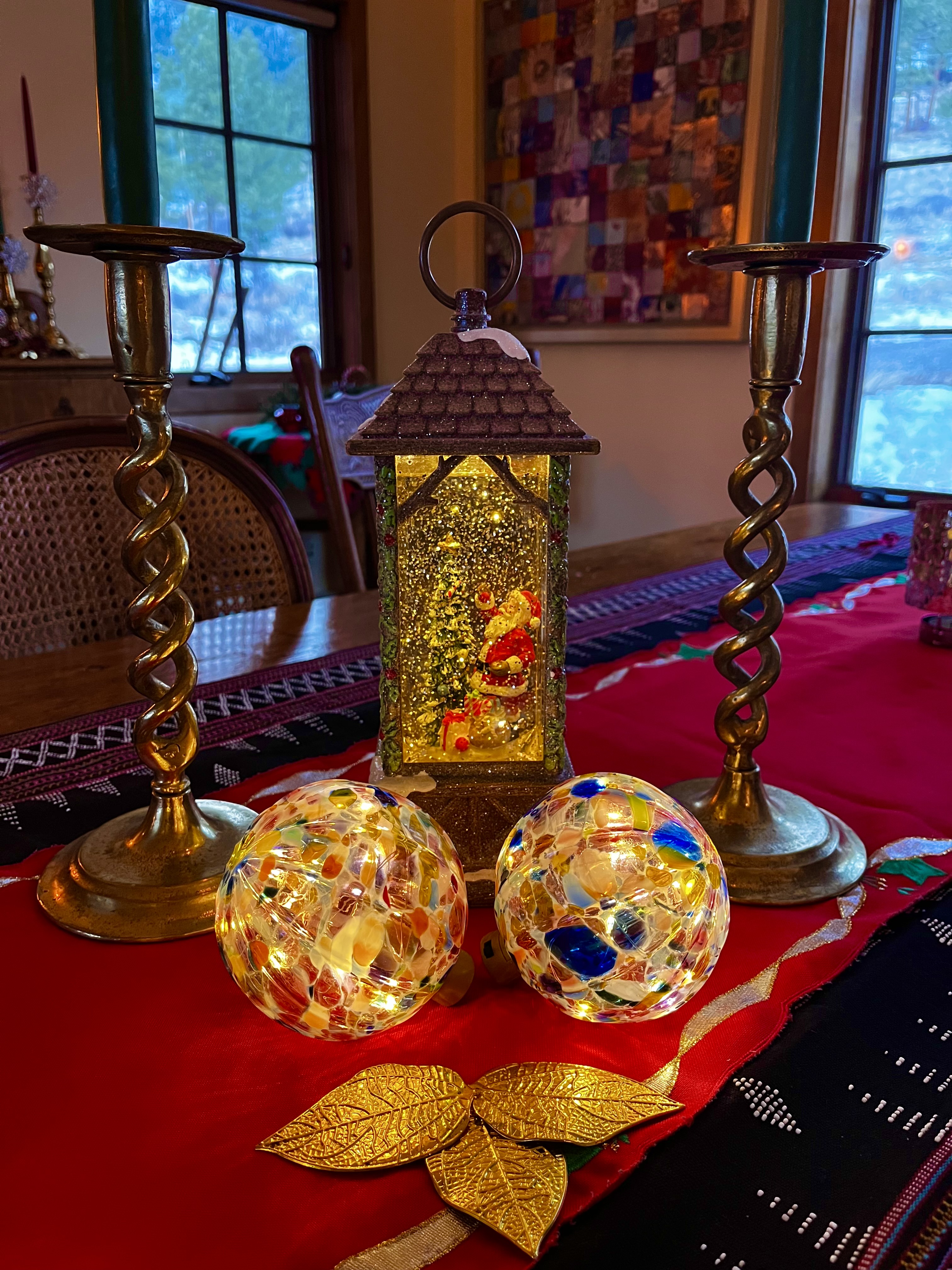
–John Muir
Our friend, Max, has spent a lot of time with his hands in the dirt. That is, when he wasn’t a student athlete, coach, husband, father, and Athletic Director for two universities in the mid-western United States. Since retiring [as AD] from Kansas State University, Max keeps an active hand as consultant and mentor to athletes, coaches and other athletic directors around the country. He is a man who is wired to pay it forward by giving back to his profession as well as devoting boundless time and energy to his family and friend relationships.
Max also likes to get his hands a little dirty–by tending the soil.

He grew up in Troy, Ohio in a family of three boys. Every spring his parents planted a large “truck garden” outside of town. A truck garden is larger than a backyard or “kitchen” garden. A pick-up truck is often used to haul things back and forth to the plotted site. His parents worked the fertile Ohio soil without motorized equipment, using only hand tools. Each summer they grew the fruit and vegetables their growing family would eat for a year.
From an early age, Max played alongside the garden patch as his parents worked. He learned the rituals of tilling, planting, weeding and harvesting. It became natural–this annual cycle of producing fresh food with your own hands. And feeding people you love from the harvest.
He carried the tradition into adulthood while raising a family and growing his career. Certain veggies are a mainstay. He always plants asparagus, beets, cucumber, green beans, leaf lettuce, onions, potatoes, spinach, tomatoes, and zucchini squash. He sometimes plants bell peppers, hot peppers, garlic, peas, or yellow squash.

We are among the fortunate beneficiaries of the abundance that grows from Max’s hands and heart, in the friendship he shares with us. Visiting his home in Kansas or when he and his wife drive to our cabin in Colorado there is always a gift…fresh and delicious from the garden.
Two summers ago, Max brought something different. Green beans in a jar, packed in seasoned brine. It was a new thing–pickling the extra beans from a bountiful harvest.

Admittedly, at first glance, these beans deserved some skepticism–pale and limp in liquid–I wasn’t sure whether I could even try them. That’s because I grew up in a household that served beans only from cans. At the family dinner table, my learned behavior was to move them as quickly as possible from mouth to paper napkin to garbage can.
Max’s proffered jars were placed in the cupboard and overlooked until later in the summer. I finally took one as a dinner hostess gift to a neighbor on our mountain hillside. She called me a few days later and raved about the pickled beans. She said they were better than any other kind of pickle, especially for hamburgers. Did I have more jars to share?
Our daughter came to visit. She likes almost everything and is creative about ways to present food. I cracked open a jar of pickled beans and added them to a tray of small bites to serve with drinks before dinner. At her suggestion, we placed them in icy martinis to sip on the shaded front porch.
I tried my own hand at pickling beans purchased from the local farmer’s market. It was a little trickier at the higher altitude of the Colorado Rockies, [see notes for high altitude processing at end] but they turned out fine. Now I’m hooked.
This summer I drove back for a lesson from the source–Max’s plot of land in the Manhattan, Kansas Community Garden. We awakened early–Max, Lynn and I, to pick beans before heat, humidity, and biting insects overtook us.


In the afternoon, we pickled our harvest from start to finish, ending the day with wine and unwind time–featuring, you guessed it, pickled beans.

Our Latvian daughter-in-law comes from Russian heritage that pickles any and all kinds of vegetables. Current nutritional trends suggest that fermented or pickled food should be included daily in healthy diets. Preserving food this way is an easy activity to do at home. Everyone reaps the benefits.
Pickled beans can be eaten as a low calorie snack or as a garnish to any food where pickles are used [as in neighbor Barbara’s hamburgers!]. They can be added to drinks such as Bloody Marys or martinis in lieu of olives. Let the beans stand as green centerpiece to a tray of rainbow colored hors d’oeuvres. They make a unique and perfect homemade gift to a friend, tied with a ribbon and a sprig of herbs.
Max–here’s to you. Keep your hands in good soil and your beans in brine.
MAX’S PICKLED GREEN BEANS–Makes 4 Pints
INGREDIENTS:


METHOD:


VARIATIONS FOR HIGH ALTITUDE WATER BATH PROCESSING
If you are preserving at an altitude higher than 1000 feet above sea level, you need to adjust processing time as indicated in the chart below.
Altitude in Feet Processing Time [Increased by Minutes]
After removing from water bath, leave undisturbed on countertop for 12-24 hours. Then check jar lids for sealing. They should not flex up and down when the center is pressed. If the lid does not seal in 24 hours, product can be immediately reprocessed or refrigerated.


A perfect summer day is when the sun is shining, the breeze is blowing, the birds are singing and the lawn mower is broken. –James Dents
Hey! It’s summer! Be free and happy and danceful and uninhibited and now-y! –Terri Guillemets
Summer afternoon–summer afternoon; to me those have always been the two most beautiful words in the English language. –Henry James

My husband refers to me as a “late adopter”. This has been true regarding certain forms of technology. I’m not the first to run with the latest innovation when it enters popular culture. But when I do jump in, it’s all the way. Then, I can’t remember life as it was before.
This summer I was surprised with a different type of “late adaptation”. It happened to be with a beverage I had never tried, even once.
On the July 4th American Independence Day holiday weekend I was with Dietician Daughter, her husband, and his Kansas family. She served me a berry and fresh fruit topped drink in a tall glass with a straw. It was deep burgundy in color. The icy glass, sweating beads of condensation, was garnished with succulent fruit. It was her version of Sangria.

On a sultry summer afternoon, around a backyard table with good people, this drink captured my attention. There was thirst-quenching coolness. There was the lushness of summer berries in red wine. I drank a second glass.

Sangria has been around for 2000+ years. When the Roman Empire reached the Iberian Peninsula of Spain and Portugal and began mixing wine into the water to sanitize it, the beginnings of Sangria were born. Long a common, informal drink on the European continent, Sangria was not widely consumed in the U.S. until it was introduced at the New York World’s Fair in 1964.
Twice I have been to the Iberian Peninsula in western Spain hiking the Camino de Santiago de Compostela, but I was not offered Sangria there. We drank wonderful Galician wines every evening as an accompaniment to the regional food. It was poured straight from the bottle and never mixed with anything.

Sangria comes from the Spanish and Portuguese word “sangre” meaning blood because of its’ dark red color. It is traditionally made with Spanish red wine, fruit, brandy, some kind of sweetener and ice. Carbonated water may or may not be added for fizz.
That’s all there is to it. This is also where Sangria becomes much more interesting. With a rudimentary knowledge of ingredients, the end result is in the hands of the maker. Dietician Daughter was imaginative in her “berry” form of creativity. Now I can’t drink it any other way.
For the rest of the summer, I began ordering Sangria in restaurants. Some were made with white wine, some with red. At the very most they might have one or two pieces of shredded, mangy looking citrus fruit in the bottom of the glass. Pizzazz and eye candy beauty were nonexistent. Not one was memorable. Not one reminded me of friends and family sharing stories and playing games on a summer afternoon. Not one begged to be repeated.
My short scientific study convinced me that the only Sangria worth the calories is the one you make yourself. With ingredients you choose. The wine must be of a quality that you would drink on its own. The fruit must be plentiful. And FRESH.

Here is the very best summer SANGRIA you will ever make. Or drink. It’s simple, it’s fruity, slightly dry and slightly sweet, a bit boozy, and refreshing like a lazy summer day. Pass the pitcher around a table in the mountains, by the sea, on the terrace, or in the backyard. Say, “yes” to a berry summer sangria. Then go lie in a hammock under the trees and muse.


LARA’S BERRY BEST SUMMER SANGRIA
In a large glass jar or pitcher, place fruit and sugar and muddle with a wooden spoon or muddler.


Add OJ and brandy and muddle again. Add red wine and stir.

Taste and adjust flavors to your liking. [More brandy or OJ or sugar as you wish.] Stir again. Add ice to chill and serve as is in clear glasses.
Get the fruit on. Garnish with lots of fresh berries or fruit of choice. Serve with a spoon for scooping winey fruit into your mouth between sips.

May be stored, covered, in refrigerator to steep and chill several hours, but then don’t add ice until serving.
Best consumed within 1-2 days.
Babies are such a nice way to start people—Don Herold

leila alisa ulfers, born may 24, 2016
It’s true what they say. Grandmother hormones materialize in much the same way maternal ones do–even 30+ years later. Babies born in one’s own family are the most miraculously perfect creations in the world. Parents [and even grandparents] check out other newborns to confirm this nuance of nature. Gradually it is understood to be a “Universal Truth”. We all simply feel this way.
The good fortune to dust off my pediatric nursing and maternal memories arrived with the birth of our first granddaughter. I reflected on the gift of “presence” my mother gave me after our son and daughter were born. It’s a gift that gives both ways.

First, an [experienced] pair of hands in the early postpartum weeks gives new parents time to focus on the interplay of relationships that are suddenly right there. Baby inside, baby outside. Everything has changed. All three, mother, father and newborn, enter a timeless dance that begins with a new song.
A distinctive aura hovers over first time parents, beginning in their own relationship. Helplessly charmed by the miracle they created, they now exist inside a bubble of enhanced love and new responsibilities. At the same time, bonds between mother and baby, father and baby unfold daily, even hourly. My presence [teaching rigorous burping techniques [!], offering parental napping time, having my own cuddling and singing time] opened a bit of space for these relationships to settle and strengthen in the first month.

dressed like daddy
The second gift of being present was entirely personal. Watching my first-born baby [now a 34 year old man] tenderly hold, and croon to, his tiny, perfect daughter overwhelmed me with wonder. That “circle of life”, as clichéd as the phrase may be, sideswiped my heart with a flush of love and emotion. I’m all in now.
At night, I mulled over the randomness of dominant and recessive genes forming this beautiful baby’s eye color [murky grey to clearly blue–overnight!], the turned up button of a nose, the rosebud mouth, the one dimpled cheek, and the movable face of so many expressions [skeptical, smiling, hesitant, observant, and sometimes cross-eyed]. Even though it was too early for spontaneous social smiling, we gathered expectantly, eagerly, with each facial movement, hoping to be the first to receive that important human recognition, “I’m happy to know you.”

dimpled dream
One day I had a flashback of maternal “déjà vu” when my daughter-in-law said, “I’m overwhelmed by how precious she is to me. I didn’t know I would feel this way.” None of us do. But almost every new mother is eventually overcome by the feelings of her own power to nurture and love her baby. That’s universal too…

wearing her “what’s not to love” onesie
I observed parents and babe develop their rhythms–for communicating, comforting, handling, and, of course, feeding. The dance changed by the minute, the hour, and the day. Flexibility is key with babies. But, in less than a week, my daughter-in-law blossomed from tentative new mama to an instinctively confident one. My joy was seeing this unfold.

mama/baby love
Newborn nourishment is where everything begins. Breastfeeding rituals gradually establish themselves. Then, suddenly, they fall apart with a day of feeding frenzy or a night of longer sleeping intervals. It is an ebb and flow of constant change in the early weeks.

independent girl time–hanging out with the owls
No less important is the nourishment of parents. Emotional swings as a result of sleep deprivation, new responsibilities, and sweetly swaddled newborn love leave not-so-much-time for meal preparation.

father fatigue happens
We planned and cooked together as a team. Daughter-in-law, knowledgeable of her protein needs, prepared the meat or fish. Son stepped up to roast veggies on the grill. I offered carbohydrate rich side dishes and green leafy salads.
Leftovers were used creatively for other meals. A big batch of brown rice became the base for protein breakfasts of eggs on rice*. Two eggs cooked over easy then cut up into a bowl of rice with freshly chopped tomato on top nourished mama with easy effort.
*Recipe for “Eggs on Rice” can be found here: Comfort Food for Cal
Grilled eggplant, peppers, onions and mushrooms from the night before became a hearty side dish the next day when combined with whole-wheat penne, sautéed garlic, fresh spinach, and a sprinkle of grated Parmesan.One night I made an old family favorite, Mujaddarah, a Lebanese lentil and rice casserole. The addition of chopped up bacon made it not purely vegetarian. Still, it was smothered with very slowly sautéed onions that made a delicious caramelized topping. Recipe found here: People Who Pull the Magic Out of You

Babycakes nearing the one month mile marker
Extra lentils [the tiny green French kind] became the basis for another day’s cold salad with green onions, carrots, cucumber, parsley, and homemade vinaigrette.
The family food tradition I used every day and wish to pass on to my granddaughter is the simple 1-2-3 of dressing a salad. Any salad, any day, any time. With ingredients found in most kitchens.
So, with arms opened wide to embrace Leila Alisa into our family’s love, care, and nurturance, here is my simple wish:
May you grow up healthy and wise and become an interesting person. And may you always make your salad dressing from scratch.
DEEDEE’s VINAIGRETTE DRESSINGIngredients: Amounts will vary according to how large the salad, so all are approximations. Taste testing necessary. Stick your finger in and adjust.

basic lineup of what you need, plus some options
Preparation:
Voilà! A lifetime of salads without bottled dressing.


Colorado supper with a glass of white

the one month director’s meeting
A year ago I wrote a story about my favourite Colorado hometown cafe. It was titled A Mountain Gem for 70 Years. The owner, Rocky St. John, passed away right before Christmas. In tribute to her, I have revised my words and added additional photos. Her sons Ben and Joe, along with their father, are keeping the cafe open in her memory. She trained them well.
Allenspark, Colorado lies in a curvy bend off Highway 7, between Estes Park and the valley below. As you drive past the majestic scenery of Wild Basin and the backside of Long’s Peak, it’s easy to simply bypass this tiny town. But if you turn right onto the business spur, it’s probably because you know about Rocky’s Meadow Mountain Cafe.
On a hillside halfway through town is a small green building with purple trim. Colorful buttons are mixed into the cement between slate stone steps climbing to the front porch. The main room has knotty pine walls and an antique potbelly stove, radiating warmth. Shelves are lined with an eccentric collection of salt-and-pepper shakers. Local artwork is for sale on the wall. Behind this quaint façade is a long history of food, friendly service, and loyal customer relationships.

It began in 1946 with a local character named Lil Lavicka. Known as the “Pie Lady”, Lil was famous for her homemade baked goods. As part of a divorce settlement, her husband hastily built a two-room cafe across from her tiny home. Lil’s Pie House flourished for twenty summer seasons.
Then, after several changes of ownership, Meadow Mountain Cafe was born. Breakfast and lunch became the daily fare. Food was fresh and home-cooked to order. Coffee was hot–with a touch of cinnamon. Consistently good food, friendly service, and reasonable pricing enhanced its’ reputation beyond the boundaries of the small community. Locals and tourists line up for a table inside or on the covered porch, complete with hummingbirds, flowers and an overhanging pine tree. Lil Lavicka’s seasonal pie house evolved into a legendary year-round cafe with returning customers who became friends.
Roxanne [Rocky] St. John began waiting tables at Meadow Mountain more than 30 years ago. It wasn’t long before her cooking finesse and creativity nudged her into the kitchen full time. Rocky worked the grill for several female owners until finally, in 2007, she took over solo ownership. Already an established part of the ongoing success of Meadow Mountain, it was time to put her personal stamp on the place.
Rocky introduced two new house specialties–the veggie burger and the green chili sauce for huevos rancheros. Cinnamon spiked coffee is still standard, of course. She chose the outside paint colors and easy-on-the-eye peach walls for the kitchen. The button-inlaid steps were designed and built for safer access in all weather conditions. An herb garden was planted out in back. Inside, the eclectic collection of coffee mugs and salt-and-pepper shakers [always part of her style] continued to grow. The kitchen blasting music-of-choice ran along the lines of Bob Dylan and Johnny Cash.
We have been driving from our cabin in Estes Park to Meadow Mountain Cafe for more than 15 years. It never disappoints. It’s not meant to be fast food. You wait patiently and sip good coffee, talk leisurely. Perhaps you warm your back near the antique stove, muse over the salt-and-pepper collection, read a book or eavesdrop quietly on another conversation. You watch regulars walk into the kitchen to say hello. At a corner table, friends sit and play cards after their meal. A man at the counter leans his chin into one hand and dozes, holding a coffee cup with the other.
Orders parade out of the kitchen. Coffee mugs are refilled. Homemade brown bread, thickly sliced for toast or sandwiches, is baked twice daily in summer to keep up with demand. The scene is homey and multi-dimensional–from the diversity of customers stepping through the door to the din of country or rock-n-roll music pouring out of the kitchen. Conversation and laughter is spiced with the clatter of plates and silverware as tables empty and fill.
What sustains this kind of success in a town of just over 500 people? Rocky, along with the women before her, crafted a timeless formula. It begins with an old-fashioned hard work ethic. It’s maintained by keeping quality high, service friendly, and community relationships strong. Rocky was passionate about what she did and consistently did it very well. And then, just maybe, that hint of cinnamon in the coffee didn’t hurt either.

new step up to the cafe
Rocky was a well-known and well-loved figure in the Estes Valley community. Meadow Mountain will continue to flourish in her memory. After a 70-year legacy of female owners [since 1946], the cafe will now operate under the expertise of Dan, Ben, and Joe St. John. In Ben’s words, “We have been well-trained.” Indeed.
And the rest of us will continue to be there to support them.
Secret eating is seldom spoken about or easily admitted. If you ask most people what they enjoy eating alone, without sharing, they hesitate with a questioning look. Or mumble that they don’t know. It’s possible they’ve never experienced this solitary pleasure.
The desire to eat unobserved isn’t like bingeing on ice cream or sneaking candy bars to feed your chocolate craving. It’s not comfort food either. It is something you do surreptitiously, consciously, and quietly by yourself. It is a moment, by choice, of indescribable satisfaction.
A survey of extended family members about clandestine eating revealed only one answer close to my definition. It came from my daughter-in-law who is Latvian with Russian heritage. She formed a covert eating ritual as a child, from the age of ten. In the summertime, after her parents left for the evening, she went to the market by herself. She bought a huge watermelon with pennies saved or found under chair cushions. Lugging it home, she managed to cut it in two, carried half to the living room sofa, watched television, and ate it down to the rind. Spoonful by decadent spoonful. Including the seeds. She was not under the watchful eye of anyone, or told to get a plate, or to sit on the floor, or not make a mess. She did it quietly and happily, for her own pleasure.
M.F.K. Fisher [1908-1992] wrote a wonderful story about secret eating. It took place one frigid winter when she and her husband lived in an unheated walkup apartment in Strasbourg, France. They were depressed by the unending cold, dreary grayness and couldn’t afford to move. So they rented a room in a pension for one luxurious week. It came with a big bed, billowy curtained windows and heat.
Each morning after waving Al off to the university, Mary Frances sat in the window considering the day ahead. She wasn’t ready to brave the outdoor temperatures. While the maid fluffed up duvets and pillows, murmuring in her Alsatian accent, Fisher carefully peeled several small tangerines. Meticulously separating each orange crescent and removing all the white “strings” between hi pieces, she placed the sections on top of newspaper over the radiator. And forgot about them.
There was a long lunch when Al returned and perhaps a wee nip of “digestif” from the decanter on the dresser before he went back to afternoon classes. By this time the orange sections had majestically puffed up, ready to burst with heat and fullness. Opening the window, she carefully placed them in the snow on the outside sill. Several chilling minutes passed. Then it was time.
For the rest of the afternoon, Mary Frances sat watching the world go by on the street below, savoring each orange morsel slowly and voluptuously. She reveled in the spurt of cold pulp and juice after biting through the crackling skin that was like …”a little shell, thin as one layer of enamel on a Chinese bowl”. She mused while vendors sold half-frozen flowers, children ran home from school, and prostitutes sipped hot tea in a café across the way.
Winter’s early darkness descended and the orange sections were gone. She couldn’t exactly say what was so magical about them. Yet she knew that others with “secret eatings of their own” would somehow understand.
I read this story many years before we moved to Europe. The first winter we lived in Germany, I traveled by myself to Strasbourg on a train from Frankfurt. Next to Place Gutenberg is a small hotel where I stayed in a room under the roof. The spire of the Strasbourg Cathedral was visible when I stuck my head out the dormer window. The bathroom was at the top of an open staircase right under the peak.
That February was bitterly cold.
I bought a bag of small clementines, peeled them into sections, and laid them on a piece of hotel stationery on top of the radiator. Then I went out to explore.
When I returned, the oranges had grown fat and hot just as Fisher described. There was no snow, but the outside temperature was below freezing. Out on the sill they went. When thoroughly chilled, I ate them one by one in the dim afternoon light. It was true–the skins were crisp and crackling. So thin that, when you bit through them, there was a “pop” followed by the rush of cool juice and pulp. It was a replay moment from the pages of a story by a writer I had long admired. It made me happy.
Several years later, a new secret eating ritual started during a visit with “Dietitian Daughter” in Colorado. She was buying a snack item for her husband from the bulk bins of a national food chain. I watched her fill a bag with flattened, dull-colored, brownish-orange pieces of fruit. They looked run over by a truck. They were unsweetened dried mangos. Dehydrated into stiffened leather. She handed me a piece and said, “Try it”.
The first sensation was what it looked like–rough, tough hard-edged, with the taste and texture of dust on shoes. As salivary juices kicked in, that road-kill-looking mango became softer, warmer, and pliable. Careful considerate chewing brought out interesting changes. It turned vaguely sweeter but held onto the essence of fruity leather. I had to chew slowly, without hurrying, before it was ready to swallow. I had to pay attention.
The degree of subtlety from dry dusty toughness to a satisfying payoff several minutes later completely hooked me. I took my own bag back to Paris.
Now when I feel the urge, I go to the hiding place in the kitchen and randomly choose several pieces of dried mango. Then I stand or sit in a window of our apartment overlooking the vine-laden courtyard where I never tire of the view.
If I stand in the kitchen window during secret eating time, I might muse over the spring unfolding of the Virginia creeper vines or the work-in-progress renovations on the apartment across the courtyard. The neighbour’s cat might be outside on the balcony chirping wistfully at pigeons. If I choose to sit in the warm afternoon sun of the dining room windows, I have a private view of sky, rooftops, vine covered brick walls, and my own blooming geraniums.
Or, I might decide to stand in the street-side windows at the front of the apartment where I take note of pedestrians, shopkeepers, or a trumpet-playing street musician four stories below.
My secret eating is something I try to keep to myself. It gives me great pleasure and satisfaction. But what is it really? Like Fisher, I can’t exactly say. Perhaps it’s simply a meditative time-out, or a few private minutes of simply “being” and not “doing”, or a satisfying break in the midst of a day, a week, a month.
There must be someone out there who understands what I mean…
My father was the fourth of six children, but the only boy. His oldest sister, Bess, made him an uncle for the first time when he was ten years old. That nephew is my oldest cousin Cal, who turns 84 this month. He doesn’t see so well anymore, yet still spends several hours a day at his law practice, serving clients he continues to outlive. His wife of more than 60 years, Joan, is one of my favorite people. She says that Cal has never been motivated by food or by his appetites.
Shortly after my first story was published Joan wrote, “I am actually doing a bit of cooking. Going out to eat has lost some of its charm. My efforts are very basic, as Cal doesn’t like anything fancy. He enjoys canned baked beans on buttered white bread. I use the vegetarian beans, but he thinks they are ‘pork’. His favorite dish from his mother is creamed tuna and peas on saltine crackers. I prefer my tuna and peas on toast points, thank you. As you can see, the bar is not high. We look forward to new ideas from you.”
I have never eaten creamed tuna and canned peas on crackers, toast points or anything. But Cal’s preferences started me thinking about the notion of comfort food.
Comfort food: n. food that is simply prepared, enjoyable to eat, and makes one feel better emotionally. [Collins English Dictionary, HarperCollins Publishers]
There is no single explanation for how our food preferences arise or change over the years. Yet the taste of certain food is tied to our experiences and emotions. Thoughts of home, family, love, hate, sickness, allergic reactions, holidays, sadness or happiness can trigger a taste memory of longing or loathing.
Cal is a true comfort food creature, formed by his mother’s cooking, honed by childhood likes that matured into adult preferences. His eating experiences are defined by U.S. Midwest geography and by the cuisine of a certain generation.
For example, he is obsessed with Jell-O. Jell-O filled with crushed pineapple and nuts or Jell-O filled with strawberries, bananas and nuts. At Christmastime something special–Jell-O with cream cheese rolled into balls and covered in nuts. This is meant to look like studded snow balls floating in a colored pond. Trying to visualize this, I’m certain I couldn’t eat it.

He also loves sweets. Chocolate pudding, cupcakes, or butter cookies like Aunt Bess used to make. Joan wrote, “Tapioca pudding is his favorite dessert. His mother made it from scratch, separating the eggs, beating the whites stiff, and folding them in after it had cooled somewhat. I make this from scratch when I see pigs fly by the window. Now he enjoys a simpler pudding.”

In similar Midwest fashion, I was raised on meat, potatoes, and mushy canned vegetables boiled before serving. So many childhood meals spent spitting vegetables into a paper napkin and hoping not to get caught.
My food preferences began to cut a wider swath in adulthood when we moved overseas to Singapore in the 1980s. Spices and chilies in ethnic cuisine from India, Malaysia, Thailand, China, Hong Kong, Indonesia and Singapore happily reformed my taste buds and palate.
Life became a tasting/eating adventure in Asia. I sweated my way through outdoor food stalls in heat and humidity plus the spices in whatever I was eating. It changed my definition of comfort food forever.
As Joan and I compared Cal’s food likes and dislikes, other family food lore tumbled out. My father’s second sister was Dorothy [Aunt Dot] who suffered from a “nervous condition” consisting of some strange phobias. She outlived two husbands and never had children. She also wasn’t much of a cook. At family potluck gatherings, she always brought her “signature” Pork and Bean dish. It was prepared by opening several cans of baked beans that contained cubes of pork fat. She added raw onions, catsup and molasses. The casserole was baked in the oven until warm. The onions were always “crunchy”. Children refused to eat it.

Joan and I lost track of time, talking and laughing about family food foibles. Cal called to ask if she had forgotten about him and his lunch. She left and later sent an email, “Cal is such a Prussian! The trains must run on time even if they have nowhere to go. However, upon seeing the glorious cupcakes you sent home to him, he was easily placated.”
You have to love a man who softens when sweets are offered.
I surveyed other family members and friends for their comfort foods. Choices ran the usual gamut of American food tastes–cheese, pizza, ice cream, popcorn, chocolate, nothing unusual. Friends from other cultures and my Latvian daughter-in-law offered more variety in their comfort food desires.
It was our friend Alec [who is part comedian] that gave the most graphic descriptor:
“My comfort IS food. I love to have my mouth FULL. A bite that causes the cheeks to protrude like two small Buddha bellies is a sign of bliss. I am comforted by eating with my hands…likely linked to Neanderthal kin who subdued dinner with their bare hands. There is nothing more satisfying than having a chokehold on a stuffed burrito or pinning the buns of a burger into submission before taking an oversized bite. Wrestling with my food gives both the victor [me] and the vanquished a sense of exhausted satisfaction, after the battle.”
My cousin Cal and I will never share the same food preferences. Nor should we. The important thing is that Cal and I are connected by the way our comfort food choices make us feel–enjoyably nourished, emotionally content, and loved.
Two recipes for opposing tastes, one sweet and bland and one well seasoned.
CAL’S TAPIOCA PUDDING

Mix first 4 ingredients in saucepan and let sit 5 minutes. Cook on medium heat. Stir constantly until it reaches a full boil. Remove from heat. Stir in vanilla. Cool 20 minutes and stir. Makes 4 servings. Eat warm or cold. Top with seasonal fruit if desired.


WENDY’S SPICY EGGS-ON-RICE


For a less spicy version, leave out red pepper flakes, garlic, and ginger. Just eggs on rice. Very nice.


Allenspark, Colorado lies in a curvy bend off Highway 7, between Estes Park and the valley below. It is situated within the Roosevelt National Forest and surrounded by mountains of the Front Range Colorado Rockies. As you drive past the majestic scenery of Wild Basin and the backside of Long’s Peak, it would be easy to bypass the business spur and keep descending the mountain.
But if you do make the right hand turn into Allenspark, it’s probably because you know about an historic hillside landmark halfway through town–Meadow Mountain Cafe.
On the outside, it is painted green with purple trim. There is always a line up of cars parked below. An assortment of buttons are mixed into the cement and stone steps that you climb to the front porch.
Inside, the main room has original knotty pine walls and a working potbelly stove for heat. Hand colored photographs by a local artist are displayed for sale.
An eccentric collection of salt-and-pepper shakers line the walls.
Behind this quirky façade, there is a long history of food and relationships that began in 1946, with a local character named Lil Lavicka.
Lil was known as the “pie lady”. As part of a divorce settlement her husband hastily built a small two-room cafe where she could sell her baked goods. On this hilly spot, in tiny Allenspark, her pie house flourished for twenty summer seasons. It was just a stone’s throw across the street from a small house where she lived into her 90’s.
Several changes of ownership and some 30 years later, Lil’s place was renamed Meadow Mountain Cafe. The menu became daily breakfast and lunch fare. Food was fresh and home-cooked to order, the coffee was hot and had a hint of cinnamon. Consistently delicious food, friendly servers and reasonable pricing enhanced its reputation within the small community and radiated beyond. Locals and tourists began lining up for a table inside, or on the covered porch with hummingbird feeders, flowers and an overhanging pine tree. Lil’s seasonal pie house evolved into an Allenspark landmark with regularly returning customers, who eventually became friends.
Roxanne [Rocky] St. John began waiting tables at Meadow Mountain in the late 1970s. Almost right away she was moved into the kitchen and continued to work the grill after two other women purchased it in the 1980s. Rocky finally took over solo ownership in 2007. It was time to put her personal stamp on the place.
Rocky is responsible for introducing the veggie burger and the incredible green chili sauce for huevos rancheros. Both became specialties of the house. Cinnamon spiked coffee remains standard, of course.
She chose the current paint colors, including easy-on-the-eye peach walls in the kitchen and built the button inlaid steps for safer access in all weather conditions. The funky array of coffee mugs and salt-and-pepper shakers were always part of her style. The music that blasts from the kitchen is pure country western or rock-n-roll oldies. Son Joe mans the grill, daughter Alicia works the front, and husband, Dan, does whatever needs doing. It’s a full family operation, year round, with added help in summer. On Tuesdays, they take one day of rest.
We have been driving from our cabin in Estes Park to Meadow Mountain Cafe for more than 15 years. I go by myself, with family, or with friends, usually for breakfast, sometimes lunch. It never disappoints. It’s not meant to be fast food.
You wait patiently and sip good coffee, talk leisurely. Perhaps you warm your back sitting at the counter by the antique stove, muse over the salt-and-pepper collection, read a book, or eavesdrop quietly on another conversation. You watch regulars walk into the kitchen looking for Rocky and to say hello. A table of friends play cards in the corner after their meal. At the other counter, a man leans his chin into one hand, and dozes, holding his coffee cup with the other.
Orders parade out of the kitchen. Coffee mugs are refilled. Homemade brown bread is sliced thickly for toast or sandwiches. Summer requires twice-a-day baking to keep up with demand. The scene is homey and multi-dimensional–from the diversity of people stepping through the front door to the din of kitchen music, mingled conversations and laughter, and the clatter of clearing plates as another table empties and fills. It always feels just right. You are glad to be hungry and in Allenspark.
What sustains 70 years of successful continuity in a community of just over 500 people? Rocky, and the female owners before her, perfected a simple yet timeless formula. Starting with an old-fashioned hard work ethic, they stay passionate about what they do and consistently do it very well. Quality is always high, service friendly, and customer relationships strong. And then, just maybe, a little hint of cinnamon in the coffee doesn’t hurt either.
I hope you have your own gem of a hometown cafe–a place with honest food, ambience, and feeling of community–where you go to be nurtured over and over again.
In Colorado, this holiday season was snow-white and the fireplace blazed night and day. There were deer and elk on the hillside, daily hikes into the National Park, a miniature snow-woman laboriously constructed from barely packable “dry” snow, and, of course, there were egg sandwiches.
A multi-layered, made-to-order egg sandwich is staple breakfast fare when we are at home in the mountains. It is nourishment spiced with geography and longstanding tradition. The ritual evolved, as things often do, from something I read.
When we lived in Singapore I was immersed in the writings of M.F.K. [Mary Frances Kennedy] Fisher. She weaves autobiographical stories of people, places, and food into descriptive prose. The mythology of her story about “Aunt Gwen’s” fried egg sandwiches caught my imagination. It is the tale of a child’s realization that food and life lessons can be inseparable from a strong adult mentor.
When Fisher was a young girl, several influential summers were spent with Aunt Gwen in Laguna Beach, California. As Mary Frances explained,
“…she taught us a thousand things too intangible to report, as well as how to roast kelp leaves, steam mussels, tease a rattlesnake away from a frightened horse, skin an eel after sundown, and stay quiet while a night-blooming cereus [cactus flower] unfolds…”
With Aunt Gwen leading the way, Mary Frances and her younger sister Anne hiked the hills and cliffs above the beach singing hymns and marching songs at the top of their lungs. There was always an egg sandwich or two carefully tucked into their pockets.
In the good Laguna days, it was an exciting promise, to warm up the pan, ready the ingredients, and make fried-egg sandwiches. Aunt Gwen insisted that we have at least two pockets somewhere on us, one for shells, stones, small fish, or lizards, and one big enough to hold these greasily wrapped, limp, steamy monsters. Then we would race the sunset to a high hill. The sandwiches stayed warm against our bodies, and when we panted to a stop, and fell against a good rock or an old eucalyptus trunk, the packets sent out damp insistent invitations… We each had two sandwiches. The first we gnashed at like fairly well mannered puppies. The second was for contemplation, as we watched all of the quiet empty slopes down to the cliff edge, and the great ocean with the sun sliding into it. —MFK Fisher, Among Friends, Alfred A. Knopf Inc. 1970
What I love about this story is that it is about satisfaction beyond physical hunger. Fisher was learning, as a child, that the right combination of food, company, and spiritual nourishment was a metaphor for living well. The ingredients of those egg sandwiches included “equal parts of hunger and happiness”, a hillside sunset, and companions she loved.
There are no cliffs overlooking an ocean where our cabin is located, but cool summer mornings and cold winter ones stimulate good appetites. Mountain views, towering ponderosa pines and native wildlife are our spiritual geography. When home in Colorado, family and friends are often with us. A tradition was born around the kitchen table in winter and the front porch in summer—our mountain version of the fried egg sandwich.
Aunt Gwen’s recipe was well documented by Fisher. It started by heating the grease from whatever was cooked the day before in a large flat-bottomed skillet. When the fragrant drippings reached a smoking hot temperature, an egg was dropped in, the yolk broken, and quickly fried so that the edges were crisply brown and barely digestible. Next, two slices of good bread were added to the pan and browned on one side only. The cooked egg was slapped into the middle of the bread slices and pressed together. Finally, the whole thing was wrapped in wax paper that partially melted into the sandwich, small pieces of which were consumed when bit into with hunger and a happy heart.
As an aid to digestion and modern taste preferences, this is our version.
ROCKY MOUNTAIN EGG SANDWICH
Ingredients [physical]
Ingredients [spiritual]
Family and/or friends gathered on a sun-warmed front porch in summer, around the kitchen table or fireplace in winter. Laughter and conversation flowing easily with a cooked-to-order egg sandwich in hand. Appetites satisfied. Camaraderie shared. A new day begins.
Method
Assemble ingredients. Cook bacon in well-seasoned cast iron skillet. Using the bacon drippings, crack an egg into round metal form and break the yolk. Season with S&P or red pepper flakes. When egg is set, remove the form and gently turn the egg over for just a few seconds. On toasted English muffin, layer a thin slice of cheese, tomato, bacon and optional ingredients [avocado, salsa, etc.]. Add cooked egg and fresh spinach leaves or other greens. Press the whole thing down to a manageable biting size. Eat immediately while hot, using both hands. A mug of strong coffee or tea is good accompaniment.
All I could now say about Aunt Gwen will never be said, but it is sure that much of my enjoyment of the art of living, as well as of eating, comes from her…as well as my certainty that the two are, or can be, synonymous. —M.F.K. Fisher, Among Friends

“There is more than the communion of bodies when bread is broken and wine drunk.” These words, written long ago by M.F.K. Fisher [1908-1992], speak of the chemistry that occurs with the right combination of people, place and food–a communal spirit shared around the table with family or friends. Bread and wine are not the only catalysts. It can happen around a pot of egg coffee, too.
Three weeks ago we reconnected with a group of people we have known for many years but not seen in a long time. It was one of those bittersweet reunions–gathering to celebrate the life of a friend who passed away. And, at the same time, seeing others with whom we had shared great moments in the past. The weekend was one of those memory jolts when you re-encounter special friendships after losing touch with them. It’s easy to catch up because what you loved about them before is still there.
For several years in early marriage, we made repeated visits to a stone farmhouse in Ann Arbor, Michigan. It was the family home of Dale and Marilyn Larson. The house was thick walled with deep windowsills constructed from native fieldstone. Of all the warm memories of time spent on that beautiful farm, the clearest one is standing in the kitchen around an enamel coffeepot with a broken egg inside.
Legend has it that the recipe for egg coffee was carried on a boat from Sweden to the New World sometime during the 1800s. In Larson family lore, the story goes like this.
A young Swedish girl, named Edla, moved to southern Minnesota in the late 1880s. She was terribly homesick, often going into the fields late at night to have a little cry. Then, Karl Larson proposed marriage and a new life began on his farm. It was 1890. There was no more homesickness. And there was always a pot of egg coffee on the stove.
Two generations later, Edla’s grandson, five-year-old Dale Larson, walked across two farm fields to visit his grandparent’s home. To gain his mother’s permission for the trek, he had to hold the hand of his older sister. She was six-and-a-half. Upon entering the kitchen, Edla would say to them, “Milk is bad for you. Coffee is good. Drink this.” So he did. For the next 80 years.
Every time we visited the Michigan stone farmhouse we drank it, too. It was a morning ritual perfected over generations and fascinating to watch. Making egg coffee became the symbol for something else–time spent with people we admired and loved. And who loved us back. Important life lessons were absorbed over cups of egg coffee in those years.
During the memorial weekend for our mutual friend, an important message from the Larson kitchen returned. It’s this–spend time with people who bring out the best parts of you, the best version of you. Then remember to go back and get refreshed.
I tried making egg coffee each time we returned from those Ann Arbor visits. But it was never quite right. I was probably too impatient or easily lured by push button coffee making. Eventually the attempts stopped and the enamel pot became merely decorative.
These days I’m more patient about the sweet spot of perfecting a ritual. With an enamel coffee pot from the flea market and step-by-step practice, I can make a good cup of egg coffee now. And always within this ritual, I’m reminded of friendship and lessons learned first in a kitchen, in a field stone farmhouse, with a broken egg at the bottom of the coffeepot.
…And in the sweetness of friendship let there be laughter, and sharing of pleasures. For in the dew of little things, the heart finds it morning and is refreshed.”–Kahlil Gibran, “On Friendship”
LARSON FAMILY EGG COFFEE


3. Stir mixture with chopstick to combine egg and coffee grounds. Pour boiling water over egg/coffee mix. Stir together with chopstick.


4. Place enamel pot over heat. When it starts to foam up and boil, turn off heat immediately. Watch closely so it doesn’t boil over.


5. Cover and let steep for 5 minutes. Then pour and enjoy. You can use a sieve to strain, but if you pour slowly it is not necessary.


Egg coffee is as good as it gets for those who love a strong, smooth, mellow brew. What happens is this: The egg congeals coarse coffee grounds into a clump and neutralizes acidity that makes coffee taste bitter. It also acts as a filter, because essential oils from the beans are in the finished beverage, rather than on a paper filter. More oils make better tasting coffee. If you throw the whole egg with shell in the pot, you probably get some added calcium benefits, too.
Edla Larson kept adding water to the same pot all day long. She was probably frugal with both eggs and coffee. I have used a second round of boiling water, but don’t go beyond that. Just start over.
Our United States home is in the Rocky Mountains of Colorado. When not in our home overseas, we live in a cabin built on a hillside outside the town of Estes Park. The back of the cabin faces the Front Range of Rocky Mountain National Park–mountains towering 10-14,000 feet above sea level. We gaze at them from a deck in the summer or through picture windows near the fireplace in the winter.
There are no streetlights and the roads are unpaved. The landscape is native Ponderosa pines, wild grasses, sage shrubs, and wildflowers. The maintenance is digging up noxious weeds, raking fallen pinecones, cutting and splitting firewood. We built a campfire ring with rocks from the land and sit around it with stories and laughter or the silence of a starry night. This has been our home-away-from-overseas-home since 1991.
The summer season return begins with the first morning after we arrive. It’s early. The sun rises at 5:30AM. Coffee is started and we pull rocking chairs onto the deck. Mountains and clouds to the south and west are pink-tinged at first light. As the sun makes its’ way upward, the color shifts to yellowish gold. When it finally rises over the eastern ridge line, the sky turns robin’s egg and then lapis blue. Second cup of coffee, still in bathrobes, day begins.
There is a different way of living and “being” in the mountains. Time is simpler, less hurried, less structured. It’s not necessary to “do” much of anything for the first transitional days. We live casually in blue jeans, moccasins or hiking boots, cotton or flannel shirts, depending on the temperature.
We eat differently too. The thinner air and long days tempt us with food and drink that somehow belong in the high country. Hearty breakfasts of egg sandwiches [More Than Just an Egg Sandwich] are eaten on the sunny front porch. It fuels the day before stacking split logs of firewood or hiking into the National Park.
When it’s time for a break, there is a place downtown we like to go. Ed’s Cantina is a 30-year locally owned and operated Mexican restaurant. The sign on the side door says, “Get in Here”. Their logo: “Live Forever. Eat at Ed’s.” When we go there, Avocado Margaritas are what we find.
Dietitian Daughter, savvy in combining nutrition with great taste, showed us the way. We fell in love, one by one. It’s the reason we wind up at Ed’s on a warm summer afternoon.
For the nutritionally minded, avocados are one of the healthiest food choices around. They are a good source of mono-unsaturated fat, the desirable fat for lowering LDL [bad] cholesterol while raising HDL [good] cholesterol. Vitamins in avocados, E and C among them, are good for skin tone and texture. There is documentation for the avocado’s anti-inflammatory properties. Even in liquid form, avocados provide a nice range of health benefits!
We also eat a lot of avocados in easy-to-make, lime-y, homemade guacamole. Less is more with guacamole. Let the avocado shine with a light touch on ingredients. Use as a sandwich spread [breakfast egg sandwiches–yes!] or more traditionally as a dip with chips.
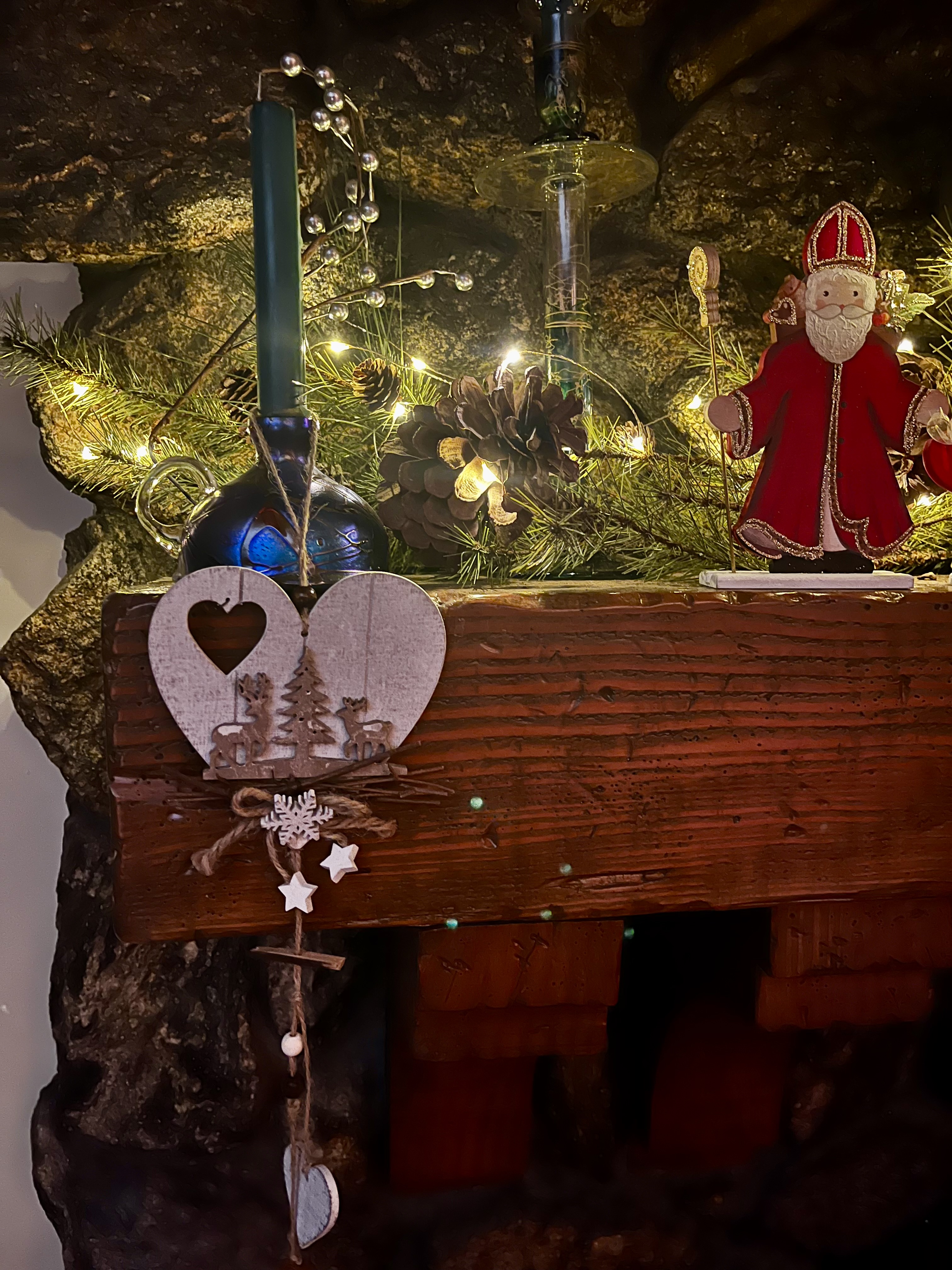
Keep your avo margs and guacamole as separate ventures, though. You can ingest too much of a good thing.
GUACAMOLE à la Colorado
Cut around outside of avocado and separate the halves. Scoop the meat out of the rind with a spoon. Mash avocado in a bowl with a fork or potato masher. Add onion, garlic, S&P. Stir together. Squeeze in as much fresh lime juice as you like, to taste. Adjust seasonings.
Will keep in refrigerator without discoloration by covering with plastic wrap pressed down on top of guacamole, allowing no air space.
ED’S AVOCADO MARGARITA [AVO MARG by order]
Into blender, scoop one half avocado, a shot or two of tequila, a generous squirt of agave syrup, an even more generous pour of limeade and lots of ice. Blend together on high setting. Serve in tall, salt rimmed glass, garnished with a slice of lime.
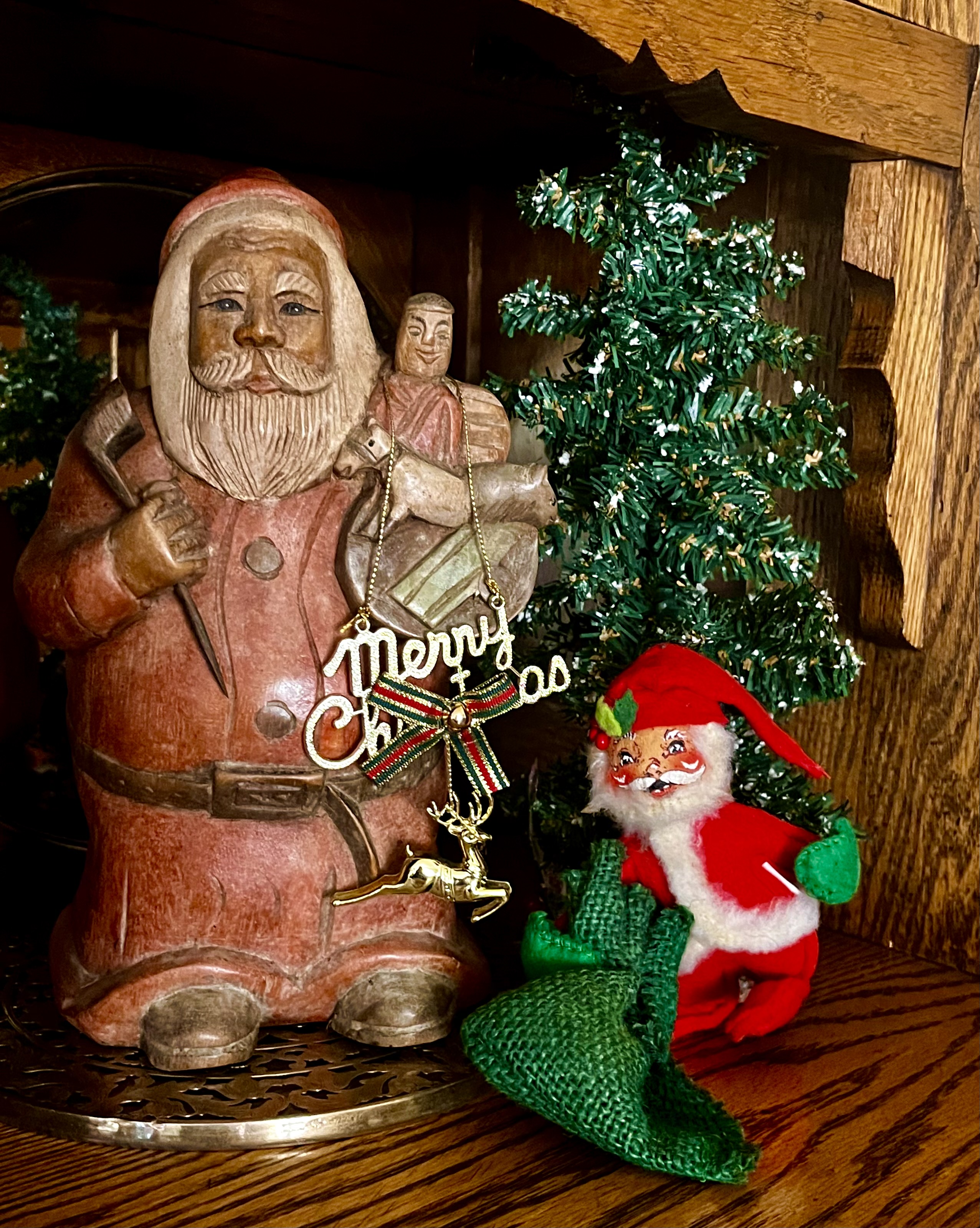
Live forever at Ed’s…