Casual Animal Brewing Company, KC, MO

This is a factual but personal story about my daughter & son-in-law’s entrepreneurial, creative, community and philanthropic spirit in the business they created together. These two inspire me.

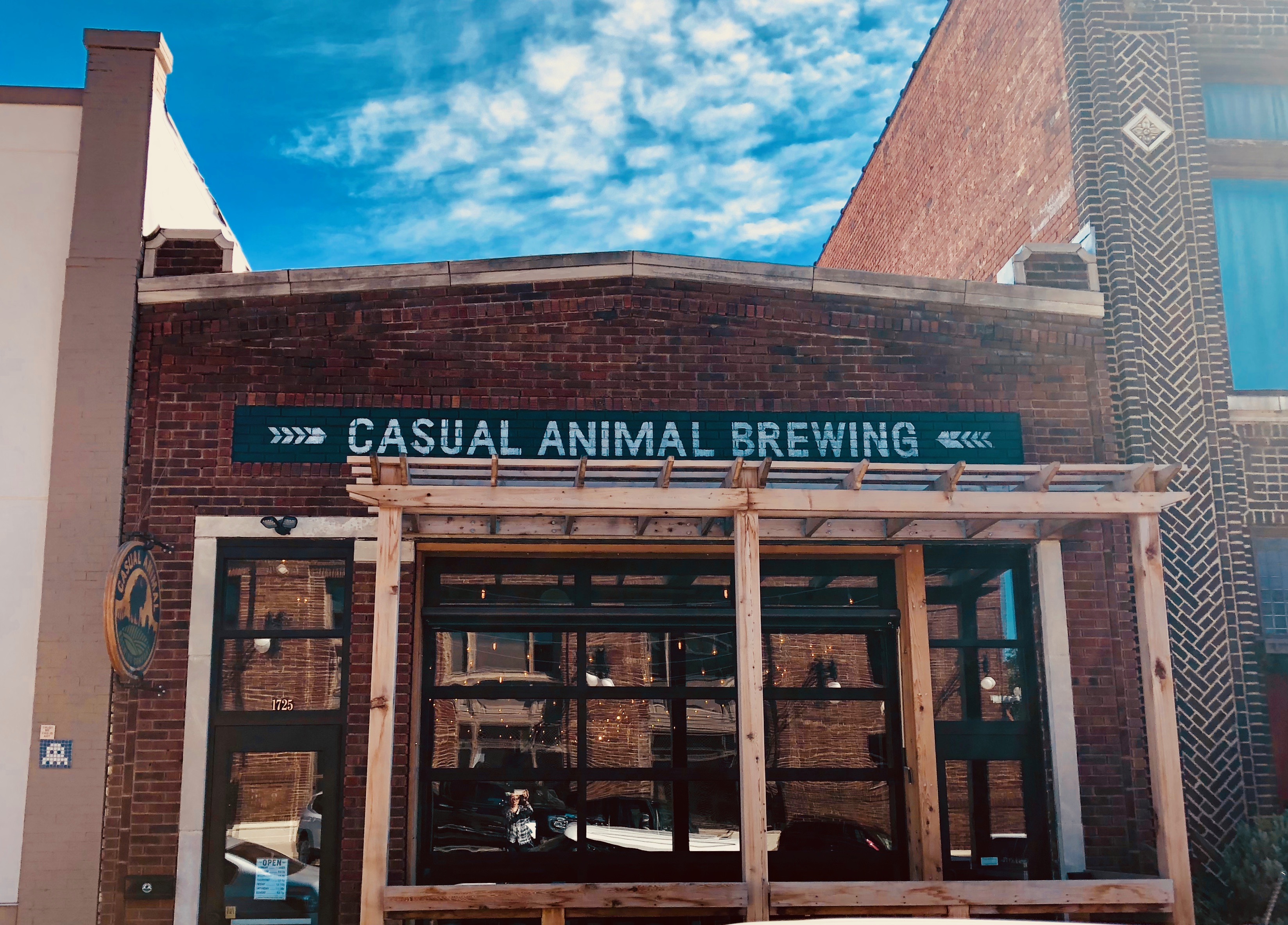
In the Crossroads area of downtown Kansas City, Missouri, directly across the street from the attractive brick façade of the former Kansas City Star Newspaper, resides Casual Animal Brewing Company.

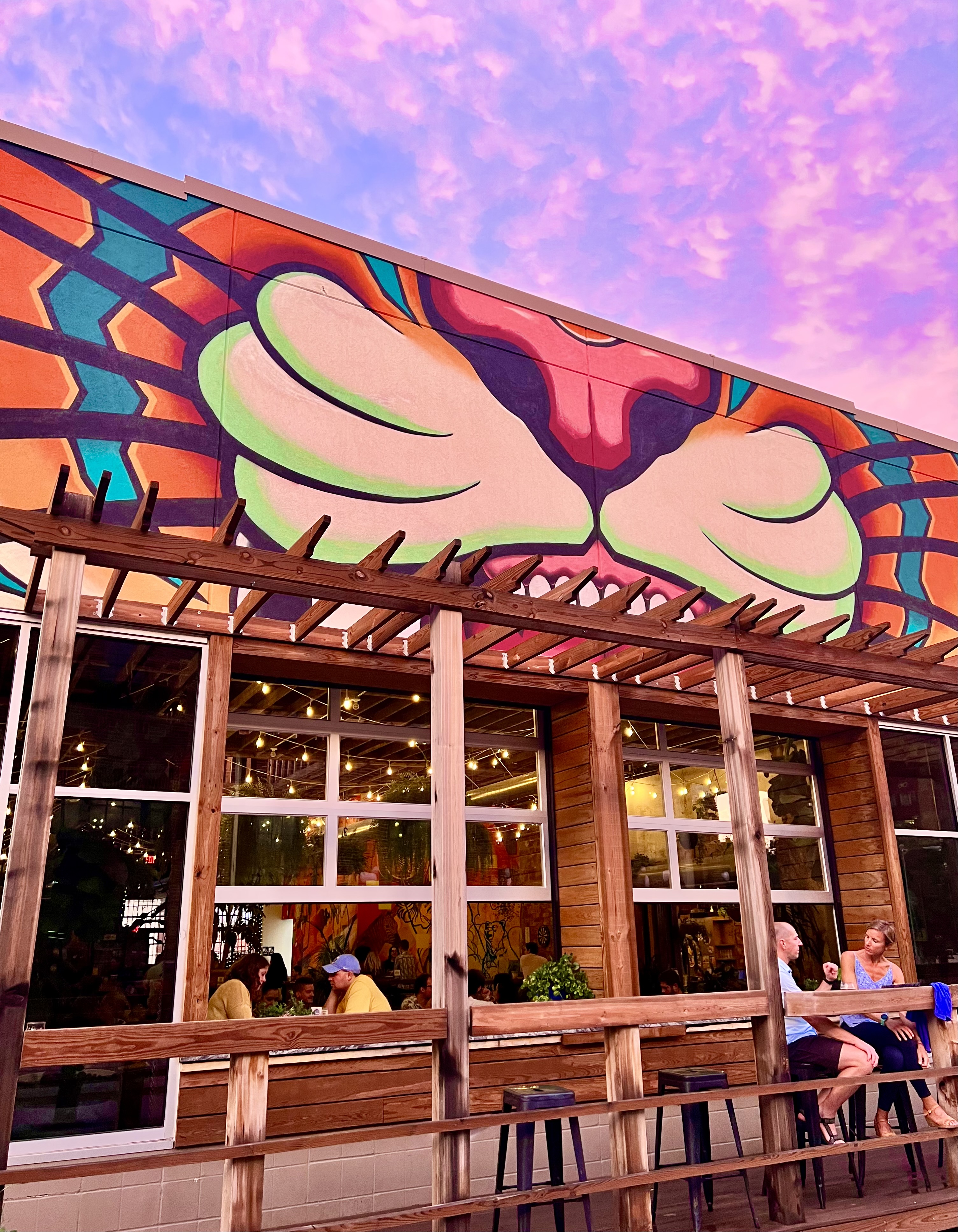
On the outside, a colorful mural is painted above a window that opens like a garage door when the weather favors outdoor seating. The bar stools, where customers sit and sip cold craft beer, overlook the sidewalk as pedestrians pass by. 

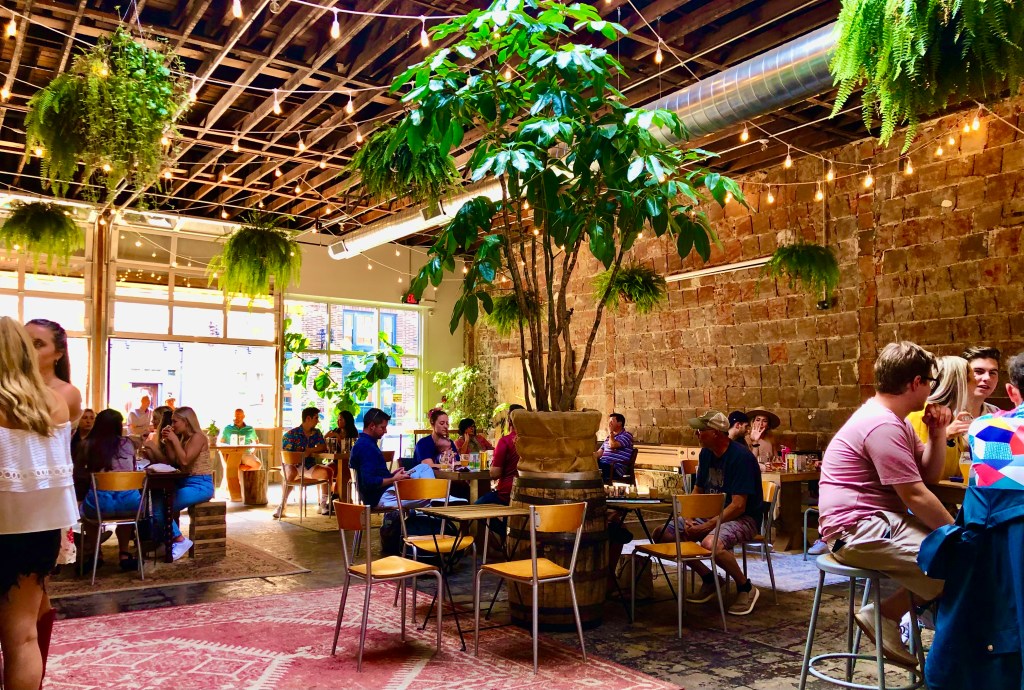
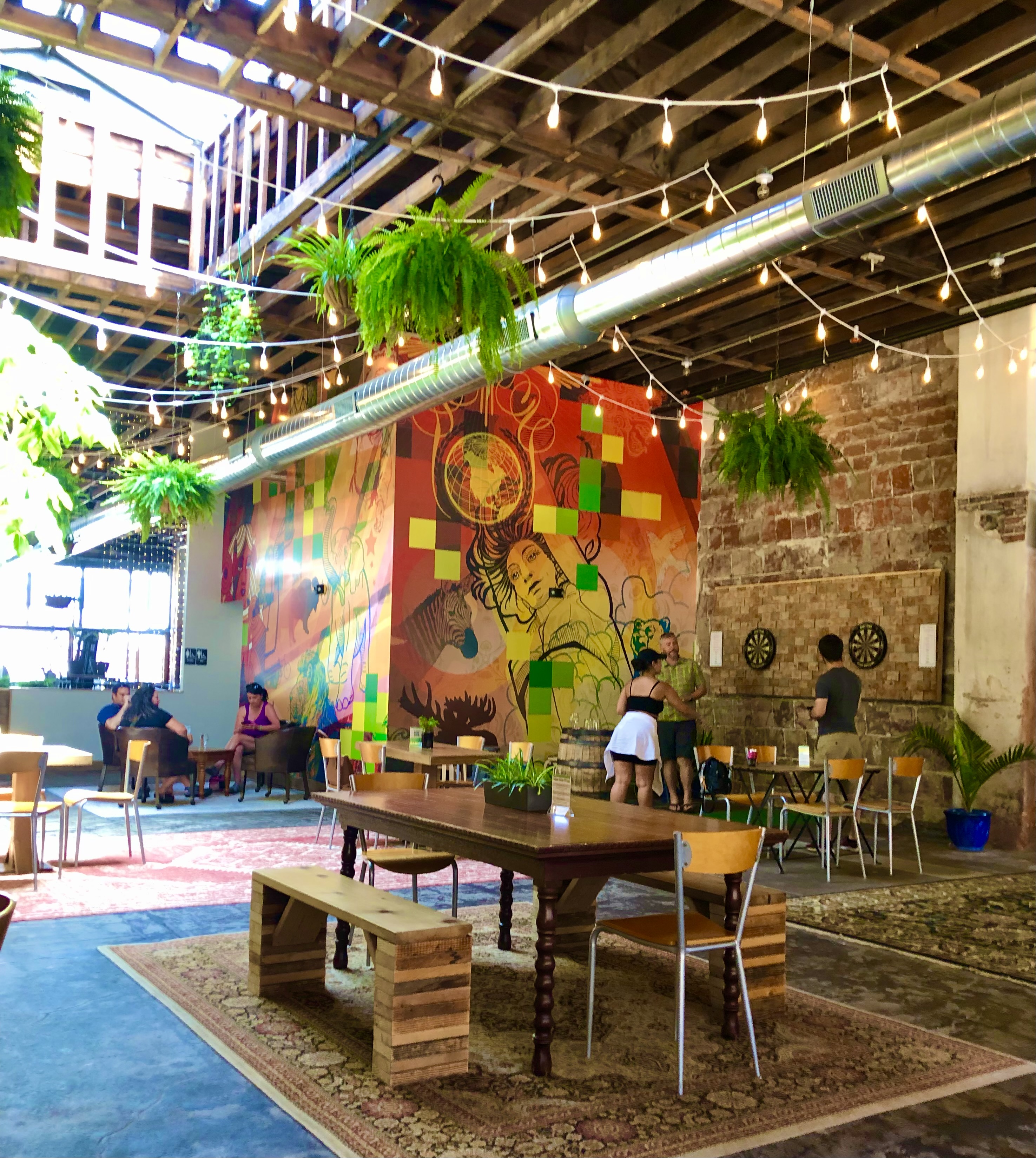
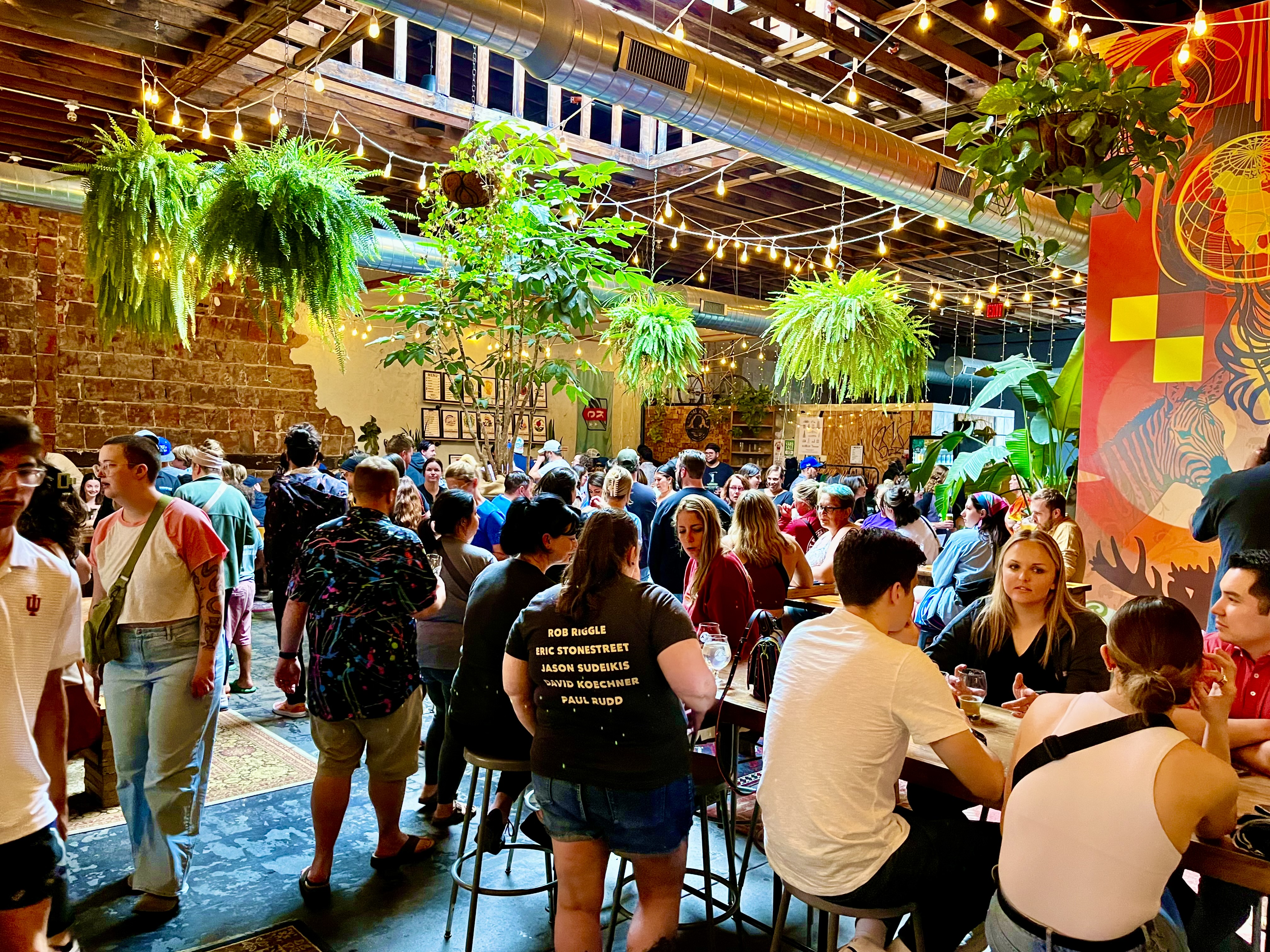
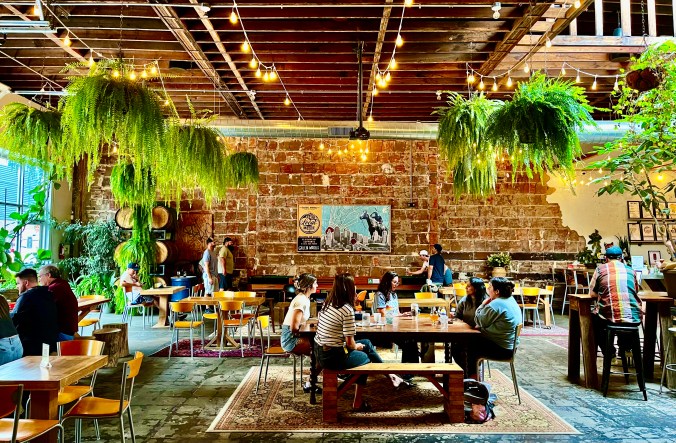
Inside, industrial steel cylinders are tucked under open ceiling beams and skylights. Hanging Boston ferns trail down from above and a tall Umbrella tree reaches upward to the central skylight. The seating is mostly handmade wooden tables. Refinished log stools line the sides of one long table. Leather sofas and cushioned chairs are placed in cozy conversation corners surrounded by potted green plants.
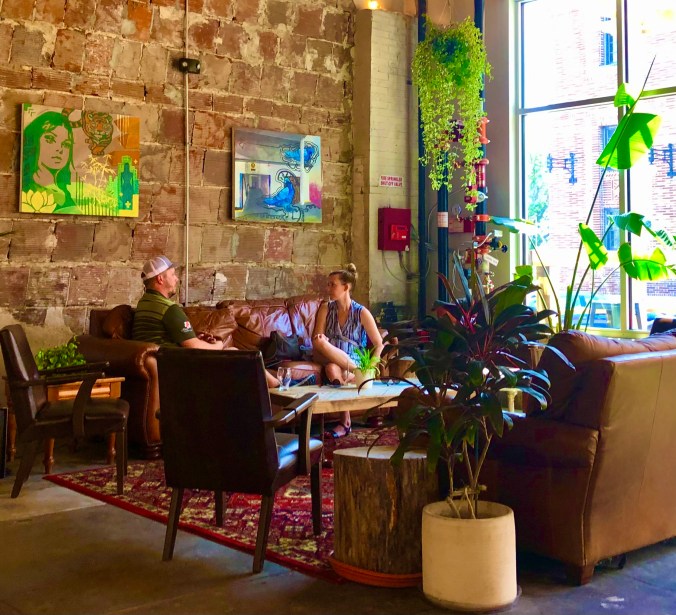
conversation in a corner
exposed rafters, steel cylinders, and strings of lights
center stage Schefflera tree under skylight
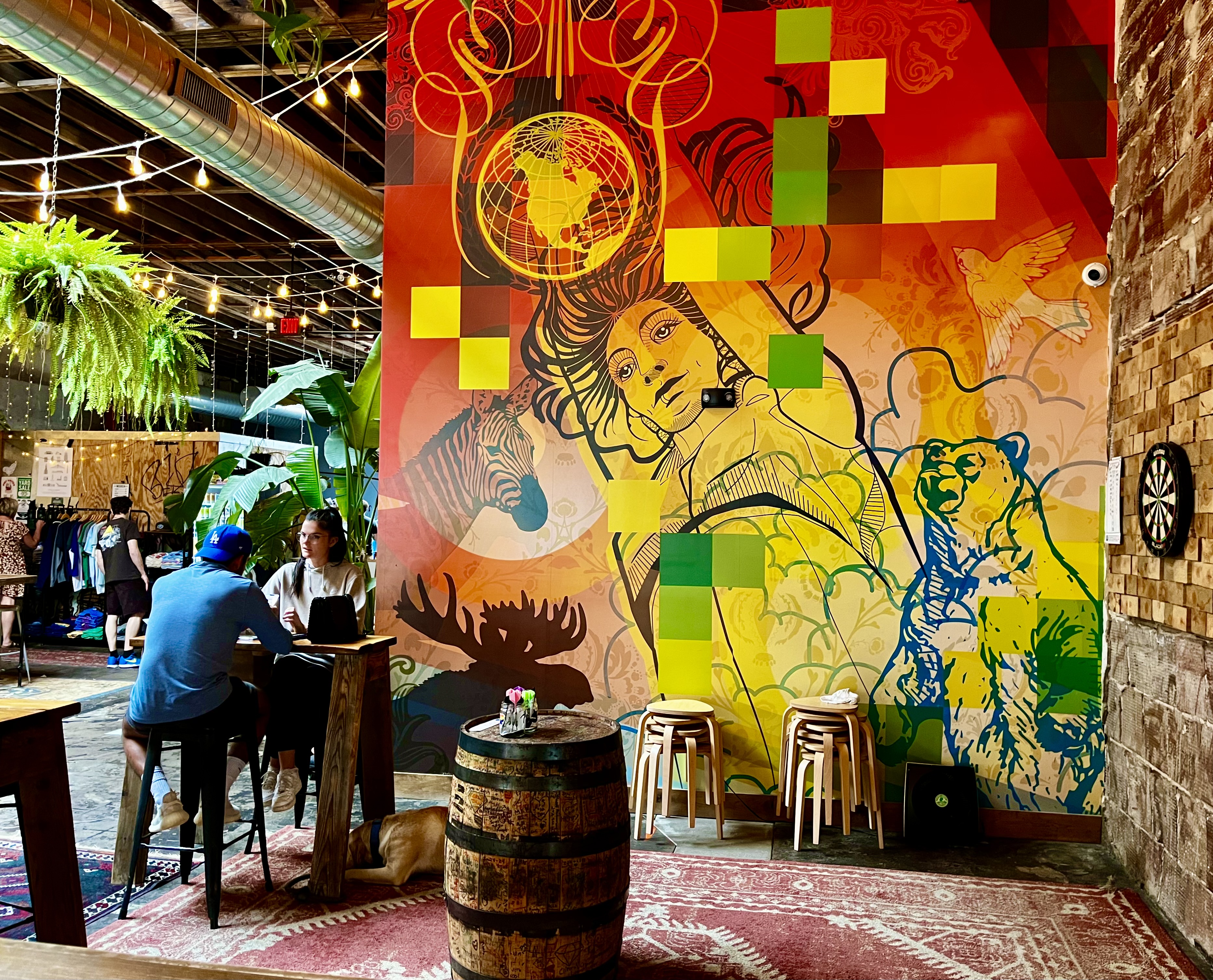
kyle art wallpaper, darts, and the door connecting new and old sides

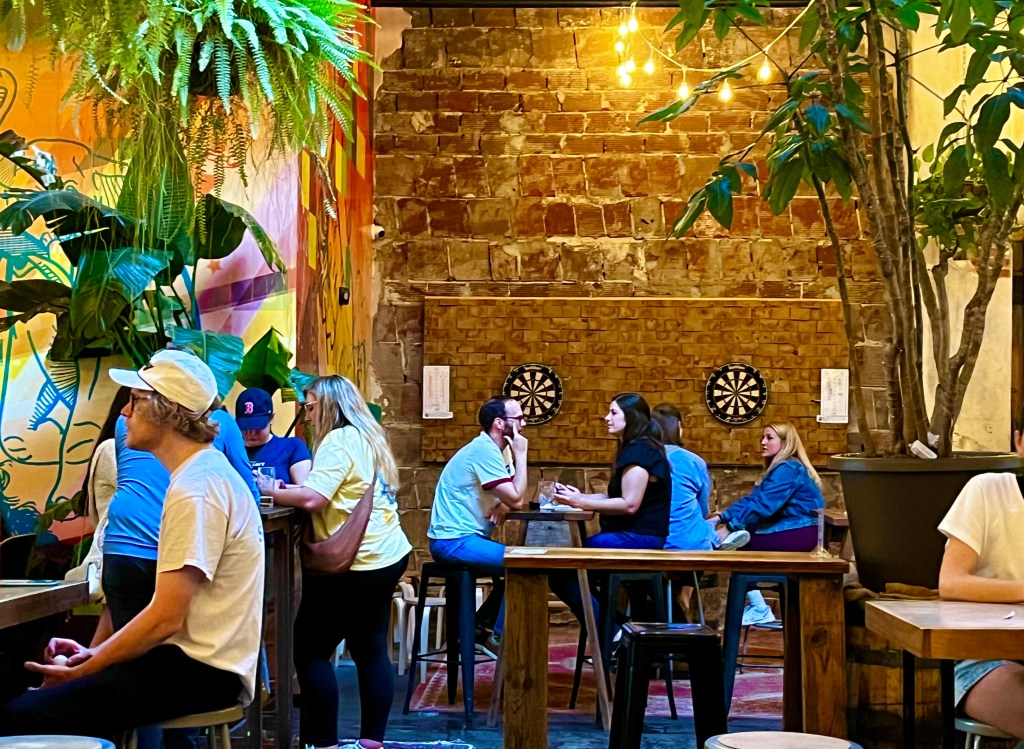
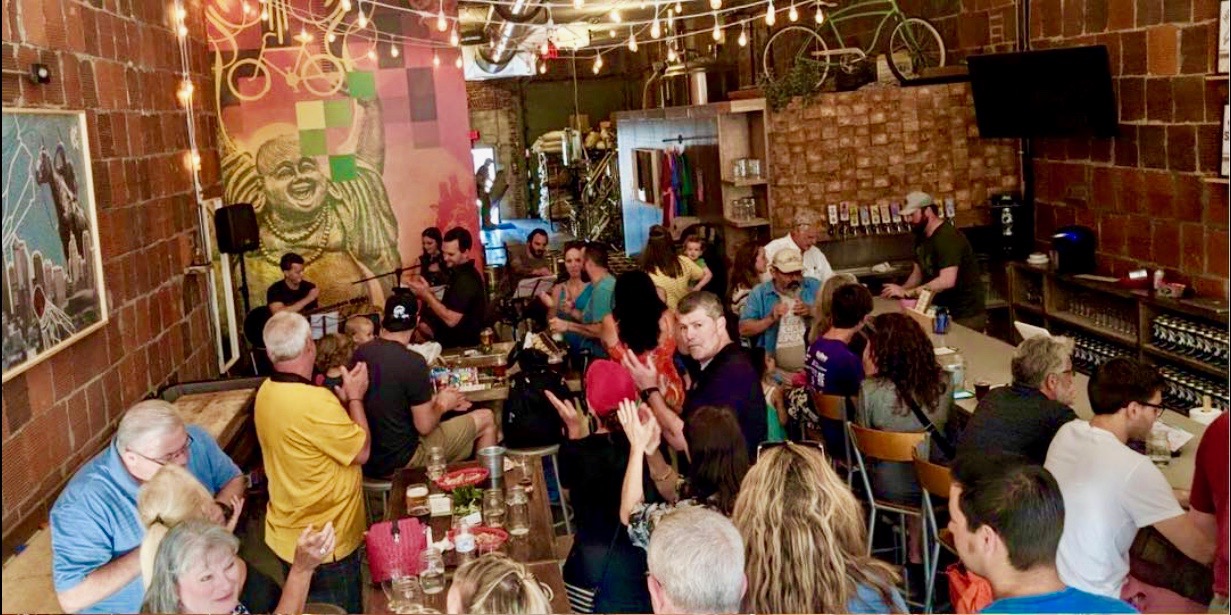
Colorful oriental carpets lay on the cement floor in a patchwork fashion. Shuffleboard, darts, and boxes of board games are ready to play with family or friends. Strings of lights are draped throughout, exposed brick walls create texture, along with original art wallpaper and paintings designed by head brewer, Kyle Gray. He also happens to co-own Casual Animal with his wife, Lara. The overall atmosphere of this craft brewery exudes laid-back ease with an infusion of warm ambience. You want to sit down, order a beer from one of eleven full taps, and just hang out for a while.

kyle paintings
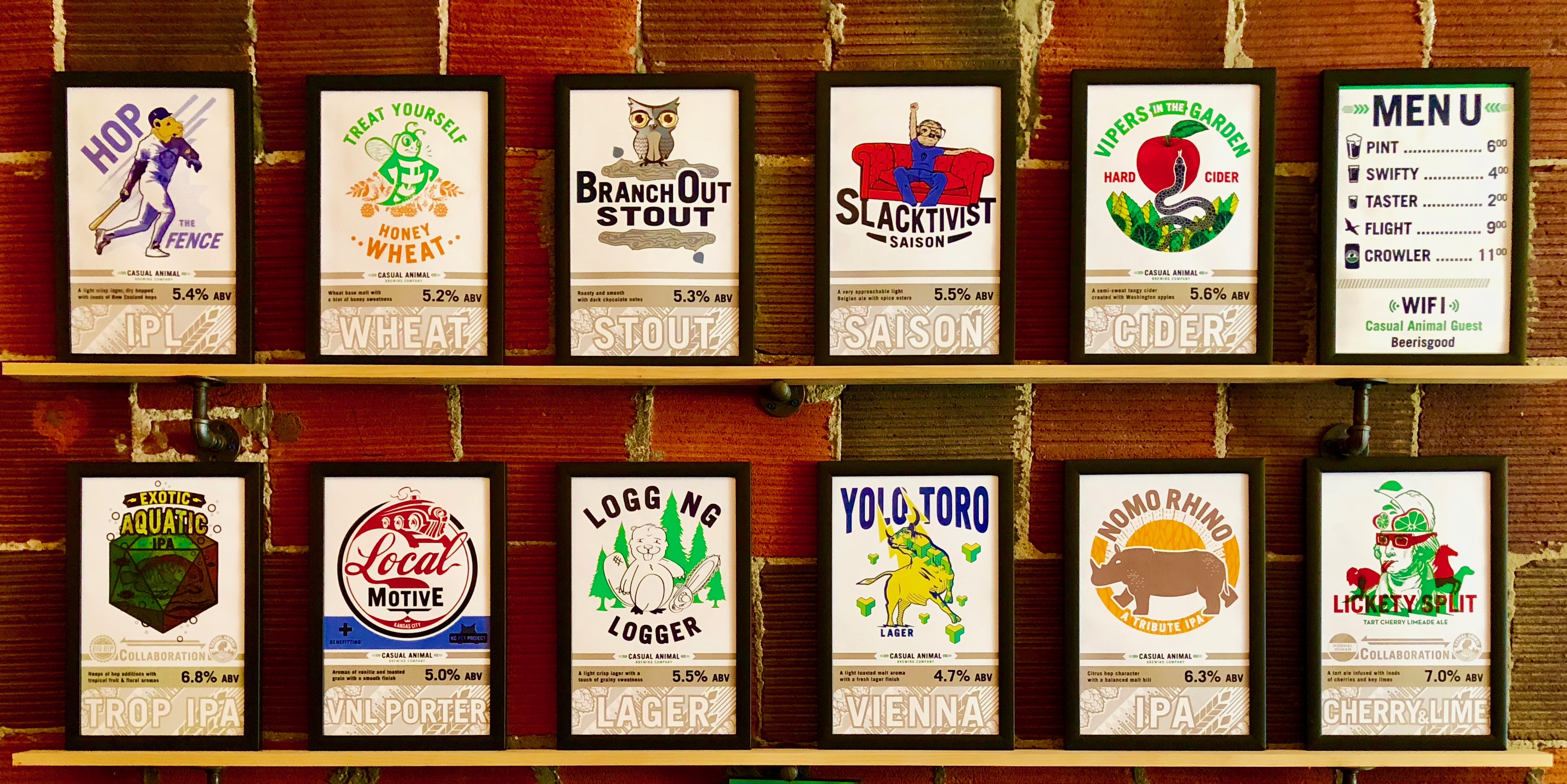
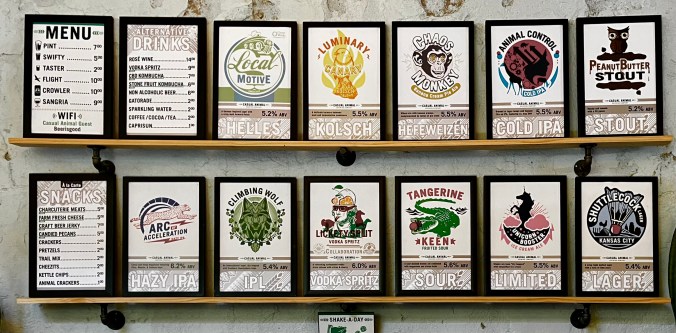
the current lineup on tap

Kyle runs the “back of the house”; creating beer recipes, brewing twice a week in a 7- barrel system, canning, designing logos for labels or merchandise sold online and directly from the brewery. Lara takes charge of the “front of the house”, staffing and training, social media and marketing, taproom events, distribution and delivery in local restaurants, liquor stores and bars.

Lara is also the current President of the East Crossroads. This is their neighborhood organization whose goal is to unify all area businesses as a destination entertainment district for locals, conferences, business travelers, and vacationers. One important aspect is to increase traffic and retail business for the diversity of restaurants, small shops, craft breweries, and cocktail bars in Crossroads. Recently she has helped the neighborhood receive $35,000 in grant monies from the city of Kansas City. This will be used for commercial branding, highlighting the district with streetlight pole banners, directional signage, and other resources.

The Beginnings Through a Pandemic to Today

The background of how Casual Animal Brewery was first dreamed and conceived by Kyle and Lara in 2017-18 is a compelling story of its own, and told here: Becoming a Casual Animal 

The story of the opening of the larger, plant-draped conservatory side of the brewery began just before the shutdown of the Coronavirus pandemic. In November 2019, Kyle was taking trash out to a dumpster in the back alley. A secretary from a neighboring business was standing outside on a break. She asked Kyle if he knew the building next door to the brewery was for sale. At the time, it was a truck storage warehouse with zero infrastructure. But it was big and shared a common wall.

Kyle called the owner, toured the space and applied for a loan in February of 2020. They closed on the property in May of that year when the whole country was hibernating at home amid the uncertainties of Coronavirus. Kyle’s brother, Alex, was hired as General Contractor and moved into their house for the next nine months. 

The risk of taking on a new, larger loan and beginning a complete renovation to expand Casual Animal (by more than doubling its size) started in earnest while a global pandemic was raging. Kyle had serious doubts and anxieties about moving forward, but ultimately decided there was no better time to expand the brewery than with this serendipitous opportunity.

Crafting a New Craft Brewery

Deconstruction before construction. Kyle, with Alex and their father, Kass, jump started the demolition. There was junk removal of heavy lath, bundles of old wire, and equipment. The linoleum floor tiles were scraped clean to the concrete underlayment. In the rear space that now houses four 15-barrel fermenters, an old ceiling of tin, wire, and plaster was painstakingly cut out, dropped, and hauled away. 

Plaster walls were blasted with a jack hammer to reveal the brick underneath. It was hard, excruciating and dirty work. Finally, Alex said, “Stop. Leave some of the wall plaster and call it done.” It is an attractive stopping point. Alex then got busy and built bathrooms, the new, larger bar area, and engaged in even dirtier work by climbing high into the ceiling rafters to painstakingly clean away 100 years of industrial dust and grime!  

looking from new side to original side with brick and plaster walls
another view of brick and plaster

Subcontractors installed electricity, HVAC, plumbing, and the front garage door window to match the original side of Casual Animal. Creating openings into the common walls required considerable consultation with structural engineers because both buildings are more than a century old. In the end, doorway-sized holes were sawed through two walls (one for each building) and reinforced with steel beams. And just like that–the taprooms and brewing areas were connected.

Debut Side 2

In January 2021, nine months after taking possession, with the mask mandate and six feet of separation still in full effect, Casual Animal, side two, opened to the public. 

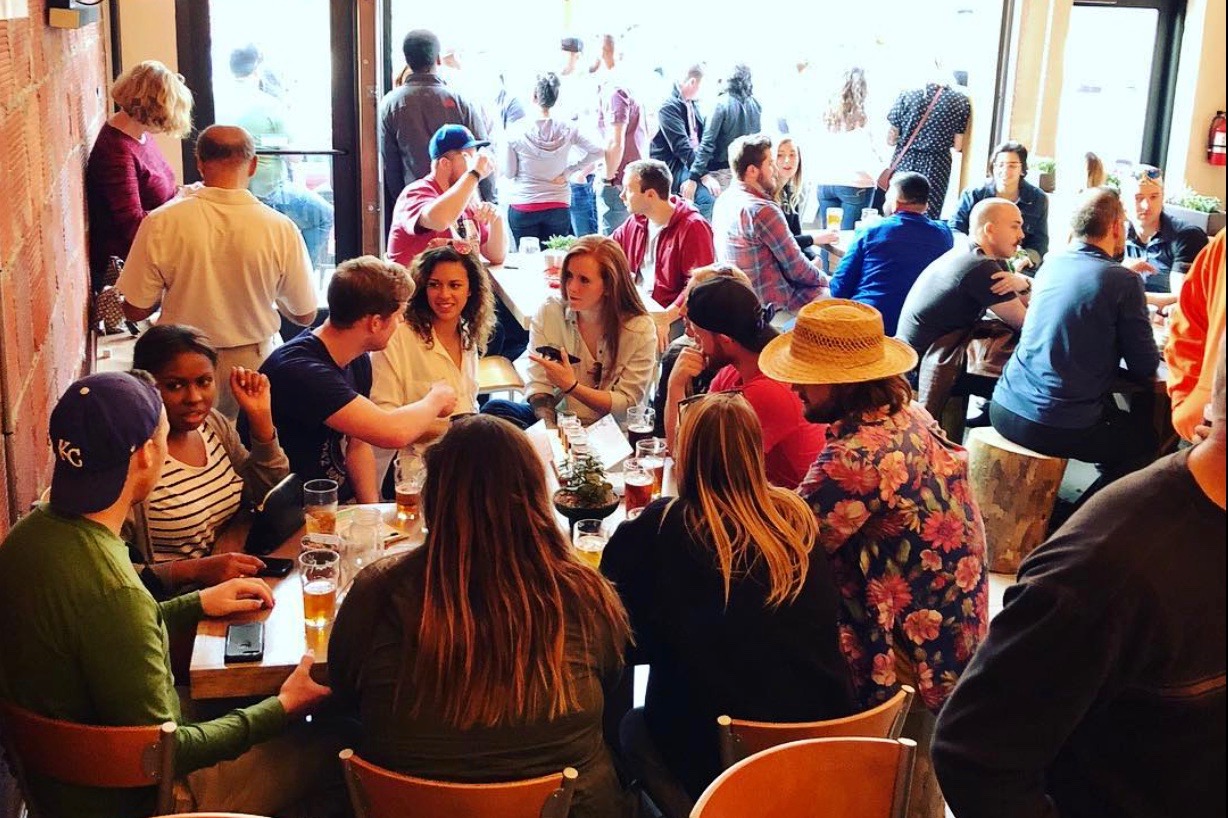
From the beginning, the word got out, and the people flocked in. The high ceilings, the big windows and skylights, the greenery and wide spacing between tables and “living room” conversation corners were a welcome reason for being with friends in public again. There was a feeling of being safe in your own “pod”. Families, and dogs, welcome. Everyone loves the casual-animal-dogs-are-welcome theme.

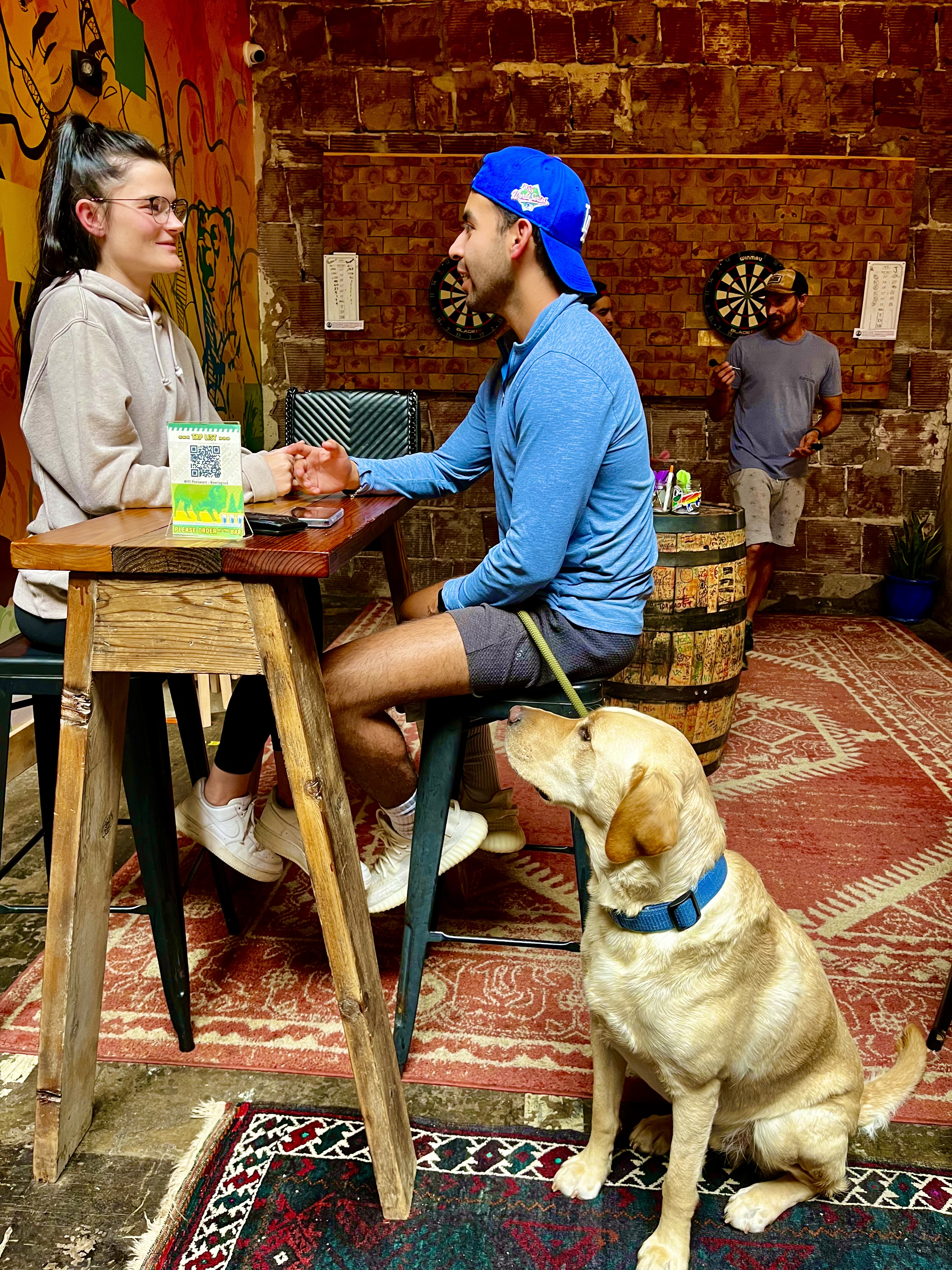
conversation corners
and dogs!

high ceilings, string lights, open windows and greenery

casual conversation in a cool space

The Current Vibe

Last fall, with the garage door opened wide on a perfect autumn day, I sat in my favorite spot next to the wall at one end of the bar–the best vantage point to soak in the early afternoon atmosphere. Sunlight was streaming in from the central skylight, customers were working on computers or talking in quiet conversation around the room. Mellow music provided soft background sound. The back brewing area behind the big tap room was clean and quiet. Tables were laid around the tall central Schefflera tree in a spoke-like pattern over the oriental carpets. Kyle-designed merchandise was hung on hangers, or neatly stacked on shelves––t-shirts, hoodies, baseball hats, water bottles. Next to the merchandise, a glass front refrigerator displayed the current variety of canned six-packs for take away. Customers regularly strolled to the bar to place an order. 

a quiet work space early in the day or conversation with a friend
view from the end of the bar

Seven women entered as a group. None of them drank beer. They ordered red sangria (locally made and canned, but not in-house), rosé wine, and vodka spritzes (a house-made cocktail on draft). The friends sat down to play Kansas City Trivia in a lively fashion. 

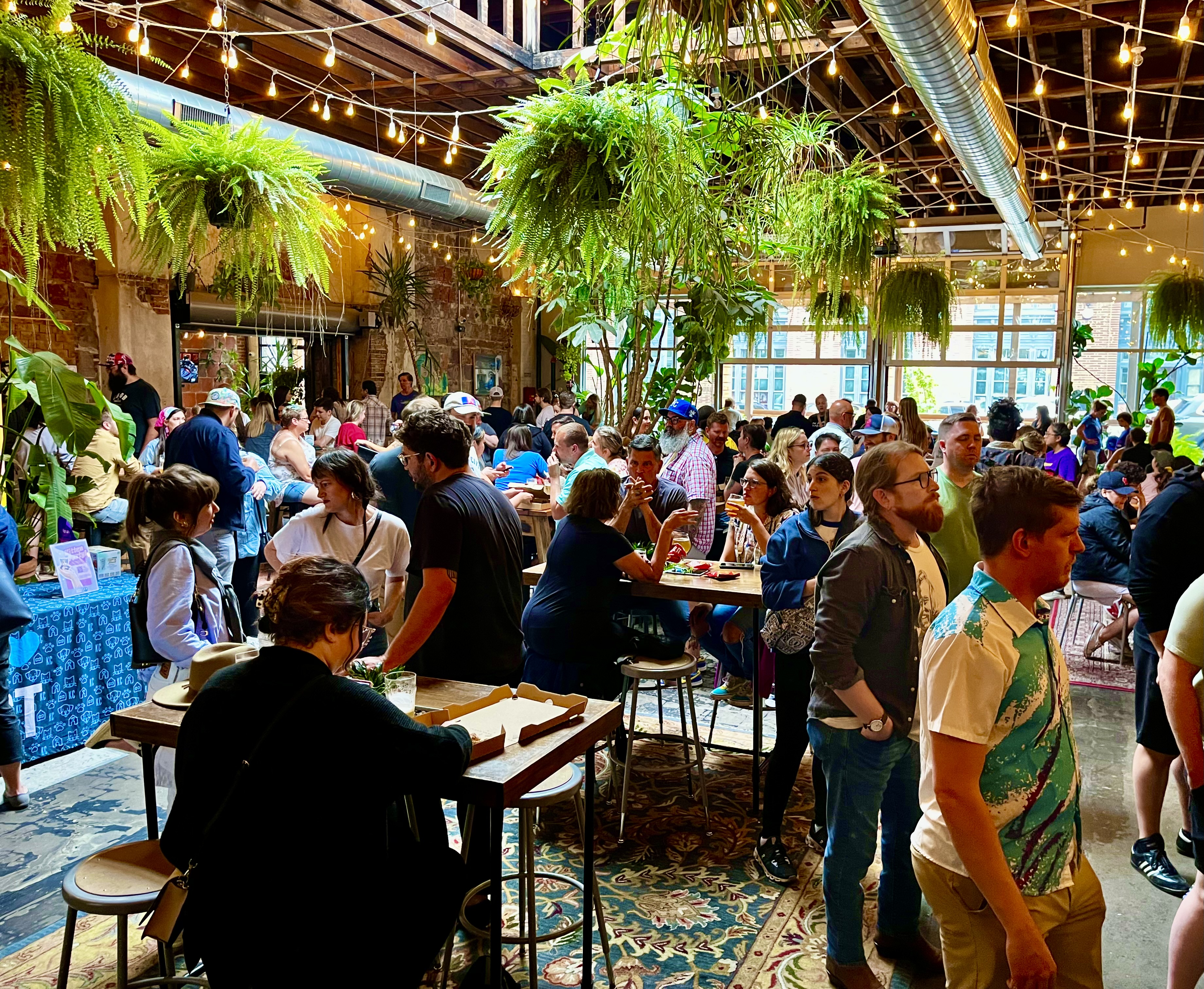
It’s now late Friday afternoon. The scene is growing steadily livelier as more people arrive, order a beer, and mingle with friends. Darts and shuffleboard are active. A group of twelve takes up the center court tables under the skylight and tree. They are standing, sitting, talking, laughing, taking pictures and enjoying themselves.
shuffleboard against the back wall

Kirstie, with 4+ years on staff, works the tap room, knows and can talk in detail about every style of beer. She offers a taste to customers who are particular or unsure. Erika has also worked at the brewery for four years. She spent 2 ½ years brewing with Kyle. Now she works in the front of the house, serving and chatting up customers. Ethan started at Casual Animal in 2018 when the first side opened. He left two years later, then returned in 2024 to become the assistant brewer with Kyle. These three, along with the rest of the employees, embody the small business model of a loyal Casual Animal family. They know their regular customers and suggest who I might approach with a few questions.

I sat down with a couple who told me they live within walking distance and often come after work or on a day off. What they love; always a likeable beer flavor in rotating fashion, the ambience of hanging lights, skylights, garage-door-open windows, the mash-up of decorating textures, the food pop-ups. As to the beer, he likes all Lagers, she is more experimental and willing to try different styles.

Another couple has a newborn. They have been coming to Casual Animal since the time of Covid when their first baby arrived. After getting vaccinated they brought the infant with them to get out of the house into a cool environment to sit and talk and sip beer. Now they are repeating the cycle three years later with baby number two. They love the plants, the trees, the natural lighting, the soft seating. They wish food was served regularly but enjoy the pop-up vendors that rotate through on a regular basis.

 Madi has been a regular casual animal for 3-4 years. She comes in the early afternoons during the week, when it is mellow and quieter, to work on her computer. She always sits at the bar, knows and likes the staff, and chats with them while working. 

Commitment to Community

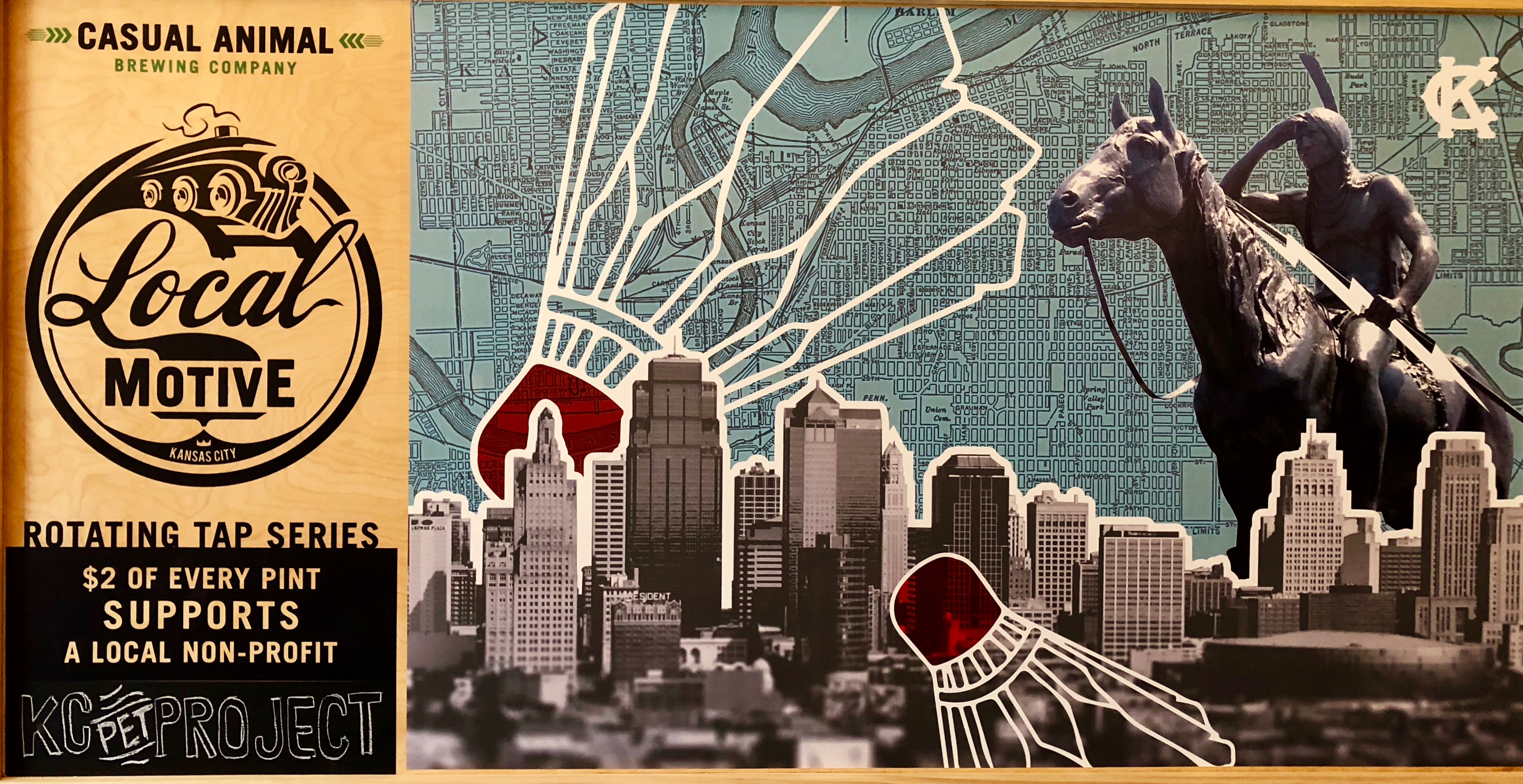
Local Motive is the name of Casual Animal’s fund-raising beer selection, sold to support Kansas City non-profit organizations. It was written into their business plan from the start, as a way of giving back to the local community. It began as a quarterly offering for the first two years. However, for half of 2020 and all of 2021, during Covid, it was placed on hold. 

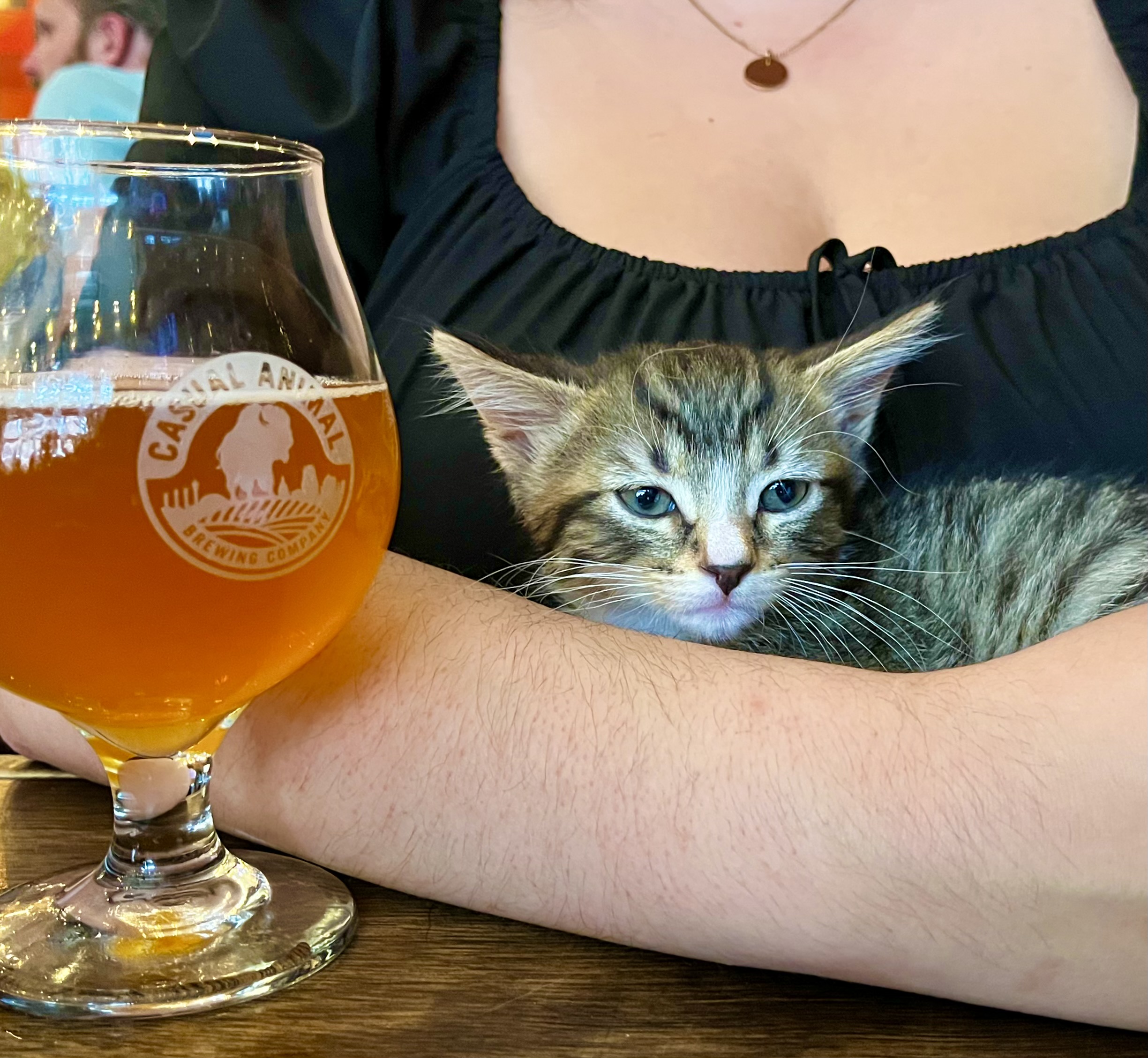
Now Local Motive rotates to a new charitable cause every two months. Two dollars from the sale of every pint of one specially selected “Local Motive” beer is donated to the non-profit’s cause at the end of a rotation period. Each non-profit can organize events at the brewery to educate the public and optimize giving during their cycle. Some of these have involved trivia nights, live music, or bringing in rescued kittens and puppies for adoption. 

Lara and Kyle annually select from a wide variety of Local Motive applications submitted on their website, choose about 15 that meet the criteria they have set, and present them to the staff. The staff votes for six non-profits as local motive recipients for the upcoming year. By the end of 2025, over the past 8 years, Casual Animal will have hit a new marker for giving back–more than $100,000 flowing into the Kansas City community and helping 30+ organizations.

Better Together

There is a collaborative relationship between Casual Animal, other breweries, and even farmers. Kyle has generated several co-branding ventures to promote a new beer, such as with Odell Brewing in Ft. Collins, Colorado, Cinder Block, Double Shift, Big Rip and others in the Kansas City area. This is usually a one-of-a-kind endeavor to co-produce something different and even experimental in the craft beer industry. 

Then there are the livestock farmers. Kyle has always donated his spent grains, barley, oats, wheat and rye, to farmers as feed for pigs, chickens, cows. In the past several years a joint relationship was formed with KC Cattle Company. Head rancher Marc Wermersen has loved cows since childhood. He is in charge of hand raising and feeding 275 head of selective Wagyu beef cattle.

spent grains for KC Cattle Company Wagyu cows

Wagyu is the American version of the highly marbled, tender, Kobe beef from Japan. For these cows, fed largely on pasture grass, the small grains extracted from Kyle’s tanks (mixed with corn) are a high energy supplemental food. As Marc says, “Good feed equals good beef equals good taste.” The relationship is reciprocal. The brewery receives Wagyu summer sausage and shaved peppered beef to serve as charcuterie meats in the taproom. Marc often gifts the brew team with steaks, ground meat, and award-winning beef hotdogs.

Special Events

Planning and organizing events is one aspect of Lara’s on-site job description. Currently, Casual Animal offers special taproom evenings such as Wednesday Art Night, where coloring and painting supplies are available to dabble in, or pop-up food vendors serving inside or from trucks on the street. There is an annual Earth Day celebration on April 22.

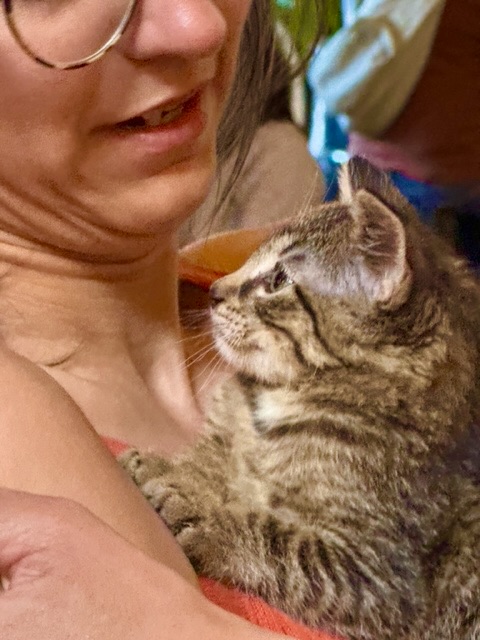
Perhaps the most popular and very highly attended event is the Kitten Pop-Up Party. KC Pet Project, a no-kill pet shelter as well as a former Local Motive recipient, currently sponsors a bi-annual Kitten Party offering rescued babies for adoption. Foster parents bring their kitten charges in baby buggies or pet carriers and customers are allowed to cuddle, play with, and love up the kitties while foster moms and dads supervise. Singles, couples, families, and kids all participate in a standing room crowd.
Being Beer Specific

And what about those beer flavors served up from Kyle’s creative, revolving list of recipes? There is a favorite taste for every palate–hazy IPAs, sours, dark stouts, lagers, Kolsch, cold IPAs, West Coast IPAs, wheat beer, nitro offerings, including some atypical choices such as an Ice Cream ale. 

When I asked Kyle and Lara to name Casual Animal’s most requested and top selling beverage choices, they said (although it varies somewhat), #1 is the Hazy IPA, #2 is a Lager, #3 a Wheat or Sour choice, #4 and #5 rotate between another kind of IPA or the Local Motive choice. Moving up in line of popularity is the Vodka Spritz draft cocktail made on site and sold on draft as a gluten free option. There is always a hard cider on tap for non-beer palates as well.

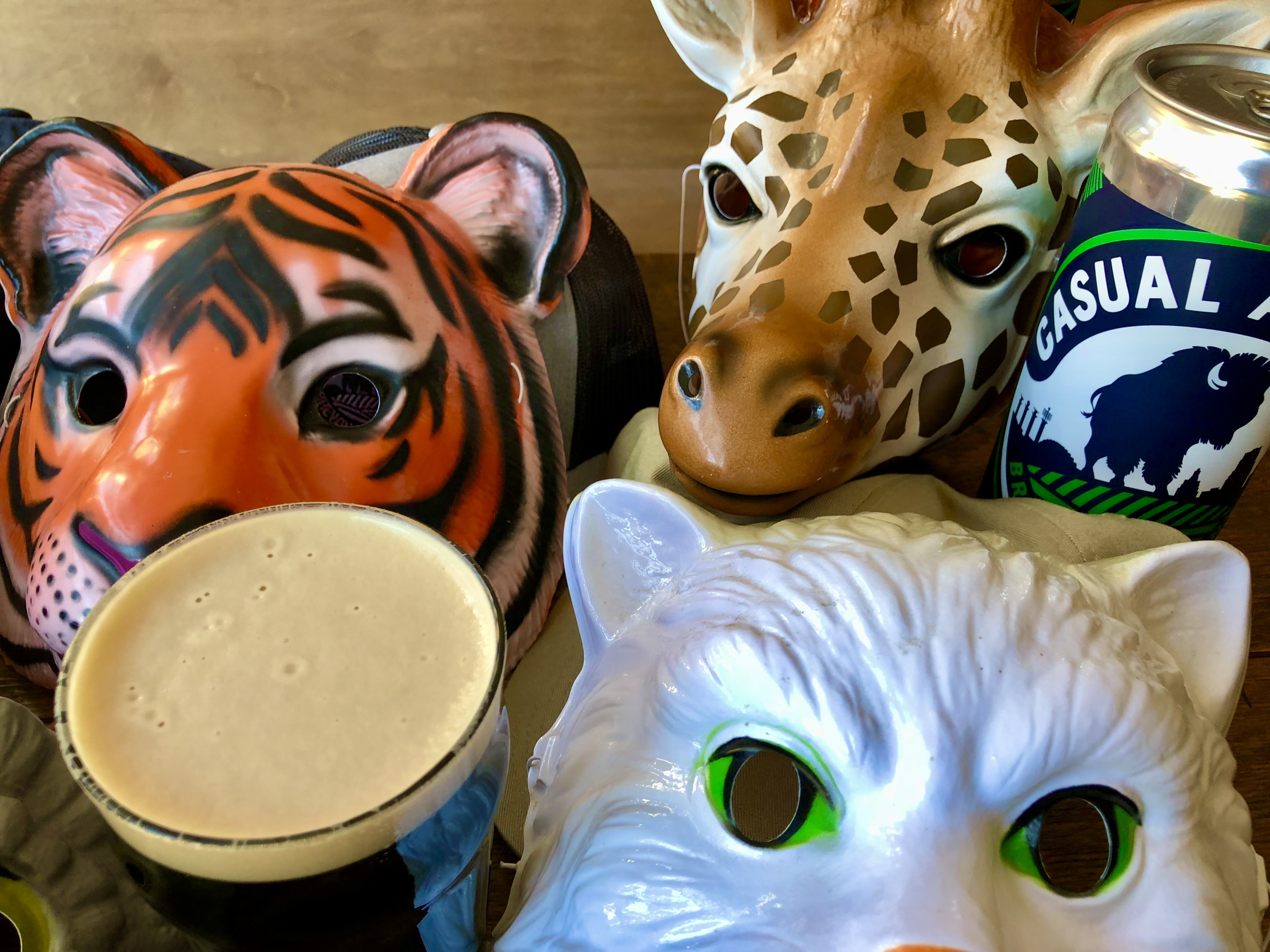
Styles of beer have creative names that are usually animal-related to the brewery theme. Animal Control Cold IPA, Bear Hug Brown, Climbing Wolf Hopped Lager, Hyper Lynx French Pilsner, Vipers in the Garden Hard Cider, Blue Flamingo Fruited Sour, Luminary Canary Kolsch, and my personal name favorite–Chaos Monkey Hefeweizen.

This is Your Third Place

So, what’s left to tell? Perhaps it’s time to stroll into Casual Animal when you find yourself in Kansas City or peruse their creative website for merchandise if you’re not. Go with friends, with family, or by yourself to work on a quiet afternoon in a beautiful environment, to attend an evening event, to plan a gathering, to sit and drink good craft beer, to listen to background music or watch a special sports event like the Super Bowl with a crowd.

Casual Animal is the classic drop-in, home-away-from-home, relaxed and easygoing brewery you have been searching for. Meet friends and stake out your favorite seats in the house.

From its origins, Casual Animal was conceived of and built to represent the “Third Place”. That other place you seek after home and after work. It’s the place you go to relax and let go, to find joy and camaraderie, to feel safe, and to have fun. It’s not just about the beer or the greenery or the skylights. What it is…no actually, what it’s about, is being somewhere else, spending good time with people in warm and welcoming community surroundings.

Isn’t that something we all need?


CASUAL ANIMAL BREWING COMPANY
1725 McGee St, Kansas City, MO 64108, USA
Telephone: +1(816) 648-0184
Hours: Monday-Thursday, 12-9PM, Friday & Saturday, 12-10PM, Sunday, 12-7PM
www.casualanimalbrewing.com
Facebook: Casual Animal Brewing Co.
Instagram: casualanimalbrewing


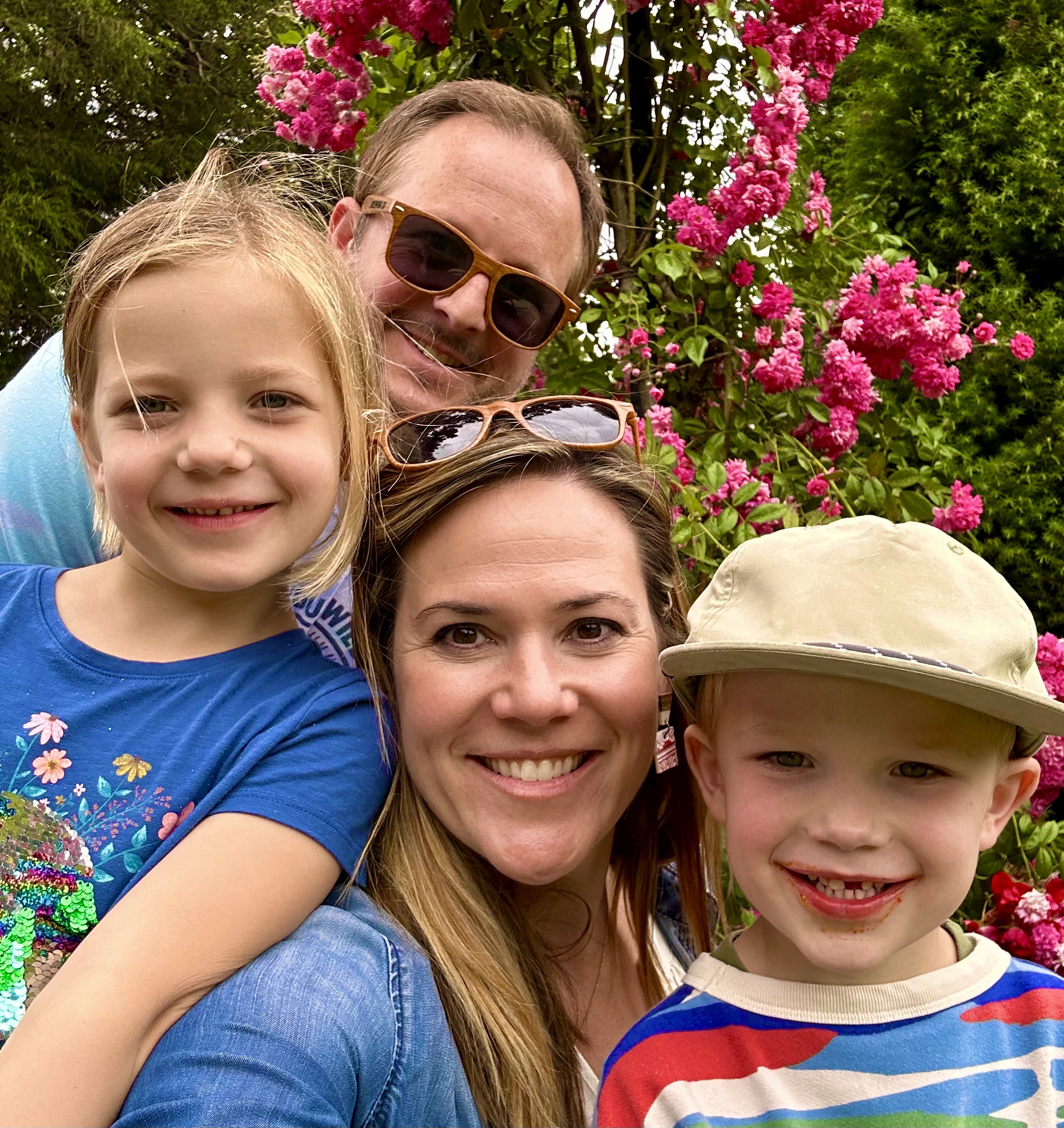
When the first side of Casual Animal opened in early February 2018, the Gray family was brewing their first baby, and daughter Sloan was born in October 2018. When they closed on the building for the second side, in May of 2020, son Isaac had just entered the world on May 13. The Grays today are a beautiful family of four.

Searching For Poppies

Visiting an overseas friend who lives in Luxembourg, I found a book of poetry by Mary Oliver on a living room table. Awake early the first morning with jet lag, I settled into a comfy chair with a cup of coffee and thumbed through poems in the dim light. One entitled “Poppies” provided pause.

Oliver is known for connecting life lessons to her observations of love for the natural world. In “Poppies” her poetic sentiment contrasts the transient beauty of wild poppy fields with the inevitability of life and death. 

“There isn’t a place in this world that doesn’t sooner or later drown in the indigos of darkness.”

To lighten the mood, she weaves in a moment of pure joy while visualizing poppies in the field.

“…But also I say this: that light is an invitation to happiness, and that happiness, when it’s done right, is a kind of holiness, palpable and redemptive. Inside the bright fields, touched by their rough and spongy gold, I am washed and washed in the river of earthy delight…” 

While immersed in her river of delight, she circles back to darkness and loss, ending with a question. 

“…and what are you going to do–what can you do about it–deep, blue night?”

Of course, there is nothing to do other than letting it go. Thus, exemplifying one of Buddha’s teachings that there is nothing anyone can successfully cling to in between the moment of conception and the moment of death. 

Poppies became my favorite flower when we lived on the island of Cyprus for three years. Every spring, deep red fields of poppy flowers bloomed in profusion all over grassy orchards, fields, and pastures. Shaped like a fine teacup, the crepe-paper-thin petals flutter freely in the breeze. En masse on a roadside or in a field or even in a small clump, they are spectacular. But poppy season is brief. Flowers wilt, fade, and fall to the earth as graying-red dust in a short time. Breathtaking in the moment and then gone. Another year passes.
Our children were young in those years. On weekends we drove out of Nicosia searching for a carpet of red and green to spread out our blanket and picnic. Spending an afternoon in a wild field of flowers and tall grasses is still a magical memory. It was stunningly beautiful, a family outing in the season of rejuvenation, and it made me happy to be there with loved ones.

Cyprus poppy field, circa 1991

During World War 1, [1914-1918], most of the fighting in Europe took place in open fields where poppies proliferated despite the death and mayhem all around. In 1915, Lt. Colonel John McCrae wrote his famous, historic poem, “In Flanders Fields”* after witnessing the returning spring bloom across red battlefields. 

*Full poem at the end of story.

Since then, poppies have been a symbol connecting the blood and sacrifice of soldiers with remembrance, hope, and peace. They are also associated with the Greek God Morpheus–the god of sleep and dreams. Morphine and opium narcotics are derived from poppies, hence the reference to death and sleep. 

What draws me to experience a profusion of blooming poppy fields whenever possible?  Because, like Mary Oliver, I connect them to a personal lesson. They remind me of the nature of our own family’s life cycle. Beauty in learning and growth, and the eventual letting go as necessitated by time. There was uncertainty and risk taken by our young family of four when we made a decision to live and work overseas in the late 1980s. In geographies and life styles, that were not a reflection of our home culture, we adapted and grew in individual ways. Incorporating the very best of each country’s experience added significantly to our lives. 

Now we are all back living full time in America. Our children are young adults with children of their own. They each have a personal perspective about growing up in other countries for thirteen and sixteen of their formative years. My hope is that it enhanced and deepened their awareness as global citizens, as more thoughtful inhabitants to contributing to the health of the world and our planet for their own children’s future.

I think about these things along with the light and dark life cycle of the seasonal poppy. The lightness, the brightness, the earthly delight when seeing them massed in peak glory. The dark side of “here and now” beauty is knowing that it is fleeting. It will leave. Which must occur in order to be ready for the next opportunity to grow.

This past spring, the seasonal return of poppies in the wild offered an opportunity to re-experience an assault of red on the senses. We were in Greece in April. Poppy season was on, but had passed its peak in Athens. Then we traveled to the island of Hydra. Asking others to be on the lookout, someone said they saw “a whole field of poppies in bloom” on a hike.

It wasn’t exactly like that. What we found was a roadside of brilliant red flowers crowning a cliff high above the Mediterranean Sea, still lacy and vibrant and swaying in the breeze. It was a sought-after reminiscence, perfect for the moment, the contrasting beauty of vibrant red petals and deep blue sea. 

…and it was enough, before moving on down the path. 


We live in a world where people think happiness is a condition, but it’s not; it’s a sensation. It’s momentary. –Fran Lebowitz

This existence of ours is as transient as clouds. A lifetime is like a flash of lightning in the sky, rushing by, like a torrent down a steep mountain. –Buddha

You can’t say I’m not happy ‘cause happy’s not an action, you just feel that way.
–Ambersunshower, from the song, ‘Walter T’, 1996 [Only available on YouTube.com]


POPPIES    by Mary Oliver

The poppies send up their
orange flares; swaying
in the wind, their congregations
are a levitation

of bright dust, of thin
and lacy leaves.
There isn’t a place
In this world that doesn’t 

Sooner or later drown
In the indigos of darkness, 
but now, for a while,
the roughage

shines like a miracle 
as it floats above everything
with its yellow hair.
Of course, nothing stops the cold

black, curved blade
from hooking forward–-
of course
loss is the great lesson.
But I also say this: that light
Is an invitation 
to happiness,
and that happiness,

when it is done right,
is a kind of holiness,
palpable and redemptive.
Inside the bright fields,

touched by their rough and spongy gold,
I am washed and washed
In the river of delight––

and what are you going to do––
what can you do
about it––
deep, blue night?

IN FLANDERS FIELDS by John McCrae

In Flanders fields the poppies blow

Between the crosses, row on row,

    That mark our place; and in the sky

    The larks, still bravely singing, fly

Scarce heard amid the guns below.

We are the Dead. Short days ago

We lived, felt dawn, saw sunset glow,

    Loved and were loved, and now we lie,

        In Flanders fields.

Take up our quarrel with the foe:

To you from failing hands we throw

    The torch; be yours to hold it high.

    If ye break faith with us who die

We shall not sleep, though poppies grow

        In Flanders fields.


a different kind of poppy, Poppy Tennis-Hewitt


A Guest Room Under the Porch

camp estes with long’s peak background

Summer in the Colorado Rocky Mountains began in June this year. 

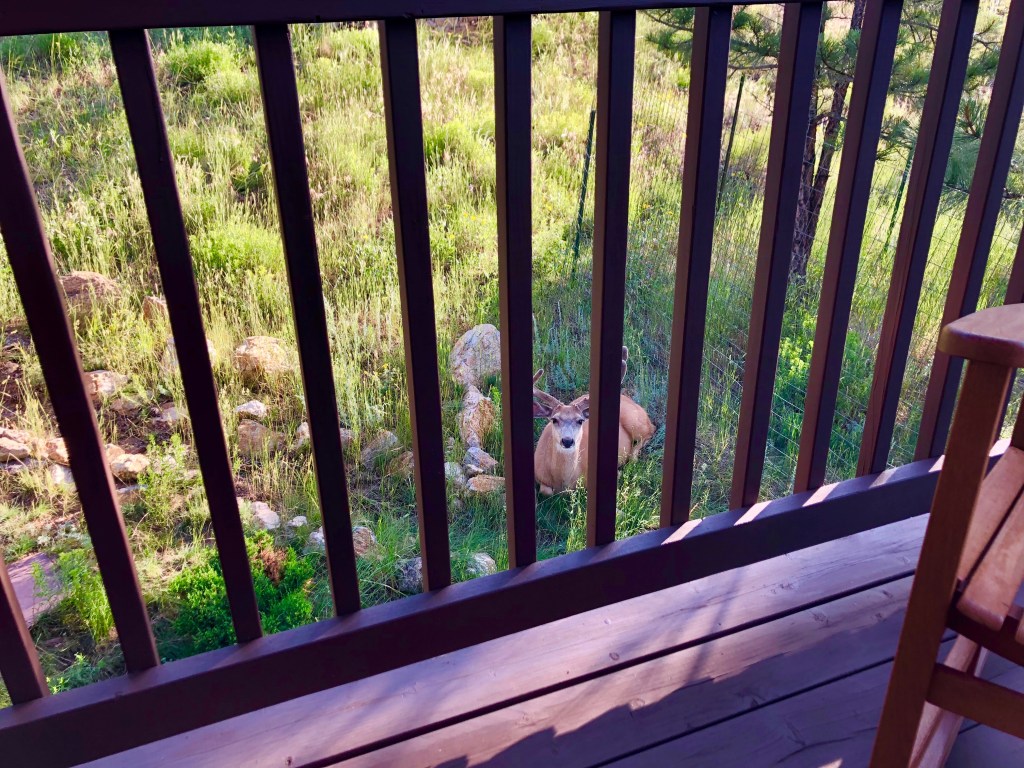
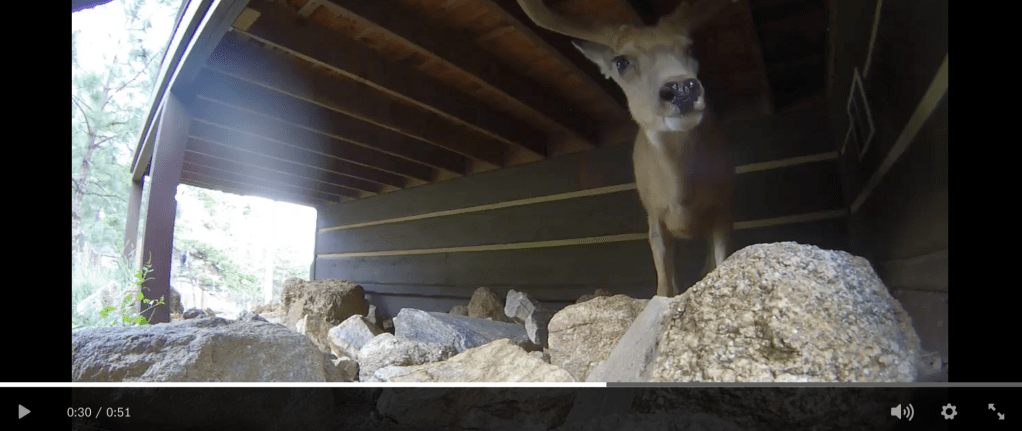
A guest I wasn’t expecting had already arrived. Stepping onto the covered front porch, a young deer with budding antlers leapt out from underneath my feet. He had moved in below the decking, among rocks laid down years ago.

The buck didn’t venture far, sticking close to nearby pine trees, pretending to graze and glance silently at me. Over the course of days, I became familiar with his routine and he with mine.

Buddy as a youngster

I began calling softly, “Hey Buddy, it’s just me”, when he startled awake with my footsteps above him. If it was late afternoon, nocturnal foraging began and he wandered away.

My husband arrived one week later. We have our morning coffee here, on the porch that faces north, with a view of craggy rock knobs and old Ponderosas. Rays of rising sunlight are welcome when the air is cool.

We began to see Buddy meandering “home”, well after sunrise, having pulled the typical all-nighter for a mule deer. Sometimes there were two younger bucks with him. When he angled down the hill toward his sleeping space the others strolled on down the road.

Because we were often sitting on top of his semi-concealed den, he began lying down in the grass area off the porch, awake and relaxed. He saw us. We saw him. He heard our voices as we talked. An unusual compatibility formed. When we left our chairs he would ease back into his rocky enclosure and bed down. One day led to the next…

Mule deer are indigenous to Colorado and Rocky Mountain National Park. They differ from their whitetail cousins with a larger body build, oversized ears, a black tipped white tail, and white patch on the rump. Males prefer sleeping among rocky ridges while females like bedding down in meadows protected by trees and shrubbery. Life span can approach ten years, but only if they avoid mountain lions, bobcats, and packs of coyotes.

the corner guest room

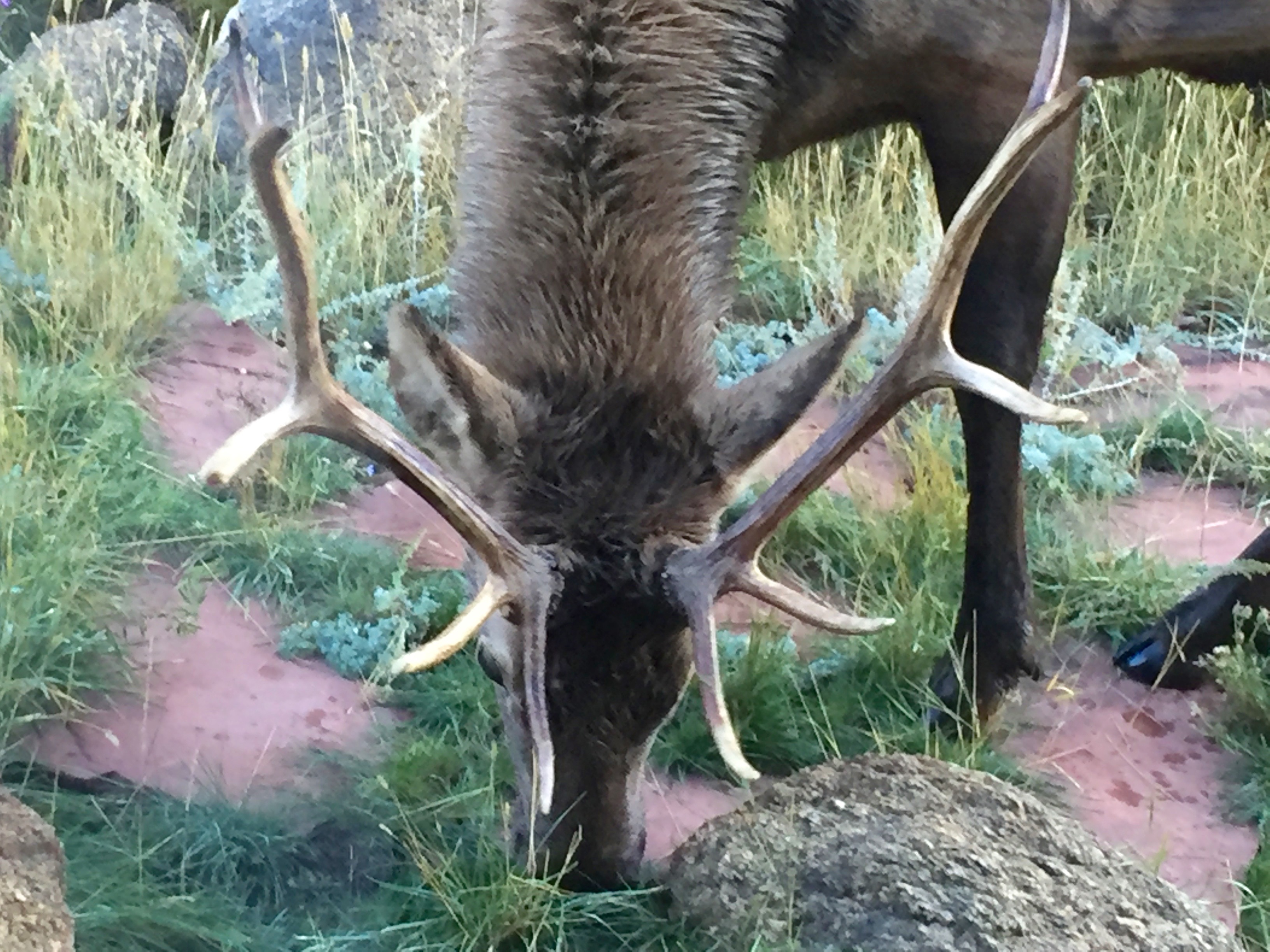
Antlers are shed and re-grown every year. In the beginning, they are covered in hairy skin called velvet. Velvet supplies blood to protect and nourish them while they are still soft and fragile. As they grow, [as much as half an inch a day] a deer’s antlers branch forward and “fork”, then fork again. When full size is reached, the velvet dies off and bucks remove it by rubbing on trees and bushes. This also strengthens their neck for sparring with other males in the fall rut.

Days turned into weeks as we watched Buddy’s frame fill out. His antlers seemed to grow visibly overnight, forking once, then twice into an impressive display. He was going to be a player in this season’s rut.

antler growth one half inch per day

In late July, we left Estes Park heading northwest on a road trip to visit two families of overseas friends. In contrast to dry, grassy, wildflower meadows and granite-rock mountains, our friends summer near water–a large lake in the Idaho panhandle, and the Methow River valley in northern Washington State.

finally left home alone

Sometimes we wondered about our under-the-porch guest back in Colorado. Husband surreptitiously placed a web cam to observe activity while we were away. Feedback went to his phone, but only for a short time. Within days, Buddy stuck his face into the camera lens and apparently kicked the whole thing over. We could only guess whether he abandoned the den…or simply triumphed over unwanted technology.

dozing
and spotting the web cam

Spending time with friendships that began in Taiwan in the 1990s was the highlight of our days on the road. In northern Idaho, on our friends’ boat, we enjoyed a scenic tour of Lake Pend Oreille followed by a sunset dinner al fresco. The next day, in a two-car caravan, we drove to Mazama, Washington where the Methow River runs through the property of our friends.

Lake Pend Oreille, Idaho
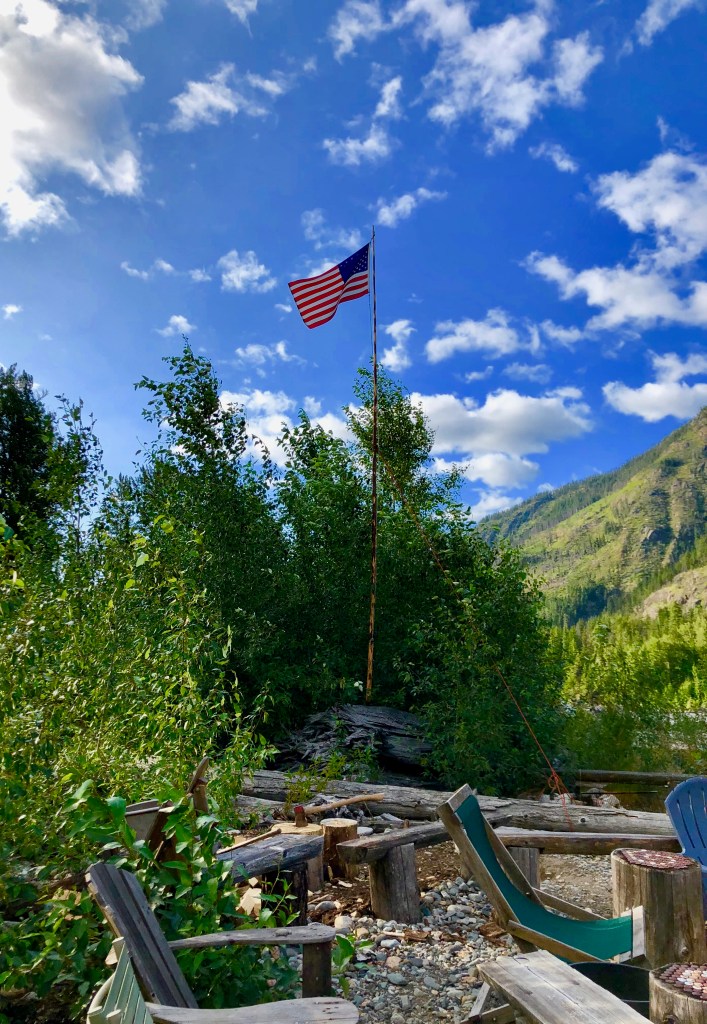
Methow River valley, Mazama, Washington

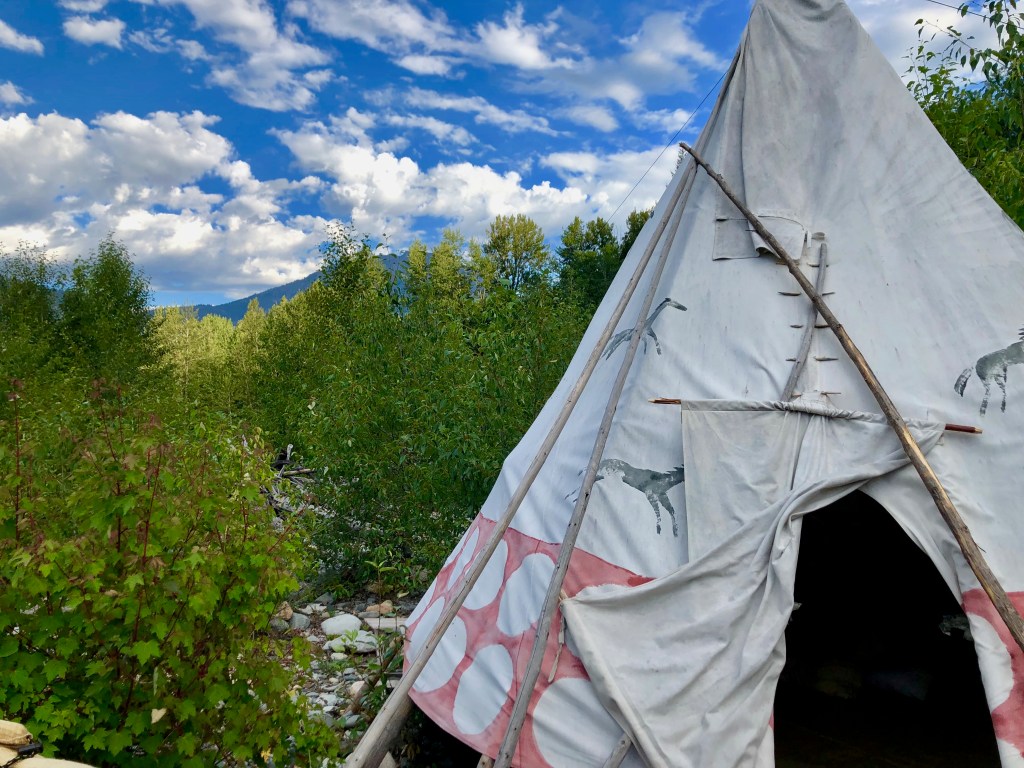
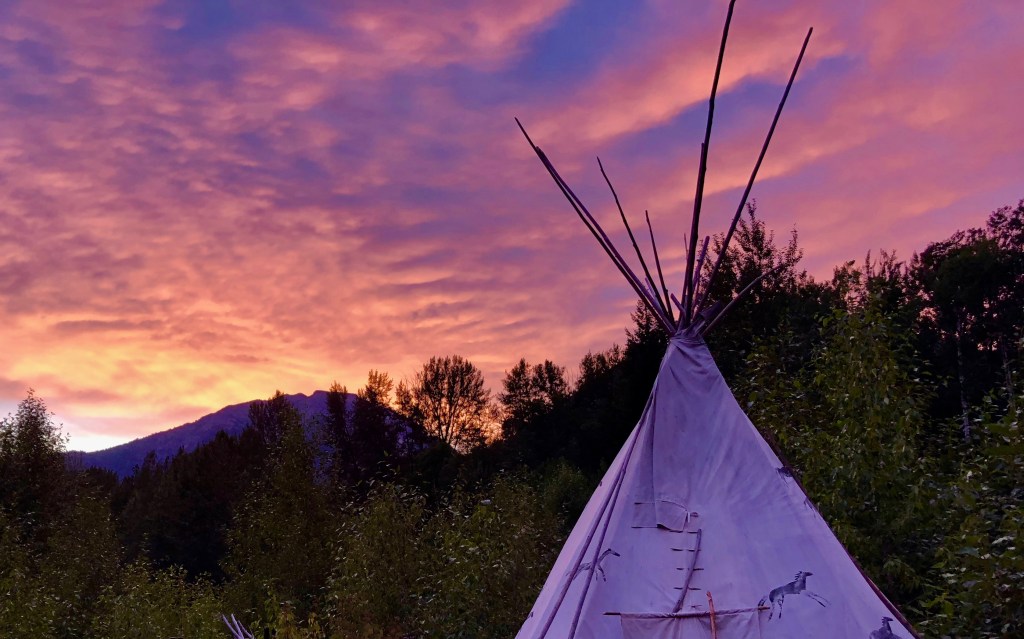
Important activities take place along this strip of rocky, sandy riverbed as the Methow flows by. Cooking over fire in a circular rock surround, lumberjacking dead trees for winter firewood, sleeping in teepee or tent, sharing meals, talking and story telling, watching clouds, the sunrise or the sunset, reading with the soothing background noise of water sounds. Rhythms of a summer lived outside play daily here. It is the spiritual landscape of our friends. While sharing their space we moved within its cadence and felt it, too.

to teepee island with the Methow running through
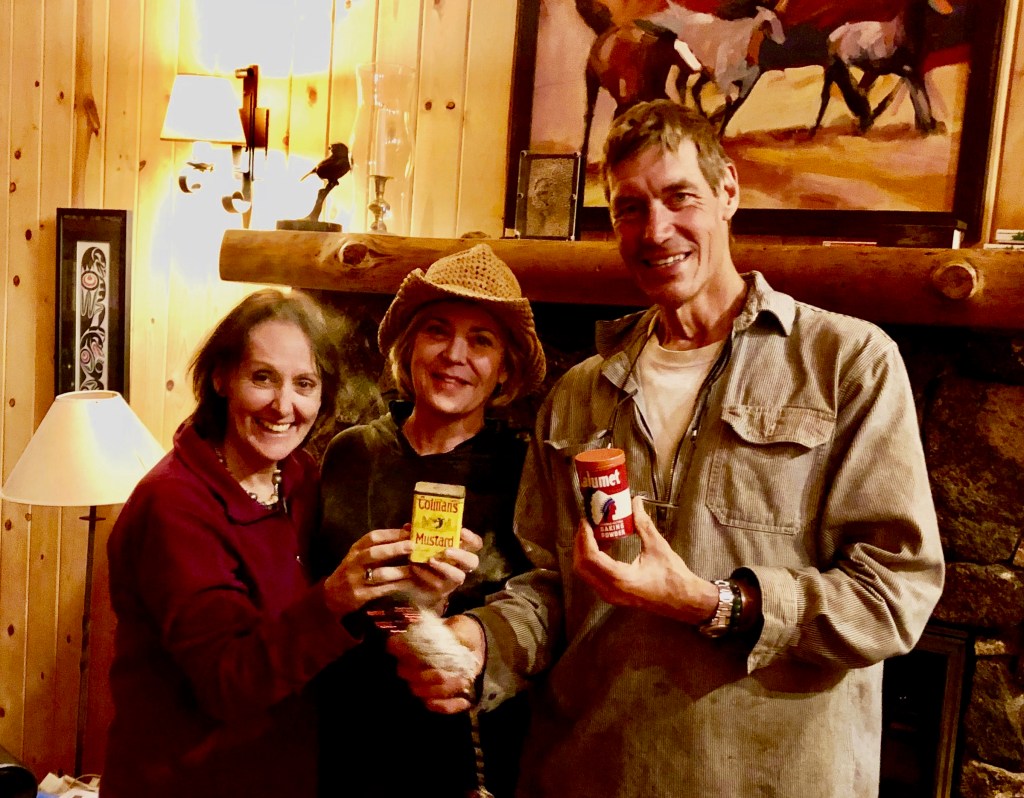
symbolic exchange of antique tins with back and forth visits

A circuitous route took us back to Colorado after saying good-bye in Mazama. When we pulled off the dirt road onto the cabin driveway, it was still light enough to note the sleeping den was empty. The web cam was upside down near rocks about fifteen feet from the porch steps. Buddy returned the next morning, noting our presence by plopping down and waiting for us to finish breakfast and move off the porch.

Our cabin was built to house a crowd. Family and friends pile upstairs and bunk in rooms with multiple beds. Less than a week after we returned home there were rounds of guests–more footsteps, new smells, even a baby’s babbling voice. Buddy moved out.

It’s been several weeks now since he left. A woman mentioned that her husband saw a deer sleeping in an unused barn on the property they are renting. It is just below us. Visiting sister-in-law saw a buck with good-sized antlers walking with a doe early one morning. We ran into Buddy, grazing one evening, as we walked home from a neighbor’s cabin. He started to walk toward us, then turned and kept his distance. There is a return to natural order on the hillside.

These days the morning air smells of approaching autumn. The temperature at sunrise can be nippy in that put-on-your-sweatshirt-to-sit-outside kind of way. Sunlight has shifted its arc. The bugling chorus of bull elk, signaling the start of the rut, is only days away. Change of season in the mountains propels the notion of moving on.

Yet, for a short while this summer we shared an uncommon acquaintance with a young deer as he grew into strength and maturity. We liked his quiet presence. He tolerated ours. We didn’t invite him, so I guess he chose us…because he found a guest room that suited him under the porch.


Long’s Peak sunrise
and sunset
buddy keeping watch by the fire ring
CLICK HERE to view a short video of Buddy coming home

Our spiritual geography in Colorado told here: Bugling Elk and Sacred Spaces

Million Mile Stories

I have flown a million miles over the 31 years we lived overseas. As the miles accumulated so did stories of airports and airplanes. One of them, now part of family lore, involved a plane departing with my  child but without me. 

There are two other unforgettable stories about one airport in particular, the old Hong Kong Kai Tak International. It closed 20 years ago, in 1998, after serving the city for 73 years. In the late 1980s we used it for three years to fly from the U.S. to our home overseas in Singapore. It was a 24 hour trip from Denver, Colorado with layovers in California and Hong Kong before landing at Singapore’s Changi Airport.

One decade and two international moves later, a contemporary oil painting by an artist friend in Taiwan transported me back to the first, spectacular, pulse-racing landing we made into Hong Kong.

In 1999, Heloiza, who is a Brazilian artist, had a show of her oil paintings in Taipei, Taiwan. Strolling the array of artwork, I saw the title “Rooftops” next to a large canvas. Looking from the title to the painting, something shivered through me. Art is supposed to create emotions like this. When I looked again, I had a visceral flashback to 1987, the summer we left Colorado and moved to southeast Asia. Now, I wanted to own that painting.

In the years since Taiwan, “Rooftops” has hung in our home in the “altstadt” in Oberursel, Germany, later above an elaborately carved marble fireplace in Paris, and now in the living room of an apartment in Princeton, New Jersey.

Neither of our two children understand why I love this painting. One summer, our son Adam stayed in Taipei to work while the rest of the family was on home leave. He disliked it so much that he removed it from the wall and stashed it out of sight until August.

Adam was only 5, 6, and 7 years old during those early years overseas. He doesn’t remember what made this particular piece of art “real” for me. Or why I keep dragging it around the world to hang in a place of prominence in our homes.

Hong Kong’s Kai Tak International was a city airport in the midst of densely populated Kowloon. There were mountains and hills and multi-story apartment buildings surrounding it. The runway protruded into the sea. Reclaimed land kept extending its’ length as airplanes grew bigger. 

kai tak runway into kowloon bay

But there was something even more remarkable about it than just longevity. Pilots of all airlines regarded it as one of the most difficult airports in the world to land a jet smoothly and safely. Because Kai Tak was renowned for its’ challenging, hair-raising approach to the runway. For a spectator on the ground witnessing jumbo airliners land was eye-popping entertainment. As a passenger in a window seat–it took my breath away.

45 degree turn to runway
landing approach into kai tak
skimming rooftops–part of a normal day

One commercial pilot with 30+ years of experience remembers, “As a pilot, it was totally unique. It was the only major airport in the world that required a 45-degree turn below 500 feet to line up with the runway, literally flying between the high-rise buildings, passing close to the famous orange and white checkerboard as you made that final turn toward the runway.”

making the turn with checkerboard marker
night time view of landing pattern

With two sleeping children who were oblivious, I watched with my forehead pressed against the window while the pilot executed that sharply arced turn to align with the runway. As the engines decelerated, the fuselage and wings seemed to barely skim the flat tops of square-shaped apartment buildings–block after block after block of them. In slow and slower motion, I looked down onto rooftops, laundry flapping on clotheslines, children playing, and Chinese faces with features easily distinguishable, turned upward. It was a bird’s eye view teeming with life. 

Landing at Kai Tak was tricky partly because of a prominent hill blocking what would normally be a straight-on approach to the runway. Another daunting reason for a truly “white knuckle” landing was inclement weather.

A Cathay Pacific pilot reflects, “This [landing on runway 13] was quite a challenge, especially in strong wind conditions. As Cathay pilots, we had plenty of practice and became very adept at flying the approach…but it was quite a challenge for pilots from other airlines, especially in the more demanding flying conditions, as they might only come into Kai Tak once a year.”

Wind was one very big problem. Rain and low ceiling cloud cover were another. Because of the unique approach over the city,  it was important for pilots to have a good view of the runway in order to avoid overshooting the turn on the approach.

A retired pilot recalls watching unsuccessful landings from the ground. “Being at the Kai Tak car park watching airplanes land in heavy rain could be very worrying. The pilots could not see the runway, and landing over Kowloon, you had to be visual with the runway. Some [pilots] seemed to wait a little longer than others before they aborted the landing and went around for another go. Some would appear out of the low clouds on the approach path, then power up and vanish back into the clouds.

Another year I was traveling alone back to Singapore via Hong Kong.  The descent began in extremely foul weather. There was rock and roll turbulence, heavy rain, and no visibility as we neared the airport. Everyone strapped in, no rooftop views, just a wish and a prayer to be on solid ground. The plane angled and tipped drastically with a big “bump”. Suddenly, the engines powered into high acceleration as the nose pulled upward sharply. We were pinned back in our seats, gripping armrests. The cabin was silent. No explanation from the flight deck. We swung around for another try. 

circling for another try

Vivid memories tie me to that now defunct airport of crazy turns, aborted landings, and inhabited rooftops appearing like colorful concrete terraced gardens in the sky.

rooftops like gardens in the sky

And that is why a painting always hangs on a wall of our home depicting blocky, geometrically aligned squares and rectangles in colors of red, blue, yellow, green, and mustard brown.

“rooftops”, by heloiza montuori, 1999

The other story, mentioned as family lore at the beginning of this story, has tried to remain buried at the bottom of mothering mistakes. But it is the one our son most definitely remembers. In today’s world of air travel the same series of circumstances would never happen again. It was bad enough 30 years ago.

Our first home leave trip was not until 1989, the second summer away from the U.S. I made the trip alone with the children, husband coming later. Four-year old daughter did not sleep for the interminable hours from Singapore to Hong Kong to California to Arizona where we had one final flight before meeting grandparents in Iowa.

She passed out in deep slumber as we landed at the Phoenix airport. There was no plane change, simply a one-hour layover to pick up additional passengers and a new crew. I asked the flight attendant if I could leave soundly sleeping child to run into terminal and make a phone call about our very delayed arrival to Des Moines.

Taking seven-year-old son, we disembarked and found the pay phones. Twenty minutes later we were back at the gate.

The jet-way door was locked. The plane was no longer there.  A new crew had boarded quickly and, because the flight was well behind schedule, a decision was made to depart right away. I went into panic mode, pleading that my child was asleep in the back of the plane. IT COULD NOT POSSIBLY HAVE LEFT! The flight attendant who had [minutes before] agreed to my brief leave-taking “forgot” to mention sleeping child. The gate agent told me it was too late, the plane was in the sky.

In actuality, the plane taxied to the departure runway, was cleared for take off and began acceleration. As a new crew member prepared to take her jump seat, she discovered a small girl in the back of the plane with no adult nearby. A hasty call to the flight deck and jet engines were powered down seconds before lift off. The plane returned to the gate.

I did not look at the faces of the other passengers as I re-boarded, holding tightly to the hand of the child with me. I knew they were appalled at the situation and angry about the further delay.

In the long walk to the back of the plane, I focused only on the shining face of my now awake child, eyes blinking and small blond head bobbling back and forth above the seat, calmly wondering what was going on.

Two stories–one of a plane swooping low over flat rooftops teeming with life, the other of a plane that left the gate…early.  A painting reminds me of one. A heart-stopping memory will not let me forget the other.

Both are reminders that life unfolds as a collection of stories–some of them expand the world we know, as when we see or do something extraordinary, and others remind us there is a world of unexpected, too.

Somewhere in between is where we live.

Becoming a Casual Animal

Every one of us is called upon, perhaps many times, to start a new lifeto embrace one possibility after anotherthat is surely the basic instinctBarbara Kingsolver, High Tide in Tucson

IMG_0621

In 1989 Ray Oldenburg coined the term “third place” to define an essential zone separate from home and the people you live with [“first place”] and work [“second place”]. Third place is your hangout, an informal social space with no dress code and a welcoming vibe that invites you to return again and again.

A third place is also one’s anchor to community life. You are drawn to it because it is socially fun, playful, and light-hearted. It’s where you go to chew the fat, discuss issues, ventilate, play games, or get to know someone.  It is “…where you relax in public, encounter familiar faces and make new acquaintances.”

Third place is like pitching a tent in your back yard. It is home away from home.

When life opportunities create a geography change and your third place is left behind, it’s important to find a new one. And if what you are looking for can’t be found after searching, a creative instinct might emerge “…to start a new life…to embrace one possibility after another”.

Screen Shot 2018-11-20 at 11.55.14

This is Kyle’s story. He grew up in Kansas, in the heartland of America. From the age of five, he began drawing images–people, animals and made up characters. Riding in the car during family vacations, he drew the storylines from books-on-tapes while the rest of the family listened. While still a high school student, Kyle knew he would pursue an artistic course of study at university. He graduated in Fine Arts and Graphic Design.

In 2006, Kyle’s first job took him away from home and long-term friends to Fort Collins, Colorado. He started out living in the basement of a relative’s house. It was isolating for a young man. He needed friends his own age and a place to socialize with them.

A booming craft beer industry was the catalyst for many microbrewery openings in Fort Collins. Kyle found his “third place”, along with a friendly social circle, in the evolving scene.

Later, in a widening circle of mutual friends, Kyle met Lara. They enjoyed camaraderie in the breweries, but also shared a strong sense of community service. Together they coached Special Olympic basketball and softball for disabled adults.

When Lara accepted a new job in another state, Kyle’s mother said, “I thought he would never leave Colorado. So when he followed Lara to Kansas City, I knew she was the one he would marry.” They did.

In 2014, the craft brewery scene in Kansas City, Missouri was not as mature as the one left behind in Colorado. Lara and Kyle searched but couldn’t find the informal, social environment they were looking for in their new hometown.

Creative “can do” instincts took over. Kyle had experimented with beer making in the past. Now he became serious, bought equipment, and began home brewing in the basement. He went to weekend fairs, gave away samples, and won some tasting competitions, too. Feedback was consistent and positive.

Screen Shot 2018-11-21 at 19.26.11

He read book after book about the chemistry of beer making, industrial brewing equipment, hops and grains and flavor additives as well as how to open a small business. He enrolled in the American Brewer’s Guild Intensive Brewing Science and Engineering program. The final weeks of coursework were on site in Vermont.

Kyle befriended local KC brewers by cold calling them. He volunteered to work one day each week to help them brew commercial batches. He gained knowledge and a warm welcome into the community of micro-brewers. By now an idea was actively fermenting.

Screen Shot 2018-11-21 at 19.27.28 2
logo designed by kyle

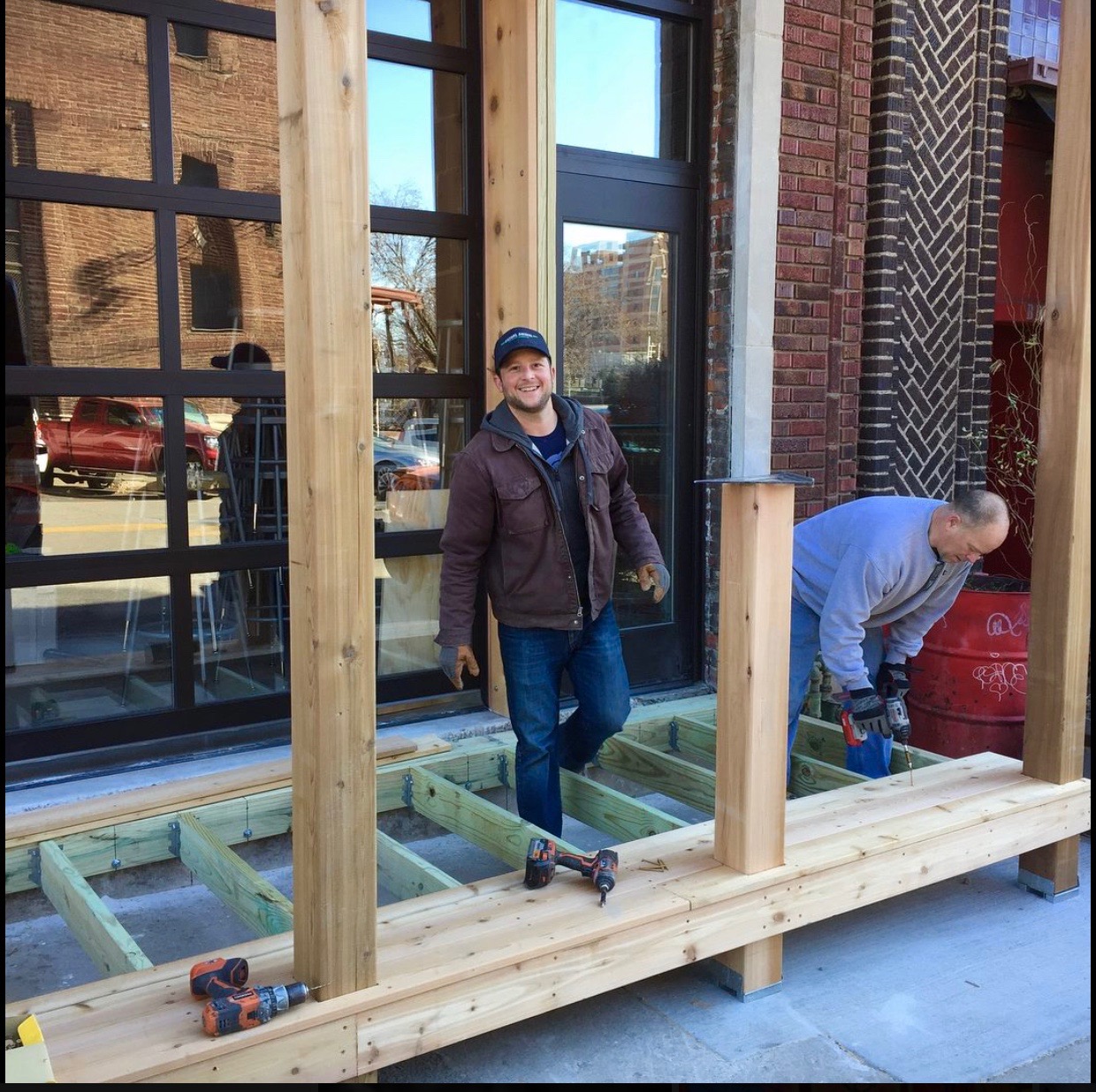
Over the next couple of years, Kyle and Lara drafted a business plan, found real estate property to buy, cultivated investors, and a bank loan. In a former commercial garage space, Kyle designed a back-of-the-house brewery with a front-of-the-house taproom. Doing most of the interior construction, alongside family members who pitched in time and expertise, Lara and Kyle founded a craft brewery on the principle of creating a social community space and then giving back to it.

Screen Shot 2018-11-20 at 09.12.56
kyle and his dad building the deck
Screen Shot 2018-11-20 at 11.53.22
lara after new equipment installation
Screen Shot 2018-11-20 at 09.07.04

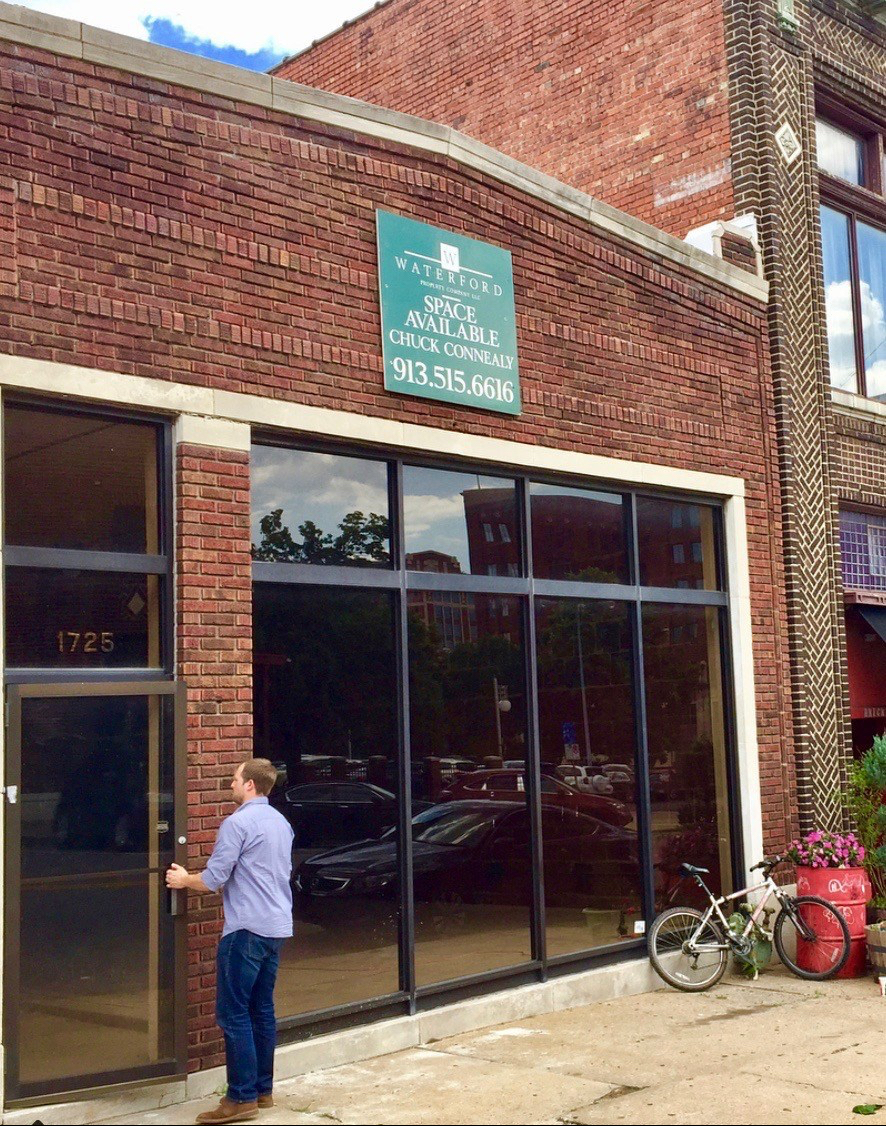
In early February 2018, Casual Animal Brewing Company opened its’ doors at 1725 McGee Street in the Crossroads area of downtown Kansas City, Missouri. Their signature motto is: “Laid back beers that tap into your wild side.”

IMG_0316
1725 McGee St, Kansas City, Missouri

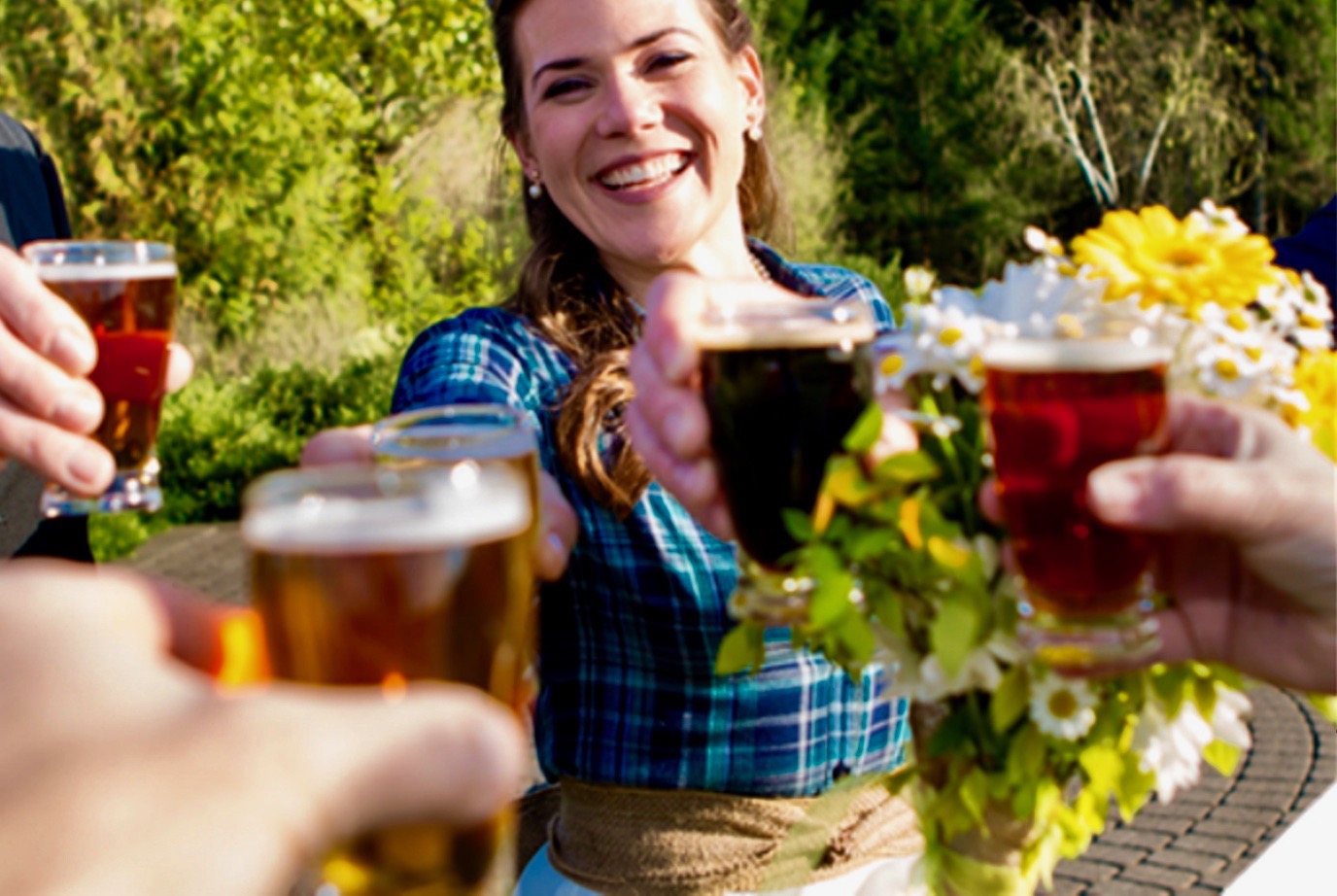
Casual Animal runs eleven full taps. Each has its’ own beer style, name, and an original logo of Kyle’s design. Animals are a recurring theme. Names are metaphorically linked to the style of brew. Customer favorites include Chaos Monkey [a banana cream pie ale], to Honey Wheat light ale, Nomo Rhino IPA, Branch Out Stout, and Hop The Fence IPL.

Screen Shot 2018-11-20 at 12.02.55
one “flight” is 5 tasting choices
IMG_0602
menu changes by popular requests and brewer’s creative recipes
Screen Shot 2018-11-20 at 09.11.54
full house
Screen Shot 2018-11-20 at 11.40.51
front door open, weather permitting
img_0299.jpg
some casual animals hanging out

Tying into Kyle and Lara’s commitment to community service, Casual Animal taps into the ethic of “giving back” by designating a rotating beer called Local Motive. The beer style changes quarterly along with the charitable organization the staff votes on to support. Two dollars of every pint of Local Motive sold is donated. In-house events promote the spirit of the current charity.

Screen Shot 2018-11-20 at 09.09.53
brut IPA featured for one local motive promotion
IMG_0598
designed by kyle–graphics and artwork for quarterly local motive tap

The most recent charity promotion was the Kansas City Pet Project, a nonprofit pet shelter that guarantees every stray animal a home. Kittens and puppies were brought into the brewery for customers to play with and cuddle. A completely contagious combination–adorable baby animals plus eleven beer styles equals fun AND donation success!

Unless you are a real brewer, all there is to know about the process of grain and hops and water turning into deliciously drinkable beer is the basics of what happens in Casual Animal’s back room. Inside a series of huge shiny stainless steel tanks,  Kyle’s chemistry know-how is mixed with the help of fermentation, time…and recipe magic.

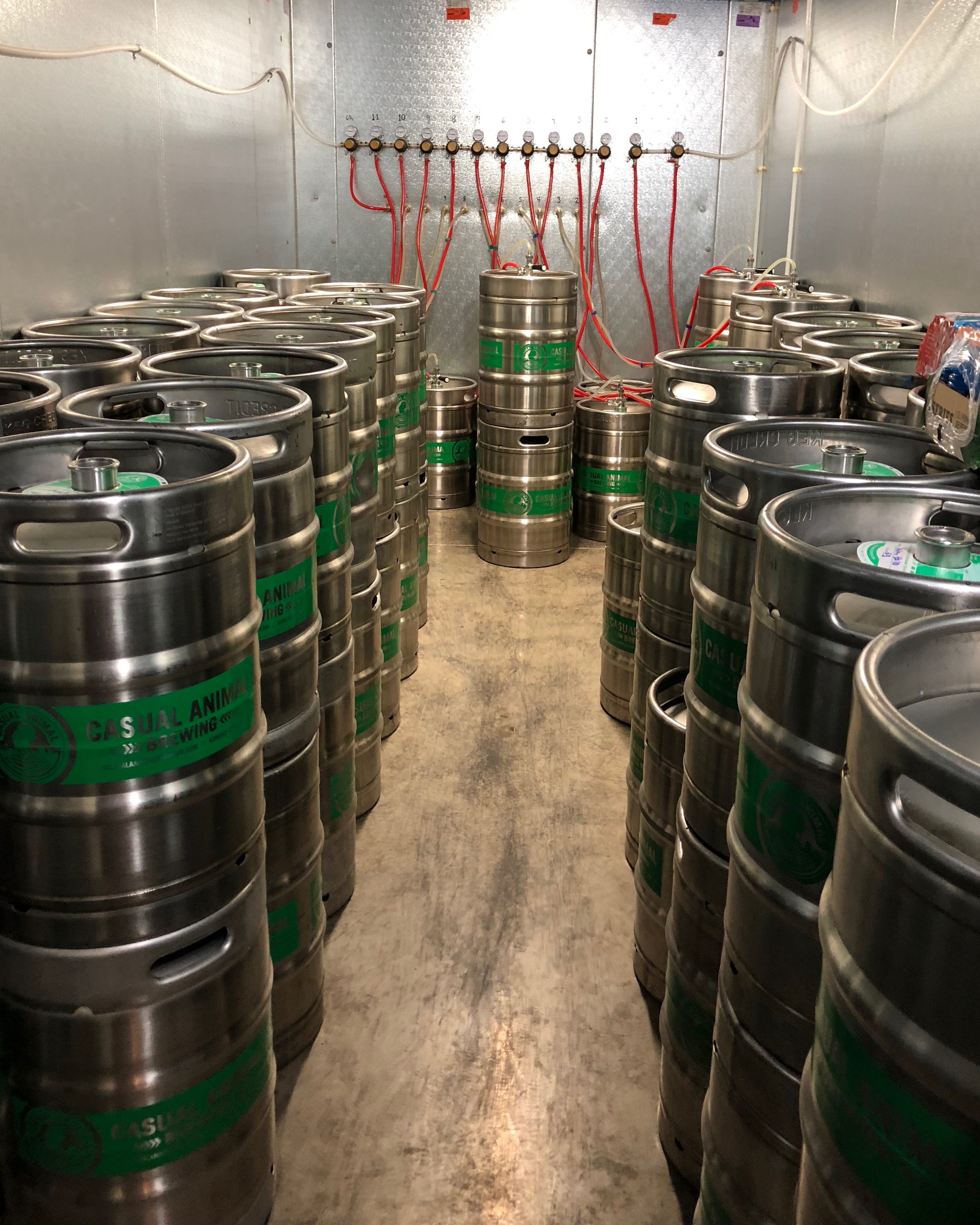
Hot Liquid Tank water is piped into the Mashtun Tank where grains are mixed together and cooked. Next, this mash up is transferred to the Brew Kettle where hops [and sometimes other flavors] are added. After time in the Kettle, the liquid is piped into the Fermenting Tank, leaving behind all the grain residue. Now yeast is added and fermentation begins. This takes approximately two weeks depending on the kind of beer. From the Fermentation Tank, beer is transferred to the Brite Tank for carbonation and clarifying. And finally, kegs are filled and stored in the massive walk-in refrigerator that feeds the taps at the front-of-the-house. 217 gallons of beer per brew.

IMG_0808
walk in refrigerator with full kegs
IMG_0812
keg feed from refrigerator to taproom
IMG_0814
looks like this on the other side

Cycle complete. As for the magic? Well, every time I sip Casual Animal’s velvety dark nitro stout, it’s easy to believe in magic.

When I asked Kyle to talk about his favorite beer tastes, he said, “Well, it depends on the day. On cold, snowy days, I would say smooth, slight malty sweetness, and roast-y to describe a tasty pint of Nitro Stout. Other days it might be an IPA with resin-y, fruity, and bitter characteristics imparted by the hops. Now, is anyone thirsty?”

There is passion and precision in Kyle’s word selection that describes every beer Casual Animal makes. That same passion speaks of a man who dreamed of possibilities and pursued them with intense preparation. And labor. And love.

The truth is, when Kyle couldn’t find his “third place”–he built one.

Screen Shot 2018-11-20 at 11.46.05

…Let me be a good animal today. Let me dance in the waves of my private tide, the habits of survival and love…–Barbara Kingsolver, High Tide in Tucson

Casual Animal Brewing Company, 1725 McGee St., Kansas City, Missouri 64108

www.casualanimalbrewing.com

Instagram and Facebook: Casual Animal Brewing Co.

On 10-10-18, Lara and Kyle produced a new brand of casual animal sweetness and introduced her to the world. Welcome Sloan Kasey!

Care About Cast Iron

img_8016.jpg
cast iron skillet with lid–before seasoning

A solid Dutch oven, a cast iron skillet, and an excellent knife with a fine blade–the good life. –Anonymous

Cast iron cookware is one of the things to have in your life–but only if you love it.

An iron skillet is a link to the past [one of the oldest cooking tools in any kitchen], relevant to the present and can be passed into the future. It connects you to the people who used it before–to the everydayness of their lives.

Cast iron is durable on top of the stove and inside the oven. It retains the flavor of foods cooked in it and is considered to be superior for cooking in general. Cast iron grabs heat and holds it. It is not Teflon, something you throw away when it becomes scratched and used. Cast iron will outlive you and begs to be passed on.

There aren’t many things in modern life that are passed down through generations and remain both beautiful and useful.Ronni Lundy, historian of Appalachian food

IMG_6108
vintage cast iron, seasoned to the sheen of glass

Older cast iron is considered by purists to be superior. It is made with higher quality raw materials and the interior surfaces are smoother. A good vintage pan will be completely black in color and almost glassy in the texture of its’ interior surface. Seasoned right it becomes nonstick. Pitted surfaces on newer cast iron allow food to stick. It’s also more difficult to season.

Several summers ago, I met “Cast Iron Don” in an antique mall in Saugatuck, Michigan when my daughter and I were on a mom/daughter getaway. Don is a consummate collector of vintage cast iron, owning more than 100 pieces. He uses only two.

Don offered a wealth of cast iron history and information when he spotted my interest in a marked “Griswold, Erie, PA” skillet for the reasonable price of $17.00. He said it was the best-priced-name-brand-cast-iron-piece in the whole market.

Cast iron cookware was made in the U.S. from the 18th century to the first half of the 20th century. Griswold, Wagner, and Sidney were brand names casting pans in foundries, which also made farm tools and weapons. Each piece was poured and polished by hand which took hours of human labor, but produced a notable difference. They were lighter, thinner, with a smoother interior.

Today, some cast iron pans are being made this way but, with labor costs as they are, prices are in the hundreds of dollars for a contemporary artisanal skillet. For the fun of a treasure hunt you can find vintage cast iron in your relatives’ kitchens, garage sales, estate auctions or flea markets at a fraction of the cost of anything new. Many of them will already be seasoned.

Well-seasoned cast iron is the equivalent of a broken in pair of well-loved jeans. This is what makes it both beautiful and utilitarian.

Cast iron is porous. To make a nonstick cooking surface it needs oil for protection. Seasoned correctly, oil bonds with the iron pores. When exposed to heat, the polymer chains link and form a durable, slick coating surface.

Back in Michigan, Cast Iron Don has refined his own techniques for rehabbing antique ironware. I don’t recommend any of his rather dangerous methods. Vats of lye, boiling water, hoses, and protective wearing apparel require a lot more time and caution than most consumers need to muster.

Rusted or mistreated skillets can often be restored with a simple steel wool scrubbing before re-seasoning. Or, use coarse salt mixed with oil and rub mixture around with a paper towel. For a super tough buildup of dirt and grime, place pan in a self-cleaning oven for one cycle. Sediment flakes off and can be wiped away.

After cleaning, the important next step is to season iron correctly.

  1. Animal fat! Use lard, bacon grease or Crisco. [Do not use vegetable based oils because they leave a sticky residue and you have to start over, so no olive oil.]
  2. Coat the entire surface including edges. Place upside down in 500 F. or 260 C. oven over a piece of foil. Bake 1 hour 15 minutes.
  3. Cool gradually in oven with door ajar. Once thoroughly cooled, wipe off any excess oil.

Cast iron needs to be cleaned in a specific way.

  1. Do not soak in water, put in dishwasher, or use soap.
  2. A hot water rinse using a stiff brush to clean off residue will keep seasoning intact. If necessary, use a small plastic scraper first.
  3. Dry completely. I always air-dry, but my daughter puts her cast iron on the stove over a low flame, briefly, to evaporate water.
  4. If necessary, wipe with a thin coat of oil and buff with paper towel.

Use your cast iron often. For everything! Consider it an heirloom to be passed on and on and on from generation to generation. Embody it with your own family’s cooking lore. Someone else may get a taste of it down the road…

Two classic cast iron skillet recipes:

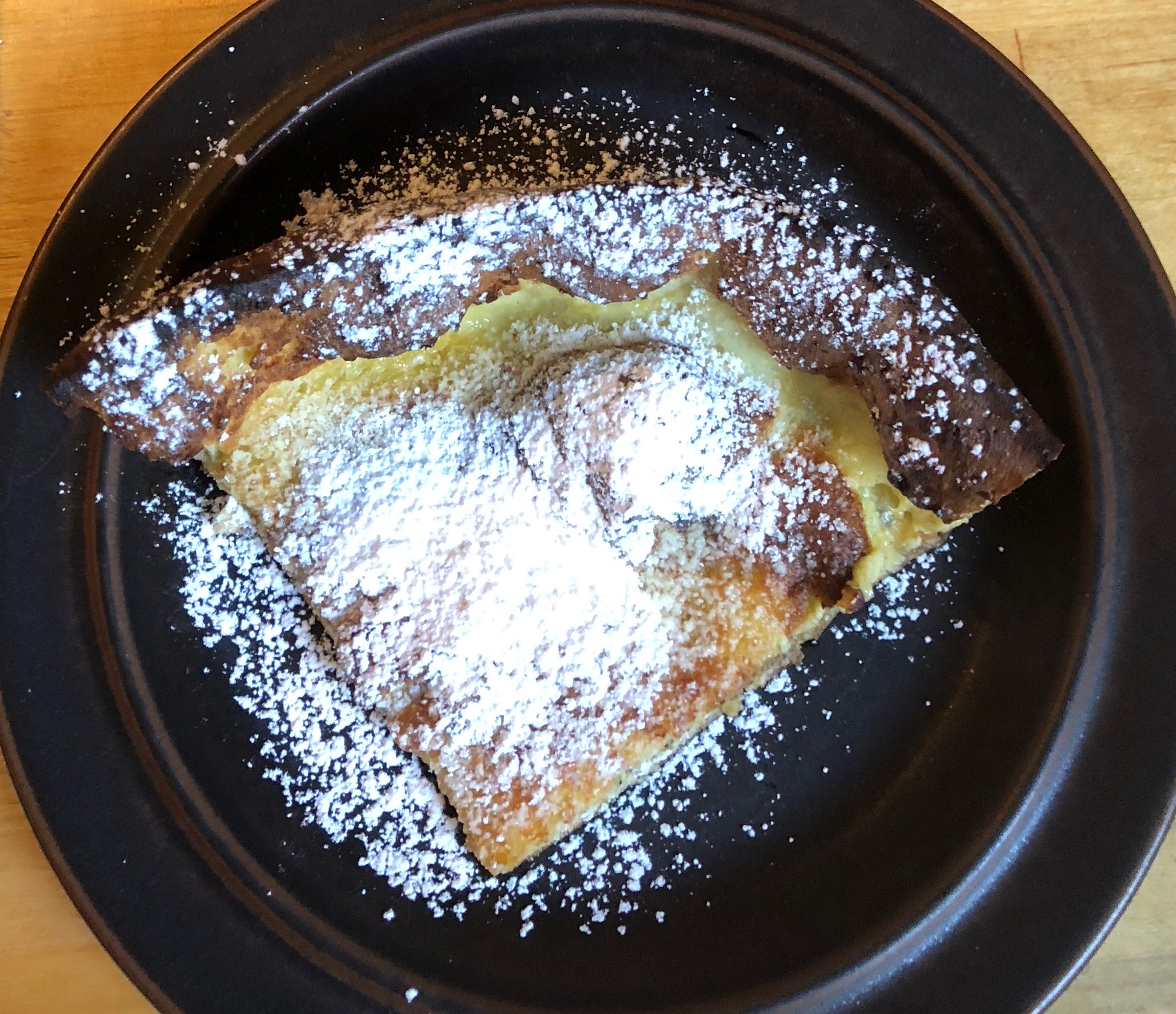
DUTCH BABY, SWEET – serves 2

  • Start with ingredients at room temperature.
  • In a bowl, whisk together 3 large eggs.
  • Then whisk in ½ C. flour, ½ C. milk, 1 T. sugar, ½ tsp. vanilla, and a pinch of nutmeg and salt.
  • Melt 2-3 T. butter in 10-12 inch cast iron skillet by placing in oven at 425 F. [220 C]. Watch so butter doesn’t burn! As soon as butter melts, pour in the batter.
  • Bake for 15-20 minutes until puffy and golden.
  • Cut into wedges and serve immediately with choice of toppings: maple syrup, confectioner’s sugar, confiture [jam], cinnamon sugar, or fresh berries.
  • Makes an excellent, light, breakfast pancake.
IMG_9445
with confectioner’s sugar topping

DUTCH BABY, SAVORY

IMG_9395
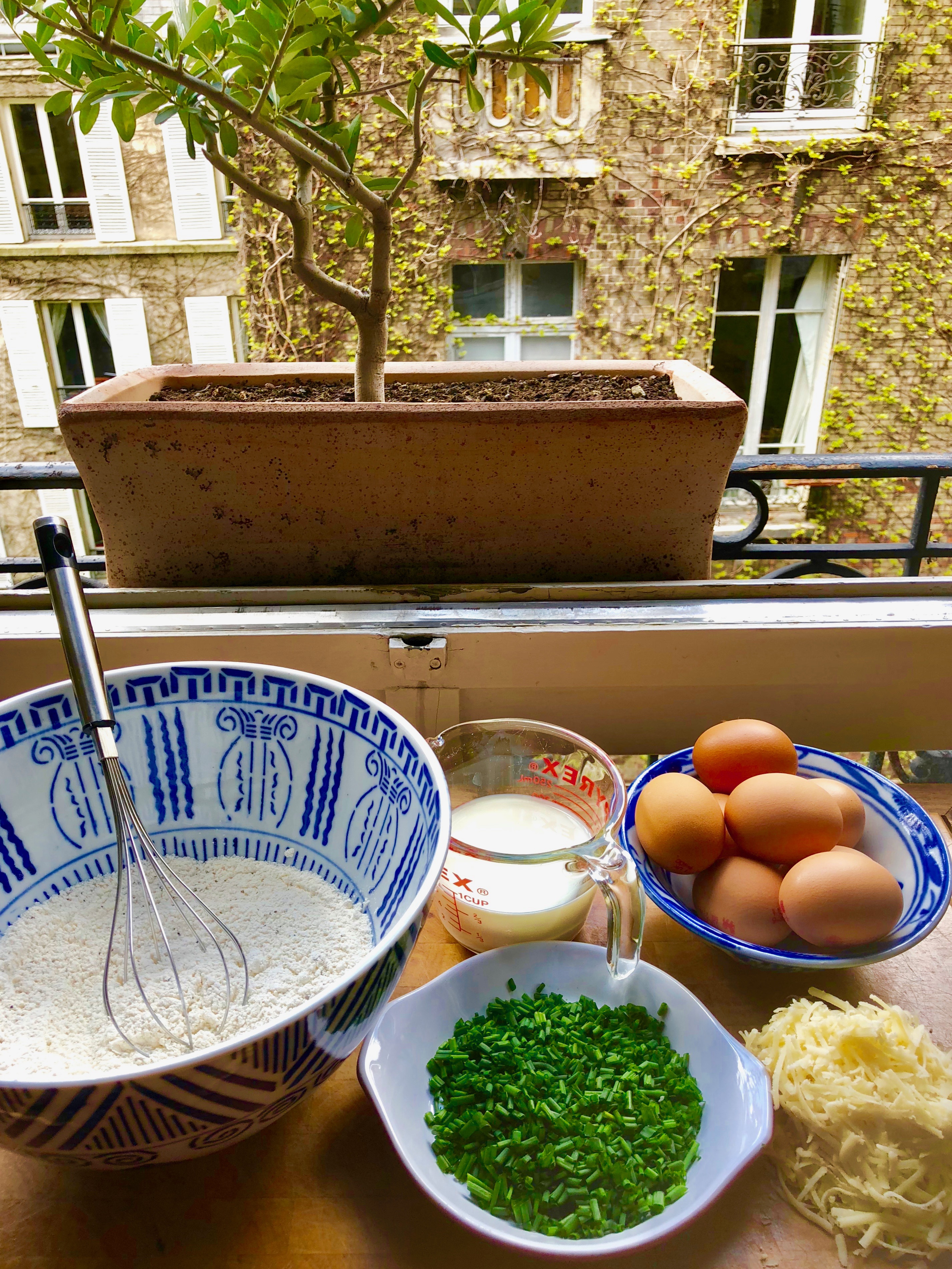
dutch baby savoury ingredients in kitchen window with a view
  • In a large bowl, whisk together 1 C. + 2 T. flour, ½ tsp. salt, ½ tsp. pepper.
  • In a separate bowl, combine 8 large eggs and ¾ C. whole milk.
  • Whisk wet ingredients into dry until just combined.
  • Stir in 2 T. fresh thyme, 2 T. minced chives [or parsley or tarragon].
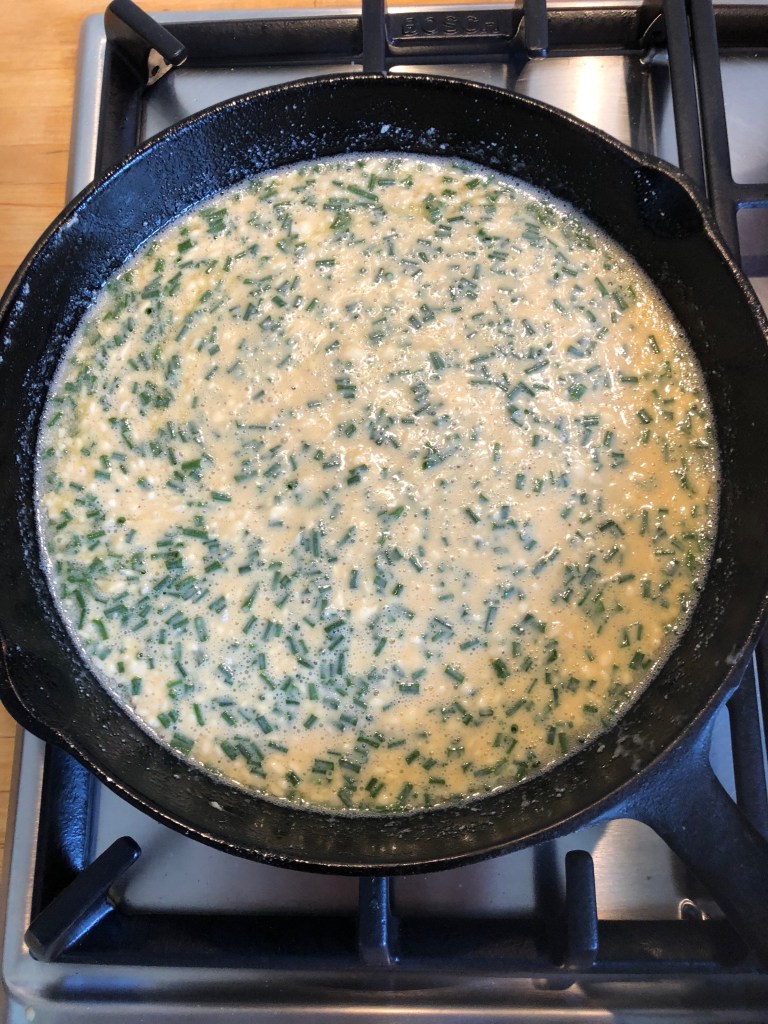
  • Melt 2-3 T. butter in 12-inch cast iron skillet until it smells nutty and brown. Swirl to coat sides and bottom of pan.
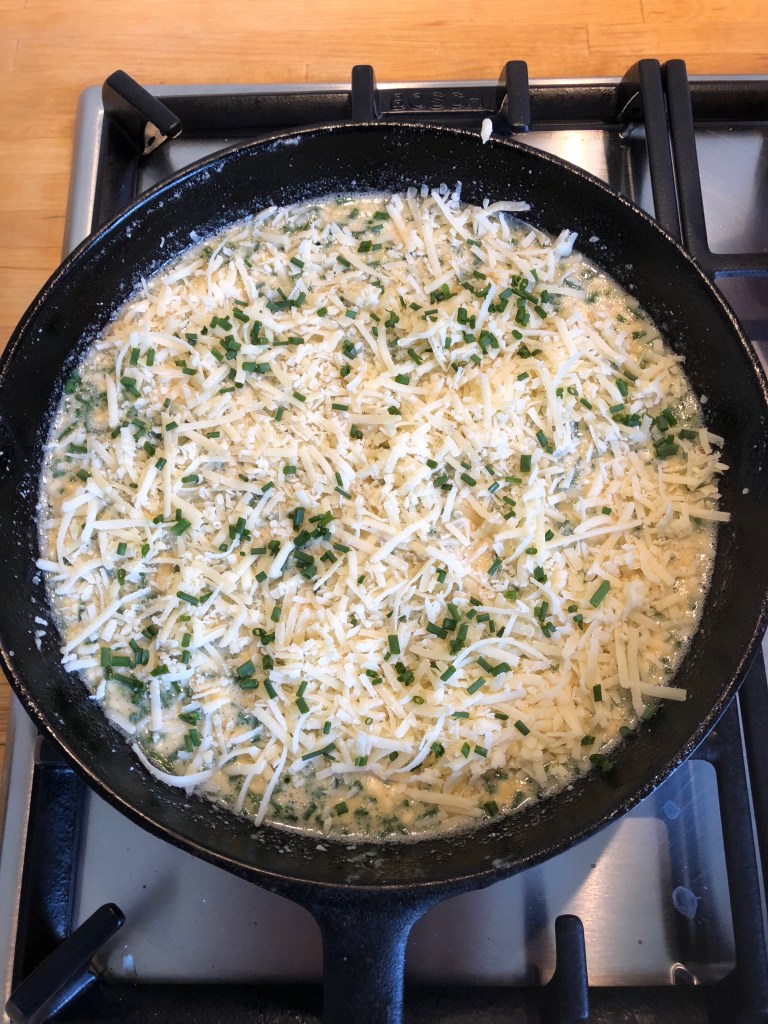
  • Pour in batter. Scatter ¾ C. freshly grated Gruyère or Parmesan cheese over top.
  • Bake 15-20 minutes at 425 F. [220 C.] until puffy and golden.
  • Serve with lemon wedges and Siracha sauce. Both add a lot of flavor!
  • Perfect brunch or hors d’oeuvre dish.

Bugling Elk and Sacred Spaces

Every part of the Earth is sacred to my people. Every shining pine needle, every sandy shore, every mist in the dark woods, every humming insect is holy in the memory and experience of my people. The perfumed flowers are our sisters; the deer, the horse, and the great eagle; these are our brothers. We are part of the Earth and it is part of us. Chief Seattle, native American

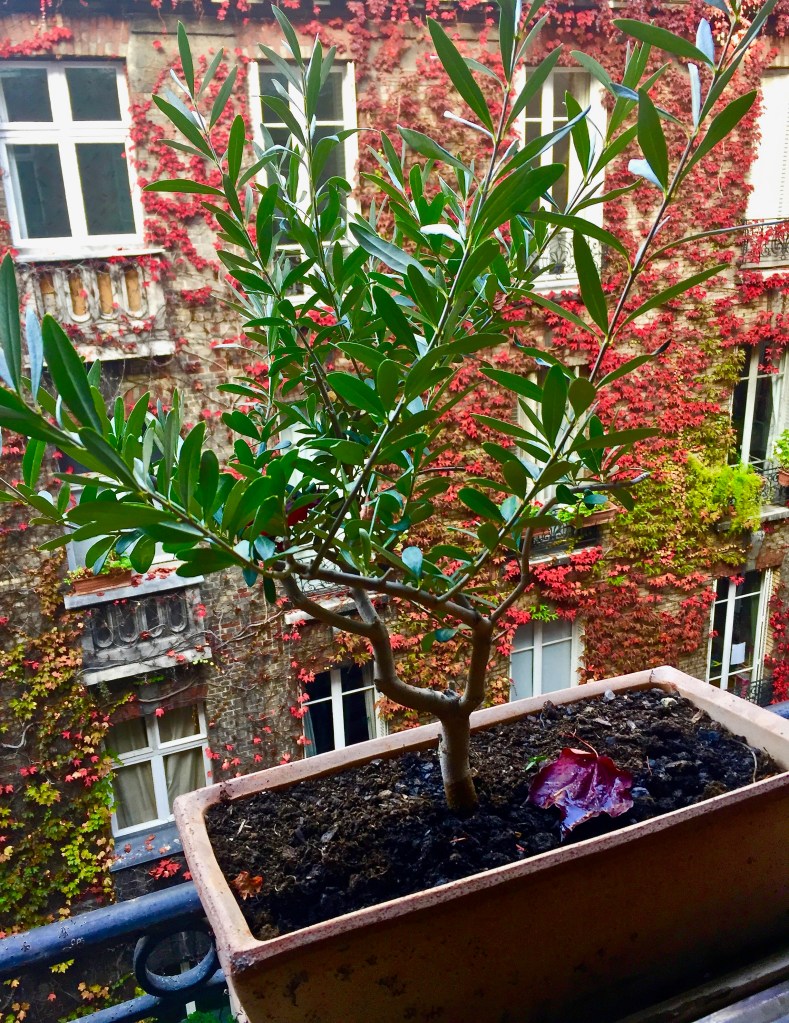
It’s autumn now in northern Europe where I returned a week ago. The courtyard Virginia creeper vine is reddening more each day. Heavier bed linens are in place so the window can remain open for good sleeping. Scarves donned for outdoor wear. And rain.

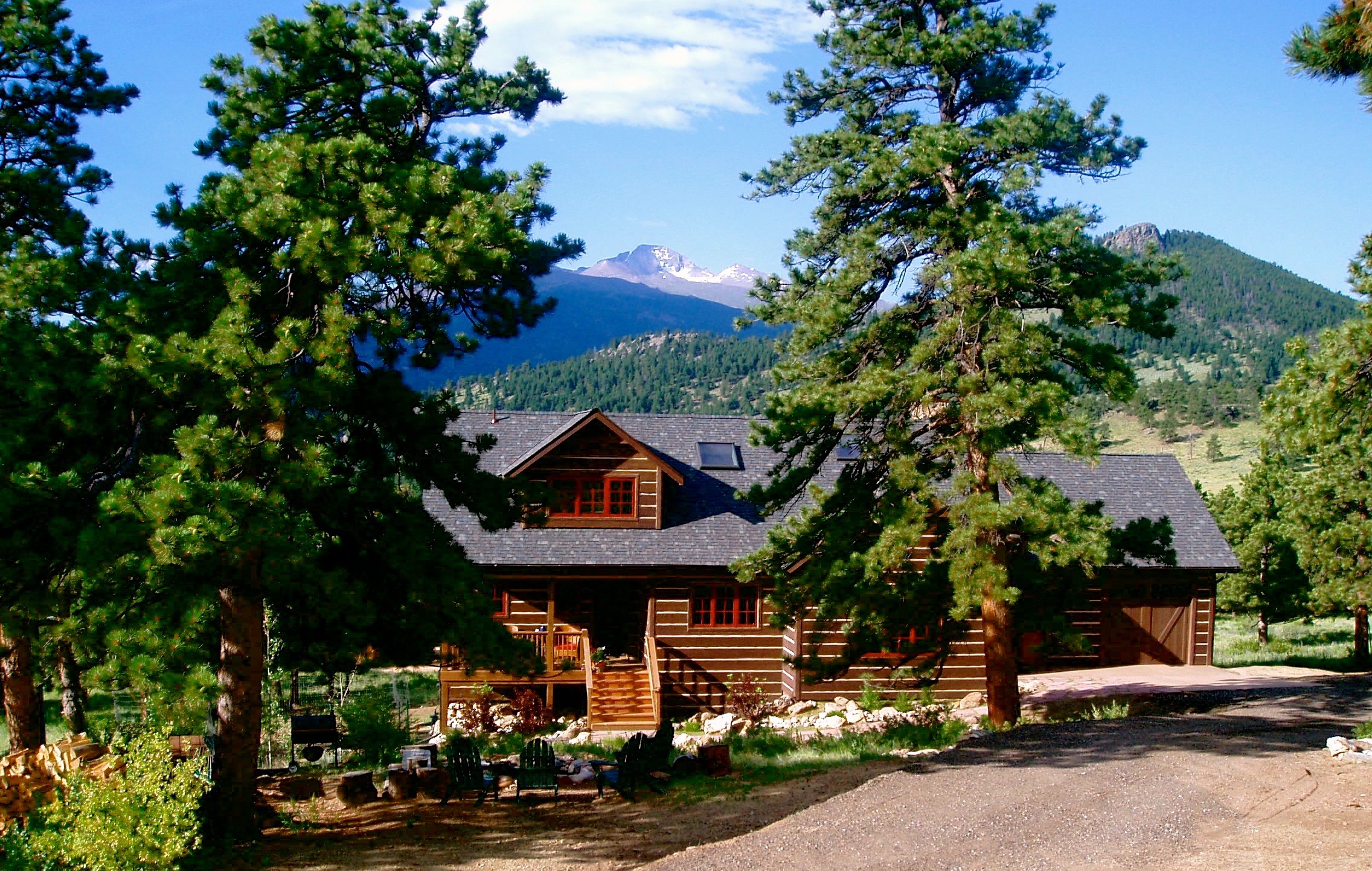
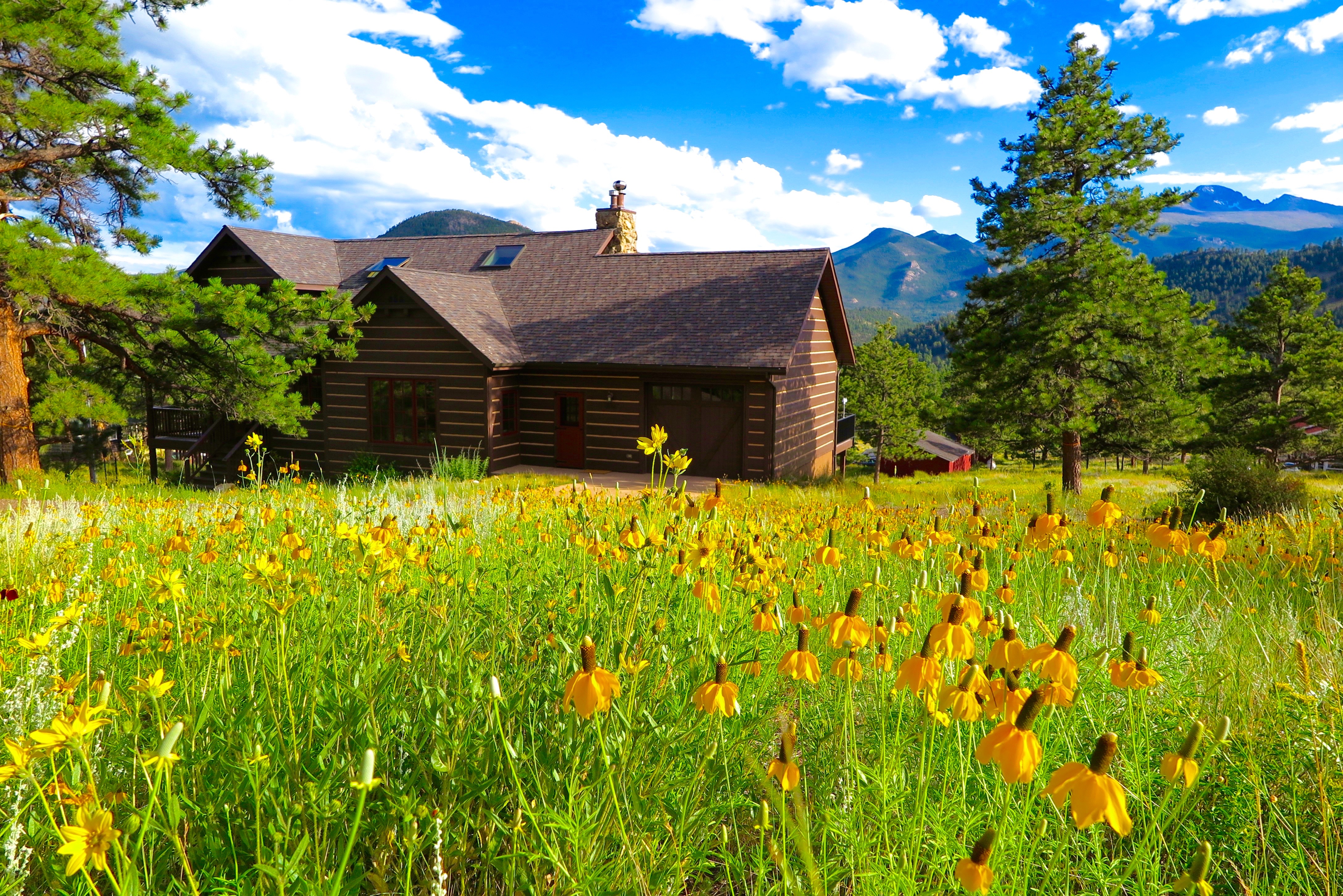
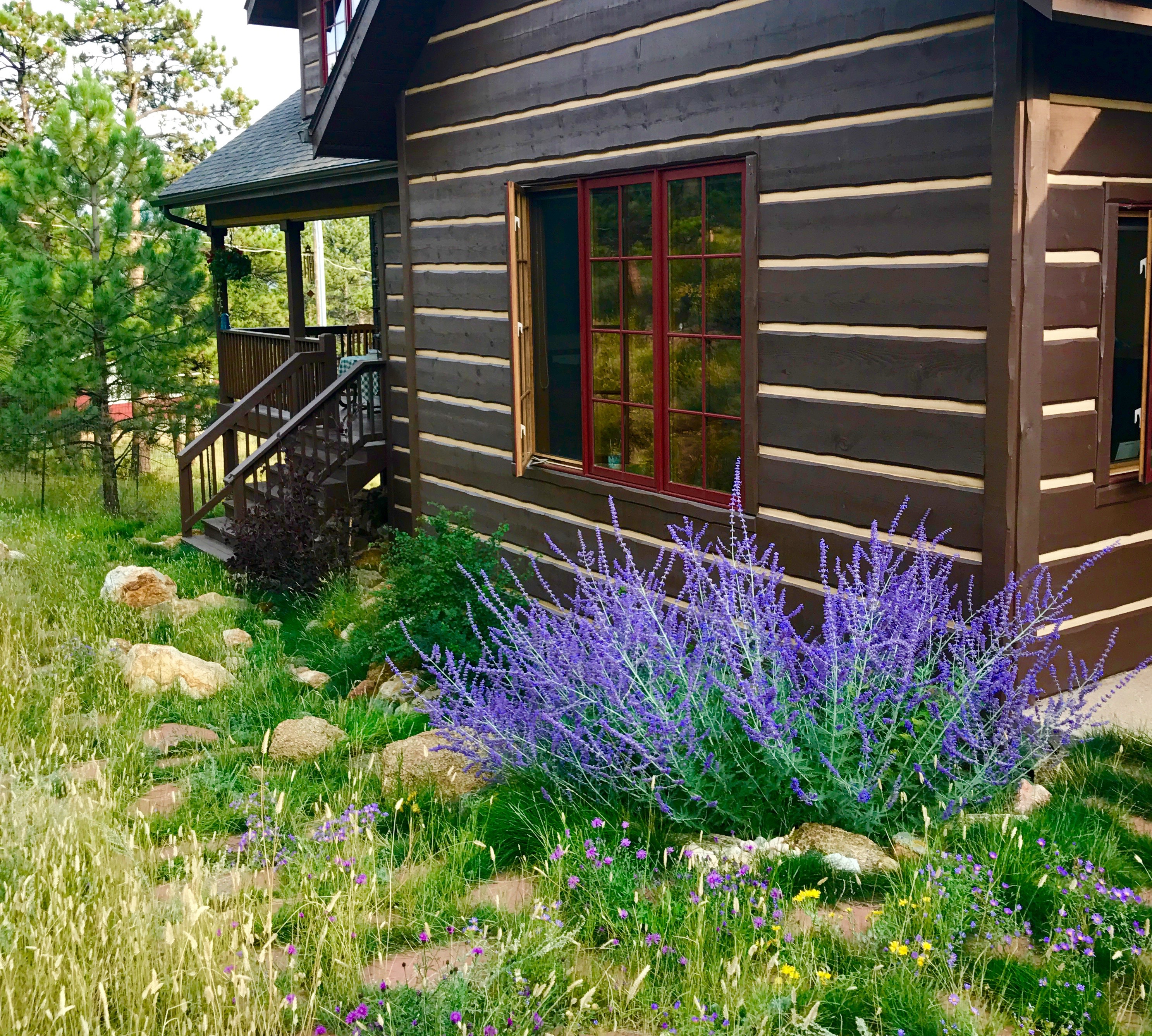
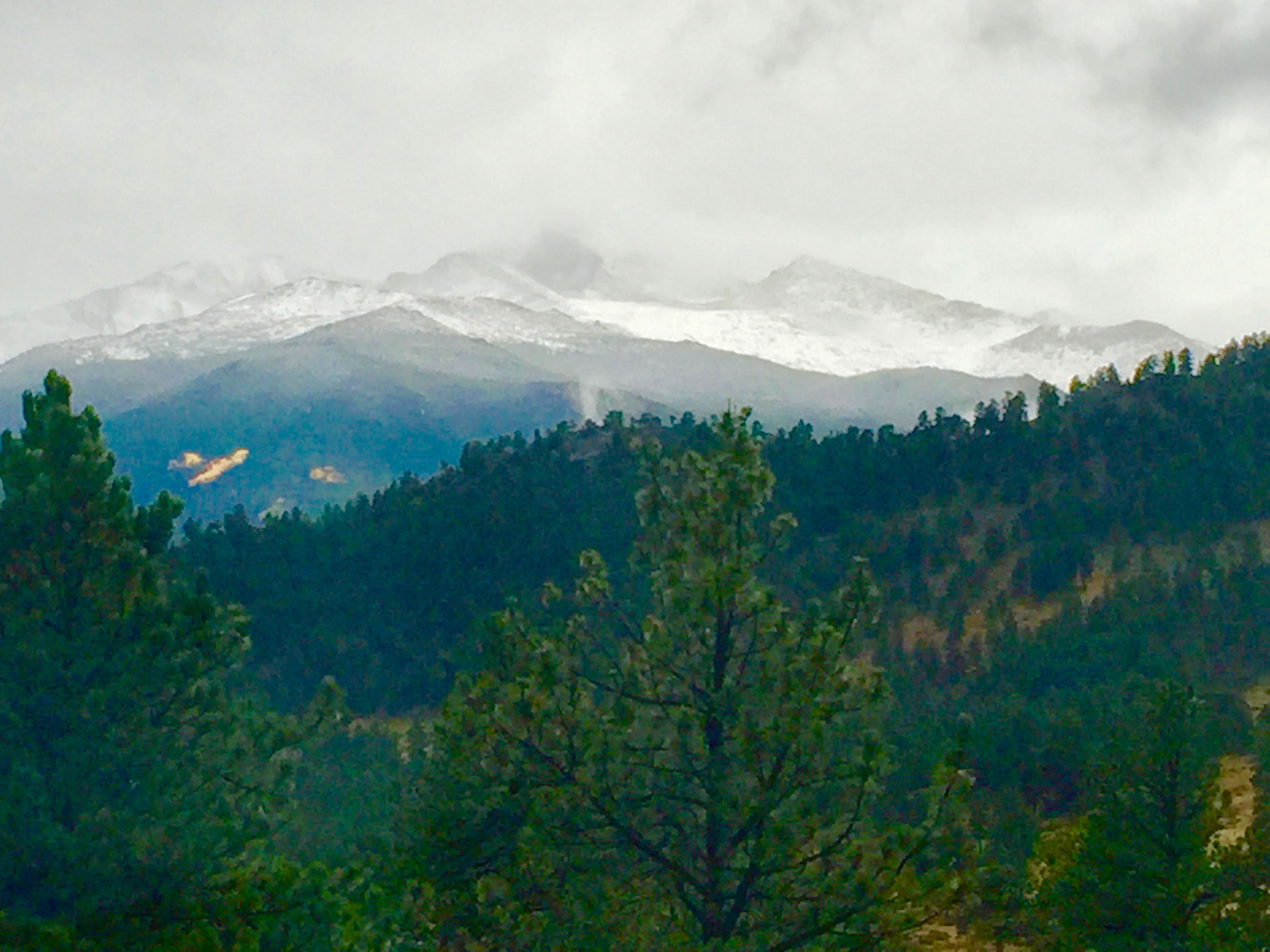
Still, for the moment, I’m thinking about a longer than normal summer season in Colorado. Three months at “Camp Estes”–our hillside home with Front Range views and walk-in access to Rocky Mountain National Park.

OLYMPUS DIGITAL CAMERA
camp estes’ long’s peak view

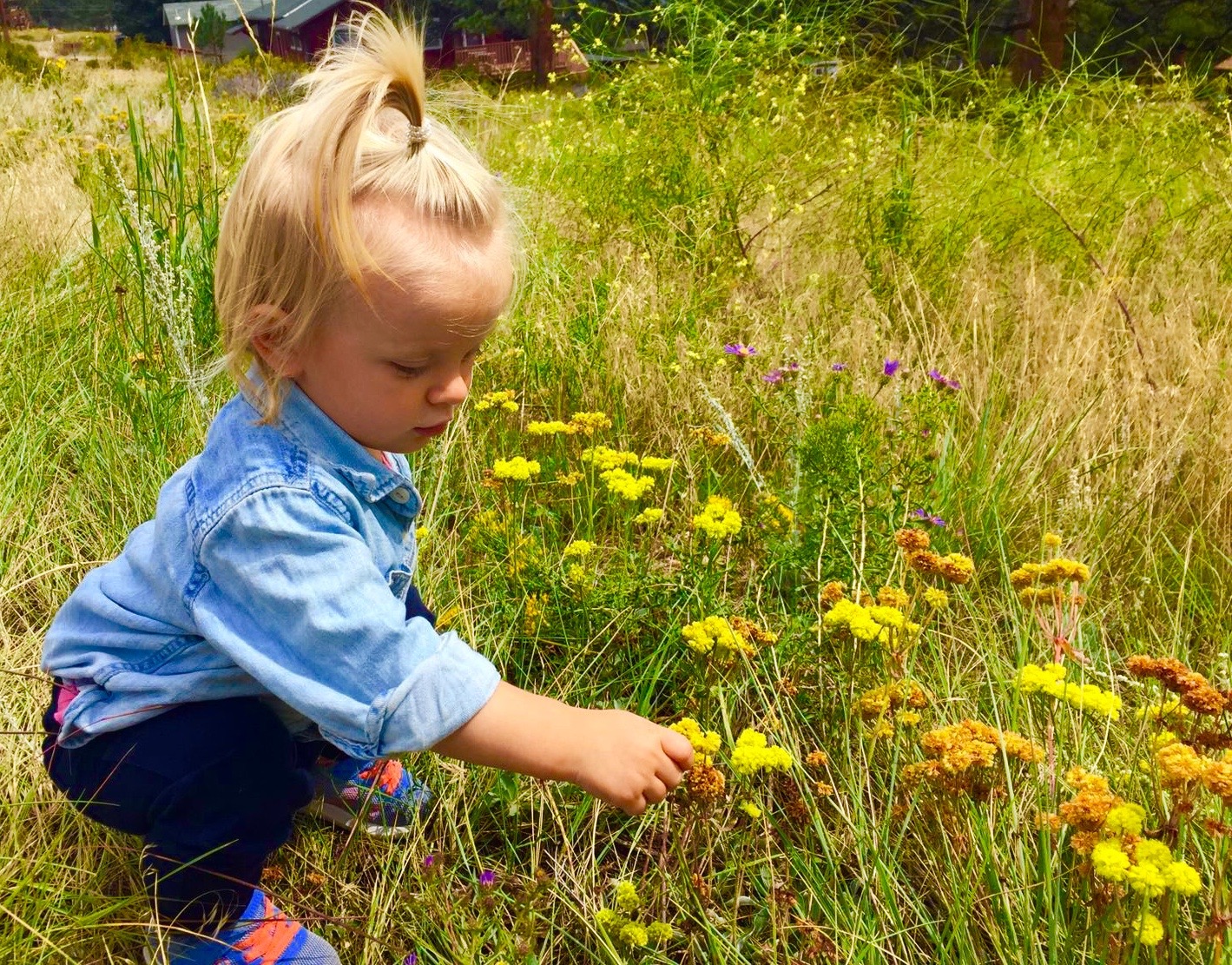
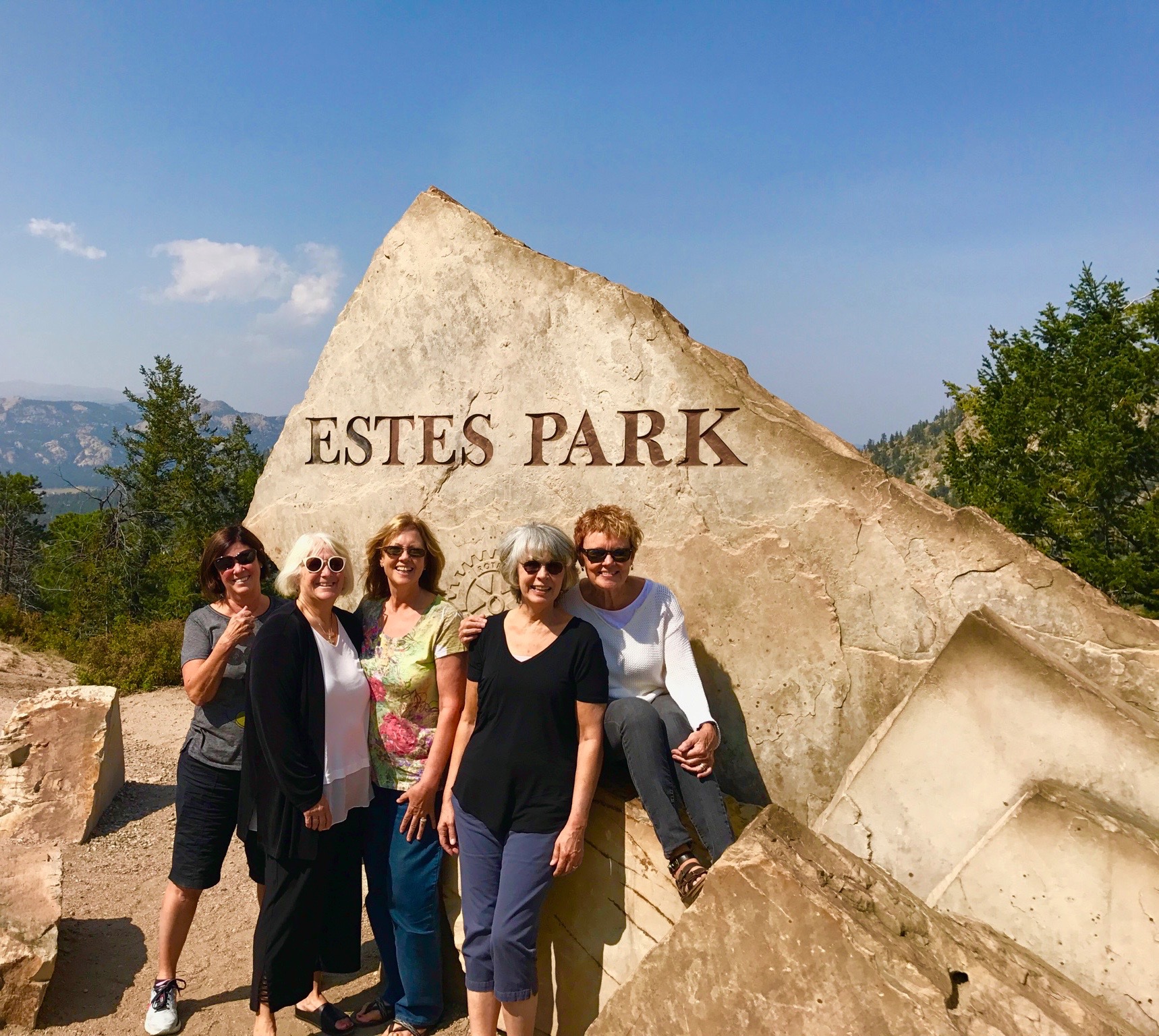
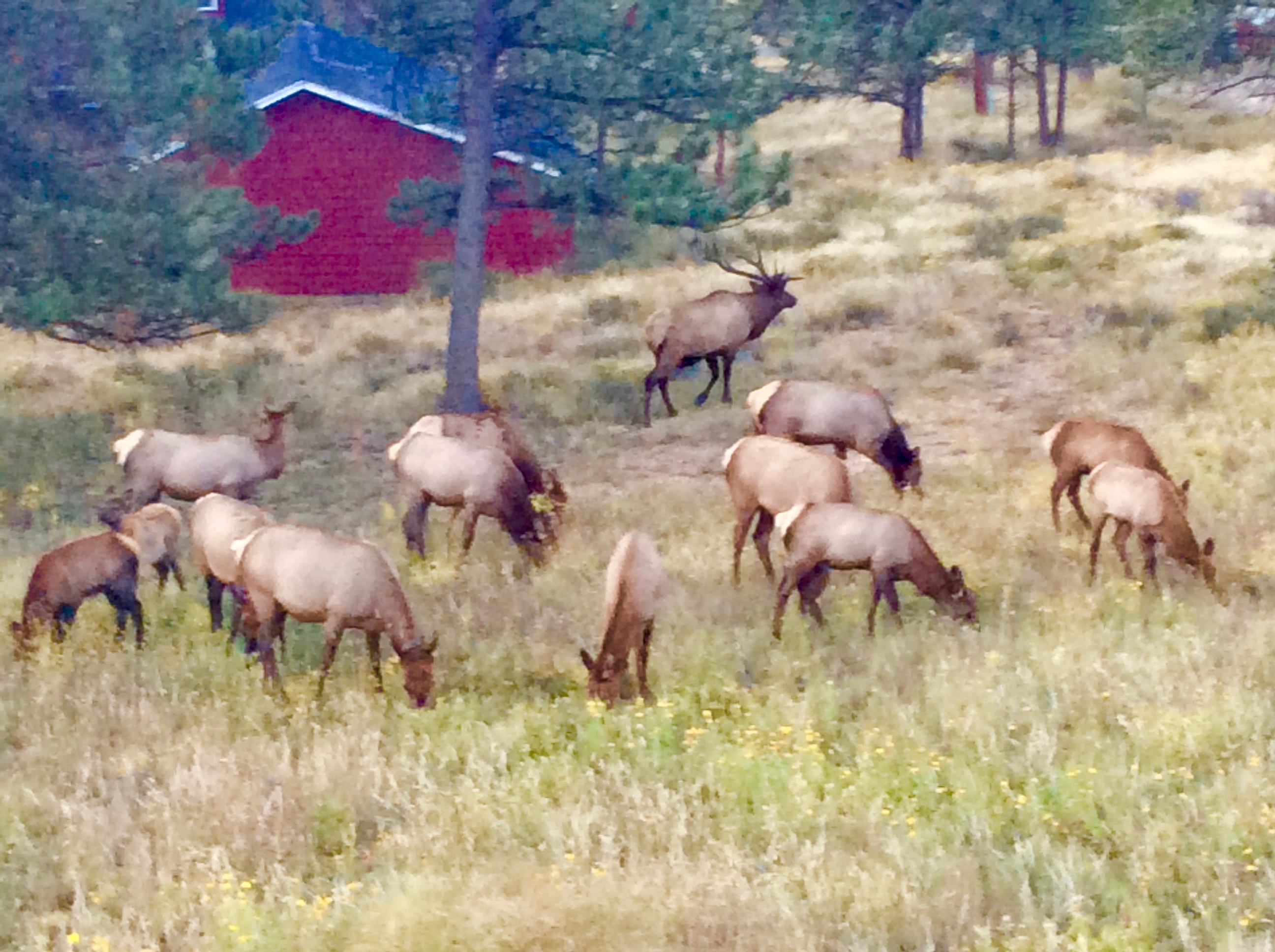
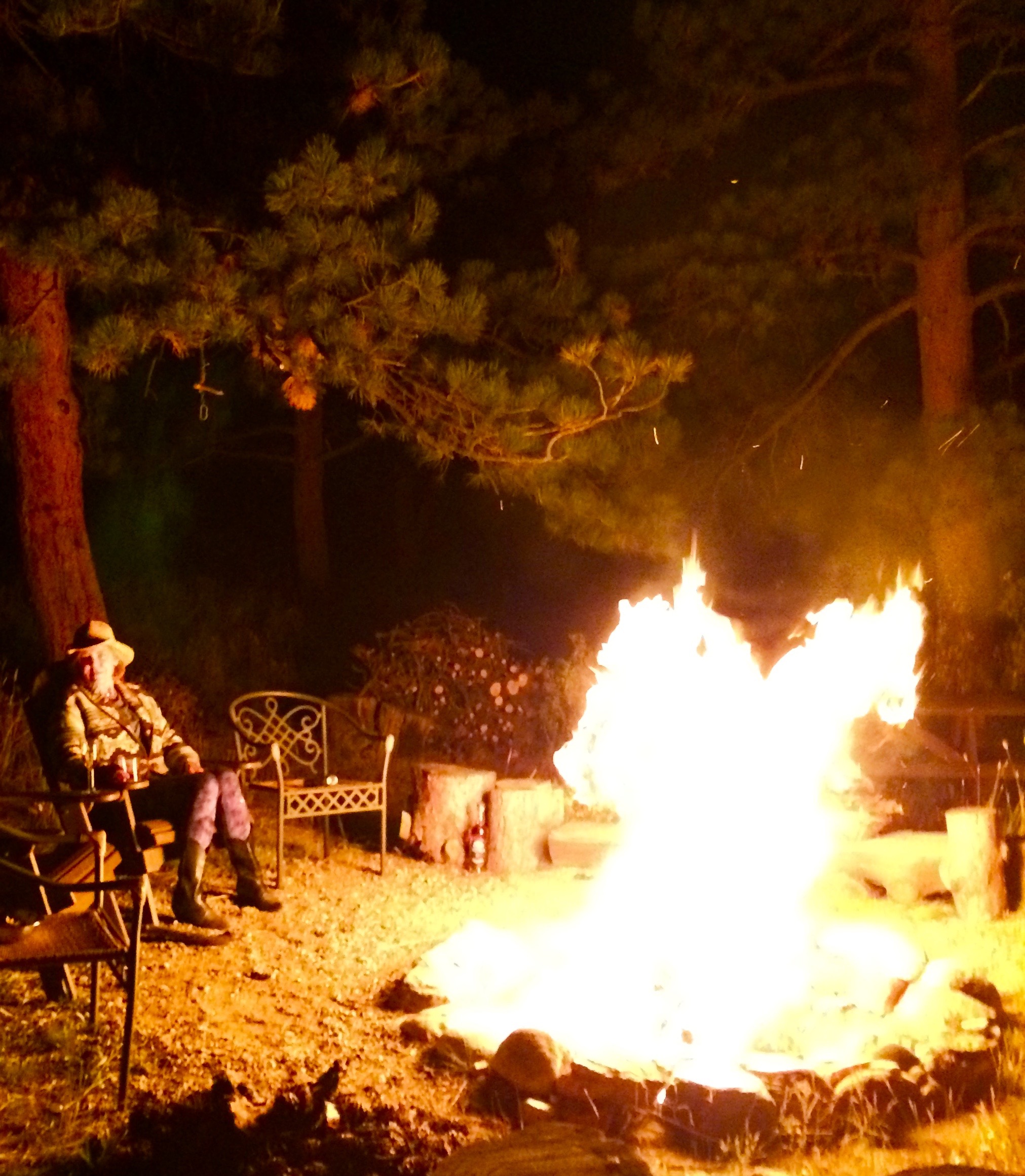
What made it particularly special were the visitors, different from other summers. A toddler grand-daughter’s first time to roam rocky, hilly landscapes, a reunion of women from my high school graduating class, visual apparitions of campfire spirits after two years of “no-burn” ban, s’mores with dark European chocolate, and a herd of rutting elk who wandered in–and stayed.

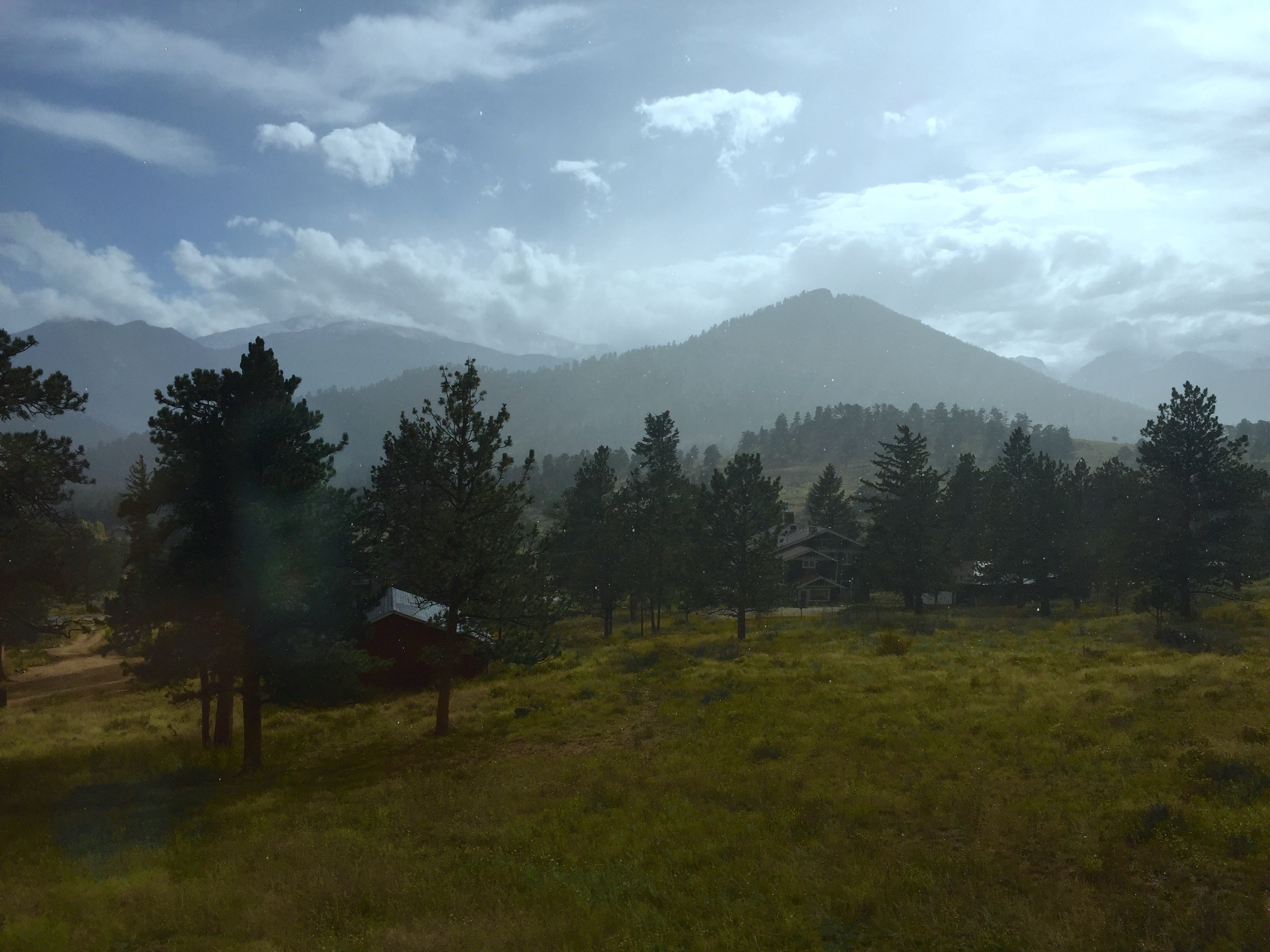
These events merged with other things I love; wildflowers in profusion, mountain sunrise and sunsets, thunderstorms and rainbows, low hanging clouds clearing to snow on the high peaks, elk bugling in the change of season.

Returning to the mountains is particularly meaningful to me because of our overseas lifestyle. For twelve summers, during the years we lived in Taipei, Taiwan, I needed to come home and recalibrate. Living and breathing for a few months at a higher altitude under clear blue skies was very different from a big Asian city of concrete, tile, and smoggy air.

The mountains give us our “spiritual geography”, a term coined by Kathleen Norris in her book Dakota: A Spiritual Journey. It is the place we inhabit to find our best selves.

Mythologist Joseph Campbell wrote of the importance of finding individual “sacred space”.

A sacred space is any space that is set apart from the usual context of life. It has no function in the way of earning a living or a reputation…In your sacred space, things are working in terms of your dynamic–and not somebody else’s…You don’t really have a sacred space until you find somewhere to be…where joy comes from inside, not something external that puts joy into you, a place that lets you experience your own will and your own intention and your own wish…

Your sacred space is where you find yourself again and again. J. Campbell

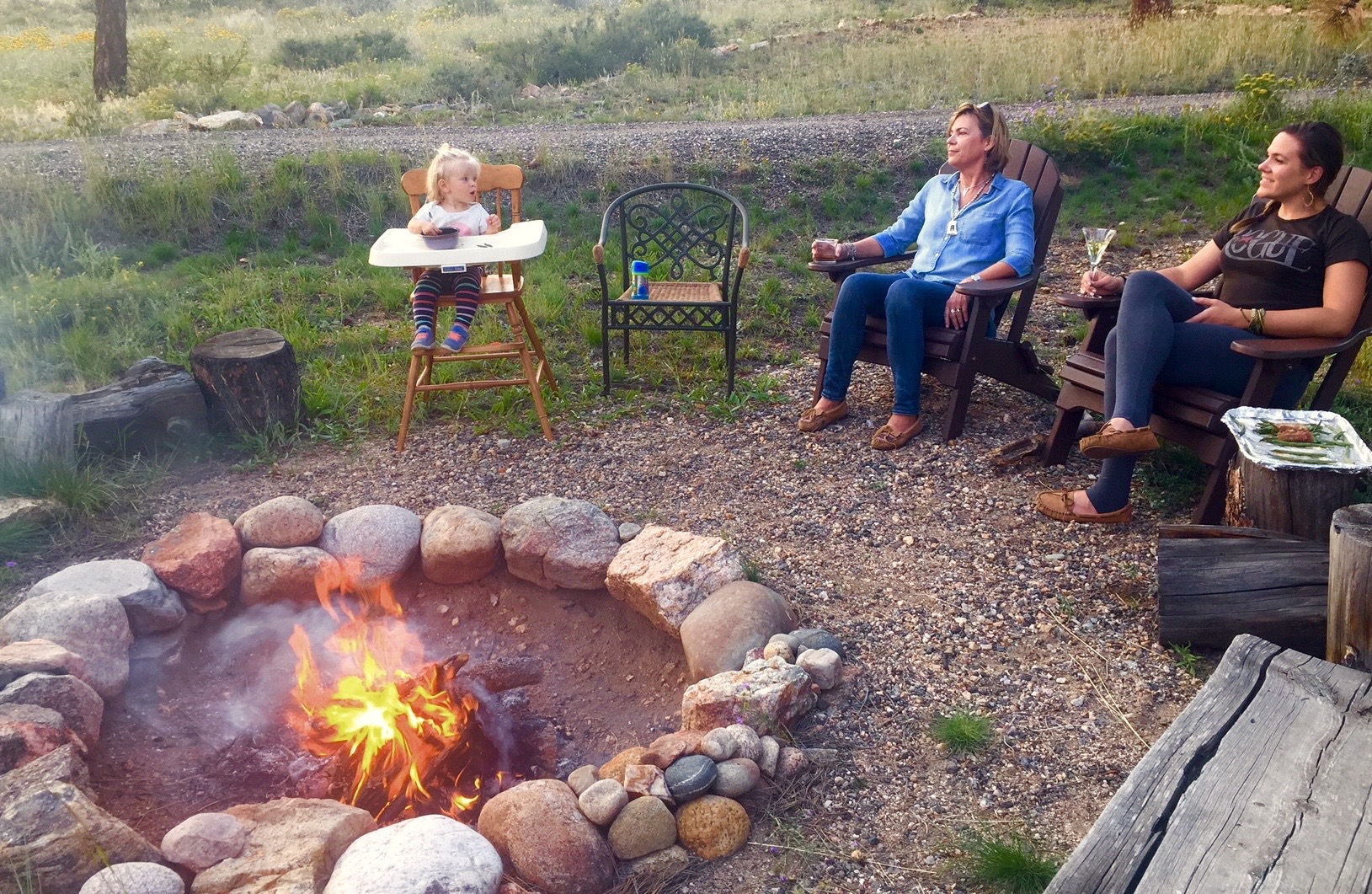
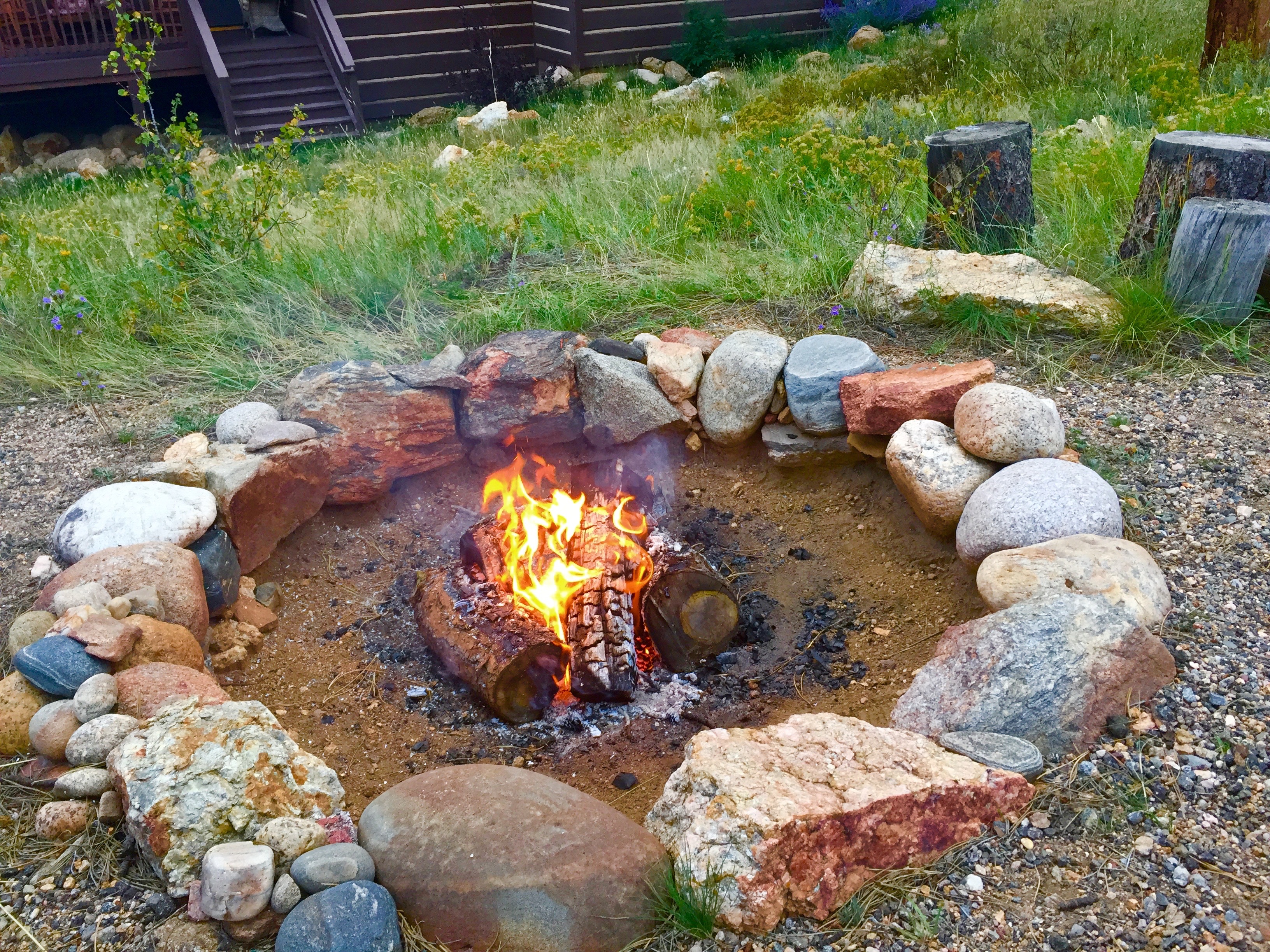
My sacred spaces begin in physical forms–a cabin in Colorado mountains, a carefully constructed stone campfire ring, and a secretive destination called “Rock on the River” where I hike alone to heal or think.

There is a chameleon-like aspect to living an overseas lifestyle, between home in the U.S. and home elsewhere in the world. In the mountains I live in jeans and soft shirts, moccasins or cowgirl boots. I drink coffee on the front porch in sunshine or on a deck overlooking Long’s Peak and Rocky Mountain National Park. I go to bed after sitting around a campfire and awaken to the smell of smoke on my pillow.

Returning home to Paris, there is a seamless slide into the city version of myself. I adapt to the rhythms around me as I sit in cafés watching people instead of coyotes, hawks, deer and elk.

Returning to the mountains is what makes this work. Feeling small and insignificant amid the backdrop of a huge landscape clears my mind. I love the smell of rapidly changing weather, poking campfires with a stick, and wild animals that roam without fences. I think about the good fortune that lies ahead–sharing this with a generation of grandchildren.

Another way to tell the story is with pictures. To those who dropped in, or to those who stayed awhile, and to those who will return–a look back at the best of this season’s memories…

IMG_1087
“mexican hat” flowers germinated from seeds sown over many years without luck. in 2005, a new cabin was built and they popped out of dormancy
IMG_8071
leila 15 months, discovers and wobbles on uneven terrain
IMG_7918
jet lag means 5:30AM sunrise with coffee on the deck
IMG_7883
sunset, first quarter moon rising
IMG_4533
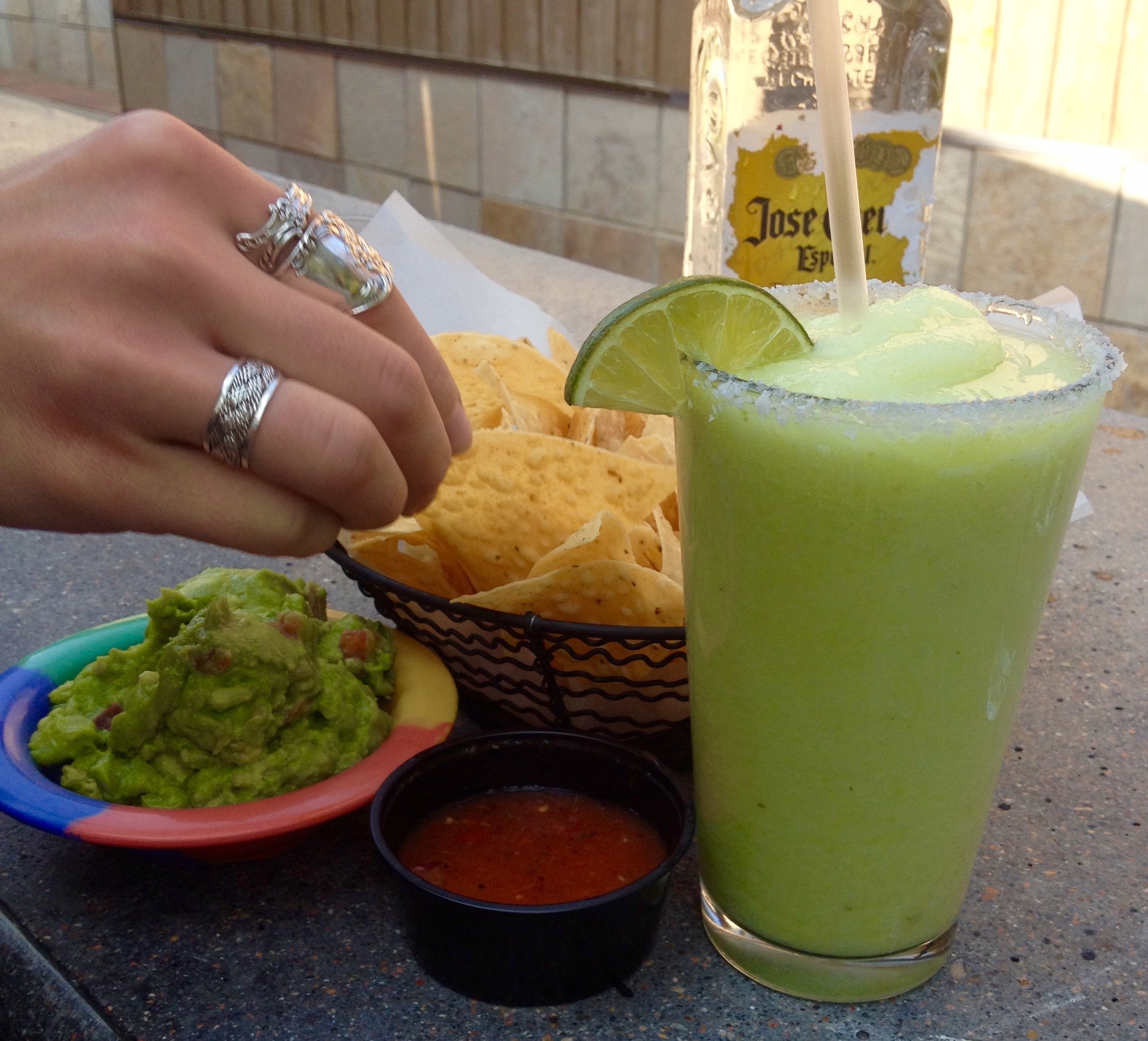
avocado margaritas at ed’s cantina, story told here: Sipping Avocado Margs in Summer
IMG_2831
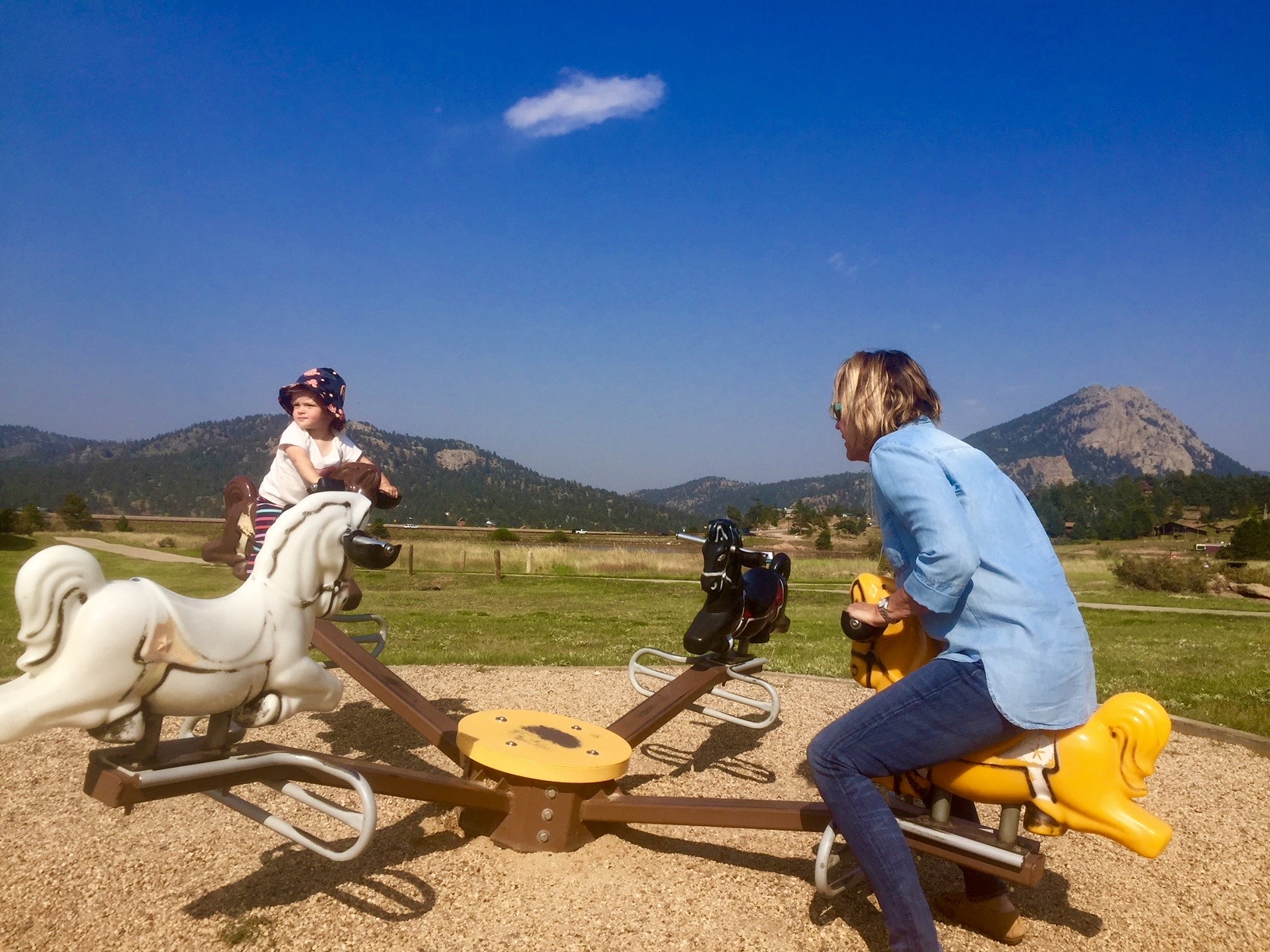
horse rides at the shaka shaka [Russian for playground]
IMG_2820
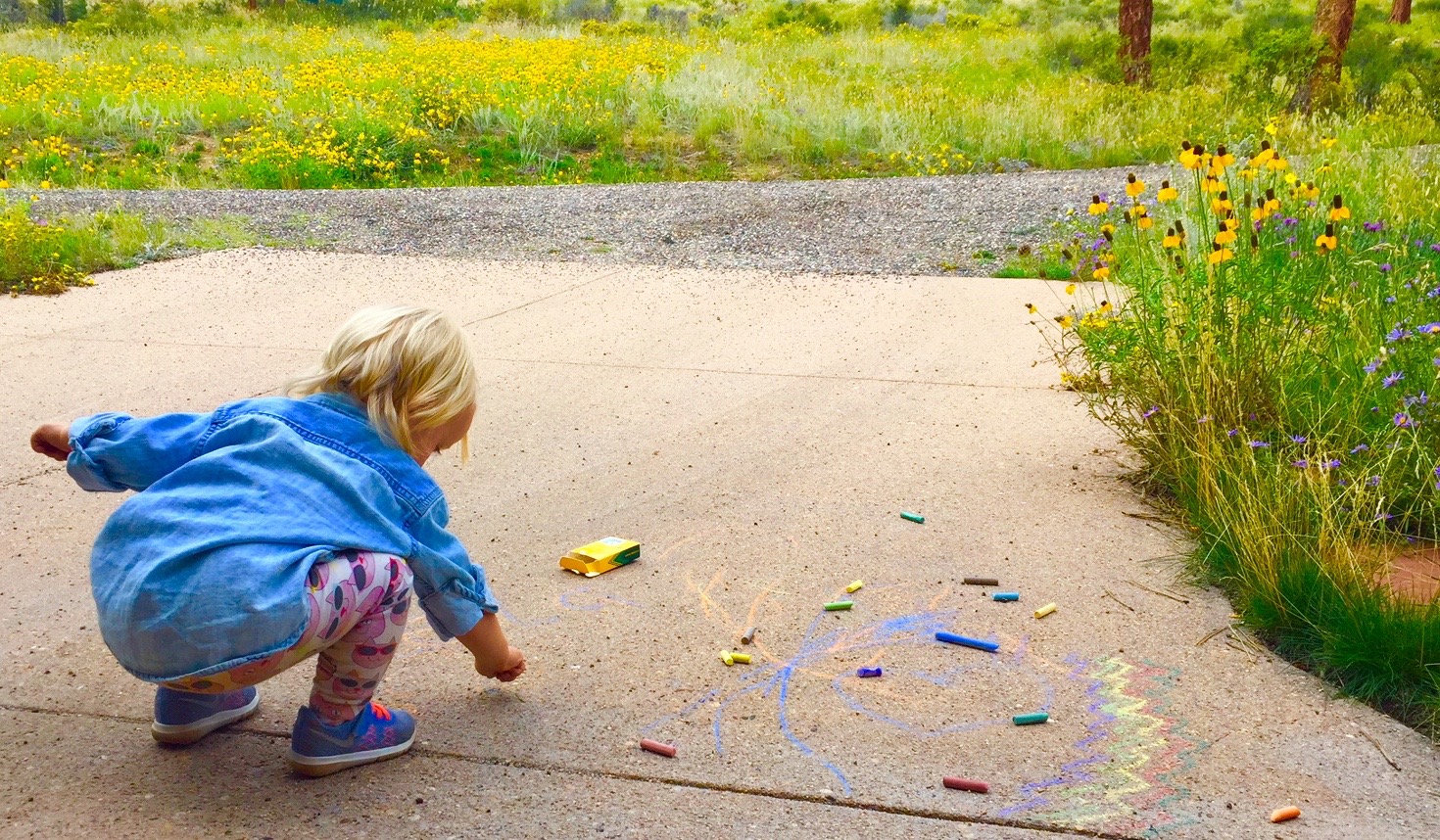
chalk art in perfect squat formation.
IMG_2844
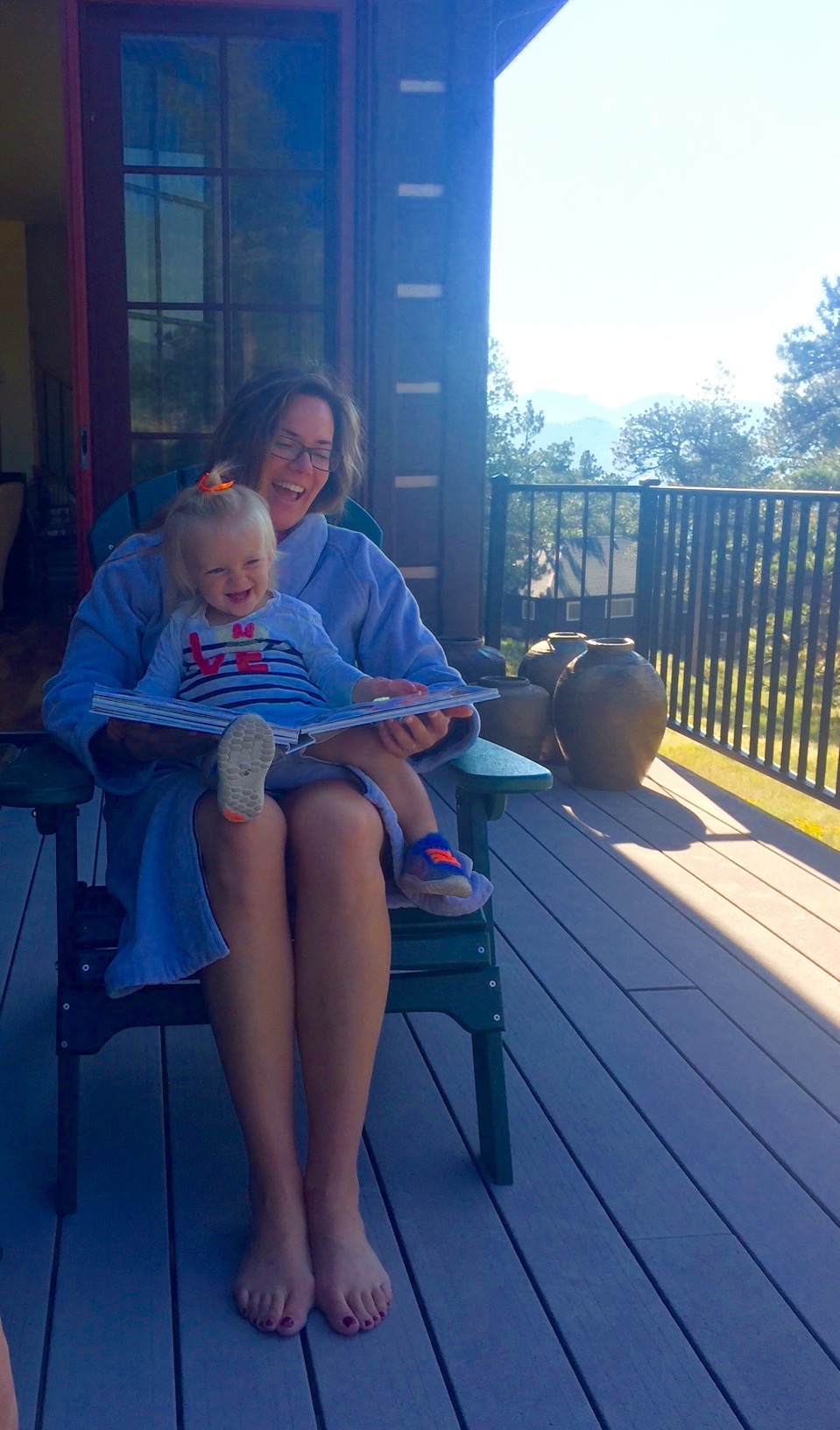
early morning reading with auntie “yaya”
IMG_8298
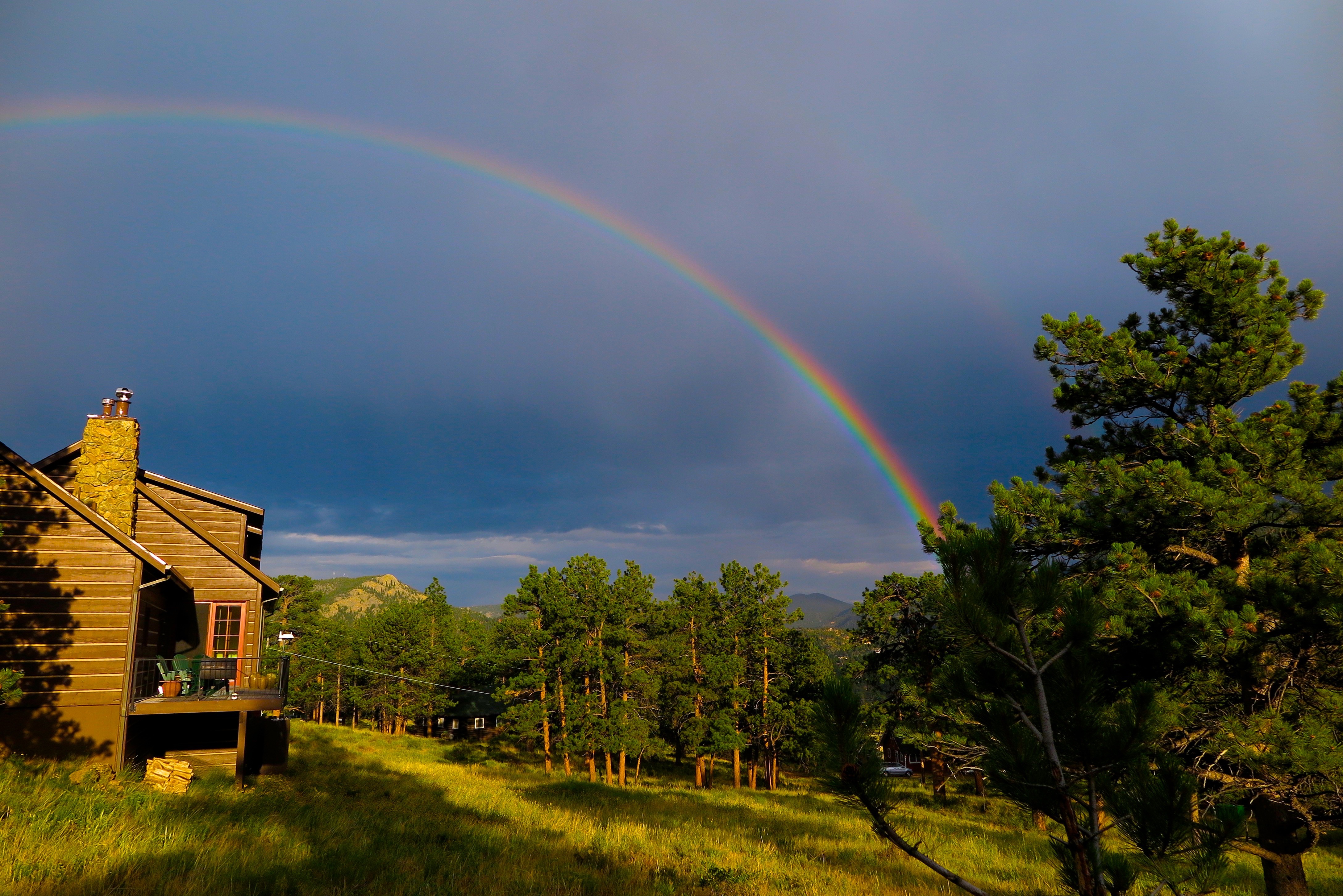
thunderstorm in sunshine
IMG_2237
IMG_2255
followed by perfect rainbows
IMG_2836
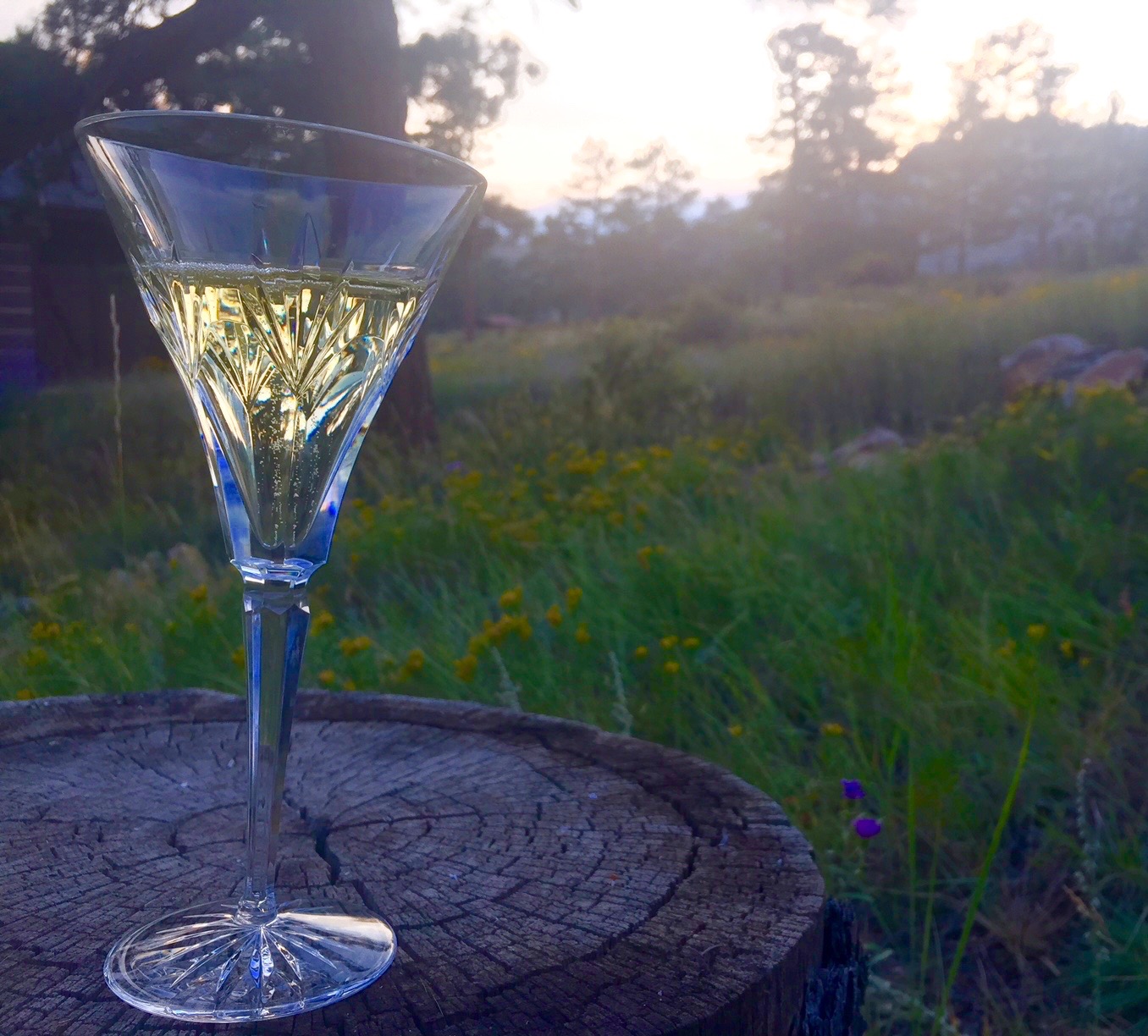
sunset champagne
IMG_2839
fire ring supper with leila, deedee and yaya
IMG_1802
high school girlfriends reunite in estes park, photo by betty cleffman hager
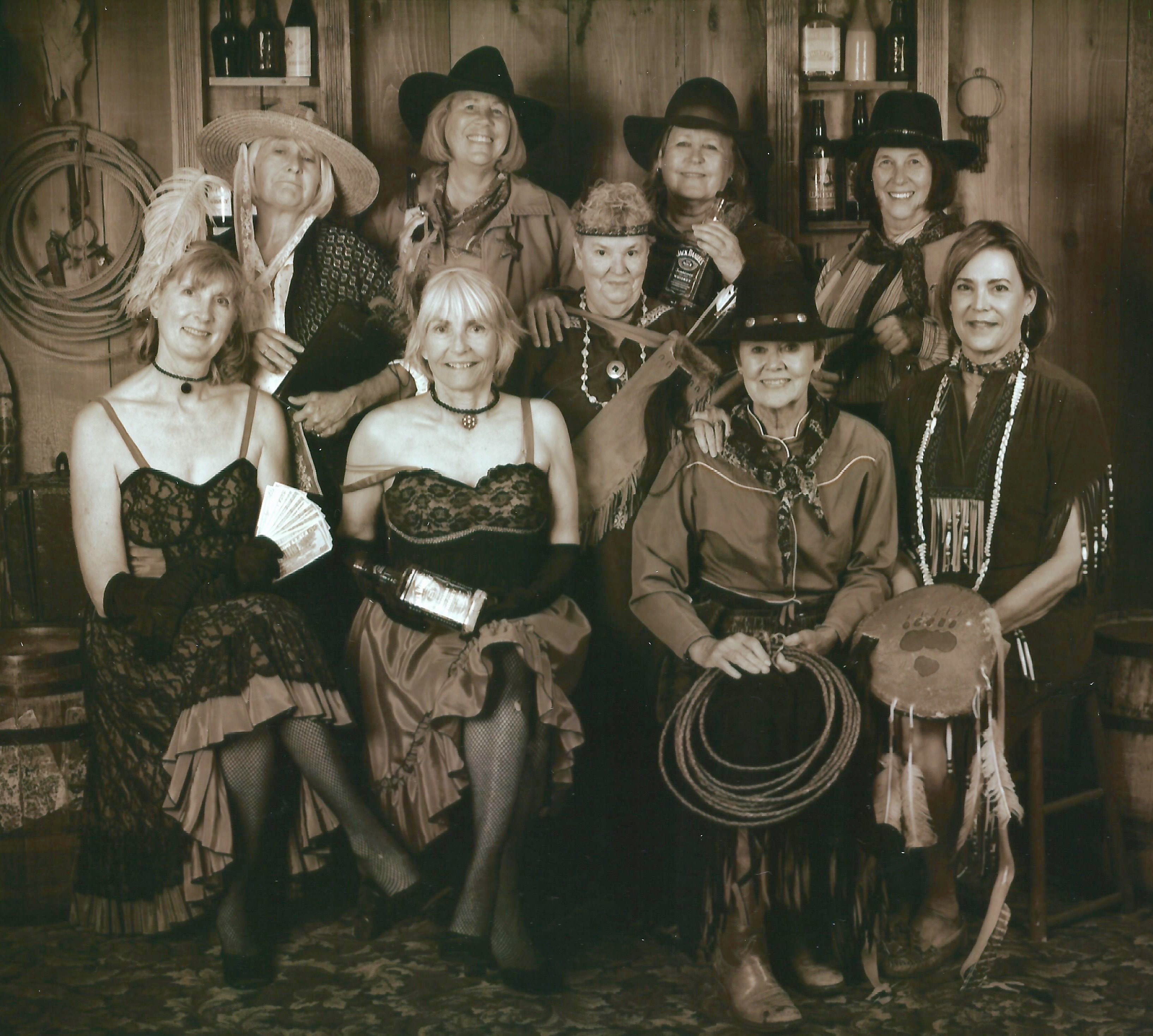
old west photo sepia
marking time with an “old time” photo
2017 Deb Colorado_092
september light, RMNP, photo by debbie windus
IMG_4073_09-14-2017
“shining pine needles”, photo by mary beckey kelly
2017 Deb Colorado_082
blooming russian sage, photo by debbie windus
IMG_8139
fire ring built in 1991 is mostly in the same configuration. when a landscaper called it a “spiritual circle”, I quit messing with it.
IMG_8127
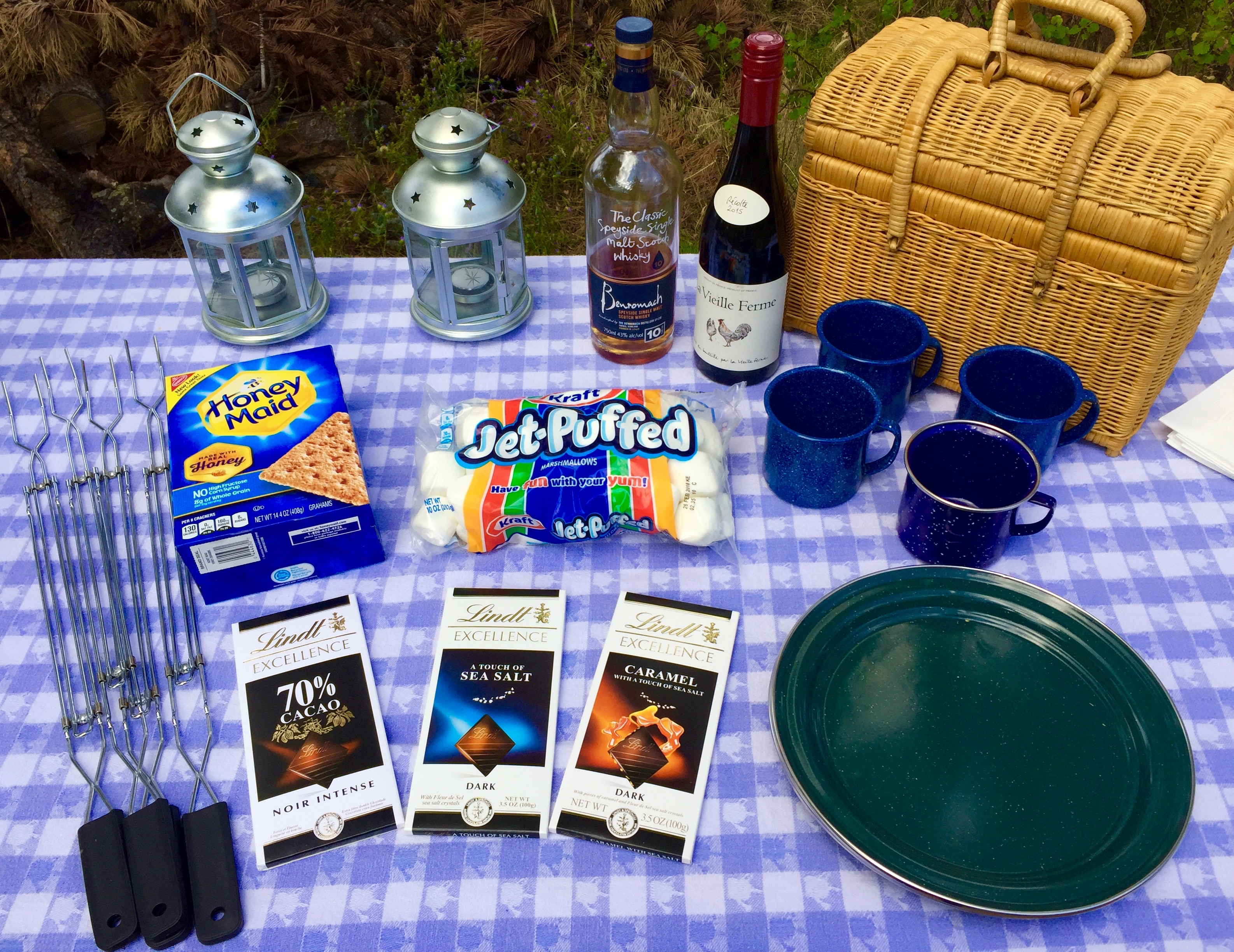
s’more ingredients: grahams, marshmellows, European chocolate choices–plain, sea salt or caramel and sea salt. whisky and wine, optional
IMG_8136
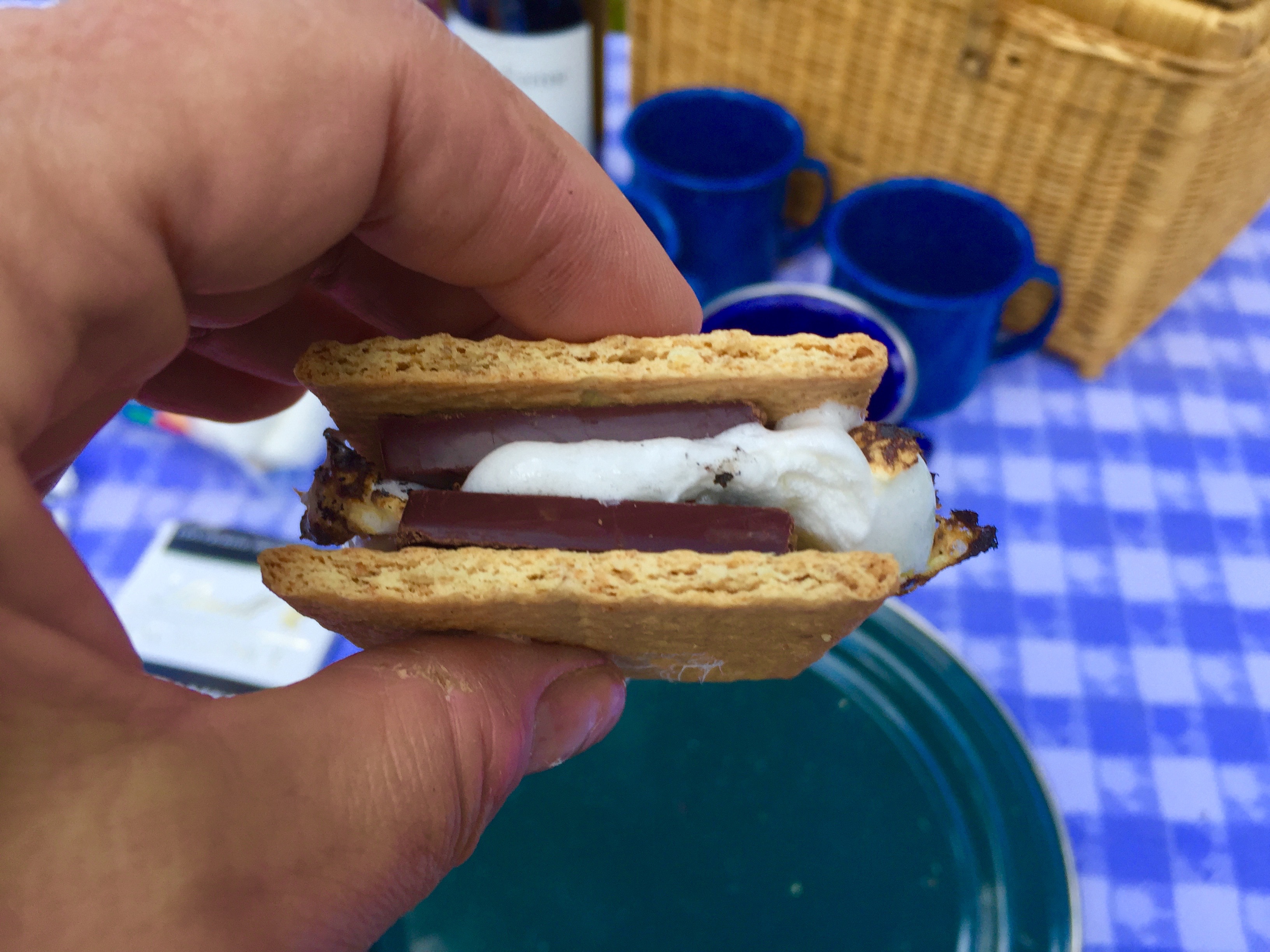
smush together, enjoy with adult beverage of choice
IMG_1840
fall begins the elk rut. 6:30 AM bugling wake ups outside bedroom window

CLICK HERE for 30 second video taken from front porch of Mr. Big re-claiming the harem after three younger males tried a take-over coup

cropped-img_0027.jpg
IMG_0150
herding on south side of camp estes
IMG_1838
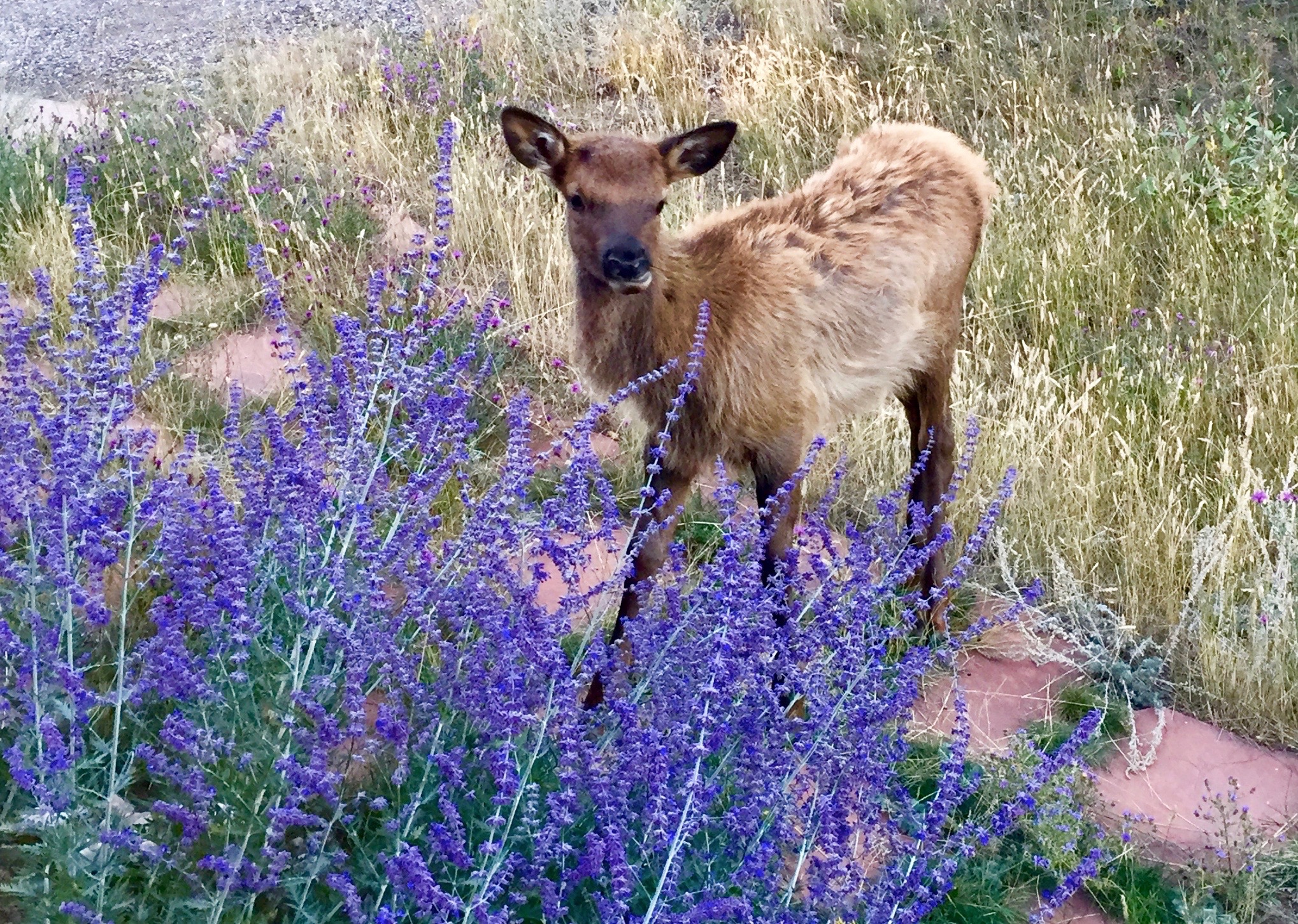
baby elk cuteness
IMG_8079
leila cuteness
IMG_8251
natural symmetry
IMG_1879
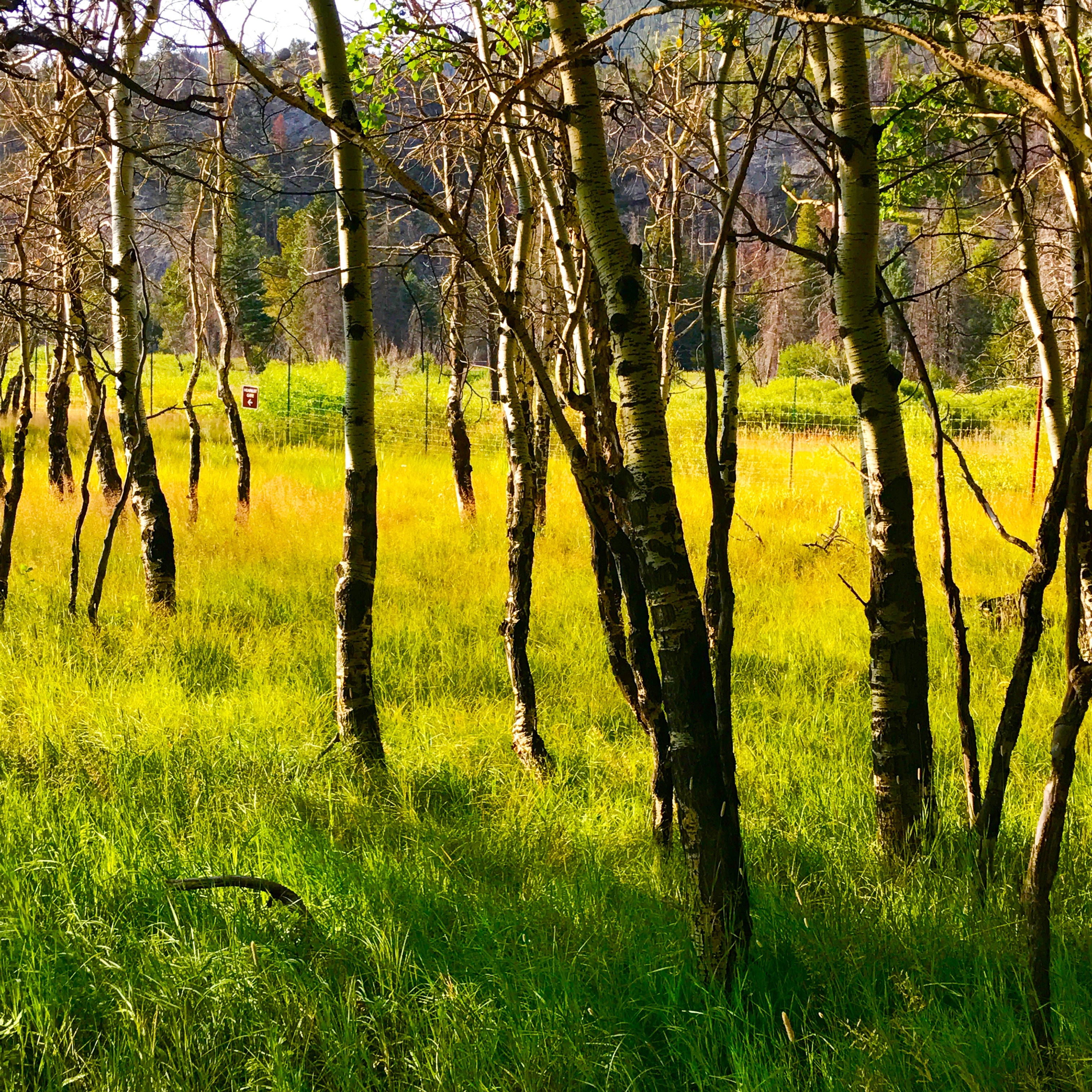
low clouds, aspen turning in distance
IMG_8180
next day, new high country snow
IMG_0455
spirit of the flames turns into double horse head

And finally, to our darling grand-daughter Leila; I hope the wide and wild natural world will always be part of your adventure, that you will be nurtured by its rhythms and beauty, and know that nature exists to support all of her creatures. You are now part of the earth and it is part of you.

Climb the mountains and get their good tidings. Nature’s peace will flow into you as sunshine flows into trees. The wind will blow freshness into you, and cares will drop away like leaves of Autumn.

John Muir

Berry Best Summer Sangria

A perfect summer day is when the sun is shining, the breeze is blowing, the birds are singing and the lawn mower is broken. James Dents

Hey! It’s summer! Be free and happy and danceful and uninhibited and now-y! –Terri Guillemets

Summer afternoon–summer afternoon; to me those have always been the two most beautiful words in the English language. –Henry James

IMG_5926 (1)

My husband refers to me as a “late adopter”. This has been true regarding certain forms of technology. I’m not the first to run with the latest innovation when it enters popular culture. But when I do jump in, it’s all the way. Then, I can’t remember life as it was before.

This summer I was surprised with a different type of “late adaptation”. It happened to be with a beverage I had never tried, even once.

On the July 4th American Independence Day holiday weekend I was with Dietician Daughter, her husband, and his Kansas family. She served me a berry and fresh fruit topped drink in a tall glass with a straw. It was deep burgundy in color. The icy glass, sweating beads of condensation, was garnished with succulent fruit. It was her version of Sangria.

IMG_2191

On a sultry summer afternoon, around a backyard table with good people, this drink captured my attention. There was thirst-quenching coolness. There was the lushness of summer berries in red wine. I drank a second glass.

IMG_2206

Sangria has been around for 2000+ years. When the Roman Empire reached the Iberian Peninsula of Spain and Portugal and began mixing wine into the water to sanitize it, the beginnings of Sangria were born. Long a common, informal drink on the European continent, Sangria was not widely consumed in the U.S. until it was introduced at the New York World’s Fair in 1964.

Twice I have been to the Iberian Peninsula in western Spain hiking the Camino de Santiago de Compostela, but I was not offered Sangria there. We drank wonderful Galician wines every evening as an accompaniment to the regional food. It was poured straight from the bottle and never mixed with anything.

IMG_6694
trail marker camino de santiago

Sangria comes from the Spanish and Portuguese word “sangre” meaning blood because of its’ dark red color. It is traditionally made with Spanish red wine, fruit, brandy, some kind of sweetener and ice. Carbonated water may or may not be added for fizz.

That’s all there is to it. This is also where Sangria becomes much more interesting. With a rudimentary knowledge of ingredients, the end result is in the hands of the maker. Dietician Daughter was imaginative in her “berry” form of creativity. Now I can’t drink it any other way.

For the rest of the summer, I began ordering Sangria in restaurants. Some were made with white wine, some with red. At the very most they might have one or two pieces of shredded, mangy looking citrus fruit in the bottom of the glass. Pizzazz and eye candy beauty were nonexistent. Not one was memorable. Not one reminded me of friends and family sharing stories and playing games on a summer afternoon. Not one begged to be repeated.

My short scientific study convinced me that the only Sangria worth the calories is the one you make yourself. With ingredients you choose. The wine must be of a quality that you would drink on its own. The fruit must be plentiful. And FRESH.

IMG_5928
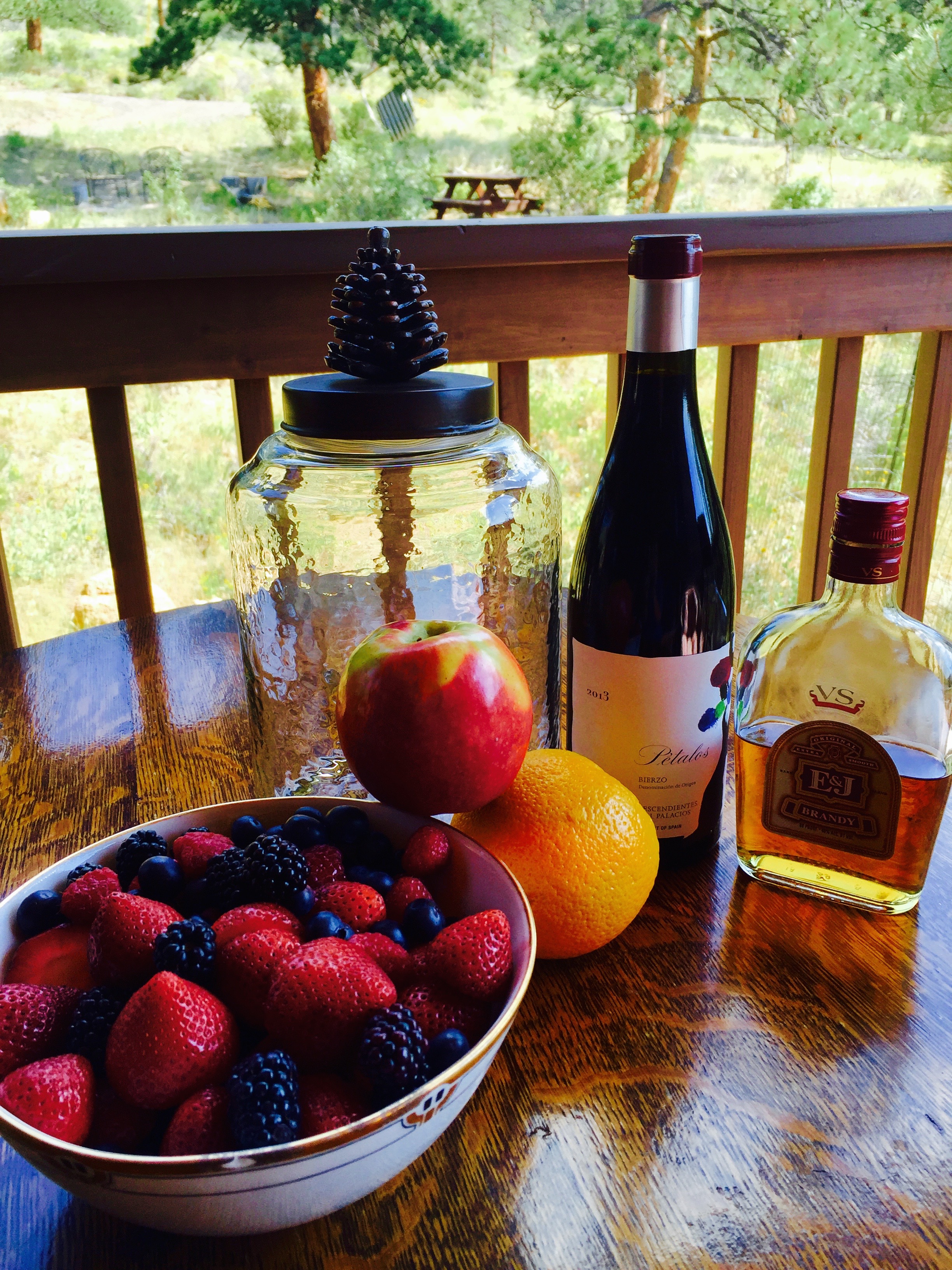
sangria ingredients: summer fruit, wine, brandy, and a jar

Here is the very best summer SANGRIA you will ever make. Or drink. It’s simple, it’s fruity, slightly dry and slightly sweet, a bit boozy, and refreshing like a lazy summer day. Pass the pitcher around a table in the mountains, by the sea, on the terrace, or in the backyard. Say, “yes” to a berry summer sangria. Then go lie in a hammock under the trees and muse.

IMG_2079
sangria in the mountains
DSCN1298
sangria on the côte d’azur, france
CIMG0547
sangria on a terrace in germany
CIMG0541
in full summer bloom
IMG_2186


LARA’S BERRY BEST SUMMER SANGRIA

  • fresh whole berries [or pieces of fruit] for garnish
  • ice to chill
  • 750 ml bottle of Spanish Red wine, chilled [I used Ribiera de Duero. Or Rioja.]
  • ½ C. brandy
  • ¾ C. orange juice
  • 3-4 T. brown sugar
  • any seasonal combination of blueberries, raspberries, blackberries, strawberries. [Or use peaches and mangoes]
  • ½ orange, rind on, sliced thinly
  • ½ apple, skin on, chopped

In a large glass jar or pitcher, place fruit and sugar and muddle with a wooden spoon or muddler.

IMG_5934

Add OJ and brandy and muddle again. Add red wine and stir.

IMG_5939

Taste and adjust flavors to your liking. [More brandy or OJ or sugar as you wish.] Stir again. Add ice to chill and serve as is in clear glasses.

Get the fruit on. Garnish with lots of fresh berries or fruit of choice. Serve with a spoon for scooping winey fruit into your mouth between sips.

IMG_2193

May be stored, covered, in refrigerator to steep and chill several hours, but then don’t add ice until serving.

Best consumed within 1-2 days.

Secret Eating

Secret-2

Secret eating is seldom spoken about or easily admitted. If you ask most people what they enjoy eating alone, without sharing, they hesitate with a questioning look. Or mumble that they don’t know. It’s possible they’ve never experienced this solitary pleasure.

The desire to eat unobserved isn’t like bingeing on ice cream or sneaking candy bars to feed your chocolate craving. It’s not comfort food either. It is something you do surreptitiously, consciously, and quietly by yourself. It is a moment, by choice, of indescribable satisfaction.

A survey of extended family members about clandestine eating revealed only one answer close to my definition. It came from my daughter-in-law who is Latvian with Russian heritage. She formed a covert eating ritual as a child, from the age of ten. In the summertime, after her parents left for the evening, she went to the market by herself. She bought a huge watermelon with pennies saved or found under chair cushions. Lugging it home, she managed to cut it in two, carried half to the living room sofa, watched television, and ate it down to the rind. Spoonful by decadent spoonful. Including the seeds. She was not under the watchful eye of anyone, or told to get a plate, or to sit on the floor, or not make a mess. She did it quietly and happily, for her own pleasure.

th-1
anna’s secret eating

M.F.K. Fisher [1908-1992] wrote a wonderful story about secret eating. It took place one frigid winter when she and her husband lived in an unheated walkup apartment in Strasbourg, France. They were depressed by the unending cold, dreary grayness and couldn’t afford to move. So they rented a room in a pension for one luxurious week. It came with a big bed, billowy curtained windows and heat.

Each morning after waving Al off to the university, Mary Frances sat in the window considering the day ahead. She wasn’t ready to brave the outdoor temperatures. While the maid fluffed up duvets and pillows, murmuring in her Alsatian accent, Fisher carefully peeled several small tangerines. Meticulously separating each orange crescent and removing all the white “strings” between hi pieces, she placed the sections on top of newspaper over the radiator. And forgot about them.

There was a long lunch when Al returned and perhaps a wee nip of “digestif” from the decanter on the dresser before he went back to afternoon classes. By this time the orange sections had majestically puffed up, ready to burst with heat and fullness. Opening the window, she carefully placed them in the snow on the outside sill. Several chilling minutes passed. Then it was time.

For the rest of the afternoon, Mary Frances sat watching the world go by on the street below, savoring each orange morsel slowly and voluptuously. She reveled in the spurt of cold pulp and juice after biting through the crackling skin that was like …”a little shell, thin as one layer of enamel on a Chinese bowl”. She mused while vendors sold half-frozen flowers, children ran home from school, and prostitutes sipped hot tea in a café across the way.

Winter’s early darkness descended and the orange sections were gone. She couldn’t exactly say what was so magical about them. Yet she knew that others with “secret eatings of their own” would somehow understand.

I read this story many years before we moved to Europe. The first winter we lived in Germany, I traveled by myself to Strasbourg on a train from Frankfurt. Next to Place Gutenberg is a small hotel where I stayed in a room under the roof. The spire of the Strasbourg Cathedral was visible when I stuck my head out the dormer window. The bathroom was at the top of an open staircase right under the peak.

chambre-mansarde
my room under the roof
hotel-gutenberg-3
cathedral view from window by night

That February was bitterly cold.

I bought a bag of small clementines, peeled them into sections, and laid them on a piece of hotel stationery on top of the radiator. Then I went out to explore.

When I returned, the oranges had grown fat and hot just as Fisher described. There was no snow, but the outside temperature was below freezing. Out on the sill they went. When thoroughly chilled, I ate them one by one in the dim afternoon light. It was true–the skins were crisp and crackling. So thin that, when you bit through them, there was a “pop” followed by the rush of cool juice and pulp. It was a replay moment from the pages of a story by a writer I had long admired. It made me happy.

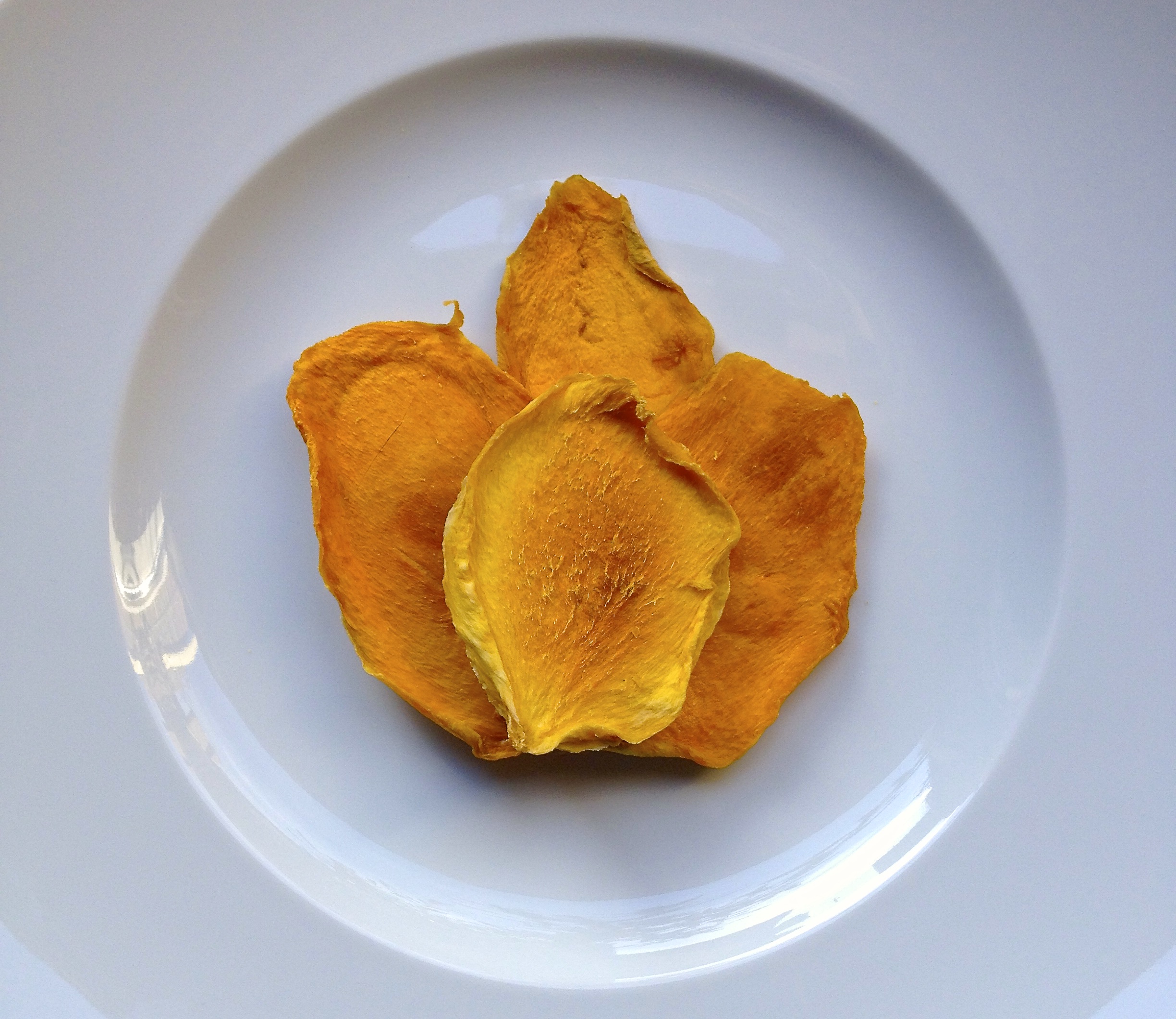
Several years later, a new secret eating ritual started during a visit with “Dietitian Daughter” in Colorado. She was buying a snack item for her husband from the bulk bins of a national food chain. I watched her fill a bag with flattened, dull-colored, brownish-orange pieces of fruit. They looked run over by a truck. They were unsweetened dried mangos. Dehydrated into stiffened leather. She handed me a piece and said, “Try it”.

The first sensation was what it looked like–rough, tough hard-edged, with the taste and texture of dust on shoes. As salivary juices kicked in, that road-kill-looking mango became softer, warmer, and pliable. Careful considerate chewing brought out interesting changes. It turned vaguely sweeter but held onto the essence of fruity leather. I had to chew slowly, without hurrying, before it was ready to swallow. I had to pay attention.

IMG_3661
unsweetened dried mangoes

The degree of subtlety from dry dusty toughness to a satisfying payoff several minutes later completely hooked me. I took my own bag back to Paris.

Now when I feel the urge, I go to the hiding place in the kitchen and randomly choose several pieces of dried mango. Then I stand or sit in a window of our apartment overlooking the vine-laden courtyard where I never tire of the view.

If I stand in the kitchen window during secret eating time, I might muse over the spring unfolding of the Virginia creeper vines or the work-in-progress renovations on the apartment across the courtyard. The neighbour’s cat might be outside on the balcony chirping wistfully at pigeons. If I choose to sit in the warm afternoon sun of the dining room windows, I have a private view of sky, rooftops, vine covered brick walls, and my own blooming geraniums.

cropped-img_16281.jpg
IMG_3885
dining room window
IMG_3891
with a view

Or, I might decide to stand in the street-side windows at the front of the apartment where I take note of pedestrians, shopkeepers, or a trumpet-playing street musician four stories below.

IMG_0729
street side windows at sunrise

My secret eating is something I try to keep to myself. It gives me great pleasure and satisfaction. But what is it really? Like Fisher, I can’t exactly say. Perhaps it’s simply a meditative time-out, or a few private minutes of simply “being” and not “doing”, or a satisfying break in the midst of a day, a week, a month.

There must be someone out there who understands what I mean…

Transcendent Picnics

qiagtiangangcloudy
trail to buffalo meadows, taipei, taiwan

There is more than the communion of bodies when bread is broken and wine drunk. –m.f.k. fisher

M.F.K. Fisher [1908-1992] wrote that the best outdoor eating is on the side of a hill in the early evening. Her story of an unforgettable picnic took place in Switzerland in the 1930s. Sixty years later, in the 1990s, on a grassy meadow in Taiwan, we had a similar family experience. Continents and decades apart, the stories are interwoven because both Fisher’s memory and mine are reflections about more than the menu.

Fisher’s story went like this. She and her husband were building a small house above Lake Geneva, Switzerland, on a steep hillside surrounded by vineyards. Her parents came from California to visit. Late afternoon sun in June promised just enough warmth for an outside meal. The four of them carried baskets to the construction site, after workers had left for the day.

A table under the apple tree was covered with a checkered cloth and set with silver, ceramic plates and cloth napkins. Bottles of wine were placed in an ancient spring-fed fountain to chill. A fire was built, ringed with stones and roofing tiles, fueled with wood shavings.

The first spring peas were ready to harvest. As the men picked from the terraced garden uphill, Mary Frances ran baskets downhill to her mother who quickly shelled them into a pot. An iron casserole was set over the open fire where the peas “cooked for perhaps four or five minutes, swirling them in butter and their own steam”. Salt and pepper at the end, then table side.

On each plate lay a small roasted pullet. There was salad of delicate mountain lettuces, a basket of good bread, and fountain-chilled white wine generously poured. And those tender young peas–freshly steamed and seasoned! They shared the harvested feast and each other’s company as the surrounding hills turned rosy and the sun began to sink. Suddenly, in a neighboring field, “…a cow moved her head among the meadow flowers and shook her bell in a slow, melodious rhythm, a kind of hymn.” Fisher never forgot it.

In the spring of our first year in Taiwan, we went on a picnic where the alignment of people, place, and food replicated Fisher’s kind of perfection. More importantly, our young daughter began to understand the communal spirit created when food is shared in good company.

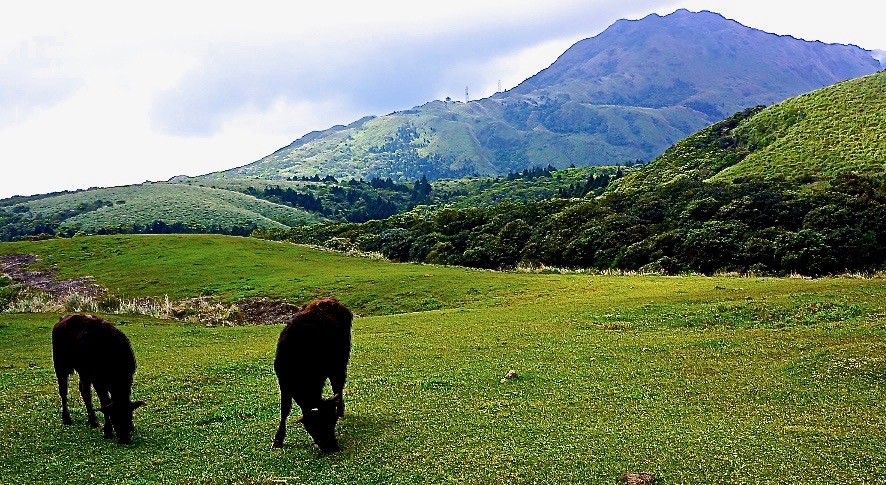
Yangmingshan is the national park north of Taipei. It was typically crowded on weekends with cooped up city people seeking fresh air, hiking trails, flowers and greenery. Friends Maddy and Cabby knew of an area in the park where water buffalo grazed freely and people were few. They organized a picnic in Buffalo Meadows on a late afternoon. We were four adults and three young children.

From the parking area we hiked uphill in a cloud so dense it moistened our hair and skin with droplets of water. At the top of the trail the landscape turned sunny and green with views all around. The soft grass was picnic perfect. Out of a backpack came a Frisbee and the men organized play on the hillside. Lara and Liza tired of running after a frisbee they couldn’t catch. They tried to follow a slow moving water buffalo. He wandered on.

lara, liza and water buffalo
girls thinking about things

Our nine-year-old daughter came over and sat down to watch the food preparation. There was a small camp stove along with a battered and blackened Japanese wok in which to put together the meal. Ingredients had been sliced, steamed, grated and pre-cooked at home. Once the stove was leveled, primed, and producing enough heat, assembly began. 

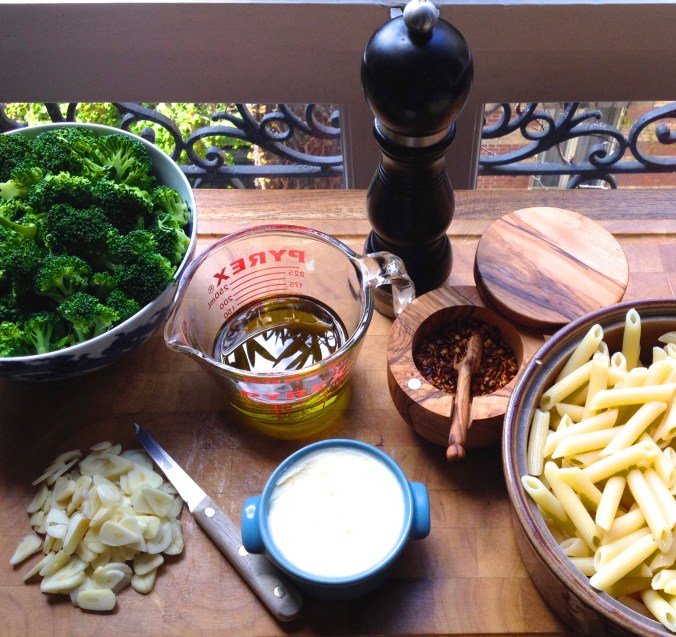
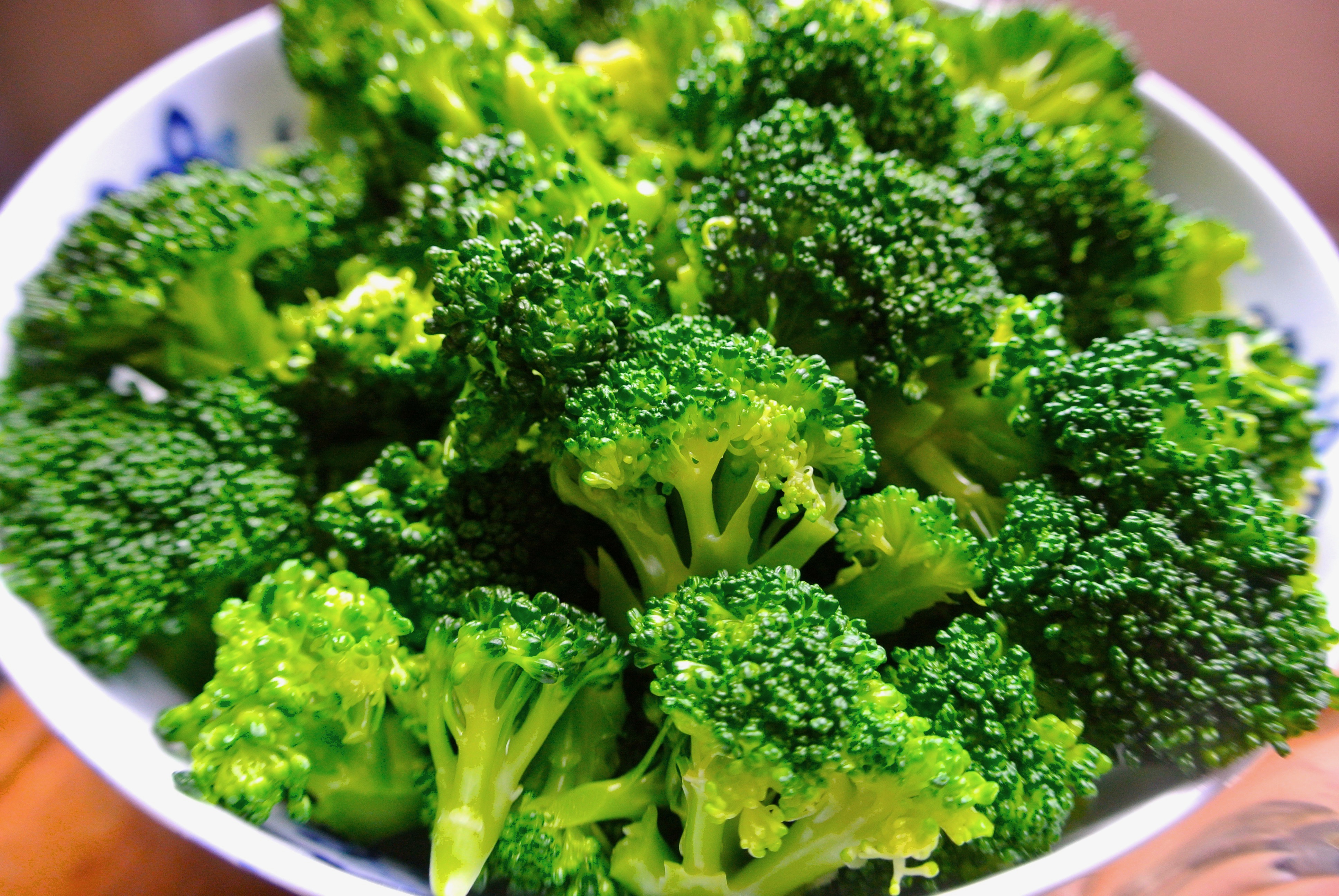
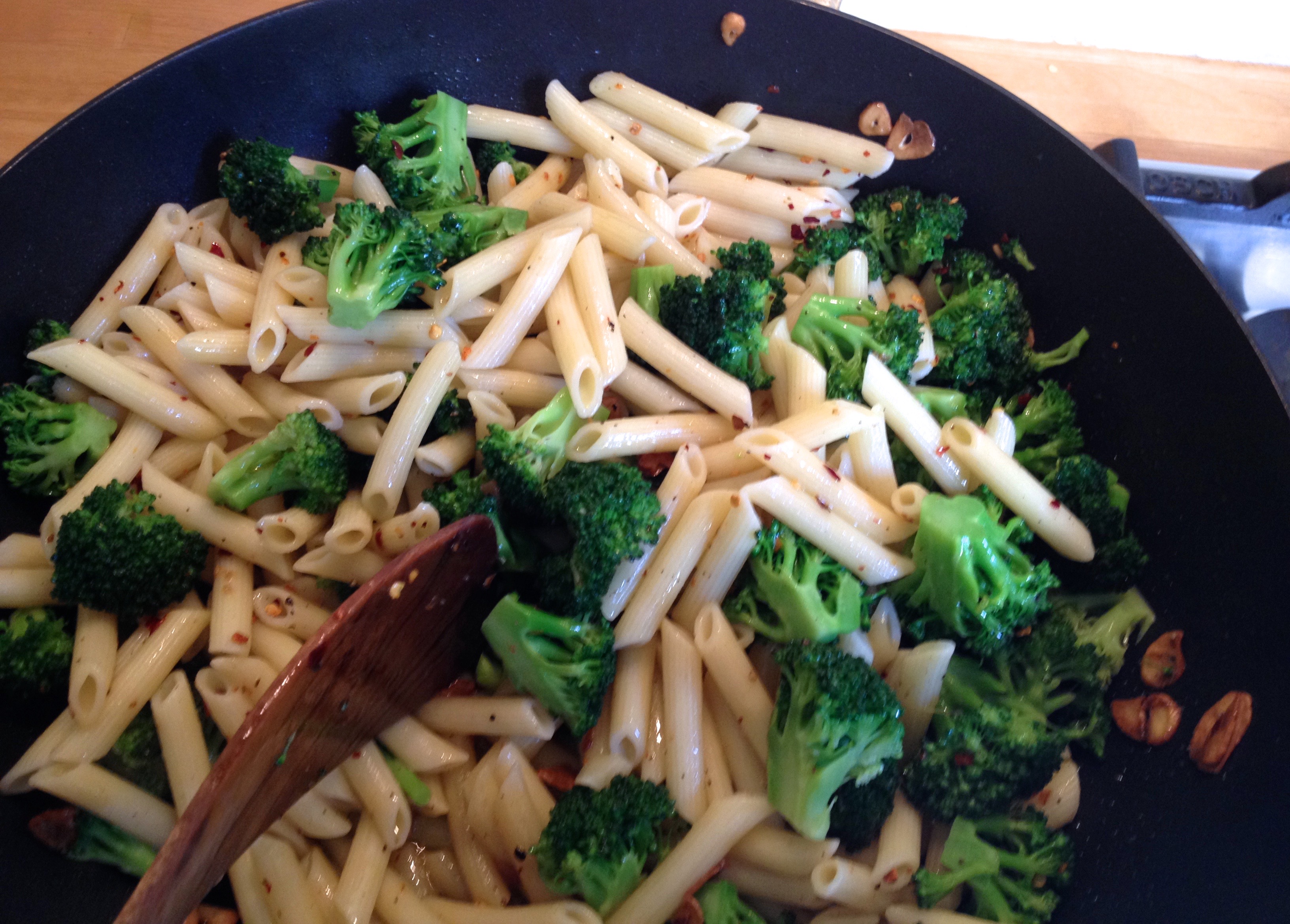
Olive oil was generously poured into the wok and heated. Thinly sliced cloves of fresh garlic were added to the hot oil. Shaking the pan continuously, the slices began to brown around the edges. Bite sized broccoli flowerets were stirred in with freshly ground pepper. Pre-cooked penne pasta was added along with butter. Everything was tumbled together with a large wooden spoon until thoroughly heated. Finally, freshly grated Parmesan cheese was layered on top and melted into everything. Lightly browned garlic slices gave toasted sweetness to the broccoli and pasta. A one-dish meal. Perfect.

Plates were passed. We sat side by side on blankets eating, laughing and talking. As the sun lowered over the far hills, the temperature cooled and we reached for jackets. Thimble sized portions of single malt whisky were passed among the adults. A breeze stirred and we leaned in closer, wrapping arms around children. Four-year-old Liza was zipped into the front of her father’s grey sweatshirt where she fell asleep curled into his chest, only the top of her blonde head showing. We talked quietly as darkness descended. The mist returned. It was time to go home.

Days later, our daughter asked if I could make that broccoli pasta. She had a faraway look in her eyes while she spoke of the picnic in Buffalo Meadows and how wonderful it had been. Looking at her face and listening to her speak I knew she had made a connection about more than the food. She was asking to go back to a feeling created on a tranquil hillside with close-knit family and friends. I never forgot her request. She had connected the dots that Fisher writes about so well–the communion of spirits when food and love are shared, around a table or on a hillside, with people who are important to us.

Perhaps this explains why a picnic, so many years ago, is vivid in my memory. Although I love reflecting on Fisher’s story of peas, a Swiss hillside, and a cowbell, my own recollection is this–a beat-up Japanese wok filled with steaming broccoli pasta, a grassy meadow, adults and children with arms around one another, and a water buffalo.


BROCCOLI GARLIC PENNE [from Silver Palate Cookbook]

basic ingredients except for parmesan

Ingredients:

  • 1 lb. [500 gm] penne pasta, cooked al dente
  • 2 heads broccoli, cleaned and cut into small flowerets
  • ½ C. extra virgin olive oil
  • 10 [or more] cloves garlic, thinly sliced crosswise
  • Freshly ground pepper
  • 4 T. [1/2 stick] good butter
  • Freshly grated fresh Parmesan cheese

Assembly:

  • Boil penne, drain, rinse under cold water.
  • Simmer broccoli in boiling water 1-2 minutes, drain, rinse in cold water.
  • Heat oil ~ 1 min. Add garlic slices and cook, shaking pan until it begins to brown ~1 min.
  • Add broccoli, stir, grind pepper on top.
  • Add butter and penne, stirring continuously until well mixed and heated through.
  • Sprinkle with freshly grated Parmesan cheese.
  • Serve immediately.
  • Pass the pepper mill.
  • Add garnish and extra Parmesan.

For variety, add shredded or cubed cooked chicken, sliced black olives, or leftover veggies. Red or yellow bell peppers make a colorful addition. [Steam or stir fry before adding.] Red pepper flakes for added spice. Cherry tomatoes, cut in half, as garnish before serving.


Sipping Avocado Margs in Summer

OLYMPUS DIGITAL CAMERA
Camp Estes in summer

Our United States home is in the Rocky Mountains of Colorado. When not in our home overseas, we live in a cabin built on a hillside outside the town of Estes Park. The back of the cabin faces the Front Range of Rocky Mountain National Park–mountains towering 10-14,000 feet above sea level. We gaze at them from a deck in the summer or through picture windows near the fireplace in the winter.

IMG_2021

There are no streetlights and the roads are unpaved. The landscape is native Ponderosa pines, wild grasses, sage shrubs, and wildflowers. The maintenance is digging up noxious weeds, raking fallen pinecones, cutting and splitting firewood. We built a campfire ring with rocks from the land and sit around it with stories and laughter or the silence of a starry night. This has been our home-away-from-overseas-home since 1991.

IMG_1888

The summer season return begins with the first morning after we arrive. It’s early. The sun rises at 5:30AM. Coffee is started and we pull rocking chairs onto the deck. Mountains and clouds to the south and west are pink-tinged at first light. As the sun makes its’ way upward, the color shifts to yellowish gold. When it finally rises over the eastern ridge line, the sky turns robin’s egg and then lapis blue. Second cup of coffee, still in bathrobes, day begins.

IMG_2079
IMG_2076
early morning pink
IMG_2085
pink to gold

There is a different way of living and “being” in the mountains. Time is simpler, less hurried, less structured. It’s not necessary to “do” much of anything for the first transitional days. We live casually in blue jeans, moccasins or hiking boots, cotton or flannel shirts, depending on the temperature.

We eat differently too. The thinner air and long days tempt us with food and drink that somehow belong in the high country. Hearty breakfasts of egg sandwiches [More Than Just an Egg Sandwich] are eaten on the sunny front porch. It fuels the day before stacking split logs of firewood or hiking into the National Park.

When it’s time for a break, there is a place downtown we like to go. Ed’s Cantina is a 30-year locally owned and operated Mexican restaurant. The sign on the side door says, “Get in Here”. Their logo: “Live Forever. Eat at Ed’s.” When we go there, Avocado Margaritas are what we find.

Screen Shot 2014-09-01 at 8.35.49 PM
Screen Shot 2014-09-01 at 8.36.28 PM

Dietitian Daughter, savvy in combining nutrition with great taste, showed us the way. We fell in love, one by one. It’s the reason we wind up at Ed’s on a warm summer afternoon.

For the nutritionally minded, avocados are one of the healthiest food choices around. They are a good source of mono-unsaturated fat, the desirable fat for lowering LDL [bad] cholesterol while raising HDL [good] cholesterol. Vitamins in avocados, E and C among them, are good for skin tone and texture. There is documentation for the avocado’s anti-inflammatory properties. Even in liquid form, avocados provide a nice range of health benefits!

We also eat a lot of avocados in easy-to-make, lime-y, homemade guacamole. Less is more with guacamole. Let the avocado shine with a light touch on ingredients. Use as a sandwich spread [breakfast egg sandwiches–yes!] or more traditionally as a dip with chips.

Keep your avo margs and guacamole as separate ventures, though. You can ingest too much of a good thing.


GUACAMOLE à la Colorado

  • 2 [or more] ripe avocados
  • diced red onion [or shallot]
  • diced or pressed clove of garlic, optional
  • salt
  • pepper
  • juice of fresh lime
IMG_1950
the basics

Cut around outside of avocado and separate the halves. Scoop the meat out of the rind with a spoon. Mash avocado in a bowl with a fork or potato masher. Add onion, garlic, S&P. Stir together. Squeeze in as much fresh lime juice as you like, to taste. Adjust seasonings.

IMG_1962
mash avos
IMG_1965
add onion, garlic, S & P
IMG_1971
add squeezed lime juice

Will keep in refrigerator without discoloration by covering with plastic wrap pressed down on top of guacamole, allowing no air space.

IMG_1990
with homemade chips

ED’S AVOCADO MARGARITA  [AVO MARG by order]

  • ½ ripe avocado
  • Jose Cuervo Silver Tequila
  • Agave syrup
  • Limeade [they say theirs is homemade, but frozen concentrate is fine]
  • Ice
  • Lime garnish

Into blender, scoop one half avocado, a shot or two of tequila, a generous squirt of agave syrup, an even more generous pour of limeade and lots of ice. Blend together on high setting. Serve in tall, salt rimmed glass, garnished with a slice of lime.

  • Best when sipped on Ed’s outdoor patio with the Big Thompson River rolling by.
IMG_2057
1/2 avocado
IMG_2062
the tequila, agave syrup, ice, limeade
IMG_2063
the blend
IMG_2066
the pour
IMG_2070
perfection in a glass

Live forever at Ed’s…

The Memorable Not-So-Great Birthday

lk-articles-Kneipp-Techniques-658x437

It was a birthday to remember. Our daughter turned 22 before Christmas 2006. We were overseas in Germany, she was in Colorado. There was no opportunity to bake a cake. Instead, I invited her on a mother/daughter adventure after the holidays. It would include some fasting and detoxifying, the Deutsch way. It was an opportunity to study foreign nutritional practices before completing her undergraduate degree in Nutrition and Food Science. She said okay because, after all, I was paying. As it turned out, she would have preferred the cake.

malteser-clinic-of-weckbecker_128_2_1280_720_5_1403698681

A friend told me about the Malteaser Klinik in Bad Brückenau, Germany. She seemed to know a lot about it without having been a client there. Her details were factual rather than descriptive. A naturopathic German physician pioneered a treatment plan to maintain, or restore, optimal health. It included many detoxifying therapies. It was medically supervised and located next to a forest. It had spa-like attributes—indoor pool, gym, sauna, hiking trails. There was free time to bond and have fun.

However, we were underprepared.

I registered us for a five-day “Therapeutic Fasting Classic”. It was their most popular package. Normally clients stayed for 7, 10 or 21 days under doctor’s orders. The plan [translated from German] included:

  1. Fasting drinks, fasting broths, etc.
  2. Best medical attention: two physician contacts per week
  3. One supervised ergometer training
  4. Daily Kneipp therapy
  5. Daily colon therapy
  6. Daily Kartoffelsack or feucht-heisse leberpackung [hot-humid liver potato sack]

Even with a good German/English dictionary not everything was entirely clear. During check-in, it was explained that fasting is an optimal way to rest and restore the digestive organs from processing solid food. Animals do it naturally in hibernation. Undisciplined humans [like us] pay clinics [like them] to tell us how to do what animals do instinctively.

That evening, in the communal dining room, places were set with hot tea and one tablespoon of solid honey served with a tiny spoon. It took the edge off since we had not eaten since that morning. Then we realized this was the entire meal. Dietitian daughter said the honey was to give our brains some carbohydrate in order to function while fasting.

IMG_1667
dinner meal; tea and 1 tablespoon solid honey

Breakfast the next morning was a glass of fresh carrot juice. Lunch was a bowl of clear broth with freshly chopped herbs to sprinkle on top. Refills allowed with extra herbs.

pineapple-and-carrot-juice-recipe
breakfast–carrot juice
IMG_1651
lunch–clear broth and green herbs

Dinner was the same as the night before, except the tea flavors changed daily. Between meals there were stations with unlimited water, tea or a faux coffee made from barley. Daughter suffered from caffeine withdrawal headache, un-helped by sympathetic doctor’s brief temple massage and, “It will go away soon.” She looked at me crossly, but remained silent.

Each day was scheduled around “meal” times, morning therapy appointments, and an afternoon potato sack ritual. Kneipp therapy is designed to toughen the body by alternating hot and cold water to various parts of the anatomy. After a timed soak in warm water the targeted area is immersed in icy water for 30 seconds. Circulation is encouraged while the immune system and bodily functions are strengthened. The logic seemed sound. Reality was a bit more shocking.

The first session was full body immersion in a tin bathtub filled with very warm water. Lovely. Except, shortly after you relaxed into the water, it was time to get out and be sprayed front and back with freezing cold water. Three times into the warm tub, three times out for an ice shower. After the cold-water-hose-wielding Frau did her thing for the third time, a small lament surfaced from daughter, “Why, exactly, are we doing this for my birthday?” Point taken, but we were already there. And we had no car.

tin_bath_york

Thankfully, daily Kartoffelsack liver detox had its high points. While we sipped broth at noon and tried to chew on the fresh herbs, a hot, damp sack of cooked potatoes was being placed under the duvet in our beds. Back in the room, we put the towel-wrapped potato sack over the right side of our torso. Shortly afterward, a dream-like state of semi-consciousness took over with vivid imagery. It was strange and pleasant at the same time.

After the first day we hurried through lunch, anticipating those warm sacks of smashed potatoes to help our livers and guide us into surreal dreams. As they cooled, we roused ourselves enough to push them to the floor. Then, without speaking, rolled over into another drug-like sleep. We didn’t know the principle behind this therapy, but it never disappointed. It was a good way to pass several hours.

By the second day, caffeine headache was gone, attitudes readjusted, and therapies were at least tolerated. Open communication was important because it was necessary to do some “inner work” as well as support each other through the nonstop, aching hunger. After the potato sack nap, afternoons and evenings were a long stretch of time to fill.

I brought the book Perfume by Patrick Süskind. It’s a dark sort of story set in France in the 1700s, dealing with murder and the sense of smell. It proved to be highly entertaining, even humorous when read aloud.

perfume
Alfred A. Knopf Publisher, 1986

We played endless rounds of Scrabble, Backgammon and card games. We listened to music. I watched German game shows on TV, answering the questions out loud for the contestants. We walked to the village in late afternoon to be distracted by the shops. We worked out in the gym before tea/honey suppertime.

Comedy proved to be one of the best diversions. First season television episodes of the American version of “The Office” provided laugh out loud entertainment so that we savored two, or more, shows each day.

By the third day, adaptation set in. Appetite diminished. We were genuinely full after bowls of broth or tea. We had more energy after “rest hour” with the potato sack.

On Friday evening we were ushered to an area of the dining room screened off from the fasting crowd. A table for two was set with linens and candles. The Clinic Director lit the candles and made a little speech congratulating us on completing the fast. We were cautioned to re-enter the food world carefully in the upcoming days.

They served us soup slightly thickened with lentils, onions, carrots and savory herbs. There was a plain piece of toasted bread. Taste buds reawakened. Every flavor was discernible. There was joy in feeling texture in the mouth. We chewed and swallowed slowly. The next morning we breakfasted on a kind of warm, nourishing gruel and a glass of apple juice before being picked up to go home.

That evening, back in Oberusel, we went out for a restaurant meal and talked about the experience with my husband and a visiting friend. Daughter and I had gone to the Malteser Klinik knowing next to nothing about the German fasting approach to health. That was definitely the adventure part.

The not-so-great birthday part was that it was not an ideal activity choice for a healthy 22 year-old. At the time, I thought any adventure, even an “unusual” one, would be more meaningful than something tangible. It was certainly memorable but understandably forgettable as a gift. Since then, with our far-reaching geography, family birthdays are special when we can be together. With cake and without broth.


WALDORF RED CAKE–Especially for Birthdays

DevilsFoodCake1
  • ½ C. butter
  • 1 ½ C. sugar
  • 2 eggs
  • 2 oz. red food color
  • 1 t. vanilla extract
  • 2 T. cocoa
  • 1 t. salt
  • 1 C. buttermilk
  • 1 t. baking soda
  • 1 t. white vinegar
  • 2 C. + 2 T. flour

Cream butter, sugar and eggs. Add cocoa and food coloring. Add buttermilk alternately with dry ingredients. Stir in vanilla and vinegar well. Pour into 2 greased 9 inch round cake pans. Bake 350F. [180C.] until done~30 minutes. Cool on racks before frosting.

FROSTING

  • 3 T. flour
  • 1 C. milk
  • 1 C. sugar
  • 1 t. vanilla extract
  • 1 C. butter

Cook flour and milk over medium heat until thick, stirring constantly. Set aside to cool. Cream sugar, butter and vanilla until fluffy. Blend creamed ingredients into the cooled flour mixture. An electric mixer works best. Spread frosting on bottom layer of cake. Cover with top layer and complete frosting.

Enjoy with loved ones.

dscn0537wald-red-sm

The Lowly Leek from Boring to Sublime

Because I live in France and am an unabashed Francophile, things that are part of French food culture often become my eating habits, too. Certain food and drink customs have been more adoptable than others.

For example, I’ve learned to love eating foie gras accompanied by a glass of Monbazillac wine. The sweetness of this wine melds perfectly with a slice of foie gras sprinkled with crystals of sea salt. Foie gras on toast followed by a sip of this wine takes me to a close-your-eyes-and-enjoy-life kind of moment.

IMG_0625
foie gras and toast with Monbazillac wine

For breakfast, I slice baguette “cereale”, full of seeds and nutty grains, into half lengthwise. I eat it hot from the toaster and smeared with butter from Brittany with chunks of sea salt in it. My daughter says I have a salt dependency, but I do enjoy the crunch and burst of flavor when I bite into a crystal of buttery salt on good toasted bread. Another local custom I adopted quite naturally is a glass of Champagne as an aperitif or with meals.

IMG_1993
bubbly apéro

There were less successful adaptations to French food culture. I eat oysters and escargots only occasionally, and beef “tartare” never. In France, raw oysters are served with a sprinkling of high quality wine vinegar and finely diced onions. They are eaten year round, not just in months with an “r” in them. Escargots drowned in garlicky butter and mopped up with torn off pieces of baguette can be pretty delicious, but only when the mood is right.

Although many people in restaurants enjoy plates of seasoned raw beef [tartare de boeuf] with crispy pommes frites alongside, I can’t get my mind around what the mushy texture might feel like in my mouth. I’ll have my pommes frites with an omelet and salad, thank you.

There have also been some unexpected surprises. Which brings me to the subject of the leek. Leeks are prominently displayed in every indoor and outdoor market, with thick green tops and shiny scrubbed white stalks. They are eaten in a myriad of ways–cooked and marinated as an appetizer, in soups and salads. Leeks are well represented and utilized as a vegetable, but I had never bought or prepared one before we lived in Paris.

IMG_0328
market display

I was seduced into trying leeks in a rather offbeat way.  While reading the book, French Women Don’t Get Fat, I diligently copied the secret recipe that every French woman turns to when her waistband begins to feel snug, but before things get radically out of control.  According to author, Mireille Guiliano, French women know to slice up leeks, boil them into broth, sip the soup, and eat boiled leek salad for two days. Thereafter, order is restored to the waistline.

On a day when it took several attempts to close the button on my jeans it was clearly time to give this recipe a try. I prepared two pounds of leeks by cutting off the green parts, slicing one inch pieces and placing them into a large pot of water to which I added some powdered veggie bouillon. [The French recipe uses unflavored water.] They simmered until soft which didn’t take very long, 15-20 minutes. The cooked leeks were separated from the reserved liquid. The plan was to drink broth every two to three hours and eat the remaining leeks drizzled with lemon juice, olive oil, salt and pepper for the next two days.

I can do anything for two days.

IMG_0368
boiling in veggie bouillon

Throughout the day, whenever I was hungry I sipped leek broth from a mug. It was warm and nourishing in an onion-y kind of way and the bouillon gave it a little salt kick. While my husband ate a normal dinner that evening with a glass of wine, I happily consumed cold boiled leeks with lemon juice, salt and pepper and a glass of water. Just like French women do when their clothes are too tight.

IMG_0382
the french woman diet plan

By the next morning, I was over it. Looking at the refrigerated leftovers was so grossly unappetizing that yesterday’s waist reducing efforts stayed covered, ignored, and soon to be forgotten. There was little hope except to toss things out when they began to smell.

A solution surfaced serendipitously. While weeding out some old papers and magazines, I came across this:  “30- minute recipe for Potato-Leek Soup with Chives“. Maybe redemption was possible with a few added ingredients.

IMG_0337
a few added ingredients

I simmered three thinly sliced potatoes in the veggie leek broth until tender, sprinkled grated nutmeg over the cooked leeks and pureed everything in the blender. The result was a velvety textured, fragrant, soulfully nourishing soup, delicious soup.

That night my husband ate three bowls full.

And I learned not to judge food by first encounter because the seemingly boring leek can become so-very-sublime.

photo 15
leeks reinvented

POTATO-LEEK SOUP WITH CHIVES

  • 2 T. olive oil
  • 2 large leeks, light green and white parts thinly sliced [2 cups, or more]
  • ¼ t. grated nutmeg
  • 1 lb. Yukon gold potatoes [3 medium] peeled and thinly sliced [any potato will do]
  • 3 3/4 C. vegetable broth [can use low sodium]
  • finely chopped chives

Heat oil in large pot over med-low heat. Add leeks, cover and cook 5 min. Add nutmeg and cook 1 min. more. Stir in potatoes and broth. Bring to a simmer. Partially cover, reduce heat and cook 10 min. or until potatoes are tender. Purée with an immersion blender. [Or a regular blender]. Serve hot or chilled, sprinkled with chives. Velvety and golden. Serves 4.

photo 17