Often the place and time help make a certain food what it becomes, even more than the food itself. –M.F.K. Fisher (writer extraordinaire 1908-1992)
This is my experience with oysters. The memory of where I was when I learned to relish raw oysters served in their shell with minimal garnish is stronger than my remembrance of the taste of them. It might be because the best oyster experience in my life occurred during the chilly winter months when we lived in Paris, France. And, typically, on Sunday mornings on our market street.
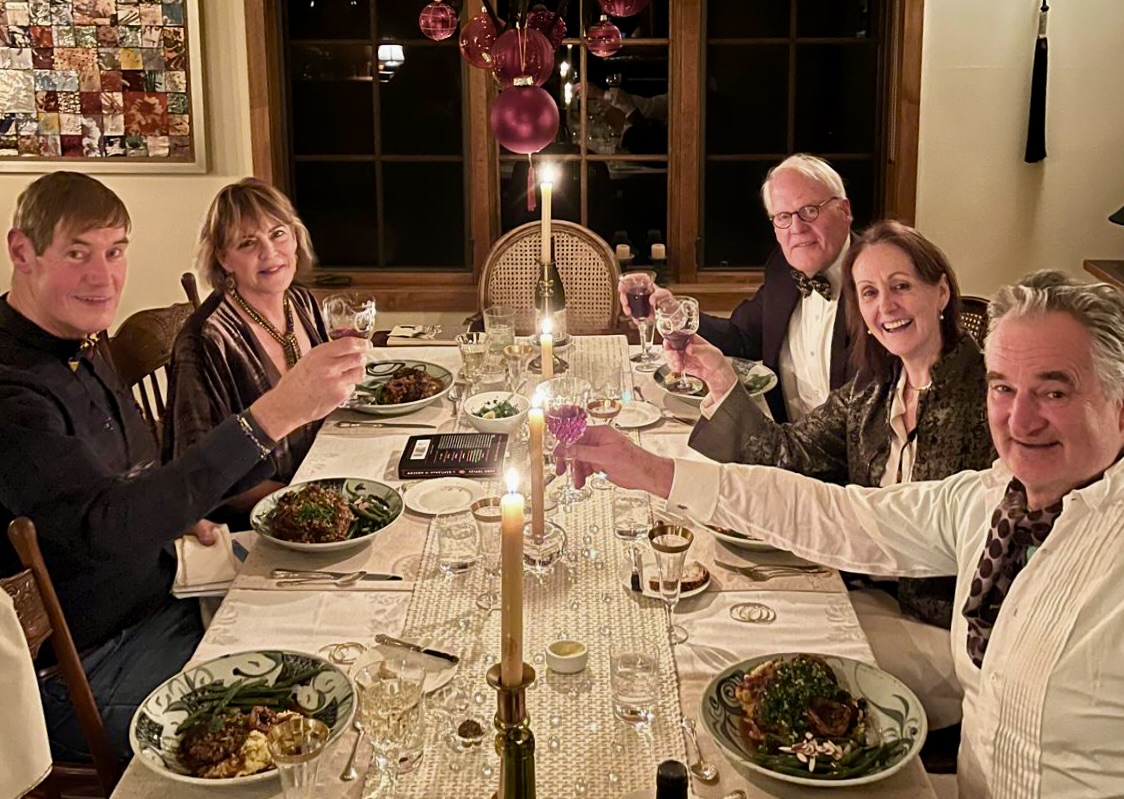
The discussion of memorable mollusk eating moments surfaced over brunch at the Stanley Hotel in Estes Park with four overseas friends, all of whom we met while living in Taipei, Taiwan in the 1990s. These two favorite couples visited us during the first weekend in January. The subject came up of the best calamari, the best mussels, the best shellfish any of us could remember eating. An oyster story came to mind, but the conversation moved on.


As a child, growing up in the middle of the United States, I knew nothing about oysters, raw or cooked. It was “foreign” to the food culture in mid-America and never served at home in any season or for any special occasion. Experimenting with new foods and an expanding palate changed in adulthood after living and traveling around Asia, the Mediterranean, and Europe for three decades from the late 1980’s to the 20-teens. But it was moving to France in 2010 that jump-started my true consideration of the oyster.
As a species, oysters are odd and unattractive creatures. In the wild, after spawning, they drift and roam freely about in the tides for several weeks before attaching themselves to the first hard object randomly bumped into. Once attached, they grow by drinking gallons and gallons of water while straining out the delicious little bits that are food. They live motionless and soundless, trying to escape the notice and menace of predators, not the least of which is man who has a particular hunger for them. Fisher mused, “Its life has been thoughtless but no less full of danger, and once it is over then we (humankind) are perhaps the better for it.”
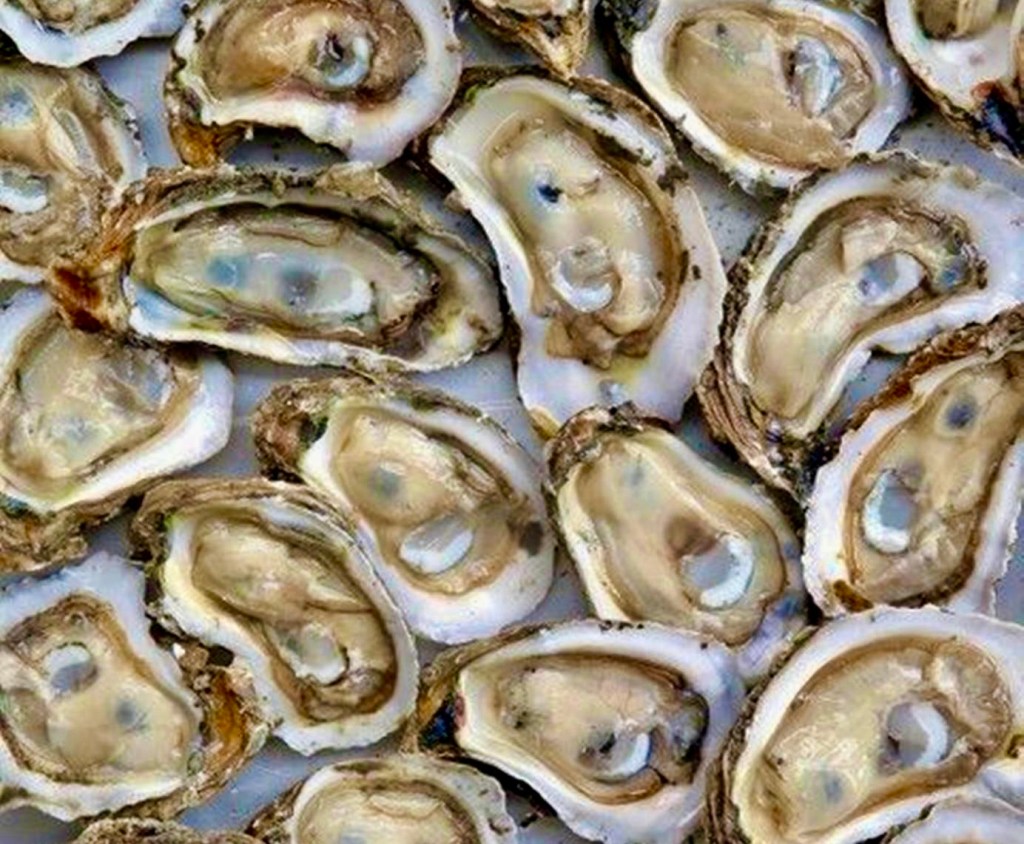
A commonly held wives’ tale is that oysters are edible only in months with an “R” in them. Not true. May, June, July and August are the months when coastline waters are warmest, and reproduction occurs in wild-harvested oysters. Fisher notes that eating them at this time will not kill you or make you sick, but “…all oysters, like all men, are somewhat weaker after they have done their best at reproducing.”
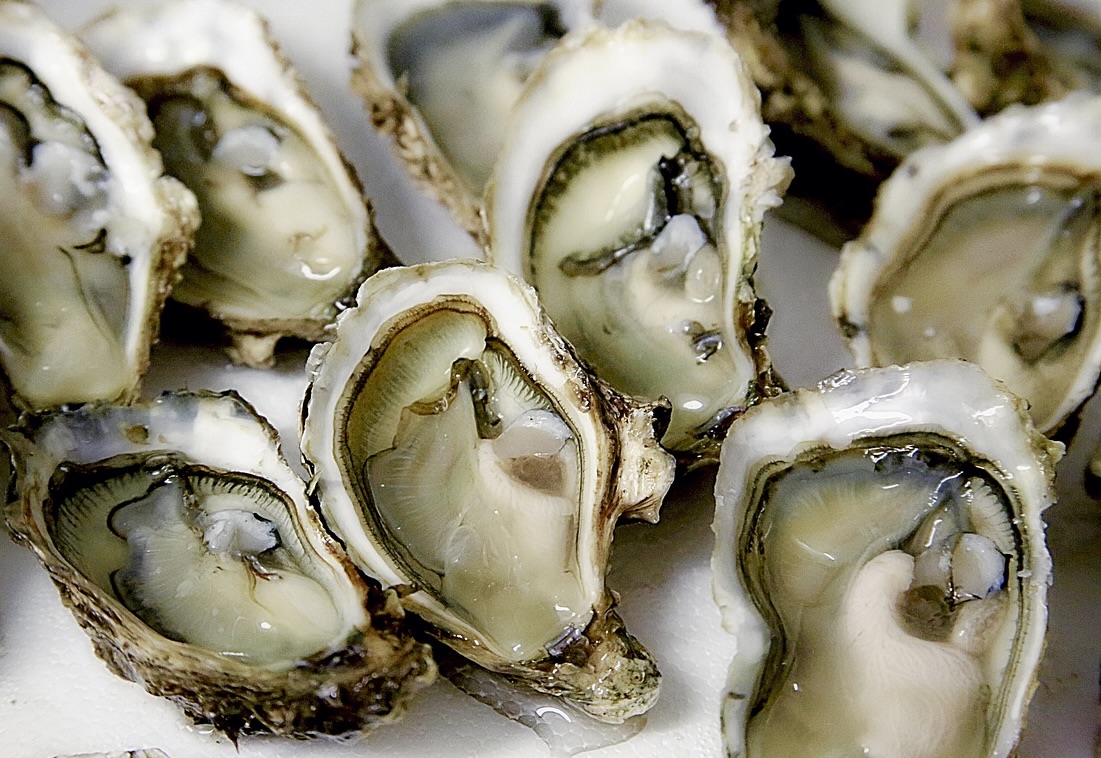
Oysters are simply good any time of year…if they are fresh, and taster like the taste of oyster. They are nutritionally healthy, full of chemical elements our own bodies house and need–oxygen, hydrogen, nitrogen. Vitamins in oysters provide fuel for energy, build healthy bones and teeth, and nourish the skin. And they contain more phosphorus, the most important food for the brain, than any other food source!
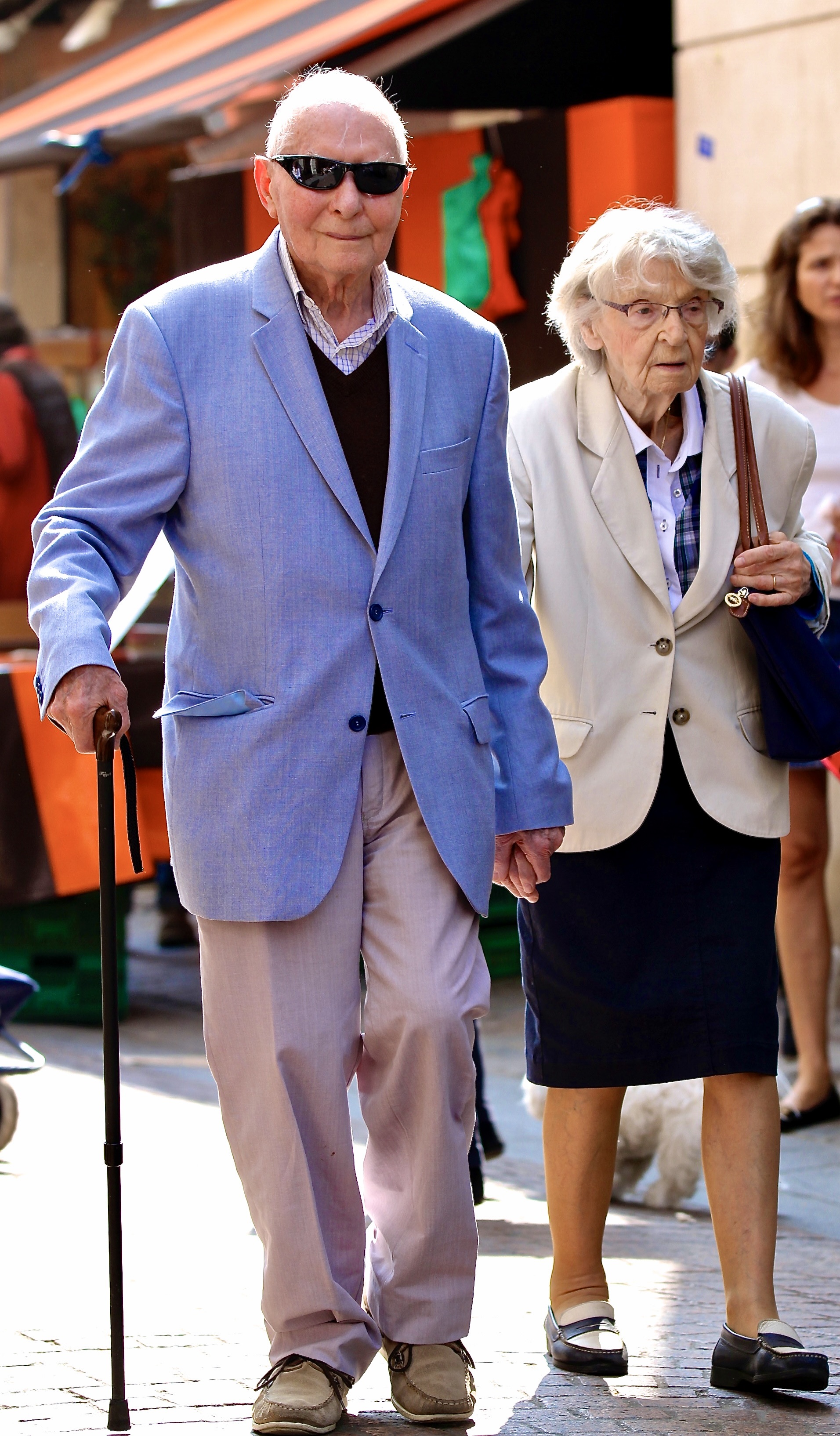
Back to Paris. Our market street in the Passy area of the 16th Arrondissement was noisy, vibrant and colorful on weekend mornings. Parisians chatted with neighbors and friends while sipping “un café” or shopping for ingredients in preparation for “le déjeuner en famille”. Children and dogs were ever present. Live music was often part of the hubbub.

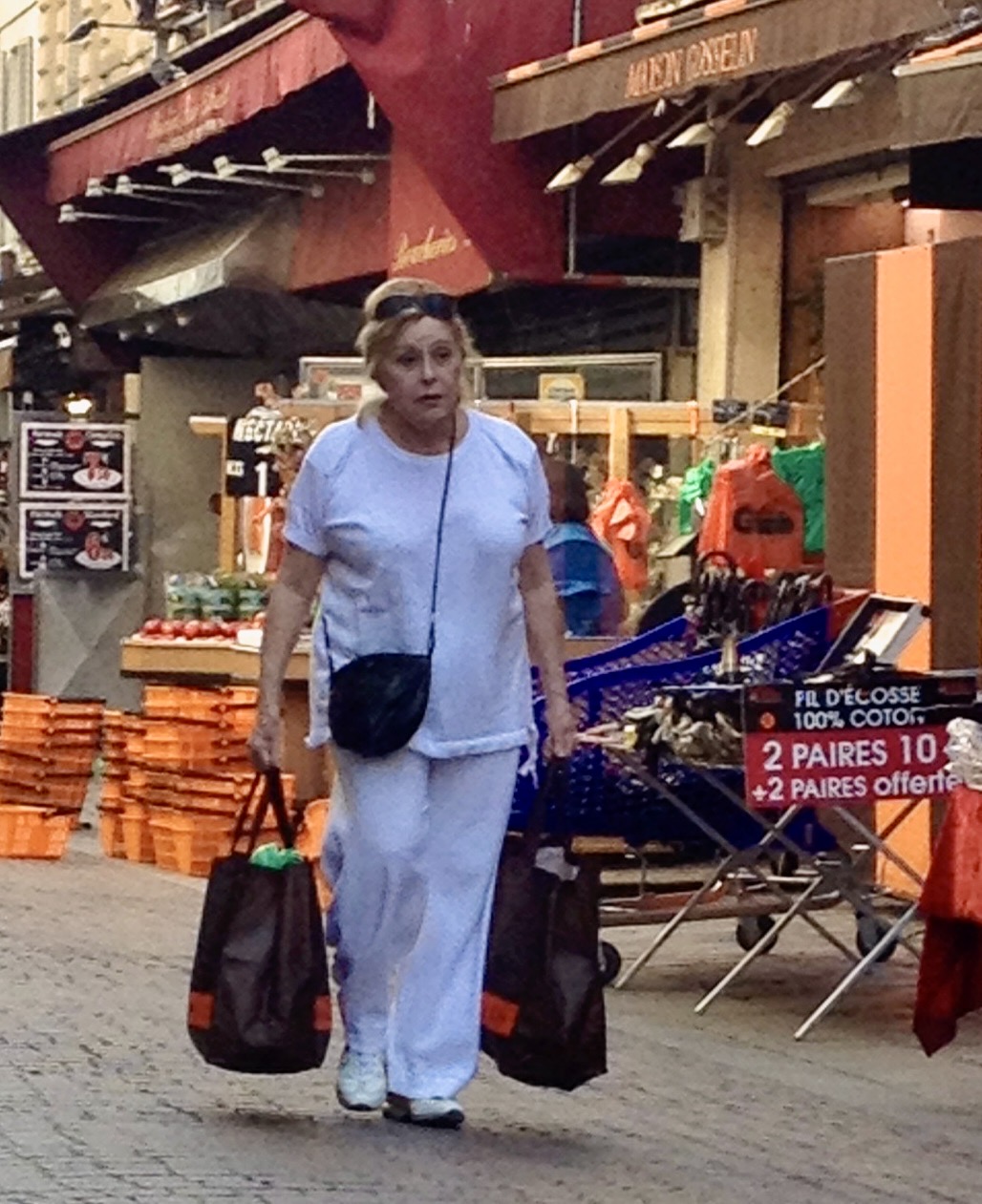


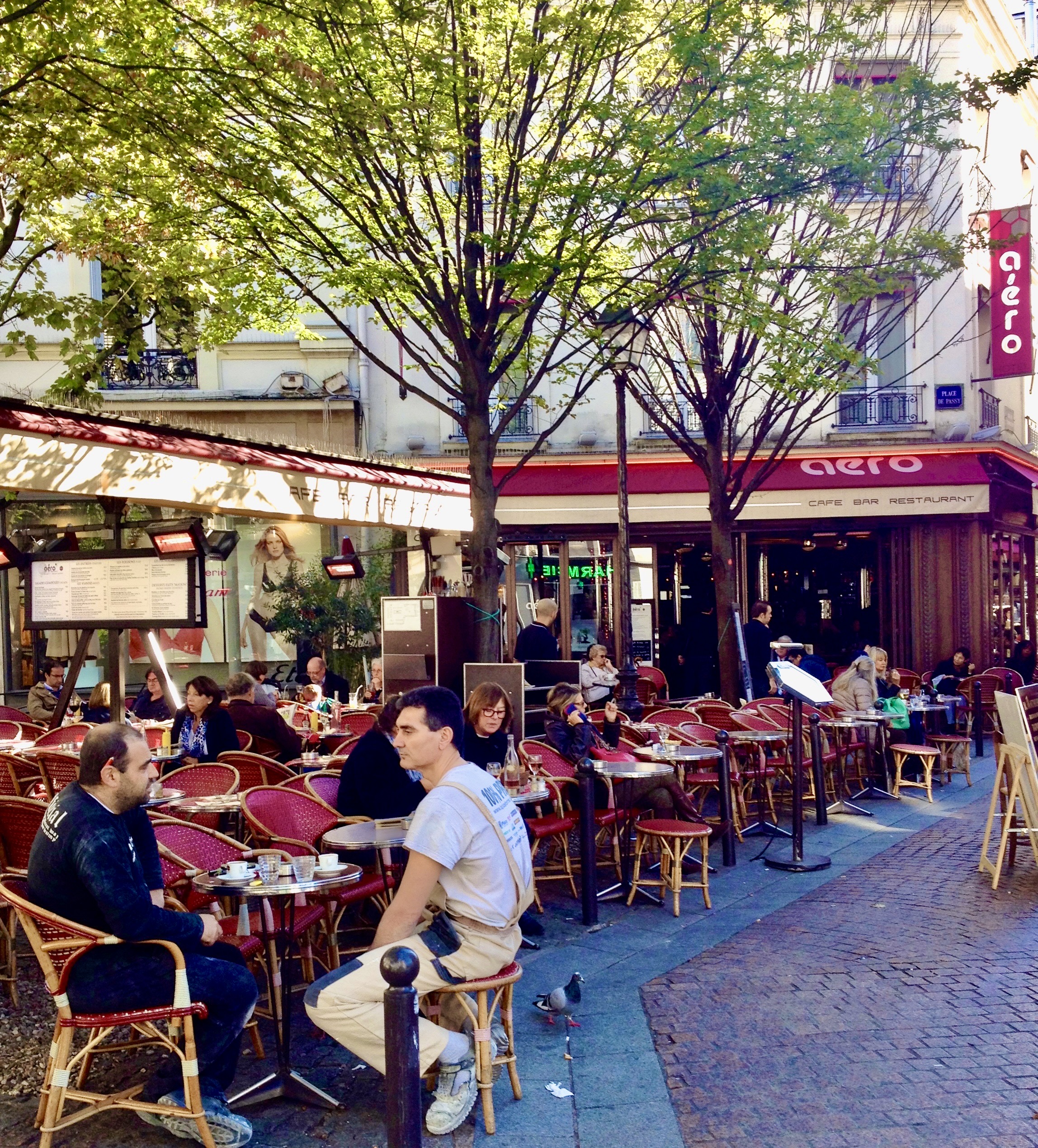
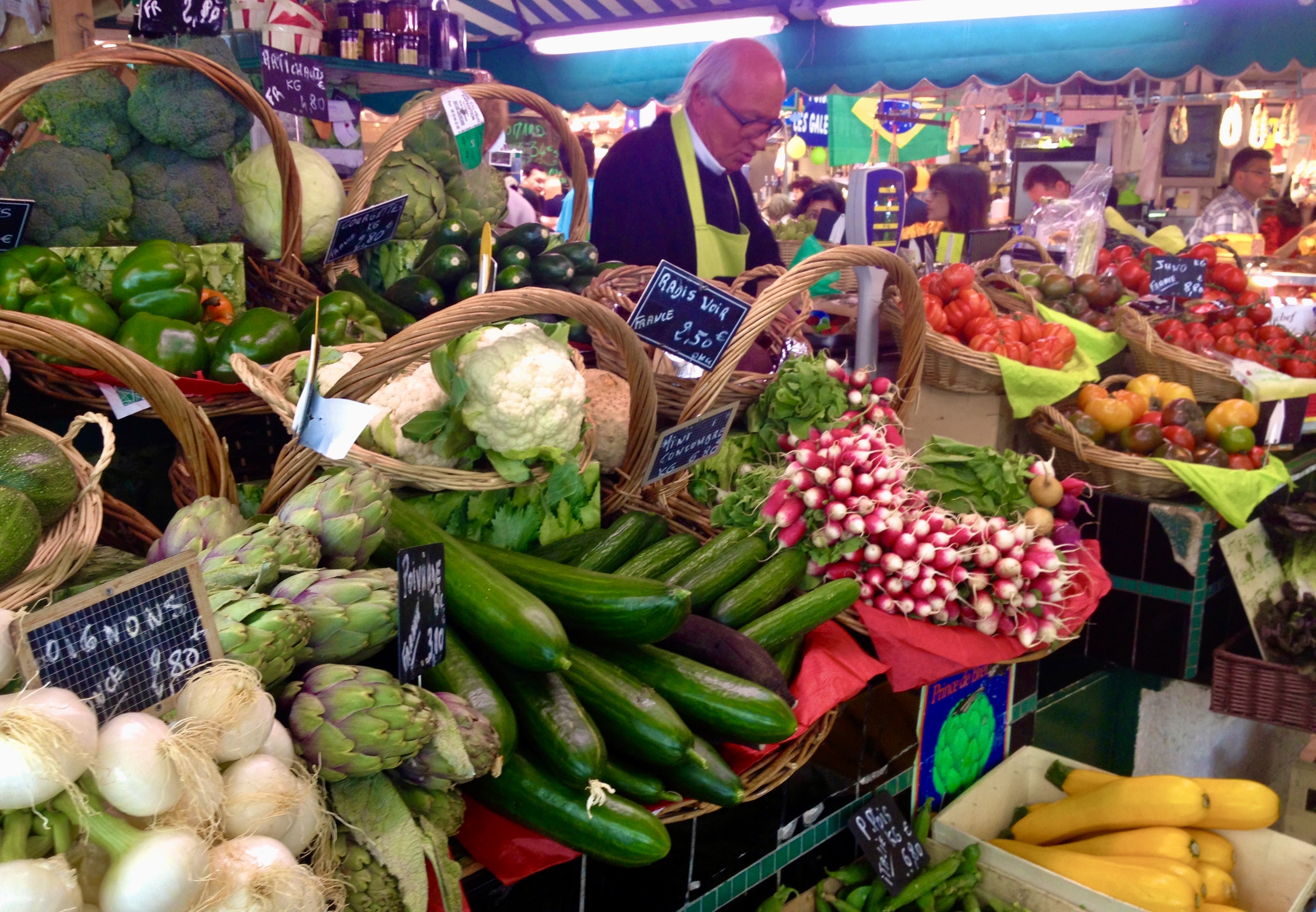
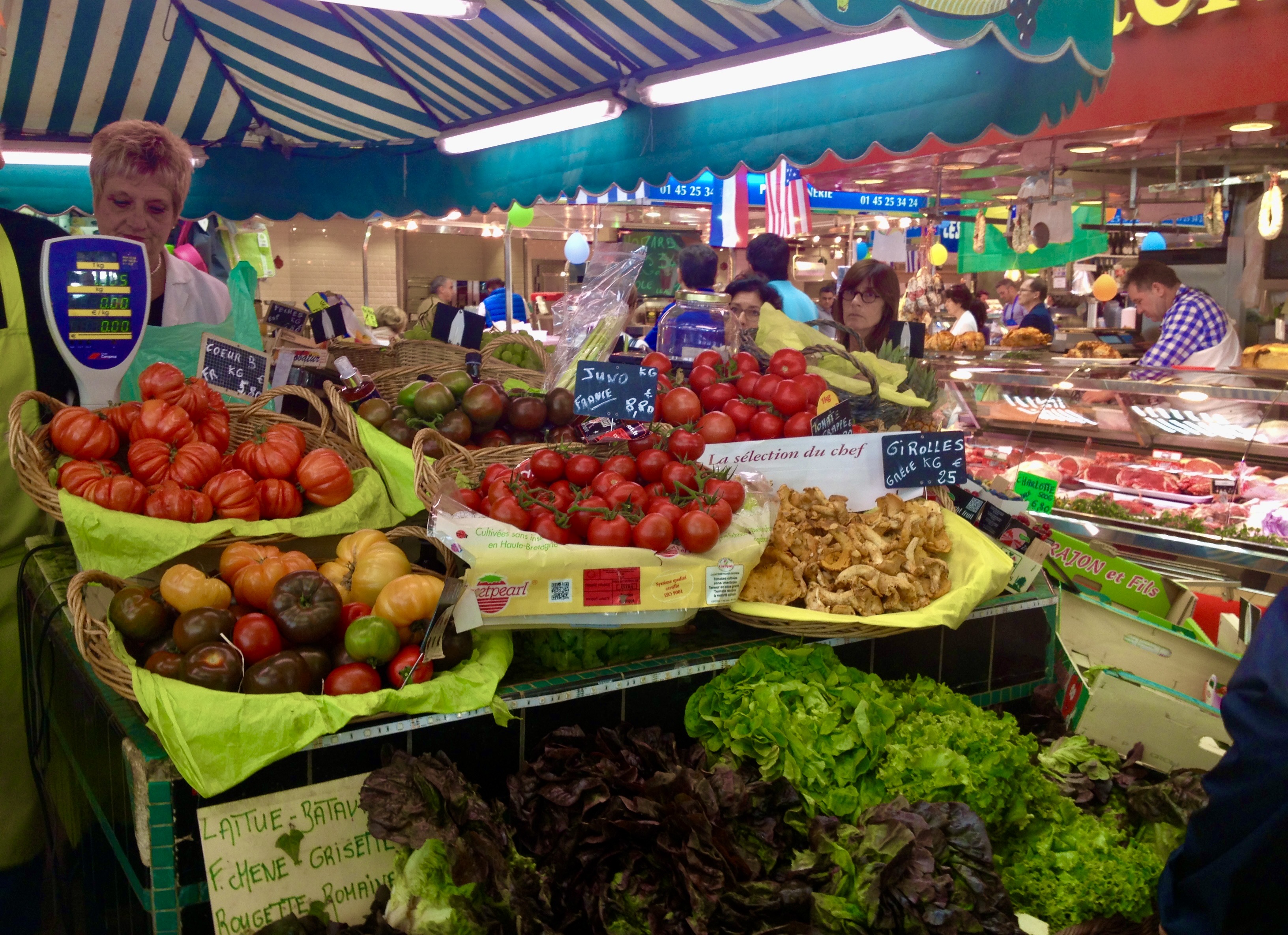
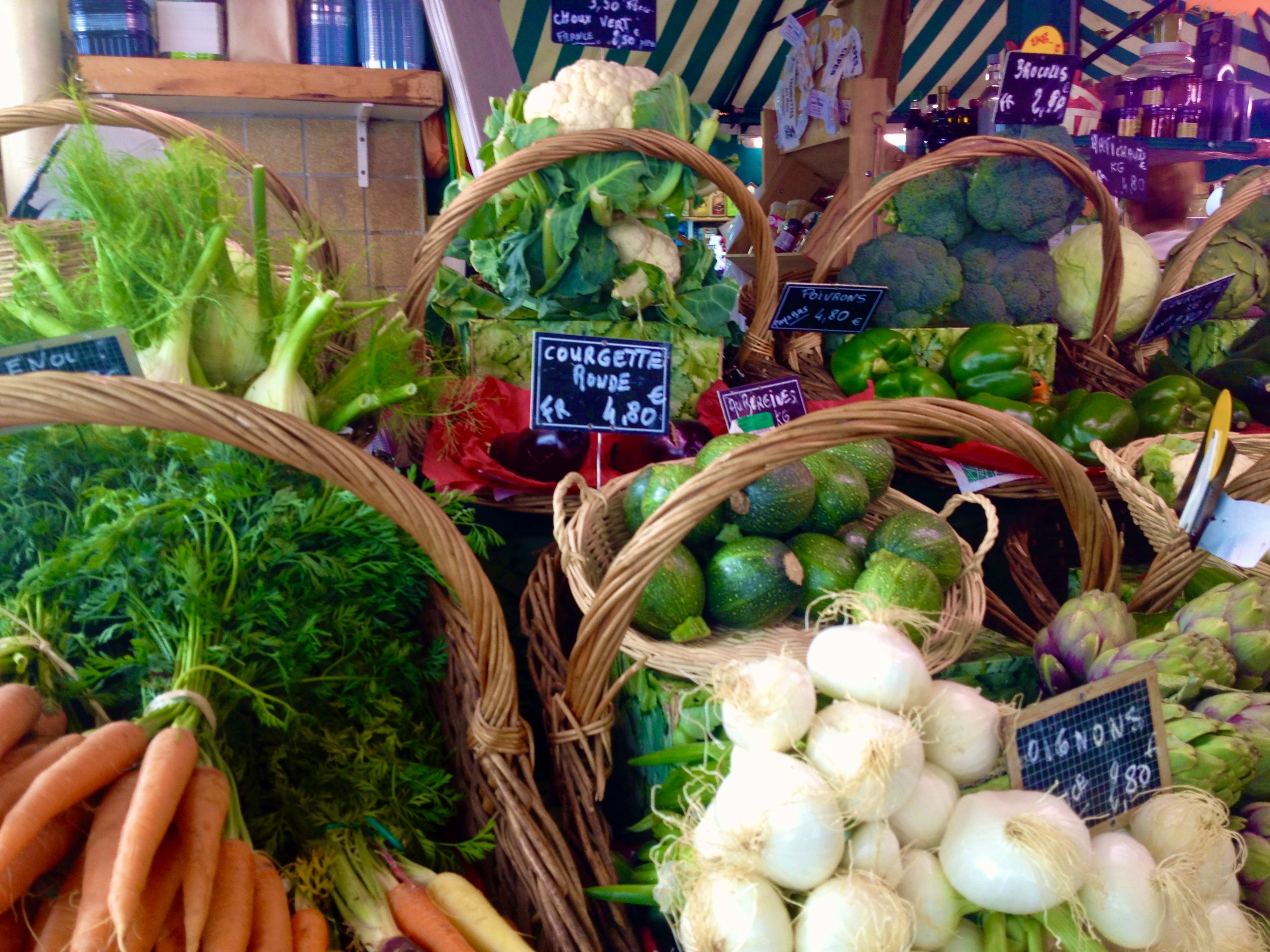
At the beginning of Market Street, on the corner across from our frequented Café Aéro was an all-in-one covered market. The front wall opened to the outside during operating hours, while the green and white tented roof offered overhead protection year-round. Inside, vendors sold everything from fruits and vegetables to fresh flowers, to breads and pastries, cheeses, fish and meats, and even household goods.
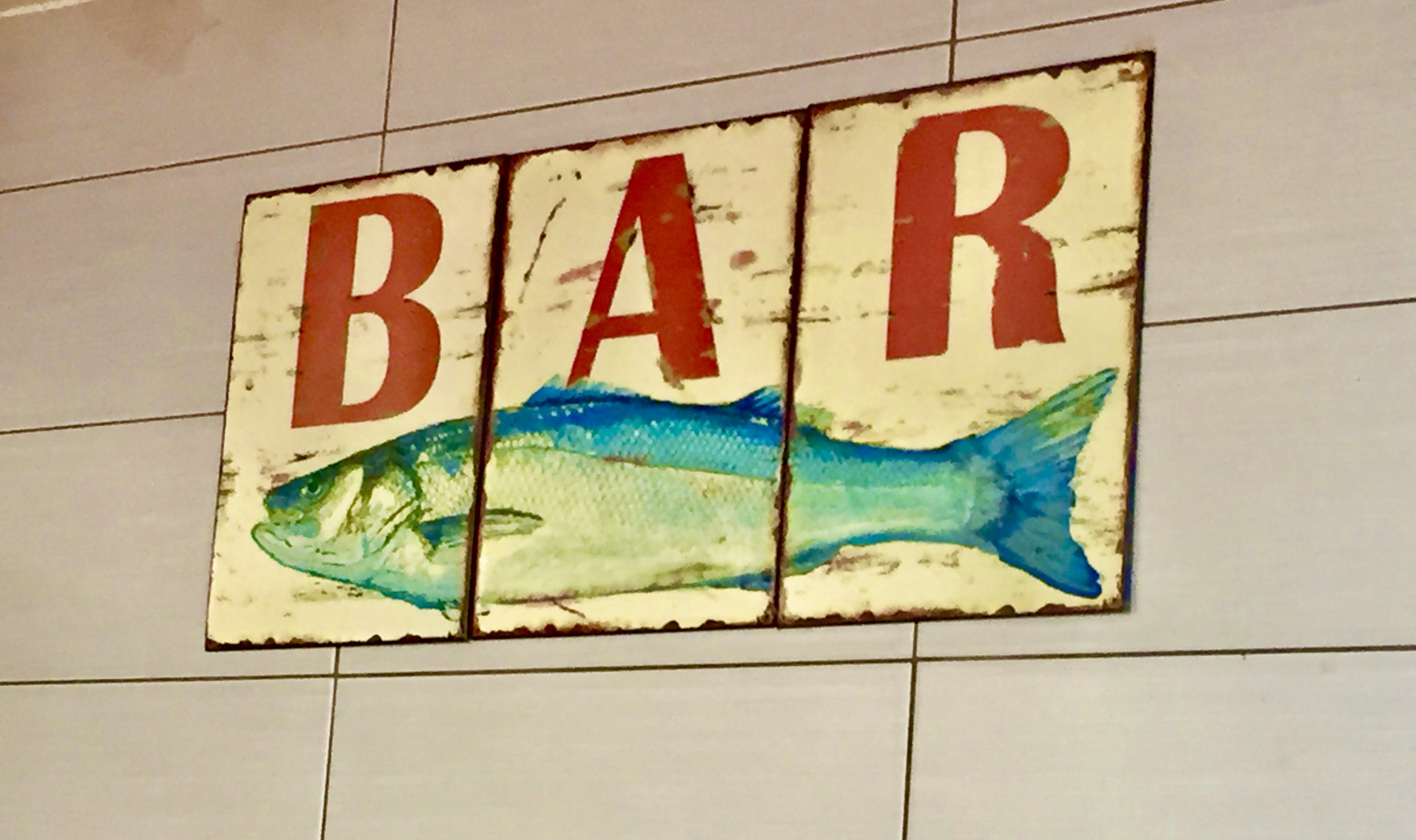
In the back, with perhaps four tiny high-top tables and stools, was a seasonal oyster bar. A wall of nondescript beige tiles posted a rusting sign saying, “BAR” in red letters, and a colorful fish underneath. Below the sign behind the bar a man rapidly opened oyster shells with skills that most do not possess. They were piled high on a pan in front of him.
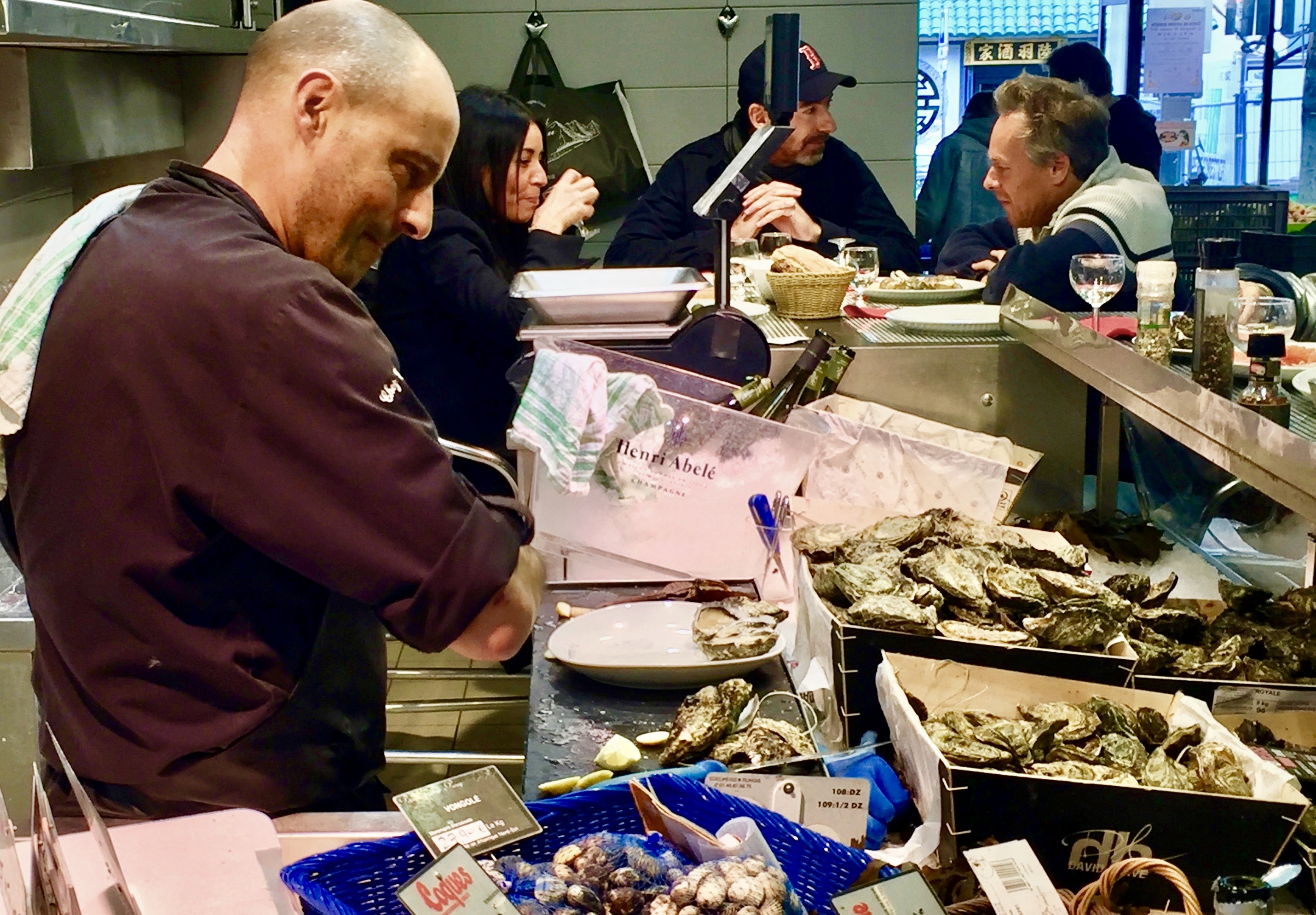
During the busy shopping morning in an unheated market, this minuscule seating area was constantly full of oyster loving customers. With luck and perfect timing, my husband and I slipped onto empty stools at a table for two right next to the bar. And here began the ritual we learned to love.
The petite table was square with white stripes, set with large red paper napkins, a knife and fork. I can’t tell you the name of one oyster we ate all those years, but every variety was delicious and shipped directly from the west coast of France. We pointed, and a dozen were placed immediately in front of us on a round plate with a bowl of fat lemon wedges in the middle. Then, a basket of dark brown bread and sweet butter was delivered, and finally, two glasses of crisp white wine, normally a Chablis from Burgundy. We began by toasting a moment of lusty shellfish eating bliss.
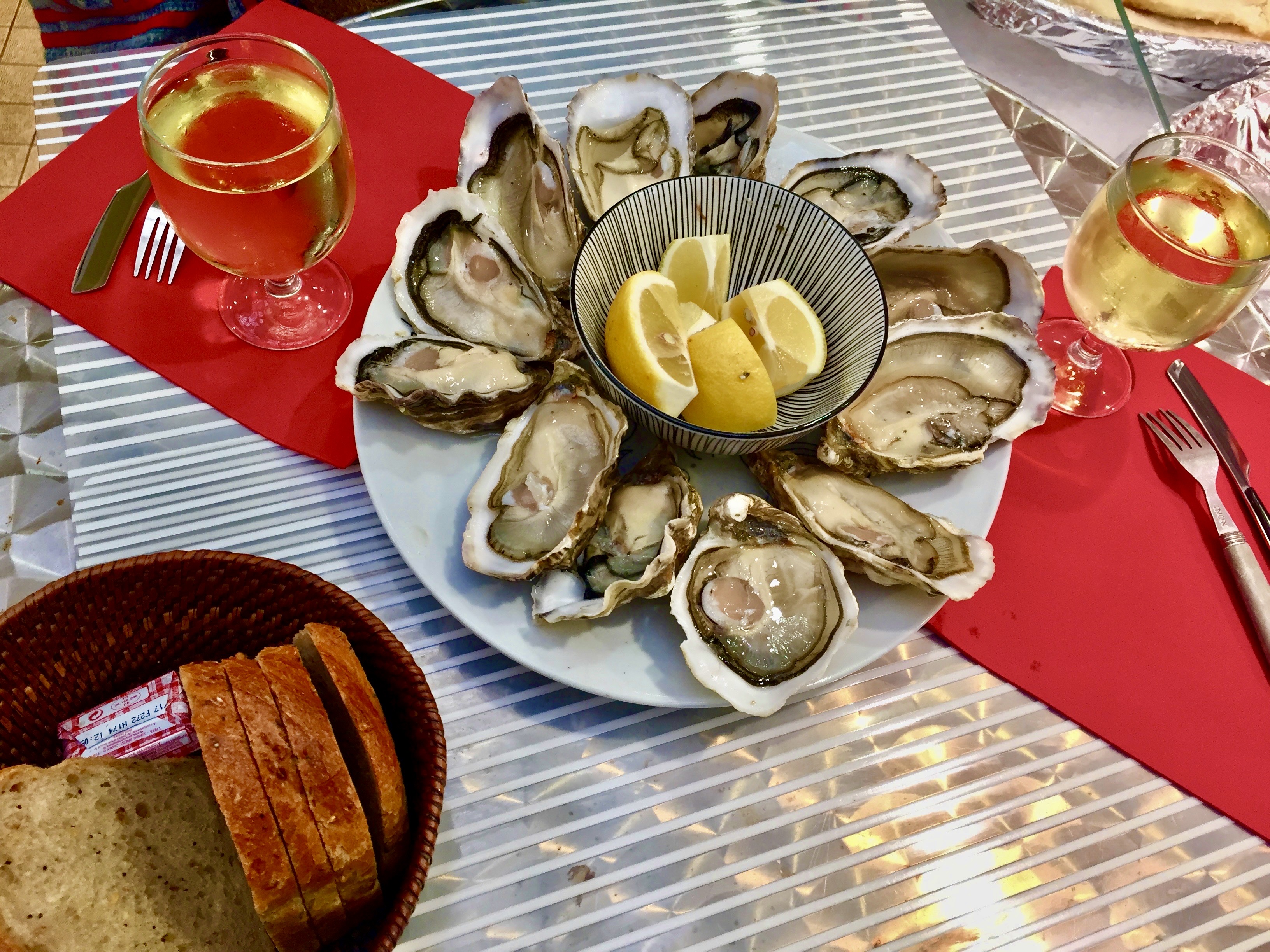
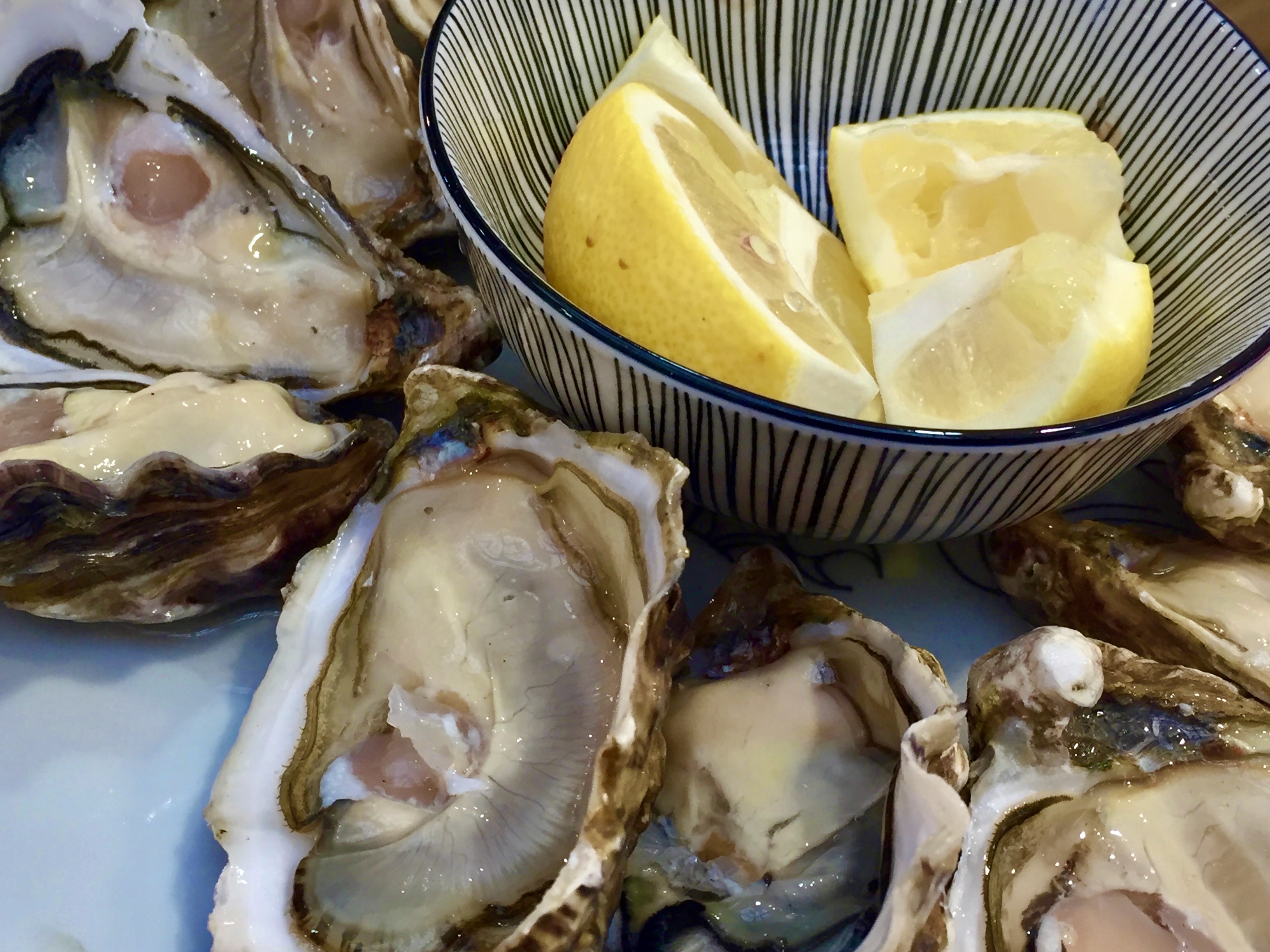
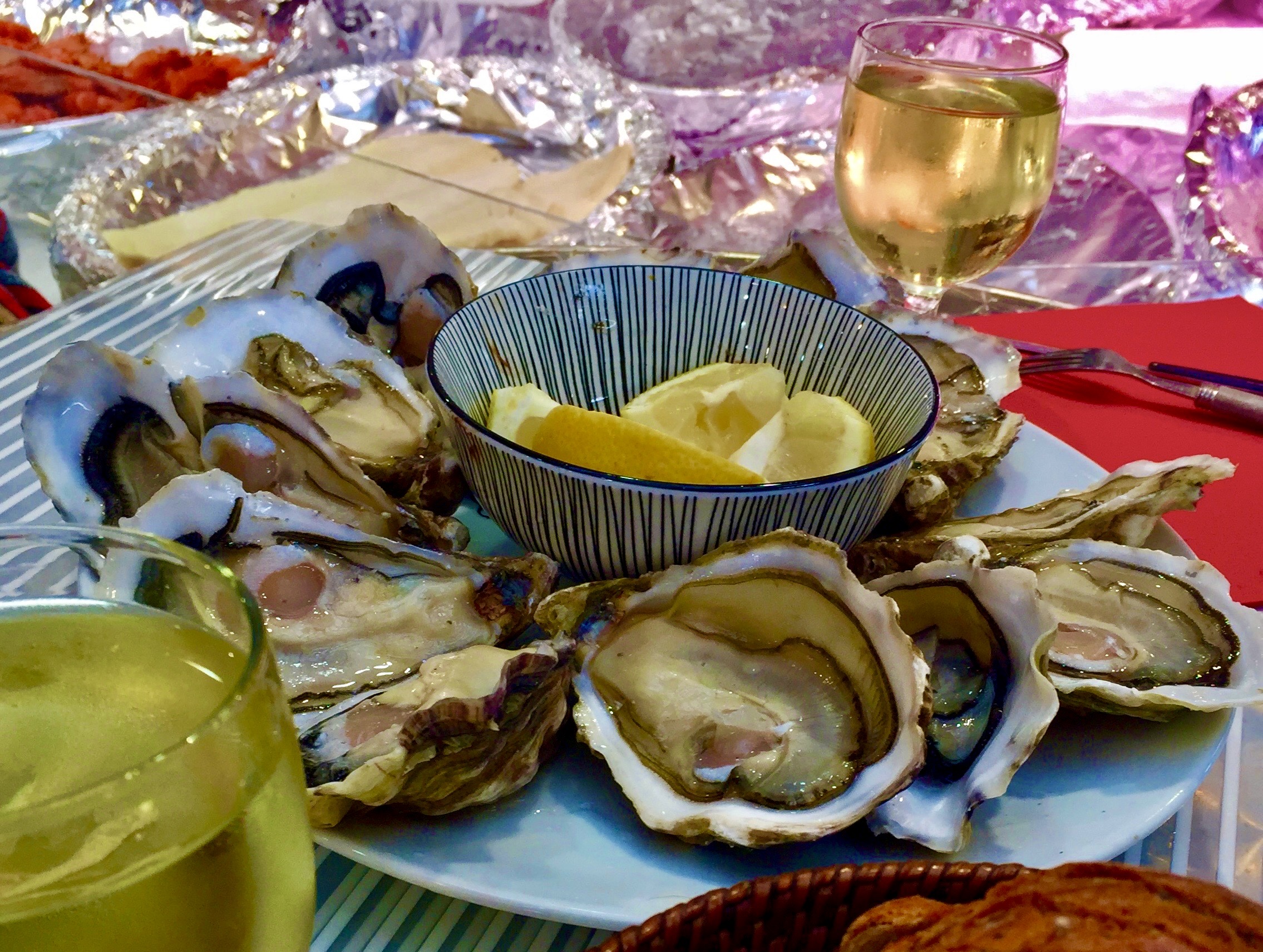
M.F.K. Fisher discovered that a few drops of lemon juice on the buttered bread tasted even better than on the oysters themselves. I tried it both ways–on the oysters and the bread. Her serving opinion proposed this rule “…that all oyster-bars and every self-respecting restaurant…which presumes to serve raw oysters in their shells…should at once make it compulsory to serve also a little plate of thin-sliced buttered good dark bread, preferably the heavy fine-grained kind…and a few quarters of lemon.”
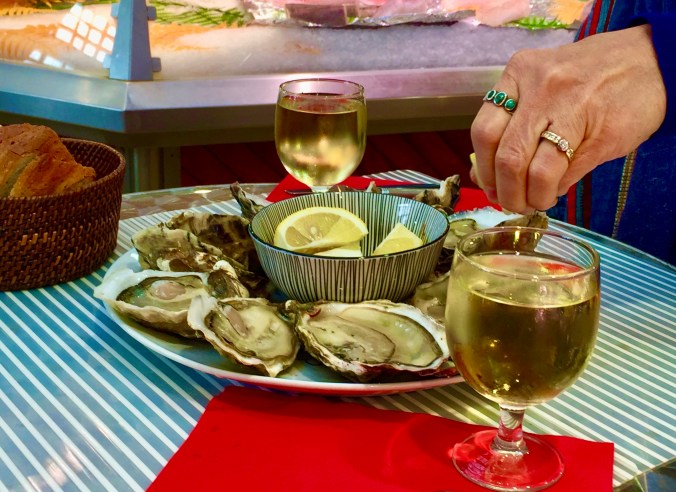
Entirely agree. And that is why eating oysters at the back of a market in Paris wintertime was about more than the taste of fresh seafood. It was about the air temperature, the crowded ambience, the skilled shucking of the oysterman, clinking glasses over our good fortune, squeezing lemon juice over briny oysters, tasting the salt and sea and citrus combined, and then biting into buttered brown bread followed by a swallow of fine wine.
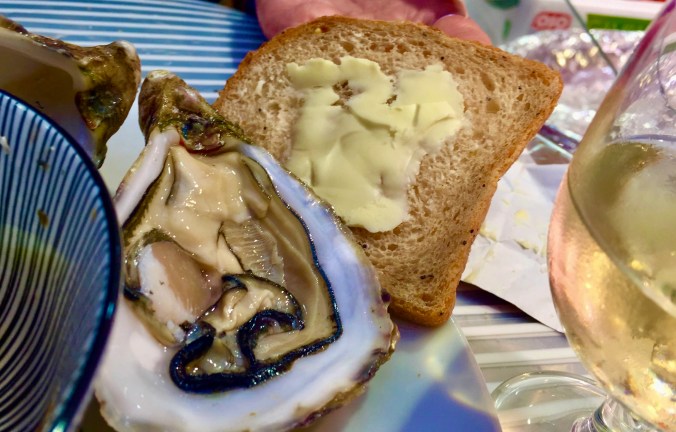
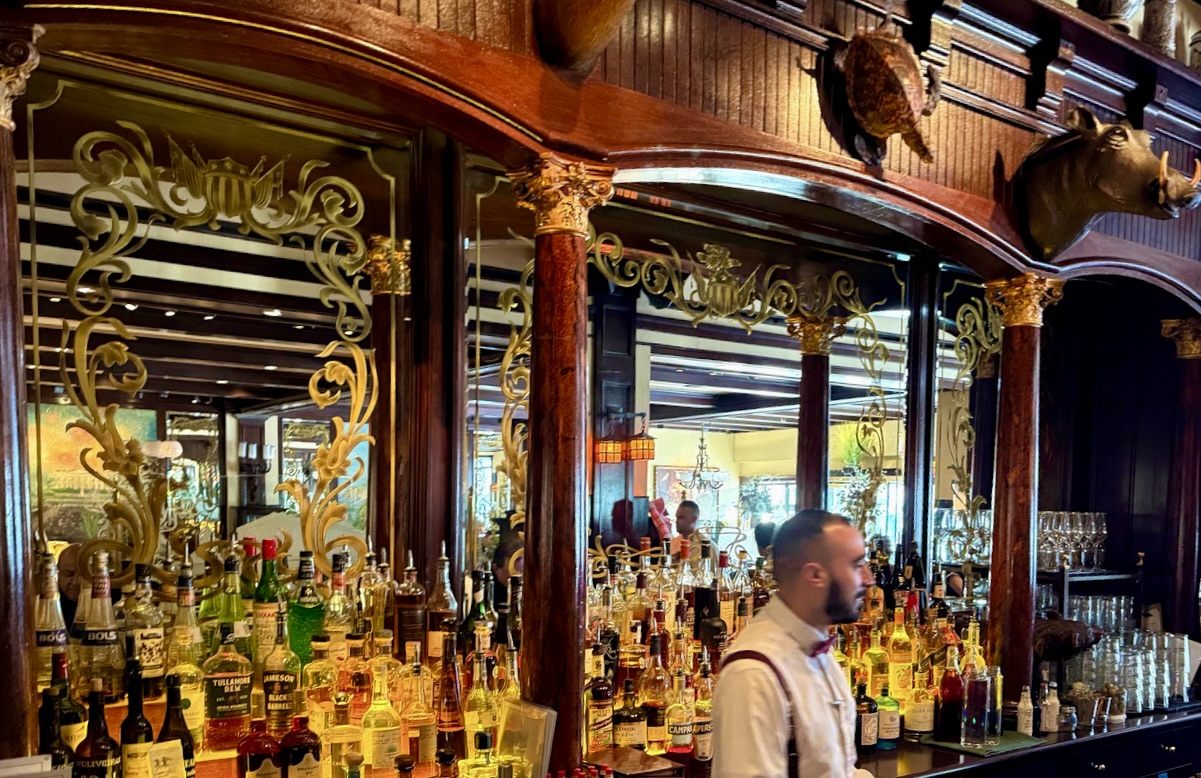
The oyster bar ritual dwindled and lost some consideration when we repatriated home to Colorado. Then, several years later, I fell into another captivating mollusk moment–this time in Washington, DC. As Fisher implied, place and time can outrank food, and this proved true again alongside an icy platter of oysters. Now the place is venerable Old Ebbitt Grill, mostly in the wintertime. Inside, at the antique bar, the precise area where I sit and who I am sitting with creates the magic that follows.
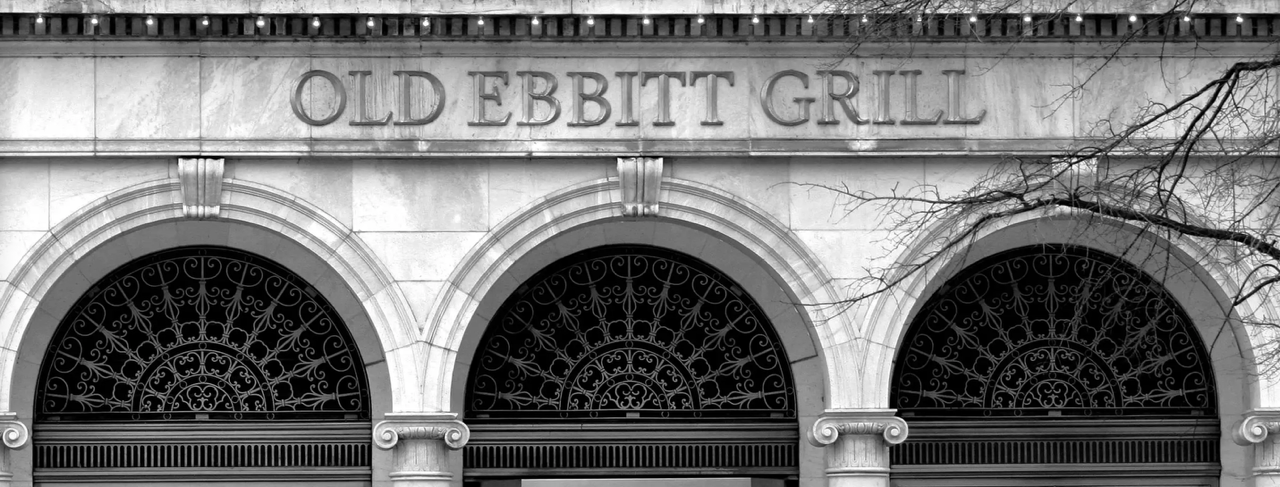
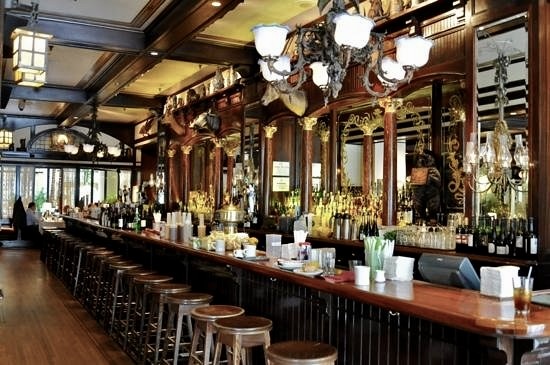
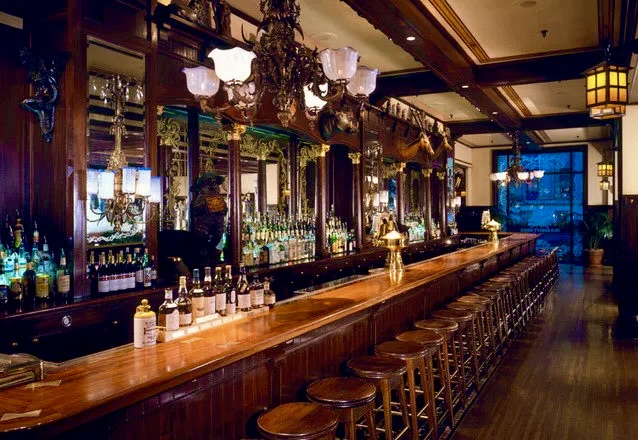
Two well worn wooden stools at the far end, away from the entrance, should be open so that we can slide onto them side-by-side. The chosen ones with me are either my husband or a best friend. Sometimes both. We peer in dim lighting across the burnished surface in front of us to the gilt-edged mirrored wall lined with bottles, greet the bartender, and begin by sipping a good cocktail or a pour of dry white wine or draft beer. We speculate quietly over far-ranging conversation for as long as we want. All the while nourishing ourselves on one or two dozen oysters, with lemon of course.
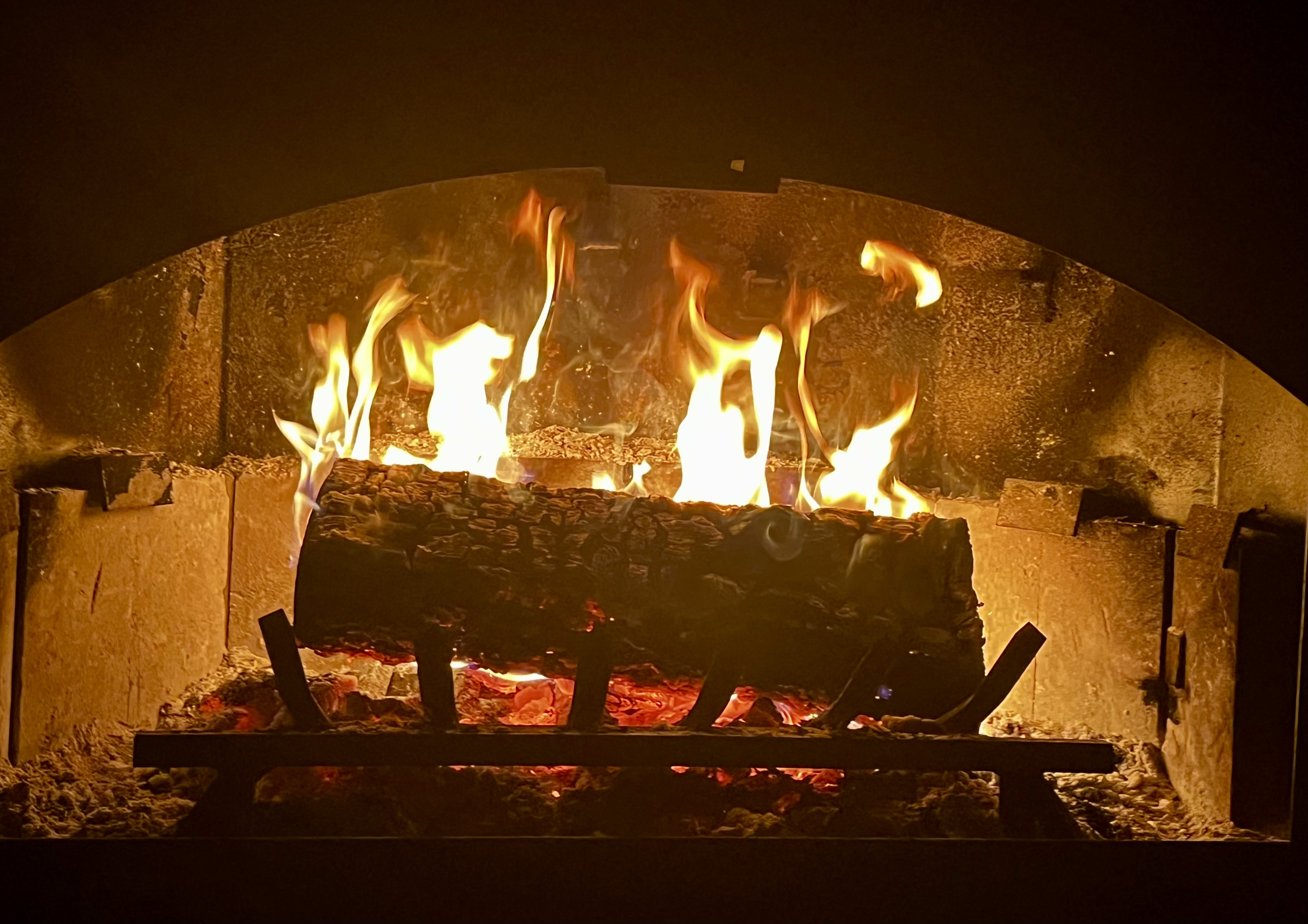
On a dark wintery Colorado evening, these vignettes keep me company in thoughtful “place and time” reminiscence of food moments shared with people I love everywhere in the world. As the wind outside blows at gale force, I pick up the wrought iron poker on the hearth, add a piece of firewood, and prod logs from red coals into warm yellow and orange flames.
Discover more from A Taste of Mind
Subscribe to get the latest posts sent to your email.


Beautifully written… I just wish I liked oysters!
Love you!
LikeLiked by 1 person
Dubs! I really enjoyed this one Wendy. You painted a picture of sights, sounds, and smells that made me feel happy and envious of your oyster adventures all at the same time. I definitely agree with both you and MFK Fisher that time and place and people play such a large influence on memorability. I find this fact to ring true when sharing beers too!
-Kyle
LikeLiked by 1 person
Kyle, I LOVE that you read and liked this one. And to know that you know the feeling of memorable times with people and food (and beer) anywhere in the world.
LikeLike
Well done, Wendy! Oysters have never been a favorite of mine, but the only ones I have tasted were the ones from a can in very thin milky broth served before Thanksgiving and Christmas when I was growing up. Your description makes me want to try the ones you write about. Thanks!
LikeLiked by 1 person
Loved the pictures of your Paris market as I too frequented it while visiting you! I am amazed that you have such beautiful pictures from those years even before you knew that a decade later you would be writing about it! As far a oysters go, they are not for me. Maybe because the only ones I have ever had were sandy and gritty; perhaps not the best representations. Nonetheless, your pictures and descriptions encourage me to try them again! bon appetit!
LikeLiked by 1 person
If you have a bad oyster experience, it will likely be your only one. Let me show you the way. But we must get back to Paris together!
LikeLike
I, too, adore oysters. Our mother ate three dozen about four years before she died. She found two tiny pearls that affected her denture fit! When you visit in February, we may go and have some oysters. Strange in the Midwest, but very delicious. Your narrative was enticing as were the pictures. I am so proud of you of your ability to put words and pictures together in such a beautiful way ❤️❤️
LikeLiked by 1 person
Well, though I appreciate your appreciation, I cannot embrace “the mollusk de jour” . Now the dry white wine???? Oh yes!
LikeLiked by 1 person
Wendy, your writing and your zest for life absolutely delight me! Thank you for being you and for sharing your amazing adventures with us!
LikeLiked by 1 person
Kathy, A wonderful find to see you in the comment box! Sending much love back your way.
LikeLike
I never acquired the taste for oysters but Max loved them. I recognize the wood on the fireplace from your extensive wood pile!!
LikeLiked by 1 person
And we loved Max! I think your difficulty with oysters is you didn’t start by trying them in France! See you soon.
LikeLike
You stirred my memories of my grandfather treating my sister and I to shellfish any way we chose. Lundy’s Restaurant in Sheepshead Bay, Brooklyn served us copious platters of ice cold oysters, buckets of steamer clams, and steamed lobsters. Gramps allowed us a sip of his beer which set the stage for my lifelong love affair with beer. Thanks for stirring those memories on me.
LikeLiked by 1 person
Always nice to see your name in comments, Gerri-Ann. Glad you enjoyed the reverie into past oyster loving days.
LikeLike