Hope as a Destination

…and my life is still, trying to get up that great big hill, of hope, for a destination. I realized quickly when I knew I should, that the world was made up of this brotherhood, of manAnd so I wake in the morning and I step outside, and I take a deep breath and I get real high, and I scream at the top of my lungs, “What’s going on?”  –Linda Perry, 4 Non Blondes, song “What’s Up?”, 1993

Recently, I made an overnight trip to Chapel Hill, North Carolina, to visit my “artist buddy” Jane Filer. Several years ago, I wrote a biographical story about her life and her paintings after we met in Santa Fe, New Mexico. Read: Being Jane Filer Two of her pieces are in our living room, “Eclipse” and “Elephant Journey”, both of them highlighted in the article.

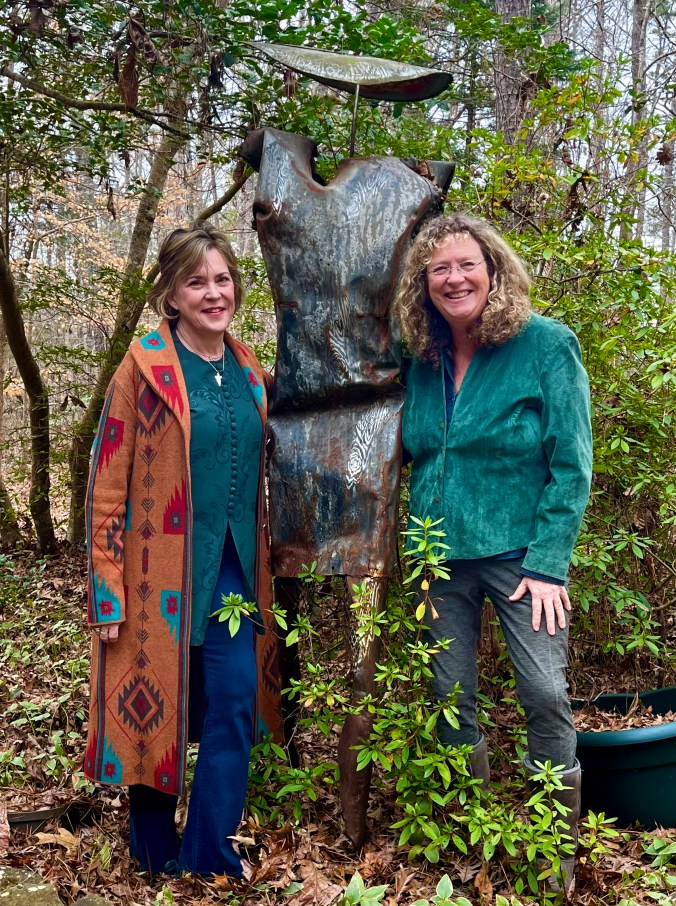
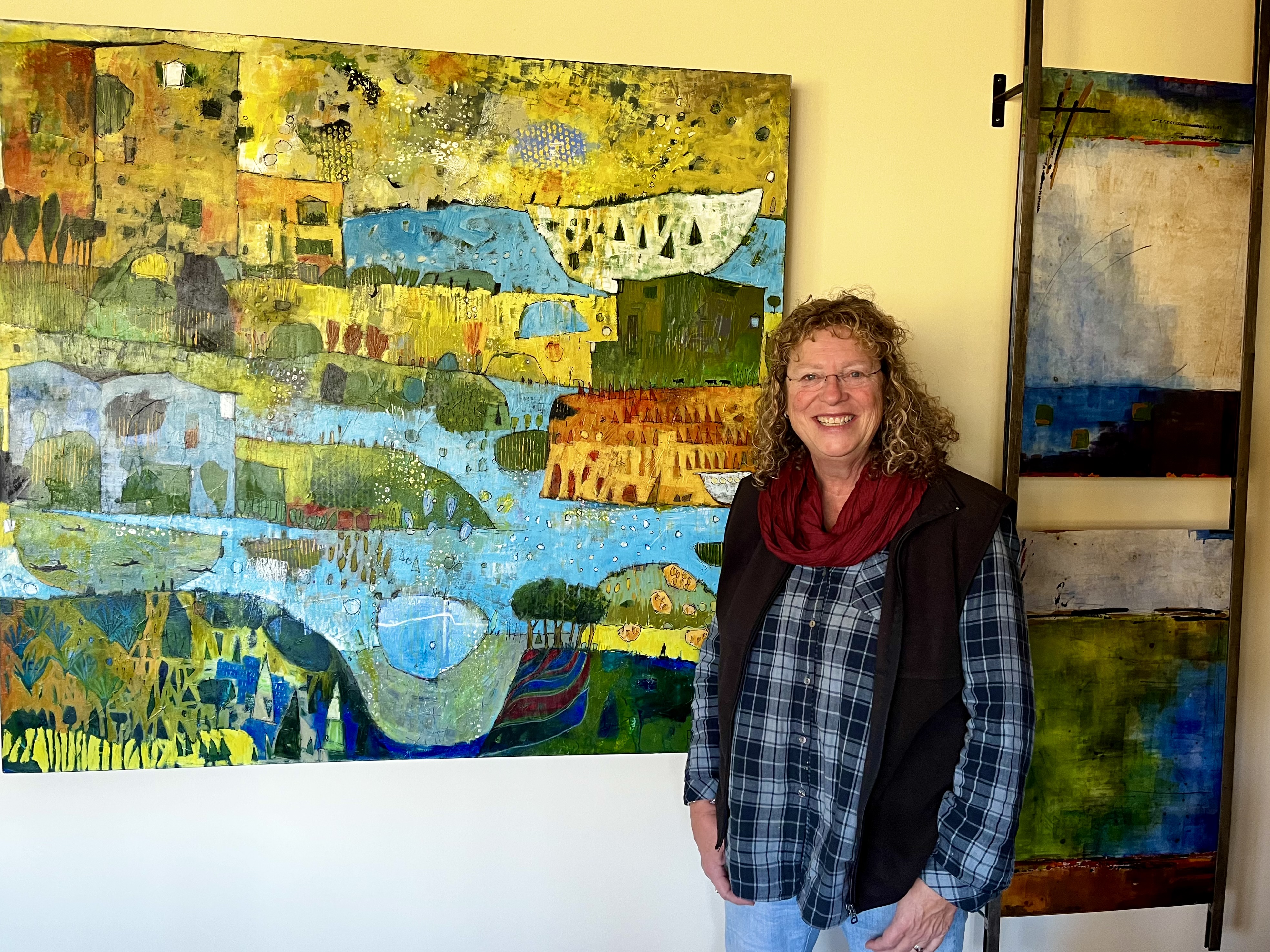
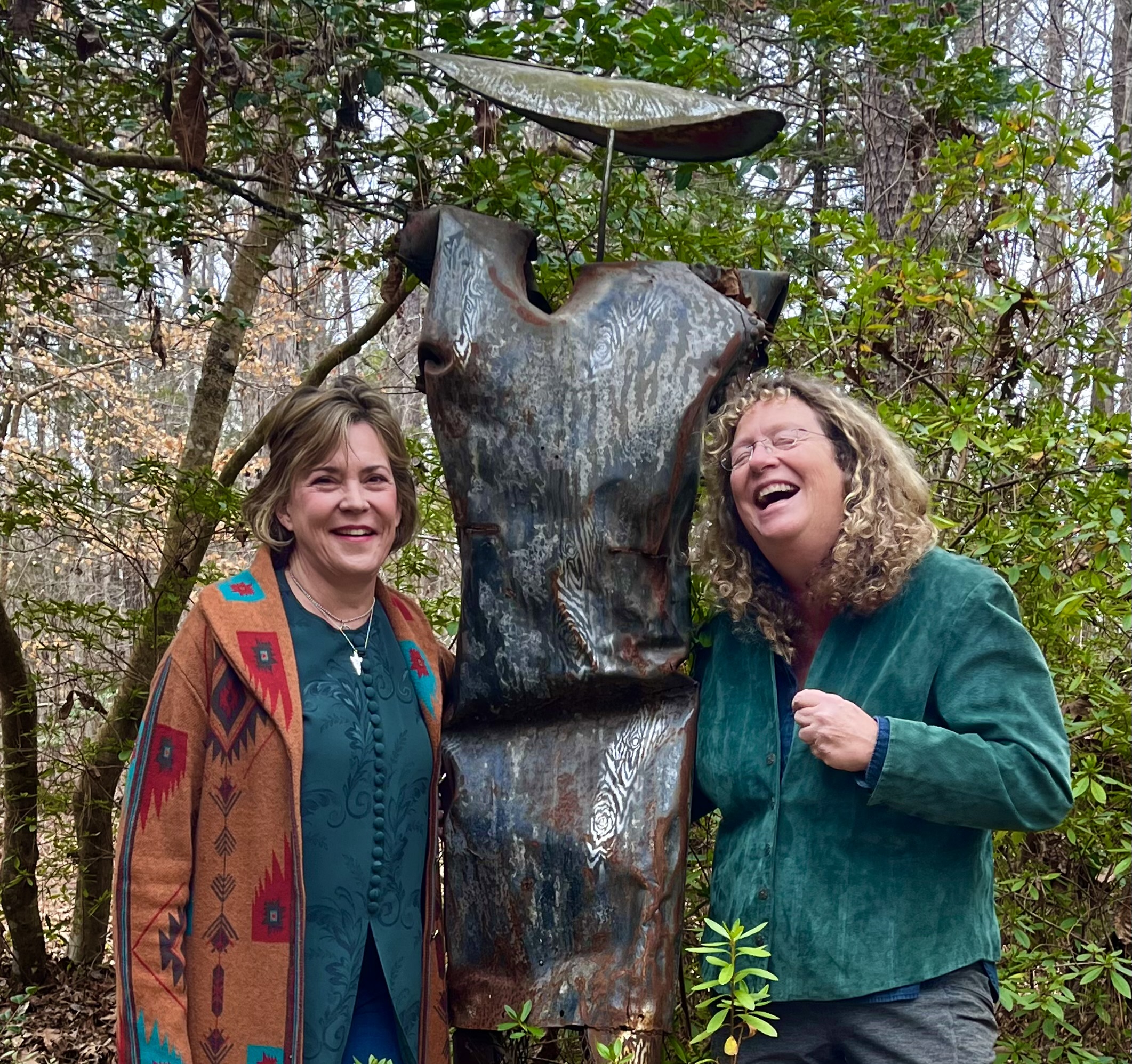
jane in the garden with headless hat woman

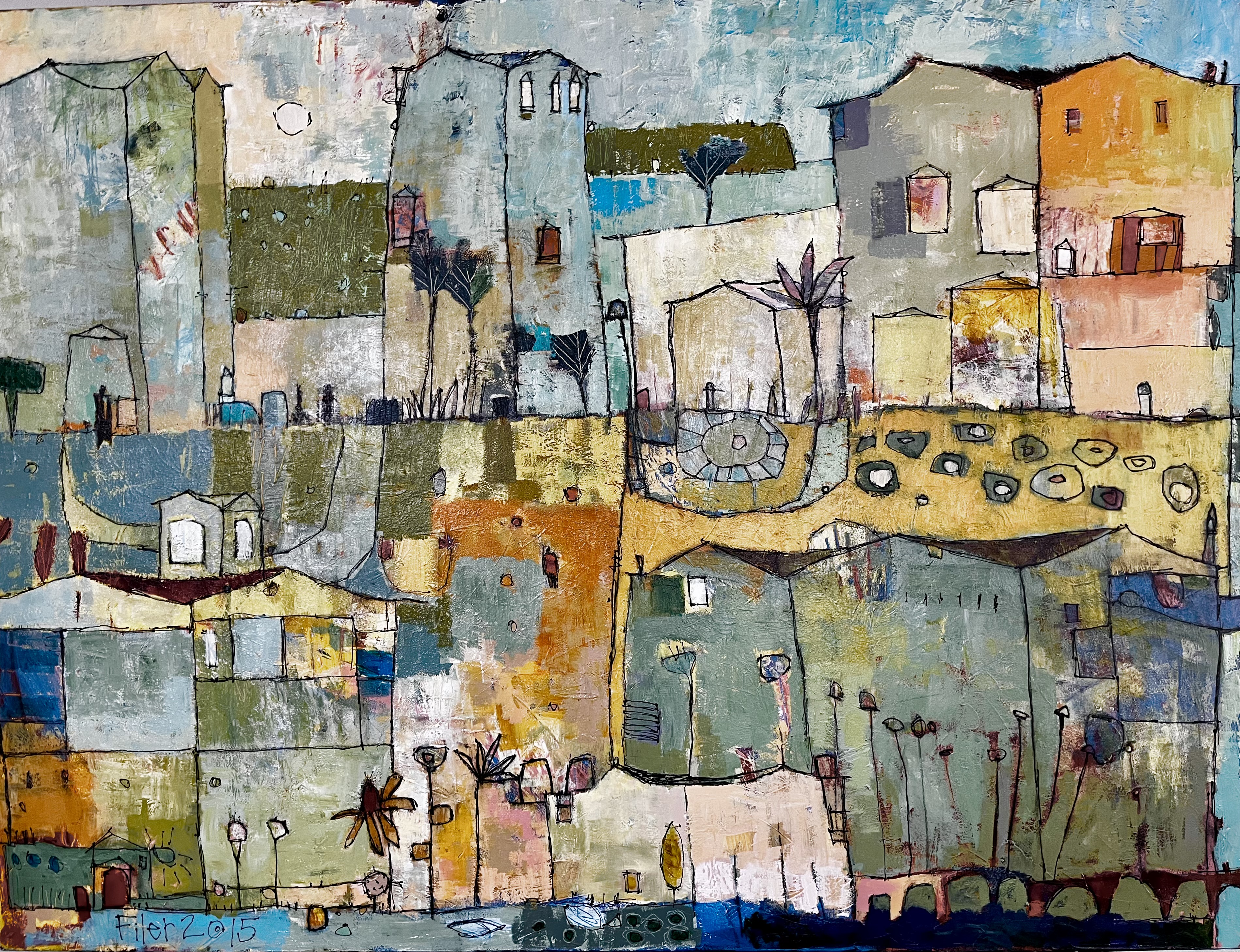
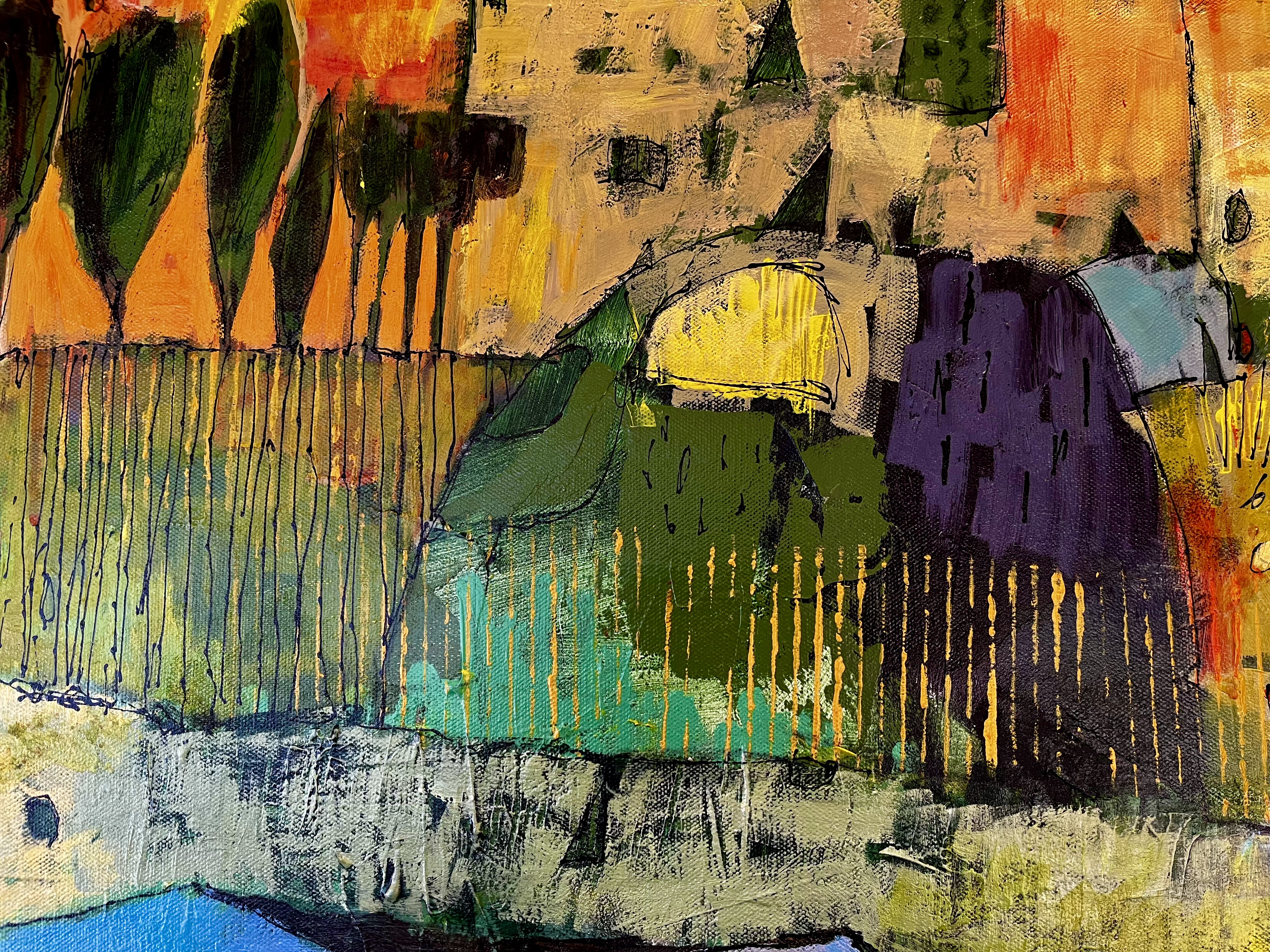
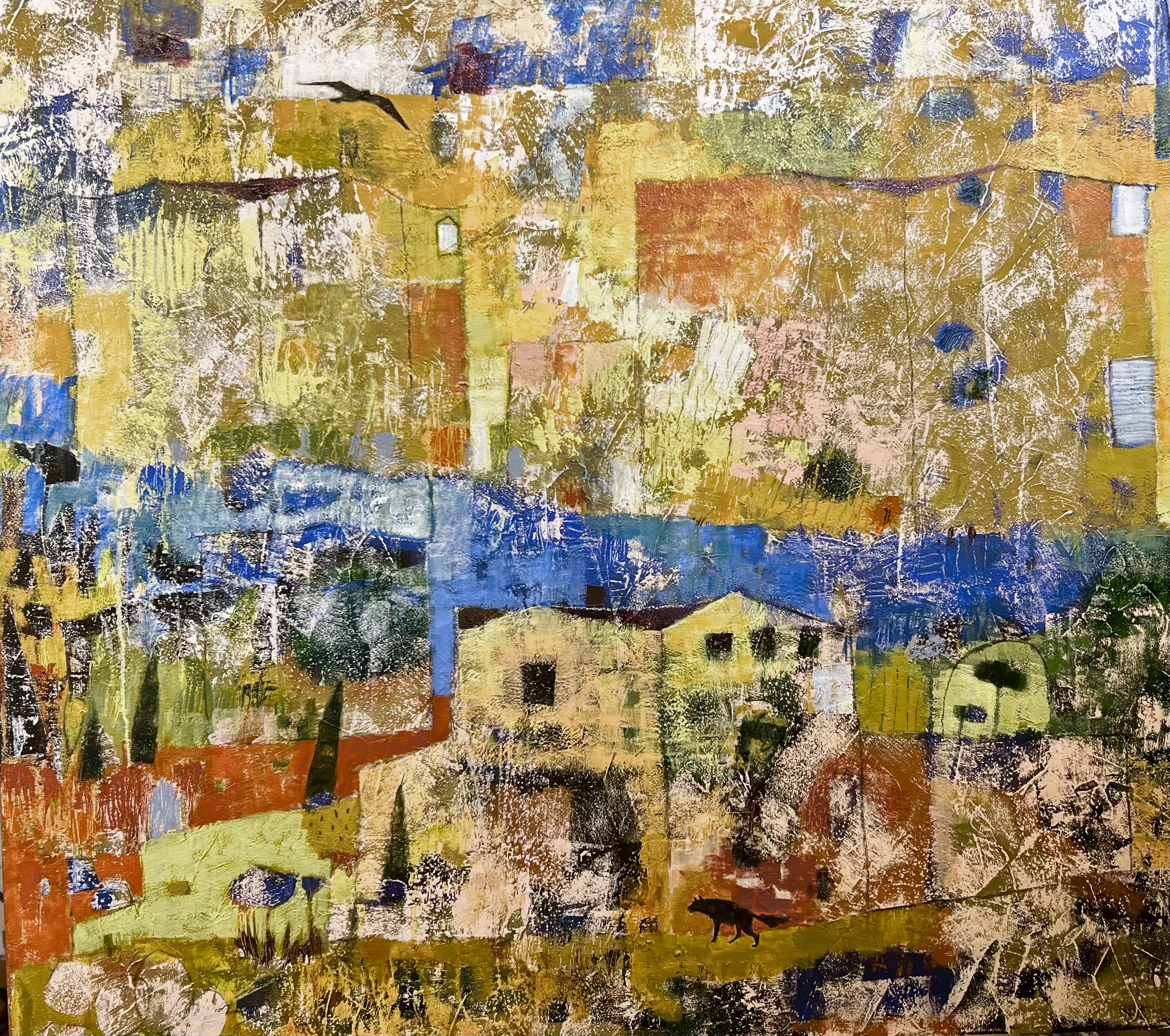
The premise of traveling to her home was a painting I noticed and kept returning to on her website janefiler.com under “Available Work”. It was entitled “Above the Bridge”. I finally called Jane and said I was really drawn to this one but needed to see the painting in person to know how it made me feel. She agreed, and we set a date.

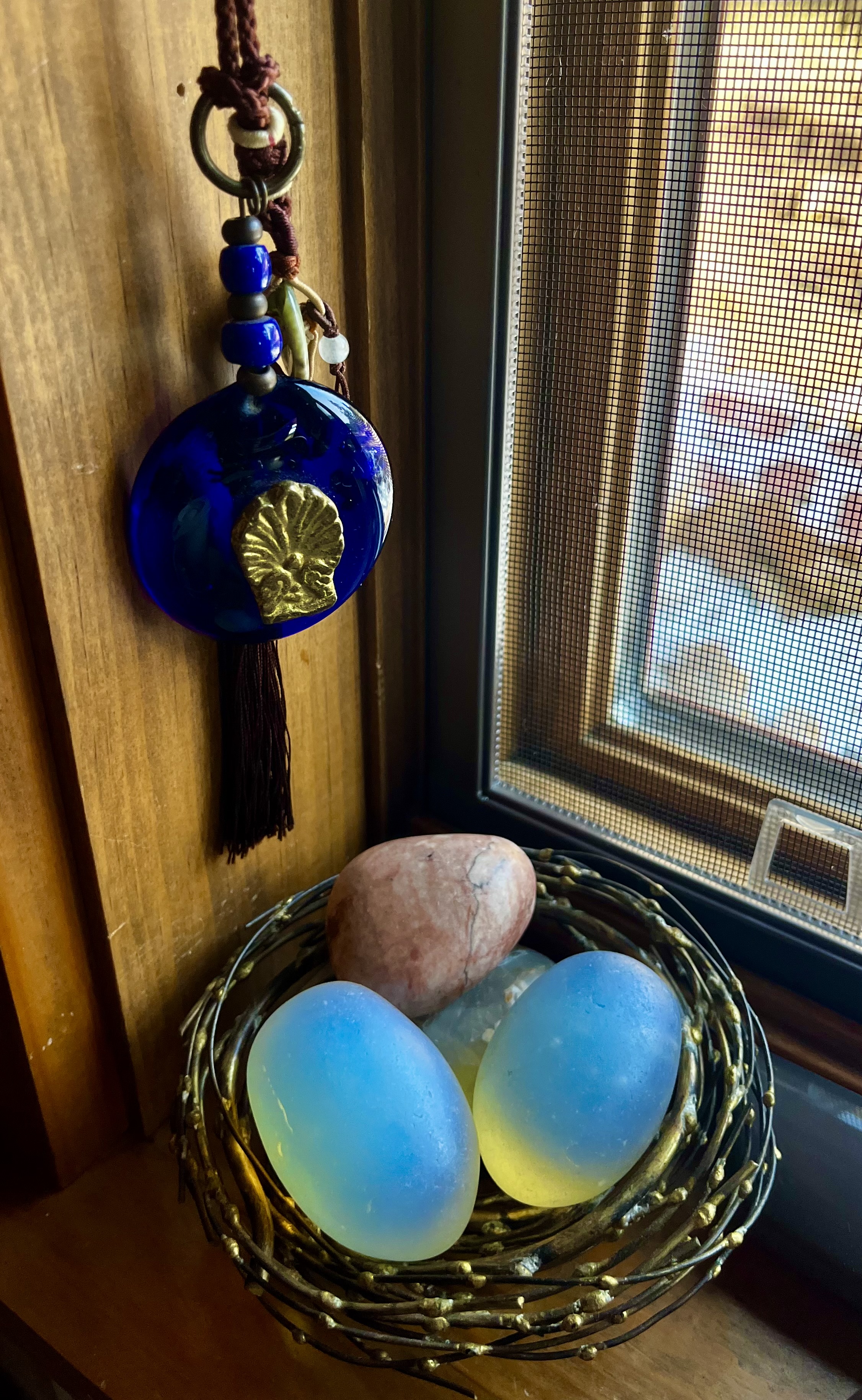
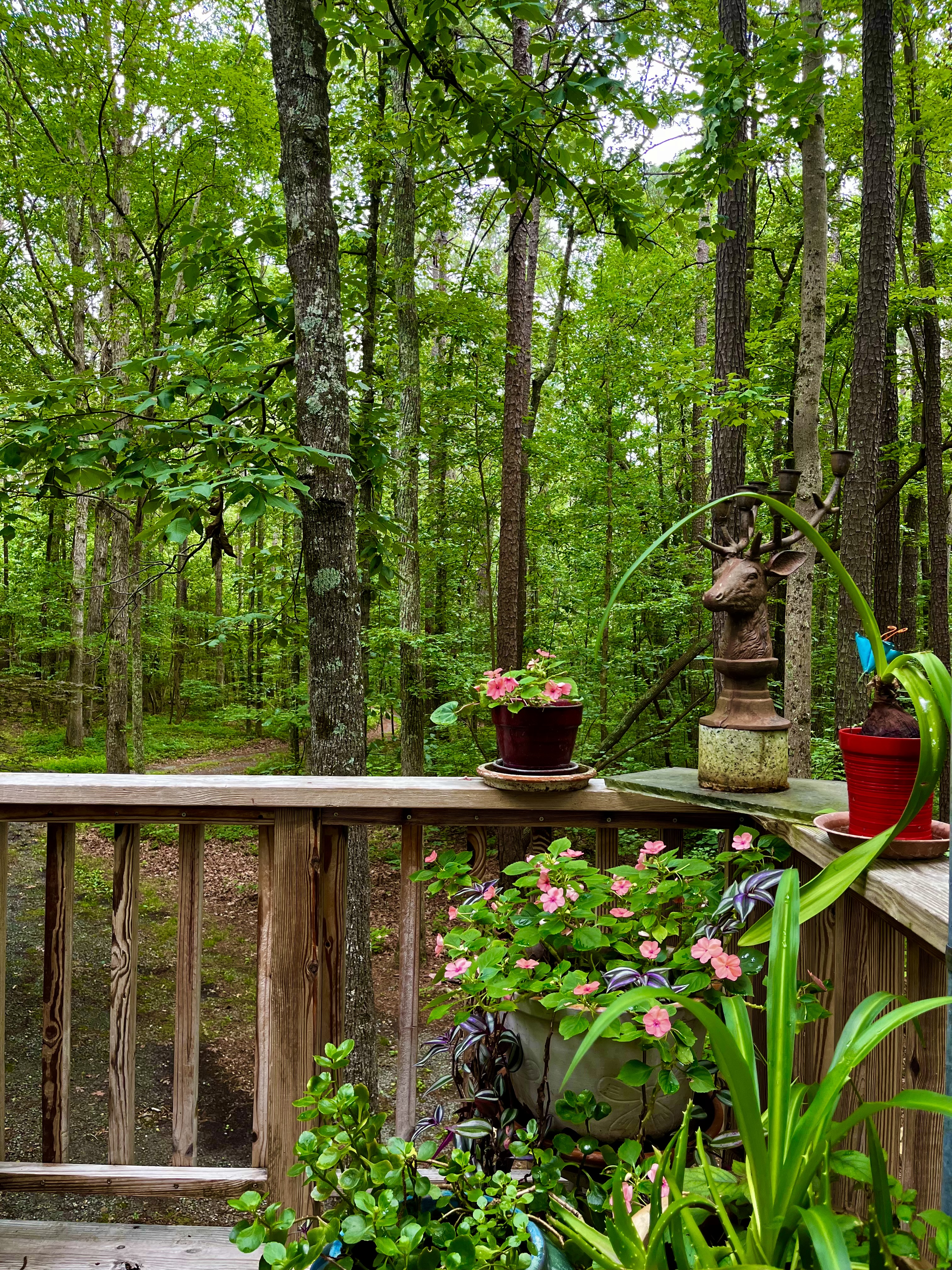
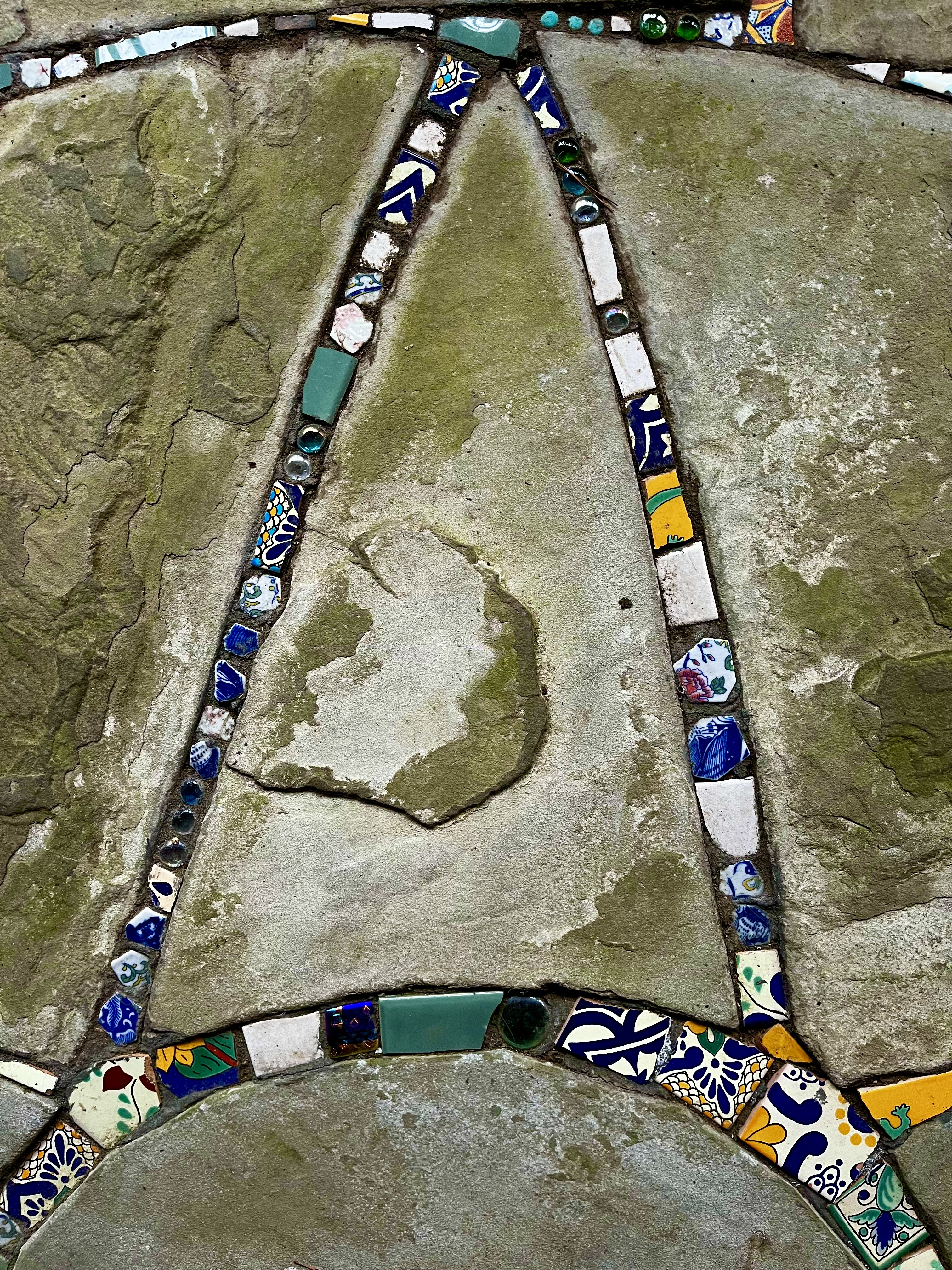
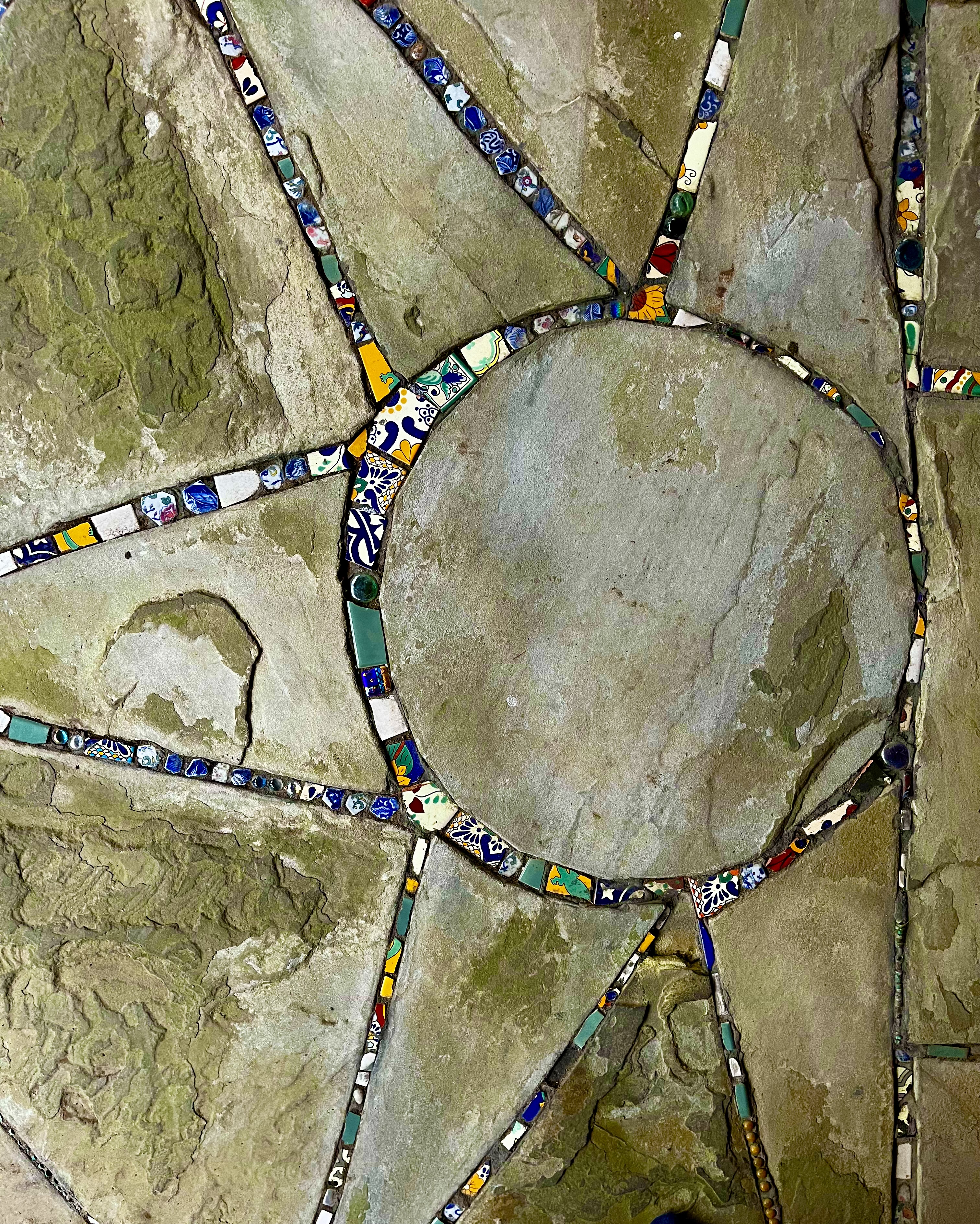
It was two years since we had last seen each other, but we fell into conversation easily, as friends generally do. I noticed the changes in her home and property since the last time I was there. A large shed had been renovated and turned into a gallery for on-site weekend art shows, there were now two cats in residence, and she started an outdoor project of reconfiguring stone pavers by outlining them with colorful pottery and pieces of glass. I picked up an alabaster egg on a windowsill to admire its smooth shape and beautiful translucency in my hand. She insisted that I take it home.
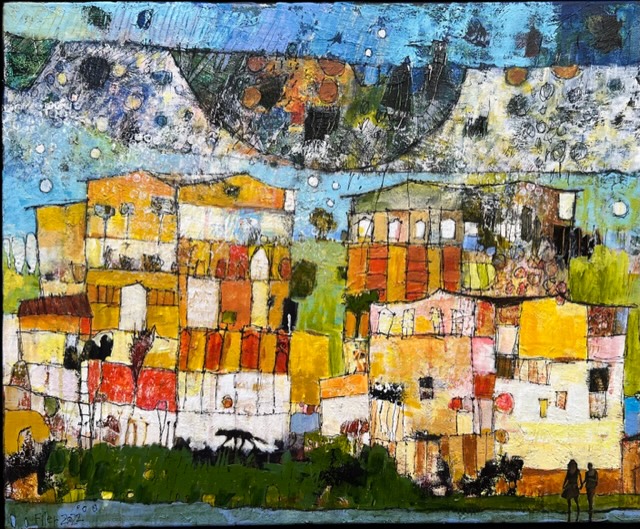
When we went into the studio to view the painting, Jane showed me a recently finished piece entitled “Congregation”. It was colorful and typical of her “primal modern” style which emanates from her dreaming-while-awake imagination. Then she moved “Above the Bridge” to the easel for my viewing. And I just knew. This was going to be my painting. 

Above the Bridge by Jane Filer, 2024

The question is why? What resonated? Like so much of Jane’s art, there are layers upon layers to see and feel and think about. Then you bring your own meaning to it. The details I first noticed were two small black figures “under the bridge”. One is swimming strongly onward; the other is rising to the surface with one arm extended straight upward.

cropped image of under the bridge
swimmers enlarged

Musing about these small figures under the bridge with the larger world painted above the bridge struck me as symbolic and meaningful. Right now. These are actions to aim for; onward and upward. For anyone, for everyone.

the rest of the world above and below the bridge

In the current American climate, where everything is moving in the direction of political dismantling and destruction, many people want, and need, to find what can be done now, while also moving toward the future. Then I thought; these are the same movements–the actions we take in the present are what we will continue to do in the future. 

Poets, artists, and writers are often sources of inspiration about what is needed in trying times. Art cuts deep to the marrow of reminding us how to refocus and get moving in stressful times, whether personal, cultural, political, or global.

Almost every generation of Americans for the past 250 years has encountered and eventually survived some kind of catastrophic period; revolution followed by war, destructive civil war, two world wars, years of severe economic depression, McCarthyism, a decade of political assassinations and riots, the unpopular 10-year Vietnamese war, murderous terrorist attacks, devastating viral pandemics. Just as it seems that so much changes within generations; history teaches that great things can, and do, persist after turmoil.

We all have a part in shifting the story. –Joy Harjo, 23rd U.S. Poet Laureate

Inside the head spinning turn of extreme change our democracy is currently undergoing, what part, as Harjo suggests, can we play in shifting the story? 

It’s really the same part we play throughout life. First, we learn, we adapt, and we move forward with what we can control. Adaptive change often means taking on complex challenges that seem impossible in the beginning. Staying immobilized doesn’t help the situation. You have to try. Like the feeling a piece of art instills, we bring the meaning and sense to what can change and what we can change.

I read a story about a woman, Maureen Morris, who opened a coffee shop called Back Street Brews in a small, politically polarized Virginia town several years ago. During a time of stridently vocal opposing sides, she pushed the notion of a gentler America inside her café. Everyone was welcome to openly discuss their views, but there would be no attacking or judging. “If it comes up, as long as it’s respectful, you can talk about whatever your beliefs are…If you are a staunch this or staunch that, I always say, keep that out of here.” 
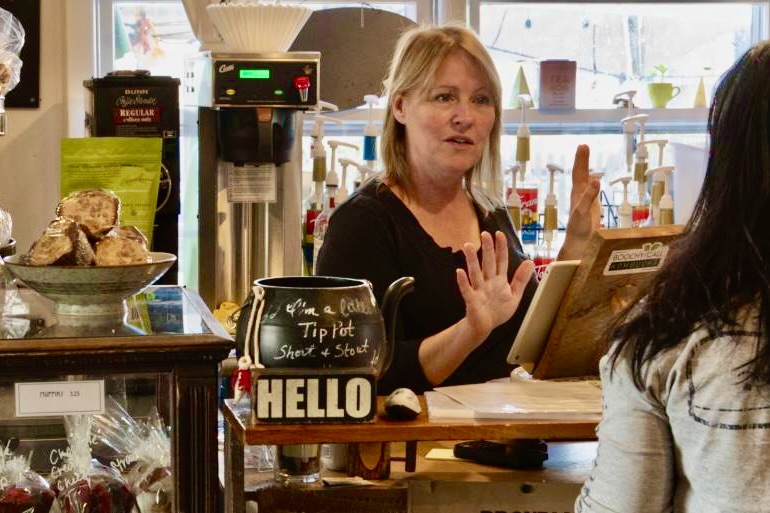
Customers began asking about each other’s family or simply shooting the breeze over coffee. Discussion groups of varying topics began showing up. Maureen’s café became known as a quiet force of civility while crossing the political divide inside a public space. Neighborly ways, respect, and social ties persist.

Ordinary people created a community where they listen and speak to each other without shouting. All due to one woman’s insistence that, amid the divisiveness of an era, she would lead from the strength of her beliefs. “It’s affecting people. Not me. Not in my bubble. We’re going to be fine, everyone! We’re going to land on our feet in my coffee bubble.”

This is how an individual shifts the story. By accomplishing small things that perhaps no one notices in the big picture but has real impact on people’s lives. Everyday lives. We nurture and nourish everyone in our circle of family, acquaintances, friends. We take care of ourselves. We stay true to our values.

Because there is a remnant of change that begins with one act of kindness, one spoken truth, one considerate conversation, one shared laugh, one poem, painting, or story. These are ways to move the narrative.

A brief scene in the old Hollywood movie, Casablanca, with Humphrey Bogart and Ingrid Bergman offers another example of one person’s action to restore balance.

During a busy evening in Rick’s American Café, a casino and piano bar in Casablanca, there is a scuffle when the thief Ugarte is discovered by authorities. After Rick refuses to hide him, Ugarte is hustled out in a loud commotion surrounded by police. The music stops and customers sit mutely, in stunned silence.

Afterward, Rick (Bogart) apologizes for the uproar, reassures everyone that the trouble is over, everything is all right, and they should continue having a good time. He speaks calmly to the crowd, tells Sam to resume playing, and without breaking stride re-rights an overturned wine glass on a table.

the saloonkeeper’s cool response to Ugarte’s arrest and his instruction for the band to play on could suggest a certain indifference to the fates of men. But in setting upright that cocktail glass in the aftermath of the commotion, didn’t he also exhibit an essential faith that by the smallest of one’s actions, one can restore some sense of order to the world?  –Amor Towles, A Gentleman in Moscow

As we find our part in “restoring some sense of order”, we also climb “that great big hill of hope”. And make it a destination.


Poems and songs are written to get our minds thinking…in an unexpected way.

TROUGH

There is a trough in waves,
a low spot
where horizon disappears
and only sky
and water are our company.

And there we lose our way
unless
we rest, knowing the wave will bring us
to its crest again.

There we may drown
if we let fear
hold us with in its grip and shake us
side to side,
and leave us flailing, torn, disoriented.

But if we rest there
in the trough,
in silence,
being with
the low part of the wave,
keeping our energy and
noticing the shape of things,
the flow,
then time alone
will bring us to another
place
where we can see
horizon, see the land again,
regain our sense
of where
we are,
and where we need to swim.


–Judy Brown
...Come dance with the west wind and touch on the mountaintops
Sail o'er the canyons and up to the stars
And reach for the heavens and hope for the future
And all that we can be and not what we are...

–John Denver, song The Eagle and the Hawk, 1971


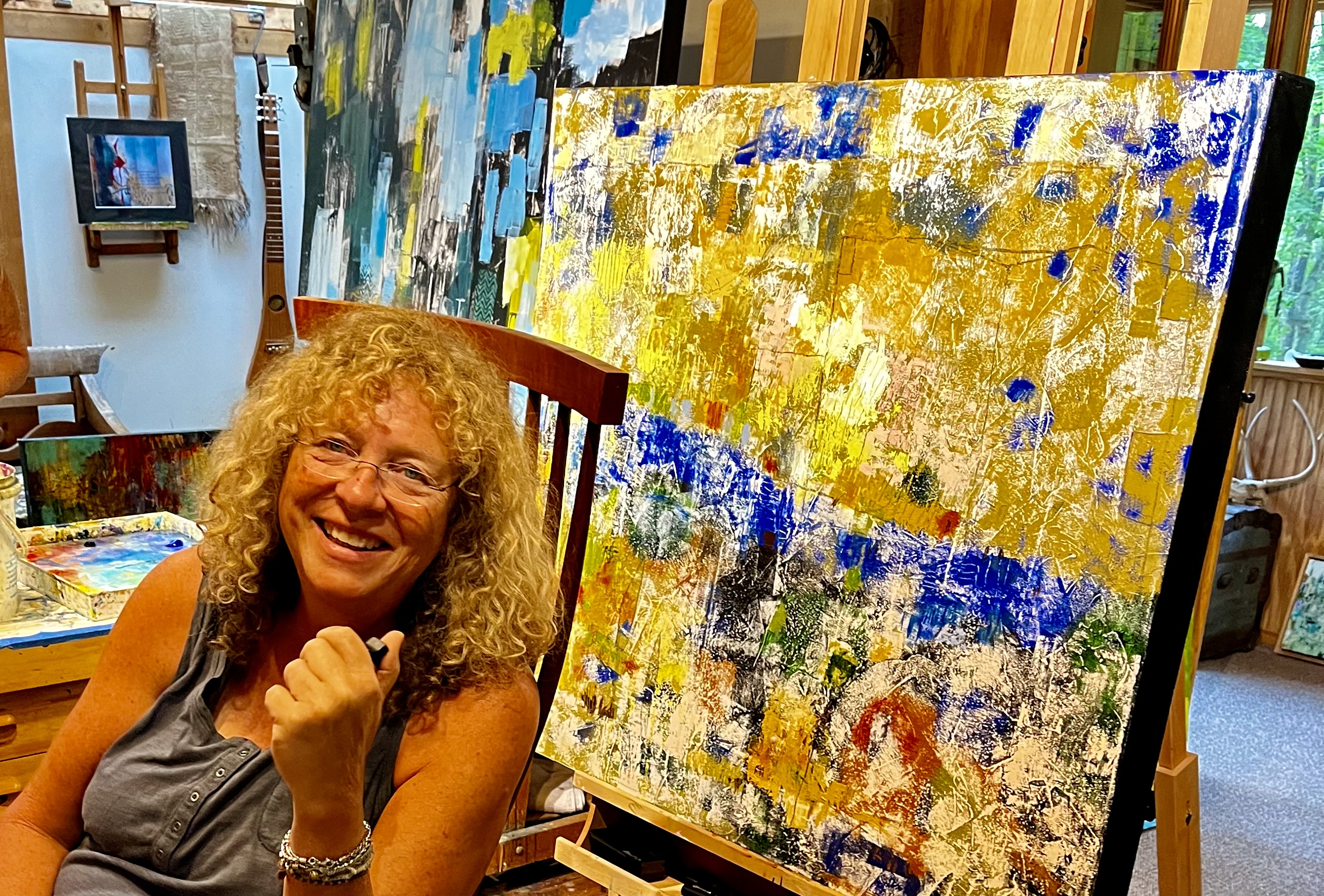
Fun Final Photo Shoot:
Being Jane Filer

The fact that I, myself, do not understand what my paintings mean while I am painting them does not imply that they are meaninglessSalvador Dalí, Spanish surrealist artist

Years ago, a man named John Filer, found this quote by Dalí, and taped it to his wife’s easel because it reminded him of her work. His wife, Jane Filer, is an artist. She has been expressing herself through painting since she was a small child. In Kindergarten, Jane went to the standing easel during free time and painted a new picture every day the entire school year. 

Today, Jane’s acrylic-on-canvas paintings carry the ethereal quality of an imaginative dream. Among overlaying colors, images materialize and hold one’s gaze. It’s impossible not to feel something and find meaning.

I wasn’t aware of Jane Filer or anything about her portfolio until I visited a friend in Boulder, Colorado more than a year ago. In her living room, there was a painting over the sofa that pulled me closer. It felt like looking into someone’s multi-layered dream. Even one of my own dreams. I wanted to know more. My friend, Cathy, told me it was painted by a woman named Jane Filer. She bought it from a gallery on Canyon Road in Santa Fe, New Mexico.

My husband and I were already planning a road trip to New Mexico the upcoming weekend. Good road trips offer new discoveries and lasting memories. What I didn’t expect as an outcome was friendship with an artist whose work I greatly admire.

Jane Filer was the middle child of four siblings–two older brothers, two younger sisters. Born on the coast of California, her accountant father moved the family to Australia for several years when she was 11. While living there, Jane gained appreciation for and inspiration from aboriginal art–particularly the strong colors and detailed, organic nature of the paintings. 

As a child, Jane’s mother told her she had an “overactive imagination”. It was not meant as a compliment. Rather, Jane was endlessly criticized and berated as a “disappointment” for not being practical enough. She turned her creative energies and vivid imagination toward her younger sisters, making up stories and songs to entertain them. Eventually she was nurtured by a paternal aunt. Drawing came naturally before Jane entered school. And then she discovered the magic of a paint brush in her hand.

Before we drove to Santa Fe, I called Bill Hester, Jane’s art dealer at the time. We were coming to look at everything he had of her work. Bill spent a lot of time with us as we strolled the gallery, asking good questions, explaining Jane’s painting method along with his personal view on poetry, metaphor, and art. 

My husband and I considered each painting individually and then circled back to speak together privately. One piece resonated with both of us. It was entitled Elephant’s Journey and reminded us of our years living overseas and the adventures we experienced as a family, in five countries for more than thirty years. Elephant’s Journey touched a mutual chord. The elephants are marching in line toward a cliff, but it is not catastrophic. We saw it as the poem for a risk we chose to live.

Jane’s family returned to the U.S. from Australia and settled in the Midwest. With encouragement from her mentoring aunt, she earned a Bachelor of Fine Arts from Southern Illinois University. After graduating, she met her husband, John Filer, who was five years older and worked in forestry. For many years, while John planted trees all over America, they travelled and lived simply in a camping trailer with national and state forests as their backyard. 

At the University of North Carolina, Chapel Hill, Jane was offered a coveted spot in the art college, working toward her Master of Fine Arts. She began teaching painting and drawing for the next 21 years. In 1986, John and Jane bought 17 acres of woods and began to build their first real home. Much of the construction was accomplished by their own creative hands.

As she was about to turn 50, Jane left teaching, which she dearly loved, to devote herself full-time to painting. John, now retired from forestry, became her manager, counselor, and confidence builder. When Jane expressed self-doubt or struggled with difficult decisions, John would simply look at her and say, “Why are you asking me? You don’t need anyone’s advice. You’re Jane Filer!” 

Ten years ago, Jane’s selling gallery expanded from Chapel Hill to Santa Fe, which is, the second largest art market in the world after New York City. 

Six months after purchasing Elephant’s Journey, I returned to Santa Fe to view another Filer painting I had seen on the gallery’s website. But I was immediately distracted by a larger piece that had just arrived from Jane’s North Carolina studio the day before. Unwrapped, on the floor, it was leaning against the wall. I studied it silently and knew I could look at this painting every day for the rest of my life. It is called Eclipse

Eclipse by Jane Filer, 2022

There are figures falling out of the sky, there are swimming figures, there is a grove of trees whose roots feed an underground river, with a tent and a lone camper above. There is water running through it and a full regatta of sailboats off on one side. The colors blend into a beautiful meditation even without the imagery. When I look at this painting, I continue to discover something new. It joined Elephant’s Journey in our living room. 

Jane Filer is a happy-by-nature-extrovert with a warm, engaging smile, a tumble of spiraling blond curls, and twinkling blue eyes. I met her in person on my next visit to Santa Fe where she was painting for two weeks as “artist in residence” at the Hester gallery. Jane is an open communicator who simply loves people. Even people she meets for the first time.

I am fascinated with life, light, love, and fear. –Jane Filer

We fell into conversation easily, starting with the psychology of being an artist. Jane told me that being off balance and a bit fearful is critical to her paintings. Dark and light, yin and yang are expressed in metaphoric imagery. She doesn’t explain what the imagery means. She doesn’t like repetition, but certain themes recur. Her connection with Nature in the form of animals, faces, figures, water, flowers, trees, are part of the story on canvas. There is often architecture, discernable buildings or shelters painted in, too. Because Jane considers art her therapy as well as a way of life, she is fearless about entering what she calls her dark side. She believes painting fills a need to dig deeply into life’s challenges and, by doing so, keeps her healthy. 

After the Santa Fe meeting, we continued talking over the phone. Then Jane invited me to visit her studio/home in the woods of North Carolina. John Filer passed away prematurely several years ago. After he died, she hired the finishing work on the house to her specifications. I found everything about it to be an extension of her naturalness, her love of nature, and living close to the earth. 

The first thing I noticed were collections everywhere. Rocks and geodes, jars and bottles, shells and bones, antique Indian artifacts–axe heads and arrowheads. There are faces that Jane has collected, sculpted, or painted. The furniture invites curling up to talk or muse on the green expanse of forest outside or to sit by the wood burning stove inside. The kitchen was one of my favorite indoor spaces. John built the wooden dish rack above an antique cast iron sink he found in the woods. It’s an efficient way to dry and store hand washed dishes. Jane designed the tile back drop over the stove and sink. The L-shaped counter invites sitting over morning coffee, talking to whoever is cooking, or sipping single malt whisky and more conversation in late afternoon. There are vignettes of photos, paintings, and artifacts tucked into wall niches or on windowsills.

wall niche collectibles, John and Jane Filer photo by Lorri Zipperer

I can’t write songs and I can’t write stories, but I can paint. –Jane Filer

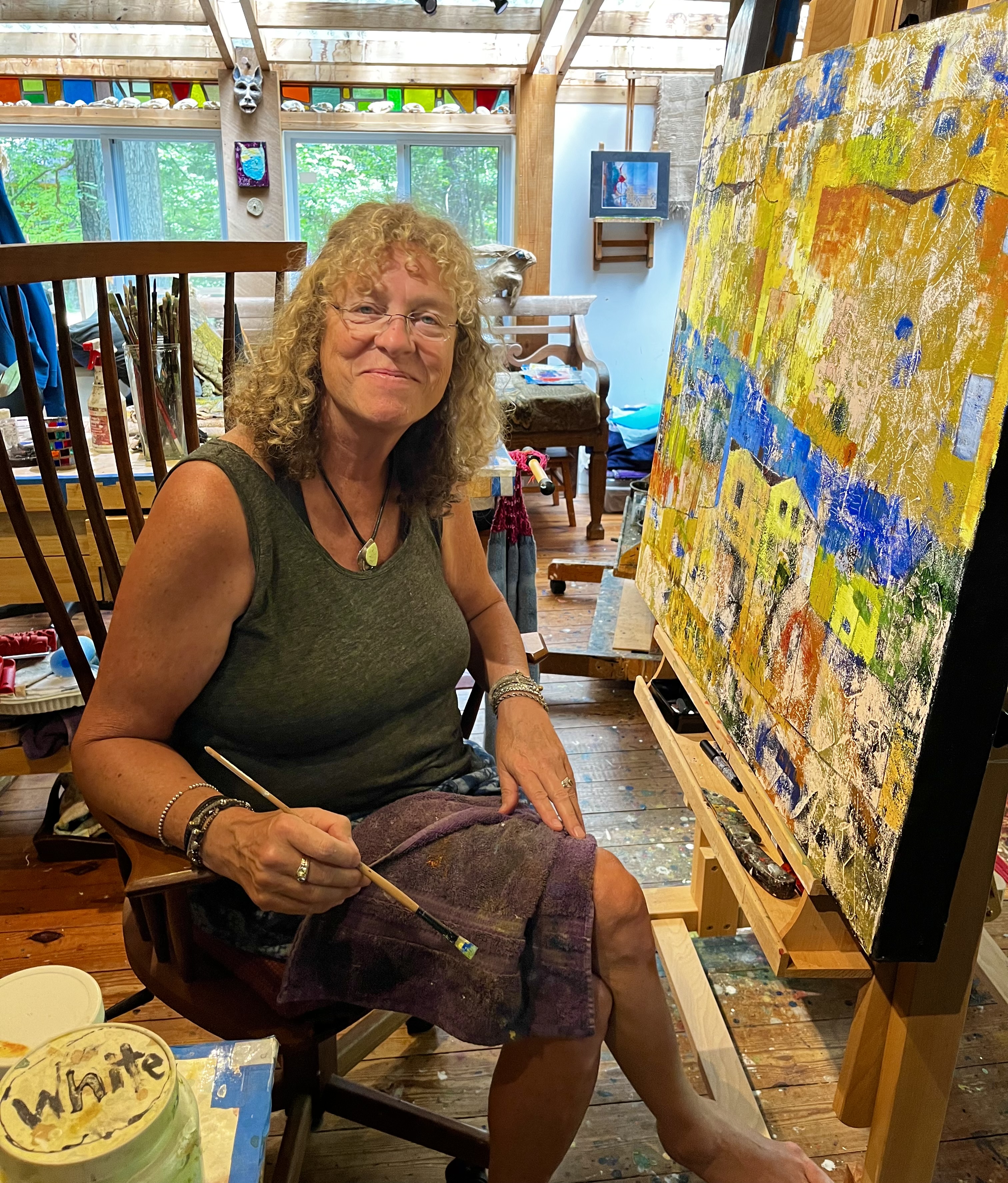
Observing an artist in their studio space is definitely zeroing in on their personal reality. Because Jane told me she dreams and/or has visions while she works, I assumed that, like writers, her working time is largely introspective, solitary, and quiet. In fact, life in the Filer studio can be just the opposite. There might be loud music and singing, phone calls and conversations. There is another artist, Michele Yellin, who paints with her, their easels set side by side. When I tried to retreat to my room to give her time to work, Jane invited me into the studio to talk while she painted. As I poked around looking at artifacts that caught my eye and asking questions, she transferred color, imagery, and texture to the canvas. Jane multi-tasks and dreams while awake.

We dream all day long. –Jane Filer

To begin a new piece, Jane sits at her easel thinking quietly before reaching for paint and covering the canvas edge to edge in colors. She moves color around abstractly until layers and shapes suggest composition. It is free-falling. When patterns and colors start to feel exciting, she sketches over the abstract with fine charcoal lines. A language is developing, the beginning of a story emerges in her mind. She feels anticipation and energy about what comes next. 

the abstract beginning, color everywhere

The next phase, moving from the abstract to the middle composition, is what Jane calls “The Hairy Middle”. It is the longest part of her painting method and often uncomfortable. Because in the “hairy part” she does a deep dive, directly facing what she likes and dislikes, and more importantly what she fears. There is collective unconscious to whatever bubbles up in this middle moment. The painting has become its own entity. Jane moves it further into existence by working through her emotions until she is on the other side. Her imagination stretches to completion, heads to an ending.

Jane can work on more than one painting at a time. She sets aside something that needs time to mature and starts a new canvas or goes back to an earlier one. She adds texture and shape with pieces of bubble wrap or corrugated cardboard, pressing them into paint and then onto the canvas. She might use a knife edge along with brush strokes to create depth. There are finely drawn outlines around imagery. The color palate is vibrant and rich. Yet the finished painting may have morphed numerous times from the original color scheme.  

Lost Lobo by Jane Filer, 2022
from the abstract to the hairy middle [as seen above] to completion

For art to be complete, it must be let go–sent off into the world.  –Jane Filer

Jane considers her paintings to be her offspring. They are born and nurtured on canvas. They are not meant to be literal, but rather offer an invitation to find personal meaning. Intuition tells her when each one is finished. Then she lets it go to stand on its own in the world.

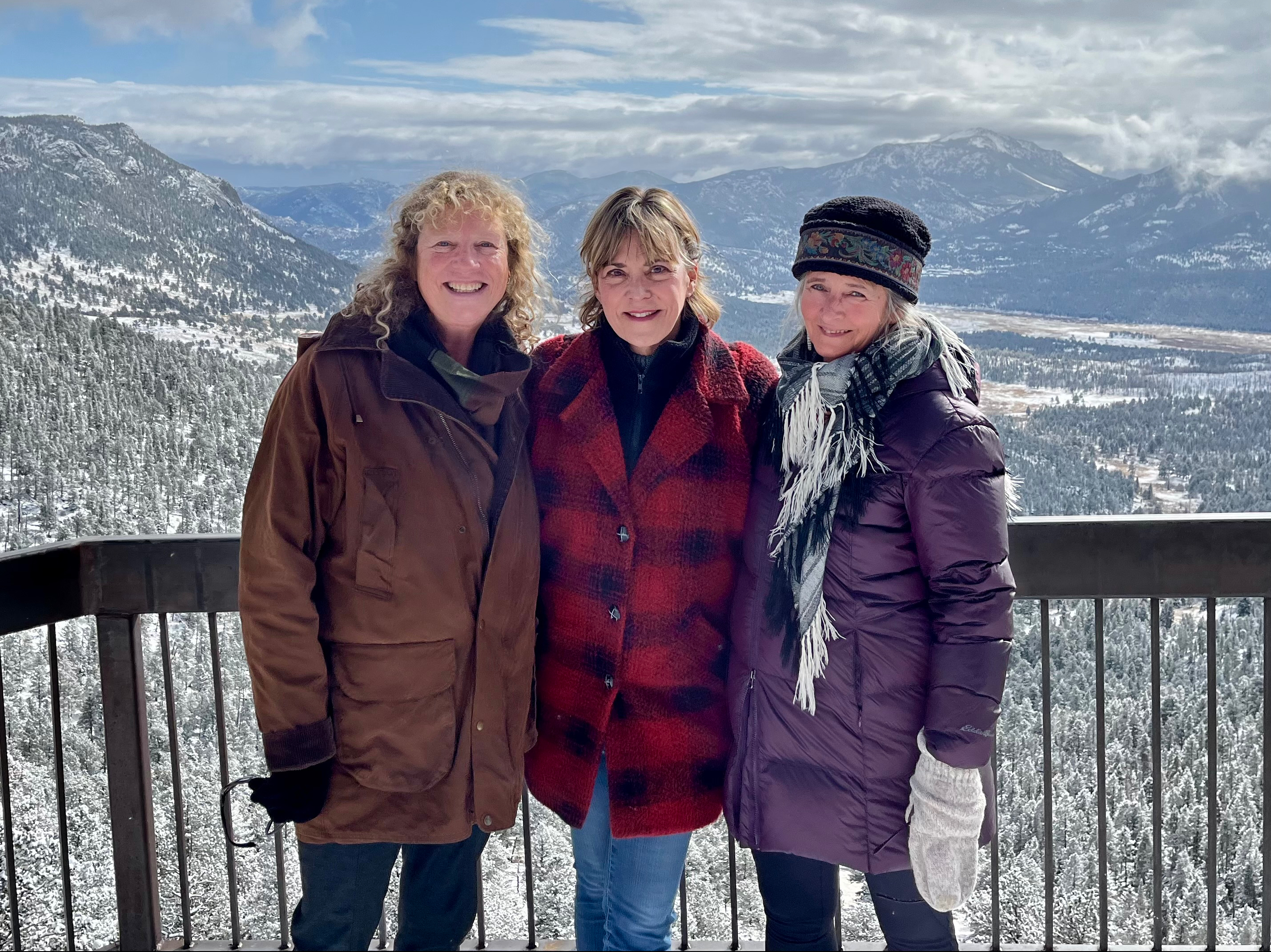
I sent Jane a photo of her two paintings on our living room wall and invited her to come see them in person. Four months later, at the end of October, Jane and her friend, Michele Yellin, drove across the country and made Colorado their first stop.

It snowed all night after they arrived. We woke to a white wonderland in the morning. It didn’t stop us from driving into Rocky Mountain National Park and having lunch at the historic Stanley Hotel. 

Jane, Wendy, Michele at Many Parks Curve overlook

The best things in life cannot be told. –Heinrich Zimmer, German linguist and historian

That is to say, it is difficult to describe art that exists outside the reach of words. But this is the very essence of it, too. Art is created to inspire emotions and depth of feeling that are simply beyond description.

I think this is what it means to be in the presence of Filer art. What begins as a dream or vision in Jane’s metaphysical mind, gains momentum in color and imagery on canvas, and opens a poetic portal to both lose and find yourself at the same time. 

I am inspired by this circle of connectedness–a painting in another’s living room, an art gallery in Santa Fe, two paintings in our home that enrich us every day, back and forth visits with an artist whose life began as a girl with an overactive imagination and is now my friend. 

That’s being Jane Filer.


Hope as a Destination –be sure to read a new story about how a piece of Jane’s art, entitled “Above the Bridge”, inspires hope and encourages ways we can create impact in a tumultuous political climate.

Current information about Jane’s art, both painting and sculpture, can be found on her website janefiler.com

Jane’s hands